

Official syllabusPaper I · Unit 12 · Attitudes, Values and Interests
Formation and maintenance of attitudes; Components of attitudes.
Definition
“It is considerably more likely that attitudes will be unrelated or only slightly related to overt behaviors than that attitudes will be closely related to actions.”
Wicker (1969)
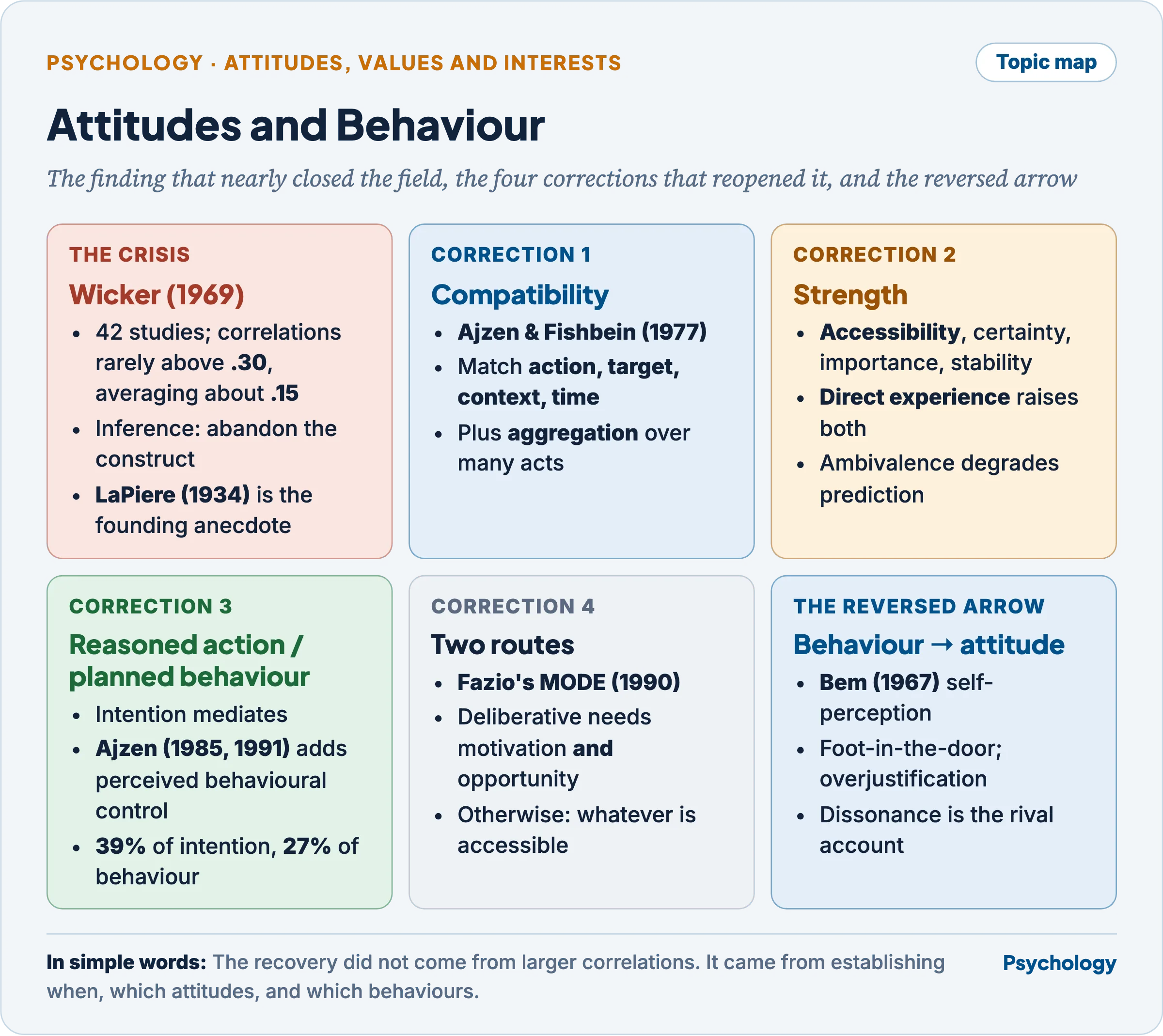
That sentence nearly closed the field down. If a stored evaluation does not predict what a person does, the concept earns its keep only as a description of talk. The recovery took thirty years and did not come from finding larger correlations; it came from establishing when attitudes predict behaviour, which attitudes do, and which behaviours. A fourth line of work inverted the question altogether and asked whether the causal arrow runs the other way.
LaPiere and Wicker: the inconsistency finding
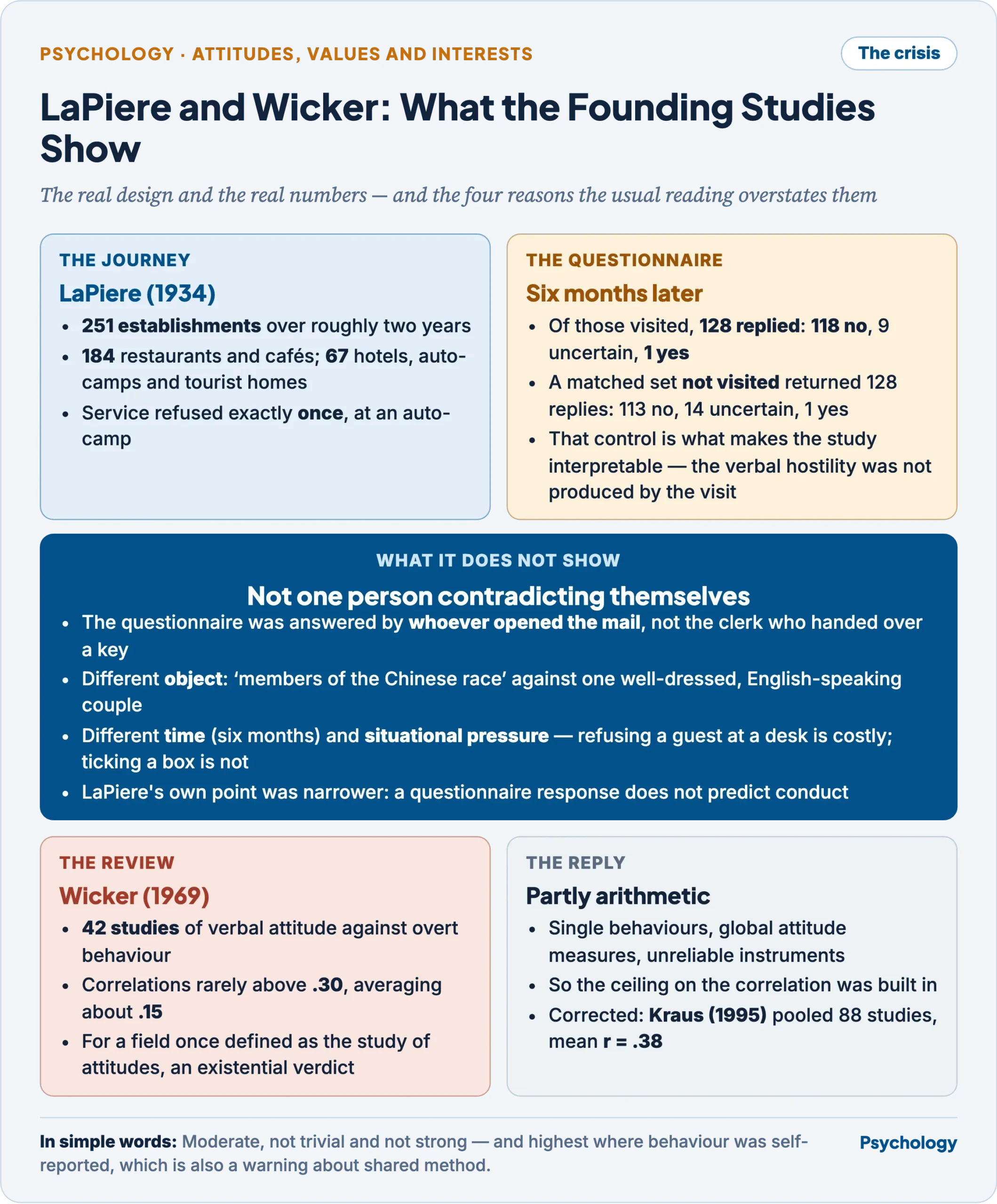
- LaPiere (1934) travelled across the United States with a young Chinese couple over roughly two years at a time of open anti-Chinese prejudice, recording how they were received.
- 251 establishments were visited in all: 184 restaurants and cafés, and 67 hotels, auto-camps and tourist homes. Service was refused exactly once, at an auto-camp LaPiere described as rather inferior.
- Six months after each visit he mailed the proprietor a questionnaire asking whether the establishment would accept members of the Chinese race as guests.
- Of the visited establishments, 128 replied (LaPiere, 1934): 118 said no, 9 were uncertain, 1 said yes — over 90 per cent verbal refusal against a single refusal in deed.
- A matched set of comparable establishments he had not visited returned 128 replies with much the same distribution — 113 no, 14 uncertain, 1 yes — which is the control showing the verbal hostility was not produced by the visit.
- Most summaries overstate what the study licenses.
- It does not show the same person contradicting themselves. The questionnaire was answered by whoever opened the mail, not necessarily by the clerk who had handed over a key.
- The two measures differ in object: the questionnaire asked about “members of the Chinese race” in general, the encounter involved one well-dressed, English-speaking couple, often accompanied by a white American professor.
- The two differ in time — six months — and in situational pressure: refusing a guest standing at a desk is costly in a way that ticking a box is not.
- LaPiere’s own stated point was narrower than the one attributed to him: the danger of treating a questionnaire response as a prediction of conduct.
- Wicker (1969) reviewed 42 studies relating verbal attitude measures to overt behaviour and found correlations rarely above .30 and averaging around .15, often near zero.
- His inference was radical: the attitude construct might be abandoned altogether. For a field once defined as the study of attitudes, that was an existential verdict.
- The methodological reply came quickly. The reviewed studies used single behaviours, global attitude measures and unreliable instruments, so the ceiling on the correlation was partly arithmetic.
The recovery: compatibility, aggregation and strength
- Ajzen and Fishbein (1977) supplied the decisive correction with the principle of compatibility, originally stated as correspondence. An attitude measure and a behaviour measure each have four elements — action, target, context and time — and they predict one another only to the extent that these elements match.
- Their review found strong attitude-behaviour relations only where correspondence was high, at least in target and action (Ajzen and Fishbein, 1977). The inconsistency literature had been comparing measures pitched at different levels of generality.
- Applied to LaPiere, the mismatch is total: a general attitude to an ethnic category was used to predict one specific action towards two specific people at one moment.
- Aggregation is the complementary fix. A general attitude does not predict any single act, but it does predict a multiple-act criterion — a composite of many relevant behaviours across occasions. A single act is contaminated by the specifics of its occasion; a sum of acts is not.
- Attitude strength supplies the third correction: some attitudes predict behaviour and others do not, and the properties separating them are measurable.
- Accessibility, how quickly the evaluation comes to mind, is the most studied. Fazio and Williams (1986) measured accessibility by response latency during the 1984 United States presidential election, and found it moderated both how participants judged the televised debates and how they later voted.
- Direct experience with the object produces attitudes that predict better. Regan and Fazio (1977) found attitudes formed by direct experience outperformed those formed from description, and Fazio and Zanna (1978) added that direct experience raised confidence as well as consistency. The mechanism is accessibility: experience makes the evaluation retrievable.
- Certainty, importance and stability work similarly, while ambivalence — genuine positivity and negativity at once — degrades prediction, because the situation decides which side is salient.
- Glasman and Albarracín (2006) confirmed the pattern across the literature: attitudes predicted future behaviour more strongly when they were accessible, stable over time, and held with confidence.
- The honest arithmetic, once these corrections are applied. Kraus (1995) pooled 88 studies and found a mean attitude-behaviour correlation of r = .38 — a moderate relation, not a trivial one and not a strong one.
- Correlations were highest where behaviour was self-reported, where attitude and behaviour matched for specificity, and with non-student samples (Kraus, 1995). The first is also a warning: part of the apparent consistency is shared method.
The theory of reasoned action and the theory of planned behaviour
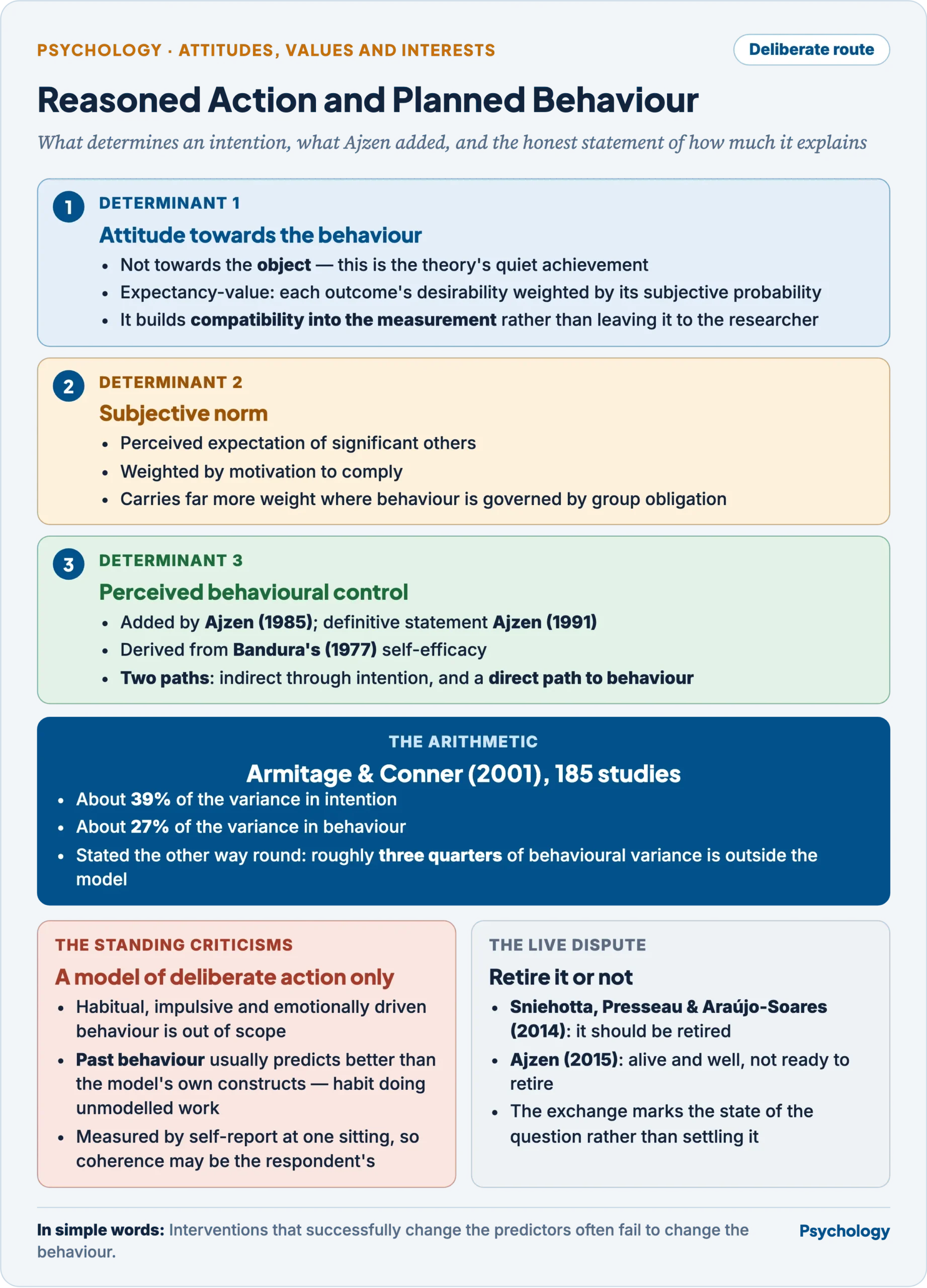
- The theory of reasoned action (Fishbein and Ajzen, 1975; Ajzen and Fishbein, 1980) treats action as the outcome of a deliberate process and inserts a mediator between attitude and behaviour.
- Behavioural intention is the immediate determinant of behaviour, and intention has two determinants.
- Attitude towards the behaviour — not towards the object — is built on an expectancy-value basis: each expected outcome’s desirability weighted by the subjective probability that the behaviour produces it.
- The subjective norm is the perceived expectation of significant others, weighted by the person’s motivation to comply with them.
- The shift from attitude-towards-object to attitude-towards-behaviour is the theory’s quiet achievement, because it builds compatibility into the model’s measurement rather than leaving it to the researcher.
- Ajzen (1985) added the third determinant, perceived behavioural control, and named the extended model the theory of planned behaviour; its definitive statement is Ajzen (1991). The construct derives from Bandura’s (1977) concept of self-efficacy.
- Perceived behavioural control has two paths: an indirect one through intention, and a direct path to behaviour, on the reasoning that believing one can act is a proxy for actually being able to.
- The addition answers the plainest objection to the earlier model. Intending to quit smoking, save money or exercise does not produce the behaviour where the person lacks the resources, skill or opportunity.
- Armitage and Conner (2001) meta-analysed 185 studies: the model accounted for about 39 per cent of the variance in intention and 27 per cent of the variance in behaviour.
- Stated the other way round, roughly three quarters of the variance in behaviour is outside the model — which is the fair summary of its performance.
- The standing criticisms are substantial, and the dispute is live.
- It is a model of deliberate action only. Habitual, impulsive and emotionally driven behaviour is outside its scope, and much of behaviour is of that kind.
- Past behaviour typically predicts future behaviour better than the model’s own constructs, which suggests an unmodelled process — habit — doing the work.
- The components are measured by self-report at one sitting, so consistency between them may reflect the respondent’s desire to appear coherent.
- It is static and non-causal in practice: almost all tests are correlational, and interventions that successfully change the predictors often fail to change behaviour.
- Sniehotta, Presseau and Araújo-Soares (2014) argued on these grounds that the theory should be retired; Ajzen (2015) replied that it is alive and well and not ready to retire. The exchange marks the current state of the question rather than settling it.
The intention-behaviour gap
- Intention is the model’s proximal cause of behaviour, and it is a leaky one. Webb and Sheeran (2006) assembled 47 experimental tests in which intentions were successfully raised by random assignment, and asked what happened to behaviour.
- A medium-to-large change in intention (d = 0.66) produced only a small-to-medium change in behaviour (d = 0.36). Because intention was manipulated rather than measured, this is causal evidence, not correlation, and it is the cleanest statement of the gap available.
- Why intentions fail to convert: competing goals, forgetting the opportunity, absence of actual control, habitual responses that run before the intention is retrieved, and the simple decay of an intention formed in a cool moment and tested in a hot one.
- The most successful remedy attacks the point of failure rather than the intention. An implementation intention is an if-then plan specifying when, where and how the action will be performed, which hands control of initiation to the situational cue.
- Gollwitzer and Sheeran (2006) pooled 94 independent tests and found a medium-to-large effect on goal attainment, d = .65, on top of the goal intention itself.
- The theoretical significance is that it works by automating the behaviour, which concedes the deliberative model’s limits while rescuing its predictions.
The MODE model: deliberative and spontaneous routes
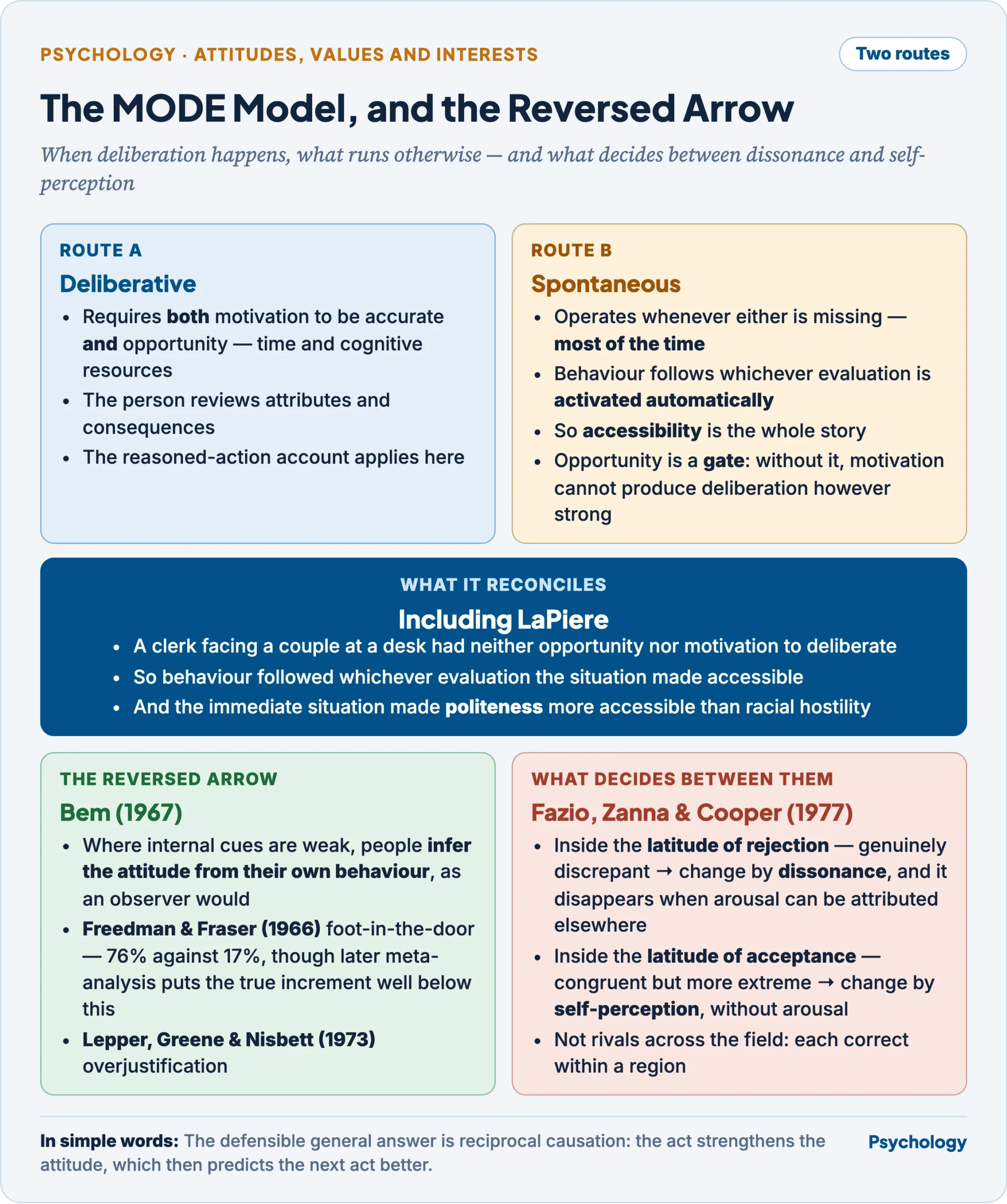
- Fazio (1990) proposed the MODE model — Motivation and Opportunity as DEterminants of which of two processes links an attitude to behaviour.
- The deliberative route requires both motivation to be accurate and opportunity, meaning time and cognitive resources. Where both are present, the person reviews attributes and consequences, and the reasoned-action account applies.
- The spontaneous route operates whenever either is missing, which is most of the time. Here behaviour is guided by whichever evaluation is activated automatically on encountering the object, so attitude accessibility is the whole story.
- Opportunity functions as a gate: without it, motivation cannot produce deliberation however strong it is.
- The attitude-to-behaviour process model (Fazio and Roskos-Ewoldsen, 1994) sets out the spontaneous sequence. An event activates the attitude; the activated attitude colours perception of the object; knowledge of what is appropriate here is activated alongside it.
- Together these yield a definition of the event, and behaviour follows from it without the alternatives ever being weighed.
- The model reconciles the two halves of the field. The reasoned-action tradition describes a real process that occurs under specifiable conditions; the inconsistency findings came largely from behaviours that were not produced that way.
- It also reconciles LaPiere. A clerk facing a couple at a desk had neither the opportunity nor the motivation to deliberate, so the behaviour was driven by whichever evaluation the situation made accessible — and the immediate situation made politeness more accessible than racial hostility.
- Criticisms: motivation and opportunity are hard to measure independently of the outcome they are invoked to explain, and the model is a framework specifying which process operates rather than a theory predicting how much behaviour follows. It buys explanatory reach at the cost of falsifiability.
Behaviour determining attitude
- Bem (1967) advanced self-perception theory as a rival reading of the dissonance findings. People often lack privileged access to their own evaluations; where internal cues are weak or ambiguous, they infer the attitude from their own behaviour and its circumstances, exactly as an observer would.
- The causal claim is therefore reversed: the behaviour is the evidence, and the attitude is the conclusion drawn from it.
- Evidence that behaviour precedes and shapes the attitude.
- Freedman and Fraser (1966) found the foot-in-the-door effect: householders who had first agreed to display a small window sign were far more likely to accept an obtrusive lawn sign two weeks later, 76 per cent against 17 per cent for those approached cold.
- The first small act appears to supply a self-description that the second request then fits.
- Later meta-analytic work puts the true increment well below the original demonstration, so the effect is real and smaller than the classic figures imply.
- Lepper, Greene and Nisbett (1973) found the overjustification effect: nursery children rewarded for drawing subsequently drew less in free play than unrewarded children. The salient external cause displaced the inference of intrinsic interest.
- Freedman and Fraser (1966) found the foot-in-the-door effect: householders who had first agreed to display a small window sign were far more likely to accept an obtrusive lawn sign two weeks later, 76 per cent against 17 per cent for those approached cold.
- Dissonance theory is the competing explanation of the same phenomena. Festinger and Carlsmith (1959) had participants perform a dull task and then tell a waiting person it was interesting, for either one dollar or twenty; those paid one dollar afterwards rated the task more enjoyable.
- Festinger (1957) explains this by aversive arousal from inconsistency, resolved by changing the attitude.
- What decides between the two is not rhetorical. Fazio, Zanna and Cooper (1977) separated their domains using the latitude of acceptance and the latitude of rejection.
- Behaviour falling inside the latitude of rejection — genuinely discrepant from the prior attitude — produces attitude change by dissonance, and the change disappears when participants can attribute their arousal to an external source.
- Behaviour falling inside the latitude of acceptance — congruent with, but more extreme than, the existing position — produces change by self-perception, and it occurs without arousal.
- So the two theories are not rivals across the whole field but each correct within a region, and the diagnostic is whether the act was discrepant and whether arousal was present.
Deciding the direction in a particular case
- The attitude is doing the causal work where: the evaluation pre-dated the act and can be independently documented; it is specific to that act rather than general; it is accessible, having been formed by direct experience; the act was freely chosen and costly; and an intention preceded it.
- The behaviour is doing the causal work where: the attitude is reported only after the act; the act occurred under situational pressure, a role, a small prior request or an incentive; the person had no clear prior evaluation to consult; and the stated attitude fits the act suspiciously neatly.
- Where the act was congruent with a vague prior leaning, self-perception is the better account. Where it contradicted a clear prior position and was freely chosen, dissonance is.
- The actor’s own explanation is weak evidence either way. A person reporting that they helped because they hold a positive attitude is making a causal attribution about themselves, and people are poor witnesses to the causes of their own behaviour — the explanation is itself a construction after the fact.
- The defensible general answer is reciprocal causation. An attitude guides the act; performing the act strengthens the attitude by supplying direct experience, which raises accessibility; the strengthened attitude then predicts the next act better. Attitude and behaviour are mutually reinforcing over time rather than ordered once and for all.
The applied case: work attitudes and behaviour
- Job satisfaction is a work-related attitude — the overall evaluation an employee forms of the job — and the claim that the satisfied worker is the productive worker is the field’s longest-running attitude-behaviour hypothesis.
- Judge, Thoresen, Bono and Patton (2001) meta-analysed 312 samples (N = 54,417) and found a corrected mean satisfaction-performance correlation of r = .30, against an uncorrected mean nearer .18.
- Links to absenteeism and turnover are weaker still, and both are heavily constrained by the labour market: dissatisfied employees stay and perform in a downturn, because the alternative is unemployment.
- The pattern is the compatibility principle in the field: a global attitude to the job is used to predict specific acts on particular days, under severe situational constraint.
- Aggregated criteria such as organisational citizenship behaviour — talking well of the employer, helping colleagues, exceeding the role — correlate better, exactly as the aggregation argument predicts.
Criticisms and limitations
- The field’s founding studies do not show what they are credited with. LaPiere compared different respondents, objects and situations, and had no attitude measure for the people who served his companions. It shows that a questionnaire does not predict an act, not that attitudes do not cause behaviour.
- Wicker’s review was selective by modern standards — single behaviours, unreliable measures, no correction for attenuation — so the .15 average understates the relation even on the evidence then available.
- The compatibility principle rescues prediction at a cost to generality. An attitude measured to match one action, target, context and time predicts that behaviour well and nothing else. The concept’s original appeal was that one evaluation would organise many behaviours.
- Most of the evidence is correlational and self-reported at a single sitting, so the attitude-intention-behaviour chain is partly a chain of related self-descriptions. The experimental intention literature is the exception, and it shows the weakest link in the chain.
- The reasoned-action family models the wrong mode for most behaviour. Habit, impulse and affect dominate ordinary conduct, and the MODE model’s answer — that deliberation requires motivation and opportunity — is correct but hard to test independently.
- The direction of causation is rarely identified in practice. Outside experiments, attitude and behaviour are measured together or in the wrong order, which is why the self-perception and dissonance readings of the same datum remain so difficult to separate.
- The literature is overwhelmingly Western and individual. Where behaviour is governed by group obligation, as caste and family practice often are in India, the subjective-norm term carries far more weight than the Western estimates suggest, and the private attitude may be irrelevant to what is done.
- What stands up is substantial. The moderators are now specified rather than guessed at: attitudes predict behaviour when the two are compatibly measured, when the attitude is strong, accessible and born of direct experience, when behaviour is aggregated, and when the actor has control.
- The honest effect sizes — a mean near r = .38 overall (Kraus, 1995), roughly a quarter of behavioural variance for the planned-behaviour model, and a large residual intention-behaviour gap — are modest and replicable, which is a better position than the field held when Wicker wrote.
Previous Year Questions
- 2017A young person helped a visually impaired woman to cross the road. He explained his action saying that he has positive attitude towards such persons. Did his attitude determine his behaviour or the behaviour determine his attitude. Explain.
- 2007Do attitudes influence behaviour? If yes, when and how? Give your answer in the light of relevant research studies.