

- Copper, nickel and chromium are the metals of wiring and of alloys, and India’s position differs sharply among them.
- Chromite is abundant and almost wholly from Odisha.
- Copper ore is low grade and short of demand, so concentrates are imported.
- Nickel has large low-grade resources but no primary mine output, and the demand is met by imports.
- Copper and nickel have both been on India’s list of 30 critical minerals since June 2023.
Copper
- Copper is a good conductor of electricity and is ductile, that is, it can be drawn into thin wire. As a metal it came into human use well before iron, for utensils and coins.
- Uses: the automobile and defence industries, and the electrical industry for wires, electric motors, transformers and generators.
- Alloys:
- With iron and nickel in some stainless steels.
- With nickel in Monel metal, which is mainly nickel.
- With aluminium in duralumin, an aluminium alloy.
- Brass adds zinc, and bronze adds tin.
- Occurrence: ancient and younger rocks alike host it, as veins and bedded deposits, and also disseminated through the host rock.
- Mining is costly and tedious, because most ores hold only a small percentage of metal.
- Low grade: Indian ore has less than 1% metal, against an international average long quoted at 2.5%. The national average for ore produced was 0.83% in 2023-24.
- India is poorly placed in both reserves and production. The domestic need is met from mine output, scrap recycling and imports.
Copper Distribution in India
- Reserves and resources:
| Item | Older estimate (in situ) | 2010 | 1 April 2020 |
|---|---|---|---|
| Ore (million tonnes) | 712.5 | 1,558.46 | 1,660.87 |
| Metal (million tonnes) | 9.4 | 12.29 | 12.20 |
- Only 163.89 million tonnes of ore (9.87%) rank as reserves. Their metal content is 2.16 million tonnes.
- By grade (2020): almost half is 0.5–1% copper, and only 0.5% of the ore has 1.85% copper or more.
- Major deposits: Singhbhum (Jharkhand), Balaghat (Madhya Pradesh), and Jhunjhunu and Alwar (Rajasthan).
| State | Share of ore, 2020 | Share of metal, 2020 | Ore output, 2023-24 (tonnes) | Share of ore output |
|---|---|---|---|---|
| Madhya Pradesh | 23.28% | 30.06% | 25,45,820 | 67.3% |
| Rajasthan | 52.25% | 38.01% | 12,31,500 | 32.6% |
| Jharkhand | 15.14% | 22.79% | 4,936 | 0.1% |
- Output in 2023-24: 3.78 million tonnes of ore, and 1,25,230 tonnes of concentrate.
- Hindustan Copper Limited (HCL) is the only integrated public sector firm, with works at Ghatsila, Khetri and Malanjkhand.
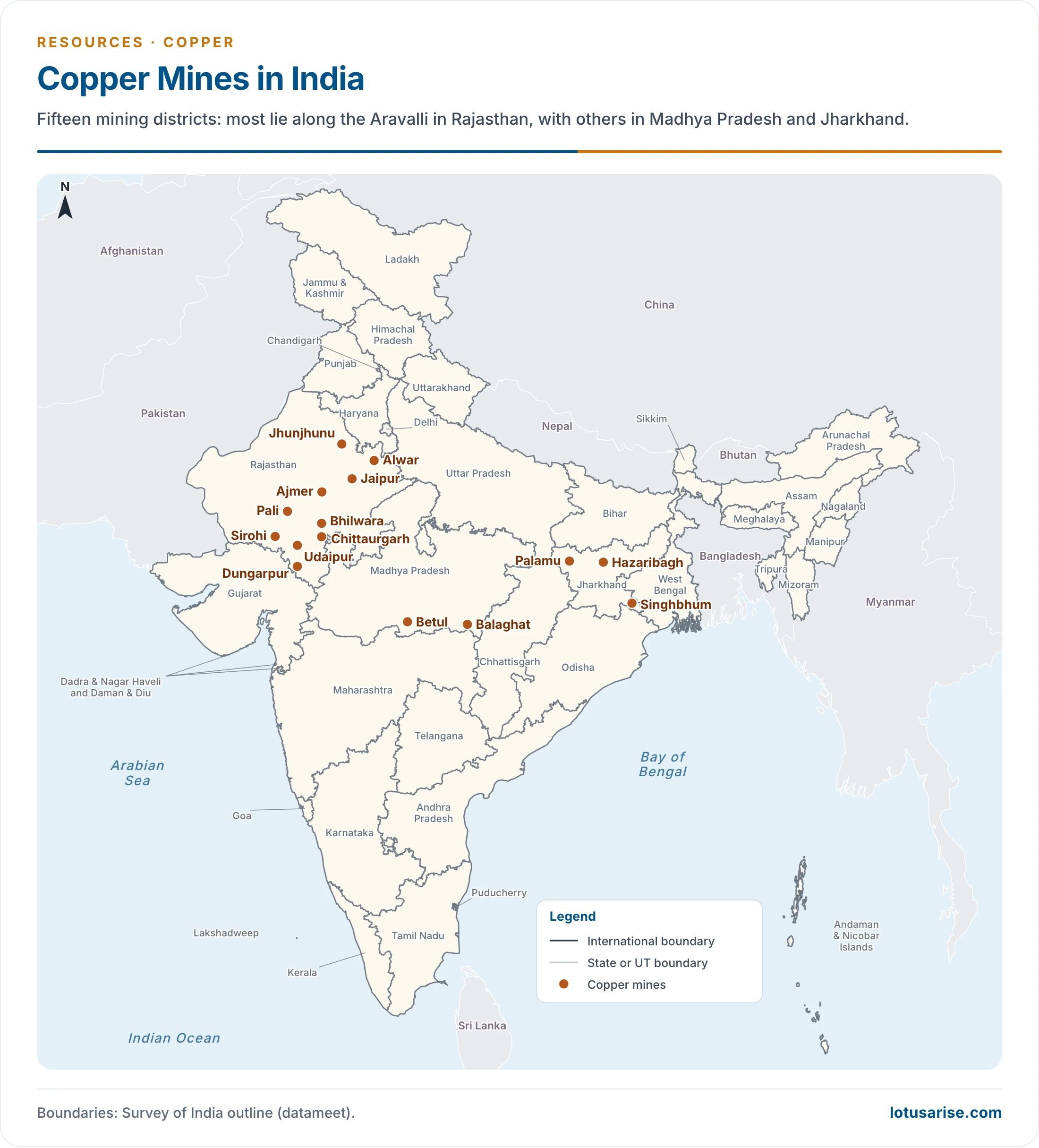
- Jammu and Kashmir and Ladakh have been separate Union Territories since the 2019 reorganisation.
Madhya Pradesh
- The largest producer, having passed Karnataka, Rajasthan and Jharkhand in turn. Its share rose from 59.85% in 2011-12 to about 67% in 2023-24.
- The Taregaon area in the Malanjkhand belt of Balaghat carries a large deposit, with recoverable reserves once put at 84.83 million tonnes of ore and 1,006 thousand tonnes of metal.
- An underground mine now works below the old opencast pit at Malanjkhand.
- Moderate deposits also occur at Kherlibazar-Bargaon in Betul.
Rajasthan
- Second in output, and first in resources.
- Its production share was stated at over 40% in an older count and over 28% in 2011-12, and it was 32.6% in 2023-24.
- The Khetri-Singhana belt in Jhunjhunu is the leading area. It runs north-east to south-west for about 80 km, from Singhana to Raghunathgarh, and is 3–5 km wide.
- Other areas: Ajmer, Alwar, Bhilwara, Chittaurgarh, Dungarpur, Jaipur, Jhunjhunu, Pali, Sikar, Sirohi and Udaipur, along the Aravalli.
- Named sites are Kho-Dariba near Alwar, Delwara-Kirovli near Udaipur, and Kishangarh in Ajmer.
Jharkhand
- Once the largest producer, till the early 1980s. Its share fell from 62% in 1977-78 to 11% in 2011-12, and to almost nothing in 2023-24.
- The main copper belt extends about 130 km.
- Singhbhum is the key district, with Rakha, Kendadih, Surda, Dhobani and Mosabani.
- Ghatsila holds the Indian Copper Complex of HCL.
- Other deposits:
- Hazaribagh: Hasatu, Baraganda, Jaradih, Parasnath, Barkanath.
- Bairakhi in the Santhal Parganas area.
- Some parts of Palamu and Gaya.
Copper Trade and Smelting
- Imports of ores and concentrates: 10,16,303 tonnes in 2023-24, mainly from Indonesia (32%), Chile (28%) and Peru (10%).
- Earlier lists named the USA, Canada, Zimbabwe, Japan and Mexico as the chief suppliers.
- Refined copper output: 5,09,429 tonnes of cathodes in 2023-24, 10th in the world.
- Most comes from Hindalco at Dahej in Gujarat, on imported concentrate.
- Vedanta’s Thoothukudi smelter in Tamil Nadu has been shut since May 2018. The Supreme Court dismissed its plea to reopen on 29 February 2024.
- World mine output (2023): Chile led with 5.37 million tonnes, followed by the Democratic Republic of Congo and Peru.
Chromite
- Chromite is the only commercially viable ore of chromium (Cr). Chemically it is iron chromium oxide (FeCr₂O₄).
- Chromium itself is a steel-grey, lustrous, hard and brittle metal that takes a high polish, resists tarnishing and has a high melting point.
- Its resistance to corrosion, oxidation and wear makes it versatile and indispensable.
- It is an important alloying metal, used with nickel, cobalt, copper and others, and it serves the metallurgical, refractory and chemical industries.
- It gives alloys additional strength, hardness and toughness.
Chromite Ore Distribution in India
- Resources: an earlier estimate of 203 million tonnes has risen to 332 million tonnes (1 April 2020), of which 79 million tonnes are reserves.
- Odisha holds over 96% of them, up from the earlier 93%.
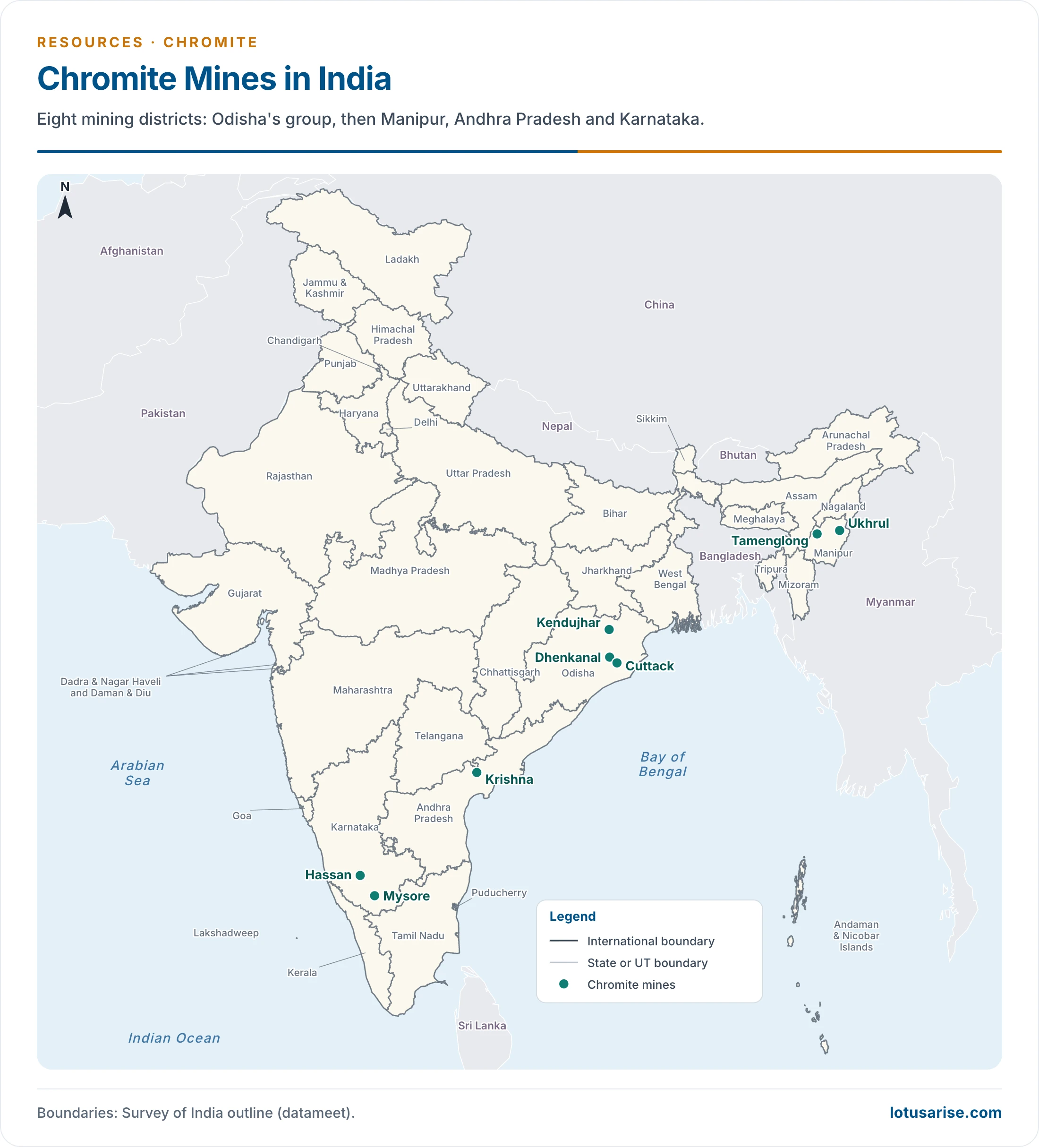
- The core is the Sukinda valley, in the former Cuttack district and now Jajpur, with Kendujhar and Dhenkanal.
- Minor deposits: Manipur, Nagaland, Karnataka, Jharkhand, Maharashtra, Tamil Nadu, Telangana and Andhra Pradesh.
- By grade (2020): charge chrome 28%, beneficiable 24%, ferrochrome 17%, refractory 16%, unclassified 11%.
- Output in 2023-24: 3,148 thousand tonnes, 12% down on the year. India ranks 3rd in the world, with 8.39% of output.
Chromite in Odisha
- Sole producer: the entire output of 2023-24, up from about 99% in earlier years.
- Over 85% of its ore was once rated high grade, from Keonjhar, Cuttack and Dhenkanal. In 2023-24 only about 21% of output was of 52% Cr₂O₃ and above.
Chromite in Other States
- Karnataka was long the second-largest producer, with Mysore and Hassan as the main districts, but it reported nil output in 2023-24.
- Other listed sources are Krishna district in Andhra Pradesh, and Tamenglong and Ukhrul in Manipur.
Chromite Trade
- Exports were only 2.12 thousand tonnes in 2023-24.
- Imports were 172.41 thousand tonnes, mainly from South Africa (93%).
Nickel
- Nickel is a lustrous, silvery-white metal with a high melting point (1,453°C).
- It has high resistance to corrosion and oxidation, and strength and toughness at high temperatures.
- It can be magnetised and alloys readily with many other metals.
- Nature offers no free nickel: it comes combined, alongside copper, uranium and other metals.
- Uses:
- Hard, with great tensile strength, so nickel steel makes armoured plates, bullet jackets, motor cars and naval parts.
- A small addition to iron greatly improves its properties, making it hard and stainless.
- These qualities suit products for consumer, industrial, military, aerospace, marine and architectural use.
- Coins have long used it.
- It also goes into storage batteries, and into catalysts that harden fats and oils for soap and vanaspati.
- Worldwide, about 65% goes into stainless steel, 20% into other steels and alloys, 9% into plating and 6% into other uses.
Health Effects of Nickel
- Exposure: nickel is an element that occurs in the environment only at very low levels. Its most common human use is as an ingredient of steel and other metal products.
- Routes into the body: breathing air, drinking water, eating food or smoking cigarettes, and skin contact with contaminated soil or water.
- Food:
- Foodstuffs naturally hold small amounts. Chocolate and fats are noted for relatively high levels.
- Eating large quantities of vegetables from polluted soils raises uptake, because plants accumulate nickel.
- Smokers take up more through the lungs, and detergents can also contain it.
- Effects of taking up too much:
- Cancer: lung and nasal cancers are the established risk, chiefly from inhaled compounds at work. The International Agency for Research on Cancer places nickel compounds in Group 1 and metallic nickel in Group 2B. Older lists add larynx and prostate cancer.
- Sickness and dizziness after exposure to nickel gas. Nickel carbonyl is the most acutely toxic form.
- Lung embolism and respiratory failure.
- Birth defects.
- Asthma and chronic bronchitis.
- Allergic reactions such as skin rashes, mainly from jewellery.
- Heart disorders.
Nickel Distribution in India
- Nickeliferous limonite in the Sukinda valley of Jajpur, Odisha, is the main occurrence. It occurs here as oxide, in the overburden of chromite.
- Sulphide nickel occurs with copper mineralisation in East Singhbhum, Jharkhand.
- It is also found with the uranium deposits at Jaduguda, Jharkhand, where a recovery plant is being developed.
- Other occurrences have been reported in Karnataka, Keralam (Kerala) and Rajasthan.
- Polymetallic sea nodules are another source.
- Resources: 189 million tonnes (1 April 2020), all in the remaining resources class, so no reserves are proved.
- Odisha: 175 million tonnes, 93% (given earlier as about 92%). Districts: Jajpur 140, Mayurbhanj 27, Keonjhar 8 million tonnes.
- Jharkhand: 9 million tonnes (5%), mainly East Singhbhum.
- Nagaland: 5 million tonnes (3%), mainly Kiphire.
- Karnataka: 0.23 million tonnes.
- Supply:
- No primary production is reported. Demand of about 45,000 tonnes a year is met by imports.
- Imports of nickel and alloys including scrap were 53,574 tonnes in 2023-24.
- HCL’s plant at Ghatsila has been launched as India’s first to make London Metal Exchange grade nickel from a primary source.
- Vedanta’s Nicomet in Goa makes nickel sulphate, with a capacity of 7,500 tonnes a year of nickel and cobalt.
- World (2023): Indonesia gave 54% of mine output and holds 42% of reserves.
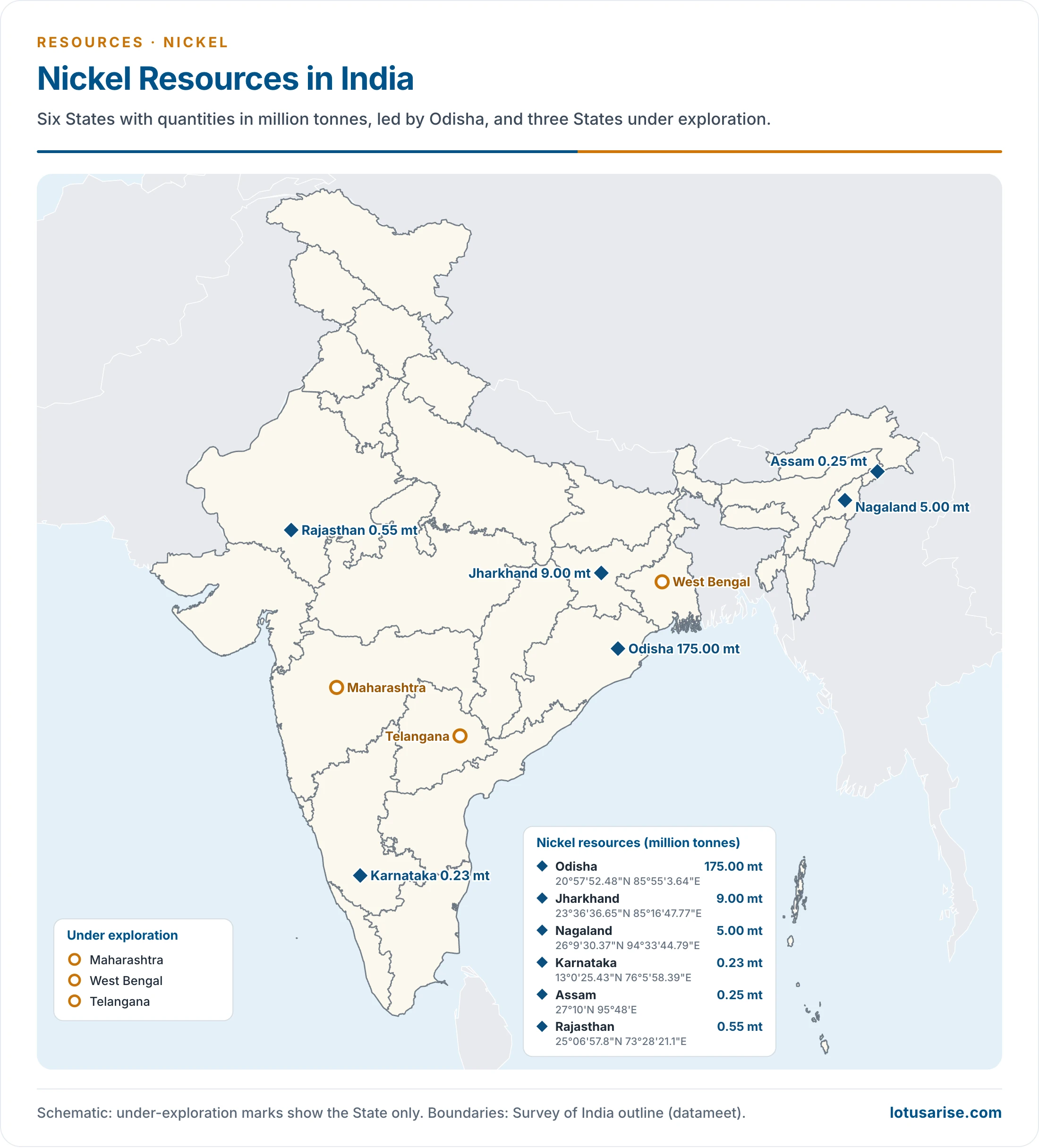
- This map also shows Assam and Rajasthan, which the 2020 inventory table does not list.
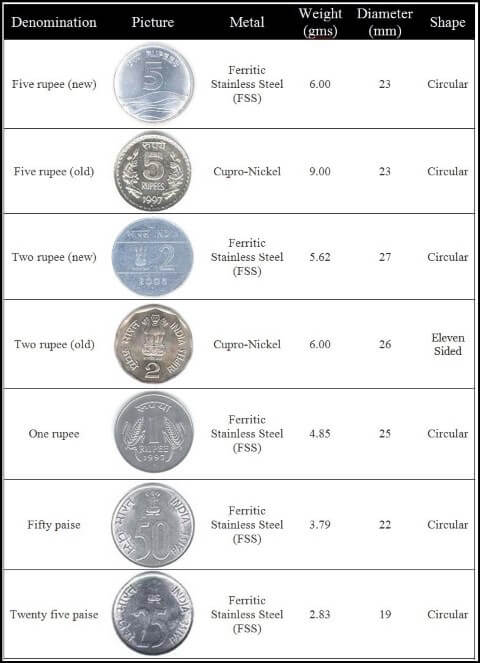
- This chart of Indian coins shows ferritic stainless steel and cupro-nickel. The 25-paise coin ceased to be legal tender on 30 June 2011.
Previous Year Questions
- No direct PYQ has been asked on this sub-topic yet.




 History Optional PYQ Master Pack: Topic-wise Model Answers (1985–2025) by LotusArise IAS
 History Optional Mains Master Kit 2027 Complete Self-Study System — Notes, Mapping & Premium Articles by LotusArise IAS
good crisp notes