

Aurobindo: Evolution, Involution; Integral Yoga.
Official Syllabus: Paper I, Section B, Unit 20
Evolution, for Sri Aurobindo, does not stop with the human mind, and it need not wait passively for Nature. The individual can take part consciously in the next step through a triple transformation: psychic (the soul comes forward and takes charge of the whole nature), spiritual (the being opens upward to higher planes of consciousness and their peace, light and power descend into it) and supramental (the Supermind descends and transforms mind, life and even the body). The being that results is the gnostic being, the first of a new type that lives by knowledge, not ignorance. Its appearance is meant to bring not only individual liberation but cosmic salvation — the Life Divine on earth, which Aurobindo regards as both possible and inevitable. This article explains the parts of the human being in Aurobindo’s psychology, the psychic being, each of the three transformations and why the psychic comes first, the role of Integral Yoga in them, the nature of the gnostic being, whether it is the same as a jīvanmukta, the idea of cosmic salvation through individual salvation, and the arguments for the Life Divine.
In simple words
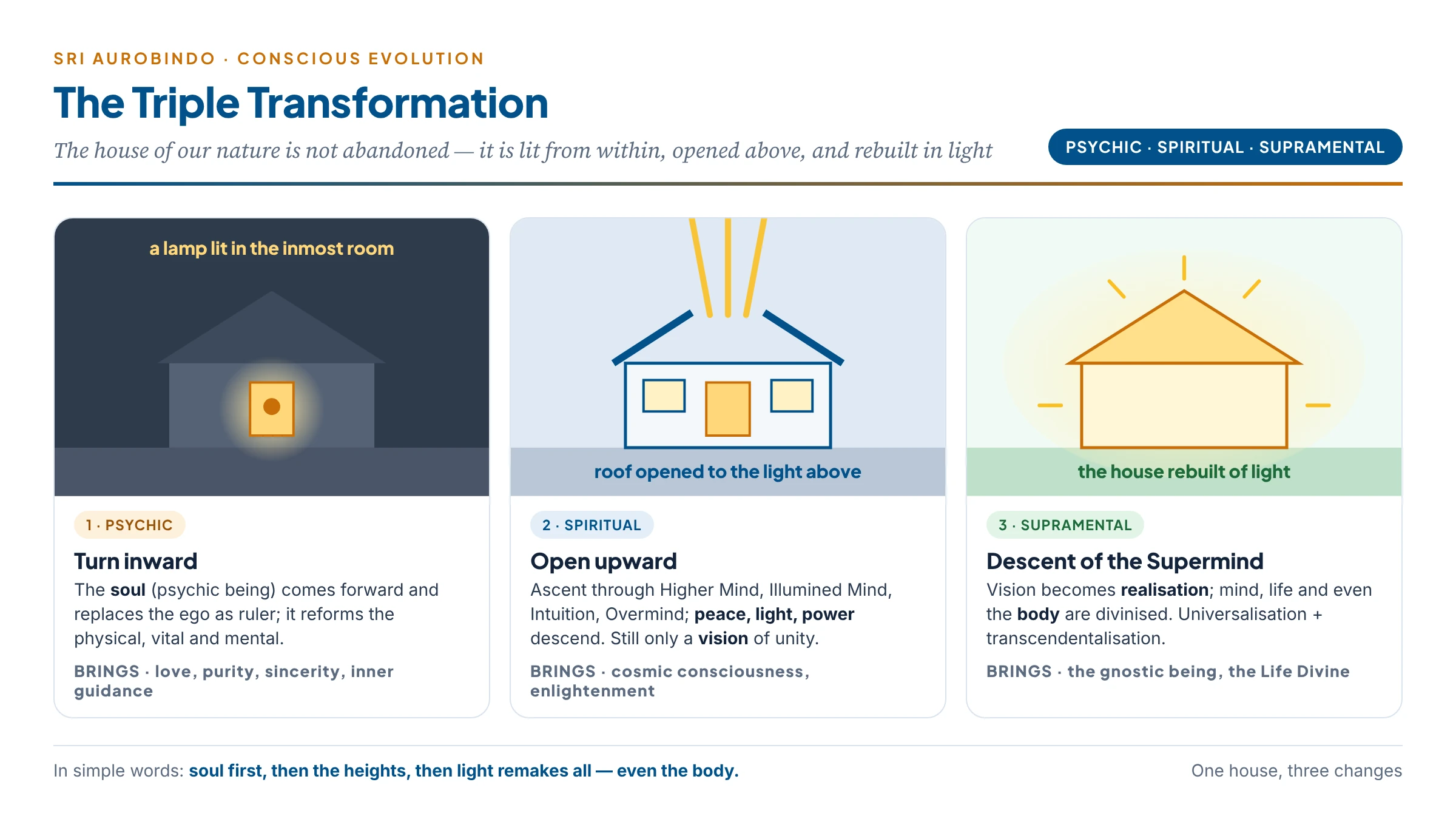
Think of an old, dark house. First a lamp is lit in its innermost room, and from there its owner begins to put the whole house in order — that is the psychic change. Next, the windows and the roof are opened so that sunlight pours in from above — the spiritual change. Finally, the house is rebuilt out of light itself, so that it no longer needs lamps or windows — the supramental change. The house is not abandoned at any stage; it is transformed.
Context & Problem
Why Transformation and Not Only Liberation
- The limit of past realisation. Great sages attained salvation; some realised Brahman. But it was individual salvation — freedom from birth and death — and it was partial, because it came through the mind or the Overmind (Article 3). The world they left behind was unchanged.
- The limit of the Overmind. Spiritual experience can transform thought and feeling, but it cannot by itself abolish illness, decay and death; only the Supermind can change the physical.
- The evolutionary demand. If Supermind is involved in Matter and is the next step of evolution, then the human being, the conscious laboratory of Nature, must co-operate with its emergence. This conscious co-operation is the triple transformation, carried out through Integral Yoga.
- Change of the whole being. The aim is not to leave mind, life and body behind but to make them fit instruments of the Divine. This first requires a radical change of our terrestrial existence — material, vital and mental — and then a final, supramental change.
The Parts of the Human Being
Aurobindo’s psychology describes the human being in layers. The triple transformation works on all of them.
| Part | What it is | Its normal condition |
|---|---|---|
| Physical (anna) | The body and its habits, inertia, need for rest | Ruled by inertia (tamas) and routine |
| Vital (prāṇa) | Desires, emotions, impulses, energy, ambition | Restless, driven by desire and ego |
| Mental (manas) | Thought, reasoning, opinions, will | Divided, doubtful, argumentative |
| Inner being | Subtler mind, vital and physical behind the surface | Usually hidden; source of intuitions and inner experiences |
| Psychic being (caitya puruṣa) | The soul — a spark of the Divine evolving within us | Veiled behind the outer nature; usually in the background |
| Central being / Jīvātman | The eternal individual self above the evolution | Unborn and unchanging; it puts forth the psychic being |
| Subconscient and Inconscient | Below waking awareness — old habits, dark automatisms | Pull the nature back to ignorance |
| Superconscient | The planes above mind — Higher Mind up to Supermind | Not yet open to ordinary consciousness |
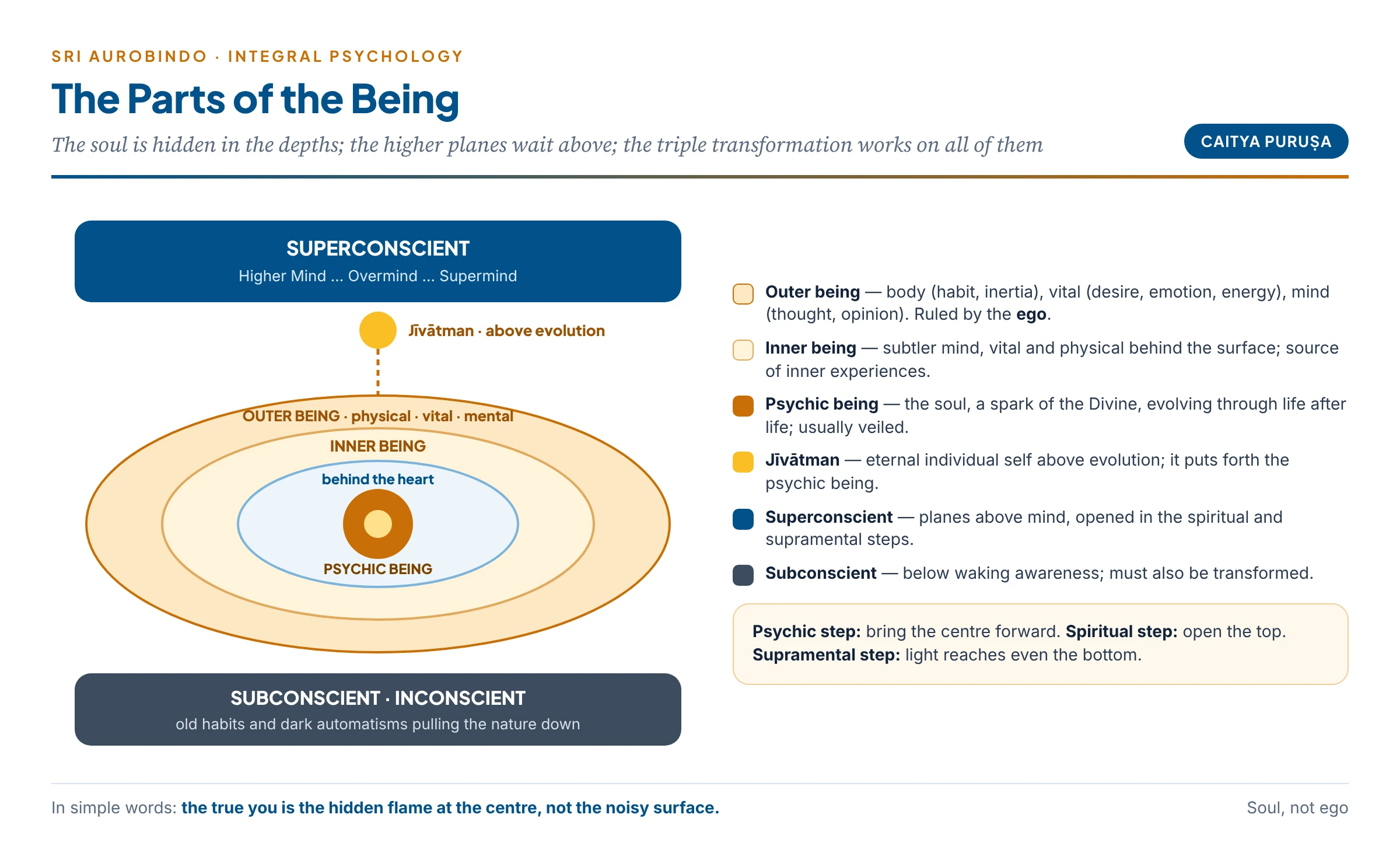
- Spirit, soul and body. In simpler language Aurobindo sees man as made of three elements: the spirit — the eternal element; the soul — the developing element; and the body — changing, brittle and perishable. Even the material side, which India often neglected, has value.
Core Doctrine
The Psychic Being: The Soul That Evolves
- A spark of the Divine. The true Self is the unborn and immutable spirit of man, which always lives on the divine plane. It is not involved in the world of ignorance, but sends down a ray, a spark of divinity, into this world. Aurobindo calls this spark the psyche.
- Present even in matter. The psychic element is inherent even in matter and evolves towards fuller existence in life and mind. In man it takes the form of the psychic being (caitya puruṣa).
- It grows. Though its essential spiritual nature does not change, the psychic being evolves: it gathers the essence of every experience and grows from life to life. Aurobindo accepts rebirth as the means of this growth.
- Seated behind the heart. It stands deep behind the emotions, in the inmost being — not the surface emotions, but the quiet centre behind them.
- In direct touch with the Divine. The psychic being is directly connected with its source, the Divine Self — but man is normally unaware of his own soul.
- Why its knowledge is limited. Mind, life and body are the instruments available to the soul. However imperfect they are, the soul must work through them; so, though spiritual and blissful in itself, it is in practice subject to mentality, vitality and physicality. Its intuitions give immediate awareness of Reality but are not complete, and its power is limited. For absolute knowledge and power, it must attain the Supermind, the source of mind, life and matter.
Common confusion
Is the psychic being the same as the jīvātman? Not exactly. Many notes simply equate them. In Aurobindo’s scheme the jīvātman (central being) is the eternal individual self above the evolution, unborn and unchanging. The psychic being is its representative within the evolution — a spark put forth by it, which grows through experience and rebirth. The jīvātman presides; the psychic being evolves. Both represent the Divine in man.
| Point | Ego | Psychic being |
|---|---|---|
| Nature | A temporary formation of mind, life and body | A spark of the Divine, the true soul |
| Centre of | Separation — “I” against others | Unity — love, harmony, oneness |
| Motive | Desire, possession, self-assertion | Aspiration for the true, the good, the beautiful, the Divine |
| Knowledge | Mental opinion, often mistaken | Inner sense of truth — it feels what is true and false |
| Fate | Must be dissolved | Must come forward and govern the nature |
The First Step: Psychic Transformation (Psychicisation)
- What it is. Locating clearly the soul-element in us and following its dictates: awakening the soul and relating matter, life and mind to that awakened soul.
- Turning inward. Consciousness must turn inwards, discover the psychic being behind the outer turmoil, and let it come to the front.
- The soul replaces the ego. In ordinary people the outward ego rules the personality. In psychic transformation the inward soul comes forward and becomes the leader, subordinating the intellect, emotions and physical habits.
- The whole nature reformed. The psychic being then reforms the physical, vital and mental — turning the entire nature towards love, purity, sincerity and surrender to the Divine.
- The inner guide. The awakened soul acts as a spiritual guide within the yoga, showing at every step what is true and what is false, what is to be accepted and what rejected.
“To merge the consciousness in the Divine and to keep the psychic being controlling and changing all the nature and keeping it turned to the Divine till the whole being can live in the Divine is the transformation we seek.” — Sri Aurobindo
Why the Psychic Awakening Is the First Step in Conscious Evolution
- It is the Divine already present in us. The psychic being is the one part of us in direct contact with the Divine; to begin with it is to begin from the Divine’s foothold in our nature.
- It is a sure guide. Mind can be deceived, the vital can be swept away by desire; the psychic being has an inner sense of truth and protects the seeker from error.
- It makes the ascent safe. Without psychic change, spiritual experiences can inflate the ego — a person may feel powerful or “chosen” and be misled. The soul in front keeps the ascent pure and humble.
- It transforms from within. Moral rules work from outside and are often broken; the psychic change works from within, so that the nature changes spontaneously, without suppression.
- It prepares the ground. By purifying and harmonising the physical, vital and mental, it makes them able to receive the higher light later.
- It turns evolution from unconscious to conscious. Up to now evolution has proceeded by Nature’s slow pressure; with the psychic awakening the individual begins to evolve consciously, by choice.
- Examination — difficulties.
- How do we identify it? It is hard to distinguish the psychic being’s voice from strong emotion, conscience, or wishful thinking.
- Subjectivity. Claims about an inner soul cannot be checked by others.
- Slow and uncertain. Aurobindo himself admits the psychic often stays veiled for a long time.
- Replies. The psychic is known by its fruits — a steady growth of love, sincerity, peace and discrimination, unlike the turbulence of the vital; and it is recognised by long practice, as a musician comes to recognise true pitch.
In simple words
A ship tossed in a storm needs, first of all, a captain at the wheel. Until then, every wave and gust decides its course. The psychic being is the true captain of our ship; the ego, our desires and our opinions are the waves and gusts. Psychic transformation means putting the captain back at the wheel — and only then is it safe to set out for distant seas.
The Second Step: Spiritual Transformation (Spiritualisation)
- Turning upward. The awakened psychic being must now turn towards what belongs to a higher reality. The mind opens itself to the Superconscient — the planes above it.
- Opening out. It is also called the process of opening out: the mental starts its onward march by opening to higher consciousness.
- The ascent. Consciousness rises through the overhead planes — Higher Mind (clarity of spiritual thought), Illumined Mind (spiritual sight), Intuition (flashes of truth) and Overmind (cosmic consciousness).
- The descent. At the same time light, peace, purity, power, knowledge and bliss descend into the mind, the vital and the body, transforming all their parts. This is the concrete realisation of the larger spiritual consciousness — what many traditions call enlightenment.
- Beyond dualities. The spiritualised mind moves beyond forms and figures, beyond ideas of good and evil, true and false, beautiful and ugly, towards the apprehension of what transcends all dualities and is One.
- Its limit. Psychic and spiritual transformation raise man to great heights, but if the soul is left there it has only a vision of unity above it, not a realisation of it. The physical is still not transformed.
The Third Step: Supramental Transformation (Supramentalisation)
- Vision becomes realisation. For the vision of unity to become a realisation, there must be a descent of the higher consciousness itself — the Supermind.
- The radical change. This transformation brings an abiding spiritual sense and the consciousness of the Infinite, and causes a radical change in the whole of our terrestrial existence. Human beings will no longer move in ignorance; they will act on knowledge.
- Two changes.
- Universalisation — expansion of consciousness until it embraces the universe.
- Transcendentalisation — knowledge of identity with the transcendent Divine.
- Down to the cells. The Supermind descends directly into physical matter. The body is divinised and becomes a conscious, radiant vehicle of the Spirit — a divine body (divya śarīra) — and Aurobindo envisages the gradual conquest of disease, decay and death. This is the absolute triumph of Spirit over the Inconscient.
- The result. Consciousness is fully divinised, all forces of disunity and duality are superseded, and a vision of complete unity emerges. The individual becomes a gnostic being and life becomes the Divine Life.
- Prerequisites. Psychicisation and spiritualisation are necessary preparations; without them the supramental descent would find no fit vessel.
- A new species. After these stages Aurobindo foresees a new supramental species, with three aims:
- removal of the separation in knowledge between souls;
- uplift of every level of being to a higher one;
- establishment of a divine life on earth.
| Psychic | Spiritual | Supramental | |
|---|---|---|---|
| Direction | Inward | Upward — and descent of overhead powers | Descent of the Supermind |
| Key change | Soul replaces ego as ruler | Mind opens to the Superconscient | Whole nature, including body, divinised |
| What it brings | Love, purity, sincerity, inner guidance | Peace, light, power, knowledge, bliss; cosmic consciousness | Truth-consciousness; unity realised; victory over death |
| Limit | Knowledge and power of the soul still limited | Only a vision of unity; body untouched | — the culmination |
| Name of process | Psychicisation | Spiritualisation | Supramentalisation |
The Role of Integral Yoga in the Triple Transformation
- Yoga as conscious evolution. Evolution is inevitable, but individual effort hastens it; that effort is Integral Yoga (Article 5). Its three stages are the three transformations.
- The method in each step.
- For the psychic step: inward concentration in the heart, sincere aspiration, and rejection of the ego’s desires so that the soul can come forward.
- For the spiritual step: concentration above the head, opening to the higher planes, and stilling the mind through quiet, calm, peace and silence.
- For the supramental step: surrender of the whole being to the Divine Mother’s force, which alone can bring down the Supermind.
- The double movement. At every stage Integral Yoga combines an ascent of consciousness with a descent of higher power — “our Yoga is a double movement of ascent and descent”.
- Evaluation.
- Strength — it gives a clear sequence and a safe order: soul first, then the heights, then the descent into matter.
- Strength — it includes the whole person, not only the meditating mind.
- Difficulty — the supramental stage is beyond present verification; its success depends on a descent no one can command.
- Difficulty — the path demands total surrender and an inner guide, which can be misunderstood or misused.
The Gnostic Being
The being who realises the Supermind Aurobindo calls the gnostic being — “gnostic” because it lives by knowledge (gnosis), not by ignorance.
- Governed by universal spirituality. Its way of being, thinking, living and acting is governed by the power of a universal spirit.
- Integral unity. It has a keen sense of integral unity in its inner and outer life — and it can create a harmonious unity even with the still-surviving mental beings around it.
- A perfect, complete individual. Its perfection comes from the highest possible integration both within and without.
- Harmony with the whole. It acts in awareness of the harmony of its individual self with the total self, its individual will with the total will, its individual action with the total action.
- Action without struggle. We feel difficulty in action because of the barriers the ego builds around itself. The gnostic being has transcended these barriers and is one in realisation with the Infinite.
- Carrying the universe within. It lives in the universe and, at the same time, carries the universe within itself; its experience of the world is that of a being who feels the whole cosmos as its own body.
- Joy without desire. It acts in a joyous spirit; its only aim is the delight of manifesting the Spirit. It has no desires, no wants, nothing to strive for. Even delight is not its goal — it is its nature. Knowledge too is not its aim: it already knows, and brings out what is already known.
- Self-exceeding, not suppression. Life, mind and body are not suppressed or abolished but perfected and fulfilled; even the body becomes an instrument of spiritual activity and no longer a hindrance.
- Free from error and moral conflict. It possesses unbroken truth-consciousness; ethical rules, mental reasoning and personal desire are replaced by the spontaneous truth of being. Its actions are a joyful outpouring of the divine will — līlā.
- Diversity, not uniformity. A gnostic race will not be cast in one mould. The law of the Supermind is unity fulfilled in diversity; though the basic consciousness is the same, there will be infinite variety in its expression.
- Individuality preserved. The individual’s identity is not lost. The gnostic individual is the inner person unveiled, without the mask of a surface personality — above the distinction of personality and impersonality, an infinite and universal being expressing itself in many forms.
- A gnostic community. The aim is not isolated individuals but the emergence of a collective gnostic life — a race beyond quarrels, disease and death, in direct communion with Saccidānanda: in religious language, the Kingdom of God on earth.
In simple words
Picture an orchestra in which every musician hears the whole symphony inside, so perfectly that no conductor and no rulebook are needed. Each plays a different instrument and a different part, yet all play one music, and each enjoys the whole. A gnostic community would be like this: real individuals, endlessly varied, acting from one shared Truth-Consciousness instead of rules and quarrels.
“Man is a transitional being; he is not final. For in man and high beyond him ascend the radiant degrees which climb to a divine supermanhood.” — Sri Aurobindo
Is the Gnostic Being a Jīvanmukta?
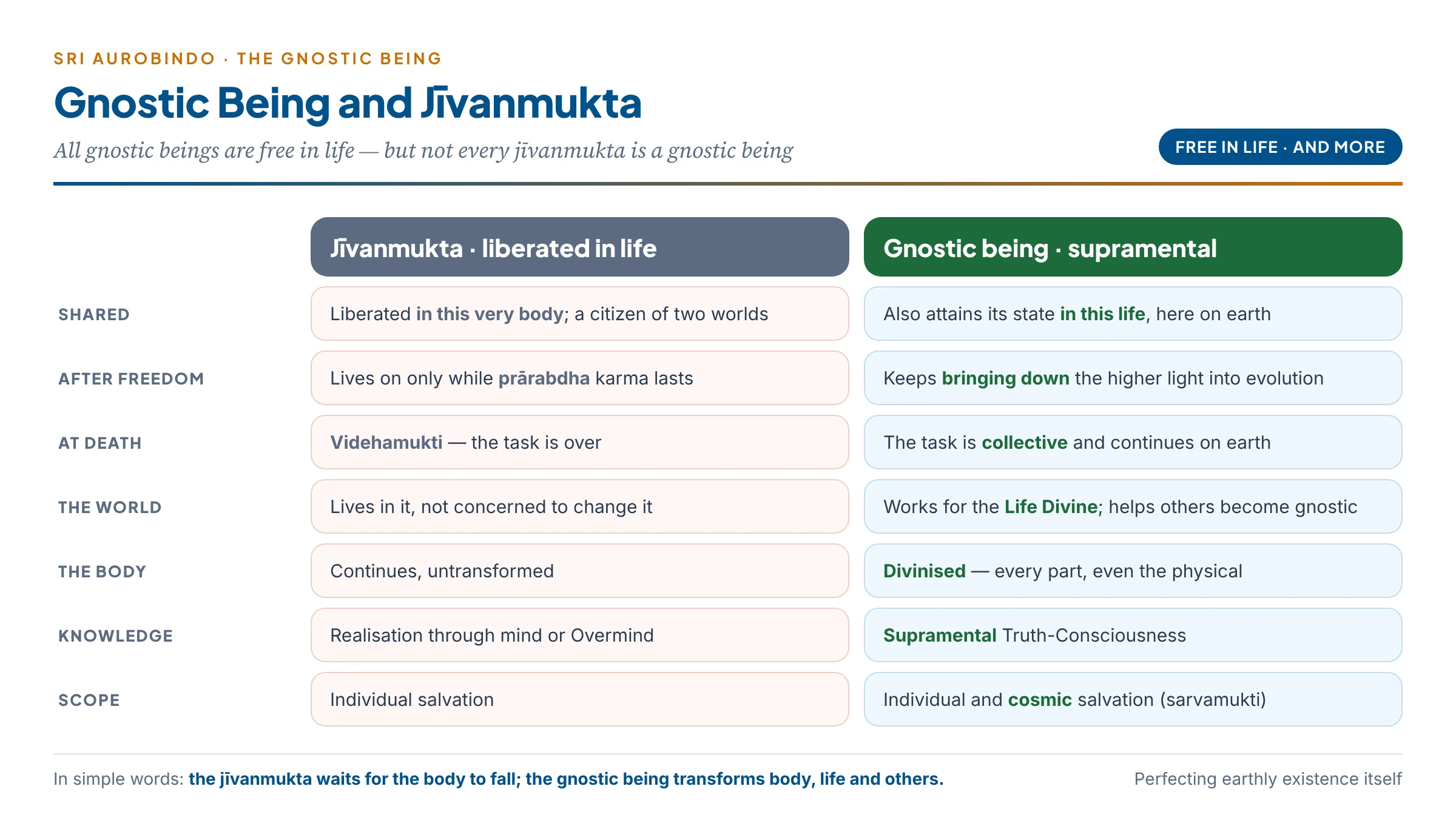
- The jīvanmukta. In Indian tradition the jīvanmukta is one who attains liberation while still in the body. He is a citizen of two worlds — embodied in the phenomenal world, yet belonging to the transcendental.
- The resemblance. The gnostic being too attains its state in this very life and represents the consummation of this-worldly nature.
- The differences.
- Purpose after liberation. The jīvanmukta continues in the body only as long as the remaining karma (prārabdha) keeps it going; once he attains videhamukti at death, his task is done. The gnostic being, even after attaining the supramental status, brings down the higher light into the evolutionary process and works to transform others into gnostic beings.
- Relation to the world. The jīvanmukta lives in the world but is not concerned with changing it; the gnostic being identifies with the creative impetus and works for the Divine Life on earth.
- Transformation of the body. Most important: in the gnostic being all parts of the embodied existence, including the physical, are transformed and divinised. It is not entering a new life or another world but the perfecting and divinising of earthly existence itself.
- Individual and collective. The jīvanmukta’s freedom is his own; the gnostic being’s realisation is meant to be collective.
- Conclusion. All gnostic beings can be thought of as jīvanmuktas, but not all jīvanmuktas are gnostic beings.
Cosmic Salvation through the Spiritual Salvation of the Individual
- Sarvamukti — liberation of all. Integral Yoga aims at the transformation of the whole of embodied existence and includes sarvamukti, the collective liberation of mankind.
- Why the individual comes first. The individual is the medium through which the Spirit reveals itself. Cosmic change does not happen to a crowd all at once; it begins in individuals who open to the higher consciousness and then radiate it.
- The gnostic being as a centre of radiation. Having attained the supramental status, the gnostic being brings down the higher light into the evolutionary process and helps others to rise; one transformed being makes it easier for the next.
- The individual and the community. The individual is not subordinate to the community or state, nor is the community a mere collection of individuals:
- Man is not to lose himself in the mass; he must find and express the truth within him and help the community seek it.
- A perfect community exists only through the perfection of its individuals.
- The spiritually liberated person is the one who can best contribute to the good of the community.
- So Aurobindo rejects both excessive individualism (as in utilitarian thought) and the submerging of the individual in the collective (as in socialist or communist thought).
- The goal: a gnostic society. The end is a collective life founded on the realised unity of all — the social form of the Supermind, in which unity is lived in diversity.
- Human unity as a step. Aurobindo saw the growing unity of mankind — not by administrative or economic means alone but by an inner change, a “religion of humanity” — as part of Nature’s slow and patient scheme towards this end.
- East meets West. The West has valued the individual, the East the collective and the beyond; Aurobindo’s cosmic salvation joins them: individual perfection and the liberation of all.
- Here and now. This salvation is ihaiva — here — and adhunaiva — now — on earth, not in a heaven after death.
Indian Connect — The Bodhisattva and the gnostic being
In Mahāyāna Buddhism the Bodhisattva postpones final nirvāṇa out of compassion, vowing to work until all beings are freed. Aurobindo’s gnostic being shares this concern for the liberation of all. The difference: the Bodhisattva helps beings out of saṃsāra, while the gnostic being works to transform the world itself into a divine life.
The Life Divine as a Possibility and an Inevitability
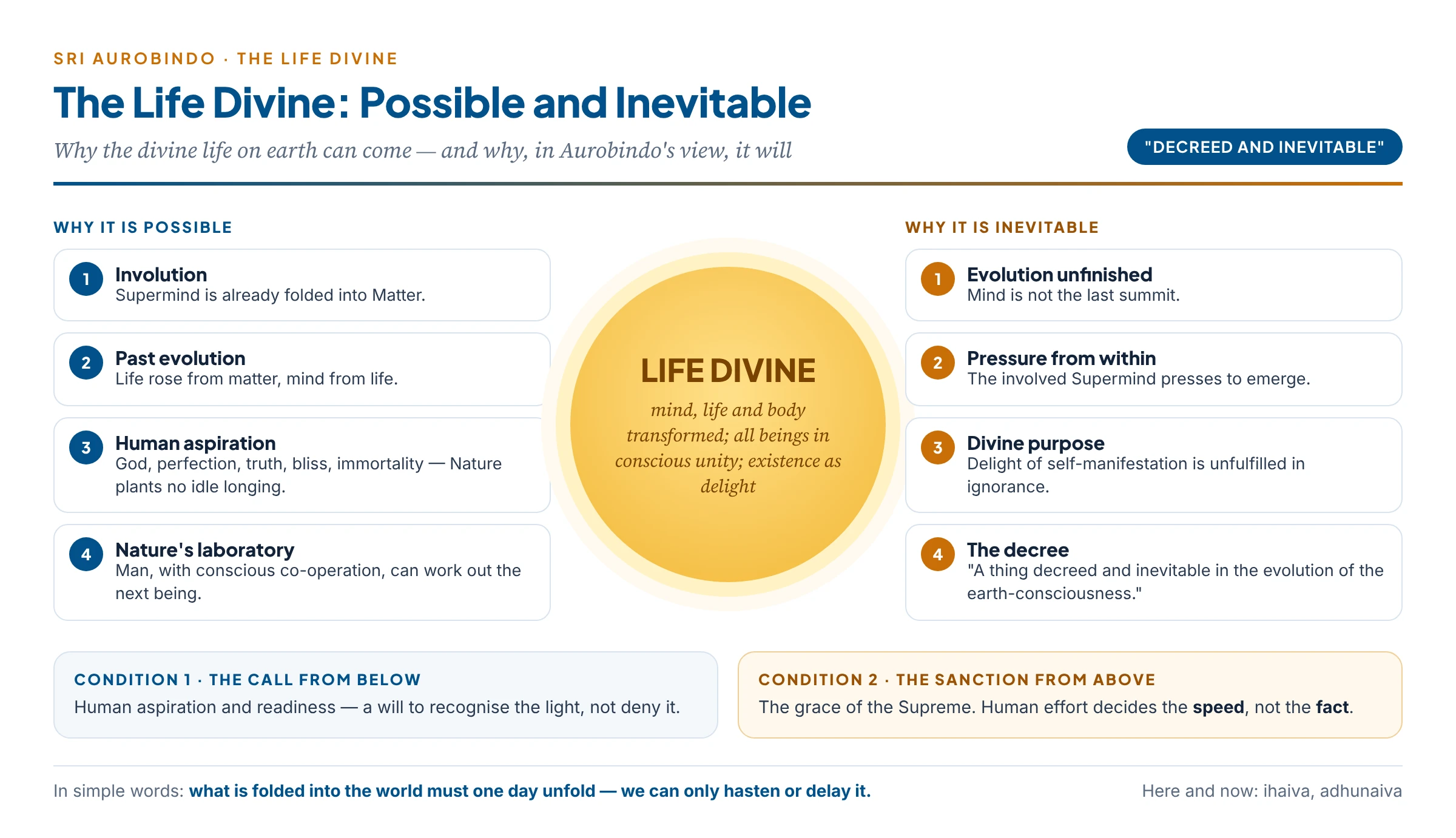
What the Life Divine is: a life on earth in which mind, life and body are transformed by the Supermind, the individual and the collective live in conscious unity with the Divine, and existence becomes an expression of truth and delight rather than of struggle and ignorance.
Why it is possible:
- The logic of involution. What is involved must evolve. Since Supermind and Saccidānanda are already involved in Matter, their manifestation in Matter is possible.
- The evidence of past evolution. Life emerged from matter and mind from life; a further emergence beyond mind is in line with the whole history of the earth.
- The constant human aspiration. Aurobindo opens The Life Divine by noting that man’s earliest and most persistent preoccupation is the divination of God, the impulse towards perfection, the search for pure Truth and unmixed Bliss, and the sense of a secret immortality. Nature does not plant an aspiration it cannot fulfil.
- Man as Nature’s laboratory. As the animal was the laboratory in which Nature worked out man, so man is the laboratory, with his conscious co-operation, in which she can work out the superman.
- Spiritual experience. The psychic and spiritual transformations have already been experienced by many; they are partial realisations of what the supramental change completes.
Why it is inevitable:
- Evolution is not ended. Mind is not the last summit of evolution; it is unstable, divided and incapable of solving the problems it creates.
- The pressure from within. The involved Supermind presses to emerge, as life pressed in matter and mind in life.
- The divine purpose. The world exists for the delight of the Divine’s self-manifestation; that purpose is unfulfilled while the world remains in ignorance.
- The decree of the Supreme. Aurobindo states it directly:
“The supramental change is a thing decreed and inevitable in the evolution of the earth-consciousness; for its upward ascent is not ended and mind is not its last summit. But that the change may arrive, take form and endure there is needed the call from below with a will to recognise and not deny the light when it comes, and there is needed the sanction of the Supreme from above.” — Sri Aurobindo
- Inevitable, but not automatic. The change needs two conditions: the call from below (human aspiration and readiness) and the sanction from above (the Divine’s grace). Human effort decides the speed, not the fact.
- The final harmony. Aurobindo tries to suggest the end in an image: as if honey could taste itself and all its drops together, and all its drops could taste each other and each the whole honeycomb as itself — so should the end be with God, the soul of man and the universe.
- Faith in the outcome. His epic Savitri puts the same conviction in a line: “And how shall the end be vain when God is guide?”
In simple words
Before the first fish crawled onto land, no one could have imagined birds or human beings. Yet both came, because the possibility was hidden in life all along. Aurobindo says that the Life Divine is to us what humanity was to the first fish: hard to imagine, yet already folded into the nature of things — so it can come, and in time it will.
Critical Evaluation
Objections
- The psychic being is unverifiable. There is no public way to confirm the existence of an evolving soul behind the heart.
- Bodily transformation strains belief. The conquest of disease and death by a descent of consciousness has no scientific support; Aurobindo himself died in 1950.
- Beyond good and evil? A being “beyond the dualities” and “beyond ethical rules” could be used to justify anything; history shows the dangers of people who think they are above morality.
- Utopianism. A gnostic society free from quarrels and disease looks like a utopia, distracting from practical reform.
- Elitism. The path is long and demanding; the gnostic being seems a goal for a very few.
- “Inevitable” is unfalsifiable. If the Life Divine does not come, one can always say the time is not ripe.
Replies and Strengths
- Inner verification. The psychic being is known by its fruits — sincerity, love, discrimination — and by sustained practice, as other inner realities are.
- Evolutionary patience. Aurobindo never claimed that the transformation would be complete in his lifetime; he spoke of a process in evolutionary time.
- Beyond ethics, not below it. The gnostic being transcends moral rules because it acts spontaneously from truth and unity — it cannot do evil, since evil arises from ego and division. Until then, discipline, purification and sincerity are demanded at every step; the psychic step comes first precisely to prevent ego-inflation.
- Not escapism. Unlike many spiritual paths, this one insists on work in the world and on the transformation of society.
- A collective horizon. By making salvation collective and earthly, Aurobindo gives spirituality a social conscience.
Critics and Defenders
Criticism — Critics
- Unverifiable soul: no public test for the psychic being.
- Immortal body: no evidence; Aurobindo himself died.
- Above morality: “beyond good and evil” can be misused.
- Utopian and elitist: a gnostic race for a chosen few.
- Unfalsifiable: “inevitable” with no time-frame.
Defence — Defenders and strengths
- Known by fruits: love, sincerity, discrimination.
- Psychic first: the soul guards against ego-inflation.
- Evolutionary time: ages separated life from mind.
- Transcends ethics from unity, not from licence.
- Collective, earthly salvation: spirituality with a social conscience.
Cross-Tradition Comparison
Indian Comparisons
| Ideal | Liberation | Relation to world | Body | Scope |
|---|---|---|---|---|
| Advaita jīvanmukta | Knowledge of identity with Brahman | Lives on till prārabdha ends; world mithyā | Continues, untransformed | Individual |
| Sāṃkhya-Yoga kaivalya | Puruṣa isolated from Prakṛti | Prakṛti ceases to act for the freed soul | Left behind | Individual |
| Mahāyāna Bodhisattva | Enlightenment, final nirvāṇa postponed | Works out of compassion within saṃsāra | Not transformed | All beings |
| Aurobindo’s gnostic being | Supramental realisation | Transforms the world into the Life Divine | Divinised | Individual and cosmic |
Indian Connect — Key takeaways
- Advaita and Yoga free the soul from the world; Aurobindo frees the world itself.
- The Bodhisattva shares the gnostic being’s care for all, but still seeks release from saṃsāra.
- Only Aurobindo includes the body in liberation.
Western Comparisons
| Thinker | Similarity | Difference |
|---|---|---|
| Nietzsche’s Übermensch | Man is a bridge, not a goal; a higher type will surpass man | Nietzsche’s superman rests on will to power and denies God; Aurobindo’s gnostic being rests on divine consciousness and the end of ego |
| Plato’s philosopher-king | The best-knowing soul should guide society | Plato’s ruler knows the Forms by reason; the gnostic being knows by identity and transforms the body |
| Kant’s kingdom of ends | A community of persons treating each other as ends | Kant’s community rests on moral law and duty; the gnostic community on spontaneous unity beyond duty |
| Kingdom of God on earth (Christian hope) | A transformed earth, not only a heaven after death | Brought about by evolution and Yoga, not by a single act of divine intervention at the end of time |
| Teilhard de Chardin | Convergence of humanity towards a higher, unified consciousness | Teilhard’s Omega Point is Christ; Aurobindo’s goal is the Supermind manifesting in matter |
Synthesis (Siddhānta)
- Conscious evolution in three steps. Psychic (the soul takes the lead), spiritual (opening to the heights and the descent of their peace and light), supramental (descent of the Supermind into the whole nature, down to the body).
- The psychic comes first because it is the Divine already within us, the sure guide that keeps the ascent pure and turns evolution from unconscious to conscious.
- The gnostic being is the fruit — a perfect, integrated, desireless, joyous individual, one with the whole, diverse in expression, and the seed of a gnostic community.
- More than a jīvanmukta. All gnostic beings are free in life, but they also transform the body and the world and work for the freedom of others.
- Cosmic salvation begins with individuals and spreads outward; the perfection of individuals and of the community go together.
- The Life Divine is possible because of involution and human aspiration, and inevitable because evolution is unfinished — given the call from below and the sanction from above.
- Contemporary relevance.
- Inner change and social change. Aurobindo’s insistence that a perfect society needs transformed individuals speaks to every reform that fails for lack of inner change.
- Holistic well-being. His attention to the physical, vital, mental and psychic parts anticipates holistic approaches to education and health.
- Hope. In an age of anxiety, his view of humanity as unfinished and evolving offers a philosophy of hope grounded in a cosmic process.
Previous Year Questions
- 2026Explain the basic characteristics of Sri Aurobindo’s Integral Yoga for the realization of supramental consciousness through triple transformation.
- 2022Explain and evaluate the role of integral yoga in the process of triple transformation for individual evolution as expounded by Sri Aurobindo.
- 2021According to Śri Aurobindo, “the awakening of the psychic being and its gradual prominence over all other parts of the being is the first step in the conscious evolution of man”. Explain and examine.
- 2020What does Aurobindo mean by “life divine” as a possibility and inevitability?
- 2018What is Evolution according to Sri Aurobindo? Describe the process of triple transformation and the nature of gnostic being in his philosophy.
- 2013Explain Sri Aurobindo’s conception of cosmic salvation through spiritual salvation of individual.