

Aurobindo: Evolution, Involution; Integral Yoga.
Official Syllabus: Paper I, Section B, Unit 20
The Supermind is the keystone of Sri Aurobindo’s philosophy. It answers the oldest question of Vedānta — how does the One become the Many without ceasing to be One? — and it names the next step of evolution. Metaphysically, the Supermind is the self-knowledge of Brahman that is at the same time Brahman’s power to manifest itself: a “Real-Idea” in which knowing and willing are one, a “Truth-Consciousness” (Ṛta-cit, Vijñāna) that sees the Many in the One and the One in the Many. It stands at the border between the higher hemisphere of Saccidānanda and the lower hemisphere of Mind, Life and Matter. In evolution, it is both the hidden goal involved in Matter and the future consciousness that will transform mind, life and body. This article explains what the Supermind is, how it differs from mind, its three poises, its unique position in Aurobindo’s scheme, the ladder of consciousness from ordinary mind through Higher Mind, Illumined Mind, Intuition and Overmind, why mind cannot reach the Infinite, the role of the Supermind in evolution, and how it compares with similar ideas East and West.
In simple words
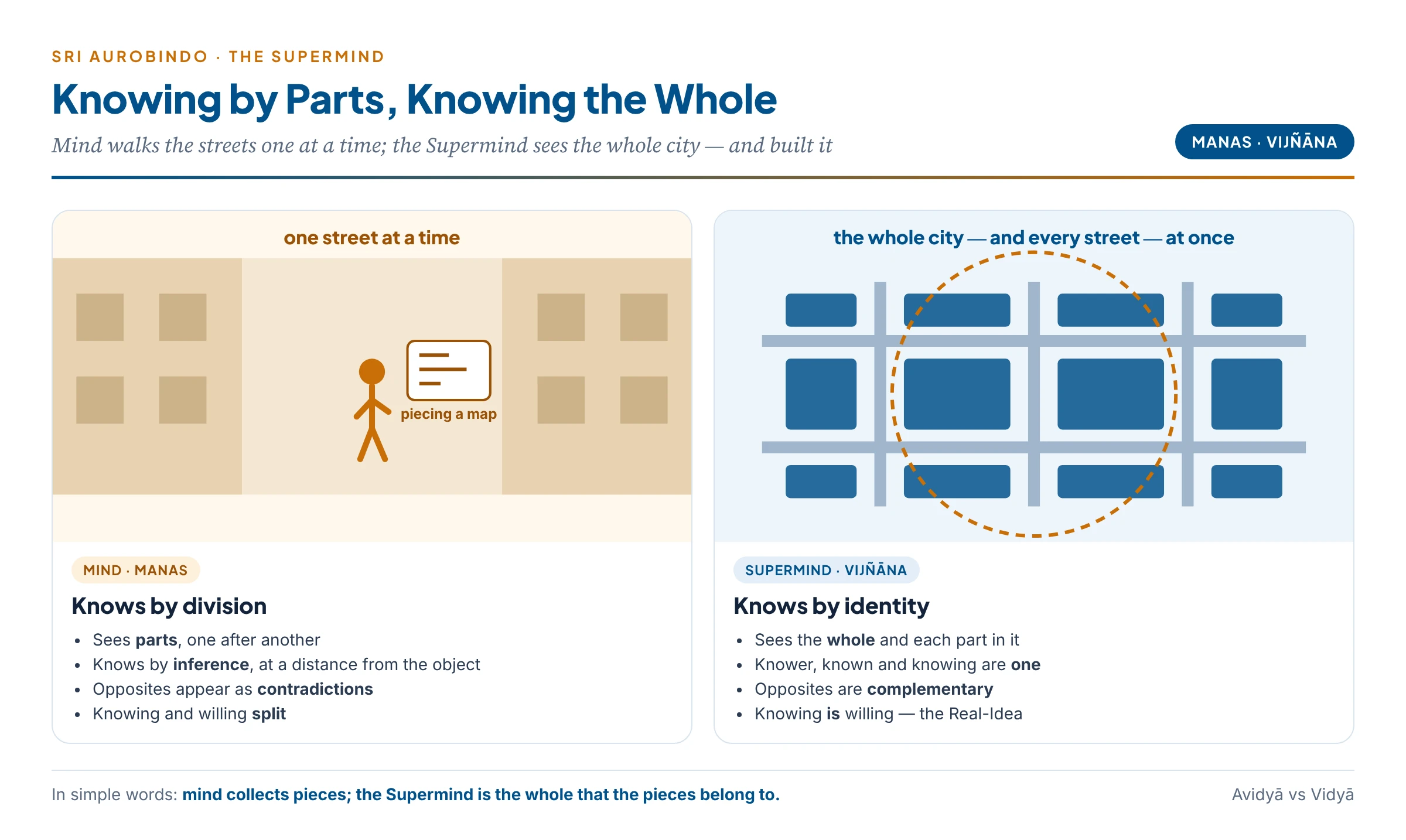
Imagine trying to understand a city by walking its streets: you see one lane at a time, and you have to piece together a map in your head. Now imagine seeing the whole city from a hill — every street, and how all of them connect, at once. Ordinary mind is the walker, knowing by pieces; the Supermind is the view from the hill, knowing the whole and every part together. And in the Supermind, the one who sees the city is also the one who built it.
Context & Problem
The Problem of the One and the Many
- The problem. If ultimate Reality is One, infinite and complete, how does a world of many finite, changing things arise from it? And if the world does arise, is the One divided or changed?
- Earlier answers.
- Śaṅkara — the many is mithyā, an appearance produced by Māyā; the One never really becomes the Many.
- Rāmānuja — souls and matter are real as the body of God, inseparable from him.
- Sāṃkhya — there is no One at all; Puruṣa and Prakṛti are two.
- Aurobindo’s answer. The One becomes the Many through its own consciousness: a creative Truth-Consciousness that holds unity and multiplicity together. That consciousness is the Supermind. With it, the world is neither an illusion nor a separate substance; it is the One’s real self-expression.
Roots in the Veda and the Upaniṣads
- Ṛta-cit — the Vedic Truth-Consciousness. The Vedic seers spoke of ṛtam, satyam, bṛhat — the Right, the True, the Vast — a cosmic order of truth beyond ordinary mind. Aurobindo identifies this with the Supermind.
- Vijñāna — the Upaniṣadic knowledge-self. In the Taittirīya ladder, above the mental sheath (manomaya) stands the vijñānamaya sheath — knowledge beyond mind — and above it bliss. Aurobindo reads vijñāna not as intellect but as supramental gnosis.
- The “gates of the Sun”. The Upaniṣads hint that one cannot pass the gates of the Sun (the symbol of the Supermind) and keep an earthly body. Aurobindo sees here the reason why earlier spirituality rose to the Truth but did not bring it down (see below).
Core Doctrine
What the Supermind Is
- The self-consciousness of Brahman. It is the Divine’s own knowledge of himself, which is at once his innate power of self-manifestation. Only the Divine can know himself in all his aspects; the Supermind is that knowledge.
- Absolute knowledge and power — Vidyā. It knows Reality and also the world-to-be; it never loses the unity with Saccidānanda.
- “Real-Idea”. An idea that is real — that carries in itself the power to become fact.
- “Truth-Consciousness”. A consciousness that does not grope for truth but is in possession of truth, because it is one with what it knows.
- The creative medium. In Aurobindo’s words, it is “conscious Reality throwing itself into mutable forms of its own imperishable and immutable substance”. Through the Supermind the Divine manifests as this world; with the Supermind, self-limitation and self-individualisation begin in Brahman.
- The first determinative expression of Saccidānanda. Sat, Cit and Ānanda are pure, undifferentiated Existence, Consciousness-Force and Delight. The Supermind is the first poise in which this undivided Reality expresses itself in forms, relations and worlds — without losing the truth of unity.
- Not mind, and not a separate reality. The name can mislead: the Supermind is not a bigger mind. It is a higher order of consciousness altogether. Nor is it a fourth entity added to Sat–Cit–Ānanda; it has no status of its own apart from them. It is their self-knowing, self-expressing poise.
The Real-Idea: Knowledge and Will as One
- In us, knowing and doing are split. We know what is good and fail to do it; we will something and lack the knowledge to achieve it. Knowledge and will are separate faculties, often at war.
- In the Supermind they are one. Its knowledge is effective: what it sees, it accomplishes; what it wills, it already knows. The Idea contains the dynamic power to realise itself in objective reality.
- The source of cosmic order. Through the Supermind the one Consciousness-Force is formulated as Knowledge and Will — the power that becomes the energy of creation. That is why the world has order and law: it is the expression of a Truth-Idea, not a chaos.
In simple words
A child wants to draw a horse and ends up with something like a dog: the idea and the hand do not agree. A master painter sees the horse in her mind and her hand draws it perfectly, as if the seeing itself were drawing. The Supermind is like that master, but perfectly: its seeing is already its doing.
Knowledge by Identity
- The highest kind of knowing. The Supermind knows by identity: the knower, the known and the act of knowing are one.
- Contrast with human knowledge. Human ignorance arises because the mind sees itself as separate from what it perceives. It must collect sense-data, form concepts and infer — always at a distance from the object.
- An everyday hint. We know our own existence not by observation or inference but by being it. The Supermind knows everything the way we know that we exist.
Supermind and Mind Compared
| Point | Mind (Manas) | Supermind (Vijñāna) |
|---|---|---|
| How it knows | By division, analysis, inference, comparison | Directly, integrally, by identity |
| What it sees | Parts, one after another | Wholes — and every part in the whole |
| Opposites | As contradictions (one or many, light or dark) | As complementary expressions of one truth |
| Knowledge and will | Separate, often in conflict | One — the Real-Idea |
| Relation to truth | Seeks truth; mixes truth with error | Possesses truth; no error |
| Relation to unity | Loses the sense of unity — the beginning of Avidyā | Never loses unity — Vidyā |
| Subject and object | Cannot work without subject–object duality | Knower and known are one |
| Role | Instrument of an evolving being in Ignorance | Creator of the world and goal of evolution |
The Triple Poise of the Supermind
The Supermind holds unity and multiplicity together in three poises, each a different balance of the One and the Many.
| Poise | What it holds | Picture |
|---|---|---|
| 1. Comprehending | Pure unity: all things held within one self-awareness; the Many exist only as the content of the One | The ocean holding all its waves within itself |
| 2. Apprehending | The One in each of the Many: the Divine present in every centre, aware of each as itself | The ocean present in every wave |
| 3. Projecting | The Many as individuals: each soul as a real centre, conscious of the One, delighting in its own play | Each wave rising as itself, yet knowing it is the ocean |
- Why it matters. These poises show how the Supermind contains unity, unity-in-difference and real individuality at once. They can be compared with the three great Vedānta schools: Advaita stresses the first poise, Viśiṣṭādvaita the second, Dvaita the third. The Supermind holds all three as true.
- The basis of individuality. Because of the third poise, the individual soul is not unreal; it is a real self of the Divine, which is why Aurobindo’s liberation does not dissolve the individual (Article 4).
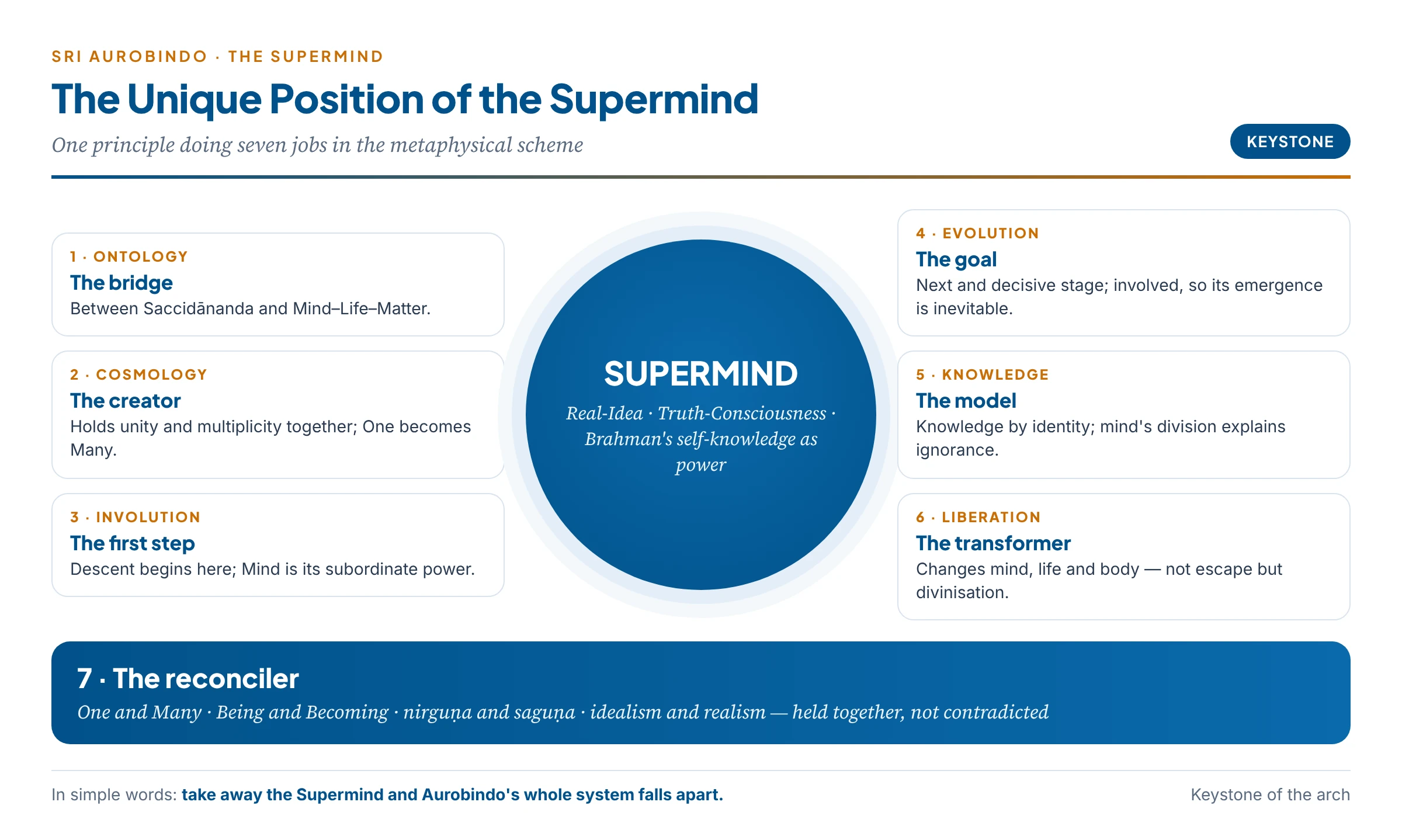
The Unique Position of the Supermind in the Metaphysical Scheme
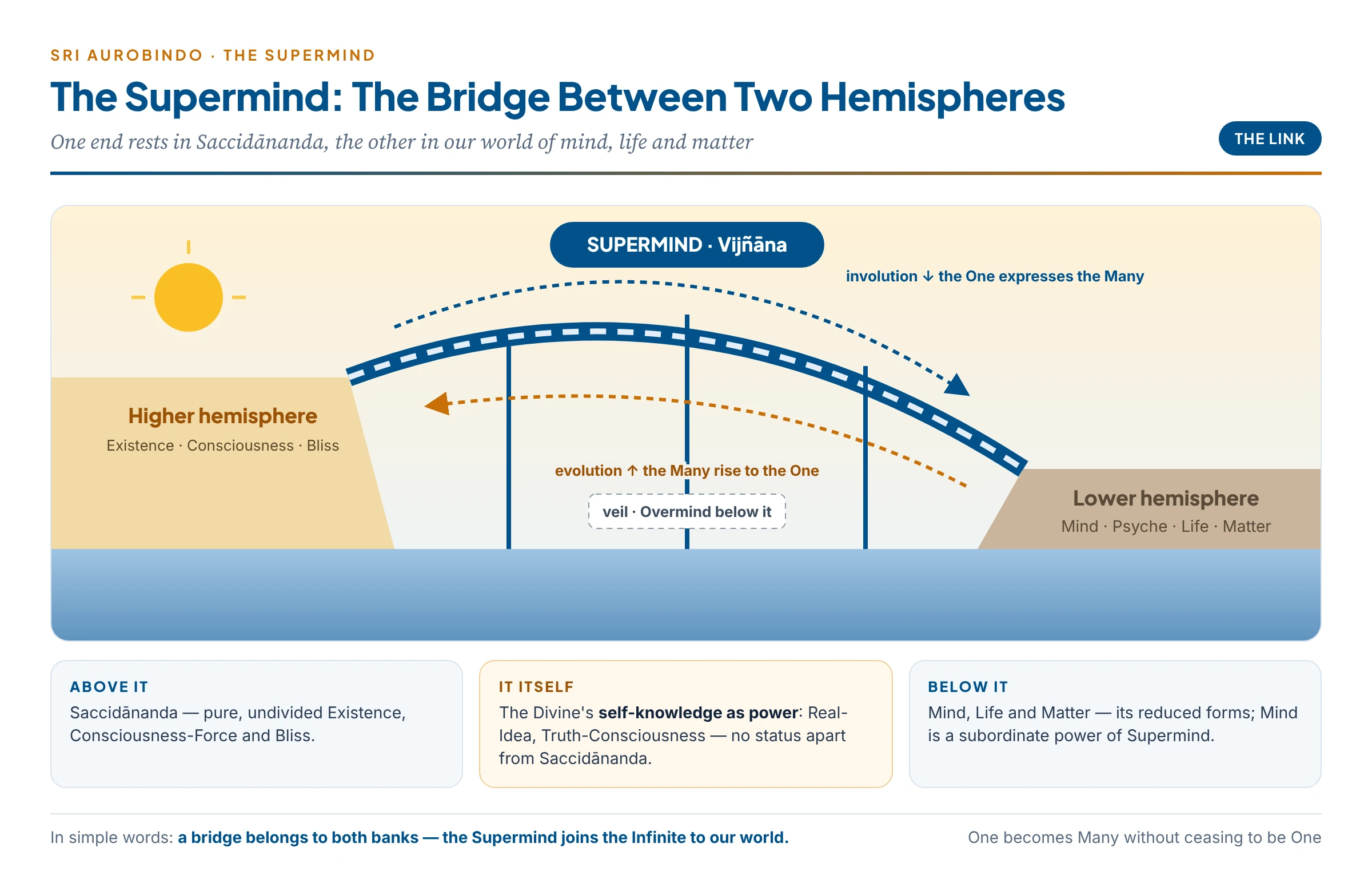
- Ontologically — the bridge. It stands between the higher hemisphere (Saccidānanda) and the lower hemisphere (Mind, Life, Matter). It connects the static, transcendent Brahman with the dynamic, evolving universe.
- Cosmologically — the creator. It is the creative power of the universe, the power that holds unity and multiplicity together. Through it the One becomes the Many without ceasing to be One.
- In involution — the first step. The descent of Spirit into Matter begins with the Supermind; Mind, Life and Matter are its progressively reduced forms (Mind is a subordinate power of Supermind).
- In evolution — the goal. The ascent from Matter is moving towards it; Supermind is the next and decisive stage of evolution.
- Epistemologically — integral knowledge. It is the model of perfect knowing; the difference between Supermind and mind explains human ignorance.
- Soteriologically — the transformer. Only the Supermind can transform not just the mind but life and body; liberation becomes transformation, not escape.
- Logically — the reconciler of opposites. One and Many, Being and Becoming, nirguṇa and saguṇa, idealism and realism are reconciled in its integral vision.
In simple words
A bridge belongs to both banks: one end rests on this shore, the other on that. The Supermind is such a bridge — one end in the infinite Saccidānanda, the other in our world of mind, life and matter. That is why it is “unique”: everything above it is pure Spirit, everything below it is Spirit veiled, and it is where the two meet.
The Ladder of Consciousness: From Mind to Supermind
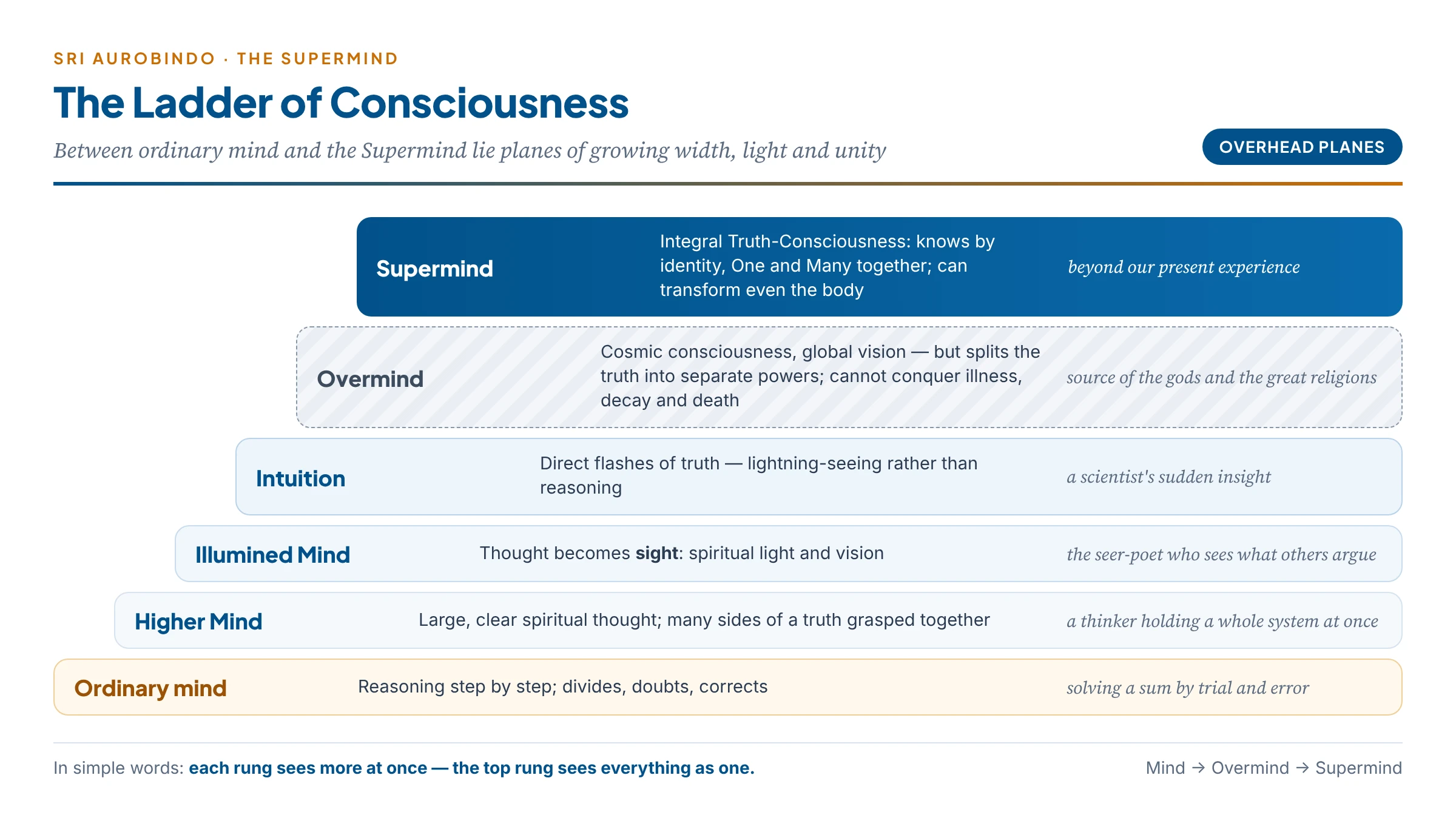
Between ordinary mind and the Supermind there are intermediate planes. Going upward, consciousness grows wider, more luminous and more unified.
| Level | Character | How it knows | Example |
|---|---|---|---|
| Ordinary mind | Reasoning, divided, slow | Step by step; doubt and correction | Solving a problem by trial and error |
| Higher Mind | Large, clear spiritual thought | Sees many sides of a truth together as one system of ideas | A thinker grasping a whole philosophy at a glance |
| Illumined Mind | Thought becomes sight | Spiritual light and vision; truth is seen, not argued | A poet or seer who sees what others reason out |
| Intuition | Direct flashes of truth | Truth-seeing in sudden lightning-flashes | A scientist’s sudden insight after long effort |
| Overmind | Cosmic consciousness; global vision | Sees the universe as a whole, but in many separate powers | The seer who perceives the gods as cosmic forces |
| Supermind | Integral Truth-Consciousness | Knowledge by identity; One and Many at once | — beyond our present experience |
- The Overmind — the delegate and the veil. The Overmind is the highest plane below the Supermind. It has a global view, but it divides the integral truth into separate, independent powers, each a truth in itself. The great gods of the Veda and the great religions draw their inspiration from this plane — which is why each religion is a real but partial truth. Aurobindo calls its creative power Overmind Māyā.
- What the Overmind can and cannot do. It can spiritualise mind and emotions and bring a cosmic consciousness, but it cannot radically transform the physical — it cannot abolish illness, decay and death. Only the direct descent of the Supermind can do that.
- The knot between hemispheres. The Overmind is the horizon or veil between the lower and higher hemispheres; beyond it lies the Supermind.
Why Mind Cannot Know the Infinite
- Mind divides by nature. It breaks the indivisible Reality into bits; it must divide and exclude; it cannot work without the subject–object duality.
- Partial knowledge only. Mind can know the Supreme in one or more aspects, but never completely and as a whole. Only the Supermind can do that.
“Mind cannot possess the Infinite, it can only suffer or be possessed by it; it can only lie blissfully helpless under the luminous shadow of the Real cast down on it from planes of existence beyond its reach.” — Sri Aurobindo
In simple words
You can fill a cup from the ocean, but you cannot pour the ocean into a cup. However many cups you fill, you have only cupfuls. Mind is the cup: it can hold aspects of the Infinite, one after another, but never the Infinite as a whole. To hold the ocean you must become the ocean — that is knowledge by identity, the way of the Supermind.
- Even intuition is coated by mind. Intuition brings brilliant messages from the Unknown — the beginning of higher knowledge — but in us a point of direct knowledge is immediately caught and coated over with mental stuff, so that what reaches us is mostly intellectual in form. Integral spiritual experience is the sole privilege of the Supermind.
- The great sages and individual salvation. Great sages have attained salvation; some have realised Brahman. But it has been individual salvation — freedom from the cycle of birth and death — and their realisation, though the highest yet, has been incomplete and partial, because their approach was through the mind or the Overmind.
Common confusion
Is the Supermind the same as intuition or the Overmind? No. Intuition and the Overmind are planes between mind and Supermind. They give flashes of truth or a cosmic view, but they still work by division and cannot transform the body. The Supermind alone is integral Truth-Consciousness, holding the One and the Many together and able to transform matter itself.
The Role of the Supermind in Evolution
- The hidden goal involved in Matter. Since the Supermind was the first term of involution, it is secretly present in Matter, Life and Mind. Evolution is possible because the Supermind has already involved the higher consciousness into matter.
- The pressure from within. The involved Supermind presses upward; consciousness in mind already feels an urge to exceed itself.
- The next step of evolution. Life has emerged from matter, mind from life; the next step must be the emergence of the Supermind. It is not only a metaphysical principle but an evolutionary destiny. Human mental consciousness is limited, unstable and divided; humanity is a transitional being.
- The supramental consciousness to come. In it:
- knowledge will be direct and integral;
- action will be spontaneous and harmonious;
- will will be aligned with the universal will;
- life will be an expression of delight rather than struggle.
- From evolution through Ignorance to evolution through Knowledge. Up to mind, evolution has proceeded through Ignorance. After the descent of the Supermind, it will proceed through Knowledge.
- The descent is a logical necessity. Because mind is not the last summit and the higher is already involved, the supramental descent is, for Aurobindo, a logical necessity that will herald a new era for mankind.
- Transformation of mind, life and body. With the descent of the Supermind, mind, life and matter will be radically transformed; their defects and mutability will vanish.
- The gnostic being. The being who realises the Supermind is the gnostic being. Unlike the traditional jīvanmukta who transcends the world, the gnostic being participates in its transformation, lives for collective evolution, acts from divine knowledge and will free of ego and conflict; ethical rules, mental reasoning and personal desire are replaced by the spontaneous truth of being (Article 4).
- Cosmic salvation here and now. The descent of the Supermind will bring cosmic salvation — in the Upaniṣadic words, ihaiva (here itself) and adhunaiva (now itself) — by transforming human life into the Life Divine.
Why Earlier Spirituality Did Not Bring the Supermind Down
- The Vedic seers rose but did not descend. In Aurobindo’s view the Vedic Ṛṣis tried to rise individually to the supramental plane, but did not bring it down and make it a permanent part of the earth-consciousness.
- The consequence — Māyāvāda. Because the highest truth was not brought down to transform the earth, the spiritual effort of India came to regard the world as unchangeable and finally as illusion; it culminated in Māyāvāda.
- Aurobindo’s life-task. The aim of his long sādhanā, and of the Mother’s, was to bring the Supermind down into mind, life and matter. In 1956, after his death, the Mother announced that the supramental had begun to manifest in the earth-atmosphere. Whether the full transformation will come, as one of his interpreters put it, time alone will answer.
Critical Evaluation
Objections
- Speculative and ad hoc. The Supermind seems introduced simply to bridge the One and the Many; it is hard to define and lacks logical proof.
- Unverifiable. It rests on mystical experience and visionary language; there is no public test of supramental consciousness.
- A self-undermining claim? If mind cannot know the Supermind, how can Aurobindo — writing in mental language — describe it at all?
- Not found in classical texts. The idea of a supramental descent transforming the body is new; the Upaniṣads speak rather of liberation from the body.
- An unclear status. Is the Supermind Brahman, Īśvara, or something between? Saying it has “no separate status” yet is a “link” can seem confusing.
- The unfulfilled prediction. The supramental transformation of the body has not visibly occurred.
Replies
- Not ad hoc but traditional. It develops the Vedic ṛta-cit and Upaniṣadic vijñāna, and plays the role every monism needs — a principle by which the One expresses the Many.
- Experience can be tested by practice. Like any spiritual claim, it is to be verified by following the discipline; Aurobindo describes intermediate planes (higher mind, illumined mind, intuition) that many seekers recognise.
- Language points beyond itself. Mind cannot possess the Supermind but can indicate it, as a map indicates a country. Aurobindo explicitly calls his descriptions inadequate.
- The status is clear in function. The Supermind is Saccidānanda in its self-knowing, self-manifesting poise — closer to Īśvara as active, conscious creator than to a separate entity.
- On prediction. Aurobindo spoke of evolutionary, not calendar, time; life took ages to emerge from matter.
Critics and Defenders
Criticism — Critics
- Ad hoc: a bridge invented to join the One and the Many.
- Unverifiable: rests on mystical experience alone.
- Self-undermining: mind describing what mind cannot know.
- Unorthodox: bodily transformation is foreign to the Upaniṣads.
- Unfulfilled: the promised descent is not visible.
Defence — Defenders and strengths
- Vedic roots: ṛta-cit, ṛtam satyam bṛhat, vijñāna.
- Solves One and Many without calling the world illusion.
- Explains ignorance: mind’s division vs Supermind’s unity.
- Open to practice: the intermediate planes are experienced by seekers.
- Evolutionary time: ages separated matter from life and life from mind.
Cross-Tradition Comparison
Indian Parallels
| Concept | Similarity to the Supermind | Difference |
|---|---|---|
| Vedic ṛta-cit (truth-consciousness; ṛtam satyam bṛhat) | Cosmic order of truth beyond mind | In the Veda it is a goal of the seer; for Aurobindo it is also the creator of the world and the next stage of evolution |
| Upaniṣadic vijñāna | Knowledge above mind (vijñānamaya above manomaya) | Usually read as intellect or a sheath to be transcended; Aurobindo reads it as supramental gnosis to be brought down |
| Īśvara (Advaita) | Brahman as conscious creator and ruler | For Śaṅkara, Īśvara belongs to the empirical order (Māyā); the Supermind is real and ultimate |
| Śakti (Tantra) | Consciousness as creative power | The Supermind adds truth-knowledge and a cosmic evolutionary role |
Indian Connect — The Supermind and the Vedānta schools
The three poises of the Supermind — comprehending, apprehending, projecting — can be read as giving each Vedānta school its due: pure unity (Śaṅkara), the One indwelling the many (Rāmānuja), and real individuals (Madhva). Aurobindo’s claim is not that one school is right and the others wrong, but that the Supermind holds all three truths at once.
Western Parallels
| Thinker | Similarity | Difference |
|---|---|---|
| Plato’s Forms | Eternal Ideas behind the world’s order | Plato’s Forms are static patterns; the Supermind is a Real-Idea that creates and enters its creation |
| Plotinus (One → Intellect → Soul → matter) | A divine Intellect (Nous) between the One and the world; the world as emanation | Plotinus’ emanation is a one-way fall away from the One; Aurobindo adds evolution — the return upward and transformation of matter |
| Kant’s intuitive intellect | An intellect whose knowing creates its object | Kant says humans can never have it; Aurobindo says humanity can evolve into it |
| Spinoza’s intuitive knowledge | Knowledge of things in God, seeing the whole | Spinoza’s is a rational vision; the Supermind is a power that acts and transforms |
| Hegel’s Absolute Idea | An Idea that realises itself in nature and history | Hegel’s Idea develops through dialectical contradiction; the Supermind holds opposites together without contradiction |
Synthesis (Siddhānta)
- The Supermind answers the problem of the One and the Many. It is the Divine’s self-knowledge as power — a Real-Idea and Truth-Consciousness — through which the One becomes the Many without loss of unity.
- Its position is unique. It stands at the border of the two hemispheres: the first term of involution, the goal of evolution, the creator of the world, the model of integral knowledge and the agent of transformation.
- It explains ignorance and points beyond it. Mind divides and so cannot possess the Infinite; the ladder of Higher Mind, Illumined Mind, Intuition and Overmind leads towards the Supermind.
- It changes the meaning of liberation. Not escape through the gates of the Sun, but the descent of the Truth to transform life on earth — collectively, here and now.
- Contemporary relevance.
- Beyond analytic reason. Aurobindo’s critique of divisive thinking echoes modern calls for holistic, systems thinking that sees wholes and relations, not just parts.
- Unity of knowledge and action. The Real-Idea, where knowing and doing are one, is an ideal for integrity in personal and public life.
- Pluralism. If every religion springs from a partial, Overmind truth, interfaith respect is grounded in the structure of consciousness itself.
“What is magic to our finite reason is the logic of the Infinite.” — Sri Aurobindo
Previous Year Questions
- 2023Explain the nature and role of Supermind in evolution as per Aurobindo’s philosophy.
- 2019Explain the unique position of the Supermind in the metaphysical scheme of Aurobindo’s philosophy.
- 2000Sri Aurobindo on the Supermind (short note).