

Aurobindo: Evolution, Involution; Integral Yoga.
Official Syllabus: Paper I, Section B, Unit 20
Involution and evolution are the two halves of Sri Aurobindo’s account of the world. Involution is the descent of the Divine — Saccidānanda — step by step through Supermind, Mind and Life into apparently dead Matter, where it lies hidden. Evolution is the ascent by which what was hidden comes out again: Life emerges from Matter, Mind from Life, and — Aurobindo holds — Supermind will emerge from Mind. The key law is simple: nothing can evolve that was not first involved. Evolution is possible only because involution has already taken place. This article explains the sevenfold (or eightfold) chain of being and its two hemispheres, the stages of descent, why involution is the precondition of evolution, the stages and the triple process of the ascent, the individual side of evolution, how involution and evolution are related, and how Aurobindo’s view differs from Darwin, Bergson, Hegel, Aristotle and Sāṃkhya-Yoga.
In simple words
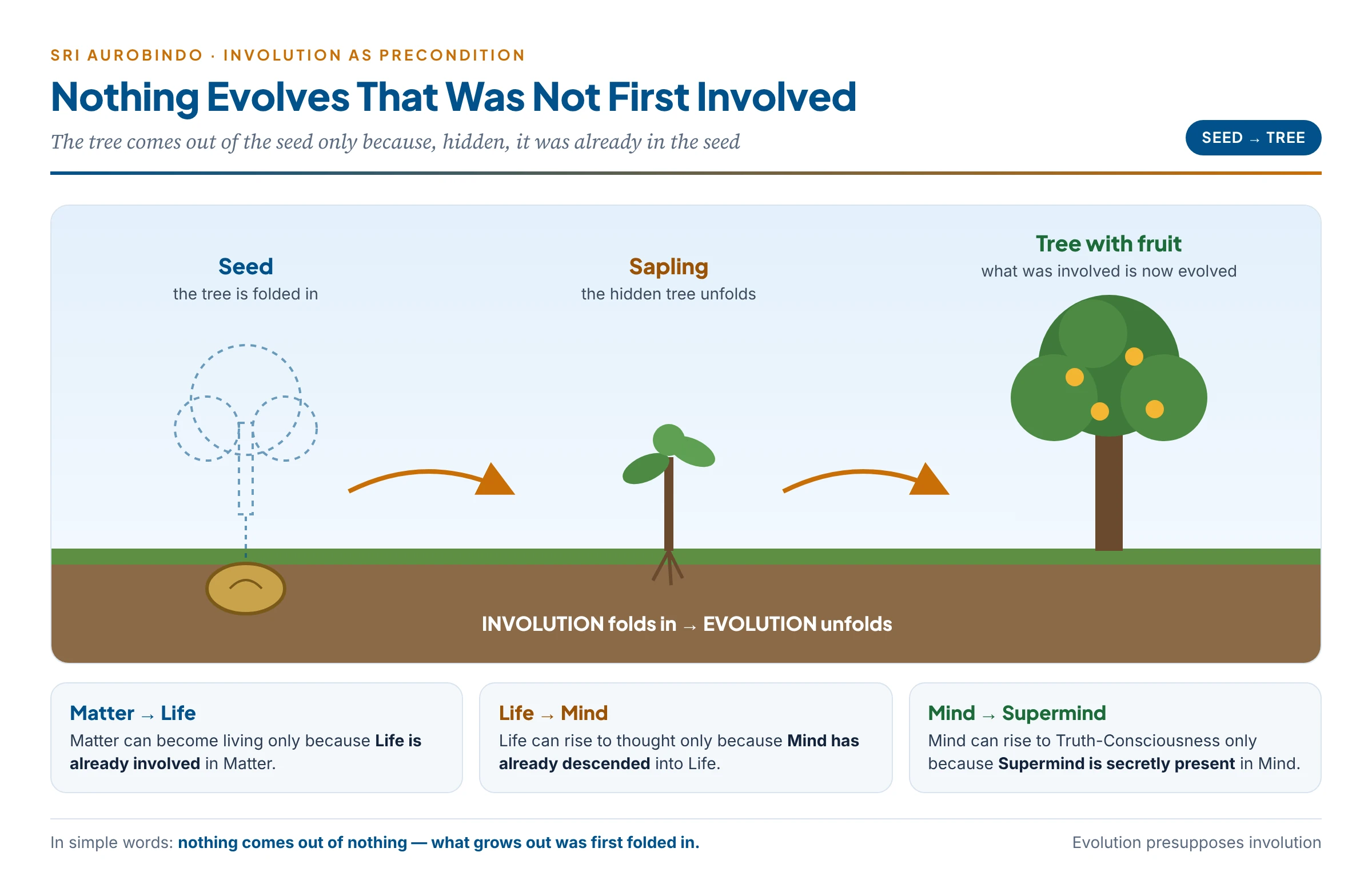
A mango seed is small, hard and seems lifeless. Yet a whole mango tree grows out of it — roots, trunk, leaves, fruit. The tree could come out only because, in some hidden way, it was already in the seed. Aurobindo applies this to the universe: Life, Mind and Spirit grow out of Matter only because they were folded into Matter at the start. The folding-in is involution; the unfolding is evolution.
Context & Problem
The Riddle of Emergence
- The facts. The universe began, as far as we know, as matter and energy without life. Then life appeared; then animals with feeling; then human beings with reflective mind.
- The puzzle. How can the higher come out of the lower? How can consciousness arise from what is unconscious, or thought from chemistry?
- Three possible answers.
- Materialism — the higher is nothing but a complicated arrangement of the lower. Aurobindo replies that this explains away what it should explain.
- Pure novelty — the higher simply appears out of nowhere. This breaks the principle that nothing comes out of nothing.
- Aurobindo’s answer — the higher was already present in the lower in a hidden, involved form. Emergence is unveiling.
- Darwin describes, but does not explain. Aurobindo accepts that evolution has happened. But Darwinism describes how matter became life and life became more complex; it does not explain why life arose at all. For Aurobindo, life was already present in matter, because all existence is a manifestation of Brahman, and Nature — which he regards as divine — evolves life out of matter and mind out of life with a purpose.
Where the Doctrine Comes From
- Spirit must descend if Matter is to ascend. Article 1 showed that Matter and Spirit are two ends of one Reality, joined by a ladder of intermediate terms. If Matter is to climb to Spirit, Spirit must already have come down into Matter.
- Ancient roots. The Taittirīya Upaniṣad ladder (matter, life, mind, knowledge, bliss) and the Sāṃkhya idea that the effect pre-exists in the cause both point the same way. In Sāṃkhya, production is manifestation (āvirbhāva) and destruction is envelopment (tirobhāva) — the very words “evolution” and “involution” in an older sense.
- Modern stimulus. Aurobindo read the evolutionary thinkers of his time — Darwin, Bergson, Hegel’s philosophy of development — and gave their idea of progress a spiritual foundation.
Core Doctrine
Creation as a Double Movement
- First, descent (involution). Saccidānanda, through the Supermind, descends into Mind, Life and Matter. This is the result of the self-concealment of the Divine.
- Then, ascent (evolution). The worldly forms rise back towards their original, higher status — what Aurobindo calls “the Spirit’s return to itself”.
- One process. The descent and the ascent are two phases of one world-process; the eight levels of being take part in both.
The Chain of Being and the Two Hemispheres
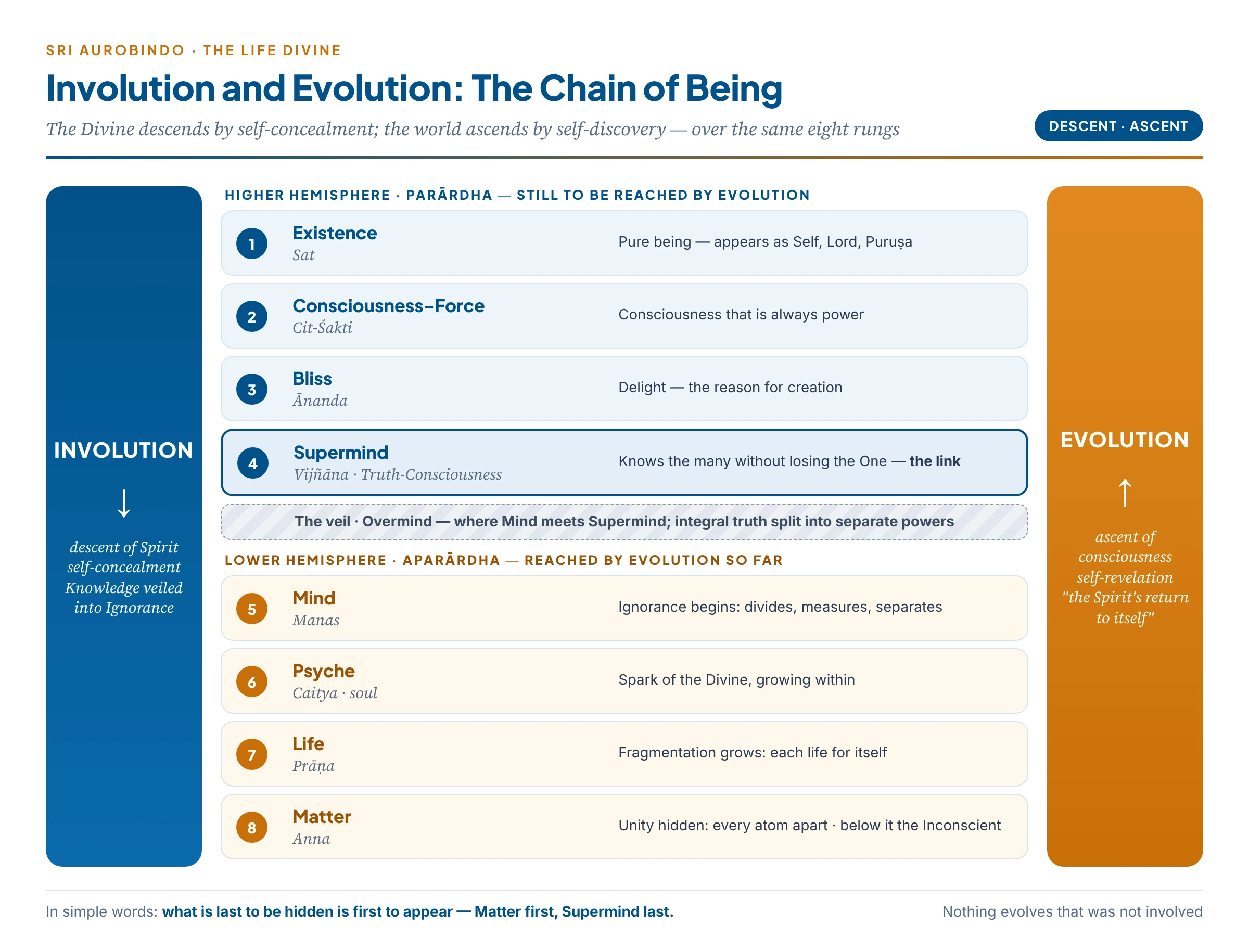
Reality is essentially one, but creation shows it at different levels — the cords or principles of being. Aurobindo speaks of a sevenfold chord; when the Psyche (soul-principle) is counted separately, there are eight principles.
| Level | Principle | Sanskrit | Hemisphere |
|---|---|---|---|
| 1 | Existence | Sat | Higher (parārdha) |
| 2 | Consciousness-Force | Cit-Tapas / Cit-Śakti | Higher |
| 3 | Bliss | Ānanda | Higher |
| 4 | Supermind (Truth-Consciousness) | Vijñāna | Higher — the link |
| 5 | Mind | Manas | Lower (aparārdha) |
| 6 | Psyche (soul) | Caitya | Lower |
| 7 | Life | Prāṇa | Lower |
| 8 | Matter | Anna | Lower |
- The higher hemisphere (the first four) shows the stages evolution is going to enter. The lower hemisphere (the last four) shows the stages evolution has so far reached.
- Not opposites — correspondences. Each lower term is a reduced form of a higher one:
- Mind is a subordinate power of Supermind.
- Life is a subordinate power of the energy of Consciousness-Force.
- Matter is the form of substance that Existence takes when it submits to the action of its own consciousness and force.
- The Psyche in us is a spark of the divine Bliss and of the true Self.
- Supermind is not a fourth reality. It has no status separate from Existence, Consciousness-Force and Bliss; it is their self-knowledge and self-expression. That is why Reality is best named by the triune principle — Saccidānanda.
- The knot between the hemispheres. Where Mind meets Supermind there is a veil; the region just below the Supermind, the Overmind, works as a horizon that divides the integral truth into separate powers (Article 3).
- In Aurobindo’s own summary: the Divine descends from pure Existence through the play of Consciousness-Force and Bliss and the creative medium of Supermind into cosmic being; we ascend from Matter through a developing life, soul and mind and the illuminating medium of Supermind towards the divine being.
Involution: The Stages of Descent
- Supermind — knowledge without loss of unity. The Supermind is absolute knowledge and power — Vidyā. It knows Reality and the world-to-be, and never loses the essential unity with Saccidānanda. Through it the one Consciousness-Force is formulated as Knowledge and Will, the power that will become the source of creation.
- Mind — where ignorance begins. In Mind the knowledge of unity is lost. Mind is Avidyā, “the immediate manifestor of the world in which we live”: it divides, measures and separates.
- Life — fragmentation grows. In Life the tendency to multiplicity and fragmentation becomes prominent: each living being struggles for itself.
- Matter — unity completely hidden. In Matter each atom is separate from every other; fragmentation is complete and unity seems lost.
- The Inconscient — the last term. Below even the dim sentience of matter lies a stage where sentience itself is absent: the Inconscient, the complete self-loss of the Spirit. The universe begins from here, as apparently unconscious material existence, through the Spirit’s own willed self-absorption.
- An ideal process. All this happens “behind the screen”, as it were: involution is not a series of events we can observe in time but the inner logic of how the Infinite gives rise to a world.
- Ignorance is not the absence of knowledge. It is knowledge hiding itself and appearing as something else. Even in ignorance some element of knowledge remains; that hidden knowledge is what will later re-emerge.
- Creation is the plunge of the Spirit into Ignorance. This is why the world we see is a mixture of light and darkness, truth and falsehood.
Indian Connect — The Upaniṣadic ladder read downwards
The Taittirīya Upaniṣad describes the self as five sheaths — annamaya (matter), prāṇamaya (life), manomaya (mind), vijñānamaya (knowledge) and ānandamaya (bliss). Read from the top downwards it is a picture of involution; read from the bottom upwards it is the path of evolution. Aurobindo’s chain of being is a dynamic, cosmic version of this ancient map.
Involution as the Precondition of Evolution
Aurobindo’s central law: evolution presupposes involution; evolution is possible only because involution has already taken place.
The argument:
- Nothing can come out of nothing; whatever emerges must have been present in some form beforehand.
- In the world, Life emerges from Matter, and Mind from Life.
- So Life must already be present in Matter, and Mind in Life — hidden, compressed, involved.
- The presence of the higher in the lower is not an accident; it is the result of the higher descending into the lower.
- Therefore the ascent of the lower (evolution) depends on a prior descent of the higher (involution).
- The steps of the reasoning.
- Matter can evolve into Life only because Life is already involved in Matter.
- Life can ascend to Mind only because Mind has already descended into Life.
- Mind can rise to Supermind only because Supermind is already secretly present in Mind.
- The whole lower hemisphere can rise to the higher only because the higher is already in the lower.
- Involution answers the question of creation. For Aurobindo, the creation of the world is involution; evolution is creation’s fulfilment.
In simple words
A spring that has been pressed down will jump up when released, but only because energy was stored in it when it was pressed. You cannot get a jump out of a spring that was never pressed. Involution is the pressing down of the Spirit into Matter; evolution is the spring rising again with all the energy that was stored in it.
The Role of Involution in the World-Process
- It explains emergence. Life, mind and spirit do not appear from nowhere; they unfold what was folded in.
- It gives evolution a direction. Since the highest was involved first, evolution has a goal: to recover the highest. The process is teleological, not blind.
- It makes further evolution inevitable. If Supermind is already involved in Mind, its emergence is not a lucky chance but a necessity waiting to happen.
- It makes the world real. The world is not an illusion laid over Brahman; it is Brahman really becoming Matter, Life and Mind.
- It explains ignorance and suffering. Darkness, division and pain belong to the stage of concealment; they are not the final truth of things.
- It unites Matter and Spirit. Matter is Spirit involved; Spirit is Matter evolved — the two negations of Article 1 are overcome.
- It gives meaning to human effort. We are not accidents in a dead universe but the place where the hidden Spirit is becoming conscious of itself.
Common confusion
Is involution a stage that comes after evolution — a falling back? No. Involution comes first. It is the descent of the Divine that makes the world possible; evolution is the ascent that follows. Some readers also confuse it with Sāṃkhya’s pralaya (dissolution of the world into Prakṛti). Aurobindo’s involution is not dissolution but the Divine’s self-concealment in creation, the condition of all later growth.
Why Would the Divine Hide Itself?
- For delight (līlā). The descent is not a fall or a punishment. Saccidānanda limits itself out of sheer joy, to have the delight of rediscovering itself in a world of many forms.
- For a richer manifestation. A truth that is lost and found again is possessed more fully than one never lost. The Divine wants to manifest itself not only as eternal perfection but as growth into perfection.
- The game of hide-and-seek. The Spirit hides in Matter and seeks itself through Life and Mind; evolution is that search, and its end is the finding.
Evolution: The Spirit’s Return to Itself
- Definition. Evolution is an ascent from a less manifest condition of the Consciousness-Force to a more manifest condition, and an integration of the higher with the lower.
“All evolution is in essence a heightening of the force of consciousness in the manifest being so that it may be raised into the greater intensity of that which is still unmanifest, from matter into life, from life into mind, from the mind into the spirit.” — Sri Aurobindo
- Matter comes first. Matter, where spirit is asleep or apparently lost, is the last term of involution and therefore the first to appear in the space-time world.
- A call from below and a response from above. The dormant spirit in matter feels an urge to rise to life; there is a call from below and a response from above, and life emerges.
- Each emergence transforms what lies below.
- With the emergence of Life, matter undergoes a considerable change — it becomes living, organised, self-reproducing.
- Then the dormant spirit in life feels an urge for Mind; with the response from above, mind emerges, bringing a great change in life and matter.
- Bound to what came before. Evolution has passed through Matter, Life, Psyche and Mind. Life evolves in Matter and so is matter-bound; Mind evolves in Life and so is both matter-bound and life-bound.
- So far, through Ignorance. Evolution up to the mental plane has proceeded through Ignorance — by struggle, trial and error, partial knowledge.
- Next, through Knowledge. Consciousness in mind is itself feeling an urge to evolve into Supermind. After the descent of the Supermind, evolution will proceed through Knowledge, and the supramental being — the gnostic being — will appear (Articles 3–4). For Aurobindo this is the next and final stage of evolution, not yet accomplished.
In simple words
Think of a dimmer switch on a lamp. The bulb is the same throughout, but as you turn the knob, the light grows from a faint glow to full brightness. Evolution is the turning of that knob: the same Consciousness-Force, faint in a stone, brighter in a plant, brighter still in an animal, brighter again in a human mind — and, Aurobindo says, not yet at full brightness.
The Triple Process: Widening, Heightening, Integration
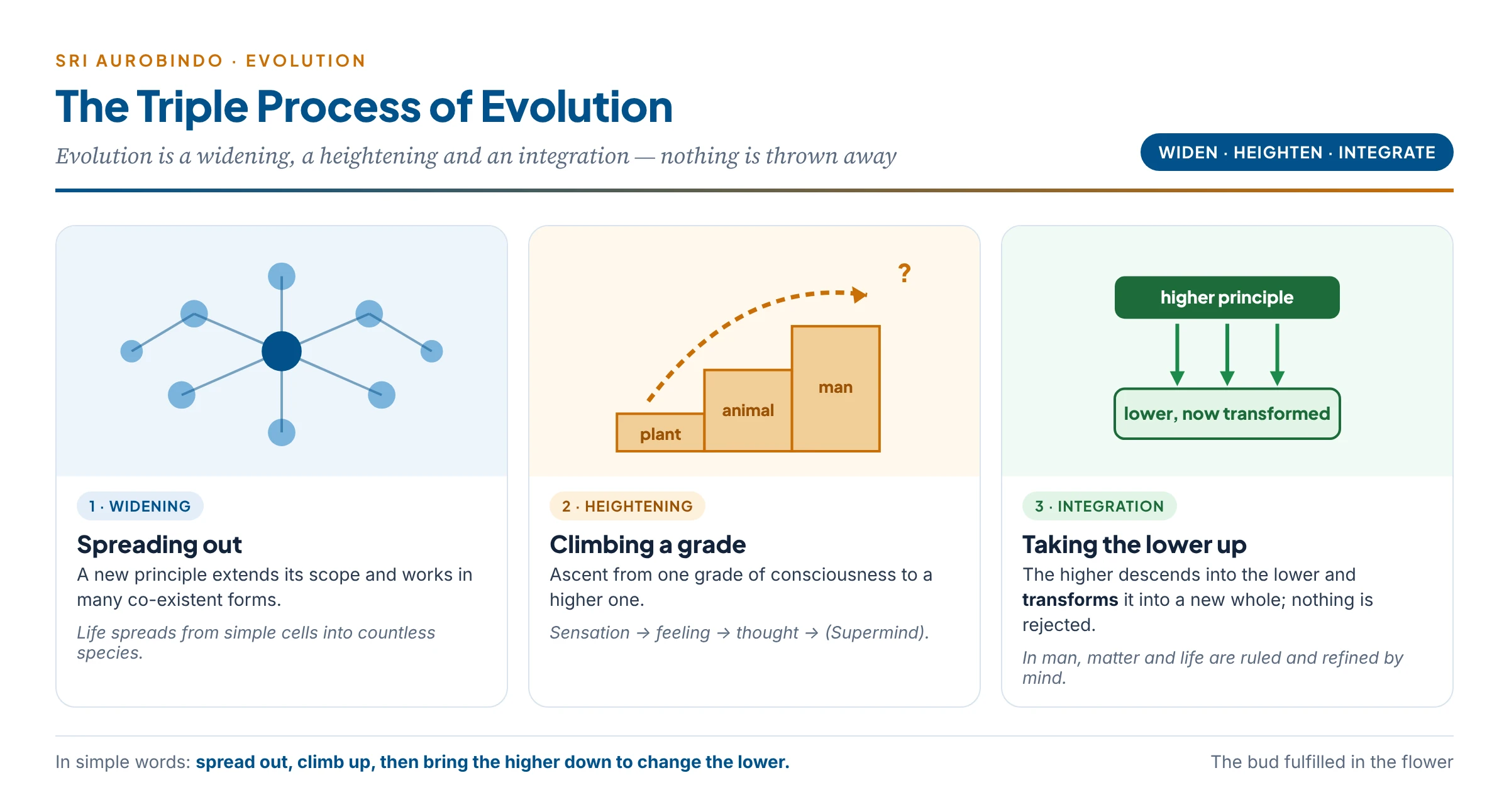
Evolution, as Aurobindo’s interpreters summarise it, is “a widening, a heightening and an integration”.
| Process | Meaning | Example |
|---|---|---|
| Widening | Extension of scope; a new principle spreads and finds room to work in many forms; co-existent forms are incorporated | Life spreads from simple cells to countless species filling every corner of the earth |
| Heightening | Ascent from one grade of consciousness to a higher grade | From plant to animal to man — from sensation to feeling to thought |
| Integration | Nothing is rejected; the higher principle descends into the lower and transforms it, taking it up into a new whole | In a human being, matter and life are not abandoned but organised and governed by mind; the body becomes the instrument of thought |
- Integration is the distinctive mark. Earlier views of spiritual progress climb away from the lower. Aurobindo’s evolution climbs and then brings the higher down into the lower to change it. When Supermind emerges, it will transform mind, life and even the body.
- Nothing is wasted. Every stage is kept and fulfilled in the next, as the bud is fulfilled — not destroyed — in the flower.
Cosmic and Individual Evolution
- Not a cold, external description. Aurobindo does not look at evolution as a detached scientist. We are ourselves involved in it, and the next stage will take us into the spiritual realm.
- We can hasten it. By our own effort we reached the mental stage; by our own effort we can strive to transform the mental into the supramental. Evolution is inevitable, but conscious effort expedites it — and this conscious effort is Yoga (Article 5).
- Evolution is as much individual as cosmic. The individual is the medium through which the Spirit reveals itself. The ascent of the individual does not merely symbolise the cosmic ascent; it helps and speeds it. This attention to individual evolution is one of the distinctive features of his theory.
In simple words
A river will reach the sea anyway; that is the slope of the land. But a boat rowed downstream gets there far sooner. Cosmic evolution is the river: it will reach Supermind because Supermind is already involved in it. Yoga is the rowing: the individual who works consciously with the current speeds the whole journey.
- Man is a transitional being. Human beings are not the summit of evolution but a middle term between the animal and the divine.
“Man is a transitional being; he is not final.” — Sri Aurobindo
- Nature’s laboratory. In The Life Divine, Aurobindo suggests that just as the animal was a living laboratory in which Nature worked out man, so man himself may be a thinking and living laboratory in whom, and with whose conscious co-operation, Nature wills to work out the superman, the god.
- The social side. Evolution also works through societies: Nature is slow and patient; civilisations rise and fall, but each is a step towards a deeper unity of mankind, which Aurobindo saw as part of Nature’s own scheme.
How Involution and Evolution Are Related
| Point | Involution | Evolution |
|---|---|---|
| Direction | Descent — from Spirit to Matter | Ascent — from Matter to Spirit |
| Movement | Self-concealment, self-limitation of the Divine | Self-revelation, self-discovery of the Divine |
| Order | Comes first; the precondition | Comes second; the fulfilment |
| Medium | Through Ignorance — knowledge hiding itself | So far through Ignorance; next through Knowledge |
| Order of terms | Supermind → Mind → Life → Matter → Inconscient | Matter → Life → Psyche → Mind → Supermind |
| What it gives | Makes evolution possible | Makes involution meaningful |
| Agent | The one Consciousness-Force (Cit-Śakti) | The same Consciousness-Force |
| Reason | Delight (Ānanda, Līlā) | Delight — of rediscovery and manifestation |
- Two sides of one coin. Involution without evolution would be a pointless loss; evolution without involution would be impossible. Each completes the other.
- The same chain travelled twice. The terms are the same; only the direction changes. What is last in involution (Matter) is first in evolution, and what was first to be veiled (Supermind) is last to be unveiled.
Critical Evaluation
Objections
- Unscientific and vague. Biology explains life’s development by natural selection, mutation and chemistry. “Hidden consciousness” in matter adds nothing testable; it looks symbolic, not demonstrable.
- Teleology rejected by modern science. Since Darwin, science has explained apparent purpose without a goal. Aurobindo reintroduces final causes that science gave up.
- Involution cannot be observed. By his own account it is an “ideal process behind the screen”. A process that leaves no trace cannot be checked.
- Denial of real novelty. Emergent evolutionists hold that genuinely new qualities appear when matter is organised in new ways. If everything was already involved, nothing is really new.
- The problem of evil. Why would a perfect, blissful Being plunge into ignorance, suffering and death? Calling it “play” seems to trivialise real pain.
- Unfalsifiable prediction. The emergence of Supermind is announced as inevitable, but no date or test is given; failure can always be explained away.
Replies and Strengths
- Different questions. Science asks how forms change; Aurobindo asks why there is a rising series at all and what it is moving towards. The two can coexist — he accepts the facts of evolution.
- Purpose is not foreign to evolution. The actual history of the universe does show a rising curve — matter, life, mind. Aurobindo’s teleology interprets this observed direction instead of explaining it away.
- Novelty is preserved at the level of manifestation. Life is genuinely new as manifest; what pre-exists is only its hidden possibility, as the oak is new though it was in the acorn.
- The logic of involution is sound. “Nothing out of nothing” is one of the oldest and strongest principles of reason; Sāṃkhya’s satkāryavāda rests on the same insight.
- On evil. Suffering belongs to the stage of division and ignorance; the very direction of evolution is towards its removal. The play is not frivolous: its aim is a fuller, conscious delight in which pain is overcome.
- Strengths. The theory gives meaning to the cosmic story, joins science and spirituality, makes the world and the body valuable, and gives human effort a cosmic role.
Critics and Defenders
Criticism — Critics
- Scientists: hidden consciousness and cosmic purpose cannot be tested.
- Emergentists: if all was involved beforehand, nothing is genuinely new.
- Empiricists: involution is unobservable — an ideal process behind the screen.
- Moral critics: why should perfect Bliss plunge into suffering?
Defence — Defenders and strengths
- Answers the why, which science leaves open; accepts the facts of evolution.
- “Nothing out of nothing”: the oldest principle of reason supports involution.
- New in manifestation, though present as possibility — like the oak in the acorn.
- Evil belongs to the stage of concealment, not to the goal.
Cross-Tradition Comparison
Aurobindo, Darwin and Bergson
| Point | Darwin | Bergson (élan vital) | Sri Aurobindo |
|---|---|---|---|
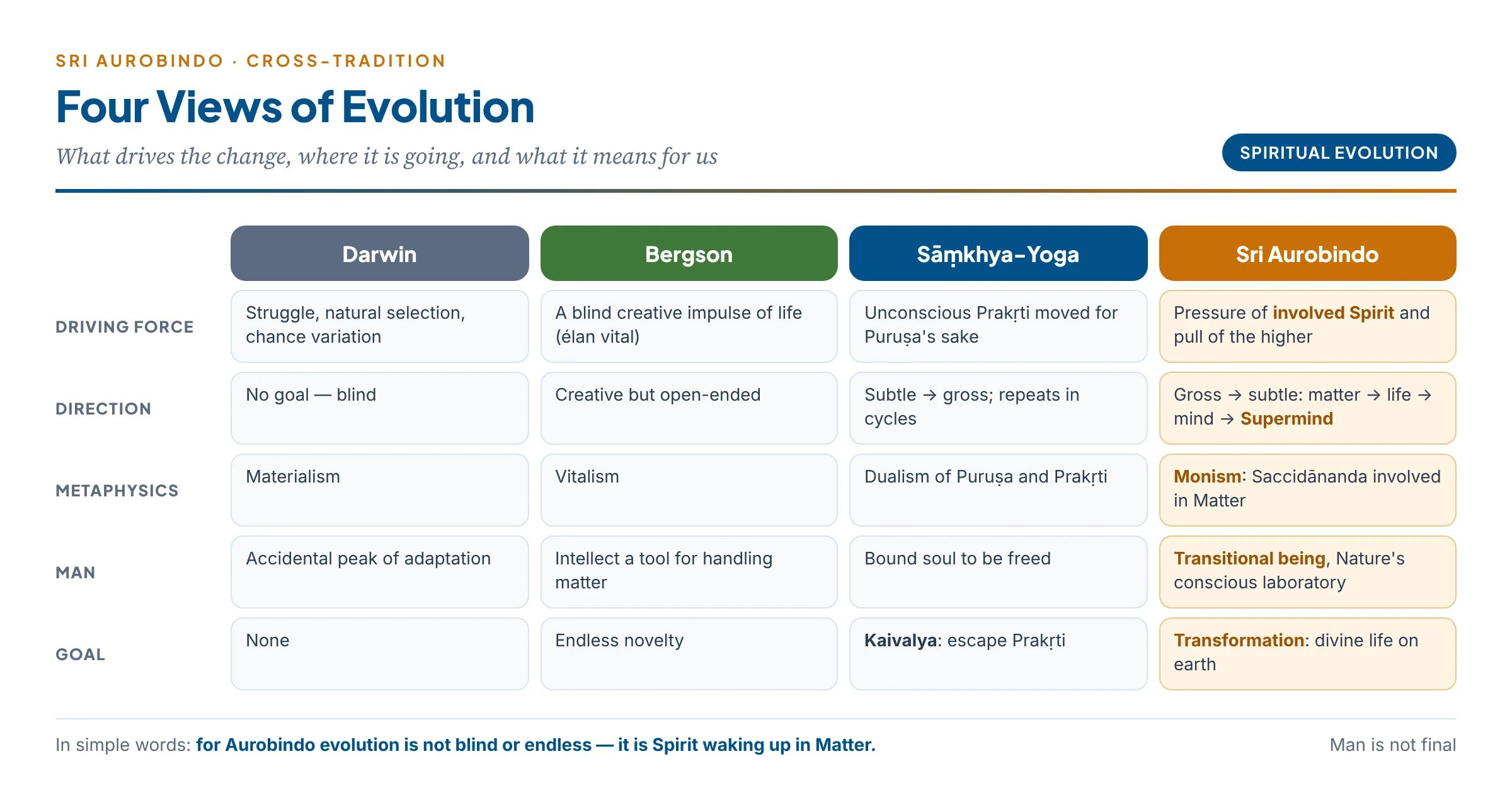
| Driving force | Struggle for existence, natural selection, chance variation | A creative vital impulse pushing life forward | The pressure of involved Spirit from within, and the pull of the higher from above |
| Nature of the movement | Blind, mechanical, without design | Creative and open, but without a fixed goal | Purposeful, conscious, guided by Supermind |
| Place of the human mind | An accidental peak of animal adaptation | Intellect is a practical tool for handling matter | Man is a transitional being, between animal and divine |
| Future | Unpredictable drift or extinction | Endless creative novelty | Ascent to Supermind and divine life on earth |
| Level explained | Biological forms only | Life and its creativity | Matter, life, mind and spirit — the whole of existence |
Hegel, Aristotle and Teilhard de Chardin
| Thinker | Similarity | Difference |
|---|---|---|
| Hegel | The Absolute unfolds itself; reality is development towards self-consciousness | Hegel’s unfolding is dialectical (thesis–antithesis–synthesis) and rational; Aurobindo’s is a spiritual ascent of consciousness, ending in a supramental, not a rational, summit |
| Aristotle | Potentiality becomes actuality; nature has final causes; the acorn strives to become the oak | Aristotle’s potentialities are fixed within each species and the world is eternal; Aurobindo’s is a cosmic evolution in which new grades of consciousness emerge |
| Teilhard de Chardin | Evolution of consciousness through a “noosphere” towards an Omega Point | Teilhard works within Christian theology; Aurobindo grounds the ascent in prior involution and points to Supermind and the divinisation of matter |
Aurobindo and Sāṃkhya-Yoga: How His Evolution Differs from Traditional Yoga Philosophy
| Point | Sāṃkhya-Yoga | Sri Aurobindo |
|---|---|---|
| What evolves | Prakṛti — unconscious matter-energy of three guṇas | Consciousness-Force — Spirit hidden in matter |
| Metaphysics | Dualism — Puruṣa and Prakṛti, both eternal and separate | Monism — Prakṛti is the Śakti of the one Saccidānanda |
| Prior descent | No involution of Spirit; Puruṣa never enters Prakṛti | Involution of Spirit is the precondition of evolution |
| Order | From subtle to gross: mahat, ahaṅkāra, manas, senses, elements | From gross to subtle: matter, life, mind, Supermind |
| Purpose | Unconscious teleology — Prakṛti evolves for Puruṣa’s experience and release | Conscious teleology — the Divine’s self-manifestation in delight |
| Future stage | None; evolution repeats in cycles of creation and dissolution | A new stage beyond mind — Supermind — is yet to come |
| Goal | Kaivalya — Puruṣa isolated from Prakṛti; evolution ends for the freed soul | Transformation — Spirit brought down to divinise mind, life and matter |
| Attitude to the world | Prakṛti is the field of bondage to be transcended | The world is the field of divine manifestation to be transformed |
Indian Connect — Key takeaways
- Both use satkāryavāda: the effect pre-exists in the cause. Sāṃkhya applies it to Prakṛti; Aurobindo applies it to Spirit in Matter.
- Same word, opposite direction: Sāṃkhya’s evolution runs from the subtle to the gross and is meant to be escaped; Aurobindo’s runs from the gross to the subtle and is meant to be completed.
- Patañjali stops at the individual’s release; Aurobindo looks to a new species and a transformed earth.
Synthesis (Siddhānta)
- One law holds the system together: nothing evolves that was not first involved. The Divine descends into Matter by self-concealment; it rises again through Life and Mind towards Supermind.
- Evolution is spiritual, not merely biological. It is the progressive heightening of consciousness, achieved by widening, heightening and integration, in which each higher principle transforms the lower.
- The human being is a bridge. Man is transitional, the conscious laboratory of the next step; individual effort can hasten cosmic evolution.
- The relation is complementary. Involution makes evolution possible; evolution makes involution meaningful. Together they make the world real, purposeful and hopeful.
- Against traditional Yoga: evolution is no longer the unfolding of an unconscious Nature to be escaped, but the self-unfolding of Spirit to be fulfilled on earth.
- Contemporary relevance.
- Science and meaning. Evolution, often presented as a story without purpose, is read as a story of rising consciousness — a bridge between scientific and spiritual worldviews.
- Human potential. If humanity is unfinished, education, ethics and inner discipline become part of evolution itself.
- Ecology. If Spirit is involved in Matter, the material world is sacred, and its care becomes a spiritual duty.
Previous Year Questions
- 2018What is Evolution according to Sri Aurobindo? Describe the process of triple transformation and the nature of gnostic being in his philosophy.
- 2016Discuss Aurobindo’s views on ‘Evolution’ and ‘Involution’. How do they differ from traditional Yoga philosophy?
- 2012‘Involution is the precondition of Evolution’. Explain the role of involution in the world process.
- 2010How are evolution and involution related in Sri Aurobindo’s philosophy?
- 2008Sri Aurobindo’s conception of evolution and involution.