

Aurobindo: Evolution, Involution; Integral Yoga.
Official Syllabus: Paper I, Section B, Unit 20
Integral Yoga (Pūrṇa Yoga) is the practical side of Sri Aurobindo’s philosophy. If evolution is the Spirit’s slow self-unfolding in Matter, Yoga is evolution made conscious and speeded up. Its aim is double: to attain a conscious union with the Divine — transcendent, cosmic and individual, “all three together” — and to transform mind, life and body so that they become fit instruments of a divine life on earth. It is called integral because it gathers the truths of all earlier yogas — Haṭha, Rāja, Jñāna, Karma, Bhakti and Tantra — and because it takes up the whole of life instead of turning away from it: “all life is Yoga“. Its distinctive movement is double — ascent and descent: one rises to higher planes of consciousness and brings their power down into mind, life and even the body. Its inner method is a triple labour of aspiration, rejection and surrender, answered by divine grace. This article explains the meaning and aim of Integral Yoga, how it synthesises the yogas, the double movement of ascent and descent, its method and stages, its chief characteristics, how it leads to supramental consciousness, how it compares with Patañjali’s Aṣṭāṅga Yoga, and the criticisms and significance of Aurobindo’s philosophy as a whole.
In simple words
Most spiritual paths are like climbing a high mountain to live forever at the snowy peak. Integral Yoga climbs the mountain too — but then brings the water of the glacier back down to the valley, to irrigate the fields and make the villages flourish. The peak is reached; the valley is not abandoned; the two are joined.
Context & Problem
Why a New Yoga?
- Evolution is inevitable, but slow. The emergence of Supermind is, for Aurobindo, certain; but Nature works over ages. Individual spiritual effort expedites the process. That effort is what he calls Yoga; because it synthesises all established methods, it is Integral Yoga.
- The limit of the old yogas.
- Most earlier yogas regarded the body as an obstacle, purified it only to discard it when the goal was reached.
- Their highest experience came in samādhi, a trance that leaves the waking consciousness behind; the seeker “passes away” into the Superconscient instead of bringing it into ordinary life.
- Their aim was mukti — release from birth — in Nirvāṇa, Brahmaloka, Vaikuṇṭha or Goloka, not the transformation of life here.
- They gave liberation but not perfection or transformation.
- The historical result. The Vedic seers rose individually towards the supramental but did not bring it down into the earth-consciousness; the Upaniṣads even hint that one cannot pass the gates of the Sun and keep an earthly body. Because of this failure, Aurobindo says, the spiritual effort of India culminated in Māyāvāda — the world was judged untransformable and finally unreal.
- What a new yoga must do. Keep the heights the old yogas reached, but add the descent that transforms life; include the whole being; and aim at the liberation of all, not only of the few.
Where It Is Taught
- The Synthesis of Yoga — the principles and methods, in four parts: the Yoga of Divine Works, the Yoga of Integral Knowledge, the Yoga of Divine Love and the Yoga of Self-Perfection.
- The Life Divine — the philosophical basis.
- Letters on Yoga and The Mother — practical guidance to disciples.
Core Doctrine
Meaning and Aim
- Union with the Divine in every way. In Aurobindo’s words, Yoga means union with the Divine — a union either transcendental (above the universe), or cosmic (universal), or individual, “or, as in our Yoga, all three together“. This is one reason it is called integral.
- The double aim. To enable the seeker to attain a conscious identity with the Divine, the true Self, and to transform mind, life and body into fit instruments of a divine life on earth.
- Realisation plus transformation. Yoga implies not only the realisation of God but an entire consecration and change of the inner and outer life, until it is fit to manifest a divine consciousness and become part of a divine work.
“By this Yoga we not only seek the Infinite, but we call upon the Infinite to unfold himself in human life.” — Sri Aurobindo
- Ascent and descent of the Supermind. It aims at ascending to the Supermind and at bringing about its descent.
- Collective liberation. It includes sarvamukti — the cosmic salvation, the collective liberation of mankind (Article 4).
- Yoga helps evolution in all its aspects. Evolution is a widening, a heightening and an integration (Article 2); Yoga hastens all three — and so it is integral.
- Other names. It is also called Pūrṇa Yoga and supramental yoga.
All Life Is Yoga
- No retreat required. Spiritual life does not demand withdrawal to forests or caves or the abandonment of family and work. Work, art, study, relationships and public life are the very field of Yoga.
- Life as the laboratory. Every action becomes an occasion for consecration; every difficulty an occasion for growth. The Synthesis of Yoga begins from the conviction that, rightly seen, all life is either consciously or unconsciously a Yoga.
- The Gītā’s ideal extended. The Gītā speaks of the yogi established in Brahman (brāhmī sthiti) while fully active in the world. Integral Yoga takes this ideal further: not only acting from the Divine, but transforming the instruments of action.
The Synthesis of the Yogas
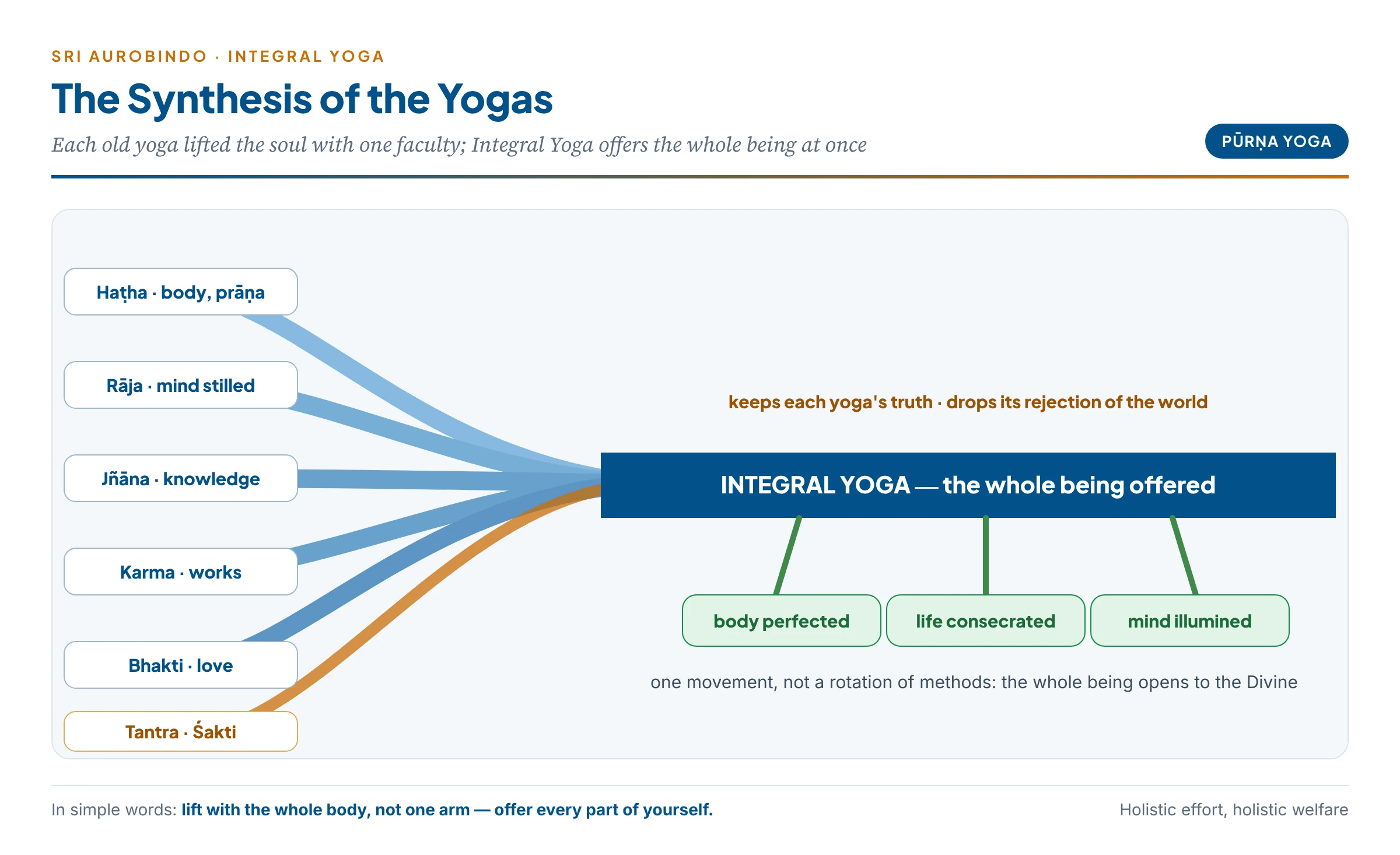
India has many yogas; most used one faculty as the lever of the whole being. Integral Yoga keeps the central truth of each without being bound by its techniques.
| Yoga | Lever it uses | What Integral Yoga takes | What it leaves |
|---|---|---|---|
| Haṭha Yoga | Body and vital energy (āsana, prāṇāyāma) | The body is part of the Divine’s instrument; health and plasticity matter | Elaborate techniques as an end; the aim of escaping through the body |
| Rāja Yoga (Patañjali) | Mind — stilling its modifications | Mental purification, concentration, silence of the mind | Trance (samādhi) as the only gate; withdrawal from the world |
| Jñāna Yoga | Intellect — discrimination of the real | Knowledge of the One Self in all | The verdict that the world is unreal |
| Karma Yoga | Will — selfless action | Work as worship; acting without ego or desire | Action only as a means to release |
| Bhakti Yoga | Heart — love of a personal God | Love and self-giving to the Divine | Confining love to a beyond after death |
| Tantra | Śakti — the divine energy in nature | Nature as the Divine Mother’s power; transformation rather than rejection | Ritual and occult techniques as the core |
- Synthesis, not a mixture. Integral Yoga does not do a little of each in rotation. It seeks the common principle behind all yogas — the opening of the whole being to the Divine — and lets knowledge, love and works grow together as one movement.
- Holistic welfare, holistic effort. In place of individual liberation, it accepts the idea of holistic welfare — and it therefore demands a holistic effort from the whole person.
In simple words
A person carrying a heavy load can use only her arms, or only her back, or only her legs — and soon tires. A trained porter lifts with the whole body together, and the load feels lighter. Each old yoga lifted the soul with one faculty — body, mind, intellect, will or heart. Integral Yoga lifts with all of them at once, and offers the whole being to the Divine.
The Double Movement of Ascent and Descent
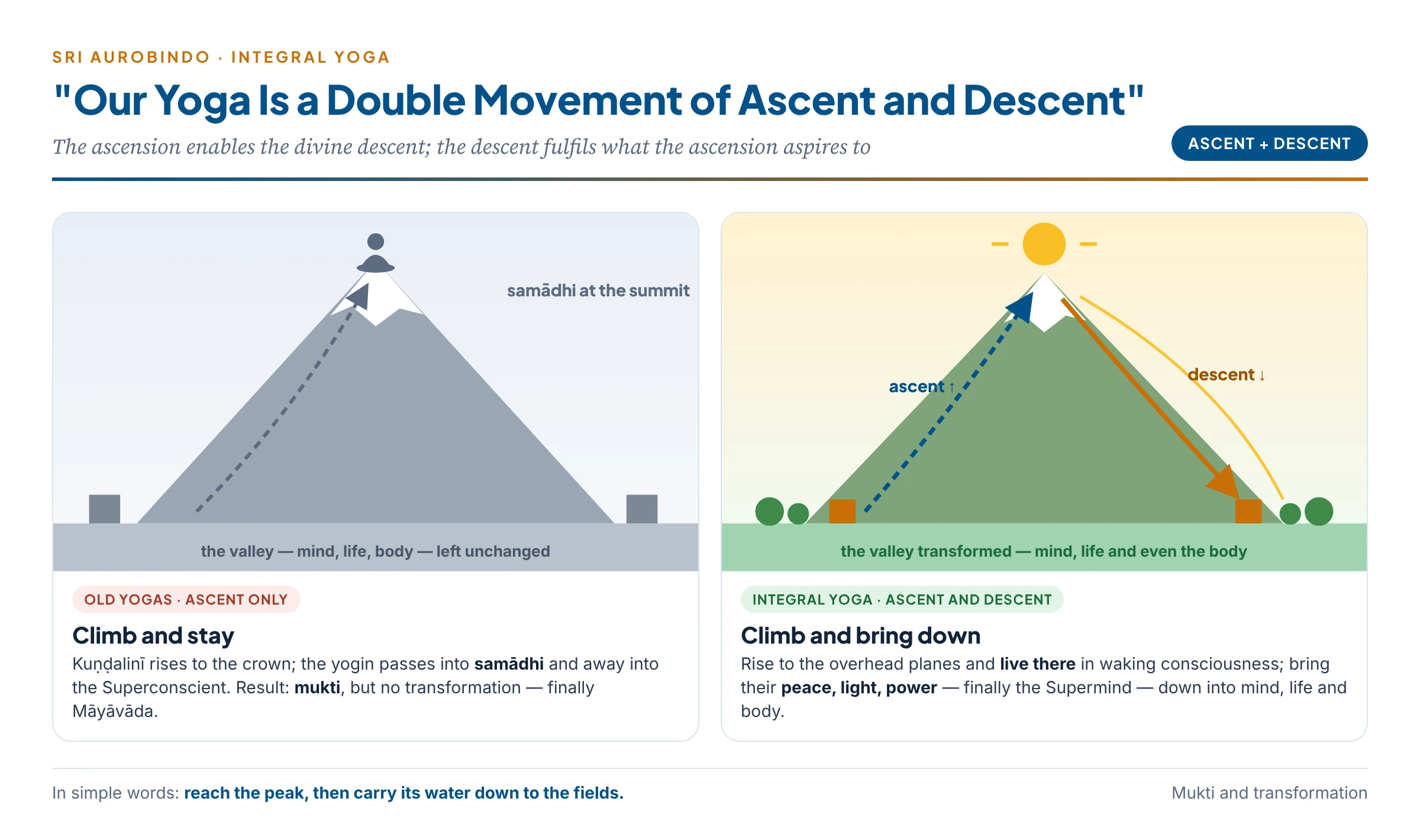
“Our Yoga is a double movement of ascent and descent; one rises to higher and higher levels of consciousness, but at the same time one brings down their power not only into mind and life, but in the end even into the body.” — Sri Aurobindo
- The ascent. Consciousness rises above the ordinary mind — beyond the top of the head — to the overhead planes: Higher Mind, Illumined Mind, Intuition, Overmind and finally the Supermind. The seeker learns not just to visit these planes in trance but to live there in waking consciousness.
- The descent. From these planes peace, light, power, knowledge, bliss and wideness descend into the mind, the vital and the body and change them. The highest level aimed at is the Supermind; only when it is brought down can a divine transformation take place in the earth-consciousness.
- What the old yogas missed.
- In the ordinary yoga one feels the awakened inner energy (kuṇḍalinī) rise to the brahmarandhra (crown of the head), where Prakṛti joins the Brahman-consciousness — but not the descent.
- When the old yogins went above the spiritual mind, they passed into samādhi: their aim was to pass away into the Superconscient, not to bring the Superconscient into the waking consciousness.
- So the dynamic changes stayed within the spiritualised mental and vital range; one could gain mukti (liberation) but not perfection or transformation.
- Two ends of one consciousness. The two movements are not contradictory but complementary: the ascension enables the divine descent; the descent fulfils that for which the ascension aspires and which it makes inevitable.
- An example from the vital. For the life-energy to become an instrument of the Divine, there are two movements: the vital rises to join the higher consciousness and steeps itself in its light; then it becomes quiet, empty of its ordinary movements, and waits until the higher power descends into it and changes it.
- Why both are needed.
- Ascent alone gives liberation but leaves the world and the body as they were — the path to Māyāvāda.
- Descent alone is impossible: nothing can be brought down that has not first been reached.
- Together, they make the transformation of earth-life possible — the aim at once of Integral Yoga and of the terrestrial evolution.
Common confusion
Does “descent” mean Integral Yoga brings God down by its own effort? No. The seeker’s part is the ascent and the opening — aspiration and surrender. The descent is the action of the higher consciousness itself, the Divine Śakti, answering the call. As Aurobindo puts it, the change needs the call from below and the sanction from above. Human effort prepares the vessel; the Divine fills it.
The Method: Aspiration, Rejection, Surrender
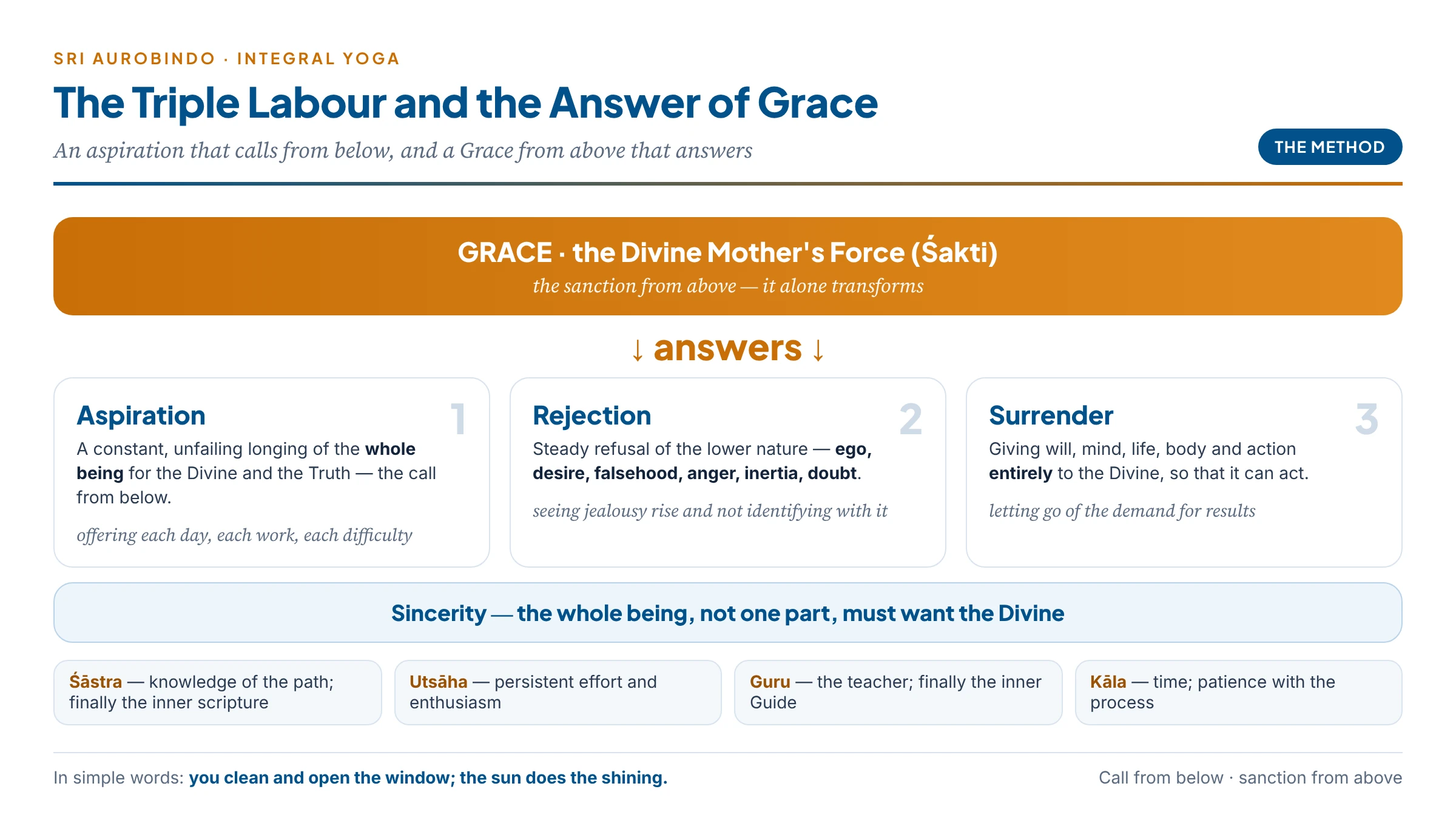
Aurobindo’s practical teaching reduces the method to a triple labour by the seeker, answered by grace from above.
| Element | What it means | Example of practice |
|---|---|---|
| Aspiration | An intense, constant, unfailing longing of the whole being for the Divine and the Truth — the call from below | Inwardly offering every day, every work, every difficulty to the Divine |
| Rejection | Steady refusal of everything that belongs to the lower nature — ego, desire, falsehood, anger, inertia, doubt | Noticing a rising jealousy and quietly refusing to identify with it |
| Surrender | Giving oneself entirely — will, mind, life, body and actions — to the Divine, so that it can act | Letting go of the demand for results; trusting the Divine’s working |
| Grace | The Divine Mother’s force, the supreme Śakti, that answers and transforms — the sanction from above | — not a technique, but the response to sincere aspiration |
In simple words
Learning to swim needs effort: you want to swim (aspiration) and you stop the panicky thrashing that drags you down (rejection). But in the end you must relax and let the water hold you (surrender). The water was always able to carry you; your part was to stop resisting it. In Integral Yoga the water is the Divine’s grace.
- Two powers effect the change. A fixed and unfailing aspiration that calls from below, and a supreme Grace from above that answers.
- The role of the Divine Mother. The Divine Śakti — the Consciousness-Force — is the active power of transformation; surrender is made to her. This is why, in Integral Yoga, the Mother is central.
- Sincerity above all. Aurobindo insists that the yoga depends less on technique than on sincerity — the whole being, not only a part, must want the Divine.
The Four Aids
In The Synthesis of Yoga Aurobindo names four aids to the path:
- Śāstra — the knowledge of the truths, principles and methods of yoga; finally the inner “scripture” written in the heart.
- Utsāha — patient and persistent personal effort, energy and enthusiasm.
- Guru — the teacher, finally the inner Guide, the Divine within.
- Kāla — time; the yoga works through the necessary duration, and the seeker must have patience.
The Process and Its Stages
- Three steps = the triple transformation (Article 4):
- Psychicisation — the soul comes forward and takes charge.
- Spiritualisation — opening to the overhead planes; descent of peace, light, power.
- Supramentalisation — descent of the Supermind and transformation of the whole nature.
- Four stages of stilling the mind. To still all the storm and tumult of the mental, Aurobindo describes four states:
- Quiet (acañcalatā) — no restlessness.
- Calm (sthiratā) — a steady, unshaken mind.
- Peace (śānti) — a positive, deep tranquillity.
- Silence (nīravatā) — complete stillness in which no thought arises unless called.
- Not separate kinds but degrees. These four are not qualitatively different states; they are progressive stages through which the mind is freed from all disturbance — and in this silence the higher consciousness can descend.
- No rigid technique. There is no fixed sequence of postures or breaths. The path adapts to each person’s nature (svabhāva); the inner guide (the psychic being) and the Divine Mother’s force shape it.
Chief Characteristics of Integral Yoga
- Synthesis of the Vedānta schools. Śaṅkara emphasised the transcendent Divine, Rāmānuja the cosmic, Dvaita the individual. Integral Yoga accepts all three and harmonises nirguṇa and saguṇa in Pūrṇādvaita: Brahman transcendent and indeterminable, Īśvara in cosmic existence, the individual in terrestrial existence — one in many and many in one.
- Integration of the world with the beyond. While affirming the transcendent Brahman, it rejects the idea of the world as illusion (Śaṅkara) or as mere suffering (the Buddha). The integral yogi seeks not only a static release in Brahman but the transformation of life, mind and body and of conditions on earth, so that the divine Śakti can overrule the darkness, ignorance, suffering, poverty and pain maintained by lower nature.
- Liberation in and of nature, not from nature. Almost all ancient schools sought liberation from nature — world, body, Prakṛti — treated as a ladder to be kicked away. In Integral Yoga, release from lower Prakṛti is only the first step; it must be followed by bringing the glories of the Spirit into life, mind and even the body.
- Double movement of ascent and descent — rising to the heights and bringing their power down.
- Transformation of the body. The body is not an obstacle but a future vessel of the Divine — to be spiritualised and finally divinised.
- Synthesis of all yogas. Haṭha, Rāja, Jñāna, Karma and Bhakti are brought together; life, mind and body all enter the yoga.
- The triple labour. Aspiration, rejection and surrender, answered by grace.
- Collective aim. Not only individual mukti but sarvamukti — the liberation of humanity and a gnostic society.
- East meets West.
- The West has valued individuality; the East has fostered collectivity and the beyond. Integral Yoga provides for cosmic salvation — liberation of all — through the perfection of individuals.
- The West emphasised materialism, dismissing the spiritual as hallucination; the East often denied matter. Integral Yoga regards both the materialist denial and the ascetic refusal as errors: spirit and matter are two ends of one spectrum.
- One integral truth behind all religions. In Aurobindo’s vision all religions emanate from one source and are different facets of one integral truth.
- Supramental aim. Its goal is not the Overmind or cosmic consciousness alone, but the Supermind and the divinisation of earthly life.
How Integral Yoga Leads to Supramental Consciousness
- Purification and quietude — rejection of desire and ego; quiet, calm, peace and silence of mind.
- Psychic opening — the soul comes forward as the inner guide and turns the whole nature towards the Divine.
- Ascent — consciousness rises through Higher Mind, Illumined Mind, Intuition and Overmind.
- Descent — peace, light and power descend and spiritualise mind, life and body.
- Surrender to the Divine Śakti — so that the supramental force can act.
- Supramental descent — the Supermind enters and transforms the whole nature, down to the body; the seeker becomes a gnostic being.
In simple words
Think of opening a house to sunlight. First you clean the windows (purification), then you light a small lamp inside so you can see what to clear away (the psychic being), then you climb up and open the skylight (the ascent), and finally the sun itself pours in and fills every corner (the descent). You cannot make the sun shine; you can only clean, open and wait.
Critical Evaluation
Objections to Integral Yoga and to Aurobindo’s System
- Vague practice. Without fixed techniques, beginners may not know what to do; “aspiration” and “surrender” can seem too general.
- Dependence on guru and grace. Heavy reliance on the Mother, the guru and grace can foster dependence, and surrender can be misused by others.
- Unverifiable aim. The supramental descent and the transformation of the body have not been demonstrated; whether Aurobindo succeeded, time alone will answer.
- Elitism. The path is long and demanding, more suited to a spiritual elite than to ordinary people.
- Lack of scriptural basis and pramāṇa theory. The supramental aim goes beyond classical texts, and the system rests on experience rather than structured epistemology.
- Ambiguity of evolution and over-optimism about evil. Evolution towards Supermind is scientifically vague, and the vision may underrate the persistence of suffering.
- General charges. Emotional expression of the human mind; impractical imagination; predominance of mystical experience; lack of logical grounds.
Replies and Strengths
- Flexibility is a strength. Because people differ, a yoga that adapts to each nature is more realistic than one rigid sequence. The basic attitudes — sincerity, aspiration, rejection, surrender — are clear.
- Surrender is not passivity. It is surrender to the Divine, not to any human authority, and it is guided by the inner psychic discrimination.
- Partial results are open to experience. Peace, inner silence, psychic opening and the descent of light are reported by many practitioners; these are steps on the way.
- Practical in daily life. “All life is yoga” makes spirituality available in work and family, not only in caves.
- A bridge between traditions. It harmonises the yogas, the Vedānta schools and the spiritual and material outlooks of East and West.
Critics and Defenders
Criticism — Critics
- Vague method: no fixed technique for beginners.
- Guru-dependence: surrender and grace can foster dependence.
- Unproven goal: supramental descent not demonstrated.
- Elitist: a long path for a few.
- Mystical, not logical: rests on experience, not pramāṇa.
Defence — Defenders and strengths
- Adapts to svabhāva: flexibility suits different natures.
- Surrender to the Divine, guided by the inner psychic sense.
- Partial fruits open to all: peace, silence, psychic opening.
- All life is yoga: spirituality in work and family.
- Grand synthesis: yogas, Vedānta schools, East and West.
Cross-Tradition Comparison
Patañjali’s Aṣṭāṅga Yoga and Sri Aurobindo’s Integral Yoga
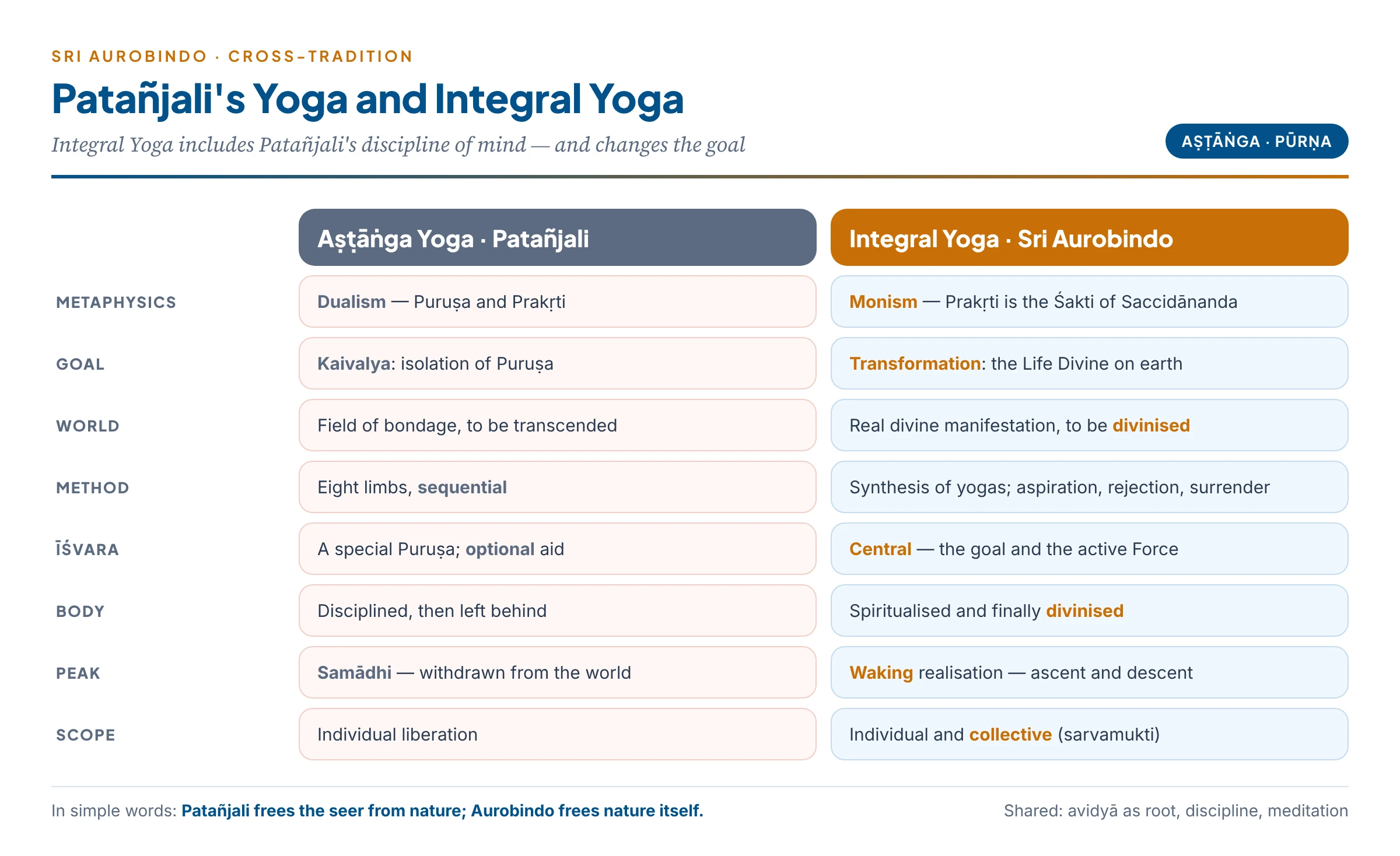
| Aspect | Aṣṭāṅga Yoga (Patañjali) | Integral Yoga (Sri Aurobindo) |
|---|---|---|
| Meaning | “Eight-limbed path” of the Yoga Sūtra; yoga as stilling the modifications of citta | “Integral” — synthesis of all yogas for total transformation |
| Metaphysics | Dualism — Puruṣa and Prakṛti | Monism — Saccidānanda; Prakṛti is its Śakti |
| Goal | Kaivalya — isolation of Puruṣa from Prakṛti | Transformation of human life into the Life Divine; supramental evolution |
| View of the world | Prakṛti is the field of bondage; to be transcended | The world is a real divine manifestation; to be divinised, not renounced |
| Self | Puruṣa — pure witness, separate from Prakṛti | Self — evolving manifestation of the Divine; psychic being and jīvātman |
| Method | Yama, niyama, āsana, prāṇāyāma, pratyāhāra, dhāraṇā, dhyāna, samādhi | Integration of jñāna, bhakti, karma and rāja yoga; aspiration, rejection, surrender to the Divine Śakti |
| Approach | Sequential, step by step from moral restraint to samādhi | Synthetic, several approaches at once; adapted to each nature |
| Īśvara | A special Puruṣa; devotion to him is one optional means (Īśvara-praṇidhāna) | Central — the Divine, personal and impersonal, is the active force and the goal |
| Body and life | Instruments to be disciplined and transcended | To be spiritualised and perfected as vessels of the Divine |
| Highest experience | Samādhi — consciousness withdrawn from the world | Waking realisation — ascent and descent into ordinary life |
| Liberation | Individual; absorption in pure consciousness beyond Prakṛti | Individual and collective (sarvamukti); transformation of earthly existence |
| Tone | World-negating, inward-turning, ascetic | World-affirming, dynamic, evolutionary |
| Distinctive feature | A precise psychology of concentration and self-discipline | Supramental consciousness and divinisation of life |
Points of similarity:
- Both see ignorance (avidyā) as the root of bondage and suffering.
- Both accept a teleological evolution of nature — Prakṛti evolves for Puruṣa; Spirit evolves towards Supermind — not a mechanical one.
- Both require purification of mind and character and concentration and meditation; Integral Yoga absorbs Rāja Yoga’s discipline of stilling the mind.
- Both regard devotion to the Divine as a powerful means.
- Both aim at a consciousness beyond the ordinary mind.
Why Integral Yoga is an advance over Patañjali’s Yoga:
- From isolation to transformation — the goal is not escape from Prakṛti but its divinisation.
- From dualism to monism — matter and spirit are reconciled, so the world need not be left.
- From the individual to the collective — liberation of all, not only of the yogin.
- From trance to waking — realisation lived in action, not only in samādhi.
- From one lever to the whole being — body, life, mind, heart and soul all take part.
- From God as a means to God as the goal — the Divine is central, not an optional aid.
- Beyond mind — it aims at the Supermind, a level Patañjali’s scheme does not envisage.
- A fair word for Patañjali. Within dualism, isolation is the consistent goal; and Patañjali’s exact psychology of citta remains a foundation on which later yogas, including Aurobindo’s, build. Integral Yoga does not reject Patañjali; it includes and exceeds him.
Other Indian Comparisons
| Path | Relation to Integral Yoga |
|---|---|
| Bhagavad Gītā | The closest ancestor — a synthesis of karma, jñāna and bhakti and action in the world (brāhmī sthiti); Aurobindo adds the supramental aim and the transformation of nature |
| Advaita (Jñāna Yoga) | Shares the realisation of the One Self; rejects the verdict of world-illusion and the withdrawal from life |
| Tantra | Shares the reverence for Śakti and the aim of transforming nature; drops ritual and occult techniques as the core |
| Buddhist meditation | Shares the stilling of mind and the end of ego; rejects the view of the world as only suffering |
Indian Connect — Key takeaways
- The Gītā is the seed: synthesis of the yogas and action in the world; Aurobindo extends it to the transformation of nature itself.
- Patañjali is included, not rejected: his discipline of mind is one strand within the integral path.
- Śaṅkara’s and the Buddha’s verdicts on the world — illusion and suffering — are the two things Integral Yoga refuses.
Western Parallels
| Thinker / tradition | Similarity | Difference |
|---|---|---|
| Plotinus | Ascent of the soul to union with the One | Only ascent — flight “of the alone to the Alone”; no descent to transform matter |
| Christian mysticism | Union with God through love and self-surrender; grace | Usually aims at the soul’s union, not the transformation of the body and the earth |
| Carl Jung (individuation) | Integration of all parts of the psyche into a whole self | Psychological, not a descent of a higher consciousness |
Significance of Sri Aurobindo
- Spirit and matter are complementary, not opposites, moving together towards divine fulfilment.
- The cosmos becomes a field of spiritual progress through the ideas of involution, evolution and the Supermind.
- Integral Yoga harmonises knowledge, devotion and action, aiming not at renunciation but at the transformation of human life into a divine life.
- A bridge between ancient Vedānta and modern evolutionary thought — between East and West.
- A philosopher of hope, envisioning humanity’s ascent to a higher consciousness and a spiritually luminous future.
- Living influence. His vision inspired integral education and the international township of Auroville (founded by the Mother in 1968), conceived as a place of human unity; and his integral humanism has been read as a spiritual ground for the constitutional ideals of justice, liberty, equality and fraternity.
Synthesis (Siddhānta)
- Yoga as conscious evolution. Integral Yoga hastens the inevitable evolution of Spirit in Matter; it seeks union with the Divine — transcendent, cosmic and individual together — and the transformation of mind, life and body.
- Integral in three senses: it synthesises all yogas; it includes the whole being; it embraces the whole of life (“all life is yoga”).
- The double movement is its heart: the ascent enables the descent, the descent fulfils the ascent; together they make transformation, not merely liberation, possible.
- The method is simple in principle — aspiration, rejection, surrender, answered by grace — and its stages are the triple transformation and the stilling of the mind into quiet, calm, peace and silence.
- Compared with Patañjali, it moves from dualism to monism, isolation to transformation, the individual to the collective, trance to waking life, and mind to Supermind — including Patañjali’s discipline while exceeding his goal.
- Contemporary relevance.
- Work as spiritual practice. “All life is yoga” offers a spirituality compatible with professional and public life — work done with sincerity and without ego becomes worship.
- Holistic education and health. Attention to the physical, vital, mental and psychic parts anticipates integral approaches in schools and medicine.
- Human unity. A yoga whose goal is the liberation of all gives spiritual grounding to global cooperation and interfaith harmony.
“By this Yoga we not only seek the Infinite, but we call upon the Infinite to unfold himself in human life.” — Sri Aurobindo
Previous Year Questions
- 2026Explain the basic characteristics of Sri Aurobindo’s Integral Yoga for the realization of supramental consciousness through triple transformation.
- 2024“Our Yoga is a double movement of ascent and descent.” Discuss the above statement in the context of Sri Aurobindo’s conception of Integral Yoga.
- 2022Explain and evaluate the role of integral yoga in the process of triple transformation for individual evolution as expounded by Sri Aurobindo.
- 2017How does Sri Aurobindo’s integral yoga help in the realization of supramental consciousness? Discuss.
- 2016Discuss Aurobindo’s views on ‘Evolution’ and ‘Involution’. How do they differ from traditional Yoga philosophy?
- 2015Sri Aurobindo’s Integral Yoga (short note).
- 2014How is Sri Aurobindo’s integral yoga is an advancement over Patanjali’s yoga? Discuss.
- 2009Compare Patanjali’s Yoga with integral Yoga expounded by Aurobindo, bringing out clearly points of similarity and dissimilarity.