

- Air transport is the fastest means of moving people and goods, and a vital modern mode for the growth of trade and commerce. It shrinks distance wherever time matters most.
- India is the world’s third-largest domestic aviation market, with airports rising from 74 in 2014 to 164 in 2025 and 165 by July 2026. An older reckoning put India ninth in the world civil aviation market.
- Its geographic strength is reach. Air services cross mountains, forests, marshes and deserts, so they work with road and rail to tie remote regions into the national economy.
Airways in India
Significance of Air Transport
- Speed: its supreme advantage, and its most peculiar feature.
- Aircraft fly at 500 km/h without difficulty, and some at supersonic speed. No other mode comes close.
- It suits every purpose where time is the key factor.
- Size of India: long distances and varied terrain make aviation indispensable for fast communication.
- Access: aircraft face no physical barrier of the kind that stops roads, railways and ships, which cannot cross the great mountain ranges.
- Inaccessible places are reached easily: the deserts of Rajasthan, the high altitudes of Leh and the forests of the North-East.
- International links: it plays a key role in international travel and transport.
- War and disasters: its value multiplies in wartime, disaster management and natural calamities such as floods, famines and epidemics.
- Cargo: express and high-value freight relies mainly on air services.
- Modernity: an airway is an index of a region’s modernity.
- Natural routes: airways are a free gift of nature. No capital goes into building or maintaining the route itself, though airports and aircraft cost a great deal.
- Employment: aviation supports about 7 million jobs, direct and indirect, on commonly quoted estimates.
- Tourism: air services draw tourists, and this in turn boosts roads and other basic infrastructure.
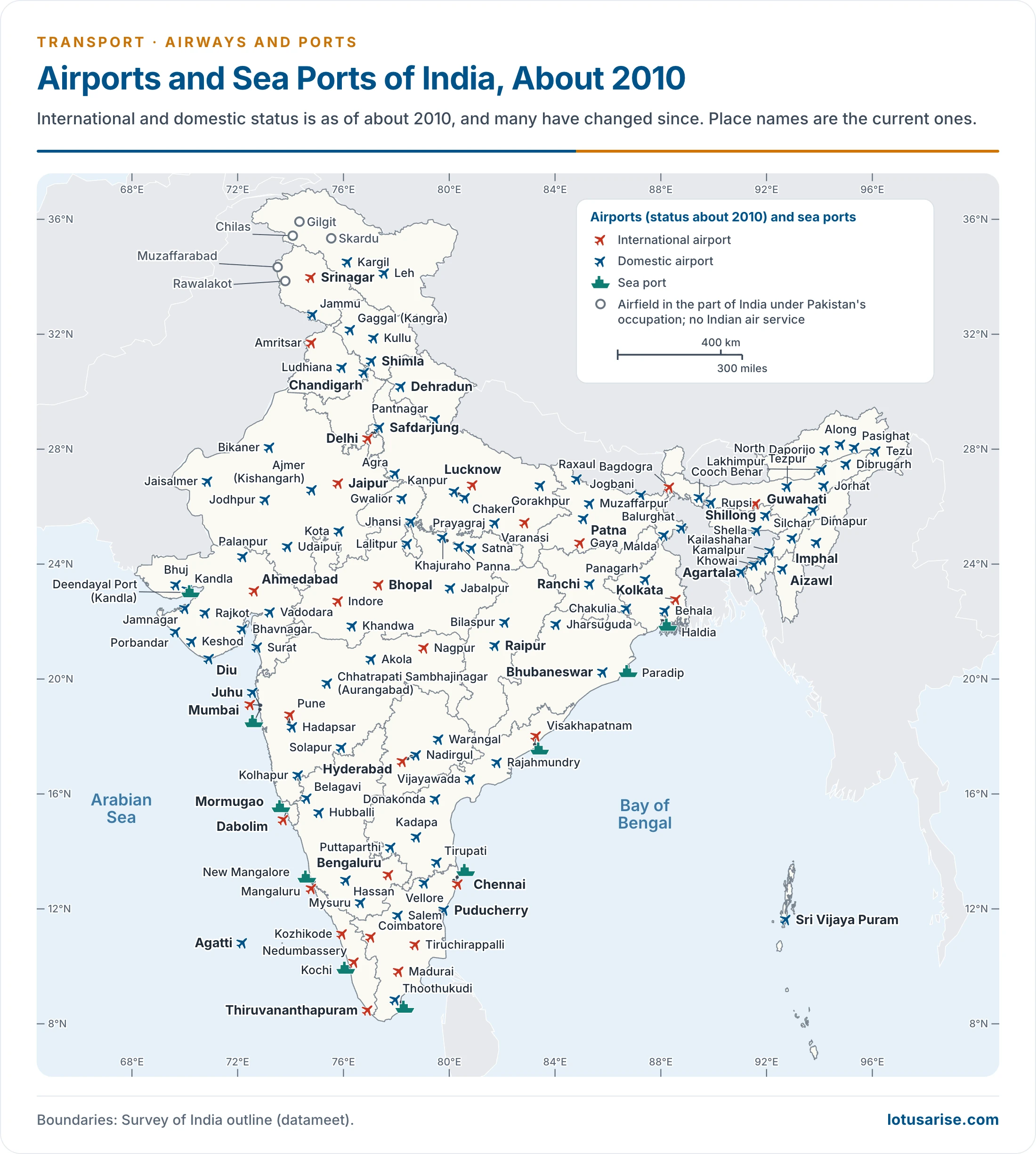
- The map shows international and domestic status as of about 2010, and many have changed. Gilgit, Skardu, Chilas, Muzaffarabad and Rawalakot lie in the part of India under Pakistan’s occupation and have no Indian air service. Bangalore is now Bengaluru, and Sholapur Solapur.
Factors for Development of Air Transport in India
- Weather: broadly favourable. Cloud, fog and mist hinder flying, but India has clear skies for most of the year, apart from a short rainy spell and winter fog in the north.
- Central location: India lies between Europe and West Asia on the west and South-East and East Asia on the east, so it sits well for long-haul routes and hub traffic.
- Extensive plains provide suitable landing sites.
- Large size: greater distances raise the need for airways.
Growth and Development of the Aviation Sector
- 1911: a humble start with air mail over about 10 km between Allahabad (now Prayagraj) and Naini, on 18 February.
- 1920–1930: British, French and Dutch operators carried forward aviation’s early set-up in India.
- 1932: Tata Sons began its airline, the forerunner of Air India.
- 1933: Indian National Airways was formed, with a Karachi–Lahore service.
- By the end of the Second World War, major cities such as Karachi, Mumbai, Delhi, Kolkata and Lahore had air services.
- 1947: four companies were flying: Tata Sons/Air India, Indian National Airways, Air Services of India and Deccan Airways.
- After Independence, many more entered, including Bharat Airways, Himalayan Aviation, Airways India and Kalinga Airlines by 1951, and they changed the sector’s face.
- 1953: air transport was nationalised. Indian Airlines Corporation took domestic services and Air India International took international ones.
- 1981: Vayudoot was set up to add to air services, starting in February 1981 with stations in the North-East. It reached remote areas that Indian Airlines left out, and it later merged into Indian Airlines.
- 1985: Pawan Hans Limited began flying helicopters for oil companies, among them ONGC, Oil India Ltd. and Enron Oil and Gas at Mumbai High, and for remote places that were otherwise hard to reach. It has a strong presence in Arunachal Pradesh, Meghalaya, Sikkim and Tripura.
- 1990 onward: private air taxis appeared as feeders. Repeal of the Air Corporations Act in 1994 ended the public monopoly on scheduled flights, and a 1997 policy removed barriers to entry and exit.
- A route dispersal plan required minimum services to the North-Eastern Region, Andaman and Nicobar Islands, Lakshadweep and Jammu and Kashmir.
- 1 April 1995: the International Airports Authority of India and the National Airports Authority merged into the Airports Authority of India (AAI).
- It runs air traffic services and aeronautical communication so that Indian air space stays safely and efficiently controlled, in line with International Civil Aviation Organization (ICAO) norms.
- Its work once ran through International and National Airport Divisions.
- Private carriers such as SpiceJet, IndiGo and Jet Airways have offered quality services.
- By 2013 IndiGo held 27.2% of the domestic market, Air India 19.3%, SpiceJet 18.5% and Jet Airways 18.1%.
- By the first half of 2026, IndiGo held 64.3% and the Air India Group 25.7%, making a near-duopoly.
- 27 January 2022: the government handed Air India to the Tata group, ending decades of public ownership and heavy losses.
- 1 January 2025: the Bharatiya Vayuyan Adhiniyam, 2024 replaced the Aircraft Act, 1934.
- The Ministry of Civil Aviation is the nodal ministry for the sector.
Public Carriers and Air Routes
- Air India long handled international services, with routes to the USA, Canada, Europe, Russia, the Gulf and Middle East, East Asia, Africa and Australia.
- Its fleet grew from 13 aircraft in 1960–61 to 34 in 2005–06, and its passengers from 1.25 lakh to 44.40 lakh over the same period. The Gulf routes, which yield more profit, received special attention.
- Indian Airlines handled domestic traffic in passengers, cargo and mail, and it also flew to neighbouring countries such as Pakistan, Maldives, Nepal, Sri Lanka, Bangladesh, Thailand and Myanmar.
- Its network covered 69 destinations, 15 of them abroad.
- Its fleet moved from 88 in 1960–61 to 49 in 1980–81 and 64 in 2005–06, and its passengers from 7.9 lakh in 1960–61 to 78.66 lakh in 1990–91.
- Vayudoot’s fleet rose from one aircraft in 1981 to 20 in 1988–89. Its services began with 14 stations in the North-East and added 23 elsewhere, and the network passed to Indian Airlines when the two merged.
- Scheduled cargo airlines in the older count included Blue Dart Aviation, Deccan Cargo and Quikjet, and 139 firms held non-scheduled permits in 2012, against 137 in December 2025.
- Air routes fan out from Delhi, Mumbai, Kolkata and Chennai, the four historic gateways. Long-haul routes run west to Dubai, Bahrain and London, and east to Bangkok, Singapore, Tokyo and Sydney, reflecting India’s central location.
- Airport works have been pursued through two channels:
- The International Airports Division built terminals and upgraded runways.
- The National Airports Division looked after domestic airports, with air traffic modernisation at Mumbai and Delhi, surveillance radar at Ahmedabad, Guwahati, Hyderabad and Thiruvananthapuram, and 12 model airports. Remote works reached Jammu and Kashmir, Lakshadweep, Himachal Pradesh and the Andaman and Nicobar Islands.
- Private and foreign finance were invited because airports need more capital than the government alone can provide. Delhi and Mumbai airports are the leading examples of modernisation by this route, followed by Chennai and Kolkata.
Current Status
| Measure | Older | Latest |
|---|---|---|
| Airports | 74 with scheduled flights (2014) | 164 (2025), 165 (July 2026) |
| Domestic passengers | 153.7 million (2023–24) | Up 7.7% in 2024–25; 123.74 million in April–December 2025 |
| International passengers | 72.5 million (2024) | 78.6 million (2025, provisional) |
| Air cargo | 2.53 million tonnes (2014–15) | 3.72 million tonnes (2024–25) |
| Scheduled fleet | 831 (January 2025) | 853 (December 2025) |
| Maintenance facilities | 96 (2014) | 166 (2025) |
- Older airport counts recorded about 450 airports and airstrips, 30 of them international, along with 26 civil enclaves and 31 non-operational domestic airports (2014).
- International airports then included Port Blair, Visakhapatnam, Guwahati, Raipur, Delhi, Goa, Ahmedabad, Srinagar, Bengaluru, Mangaluru, Kochi, Kozhikode, Thiruvananthapuram, Bhopal, Indore, Mumbai, Nagpur, Imphal, Bhubaneswar, Amritsar, Jaipur, Udaipur, Chennai, Coimbatore, Tiruchirappalli, Hyderabad, Lucknow, Varanasi, Kolkata and Bagdogra.
- New capacity: Navi Mumbai (8 October 2025) and Noida International Airport at Jewar (Phase I, 28 March 2026) give the two largest city regions second airports.
- International reach: direct flights served 91 foreign destinations by the end of 2025.
- Passenger systems: the Digi Yatra identity system had reached 24 airports, and 98 airports had switched over to green energy by 31 December 2025.
Air Transport and Regional Development
Role in Regional Development
- According to ICAO, each dollar invested in aviation returns three dollars to the regional economy.
- A 2025 estimate puts the sector’s output multiplier at 3.25 and employment multiplier at 6.1.
- Aviation is a hub of activity. Airports act as growth poles, which spread growth through spillover and trickle-down effects.
- Tourism draws in new infrastructure such as roads and transport.
- Tourist demand also builds markets, shops, restaurants, hotels and other amenities.
- Local skills gain, and the exchange of views between visitors and locals opens new avenues.
- Local handicrafts find buyers, which brings income while preserving cultural heritage.
- Ideas and innovation spread as tourism grows.
- National attention: closer contact with outsiders brings local issues and problems to the notice of the national government, and that can check extreme regionalism.
Complementary Role with Other Networks
- Air transport cannot work alone, since last-mile links can only come from road and rail.
- Roads and metro links feed airports, and road links to 24 airports have been treated as basic infrastructure.
- Heavy cargo stays with road, rail and ships, while aircraft take perishable, high-value and time-sensitive goods.
- In hill States, islands and the North-East, air often substitutes for surface routes until roads and railways catch up.
Regional Patterns
- Concentration: traffic gathers at the big metro airports, so the network has the shape of hubs and spokes, and it widens the advantage of large cities unless regional routes are supported.
- North-East: AAI planned Guwahati as an inter-regional hub, with Agartala, Imphal and Dibrugarh as intra-regional hubs.
- Under UDAN, 90 of 164 awarded routes in the region were running by the end of 2025.
- Vayudoot and Pawan Hans carried this role in earlier decades.
- Hill and island areas: Leh, the Andaman and Nicobar Islands, Lakshadweep and Himachal Pradesh depend on air services for reliable all-season links.
- Disaster response: airlifts serve flood-hit and landslide-hit areas when surface routes are cut.
- Tourism circuits: air links turn distant heritage and nature sites, such as Khajuraho, Leh and Port Blair, into reachable destinations, and that spreads hotel and transport jobs beyond the metros.
Feasibility of a Comprehensive Network
- In favour: size, clear weather, level sites, a rising middle class and growing cities.
- Against: high fares, thin demand on regional routes, costly land near cities, shortage of airlines’ cash, and foggy winters over the north.
- Of 663 UDAN routes launched since 2017, 327 had fallen out of use by February 2026, and audit findings put long-term viability at only 7–10% of routes.
- Conclusion: a nationwide network is feasible only with public support on thin routes, helipads and small aircraft for hills, and tight links with surface transport.
Challenges and Prospects
Challenges of the Aviation Sector
- High fares: well above rail and road, so air travel has been class transport rather than mass transport.
- Last-mile connectivity must come from rail and road.
- Heavy cargo is unsuited to aircraft.
- Weather: storms, rain and fog restrict flights.
- Safety: most accidents are fatal, with slim chances of survival.
- Geography limits airport sites, and airports cannot be built everywhere.
India-specific Challenges
- Imported aircraft: India imports carrier aircraft and has no domestic base for them.
- Fuel taxes: taxes on air turbine fuel are very high.
- Maintenance, Repair and Overhaul (MRO) is under-developed, though facilities have grown (96 in 2014, 166 in 2025).
- Low use: fewer people choose air than other transport.
- Capital intensity: aviation needs heavy capital, and airport expansion is hard.
- Competition: low-cost carriers took market share from premium airlines, which then cut fares. The resulting price war threatens carriers’ finances.
- Financial health: India’s market grows fast, yet airlines have been in loss. The Centre for Asia Pacific Aviation forecast a consolidated loss of $1.65 billion for the industry in one recent projection.
- Older public-sector losses: Air India needed a Turn Around Plan and Financial Restructuring Plan in April 2012, before its sale.
Prospects in the Indian Aviation Sector
- Air traffic density needs to rise.
- Rising GDP and per capita income are enlarging the middle class, the sector’s customer base.
- Rising urban population adds to demand.
- Government schemes give the sector a fillip.
- Low-cost flights have become competitive with luxury classes on railways.
- Airport modernisation by private firms through public–private partnership (PPP) helps, such as GMR at Delhi, with Mumbai among others.
- Greenfield projects at Hyderabad and Bengaluru are adding world-class infrastructure.
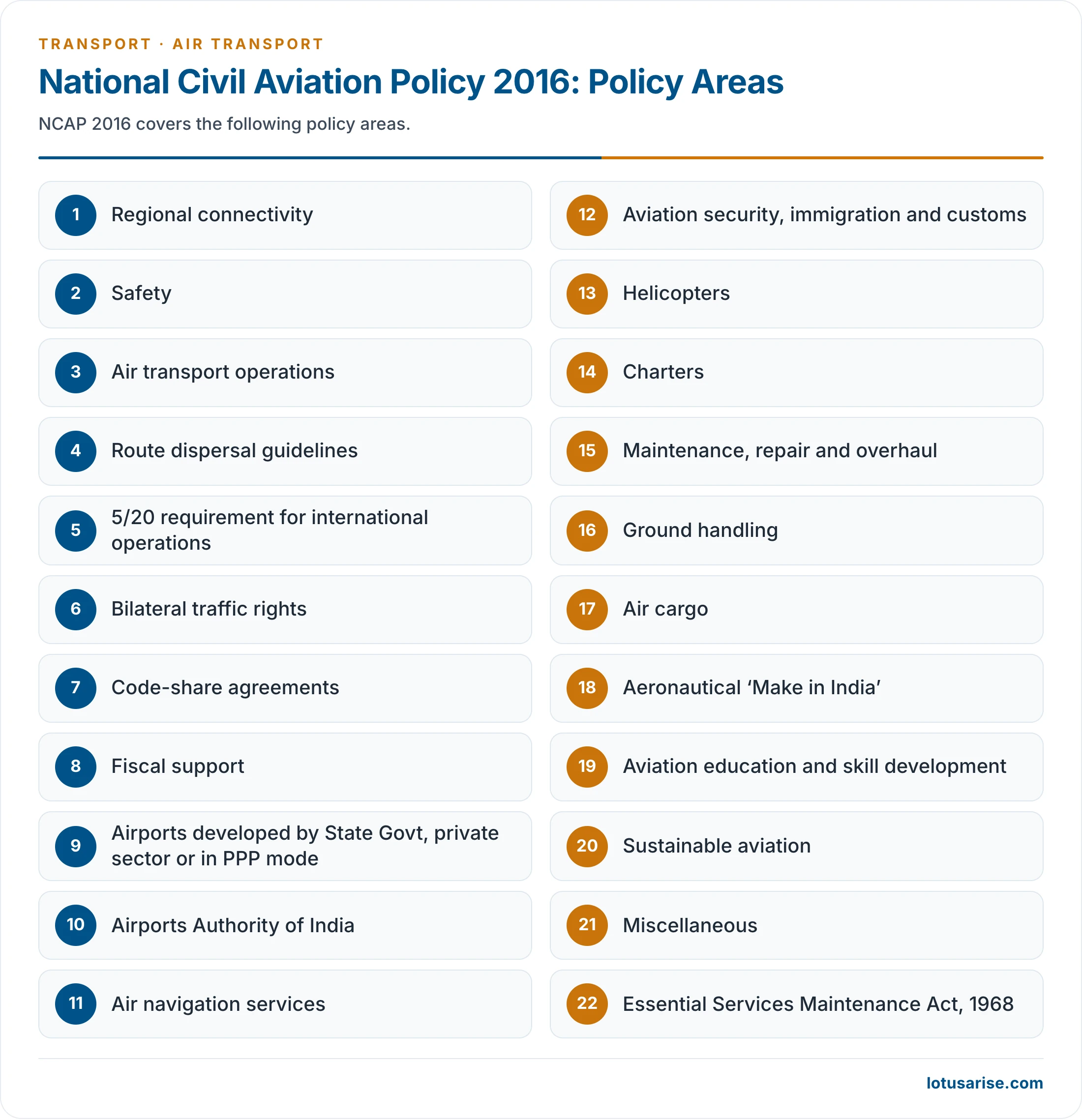
- 5/20 requirement for international operations: the National Civil Aviation Policy (NCAP) lets all domestic airlines fly international routes, provided they deploy 20 aircraft or 20% of total capacity, whichever is higher, on domestic operations.
Aviation Under Make in India
- Aviation is one of 25 sectors under the Make in India scheme.
- Freight at Indian airports is expected to cross 11.4 million tonnes by 2032. Actual cargo stood at 3.72 million tonnes in 2024–25.
- India is among the fastest-growing markets, expected to carry 520 million passengers by 2037, according to the International Air Transport Association (IATA).
- 100% FDI is allowed under the automatic route for greenfield and brownfield projects.
- Fleet: Boeing expected Indian carriers to reach around 1,200 aircraft by 2020, while the scheduled fleet stood at 853 in December 2025.
- Aerotropolis model: airports are following a Special Economic Zone-style model that earns revenue from retail, advertising, vehicle parking, security equipment and services.
Current Schemes Related to the Aviation Sector
GPS-Aided Geo Augmented Navigation (GAGAN)
- India’s first Satellite-based Augmentation System.
- It gives extra accuracy for civil aviation safety, with scope to expand navigation services across geographies.
No Objection Certificate Application System (NOCAS)
- It streamlines the online process of timely height clearances for buildings around airports.
eGCA
- The functions and processes of the Directorate General of Civil Aviation (DGCA) move online for faster service and oversight.
- Initiated on 14 May 2019, with the first module on pilot licensing launched from November 2019.
DigiSky
- An online portal for meeting the rules on flying civil drones.
- Its beta version covers registration of drones and pilots, flight path approval and post-flight analysis, on the principle of No Permission No Takeoff (NPNT).
e-sahaj
- All security clearances of the ministry moved to this portal, which covers 24 categories.
Regional Connectivity Scheme: UDAN
- UDAN (Ude Desh Ka Aam Nagrik), launched on 21 October 2016, links underserved airports to key airports at capped fares of ₹2,500 for a one-hour flight.
- The first flight was Shimla–Delhi on 27 April 2017.
- It applies to routes of 200–800 km, with no lower limit for hilly, remote, island and security-sensitive regions.
- Viability Gap Funding (VGF) goes to selected operators from the Regional Connectivity Fund (RCF), and States reimburse their share. It runs for three years from the start of operations on a route.
- Concessions: the Centre offered lower taxes on fuel at these airports (about 2% excise), service tax at one-tenth of the rate, and liberal code sharing. States were asked to cut Value Added Tax (VAT).
- Funding: a levy on certain flights feeds the RCF, with States contributing 20% (10% in the North-East and Union Territories).
- Balanced growth: allocations spread across five regions (North, West, South, East and North-East), with a cap of 25% for each.
- Reverse bidding picks the operator asking for the least VGF, and the first proposer has a right to match. VGF falls if load factors stay high and ends after three years, once a route should sustain itself.
- Progress to December 2025: 657 routes connecting 93 airports, among them 15 heliports and 2 water aerodromes, with more than 159 lakh passengers on 3.34 lakh flights.
- Modified UDAN (Cabinet, March 2026): ten years from 2026–27 to 2035–36 with ₹28,840 crore, to develop 100 airports from unserved airstrips and 200 helipads, and to support operations at about 441 aerodromes.
- The next phase was launched from Rajasthan as Viksit UDAN (2026).
Integrated National Civil Aviation Policy 2016
Vision
- An ecosystem to make flying affordable for the masses, with 30 crore domestic tickets by 2022 and 50 crore by 2027, and 20 crore international tickets by 2027.
- Cargo of 10 million tonnes by 2027.
Mission
- Safe, secure, affordable and sustainable air travel and cargo, with access to various parts of India and the world.
Objectives
- An integrated ecosystem for significant growth of civil aviation, which would promote tourism, raise employment and bring balanced regional growth.
- Safety, security and sustainability through technology and effective monitoring.
- Regional connectivity through fiscal support and infrastructure.
- Ease of doing business through deregulation, simple procedures and e-governance.
- A harmonised sector chain covering cargo, MRO, general aviation, aerospace manufacturing and skill development.
National Civil Aviation Policy Highlights
1. Bilateral Traffic Rights
- India will enter an ‘Open Sky’ Air Services Agreement (ASA), on a reciprocal basis, with SAARC countries and countries lying entirely beyond a 5,000 km radius of New Delhi.
- Unlimited flights above existing bilateral rights will be allowed directly to and from major international airports notified by the ministry.
- Under the earlier approach, India signed bilateral ASAs that set out where a country’s carriers may land and how many seats a week they may offer.
2. Regional Connectivity
- Regional connectivity is the centrepiece of the policy, under the Narendra Modi government’s aim to connect the unconnected.
- Fares are capped at ₹2,500 per hour of flying on one-hour flights to and between Tier 2 and Tier 3 cities, and from them to metro cities.
- 50 existing airports were to be revived over three years, at ₹50–100 crore each, as announced in the Budget.
- The goal was to raise domestic ticketing from 8 crore in 2015 to 30 crore annually.
- Airlines flying these routes may take losses, so they get lower VAT, lower excise duty and VGF.
3. Safety
- The focus is on pre-empting and preventing accidents and incidents, with zero tolerance for violations.
- DGCA will get administrative and financial autonomy for safety oversight, and it will work towards:
- A single-window system for all aviation transactions, queries and complaints.
- Real-time safety tracking and prompt incident reporting.
- The Aircraft Accident and Incident Investigation Bureau (AAIIB) will be strengthened, with contract staff if needed, for speedy, independent and professional investigation.
- A consultative group of industry experts at DGCA will meet every quarter to find areas for improvement.
4. Airports Developed by State Governments, Private Sector or in PPP Mode
- The ministry will keep encouraging airports built by State governments, the private sector or PPP.
- It will press States to form special purpose vehicles (SPV) with AAI or other public undertakings and industry, so they hold a stake.
- Future greenfield and brownfield projects should be cost-efficient without any compromise on safety, security or efficiency.
5. Aviation Security, Immigration and Customs
- The government will set performance norms for these agencies on speed of passenger processing and on grievance handling.
- Global best practices will come in for IT, check-in, baggage handling, mobile boarding passes, security checks, immigration and customs.
- Private security agencies may be used for non-core functions, in consultation with the Ministry of Home Affairs (MHA).
6. Air Navigation Services (ANS)
- ANS will be upgraded in line with global trends. With GAGAN, India became the fourth country to use satellite-based navigation of this kind.
- AAI will provide a fully harmonised system, in step with ICAO’s Global Air Navigation Plan.
- CATC Allahabad (now Prayagraj), the training institute, will become a world-class centre.
- All aircraft registered in India from 1 January 2019 must be GAGAN-enabled.
7. Helicopters
- Helicopters matter for remote connectivity, intra-city movement, tourism, law enforcement, disaster relief, search and rescue, and medical evacuation.
- India had fewer than 300 civilian helicopters, which is low for a developing country.
- The government will help develop at least four heli-hubs first.
- DGCA will issue separate rules for Helicopter Emergency Medical Services (HEMS), whose helicopters may not be used for anything else.
8. Maintenance, Repair and Overhaul
- Indian carriers’ MRO business is about ₹5,000 crore, with 90% spent abroad, in Sri Lanka, Singapore, Malaysia and the UAE.
- The aim is an MRO hub in Asia that also draws foreign airlines.
- Measures planned:
- Customs exemption on tools and tool-kits.
- Foreign aircraft may stay for the whole maintenance period or up to six months, whichever is less, if they make no commercial flights.
- Prompt visas for foreign experts.
- Land for MRO in all future airports and heliports with potential.
- Persuading States to zero-rate VAT on MRO.
9. Ground Handling
- The new framework replaces earlier rules, with these terms:
- Three ground handling agencies at all major airports, including an Air India subsidiary or joint venture.
- Non-major airports are exempt from a minimum number.
- Self-handling is open to all domestic scheduled airlines, including helicopter operators, with their own or leased equipment.
- Hiring through manpower suppliers is not permitted.
10. Air Cargo
- Domestic and international air cargo and express delivery matter for Make in India, e-commerce and exports, and they have high job potential for semi-skilled workers.
- The framework:
- Co-located cargo facilities fall under the Harmonised List of Infrastructure, with the benefit of infrastructure status.
- Simpler Customs procedures and paperless processing through digital signatures.
- Advance Cargo Information (ACI) in phases.
- A single window at cargo terminals for Customs, wildlife clearance, Drug Controller, Plant and Animal Quarantine, FSSAI, Archaeological Survey of India and DGCI, with prompt online clearances.
- Cargo villages near airports.
- The Air Cargo Logistics Promotion Board (ACLPB) will propose steps to promote trans-shipment, monitored by the ministry, with Free Trade and Warehousing Zones (FTWZ), air freight stations, bonded trucking and dedicated cargo airports.
11. Aviation Education and Skill-building
- The government will build an ecosystem so training institutes are used fully, and costs fall on a self-sustaining basis, without the institutes becoming profit-seeking commercial centres.
- The ministry will develop a scheme of financial support for type-rating of pilots.
12. Miscellaneous Initiatives
- Seaplanes will be promoted for tourism and regional links along India’s 7,500 km coastline, a length re-assessed at 11,098.81 km in 2025.
- General aviation and aero-sports will be promoted.
- Guidelines will cover Remotely Piloted Aircraft Systems (RPAS) for civil use.
Previous Year Questions
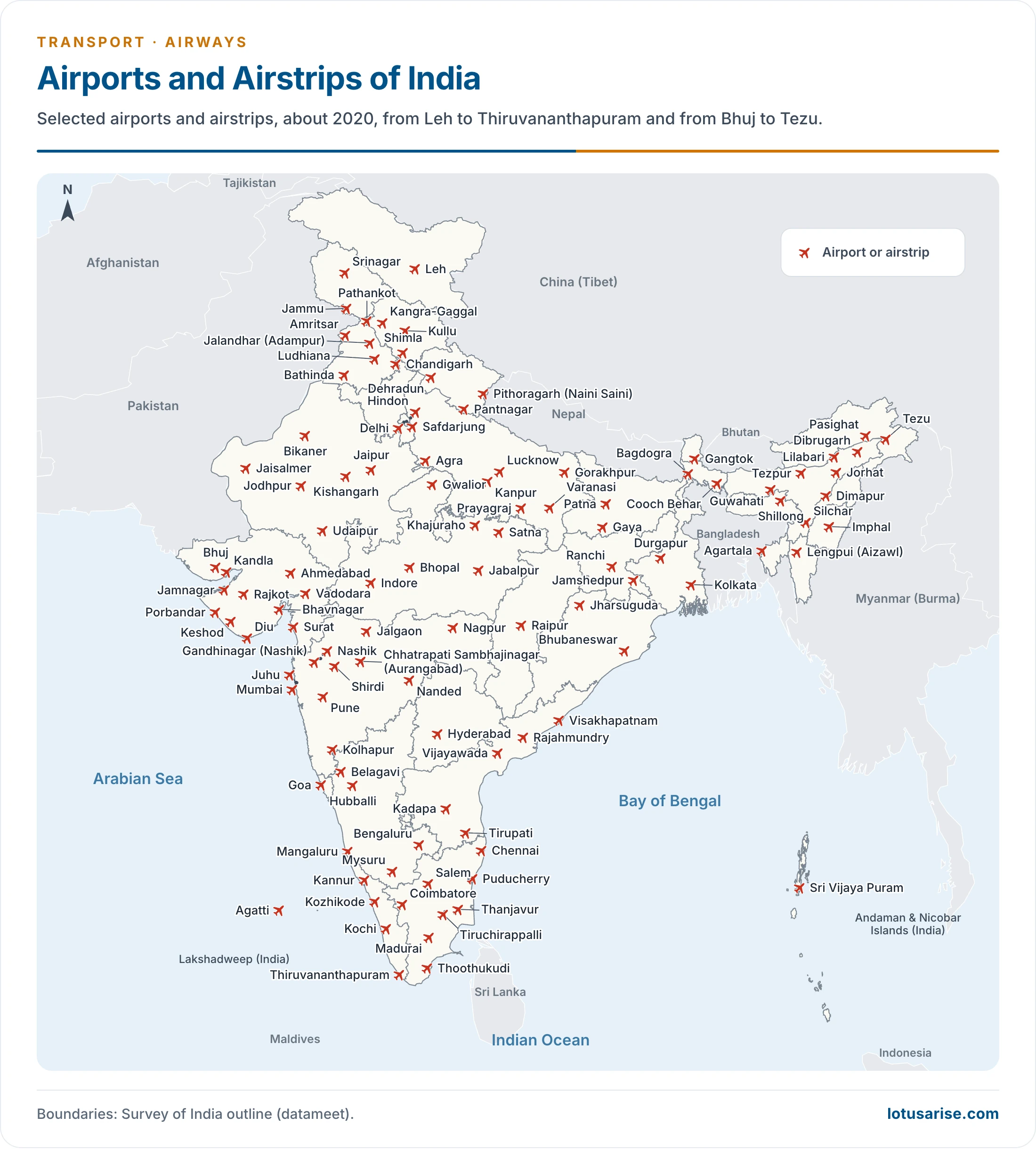
2024Map item: Along Airport2017Critically examine the feasibility of development of a comprehensive network of airways in India.2011Assess the growing importance of air transport in India and examine its role in the regional development of the country.1992Discuss the basis on which the current network of Airways is built in India, highlighting its role in the overall transportation milieu.





THANKS
tqsm sir
Thanks 😊
Very helpful article thank you so much now I got a clear idea about Indian aviation
shandar jbrdst article…and a lot of info in sequencial development in the sector ,,,thank you so much @LotusArise.com