

Administrative Law: Meaning, scope, and significance; Dicey on Administrative law; Delegated legislation; Administrative Tribunals.
This article: Administrative adjudication and the meaning of tribunals; why tribunals arose (welfare state, volume, speed, cost, expertise, flexibility); court and tribunal compared; types of tribunals; the British story (Hewart, Donoughmore, Franks Committee 1957, Tribunals and Inquiries Act 1958, Leggatt Review 2001, Tribunals, Courts and Enforcement Act 2007); the Indian constitutional basis (42nd Amendment, Articles 323A and 323B); the Administrative Tribunals Act 1985, the CAT and SATs; the leading judgments from Sampath Kumar to Madras Bar Association 2025; rationalisation (Finance Act 2017, Tribunals Reforms Act 2021, Tribunals Reforms Act 2026 and the National Tribunals Commission); other major tribunals (NCLT and NCLAT, NGT, ITAT, AFT, consumer commissions, GSTAT, inter-State water tribunals); problems and reforms; natural justice in tribunal proceedings.
Official Syllabus: Paper I · Unit 1-06 Administrative Law
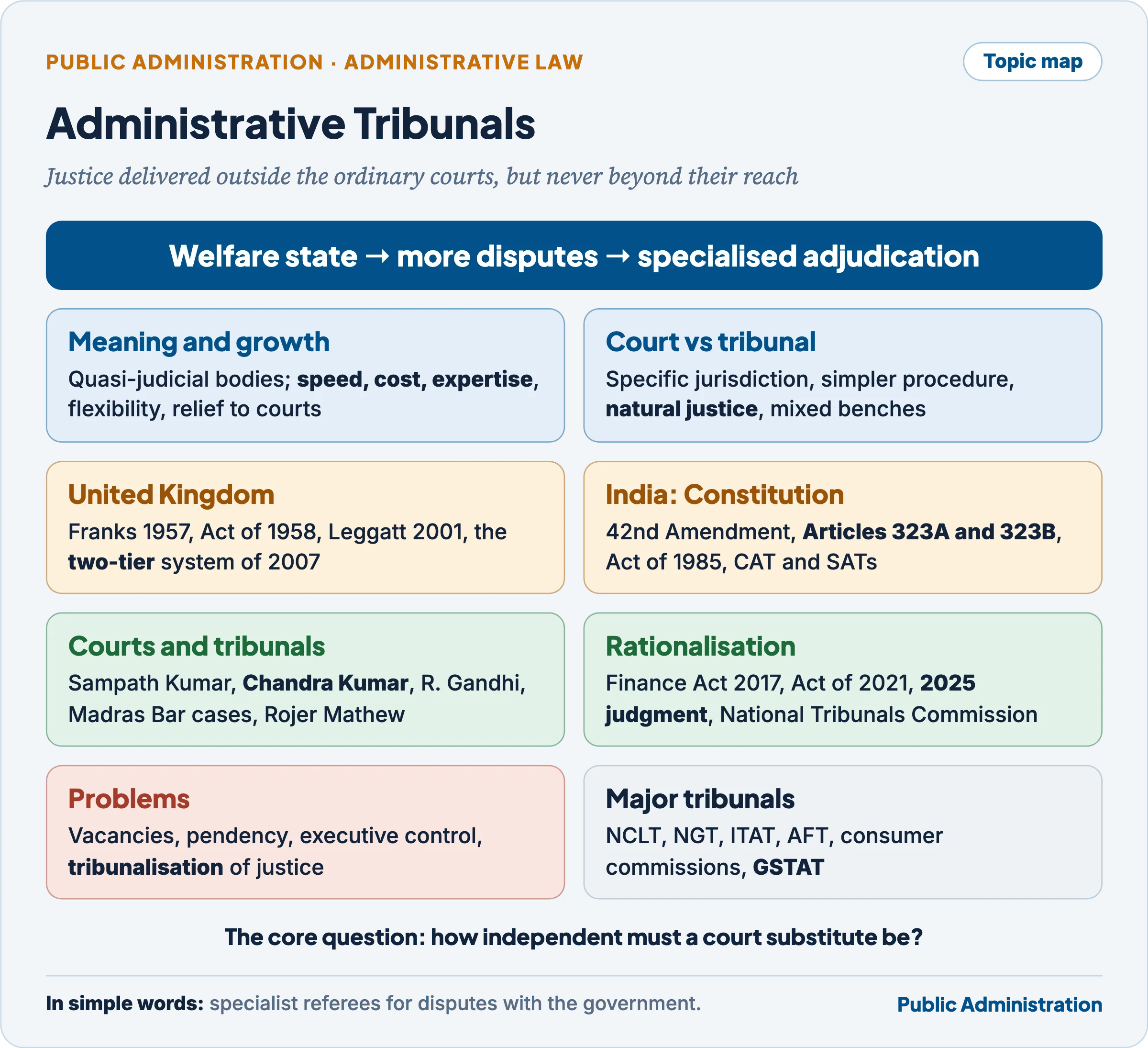
When a government only collected revenue and kept order, the ordinary courts could handle most quarrels between citizen and State. The welfare and regulatory state changed that. Pensions, tax assessments, industrial disputes, licences, environmental clearances, company insolvencies and the service conditions of millions of public employees now generate disputes by the hundred thousand, many of them technical and most of them urgent.
Administrative tribunals are the institutional answer: bodies created by statute, outside the regular hierarchy of courts, that decide such disputes with judicial fairness but administrative speed and expertise. They sit at the meeting point of the two ideas that run through administrative law: the need to give the administration effective power, and the need to keep that power under law. Their whole history, in Britain and in India, is a contest over one question: how independent must a body be when it takes over work that courts once did?
In simple words
Think of a cricket match where the umpire is not a High Court judge but a specialist who knows the rules of the game thoroughly, decides quickly at the ground, and costs little. That is a tribunal. But if the umpire is chosen and paid by one of the two teams, nobody will trust his decisions. That is the independence problem of tribunals.
These notes are the third of three on administrative law. The first covers meaning, scope, significance and Dicey’s rule of law, where Dicey’s suspicion of special administrative courts begins the story told here; the second covers delegated legislation, the rule-making side of administrative power. Tribunals are its adjudicating side: delegated legislation lets the executive make law, tribunals let specialised bodies decide disputes under it.
1. Meaning: Administrative Adjudication and Tribunals
In simple words
When a government office decides a dispute about someone’s rights (a pension refused, a tax demand, a promotion denied) and does so like a judge, after hearing both sides, that is administrative adjudication. A tribunal is a permanent body set up by law to do this work for one field.
1.1 Administrative adjudication
- Administrative adjudication means the determination of questions of law and fact, affecting the rights and obligations of private parties, by an administrative agency that is required by statute to act judicially. The agency applies a law to a particular case, as a court would, rather than making a general rule.
- Two faces of administrative power:
- Rule-making (quasi-legislative): the executive makes general rules under delegated authority, covered in the article on delegated legislation.
- Adjudication (quasi-judicial): the executive or a specialised body decides individual disputes. Tribunals are the most developed form of this.
- Three kinds of administrative action were once sharply separated:
- Purely administrative (policy and management, such as transferring an officer), traditionally free of a duty to hear.
- Quasi-judicial (deciding a lis, a dispute between parties, or a question affecting rights, under a duty to act judicially), bound by fair procedure.
- Judicial (the work of courts).
- The line has blurred. In A.K. Kraipak v Union of India (1969) the Supreme Court held that the rules of natural justice apply to administrative enquiries too, because the aim of both quasi-judicial and administrative enquiries is to reach a just decision. In England, Ridge v Baldwin (1964) had already revived the duty of fairness. Today the question is not the label but whether the decision affects a person’s rights or interests.
1.2 What a tribunal is
- Literal meaning: “tribunal” originally meant the seat of a judge. In administrative law it refers to bodies other than the regular courts that decide controversies in the manner of courts but are not courts.
- A widely used definition: administrative tribunals are authorities outside the ordinary court system which interpret and apply the laws when acts of public administration are challenged in formal suits or by other established methods. They are agencies created by specific enactments to adjudicate disputes that arise in implementing those enactments.
- The Supreme Court’s tests:
- In Durga Shankar Mehta v Raghuraj Singh (1954) the Court read “tribunal” in Article 136 to include all adjudicating bodies constituted by the State and vested with judicial, as distinct from purely administrative, functions.
- In Associated Cement Companies v P.N. Sharma (1965) it held that the feature common to courts and tribunals is that both exercise the judicial power that inheres in the sovereign State.
- A body may have other administrative functions too; what makes it a tribunal is that a statute has conferred on it some of the State’s adjudicating power.
- The British view: the Franks Committee (1957) held that tribunals are machinery provided by Parliament for adjudication rather than part of the machinery of administration. H.W.R. Wade, the leading English authority on administrative law, put the paradox neatly: tribunals are called “administrative” only because the reasons for preferring them to courts are administrative (speed, cost, expertise); in what they do, they are judicial.
- A body midway: a tribunal is neither a court nor an executive office. It is a compromise between the two: judicial in method, administrative in origin and purpose.
1.3 Characteristics of an administrative tribunal
| Feature | What it means in practice |
|---|---|
| Statutory origin | Created by an Act (or under Articles 323A and 323B), never by executive order alone |
| Specific jurisdiction | Hears only disputes arising under its parent law (service matters, tax, company law, environment) |
| Judicial power of the State | Decides rights and liabilities; its orders bind the parties |
| Duty to act judicially | Must be impartial and follow natural justice: notice, hearing, reasons, no bias |
| Flexible procedure | Not bound by the Code of Civil Procedure or strict rules of evidence; regulates its own procedure |
| Some powers of a civil court | Summoning witnesses, requiring documents, taking evidence on oath; some (like the CAT) can punish for contempt |
| Mixed membership | Judicial members sit with technical, accountant, expert or administrative members |
| Independence expected | Must decide free of the department whose acts it reviews |
| Subject to judicial review | Its decisions can be corrected by the High Courts and the Supreme Court |
Two points in this table carry most of the later controversy. Mixed membership is the source of the tribunal’s expertise, but also of the charge that civil servants are judging their own colleagues. Independence is “expected” rather than guaranteed by the Constitution, which is why the courts have spent forty years defining it.
2. Why Tribunals Arose
In simple words
Courts were built for a world of property and contract disputes between private persons. When the State began to run schools, hospitals, factories and pension schemes, millions of new disputes appeared. Courts were too slow, too costly and too general for them, so specialised bodies were created.
2.1 The welfare state as the root cause
- From police state to welfare state: in the eighteenth and nineteenth centuries, under laissez-faire, courts were the guardians of individual liberty and property, often against the State. The welfare state placed social interest above individual right in many fields (labour, land, rent, social insurance) and created thousands of discretionary decisions.
- A new kind of justice: such disputes need public-good-oriented justice, in which the individual’s claim is weighed against the purpose of a social programme. Courts trained in private law were thought ill-suited to do this. A well-known observation, often credited to the constitutional jurist H.M. Seervai, holds that the development of administrative law in a welfare state has made administrative tribunals a necessity.
- The volume of disputes: each new function (industrial relations, taxation, social security, environmental regulation, insolvency) brings its own stream of litigation that the ordinary courts could not absorb.
2.2 The practical advantages
| Reason | How tribunals meet it | Indian illustration |
|---|---|---|
| Speed | Simple procedure, no elaborate pleadings, fixed time limits | GST appeals moved from High Courts to the GSTAT |
| Low cost | Nominal fees; parties may appear in person | CAT application fee of ₹50 |
| Expertise | Technical members bring knowledge of tax, telecom, environment | Expert members of the NGT; accountant members of the ITAT |
| Flexibility | Not bound by rigid procedure or by precedent in the way courts are | Industrial tribunals may vary terms of employment in a way a civil court could not |
| Relief to courts | Diverts specialised litigation away from High Courts | Service cases moved from High Courts to the CAT in 1985 |
| Experimentation | New standards can be developed case by case and changed easily | Environmental principles developed by the NGT |
| Policy sensitivity | Decisions informed by the aims of the programme | Consumer commissions protect the weaker party |
| Access | Benches in many cities; informal hearings | Consumer commissions in every district |
- W.A. Robson, the British scholar who defended administrative justice in Justice and Administrative Law (1928), summed up the case for tribunals as their cheapness and speed, the technical knowledge they bring to judicial work in special fields, the help they give to efficient public administration, and their capacity to lay down new standards and promote social improvement.
- Robson’s central argument was that Dicey’s fear of administrative justice was misplaced: properly constituted tribunals do not abolish the rule of law, they extend fair adjudication into fields the courts never reached.
2.3 Why India needed service tribunals in particular
- By the 1960s the High Courts were flooded with writ petitions by government servants on promotion, seniority, pay and discipline.
- The First Administrative Reforms Commission, in its report on personnel administration (1969), recommended Civil Services Tribunals at the national and State levels as the final appellate authority for major penalties such as dismissal, removal and reduction in rank.
- A committee on High Court arrears chaired by Justice J.C. Shah, set up in 1969, recommended an independent tribunal to deal exclusively with service matters, given the large number of pending service writs.
- The Swaran Singh Committee (1976), set up by the Congress party to propose constitutional changes, recommended administrative tribunals for service matters, an all-India labour appellate tribunal and tribunals for revenue, land reforms and essential commodities. Its proposals became Part XIVA of the Constitution through the 42nd Amendment.
- The Emergency context matters: critics then and since saw the 42nd Amendment’s tribunals as a way to reduce the High Courts’ jurisdiction at a time of conflict between the government and the judiciary. This suspicion explains why the Supreme Court has examined every tribunal law so closely.
Indian Connect — The oldest Indian tribunal
- The Income Tax Appellate Tribunal (ITAT), set up in January 1941, was India’s first tribunal. Its purpose was to reduce the courts’ tax workload and build expertise in tax disputes, and it is often called the “mother tribunal”.
- It sits with a judicial member and an accountant member, the classic tribunal combination of law and technical knowledge.
- Its pendency rose from about 38,800 cases at the start of 2024-25 to about 68,000 by 30 June 2026 (Lok Sabha reply, August 2026), which shows that a tribunal created to relieve courts can itself develop a backlog.
3. Court and Tribunal: Features Compared
In simple words
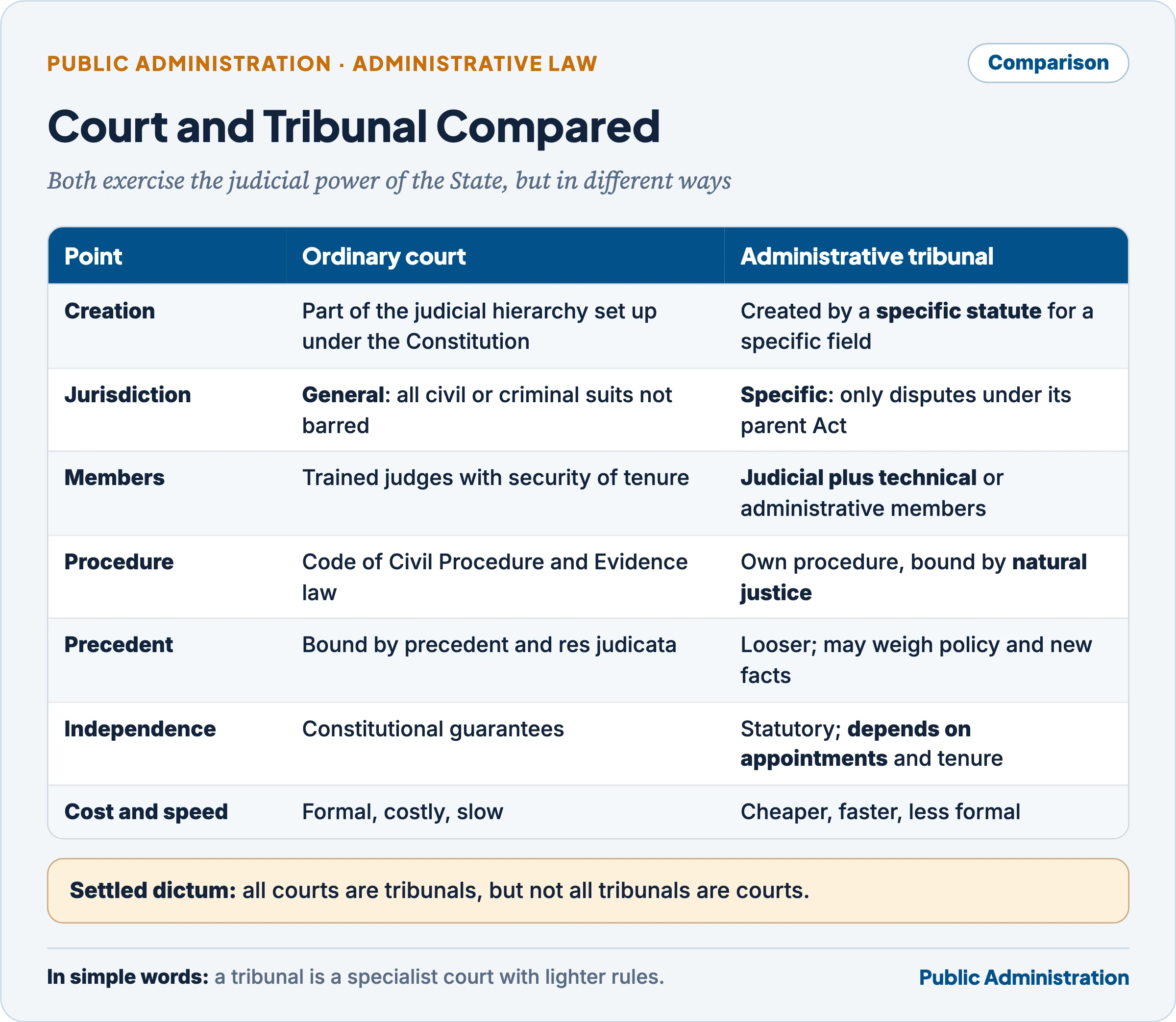
A tribunal does the work of a court for one subject, with lighter rules and with experts on the bench. Every court is a kind of tribunal (a body that decides disputes), but a tribunal is not a court unless the law makes it one.
3.1 What they share
- Both are created by law and exercise the judicial power of the State.
- Both decide disputes between parties finally (subject to appeal or review), and their decisions bind.
- Both must act impartially and objectively; both are subject to the supervisory jurisdiction of the High Courts and to appeal or special leave to the Supreme Court.
- Many tribunals have powers of a civil court for summons, discovery and evidence on oath, and some can punish for contempt of themselves.
3.2 Where they differ
| Point | Ordinary court | Administrative tribunal |
|---|---|---|
| Place in system | Part of the constitutional hierarchy of courts | Outside the hierarchy; created by a specific statute |
| Jurisdiction | General: any civil or criminal matter not barred | Specific: only disputes under the parent law |
| Bench | Judges trained in law, with constitutional security of tenure | Judicial members with technical or administrative members |
| Procedure | Code of Civil Procedure, Evidence Act (now the Bharatiya Sakshya Adhiniyam, 2023) | Own procedure, bound only by natural justice and the parent Act |
| Precedent | Bound by precedent and by res judicata | Follows precedent more loosely; can weigh policy and new facts |
| Vires of the law | Can decide validity of any law | Cannot decide validity of its own parent statute (L. Chandra Kumar, 1997) |
| Independence | Guaranteed by the Constitution (tenure, salaries, removal) | Depends on statute: selection, tenure and service conditions |
| Approach | Adversarial, legal rights of parties | Can be inquisitorial and policy-informed |
| Cost and speed | Formal, costly, slow | Cheaper, faster, informal |
- Res judicata is the rule that a matter finally decided cannot be reopened between the same parties. Courts apply it strictly; tribunals often have statutory power to review their own decisions when new facts emerge.
- The single most important difference is the last-but-two: a court’s independence is constitutional, a tribunal’s is statutory. Everything Parliament gives a tribunal, Parliament can take away, which is why the courts have read independence into Articles 14, 50 and the basic structure.
Common confusion
Are all tribunals courts, or are all courts tribunals? The settled position is that all courts are tribunals, but not all tribunals are courts. In Harinagar Sugar Mills v Shyam Sundar Jhunjhunwala (1961) the Supreme Court explained that “courts” means the ordinary courts of civil judicature, while “tribunals” are bodies appointed to decide controversies under special laws; both act judicially, but a tribunal has only some of the trappings of a court. A tribunal is therefore the wider category. The statement “all tribunals are courts, but all courts are not tribunals” reverses this: it is accurate only in the loose sense that tribunals do court-like work, and a full explanation must point out that the legal dictum runs the other way.
4. Types of Tribunals
In simple words
Tribunals can be sorted in three ways: by the kind of dispute they hear, by the constitutional or legal power that created them, and by where an appeal from them goes.
4.1 By function
| Type | What they decide | Indian examples |
|---|---|---|
| Service tribunals | Recruitment and conditions of service of public servants | CAT, State Administrative Tribunals, Armed Forces Tribunal |
| Tax tribunals | Appeals against assessments | ITAT, CESTAT, GSTAT |
| Economic and commercial | Company law, insolvency, debt recovery, securities | NCLT, NCLAT, DRT, DRAT, Securities Appellate Tribunal |
| Regulatory appellate | Appeals against sector regulators | TDSAT (telecom), APTEL (electricity), NCLAT (competition) |
| Environmental | Environmental disputes and compensation | National Green Tribunal |
| Consumer | Deficiency in goods and services | District, State and National Consumer Commissions |
| Labour | Industrial disputes | Central Government Industrial Tribunals |
| Federal | Disputes between States | Inter-State river water disputes tribunals |
| Claims | Compensation | Railway Claims Tribunal, motor accident claims tribunals |
4.2 By source of power
- Under Article 323A: administrative tribunals for service matters only (CAT, SATs).
- Under Article 323B: tribunals for the subjects listed there (taxation, foreign exchange, industrial disputes, land reforms, urban ceiling, elections, essential goods, rent and tenancy, offences).
- Under ordinary legislative power: in Union of India v R. Gandhi (2010) the Supreme Court held that Articles 323A and 323B are enabling, not exhaustive: Parliament and State legislatures can create tribunals on any subject in their lists of the Seventh Schedule. The NCLT, NGT and consumer commissions rest on this power.
- Under Article 262: tribunals for inter-State river water disputes, created under a law of Parliament.
4.3 By status relative to the High Court
- Substitutes for the High Court: appeals lie directly to the Supreme Court (NGT, NCLAT, AFT, NCDRC, SAT, TDSAT, APTEL). These raise the sharpest independence questions because they replace a constitutional court.
- Subordinate to the High Court: appeals lie to the High Court (ITAT, CESTAT, DRAT, Railway Claims Tribunal, industrial tribunals).
- Service tribunals after 1997: the CAT’s orders are reviewed by a Division Bench of the High Court under Articles 226 and 227, and then by the Supreme Court.
4.4 Other classifications
- Statutory tribunals (created by Acts) versus domestic tribunals (disciplinary bodies of professions or organisations, such as a Bar Council’s disciplinary committee, or a departmental disciplinary authority).
- Permanent tribunals versus ad hoc tribunals (an inter-State water tribunal set up for one dispute, or an industrial tribunal for one reference).
- Single-member versus multi-member benches.
- Country models: Britain has a unified two-tier tribunal system; France has a separate hierarchy of administrative courts topped by the Conseil d’État; the United States confines agency adjudication to quasi-judicial functions subject to full review by courts (Article III of its Constitution reserves judicial power to courts). India sits between Britain and France: many separate tribunals, but under the supervision of ordinary constitutional courts.
5. Tribunals in the United Kingdom
In simple words
Britain first feared tribunals as a back door to bureaucratic despotism. Over a century it reformed them step by step until they became an independent second branch of the judiciary with its own appeal court.
5.1 The early suspicion
- Dicey’s legacy: Dicey’s rule of law (1885) assumed that every dispute with officials should go to the ordinary courts; special administrative jurisdictions looked to him like the French droit administratif, which he wrongly saw as a shield for officials. (See the article on meaning, scope and Dicey.)
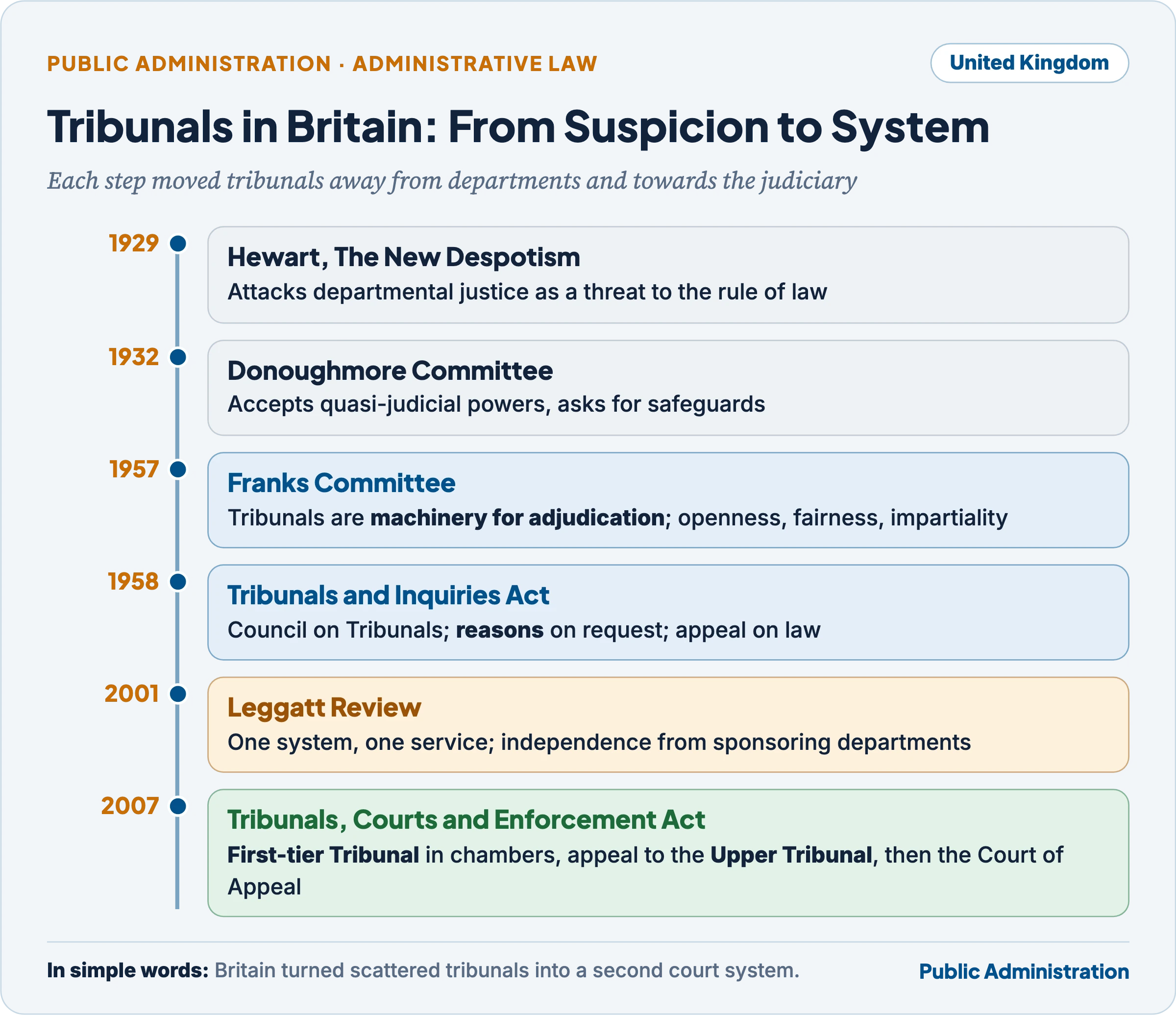
- Lord Hewart, Lord Chief Justice, in The New Despotism (1929) attacked the growth of ministerial rule-making and departmental adjudication as a threat to Parliament and the courts.
- Donoughmore Committee on Ministers’ Powers (1932) accepted that delegated legislation and quasi-judicial decisions by ministers were unavoidable, but asked for safeguards: impartiality, a hearing, reasons, and appeal on points of law.
- Tribunals multiplied after the Second World War with the welfare state (national insurance, national assistance, national health service, rent).
5.2 The Franks Committee (1957)
- The Committee on Administrative Tribunals and Enquiries, chaired by Sir Oliver Franks, was set up in 1955 amid public concern over the handling of land by government (the Crichel Down affair) and reported in July 1957.
- Central finding: tribunals are machinery for adjudication, not part of the administration. Parliament had deliberately provided for decisions outside and independent of the department concerned.
- Three guiding principles:
- Openness: proceedings in public; reasons for decisions known; parties aware of the case against them.
- Fairness: a clear procedure that lets parties know their rights, present their case fully and meet the case against them.
- Impartiality: freedom from the influence, real or apparent, of the departments concerned.
- Key recommendations: a standing Council on Tribunals; chairmen with legal qualifications appointed by the Lord Chancellor, not ministers; reasoned decisions; a general right of appeal on points of law to the courts; legal representation in most tribunals.
- The Committee did not find widespread injustice; it found much to commend, and aimed to make justice visibly fair.
5.3 The Tribunals and Inquiries Act 1958 and after
- Tribunals and Inquiries Act 1958 gave effect to most of Franks:
- set up the Council on Tribunals to keep the working of tribunals under review;
- required tribunals to give reasons for decisions on request;
- provided appeal on points of law from many tribunals to the High Court;
- limited ministerial removal of tribunal members.
- Later Acts of 1971 and 1992 consolidated this law. But the system remained fragmented: around seventy tribunals, many still administered and funded by the very departments whose decisions they reviewed.
5.4 The Leggatt Review (2001)
- Sir Andrew Leggatt, a retired Lord Justice of Appeal, reported in 2001 under the title Tribunals for Users: One System, One Service.
- Diagnosis: tribunals were neither independent nor coherent; users faced a confusing maze; sponsoring departments controlled budgets and staff.
- Remedy: a single Tribunals Service independent of user departments; tribunals grouped into divisions; a common appellate tier; tribunals made user-friendly so that people could present their own cases.
5.5 The Tribunals, Courts and Enforcement Act 2007
- Created a unified two-tier structure:
- First-tier Tribunal, organised in chambers (for example social entitlement, tax, immigration and asylum, property, health and education).
- Upper Tribunal, which hears appeals on points of law from the First-tier, and is a superior court of record; it can also exercise a judicial review jurisdiction in some cases.
- Further appeal lies to the Court of Appeal on important points.
- Created the office of the Senior President of Tribunals, a senior judge who leads the tribunal judiciary.
- Gave tribunal members the title of tribunal judges and placed them under the statutory guarantee of judicial independence.
- Replaced the Council on Tribunals with the Administrative Justice and Tribunals Council (itself abolished in 2013).
- A single administrative agency now runs both courts and tribunals (HM Courts and Tribunals Service, since 2011). Employment tribunals have their own appeal tribunal.
| Stage | Diagnosis | Main remedy |
|---|---|---|
| Hewart, 1929 | Tribunals as “new despotism” | Return power to courts |
| Donoughmore, 1932 | Delegation unavoidable | Safeguards, not abolition |
| Franks, 1957 | Tribunals are adjudicators | Openness, fairness, impartiality; Council on Tribunals |
| Leggatt, 2001 | Fragmented and departmental | One system, one service |
| TCEA, 2007 | Need for a coherent judiciary of tribunals | Two-tier system, Senior President, judicial status |
The British lesson is that independence came through structure: separate administration, judicial leadership, uniform appeals and judicial titles. India has tried to reach the same goal through litigation and has only begun, in 2026, to build a common administrative body.
6. The Constitutional Basis in India: Articles 323A and 323B
In simple words
India’s Constitution originally said nothing special about tribunals. In 1976 Parliament added a new Part that allows Parliament to create tribunals for government service disputes, and allows Parliament and State legislatures to create tribunals for a list of other subjects.
6.1 The 42nd Amendment, 1976
- Section 46 of the Constitution (Forty-second Amendment) Act, 1976 inserted Part XIVA, “Tribunals”, with Articles 323A and 323B.
- It also amended Article 227 so that High Courts’ superintendence would not extend to certain tribunals, and Article 136 already permitted special leave appeals against “any court or tribunal”.
6.2 Article 323A: administrative tribunals
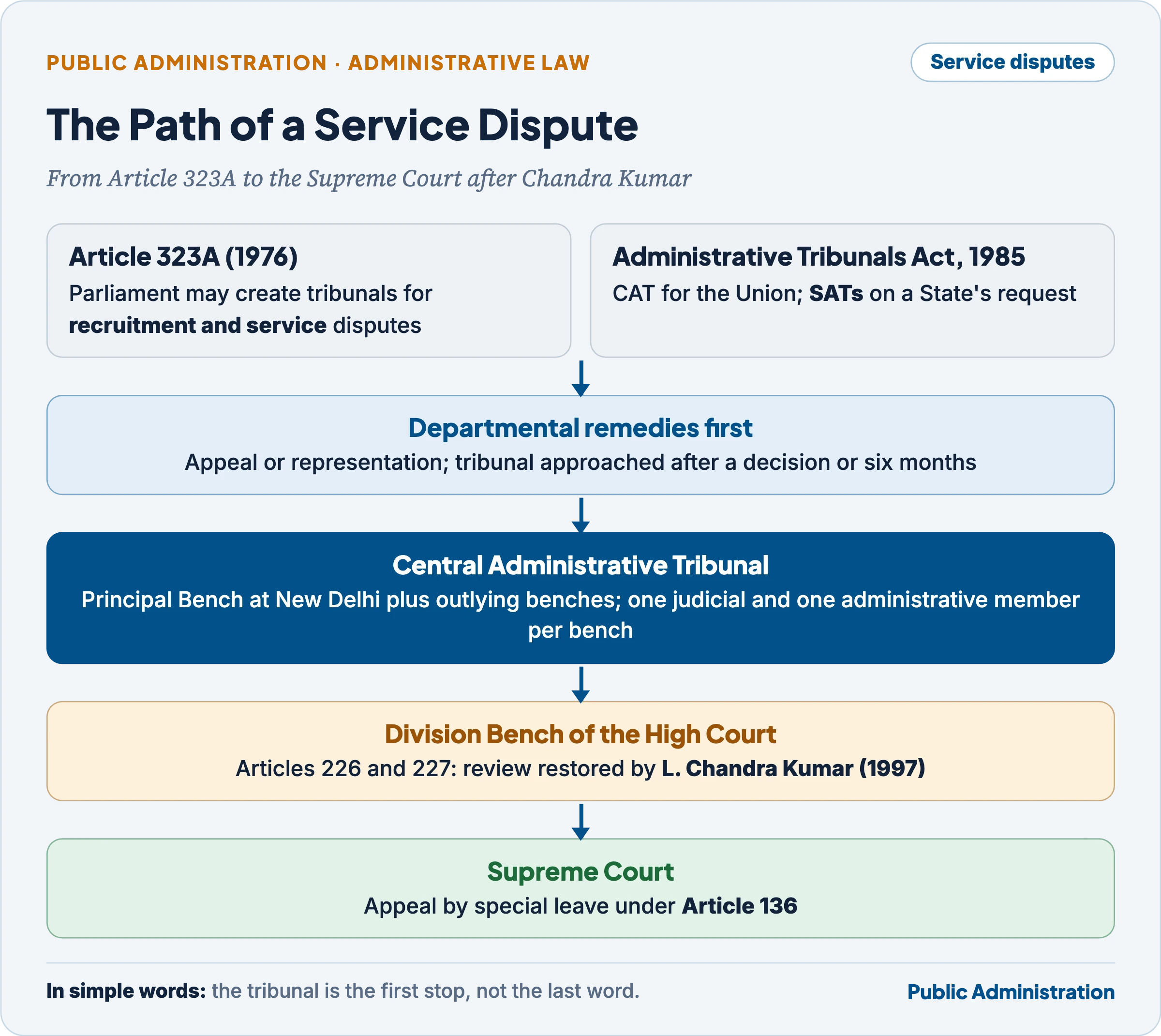
- Clause (1): Parliament may by law provide for adjudication by administrative tribunals of disputes and complaints about recruitment and conditions of service of persons appointed to public services and posts in connection with the affairs of the Union, a State, a local or other authority, or a corporation owned or controlled by the government.
- Clause (2) allows such a law to:
- establish an administrative tribunal for the Union and a separate one for each State or for two or more States;
- specify their jurisdiction, powers (including contempt) and procedure;
- exclude the jurisdiction of all courts except the Supreme Court under Article 136 (clause 2(d));
- transfer pending cases to the new tribunals.
6.3 Article 323B: tribunals for other matters
- Parliament or a State legislature, within its legislative competence, may provide for tribunals for matters listed in clause (2):
- levy, assessment, collection and enforcement of taxes;
- foreign exchange, import and export across customs frontiers;
- industrial and labour disputes;
- land reforms (acquisition of estates and rights in them);
- ceiling on urban property;
- elections to Parliament and State legislatures (other than matters under Articles 329 and 329A);
- production, procurement, supply and distribution of foodstuffs and essential goods, and price control;
- rent, its regulation and tenancy (added by the 75th Amendment, 1994);
- offences against these laws and incidental matters.
- Like 323A, clause (3)(d) permitted exclusion of courts’ jurisdiction except under Article 136.
6.4 Articles 323A and 323B compared
| Point | Article 323A | Article 323B |
|---|---|---|
| Subject | Only public service matters | A list of subjects (tax, land, labour, elections and others) |
| Who legislates | Parliament only | Parliament or State legislatures, as per their competence |
| Structure | One tribunal for the Union and one for each State (or joint) | A hierarchy of tribunals may be created |
| Example | CAT, SATs | Tax and industrial tribunals, State land tribunals |
| Exclusion of courts | Permitted by clause 2(d), struck down in 1997 | Permitted by clause 3(d), struck down in 1997 |
- After L. Chandra Kumar (1997), the clauses allowing exclusion of the High Courts’ and the Supreme Court’s writ jurisdiction are unconstitutional to that extent. The rest of the two articles remains valid.
- After R. Gandhi (2010), these articles are not the only source of power to create tribunals.
Common confusion
Does every tribunal in India owe its existence to Articles 323A and 323B? No. Article 323A covers only service tribunals, and 323B a fixed list. Bodies such as the National Green Tribunal, the NCLT and the consumer commissions are created under Parliament’s ordinary legislative power over subjects in the Union and Concurrent Lists, as the Supreme Court confirmed in R. Gandhi (2010). Inter-State water tribunals rest on Article 262. The Income Tax Appellate Tribunal (1941) is older than the Constitution itself.
7. The Administrative Tribunals Act, 1985: CAT and SATs
In simple words
Under Article 323A, Parliament passed a law in 1985 that set up one Central Administrative Tribunal for Union government employees and allowed each State to ask for its own tribunal. A government servant who is denied a promotion or punished unfairly goes to this tribunal instead of filing a case in the High Court.
7.1 The Act and its establishment
- The Administrative Tribunals Act, 1985 (Act 13 of 1985) received assent on 27 February 1985. The Central Administrative Tribunal (CAT) came into existence on 1 November 1985.
- The Act was amended in 1986 and 1987 to give effect to the Supreme Court’s directions in the Sampath Kumar case (restoring Article 32 jurisdiction and changing appointment rules), and substantially in 2006 (Act 1 of 2007).
- Three kinds of tribunal under the Act:
- the Central Administrative Tribunal, for Union employees;
- State Administrative Tribunals (SATs), set up by the Union government on the request of a State (section 4(2));
- Joint Administrative Tribunals for two or more States.
7.2 Composition of the CAT
- Chairman and members: the CAT has a Chairman (qualified to be, or who has been, a High Court judge; in practice usually a retired High Court Chief Justice) and judicial and administrative members.
- The 2006 amendment abolished the post of Vice-Chairman as a separate rank, giving all members equal status; a member may be designated “Vice-Chairman” only to perform administrative functions at a bench.
- Strength: in September 2025 the CAT comprised 69 members (35 judicial including the Chairman, and 34 administrative), working through a Principal Bench at New Delhi and 18 outlying benches, besides circuit sittings.
- Benches: a bench ordinarily has one judicial and one administrative member, combining knowledge of service law with knowledge of how government works.
- Qualifications after 2006:
- Judicial member: qualified to be a High Court judge, or a senior officer of the Indian Legal Service or Department of Legal Affairs with specified service.
- Administrative member: two years as Secretary to the Government of India, or five years as Additional Secretary, or equivalent.
- Appointment: originally by the President after consultation with the Chief Justice of India. Selection is now governed by the Supreme Court’s directions in the Madras Bar Association cases and, from 2026, by the National Tribunals Commission (see section 9 below).
- Tenure: the 2006 amendment gave five-year terms (renewable once for members), with age limits of 68 for the Chairman and 65 for members. Today the Court’s directions require a five-year term, with retirement at 70 for chairpersons and 67 for members; the 2026 Act provides five years or age 67 for members.
- Removal: only on proved misbehaviour or incapacity after an inquiry by a Supreme Court judge (section 9 of the 1985 Act).
- Post-retirement bar: a CAT Chairman cannot take further government employment; members may move only to higher posts within tribunals, and no former member may appear before the tribunal in which he served (section 11).
7.3 Jurisdiction and powers
- Section 14 gives the CAT, from the appointed day, all the jurisdiction, powers and authority previously exercisable by all courts (except the Supreme Court) in service matters of:
- members of the All India Services;
- persons in any civil service of the Union or holding a civil post under the Union;
- civilians in defence services or posts connected with defence;
- employees of local authorities, corporations and societies notified under section 14(2): over 230 public sector undertakings and organisations were covered by 2025.
- Excluded by section 2: members of the armed forces (they go to the Armed Forces Tribunal), officers and staff of the Supreme Court and High Courts, and the secretarial staff of Parliament.
- “Service matters” include remuneration, pension, seniority, promotion, confirmation, leave, disciplinary matters and tenure.
- Powers: the CAT can exercise powers of a civil court for summons, documents and evidence (section 22(3)); it has the power to punish for contempt of itself, as a High Court does (section 17); its orders are executed like court decrees.
- Exclusion of jurisdiction (section 28): courts other than the Supreme Court were barred from service matters. After 1997 this survives only to bar civil courts and the original jurisdiction of High Courts; the CAT is now the court of first instance, with review by the High Court.
7.4 Procedure
- Application (section 19): an aggrieved person files an Original Application with a nominal fee (₹50).
- Exhaustion of remedies (section 20): the tribunal ordinarily admits an application only after the applicant has used departmental appeals or representations, or after six months have passed without a decision.
- Limitation (section 21): generally one year from the final order, with power to condone delay for sufficient cause.
- Procedure (section 22): the tribunal is not bound by the Code of Civil Procedure, is guided by the principles of natural justice, and may regulate its own procedure.
- Representation: in person or through a legal practitioner.
- After the decision: writ petition to a Division Bench of the High Court within whose territory the bench sits, then special leave to the Supreme Court under Article 136. In Union of India v Alapan Bandyopadhyay (2022) the Supreme Court held that even orders of the CAT’s Chairman transferring cases between benches can be challenged only before the High Court having territorial jurisdiction over the bench concerned.
7.5 State Administrative Tribunals
- Set up only on a State’s request, and so their number has varied. Several States established SATs in the 1980s and 1990s; some later asked for their abolition, finding them costly once the High Court tier was restored in 1997 (Madhya Pradesh and Tamil Nadu among them).
- Odisha: the Union rescinded the notification establishing the Odisha Administrative Tribunal in August 2019 at the State’s request. In Orissa Administrative Tribunal Bar Association v Union of India (21 March 2023), the Supreme Court upheld the abolition: Article 323A is enabling, not mandatory; a State may ask for an SAT to be abolished and the Union may rescind it; abolition does not violate the right of access to justice, because the cases return to the High Court.
- Selection of SAT members now involves the State’s Chief Secretary on the selection committee (2026 Act).
7.6 Effectiveness and utility of the CAT and SATs
| Achievements | Shortcomings |
|---|---|
| About 9.73 lakh cases instituted from 1985 to July 2025, of which about 9.04 lakh were disposed of, a disposal rate near 93 per cent | Pendency of about 69,000 in the CAT and nearly 29,000 in SATs (law ministry, December 2025) |
| Cheap access: ₹50 fee, appearance in person | The extra High Court tier after 1997 made litigation longer and costlier for employees |
| Specialised service jurisprudence developed across benches | Retired officers judge decisions of serving colleagues; doubts about detachment |
| Relieved High Courts of a large class of writs | Government departments, the main litigants, often delay compliance with orders |
| Covers PSUs and autonomous bodies through notifications | Vacancies and short effective tenures; no intra-tribunal appeal; conflicting decisions of benches |
- The 2013 debate: the claim that judicial review of tribunal decisions “defeats the very objective” of tribunals has force in practice: the employee who once went straight from the CAT to the Supreme Court now faces three tiers. But the Supreme Court’s answer is that tribunals manned partly by civil servants and appointed largely by the executive cannot be the final word on the law, so High Court review is the price of their constitutional validity.
- Proposals to resolve it: the Law Commission suggested in its 162nd Report (1998) either a statutory appeal to a High Court Division Bench or a National Appellate Administrative Tribunal with appeal only to the Supreme Court; its 215th Report (2008) asked that L. Chandra Kumar be revisited by a larger bench and favoured an intra-tribunal appeal. A Parliamentary Standing Committee (2006) also preferred restoring the original conception, with any statutory appeal going only to the Supreme Court. None of these has been adopted.
Indian Connect — CAT in the life of the civil service
- Disciplinary penalties, promotion disputes, seniority lists, pay fixation and pension cases of Union employees all begin at the CAT, which makes it the first-line protector of Article 311 (protection against dismissal without inquiry) and Articles 14 and 16 (equality in public employment).
- Senior appointments too reach the CAT: the dispute over disciplinary proceedings against West Bengal’s former Chief Secretary, Alapan Bandyopadhyay (2021–22), reached the Supreme Court on the narrower question of which High Court could review the CAT’s order transferring his case.
- The CAT’s 10th All India Conference (20 September 2025), inaugurated by the Chief Justice of India, focused on faster disposal, technology and compliance with orders.
8. Courts and Tribunals: The Key Judgments
In simple words
Every time Parliament designed tribunals in a way that gave the government a strong hand, someone went to the Supreme Court. Over forty years, case by case, the Court built a rulebook: tribunals may replace courts only if they are as independent as courts.
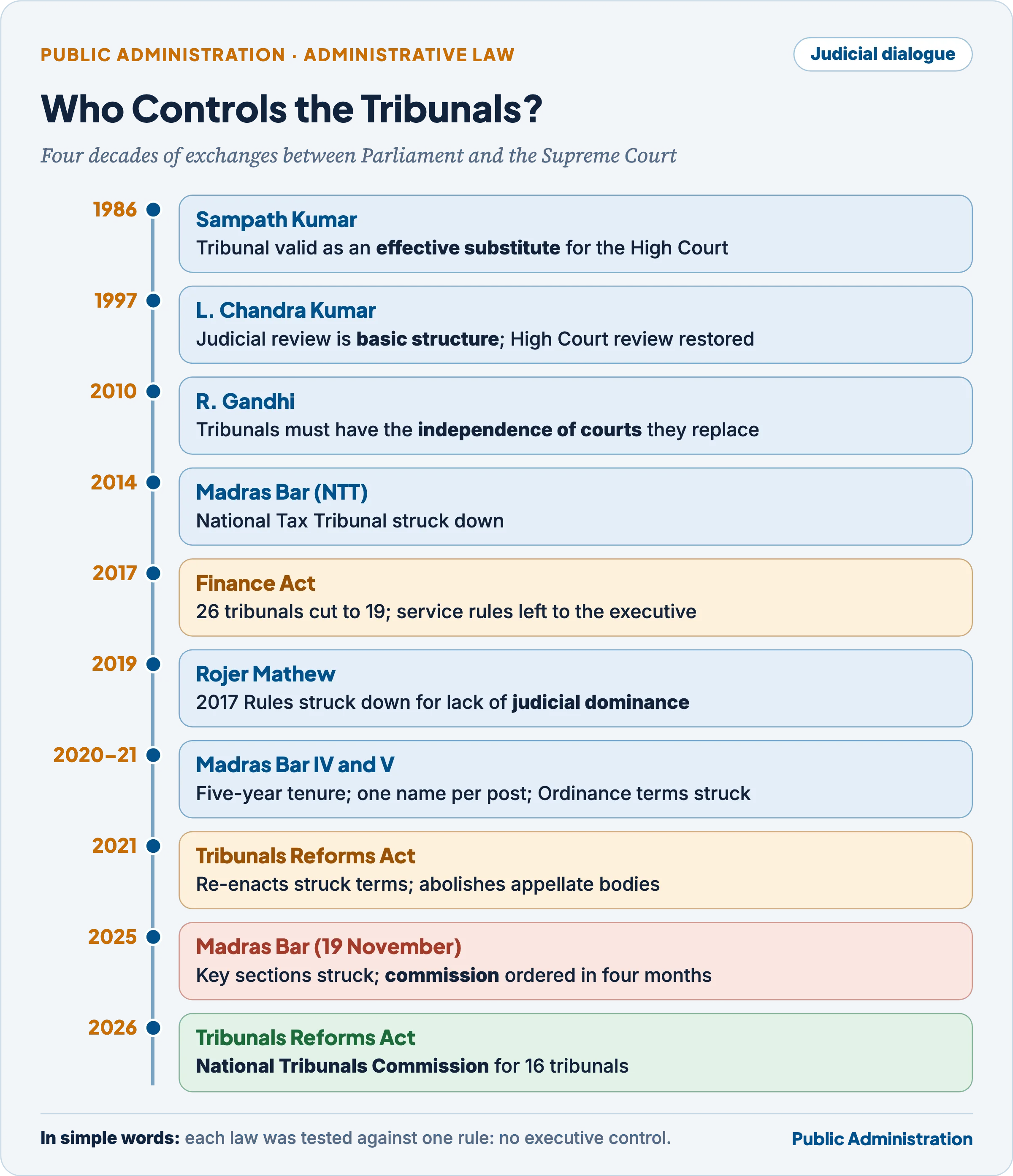
8.1 S.P. Sampath Kumar v Union of India (decided December 1986; reported 1987)
- Challenge: the 1985 Act excluded the High Courts’ writ jurisdiction in service matters. Was this an attack on judicial review, a basic feature of the Constitution?
- Holding (five-judge bench, led by Chief Justice P.N. Bhagwati): the Act was valid. Parliament may set up an alternative institutional mechanism in place of the High Court, provided it is an equally effective substitute.
- Conditions: the tribunal must have the same efficacy as a High Court; appointments must be made by the government only after effective consultation with the Chief Justice of India, or by a high-powered selection committee headed by the CJI or his nominee; the Chairman should ordinarily be a person with judicial experience.
- Significance: it accepted tribunals as substitutes for High Courts, a view later qualified.
8.2 R.K. Jain v Union of India (1993)
- Context: a petition about appointments to the Customs, Excise and Gold (Control) Appellate Tribunal (CEGAT).
- Observations: the Supreme Court expressed anguish at the functioning of tribunals: vacancies, poor quality of some appointments, and the fact that the only remedy against their orders, a special leave petition to the Supreme Court, was costly and distant for ordinary litigants. It suggested that an appeal to a Bench of two judges of the High Court would be cheaper and more accessible, and called for an expert review of tribunals.
- Significance: it paved the way for the rethink in L. Chandra Kumar.
8.3 L. Chandra Kumar v Union of India (18 March 1997)
- Bench: seven judges, opinion by Chief Justice A.M. Ahmadi.
- Holdings:
- The power of judicial review of the High Courts under Articles 226 and 227 and of the Supreme Court under Article 32 is part of the basic structure of the Constitution.
- Article 323A(2)(d) and Article 323B(3)(d), and section 28 of the Act, are unconstitutional to the extent they exclude that jurisdiction.
- Tribunals may still act as courts of first instance in their fields and may even decide the constitutional validity of statutes and rules, except their own parent statute.
- All decisions of tribunals are subject to scrutiny before a Division Bench of the High Court within whose jurisdiction the tribunal falls.
- Tribunals are supplementary to, not substitutes for, the High Courts. Sampath Kumar was overruled on this point.
- Until a wholly independent agency is set up to administer all tribunals, they should be placed under a single nodal ministry, preferably the Ministry of Law.
- Effect: the High Court tier was restored. The judgment is the most cited source for the principle that judicial review cannot be ousted.
Common confusion
Did L. Chandra Kumar abolish administrative tribunals or reduce them to a useless tier? No. The judgment upheld the tribunals and their power to decide cases as courts of first instance, including on the validity of laws other than their parent Act. What it struck down was only the exclusion of the High Courts’ and the Supreme Court’s writ jurisdiction. The extra tier is the consequence, and later reports have debated how to make it quicker (a statutory appeal, an appellate tribunal, or a larger bench to revisit the ruling).
8.4 Union of India v R. Gandhi, President, Madras Bar Association (11 May 2010)
- Context: the National Company Law Tribunal and Appellate Tribunal under the Companies Act, 1956 (Parts IB and IC, inserted in 2002), which were to take over company-law jurisdiction of the High Courts.
- Holdings (Constitution Bench):
- Parliament can create tribunals on subjects in its legislative lists, beyond Articles 323A and 323B.
- If tribunals are to be vested with judicial power hitherto exercised by courts, they must possess the independence, security and capacity associated with courts.
- Where jurisdiction is transferred only for speed, technical members are not needed; where they sit, they must not outnumber judicial members; only Secretary-level officers with specialised knowledge may be technical members.
- Many provisions on qualifications and the selection committee were held defective and were to be corrected.
- Significance: it laid down the “equivalence” principle: a court substitute must be as independent as the court it replaces.
8.5 Madras Bar Association v Union of India (25 September 2014): the National Tax Tribunal case
- Context: the National Tax Tribunal Act, 2005 would have taken over the High Courts’ appellate jurisdiction on substantial questions of law in tax matters.
- Holding (Constitution Bench): the Act was struck down. Deciding substantial questions of law is a core High Court function; transferring it to a body with executive-influenced appointments and the possibility of non-judicial members violated the basic structure (separation of powers, judicial independence and the rule of law).
- Directions: administrative support for tribunals should come from the Ministry of Law and Justice, not from parent ministries; tribunals should not seek facilities from the departments whose cases they decide.
- A further Madras Bar Association judgment in 2015 upheld the NCLT and NCLAT under the Companies Act, 2013, subject to correcting several provisions on members and selection, in line with R. Gandhi.
8.6 Rojer Mathew v South Indian Bank (13 November 2019)
- Context: the Finance Act, 2017 merged tribunals and, through section 184, let the Union government make rules on qualifications, appointment, tenure, salaries and removal of members of 19 tribunals. The 2017 Rules gave the executive a majority on selection committees and short three-year terms.
- Holdings (five-judge bench, Chief Justice Ranjan Gogoi):
- Section 184 was not excessive delegation in itself, but the 2017 Rules were struck down because the lack of judicial dominance in selection committees violated the separation of powers; short tenures and executive removal powers undermined independence.
- The question whether the Finance Act could validly be passed as a Money Bill was referred to a larger bench.
- The Court asked the government to conduct a judicial impact assessment of tribunal mergers, to consider amalgamating tribunals and creating a single administrative body, and to reconsider direct appeals to the Supreme Court, which burden it.
8.7 Madras Bar Association IV (27 November 2020) and V (14 July 2021)
- MBA 2020 (three judges, Justice L. Nageswara Rao): examined the 2020 Rules and laid down binding directions:
- selection committees with judicial dominance (the CJI or nominee with a casting vote);
- the committee to recommend one name per post (with one for the waiting list), not a panel the executive can choose from;
- a five-year term, with retirement at 70 for chairpersons and 67 for members;
- advocates with ten years’ practice eligible as judicial members;
- the Union to set up a National Tribunals Commission to supervise appointments, functioning and administration.
- The 2021 Ordinance: the Tribunals Reforms (Rationalisation and Conditions of Service) Ordinance of 4 April 2021 reintroduced a four-year term, a minimum age of 50, and a panel of two names.
- MBA 2021: the Court struck down the four-year tenure and the minimum age of 50 as an impermissible legislative override of its earlier directions.
8.8 Madras Bar Association v Union of India (19 November 2025)
- Context: within a month of MBA 2021, Parliament passed the Tribunals Reforms Act, 2021, which re-enacted the struck-down provisions of the Ordinance.
- Bench: Chief Justice B.R. Gavai and Justice K. Vinod Chandran; opinion by the Chief Justice, with a short concurrence.
- Holdings:
- The Court refused the Union’s request to refer the case to a larger bench: no new question arose, since everything had been settled in the earlier Madras Bar and Rojer Mathew judgments.
- Parliament cannot override a judicial decision by re-enacting the same measure in another form; it may only cure the defect the Court identified. Re-enacting provisions found unconstitutional is “legislative override in the strictest sense”.
- Sections 3, 4, 5, 6 and 7 of the 2021 Act (minimum age of 50, four-year tenure, two-name panels, and pegging allowances to civil-service equivalents) were struck down.
- The principles and directions of MBA 2020 and MBA 2021 continue to govern appointment, qualifications, tenure and service conditions until Parliament cures the defects.
- Selections made by selection committees before the 2021 Act (for example 2018 selections to the ITAT and CESTAT) are governed by the old parent Acts: members of those tribunals so selected serve to 62, and chairpersons to 65.
- The Union was directed to set up a National Tribunals Commission within four months.
- Significance: the judgment treated judicial independence as an operative test, not an abstract principle, and expressed the Court’s disapproval of the Union’s repeated refusal to accept settled rulings. It is reported as (2026) 2 SCC 1.
8.9 Principles distilled from the case law
| Principle | Source |
|---|---|
| Tribunals may be created, even as courts of first instance | Sampath Kumar; Chandra Kumar |
| Judicial review by High Courts and the Supreme Court cannot be excluded | Chandra Kumar |
| A tribunal replacing a court must have the court’s independence | R. Gandhi; MBA 2014 |
| Technical members only where expertise is needed; never outnumbering judges | R. Gandhi |
| Judicial dominance in selection; executive not a dominant voice | Rojer Mathew; MBA 2020 |
| Five-year terms; 70 and 67 as retirement ages | MBA 2020; MBA 2021 |
| Administration through the Law Ministry or an independent commission | Chandra Kumar; MBA 2014; MBA 2020; MBA 2025 |
| Parliament may cure, not override, a judgment | MBA 2021; MBA 2025 |
9. Rationalisation of Tribunals, 2017 to 2026
In simple words
By 2015 India had many small tribunals, some idle, some swamped, each run by a different ministry. The government began to merge and close them. But each reform also tried to give the government more control over appointments, and each was challenged in court, until a common commission was finally created in 2026.
9.1 The Finance Act, 2017
- Part XIV of the Finance Act, 2017 merged tribunals on grounds of functional similarity, cutting their number from 26 to 19. Examples:
- the Competition Appellate Tribunal merged with the NCLAT (from 26 May 2017);
- the Cyber Appellate Tribunal and the Airports Economic Regulatory Authority Appellate Tribunal merged with TDSAT;
- the Appellate Tribunal for Foreign Exchange merged with the Appellate Tribunal under SAFEMA;
- the Employees’ Provident Fund Appellate Tribunal merged with the Central Government Industrial Tribunals;
- the Railway Rates Tribunal merged with the Railway Claims Tribunal;
- the Copyright Board merged with the Intellectual Property Appellate Board.
- Section 184 gave the Union power to prescribe by rules the qualifications, appointment, tenure, salaries and removal of members of these tribunals.
- Controversies: (i) the Act was passed as a Money Bill, bypassing the Rajya Sabha’s full role, though its tribunal provisions had little to do with taxation or expenditure; (ii) service conditions were left to executive rules; (iii) no judicial impact assessment was done.
9.2 The Tribunals Reforms Act, 2021
- The Tribunals Reforms (Rationalisation and Conditions of Service) Bill, 2021 was introduced on 13 February 2021; as it was not passed in that session, an Ordinance of 4 April 2021 was promulgated, later replaced by the Tribunals Reforms Act, 2021 (Act 33 of 2021), notified on 13 August 2021.
- Abolished appellate bodies and transferred their work to High Courts, commercial courts or civil courts, including:
- the Film Certification Appellate Tribunal under the Cinematograph Act, 1952;
- the Intellectual Property Appellate Board, which heard trade mark, patent, copyright and geographical indication appeals;
- the Airport Appellate Tribunal;
- the Plant Varieties Protection Appellate Tribunal;
- the Authority for Advance Rulings under the Income-tax Act, among others.
- Uniform service conditions for the 16 tribunals in its First Schedule: a selection committee headed by the CJI or nominee recommending two names, a four-year term, retirement at 70 and 67, and a minimum age of 50. Sections 183 and 184 of the Finance Act and its Eighth Schedule were omitted.
- Rationale given: data showed that tribunals in several sectors had not delivered faster justice and were costly; the Court itself had criticised direct appeals from tribunals to the Supreme Court.
- Criticism: the abolitions were made without consultation or judicial impact assessment; specialised work moved to already overburdened High Courts (the Delhi High Court responded by creating an Intellectual Property Division in 2021); and the service provisions defied MBA 2020 and 2021.
9.3 The Tribunals Reforms Act, 2026 and the National Tribunals Commission
- Background: the idea of an independent body to administer tribunals goes back to L. Chandra Kumar (1997); the Parliamentary Standing Committee on Personnel, Public Grievances, Law and Justice (2015) recommended a National Tribunals Commission (NTC); the Court directed one in MBA 2020 and again, with a four-month deadline, in November 2025.
- Passage: the Tribunals Reforms Bill, 2026 was introduced and passed in August 2026 (passed by the Lok Sabha without debate), and received assent on 13 August 2026. It repeals the 2021 Act.
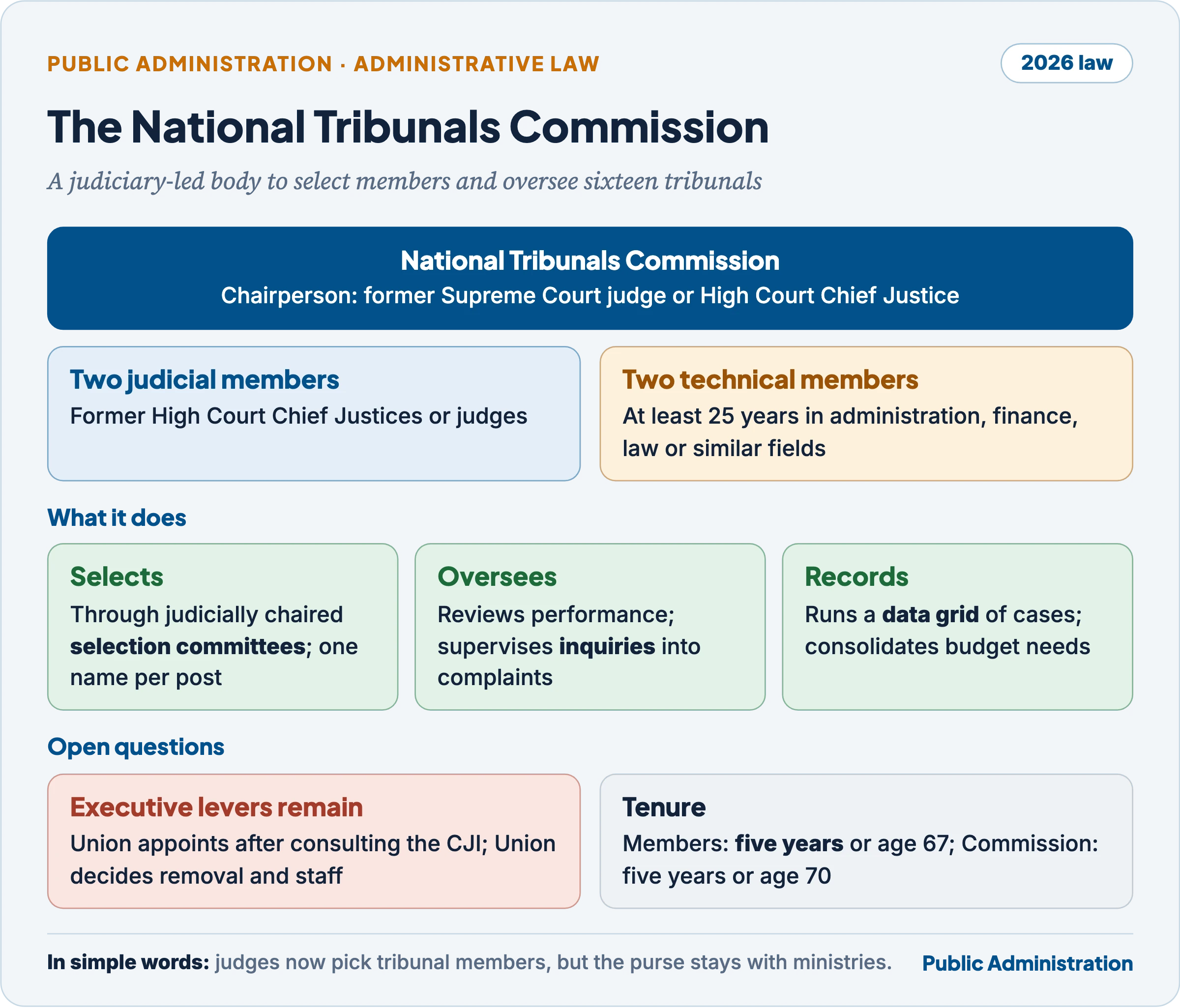
- Coverage: 16 tribunals, including the CAT and SATs, CESTAT, ITAT (now under the Income-tax Act, 2025), NCLAT, NGT, AFT, NCDRC, SAT, TDSAT, APTEL, DRT and DRAT, the Railway Claims Tribunal, the SAFEMA Appellate Tribunal and Central Government Industrial Tribunals (under the Industrial Relations Code, 2020).
- Composition of the NTC: a Chairperson who has been a Supreme Court judge or a High Court Chief Justice; two judicial members (former High Court Chief Justices or judges); two technical members with at least 25 years’ experience in public administration, finance, law, accountancy, banking, management or technology. The Union appoints the Chairperson and judicial members after consulting the CJI.
- Functions:
- conducts selection of chairpersons and members through search-cum-selection committees chaired by the NTC Chairperson (for chairpersons) or a judicial member (for members), with a casting vote for the chair; a Union Secretary (or a State’s Chief Secretary for SATs) and nominees of the NTC sit on them, and experts assess candidates but do not vote;
- recommends one candidate per vacancy plus one for the waiting list; the Secretariat forwards recommendations within three days and the government must appoint within three months;
- reviews performance and prepares annual reports; supervises inquiries into complaints against members;
- maintains a National Tribunals Data Grid of all cases in the 16 tribunals;
- consolidates the financial, staffing and premises needs of tribunals; the CAG audits the Commission, and its reports are laid before Parliament.
- Tenure: members of tribunals hold office for five years or until 67; NTC members for five years or until 70; reappointment is allowed with performance considered.
- Early criticisms:
- “Consultation” with the CJI repeats the language that once fuelled the judges’ appointment cases; it is unclear whether the Union can override the CJI.
- The Union alone may remove NTC and tribunal members on grounds such as insolvency or incapacity, and screens complaints and decides on inquiry reports; vague grounds like “incompetence” invite pressure.
- The NTC’s Secretary is a government appointee not clearly under the Chairperson’s disciplinary control.
- Staff and infrastructure of tribunals remain with parent ministries, which are often the main litigants.
- Hence the law is widely expected to face another round of litigation.
| Reform | Merits | Demerits |
|---|---|---|
| Merging tribunals (2017) | Fewer idle bodies; economies of scale; common rules | Different specialisations lumped together; no impact study; passed as a Money Bill |
| Abolishing appellate bodies (2021) | Ends costly, under-used tribunals; appeals to constitutional courts with secure independence | Loses specialisation; adds to High Court arrears; done without consultation |
| National Tribunals Commission (2026) | Judicial-majority selection; one name per post; performance review; data grid; budget planning | Executive retains removal and staff control; unclear CJI primacy; litigation likely |
10. Other Important Tribunals
In simple words
Besides the service tribunals, India has tribunals for company law, environment, tax, the armed forces, consumers, GST and disputes between States. Each was created because a particular kind of dispute needed speed and expertise.
10.1 An overview
| Tribunal | Law and year | Hears | Appeal lies to |
|---|---|---|---|
| ITAT | Income-tax Act; set up 1941 | Income tax appeals | High Court |
| CESTAT | Customs Act, 1962 | Customs, excise, service tax | High Court; Supreme Court in some matters |
| NCLT and NCLAT | Companies Act, 2013; functioning from June 2016 | Company law; insolvency under the IBC, 2016; NCLAT also hears appeals against the Competition Commission | NCLAT, then Supreme Court |
| DRT and DRAT | Recovery of Debts and Bankruptcy Act, 1993 | Bank debt recovery; personal insolvency | DRAT, then High Court |
| Armed Forces Tribunal | AFT Act, 2007; functioning from 2009 | Service matters and court-martial appeals of the armed forces | Supreme Court |
| National Green Tribunal | NGT Act, 2010; set up October 2010 | Environmental civil cases, appeals, compensation | Supreme Court within 90 days |
| Consumer commissions | Consumer Protection Act, 2019 (earlier 1986) | Complaints of deficiency in goods and services | Up the tiers, then Supreme Court |
| GSTAT | CGST Act, 2017, section 109; launched 2025 | Second appeals in GST; anti-profiteering | High Court and Supreme Court |
| TDSAT, APTEL, SAT | TRAI Act 1997; Electricity Act 2003; SEBI Act 1992 | Appeals against regulators | Supreme Court |
| Inter-State water tribunals | Article 262; ISRWD Act, 1956 | Disputes between States over river waters | Courts barred; Supreme Court via Article 136 as interpreted |
10.2 National Green Tribunal
- Structure: Principal Bench at New Delhi; zonal benches at Bhopal, Pune, Kolkata and Chennai. Chairperson a former Supreme Court judge or High Court Chief Justice; judicial members and expert members with scientific or administrative experience in environment.
- Jurisdiction: civil cases raising a substantial question relating to environment under seven Acts in Schedule I (the Water Act, Water Cess Act, Forest (Conservation) Act, Air Act, Environment (Protection) Act, Public Liability Insurance Act and Biological Diversity Act); appeals against orders under these Acts; relief and compensation to victims of pollution and restoration of environment.
- Principles it must apply (section 20): sustainable development, the precautionary principle and the polluter pays principle.
- Procedure: not bound by the Code of Civil Procedure; guided by natural justice; aims to dispose of cases within six months; appeal to the Supreme Court within 90 days.
- Suo motu power: in Municipal Corporation of Greater Mumbai v Ankita Sinha (7 October 2021) the Supreme Court held that the NGT is a sui generis forum that can take up matters on its own within its environmental domain, because it performs preventive and remedial functions, not just adjudication.
- The “hindrance to development” debate (Paper II, 2016):
- Critics’ case: orders such as the ban on older diesel vehicles in the National Capital Region (2015), the halting of construction, mining and industrial projects, and heavy environmental compensation have imposed costs, created uncertainty for investors and sometimes amounted to policy-making by a tribunal; some orders have been set aside or modified by the Supreme Court; vacancies have reduced benches.
- Defenders’ case: the NGT enforces laws Parliament itself passed; its directions respond to regulatory failure by pollution control boards; development that destroys air, water and forests is not development in the sense of Article 21; the principle of sustainable development reconciles both; and its speed (compared with High Courts) actually reduces uncertainty.
- Balanced view: the tribunal’s legitimacy depends on reasoned, evidence-based orders with attention to economic costs and on full benches of judicial and expert members.
10.3 Consumer commissions
- The Consumer Protection Act, 2019 (in force from July 2020) replaced the 1986 Act and created a three-tier quasi-judicial structure: District, State and National Consumer Disputes Redressal Commissions.
- Pecuniary jurisdiction (rules of December 2021): District up to ₹50 lakh; State above ₹50 lakh up to ₹2 crore; National above ₹2 crore.
- Features: simple complaints, e-filing, mediation, product liability, appearance without lawyers. The NCDRC is now one of the 16 tribunals under the National Tribunals Commission.
10.4 Goods and Services Tax Appellate Tribunal (GSTAT)
- Long delay: GST began on 1 July 2017, but its appellate tribunal under section 109 of the CGST Act took eight years to become functional; meanwhile second appeals went to High Courts as writs, adding to arrears.
- Launch: the Finance Minister formally launched the GSTAT in New Delhi on 24 September 2025, with an e-courts portal. Its President is Justice (retd.) Sanjaya Kumar Mishra.
- Structure: a Principal Bench at New Delhi and 31 State Benches sitting at about 45 locations; each State bench has two judicial members, one technical member (Centre) and one technical member (State), a design that reflects cooperative federalism in GST.
- Functioning: the first hearing by the Principal Bench took place on 18 December 2025, and staggered filing of backlog appeals was allowed until 30 June 2026. It is the final fact-finding forum in GST disputes and hears anti-profiteering cases.
10.5 Armed Forces Tribunal
- Created by the Armed Forces Tribunal Act, 2007 to decide service matters and appeals against court-martial verdicts of members of the Army, Navy and Air Force, who are outside the CAT.
- Article 227(4) excludes High Courts’ superintendence over courts and tribunals under laws relating to the armed forces, and appeals lie to the Supreme Court. The Law Commission (272nd Report) argued that the right to approach the High Court under Article 226 should remain available.
- Vacancies have been chronic; in March 2021, 23 of 34 posts of members were vacant, and the AFT was among seven tribunals without a regular chairperson in December 2025.
10.6 Inter-State river water tribunals (Paper II, 2022)
- Article 262 lets Parliament provide for adjudication of disputes about inter-State rivers and bar the jurisdiction of the Supreme Court and other courts. Parliament passed the Inter-State River Water Disputes Act, 1956.
- The Union government’s role in adjudication:
- on a State’s request, and if negotiation fails, the Union must constitute a tribunal (within one year, after the 2002 amendment);
- it notifies the tribunal’s award in the Gazette; after 2002 the award has the force of a decree of the Supreme Court;
- it may frame schemes to implement the award; for the Cauvery, after the Supreme Court’s modification of the award in February 2018, the Union set up the Cauvery Water Management Authority (2018);
- it bears the political burden of delay: tribunals have taken decades (the Cauvery tribunal, set up in 1990, gave its final award in 2007).
- Reform: the Inter-State River Water Disputes (Amendment) Bill, 2019, which proposed a single permanent tribunal with benches and a prior Dispute Resolution Committee, passed the Lok Sabha in 2019 but did not become law.
10.7 NCLT, NCLAT and the insolvency test
- The NCLT and NCLAT replaced the Company Law Board, the BIFR and the High Courts’ company jurisdiction, and became the adjudicating authority under the Insolvency and Bankruptcy Code, 2016.
- A September 2025 study of commercial tribunals found that insolvency cases at the NCLT took about 752 days on average against the Code’s outer limit of 330 days, and that both the NCLT and NCLAT relied heavily on contractual staff. In August 2026 the government reported about 14,800 cases pending before the NCLT and 12 of 63 member posts vacant.
11. Problems of the Tribunal System
In simple words
Tribunals were meant to be quick, cheap and expert. In practice many are short of members, have long queues of cases, depend on the ministry whose decisions they review, and are often staffed by retired officials looking for one more job.
11.1 Vacancies
- In December 2025 the Union law ministry told the Rajya Sabha that about 93 of 518 sanctioned member posts (about 18 per cent) were vacant across tribunals, and seven tribunals had no regular chairperson (including the Central Government Industrial Tribunals, CESTAT, the SAFEMA Appellate Tribunal, DRT and DRAT, the Railway Claims Tribunal and the AFT).
- In August 2026, 7 of 39 Debts Recovery Tribunals had no presiding officer, and others held additional charge.
- Why vacancies persist: selection processes depend on the government’s timetable; recommended names are kept pending; short terms mean constant turnover; litigation over service rules froze appointments for years.
11.2 Pendency
| Tribunal (late 2025) | Approximate pending cases |
|---|---|
| DRT and DRAT together | 2.5 lakh |
| CESTAT | 72,000 |
| Central Administrative Tribunal | 69,000 |
| ITAT | 43,000 |
| State Administrative Tribunals | 28,940 |
| Armed Forces Tribunal | 6,900 |
| National Green Tribunal | 5,301 |
| All tribunals | over 5.24 lakh |
- These figures from the law ministry (December 2025) show the central paradox: bodies created to cut delay now carry their own backlogs. A 2025 civil-society study estimated that about ₹24.7 lakh crore (around 7.5 per cent of GDP) was locked in disputes before key commercial tribunals.
11.3 Independence and executive control
- Parent ministry as litigant: the ministry that funds, staffs and houses a tribunal is often the main party before it (the Finance Ministry before tax tribunals; public sector banks, which once housed DRTs in their premises, before DRTs).
- Executive say in appointments: before the 2020 directions, selection committees often had a majority of secretaries; panels of names let the government choose.
- Short and renewable tenures make members look to the government for reappointment.
- Service conditions by rules, which the executive can change.
- Removal and inquiry powers with the government.
11.4 “Retired-judge capture” and post-retirement jobs
- Chairpersons and judicial members are usually retired judges; administrative members are usually retired civil servants.
- Concerns: (i) the prospect of a post-retirement tribunal post may influence decisions before retirement; the former Union Finance and Law Minister Arun Jaitley argued in 2012 that the desire for post-retirement jobs influences pre-retirement judgments; (ii) short residual careers mean little time to build expertise; (iii) retired civil servants judging decisions of their former departments undermines the appearance of impartiality; (iv) tribunals come to be seen as retirement homes rather than a career judiciary.
- Responses: the Law Commission (162nd Report, 1998) proposed recruiting members of the Bar aged 45 to 50 with a path to High Court judgeship; MBA 2020 opened judicial membership to advocates with ten years’ practice; cooling-off periods have been suggested.
11.5 Tribunalisation of justice
- Meaning: the transfer of large areas of judicial work from the constitutional courts to tribunals created and controlled by statute.
- Concerns:
- It shifts adjudication from judges with constitutional guarantees to bodies with statutory ones, weakening the separation of powers.
- Direct appeals from many tribunals to the Supreme Court turn the apex court into a court of first appeal, as the Court itself noted in Rojer Mathew.
- It creates extra tiers (tribunal, appellate tribunal, High Court, Supreme Court) and forum shopping.
- Fragmentation: different qualifications, procedures, tenures and appellate routes; little coordination.
- Access: benches are concentrated in a few cities; in 2025, 18 States had no local DRT.
- Quality: technical members sometimes decide pure questions of law; reasoning varies.
- The opposite view: tribunalisation is a rational institutional response to the complexity and volume of modern disputes, not a random event. Where the right design is chosen (independent selection, adequate benches, appeal on law), tribunals deliver justice that courts could not.
11.6 Other problems
- Non-compliance with orders by government departments and repeated appeals by the government against routine orders.
- Infrastructure and staffing: heavy use of contract staff, poor libraries and IT in some tribunals.
- No uniform code of procedure, so practice varies from tribunal to tribunal.
- Data gaps: until the 2026 data grid, there was no common record of pendency and disposal across tribunals.
Indian Connect — Tribunals and the courts’ own workload
- Tribunals were supposed to relieve the High Courts. After 2021, abolished tribunals’ work returned to them, while tribunals’ orders are routinely challenged in writ petitions.
- The Supreme Court, in its November 2025 judgment, observed that the responsibility for pendency rests equally with the executive and the legislature, who must respect constitutional principles and precedent.
- Hence the reform debate is not “courts or tribunals” but how to design both so that they share the load without weakening independence.
12. Reform Suggestions
In simple words
Many committees and judgments have offered remedies. Most agree on the same few ideas: independent appointment, longer terms, one body to run all tribunals, more benches, and a clear appeal route.
12.1 What the major reviews proposed
| Body | Year | Main proposals on tribunals |
|---|---|---|
| First Administrative Reforms Commission | 1969 | Civil Services Tribunals as final appellate authority for major penalties |
| Swaran Singh Committee | 1976 | Service, labour, revenue and other tribunals; led to Part XIVA |
| Law Commission, 162nd Report | 1998 | Bar members as judicial members; appeal to a High Court Division Bench or a National Appellate Administrative Tribunal |
| Parliamentary Standing Committee (17th Report) | 2006 | Restore the original conception of the CAT; any statutory appeal only to the Supreme Court; Law Ministry as nodal ministry; personal liability of officers who do not comply |
| Law Commission, 215th Report | 2008 | L. Chandra Kumar to be revisited by a larger bench; intra-tribunal appeal |
| Law Commission, 232nd Report | 2009 | Uniform retirement age for chairpersons and members |
| Parliamentary Standing Committee (74th Report) | 2015 | An independent National Tribunals Commission |
| Law Commission, 272nd Report | 2017 | Uniform appointments, tenure and service conditions; CJI-led selection; appeals to High Court Division Benches; benches wherever High Courts sit |
| Supreme Court directions | 1997 to 2025 | Judicial dominance in selection; five-year terms; single nodal ministry, then an independent commission |
12.2 The Law Commission’s 272nd Report (2017)
- Titled Assessment of Statutory Frameworks of Tribunals in India (October 2017), prepared under the chairmanship of Justice B.S. Chauhan.
- Main recommendations:
- Where a tribunal takes over High Court jurisdiction, its members should have qualifications akin to High Court judges; where it takes over district court work, those of district judges.
- Uniformity in appointment, tenure and service conditions across tribunals.
- A selection committee headed by the CJI or a Supreme Court judge nominated by him for chairpersons and judicial members.
- Chairpersons to be former Supreme Court judges or High Court Chief Justices; technical members only where a field needs expertise, with at least fifteen years’ domain experience.
- Vacancies to be filled in advance, preferably starting six months before they arise.
- Orders of tribunals to be challengeable before a Division Bench of the High Court with territorial jurisdiction, avoiding direct appeals to the Supreme Court.
- Benches wherever High Courts sit, for access to justice.
- Tribunals under a single nodal agency.
12.3 A consolidated reform agenda
- Appointments: judicial-majority selection; one name per vacancy; time-bound government action; transparent criteria; cooling-off for retired officers judging their former departments.
- Tenure and service: five-year terms, retirement at 70 and 67, service conditions fixed by statute and not varied to members’ disadvantage.
- Administration: a functioning National Tribunals Commission controlling not only selection but budgets, staff and infrastructure, so that tribunals no longer depend on litigant ministries.
- Structure: merge tribunals only after a judicial impact assessment; create appellate benches within tribunal systems where volume justifies it, with a single appeal on law.
- Access and technology: benches in every major State, e-filing and virtual hearings (the GSTAT model), a common data grid.
- Quality: training of members, reasoned orders, publication of decisions.
- Government as litigant: fewer routine appeals and quick compliance with tribunal orders.
12.4 Merits and demerits of tribunals: the central debate
Criticism — The case against tribunalisation
- Dicey’s fear in modern form: a parallel justice system controlled by the executive dilutes the rule of law and equality before ordinary courts.
- Independence is fragile: appointments, tenure, salaries, removal and budgets have remained in executive hands for decades; forty years of litigation show the State’s reluctance to let go.
- The promised speed has not come: over five lakh cases are pending, vacancies are chronic, and an extra High Court tier was added after 1997.
- Capture: retired judges and civil servants seeking post-retirement posts, and parent ministries funding the bodies that judge them.
- Fragmentation and forum shopping: dozens of procedures and appellate routes; the Supreme Court burdened with direct appeals.
- Quality and accountability: technical members deciding questions of law; uneven reasoning; little public scrutiny.
Defence — The case for tribunals
- The welfare state cannot do without them: the volume and technicality of tax, environmental, company and service disputes exceed what generalist courts can handle.
- Expertise improves justice: benches combining law with accountancy, environmental science or administration produce better-informed decisions.
- Access for ordinary people: nominal fees, appearance in person, district-level consumer commissions and a ₹50 CAT fee make justice affordable.
- Constitutional safeguards are now strong: judicial review cannot be excluded, judicial dominance in selection is required, and the National Tribunals Commission gives a common framework.
- Results exist: the CAT has disposed of about nine lakh cases; the NGT has shaped Indian environmental law; GST appeals finally have a specialised national forum.
- The problem is design, not the idea: Britain shows that a well-designed tribunal system can be independent, coherent and user-friendly.
13. Natural Justice in Tribunal Proceedings
In simple words
Tribunals are freed from the courts’ detailed rulebooks, but not from basic fairness. Whoever decides must be unbiased, must hear both sides and must give reasons. These three rules are called natural justice.
- Why natural justice is the tribunal’s code of procedure: laws like section 22 of the Administrative Tribunals Act and the NGT Act free tribunals from the Code of Civil Procedure but bind them to natural justice. This is what makes their flexibility compatible with the rule of law.
- The rule against bias (nemo judex in causa sua): no one should be a judge in his own cause. It covers pecuniary bias (a financial interest), personal bias (relationship or hostility) and official or policy bias (a prior commitment, or deciding a case one’s own department brought). Tribunals manned by officers of the litigating department are vulnerable to the appearance of policy bias, which is why independence of selection matters.
- The right to be heard (audi alteram partem): adequate notice of the case, disclosure of the material relied on, a reasonable opportunity to present evidence and argument, and, where needed, cross-examination and legal representation.
- Reasoned decisions: a speaking order shows that the tribunal applied its mind and makes appeal and review meaningful. Franks made reasons a cornerstone of tribunal justice; in India, S.N. Mukherjee v Union of India (1990) required administrative authorities exercising quasi-judicial functions to record reasons.
- Extension to administrative action: A.K. Kraipak (1969) applied natural justice to administrative enquiries, and Maneka Gandhi v Union of India (1978) read fair procedure into Article 21, so that natural justice now has a constitutional footing.
- Exceptions: natural justice may be excluded or modified by statute or the Constitution, in emergencies, or where a hearing would be futile; for example, Union of India v Tulsiram Patel (1985) upheld dismissal without inquiry where Article 311(2)’s second proviso applies. But courts read exclusions narrowly.
- Consequence of breach: an order made in breach of natural justice can be quashed by writ of certiorari by the High Court; this is one of the main grounds on which tribunal orders are reviewed (others being lack or excess of jurisdiction, error of law apparent on the record, and mala fides).
For the full treatment of natural justice and judicial control of administrative discretion, see the article on meaning, scope and significance of administrative law and Dicey.
14. Tribunals and the Larger Debate on Administrative Law
In simple words
Tribunals are a test case for the whole subject: do special bodies for disputes with government protect citizens or protect government? The answer depends on how they are built and checked.
14.1 From “negation of law” to instrument of the rule of law
- The critics’ charge: a well-known criticism held that administrative law, with its creature administrative tribunals, is like martial law, the negation of law. Lord Hewart’s attack and Dicey’s suspicion of droit administratif rest on the same fear: separate bodies, separate rules, officials judging officials.
- What the charge got right: early tribunals in Britain and India often lacked public hearings, reasons, legal qualifications and appeals; W.A. Robson himself noted the lack of publicity, abbreviated unpublished decisions and poor fact-finding as real defects.
- What it got wrong: tribunals are created by law, apply law, and are controlled by law. With Franks’s principles, judicial review after Chandra Kumar and independence after the Madras Bar cases, they have become instruments of the rule of law in fields the courts never reached.
- Red light and green light: in the language of Carol Harlow and Richard Rawlings, the “red light” view sees administrative law as a brake on power, enforced by courts; the “green light” view sees it as a facilitator of good administration. Tribunals embody the green light, while judicial review of tribunals is the red light behind them.
14.2 Tribunals and judicial review as twin safeguards
- Tribunals interpret law in specialised fields and correct individual administrative errors quickly (a wrong assessment, an unfair promotion).
- Judicial review corrects the tribunals themselves and addresses excess of jurisdiction, errors of law, bias and unreasonableness.
- Together they guard against both administrative weakness (incompetence, delay) and administrative excess (arbitrariness, abuse of power).
14.3 How the organs of the State uphold the basic principles of administrative law
| Organ | Judicial review | Preventing misuse of power | Providing remedies |
|---|---|---|---|
| Legislature | Creates tribunals and preserves appeals in their parent Acts | Committees on subordinate legislation; questions and debates | Laws creating tribunals, ombudsmen and consumer forums |
| Executive | Accepts and complies with court and tribunal orders | Internal appeals, vigilance, codes of conduct, reasons for decisions | Departmental grievance redressal before tribunals |
| Judiciary | Articles 32, 226, 227 and 136; basic structure doctrine | Natural justice, proportionality, non-arbitrariness under Article 14 | Writs, compensation, directions to set up bodies like the NTC |
| Tribunals | Decide validity of rules (except their own parent Act) | Quash arbitrary service and tax decisions | Quick, cheap, specialised relief |
Key Terms
| Term | Meaning in simple words |
|---|---|
| Administrative adjudication | Deciding disputes about rights by an administrative body that must act judicially |
| Quasi-judicial | A function that is judicial in method (hearing, evidence, reasons) but performed by a non-court body |
| Administrative tribunal | A statutory body outside the ordinary courts that decides disputes arising under a specific law |
| Domestic tribunal | A disciplinary body within a profession or organisation |
| Lis | A dispute between two parties that requires a decision |
| Res judicata | A matter finally decided cannot be reopened between the same parties |
| Article 323A | Allows Parliament to set up tribunals for public service disputes |
| Article 323B | Allows Parliament and State legislatures to set up tribunals for listed subjects |
| Original Application | The petition filed before the CAT under section 19 of the 1985 Act |
| Service matters | Pay, pension, seniority, promotion, discipline and other conditions of service |
| Judicial member | A tribunal member with judicial or legal qualifications |
| Technical or administrative member | A member with expertise in a field or long administrative experience |
| Search-cum-selection committee | The panel that selects tribunal chairpersons and members |
| Judicial dominance | Judges having the decisive say in selecting tribunal members |
| Legislative override | A law that tries to nullify a court judgment without curing its defect |
| Tribunalisation of justice | Shifting judicial work from constitutional courts to statutory tribunals |
| Judicial impact assessment | A study of how a new law will affect court and tribunal workloads |
| National Tribunals Commission | The judiciary-led body created in 2026 to select members and oversee 16 tribunals |
| First-tier and Upper Tribunal | The two levels of Britain’s unified tribunal system since 2007 |
| Council on Tribunals | The British oversight body created in 1958 after the Franks Committee |
| Natural justice | Basic fairness: no bias, a fair hearing and reasoned decisions |
| Speaking order | A decision that states its reasons |
| Certiorari | A writ by which a higher court quashes an order of a lower court or tribunal |
| Sui generis | One of a kind; used by the Supreme Court for the NGT |
| Polluter pays principle | The one who causes pollution bears the cost of remedying it |
Commissions, Committees and Judgments
| Body or case | Year | Key point |
|---|---|---|
| Donoughmore Committee (UK) | 1932 | Delegated and quasi-judicial powers accepted with safeguards |
| Franks Committee (UK), Sir Oliver Franks | 1957 | Tribunals are adjudication machinery; openness, fairness, impartiality |
| Tribunals and Inquiries Act (UK) | 1958 | Council on Tribunals; reasons; appeal on law |
| Leggatt Review (UK), Sir Andrew Leggatt | 2001 | One system, one service |
| Tribunals, Courts and Enforcement Act (UK) | 2007 | First-tier and Upper Tribunal; Senior President of Tribunals |
| First Administrative Reforms Commission | 1969 | Civil Services Tribunals |
| Swaran Singh Committee | 1976 | Proposals that became Articles 323A and 323B |
| 42nd Constitutional Amendment | 1976 | Part XIVA: Articles 323A and 323B |
| Administrative Tribunals Act | 1985 | CAT (1 November 1985), SATs, joint tribunals |
| Durga Shankar Mehta v Raghuraj Singh | 1954 | Meaning of “tribunal” under Article 136 |
| Harinagar Sugar Mills v Shyam Sundar Jhunjhunwala | 1961 | All courts are tribunals, not all tribunals courts |
| Associated Cement Companies v P.N. Sharma | 1965 | Courts and tribunals both exercise the State’s judicial power |
| A.K. Kraipak v Union of India | 1969 | Natural justice extends to administrative enquiries |
| S.P. Sampath Kumar v Union of India | 1986 (reported 1987) | Tribunal valid as an effective substitute for the High Court |
| S.N. Mukherjee v Union of India | 1990 | Reasons required for quasi-judicial decisions |
| R.K. Jain v Union of India | 1993 | Anguish over tribunals; suggested High Court bench appeal |
| L. Chandra Kumar v Union of India | 1997 | Judicial review is basic structure; High Court Division Bench review |
| Law Commission, 162nd Report | 1998 | Bar recruitment; HC appeal or national appellate tribunal |
| Law Commission, 215th Report | 2008 | Revisit Chandra Kumar |
| Union of India v R. Gandhi | 2010 | Court substitutes need court-like independence |
| Madras Bar Association (NTT case) | 2014 | National Tax Tribunal struck down |
| Parliamentary Standing Committee, 74th Report | 2015 | National Tribunals Commission proposed |
| Finance Act | 2017 | 26 tribunals merged into 19; section 184 |
| Law Commission, 272nd Report (Justice B.S. Chauhan) | 2017 | Uniform framework; CJI-led selection; HC appeals |
| Rojer Mathew v South Indian Bank | 2019 | 2017 Rules struck down; judicial dominance |
| Madras Bar Association IV | 2020 | Five-year term; 70/67; one name; NTC |
| Madras Bar Association V | 2021 | Four-year term and minimum age 50 struck down |
| Tribunals Reforms Act | 2021 | Appellate bodies abolished; uniform terms |
| Municipal Corporation of Greater Mumbai v Ankita Sinha | 2021 | NGT has suo motu power |
| Orissa Administrative Tribunal Bar Association v Union of India | 2023 | Abolition of the Odisha SAT upheld |
| Madras Bar Association v Union of India | 19 November 2025 | Sections 3 to 7 of the 2021 Act struck down; NTC within four months |
| Tribunals Reforms Act | 2026 | National Tribunals Commission for 16 tribunals |
Contemporary Developments
- 20 September 2025: the 10th All India Conference of the CAT was inaugurated by the Chief Justice of India; the CAT reported about 9.73 lakh cases instituted and 9.04 lakh disposed of since 1985.
- 24 September 2025: the Goods and Services Tax Appellate Tribunal was launched with a Principal Bench in New Delhi and 31 State Benches; its first hearing was held on 18 December 2025.
- 19 November 2025: in Madras Bar Association v Union of India, the Supreme Court struck down sections 3 to 7 of the Tribunals Reforms Act, 2021 and directed a National Tribunals Commission within four months.
- 4 December 2025: the law ministry told the Rajya Sabha that about 18 per cent of tribunal member posts were vacant and seven tribunals lacked chairpersons; total pendency exceeded 5.24 lakh cases.
- 7 August 2026: a Lok Sabha reply showed ITAT pendency rising to about 68,000 by 30 June 2026 and 7 of 39 DRTs without presiding officers.
- 13 August 2026: the Tribunals Reforms Act, 2026 received assent, repealing the 2021 Act and creating the National Tribunals Commission for 16 tribunals.
- 2025-26: the new Income-tax Act, 2025 and the Industrial Relations Code, 2020 became the parent laws of the ITAT and the Central Government Industrial Tribunals, as listed in the 2026 Act.
Revision Grid
| Thinker or body | Work or report (year) | Key idea |
|---|---|---|
| A.V. Dicey | Introduction to the Study of the Law of the Constitution (1885) | Disputes with officials belong in ordinary courts |
| Lord Hewart | The New Despotism (1929) | Departmental justice threatens the rule of law |
| W.A. Robson | Justice and Administrative Law (1928) | Tribunals are cheap, quick, expert and serve social policy |
| Donoughmore Committee | Report on Ministers’ Powers (1932) | Quasi-judicial powers need safeguards |
| Franks Committee | Report on Administrative Tribunals and Enquiries (1957) | Openness, fairness, impartiality |
| H.W.R. Wade | Administrative Law | Tribunals are judicial in nature, administrative only in their rationale |
| Leggatt Review | Tribunals for Users: One System, One Service (2001) | Unified, independent tribunal service |
| Harlow and Rawlings | Law and Administration | Red light and green light views of administrative law |
| Swaran Singh Committee | Report (1976) | Tribunals for service and other matters |
| Supreme Court | L. Chandra Kumar (1997) | Judicial review cannot be excluded |
| Supreme Court | R. Gandhi (2010) | Court substitutes need court-like independence |
| Law Commission | 272nd Report (2017) | Uniform, independent tribunal framework |
| Supreme Court | Madras Bar Association (2025) | No legislative override; NTC ordered |
| Parliament | Tribunals Reforms Act (2026) | National Tribunals Commission |
Previous Year Questions
- 2024The development of administrative law in Welfare State has made administrative tribunals a necessity. Examine.
- 2022All tribunals are courts, but all courts are not tribunals. Explain.
- 2021Judicial review, prevention of misuse or abuse of administrative power and provision of suitable remedies are the basic principles of administrative law. Justify as how various organs of the State are able to uphold these principles.
- 2013Discuss the views that ‘tribunals should have the same degree of independence from the executive as that enjoyed by the Supreme Court and the High Courts, especially for those tribunals that look over the functions of High Courts.”
- 2000Write short note on Effectiveness and utility of Central and State Administrative Tribunals.
- 1991Administrative Tribunals are authorities outside the ordinary court system which interpret and apply the laws when acts of Public Administration are attacked in formal suits or by other established methods.’ Discuss.
- 1990‘…… administrative law, with its creature administrative tribunals, is like martial law, the negation of law.’ Comment.
- 1988Administrative tribunals and judicial review are not only instruments of interpretation of law but also safeguards against administrative weaknesses and administrative excesses. Comment.
- 2022Examine the role of central government in adjudication of disputes relating to water of interstate rivers.
- 2016“National Green Tribunal is viewed by many critics as a hindrance to economic development” Evaluate the statement and give arguments in support of your answer.
- 2013“Judicial review of administrative tribunal’s decisions defeats the very objective of establishing tribunals.” Comment with reference to Central Administrative Tribunal.
- 1997“The machinery of administrative tribunals has been provided for the purpose of speedy and cheap justice against official excesses.” Comment.