

Administrative Thought: Scientific Management and Scientific Management movement; Classical Theory; Weber’s bureaucratic model – its critique and post-Weberian Developments; Dynamic Administration (Mary Parker Follett); Human Relations School (Elton Mayo and others); Functions of the Executive (C.I. Barnard); Simon’s decision-making theory; Participative Management (R. Likert, C. Argyris, D. McGregor).
This article: the participative management school; Rensis Likert’s four systems, linking pins and supportive relationships; Chris Argyris on personality and organisation, immaturity–maturity, interpersonal competence and organisational learning; Douglas McGregor’s Theory X and Theory Y, the professional manager and managerial cosmology; critique; participative management in developing countries and in India.
Official Syllabus: Paper I · Unit 1-02 Administrative Thought
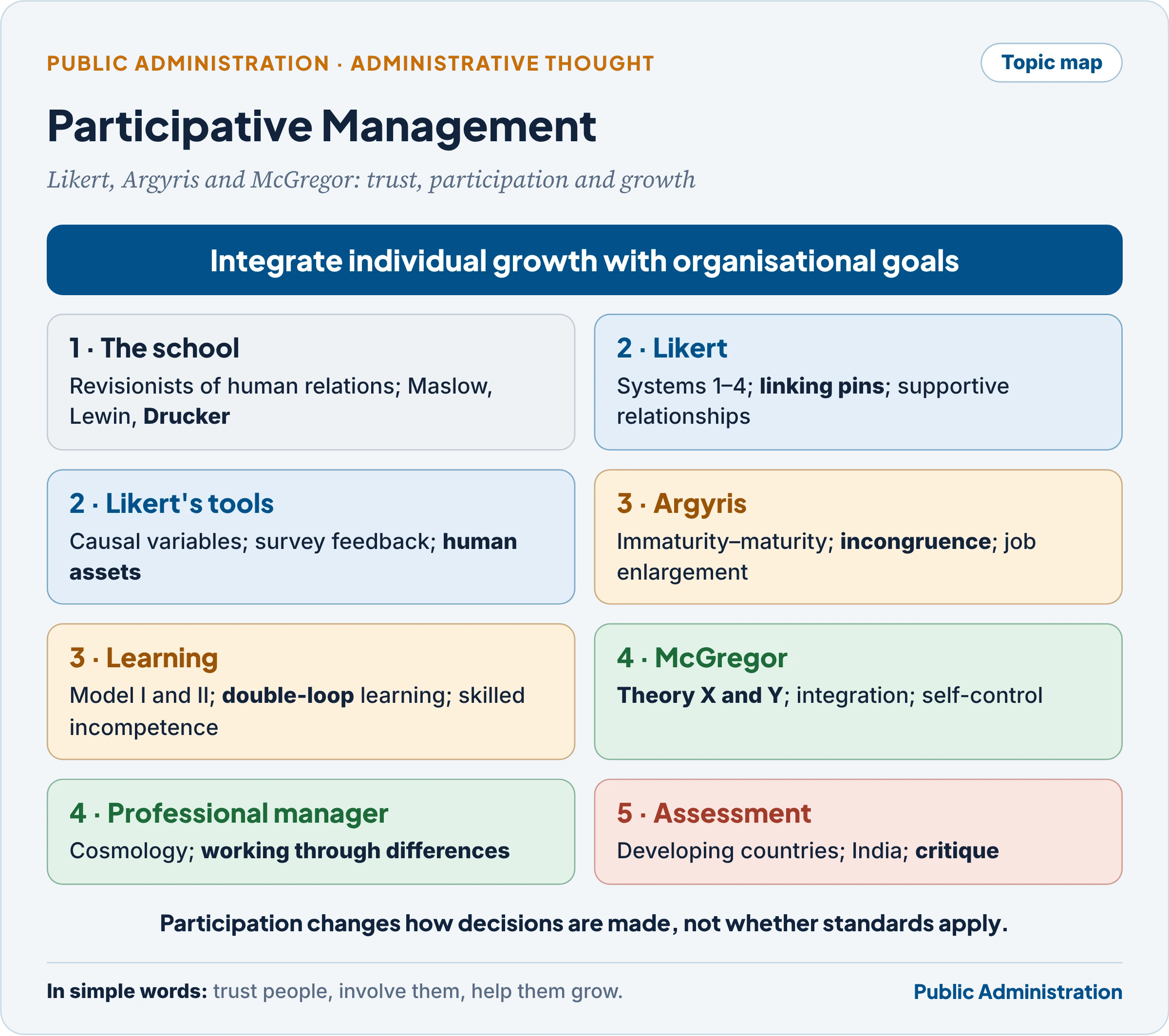
Participative management (also called organisational humanism or the neo-human relations school) brings together writers of the 1950s and 1960s who argued that organisations work best when employees share in decisions, are trusted to direct themselves, and can grow as persons at work. Warren Bennis called them revisionists: they kept the human relations insight that people matter, but tested it with research and linked it to structure, leadership and organisational effectiveness.
- Rensis Likert measured management styles and found the participative group system (System 4) most productive; he proposed linking pins and supportive relationships.
- Chris Argyris showed that the formal organisation clashes with the needs of a mature personality, and later studied how organisations learn.
- Douglas McGregor argued that management practice rests on assumptions about people: Theory X (people dislike work and must be controlled) or Theory Y (people can direct themselves when committed).
In simple words
Two block offices run the same scheme. In the first, the BDO issues orders, checks every file and punishes delays; staff do the minimum. In the second, the BDO sets targets with the team, asks frontline staff how to remove bottlenecks and lets them fix small problems themselves; staff take ownership. The participative school explains why the second office usually performs better, and when it might not.
1. The Participative Management School
In simple words
Mayo showed that workers are social beings. The participative writers went further: workers are also capable adults who want to use their judgement. Organisations that let them do so gain energy; those that do not breed apathy.
- Common assumptions:
- people have higher needs (esteem, self-actualisation) as well as social and economic ones (drawing on Abraham Maslow, 1943);
- participation in goal-setting and decisions raises commitment, motivation and the quality of decisions;
- trust and supportive supervision outperform close control and punishment;
- the formal organisation should be redesigned (flatter, team-based, enlarged jobs) to fit human needs;
- organisational effectiveness and individual growth can be integrated.
- Difference from the human relations school: human relations focused on feelings and group belonging and often used participation as a technique to win cooperation; participative management made participation and individual growth the basis of structure and leadership, and grounded its claims in systematic research.
- Intellectual roots: Follett’s integration and power-with; Mayo’s groups; Kurt Lewin‘s group dynamics and experiments on democratic leadership; Maslow’s hierarchy of needs.
- Related writers: Frederick Herzberg (motivators and hygiene factors, 1959), Peter Drucker (management by objectives, The Practice of Management, 1954), Warren Bennis (adaptive organisations), William Ouchi (Theory Z, 1981).
2. Rensis Likert: Systems of Management
In simple words
Likert asked thousands of employees how their managers behaved and compared the answers with results. Departments where managers trusted staff, listened to them and set high goals together did best.
2.1 Life and works
- Rensis Likert (1903–1981), American social psychologist; doctorate from Columbia University (1932), where he devised the Likert scale for measuring attitudes; headed the morale division of the US Strategic Bombing Survey; founded the Survey Research Center (1946) at the University of Michigan, which grew into the Institute for Social Research; directed it until 1970.
- Major works: New Patterns of Management (1961); The Human Organization: Its Management and Value (1967); New Ways of Managing Conflict (with Jane Gibson Likert, 1976).
- Research base: about 25 years of studies, with a large research team, on railways, hospitals, schools, insurance companies, industrial firms and voluntary organisations, covering employees from unskilled workers to research scientists.
2.2 Employee-centred and job-centred supervision
- Job-centred supervisors keep subordinates busy on a prescribed work cycle at a rate set by time standards (Taylor’s approach); they see themselves as getting the job done with the resources at hand.
- Employee-centred supervisors focus on the human aspects of subordinates’ problems and on building effective work groups; they exercise general rather than detailed supervision, care more about goals than procedures, and permit maximum participation in decisions.
- Finding: employee-centred supervision is generally more productive; but high productivity also requires high performance goals and the ability to lead decision-making towards them. Supportiveness without high goals is not enough.
2.3 The four systems of management
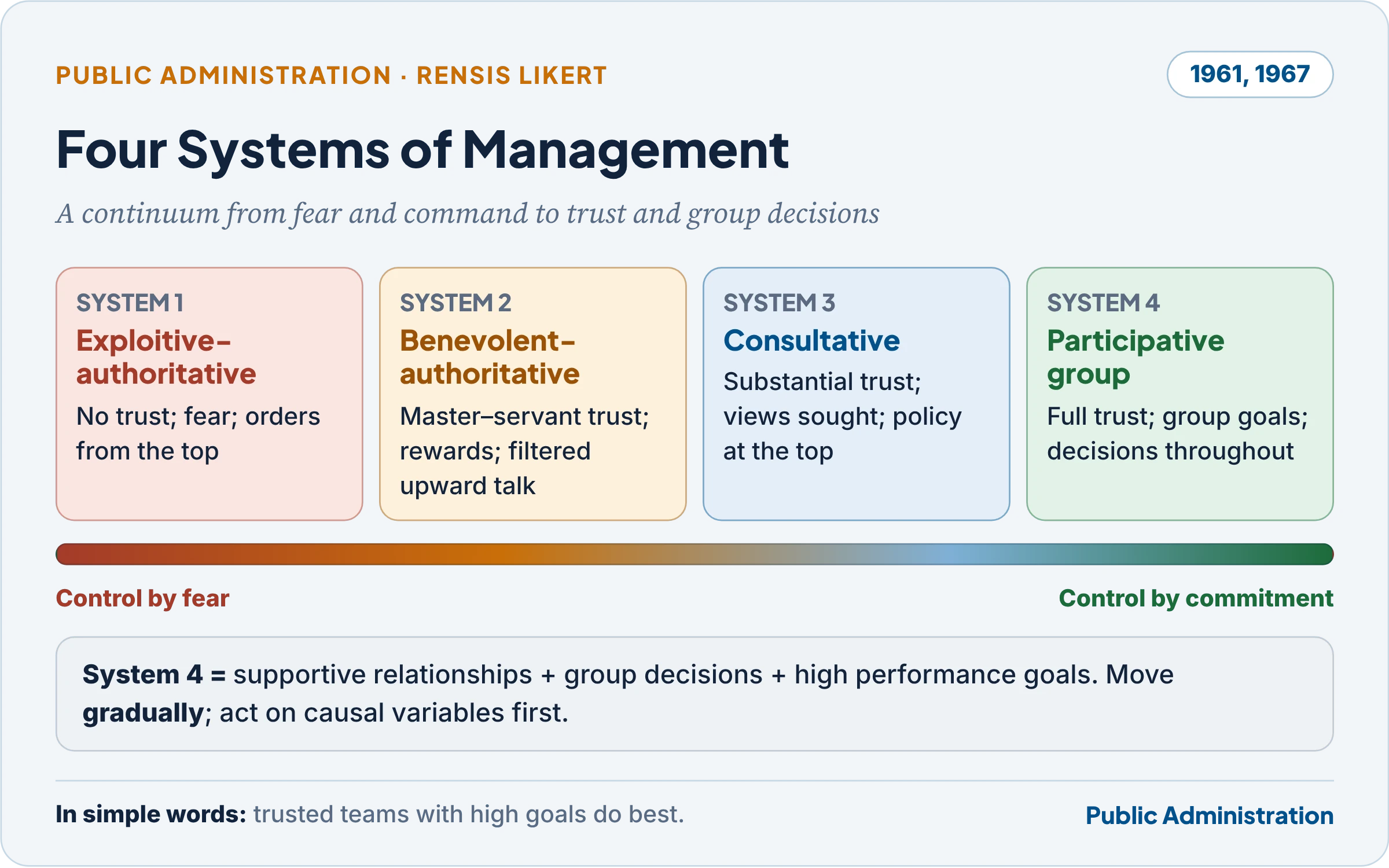
Likert described a continuum of management systems along variables such as leadership, motivation, communication, interaction–influence, decision-making, goal-setting and control:
| Basis | System 1: Exploitive-authoritative | System 2: Benevolent-authoritative | System 3: Consultative | System 4: Participative group |
|---|---|---|---|---|
| Confidence in subordinates | None | Condescending, as of master in servant | Substantial but not complete | Complete in all matters |
| Motivation | Fear, threats, punishment, occasional rewards | Rewards and some actual or potential punishment | Rewards, occasional punishment, some involvement | Economic rewards based on a group-developed system; participation in goals and methods |
| Communication | Downward | Mostly downward; upward limited to what the boss wants to hear | Down and up | Down, up and across; free and accurate |
| Decision-making | At the top | Policy at the top; some within a prescribed framework lower down | Broad policy at the top; specific decisions lower down | Throughout the organisation, linked by overlapping groups |
| Goal-setting | Orders issued | Orders, with some comment invited | After discussion with subordinates | Group participation |
| Control | Concentrated at the top | Mainly at the top | Moderate delegation | Widespread responsibility; informal and formal organisation coincide |
- System 4 features: supportive relationships, group decision-making and supervision, and high performance goals. Likert found that managers who applied System 4 had the greatest success as leaders and that their units were generally the most productive and had the best labour relations.
- System 5: Likert also speculated about a future system in which the authority of hierarchy would largely disappear; individuals would derive authority from their linking-pin roles and from the influence of the overlapping groups to which they belong.
2.4 Causal, intervening and end-result variables
- Causal variables: independent variables that management can change: leadership behaviour, structure, policies.
- Intervening variables: the internal state of the organisation: loyalties, attitudes, motivation, communication, interaction–influence, decision-making capacity.
- End-result variables: productivity, costs, earnings, quality, and also human satisfaction.
- Implication: management should act on causal variables and wait for improvements in intervening variables to work through to results; short-term pressure (System 1 or 2) may raise output for a while but runs down the human assets of the organisation, a cost that conventional accounts do not show.
- Human asset accounting: Likert argued that organisations should measure the value of their human organisation (skills, loyalty, motivation, customer goodwill) and record investment in or depletion of it, much as they record physical assets. The idea inspired human resource accounting, though reliable measurement proved difficult.
2.5 The organisational improvement cycle
Likert’s guidelines for moving towards System 4 (often through survey feedback):
- focus action on the causal variables, not directly on intervening variables;
- move from System 1 towards System 4 gradually, since leaders and members lack the skills for interaction and adaptation needed for a sudden jump;
- involve those whose behaviour must change in all steps of the improvement cycle;
- use objective, impersonal evidence as much as possible in planning action;
- secure the initiative and active participation of those in the most powerful positions;
- conduct action planning in a supportive, helpful atmosphere.
2.6 Does every organisation start at System 1 and end at System 4?
- The claim: the four systems form a developmental continuum; Likert believed that, with the right causal changes, organisations could and should move towards System 4, and he cited forces pushing in that direction: competition, changing attitudes, higher education, managers’ dissatisfaction with current practice, and the growth of complex organisations.
- In support: many organisations began in the authoritarian mode of early industry and moved towards consultation and participation as workforces became educated and work more complex; the improvement cycle describes a stepwise path.
- Against a fixed sequence:
- organisations do not all start at System 1; new professional organisations may begin at System 3 or 4;
- movement is not inevitable or one-way: crises, cost-cutting and political pressure can push organisations back towards Systems 1 and 2;
- contingency theorists (Fiedler; Lawrence and Lorsch; Morse and Lorsch) found that the best system depends on the task, technology, environment and people; System 4 suits complex, uncertain, professional work, while routine or emergency tasks may need more directive systems;
- critics noted that although managers say they prefer System 4, most organisations in practice run successfully on System 2.
- Assessment: System 4 is better seen as an ideal direction and a diagnostic tool than as a law of organisational evolution.
2.7 The linking pin model
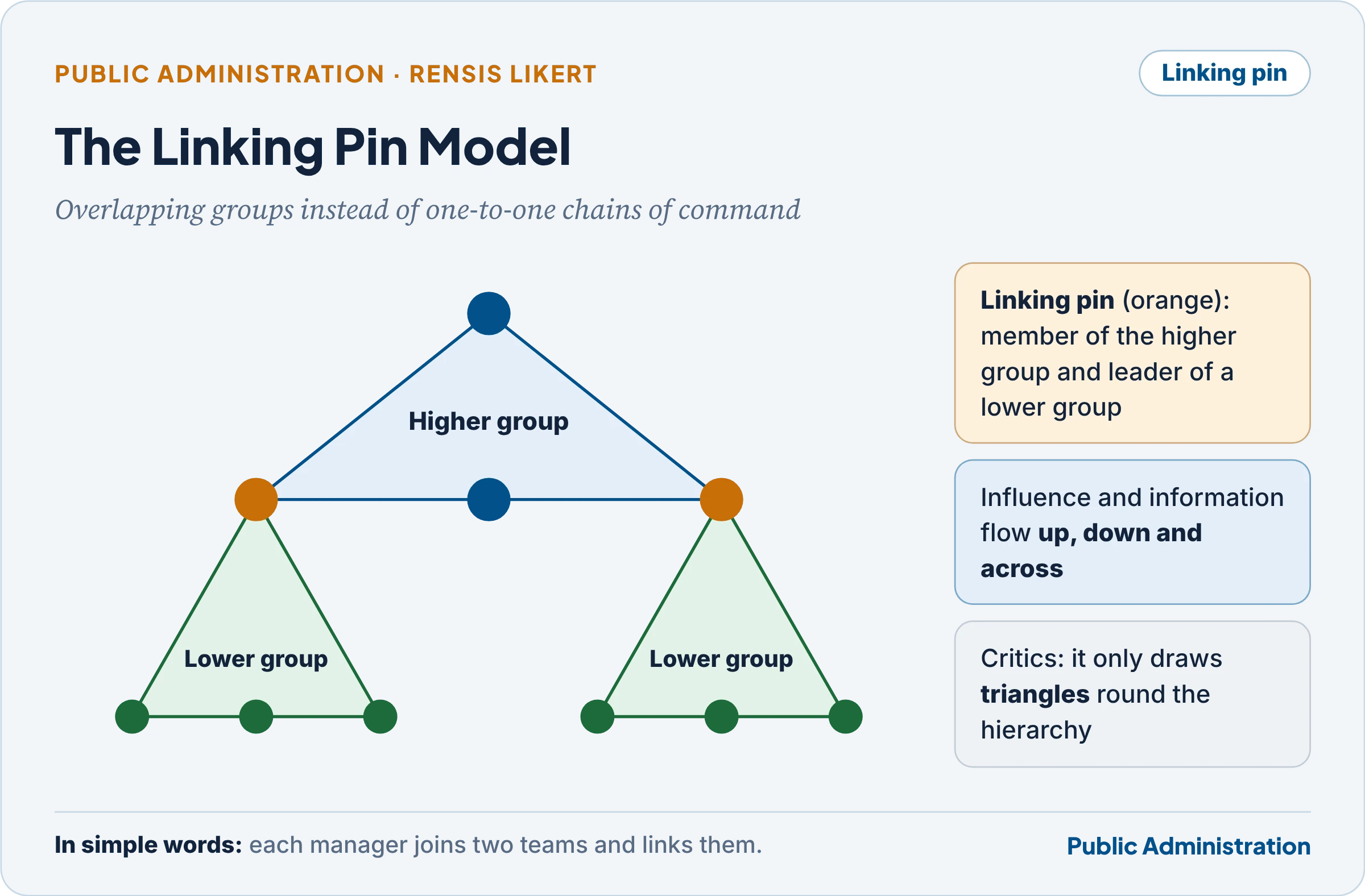
- Every individual belongs to two groups: he is a member of a higher-level group (with his peers and superior) and the leader of a lower-level group. People who hold such overlapping memberships are linking pins.
- Group-to-group, not man-to-man: the organisation becomes a structure of overlapping work groups rather than a chain of one-to-one superior–subordinate relationships; communication, influence, decisions and goals flow upward as well as downward.
- Lateral linkages: Likert extended the model with horizontal and cross-functional linking pins (line and staff, product departments), anticipating matrix and project structures.
- The interaction–influence system: in an ideal organisation, (i) each member’s goals and values are reflected in those of the work group and organisation; (ii) pressure for high performance, efficient methods and skill development comes from the members themselves; (iii) each member can exert influence on the decisions of the organisation through the communication and decision processes.
2.8 Supportive relationships and conflict
- Principle of supportive relationships: “the leadership and other processes of the organisation must be such as to ensure a maximum probability that in all interactions and all relationships with the organisation each member will, in the light of his background, values and expectations, view the experience as supportive and one which builds and maintains his sense of personal worth and importance.”
- Leadership is relative: there are no universal rules, only general principles that a leader must adapt to the expectations, values and skills of those he works with.
- Conflict: Likert defined conflict as the active striving for one’s own preferred outcome which, if attained, precludes others from attaining theirs; he distinguished substantive (task-based) from affective (emotional) conflict, criticised win–lose strategies, and proposed System 4 methods for resolving conflict.
2.9 Are successful leaders found in System 4?
- Evidence for: Likert’s Michigan studies found that the highest-producing departments and the most successful managers used System 4 practices: supportive relationships, group decision-making and high performance goals; System 4 units had better labour relations, lower costs and higher motivation over time.
- Qualifications:
- success depends on high performance goals and technical competence, not participation alone;
- authoritarian systems may produce good short-run results by “liquidating” human assets, which shows up only later;
- contingency research (Fiedler’s model, situational leadership) shows that the most effective style varies with the task, the followers and the situation;
- the evidence came largely from American organisations with educated workforces.
- Conclusion: System 4 describes the leadership of the most successful managers in complex, knowledge-based settings; it is a strong general tendency, not a universal law.
2.10 Critique of Likert
- Pro-participation bias: the research appears biased towards System 4; few managers would disagree with its attractive characteristics, but the evidence that it causes better results is weaker.
- Small groups to whole organisations: findings from small work groups were generalised to entire organisations.
- Causation and timing: System 4 was often introduced when companies were already profitable; results attributed to survey feedback may reflect general prosperity.
- Crude measurement: measures of human variables and human asset accounting remain rough.
- Linking pin: critics said it merely draws triangles around the traditional hierarchy and may slow decisions by multiplying meetings.
- Idealised interaction–influence system: its features are rarely found in real organisations.
- Contribution: nevertheless, participative management, System 4, linking pins, supportive relationships and the interaction–influence system have had far-reaching influence on modern management and on survey-based organisational development.
3. Chris Argyris: Personality and Organisation
In simple words
A twenty-five-year-old officer is an adult outside the office: she manages a household, votes and makes decisions. Inside a rigid office she may be treated like a child: told exactly what to do, watched closely and never asked her opinion. Argyris said this mismatch produces frustration, apathy and conflict.
3.1 Life and works
- Chris Argyris (1923–2013), American psychologist and organisation theorist; taught at Yale (industrial administration) and, from 1971, at Harvard as James Bryant Conant Professor of Education and Organizational Behavior.
- Major works: Personality and Organization (1957); Understanding Organizational Behavior (1960); Interpersonal Competence and Organizational Effectiveness (1962); Integrating the Individual and the Organization (1964); Organization and Innovation (1965); Intervention Theory and Method (1970); Management and Organizational Development (1971); Theory in Practice (with Donald Schön, 1974); Organizational Learning (with Schön, 1978); Overcoming Organizational Defenses (1990); Knowledge for Action (1993).
- Central concern: the incongruence between the needs of the healthy individual and the demands of the formal organisation, and how to increase both individual growth and organisational effectiveness.
3.2 The immaturity–maturity continuum
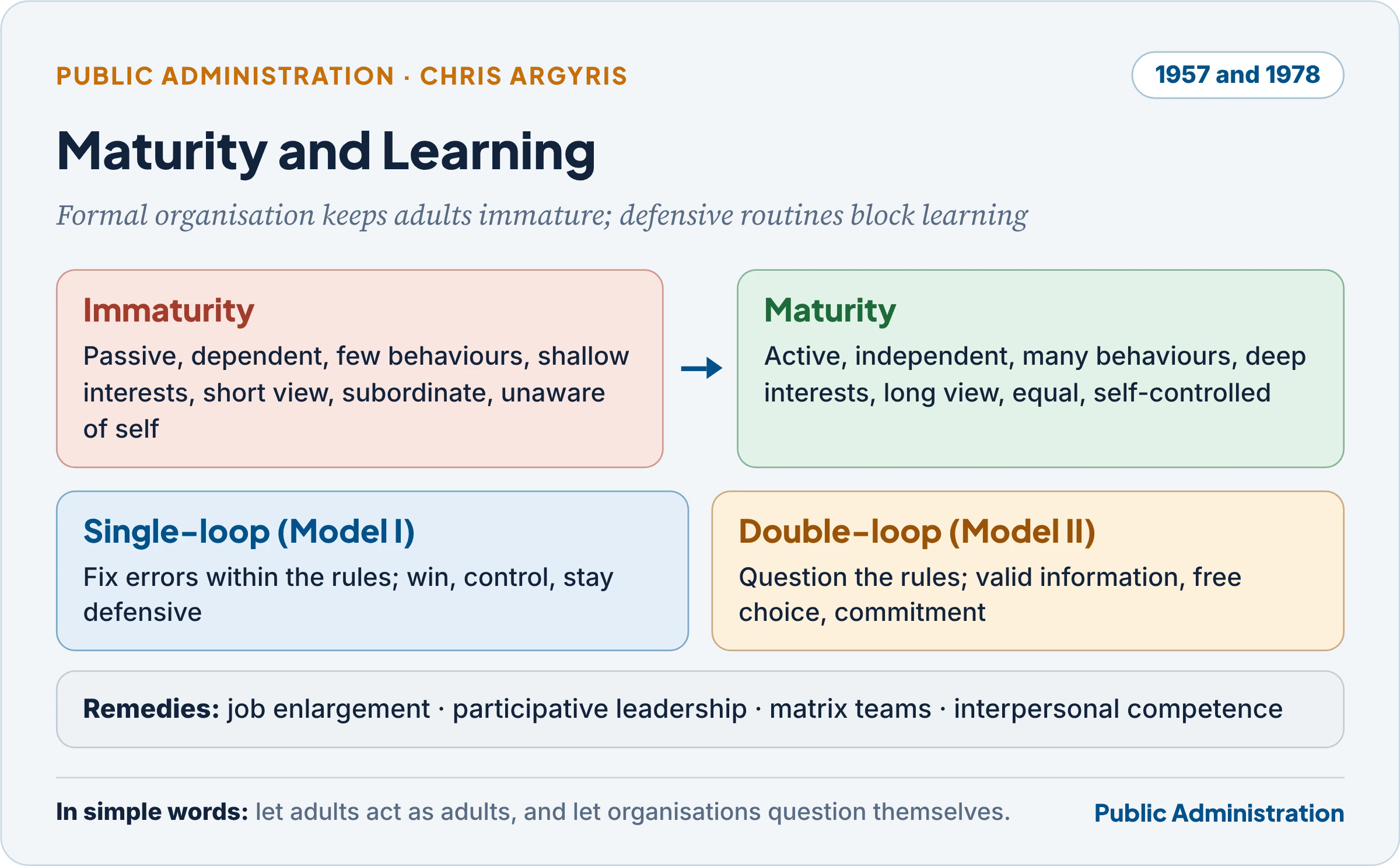
As a person develops from infancy to adulthood, he moves along seven dimensions:
| From (immaturity) | To (maturity) |
|---|---|
| Passivity | Activity |
| Dependence | Relative independence |
| Behaving in a few ways | Behaving in many ways |
| Erratic, shallow, brief interests | Deeper, stronger, more stable interests |
| Short time perspective | Long time perspective (past and future) |
| Subordinate position | Equal or superordinate position |
| Lack of awareness of self | Awareness and control of self |
- Self-actualisation: a healthy person strives to move towards maturity and to realise his potential.
3.3 The critique of formal organisation
- The incongruence: the principles of formal organisation (task specialisation, chain of command, unity of direction, span of control) and management controls (budgets, work study, cost accounting) require employees to be passive, dependent, subordinate, to use few abilities and to have a short time perspective: that is, to behave immaturely.
- Consequences: frustration, psychological failure, short-term perspective and conflict; employees respond by leaving, climbing the hierarchy, using defence mechanisms (daydreaming, aggression, apathy), joining informal groups and unions that resist management, and stressing money over meaning.
- Management’s vicious response: executives see apathy and resistance as proof that workers are lazy, and tighten directive leadership and controls, which deepens the incongruence.
- On budgets: Argyris found that budget pressure unites employees against management, places supervisors under tension, and leads to inefficiency, aggression and human-relations problems; the budget, a neutral tool, gets blamed.
- Authority: he was highly critical of authority-based structures; critics later accused him of an antipathy to authority without parallel.
3.4 The fusion process
- With E. Wight Bakke, Argyris developed the fusion process theory: the organisation tries to make the individual an agent of its goals (socialising process), while the individual tries to make the organisation an agency for his own self-actualisation (personalising process). Both operate at once; their fusion determines how well individual and organisation are integrated.
3.5 Remedies
- Job enlargement: give each employee a wider range of tasks using more of his abilities, more control over his work and more participation in decisions about it.
- Participative, reality-centred leadership: leadership that adapts to the situation and involves employees in policy formulation, decentralising responsibility.
- Appropriate structures for different purposes: in place of the uniform pyramid, a mix: the pyramidal structure for routine, non-innovative work (a town post office); a modified formal structure with participation (akin to Likert’s); a defined but participative structure; and the matrix organisation, in which project teams of different functions solve specific problems and superior–subordinate relations give way to self-discipline.
- Interpersonal competence: Argyris found low interpersonal competence in many organisations: people did not trust one another, were defensive, avoided expressing feelings, stuck to old ways and confined themselves to routine. He proposed four behaviours to build it:
- owning (accepting responsibility for) one’s ideas and feelings;
- openness to the ideas and feelings of others;
- experimenting with new ideas and feelings;
- helping others to own, be open and experiment.
- T-group (sensitivity) training: laboratory training in which participants learn about group functioning and their own impact on others; Argyris saw it not as education for authoritarian leadership but as development of effective, reality-centred leaders, and proposed long-range programmes for reforming governmental organisations through such training of senior officials.
3.6 Organisational learning: Model I, Model II and double-loop learning
- Espoused theory and theory-in-use: what people say guides their actions (espoused theory) often differs from the theory that actually guides them (theory-in-use).
- Model I (the common theory-in-use): achieve your purpose as you define it; win, do not lose; suppress negative feelings; be “rational”. Its strategies are unilateral control and self-protection. It produces defensiveness, mistrust and single-loop learning.
- Model II: act on valid information; make free and informed choices; build internal commitment to choices and monitor their implementation. It encourages openness and double-loop learning.
- Single-loop learning: detecting and correcting errors within existing goals, values, plans and rules (a thermostat adjusting heat to a set temperature).
- Double-loop learning: questioning and changing the governing variables themselves (asking whether the set temperature is right). Organisations need it to make informed decisions in rapidly changing and uncertain contexts.
- Defensive routines and skilled incompetence: organisations develop routines that protect people from embarrassment or threat but also prevent learning; managers become skilled at producing outcomes they do not intend (Argyris called this skilled incompetence).
3.7 The two faces of organisational incompetence
Reading Argyris’s work as a whole, organisational incompetence has two distinct faces:
- Structural face (1950s–60s): the formal organisation, by its specialisation, hierarchy and controls, keeps individuals immature, wasting their capacities and producing apathy, conflict and low performance. The cure lies in redesigning jobs, structures and leadership.
- Behavioural–cognitive face (1970s–90s): even competent, well-intentioned people operating under Model I produce defensive routines and skilled incompetence; the organisation cannot detect or correct its fundamental errors because it cannot learn double-loop. The cure lies in changing theories-in-use through Model II learning.
- Why “separate and distinct”: the first arises from design (what the organisation does to people); the second from reasoning and interaction (what people do to one another and to themselves). Each can exist without the other; effective organisations must address both.
3.8 Argyris’s criticism of Simon
- Argyris criticised Simon’s “rational man” organisation theory for excluding variables central to behaviour: personality, interpersonal relations, self-actualisation, emotions and conflict; for relying on descriptive-empirical mechanisms of organisational influence that support authoritarian structures; and for an inconsistent concept of satisficing man.
- Simon’s reply: Argyris chose de-emphasis of authority as the way out but at the price of neglecting consequences for organisational effectiveness; Simon equated unrestrained self-actualisation in organisations with anarchy.
3.9 Critique of Argyris
- Self-actualisation as utopia: the concept lacks precise operational indicators; George Strauss questioned whether everyone seeks self-actualisation at work: many value security and are content under directive leadership.
- Idealism: Peter Drucker called him a romantic who neglected ground realities; Simon equated his vision with anarchy.
- Anti-authority bias: no organisation can survive without formal structure and authority; many members accept authority because it is consistent with their values.
- Remedial, not radical: job enlargement and T-groups are short-sighted remedies while the basic conflict of interests between employer and employee remains; they may help maintain the status quo.
- Normative and weakly tested: many propositions are normative and lack strong empirical support.
- Contribution: Gordon Lippitt saw his greatest contribution in the idea that formal organisations are basically anti-maturing and act against employees’ sense of self-actualisation. His later work on organisational learning shaped the “learning organisation” movement (Peter Senge, 1990).
4. Douglas McGregor: Theory X and Theory Y
In simple words
If a manager believes staff are lazy, she watches them closely; they feel distrusted, do the minimum, and she concludes she was right. If she believes they want to do good work, she gives them responsibility; most rise to it. McGregor said a manager’s beliefs about people shape the very behaviour she sees.
4.1 Life and works
- Douglas McGregor (1906–1964), American social psychologist; professor at the Massachusetts Institute of Technology, where he helped found its industrial relations section; president of Antioch College (1948–1954); returned to MIT’s Sloan School of Management.
- Major works: The Human Side of Enterprise (1960); Leadership and Motivation (1966); The Professional Manager (published posthumously, 1967, edited by Caroline McGregor and Warren Bennis); the article “An Uneasy Look at Performance Appraisal” (1957).
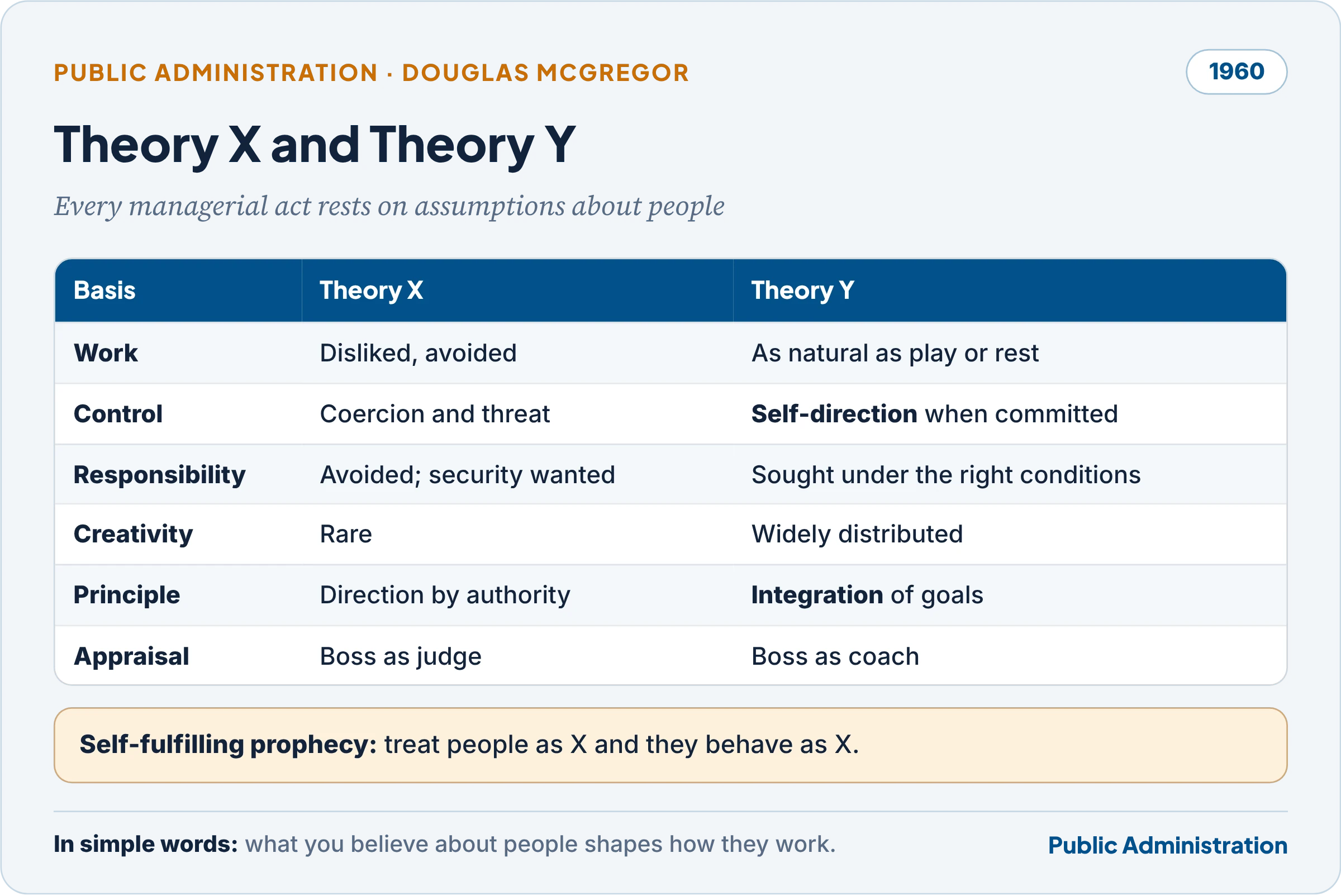
- Basic hypothesis: “every managerial act rests on a theory“: on assumptions, often unstated, about human nature and behaviour. The assumptions management holds about controlling its human resources determine the whole character of the enterprise.
4.2 Theory X
The traditional view of direction and control assumes that:
- the average human being has an inherent dislike of work and will avoid it if he can;
- because of this, most people must be coerced, controlled, directed and threatened with punishment to make them put in adequate effort towards organisational objectives;
- the average human being prefers to be directed, wishes to avoid responsibility, has relatively little ambition, and wants security above all.
Central principle: direction and control through the exercise of authority (the scalar principle).
4.3 Theory Y
The integration of individual and organisational goals assumes that:
- the expenditure of physical and mental effort in work is as natural as play or rest; depending on controllable conditions, work may be a source of satisfaction or of punishment;
- external control and the threat of punishment are not the only means of securing effort; people will exercise self-direction and self-control in the service of objectives to which they are committed;
- commitment to objectives is a function of the rewards associated with their achievement; the most significant rewards (satisfaction of ego and self-actualisation needs) can be direct products of effort directed towards organisational objectives;
- under proper conditions, the average human being learns not only to accept but to seek responsibility; avoidance of responsibility, lack of ambition and emphasis on security are generally consequences of experience, not inherent characteristics;
- the capacity to exercise a relatively high degree of imagination, ingenuity and creativity in solving organisational problems is widely, not narrowly, distributed;
- under modern industrial conditions, the intellectual potential of the average person is only partially utilised.
Central principle: integration: “the creation of conditions such that the members of the organisation can achieve their own goals best by directing their efforts toward the success of the enterprise”.
- From Follett to McGregor: the principle of integration carries Follett’s idea of integrating differences into the relation between the individual and the organisation; McGregor’s preference for self-control over external control echoes her “fact-control” and power-with, and his strategy of working through differences (Section 4.7) restates her constructive conflict for the managerial teams of large, complex organisations (see the article on Follett).
4.4 Managerial implications
| Managerial function | Theory X | Theory Y |
|---|---|---|
| Goal-setting and planning | Superior sets objectives; little participation; few alternatives explored; low commitment | Superior and subordinates set objectives jointly; many alternatives; high commitment |
| Leadership | Autocratic, based on authority; people follow orders but resist covertly | Participative, based on competence; people seek responsibility |
| Communication | One-way, top-down; little feedback | Two-way; information flows freely |
| Control | External, rigid; focus on fault-finding | Internal; self-control |
| Appraisal | Superior as judge; focus on the past | Superior as coach; focus on the future and problem-solving |
| Motivation | Punitive, coercive | Rewarding, developmental |
- Practices consistent with Theory Y: decentralisation and delegation; job enlargement; participative and consultative management; performance appraisal by objectives set by the subordinate with the superior (McGregor’s 1957 critique of judgemental appraisal); the Scanlon Plan of union–management cooperation and gain-sharing.
- The self-fulfilling prophecy: Theory X practices produce the very behaviour that Theory X assumes (passivity, resistance), confirming the manager’s belief; Theory Y breaks the cycle by changing the assumptions first.
4.5 Theory X and Theory Y as models of motivation
- What they describe: two contrasting sets of managerial assumptions, and therefore two models of how managers try to motivate: by external control and economic incentives (carrot and stick) or by integration and self-control (satisfying higher needs through work).
- Link to Maslow: Theory X addresses only lower needs (physiological, safety); once these are reasonably satisfied, they cease to motivate, and the carrot-and-stick approach fails. Theory Y appeals to social, esteem and self-actualisation needs.
- Not types of people or styles alone: McGregor did not say some people are X and others Y; he said management’s assumptions shape practices and outcomes. Nor is Theory Y “soft” management: it demands high goals and responsibility.
- Limits: motivation research has gone well beyond Theory Y (expectancy theory, goal-setting, self-determination theory); the evidence that Theory Y practices always raise performance is mixed; Morse and Lorsch (“Beyond Theory Y”, 1970) showed that fit between task, organisation and people matters more than either theory; William Ouchi‘s Theory Z (1981) added long-term employment, collective decisions and culture.
4.6 Theory Y is indicative, not prescriptive
- McGregor on professional help: in discussing the relations of staff experts with line managers, McGregor argued that “true professional help is not in playing God with the client, but in placing professional knowledge and skills at the client’s disposal”. The expert’s role is to help the client solve his own problem, not to impose solutions and controls.
- Applied to Theory Y: Theory Y is not a set of techniques or rules to be installed (that would itself be a Theory X approach). It is a set of assumptions that indicate a direction; managers must invent practices suited to their own situation. McGregor called Theory Y “an invitation to innovation”.
- Why this matters: prescriptive implementation (ordering staff to participate, imposing “empowerment” programmes) contradicts Theory Y’s own logic of self-direction; genuine change comes when managers revise their assumptions and develop practices with those affected.
4.7 The Professional Manager and managerial cosmology
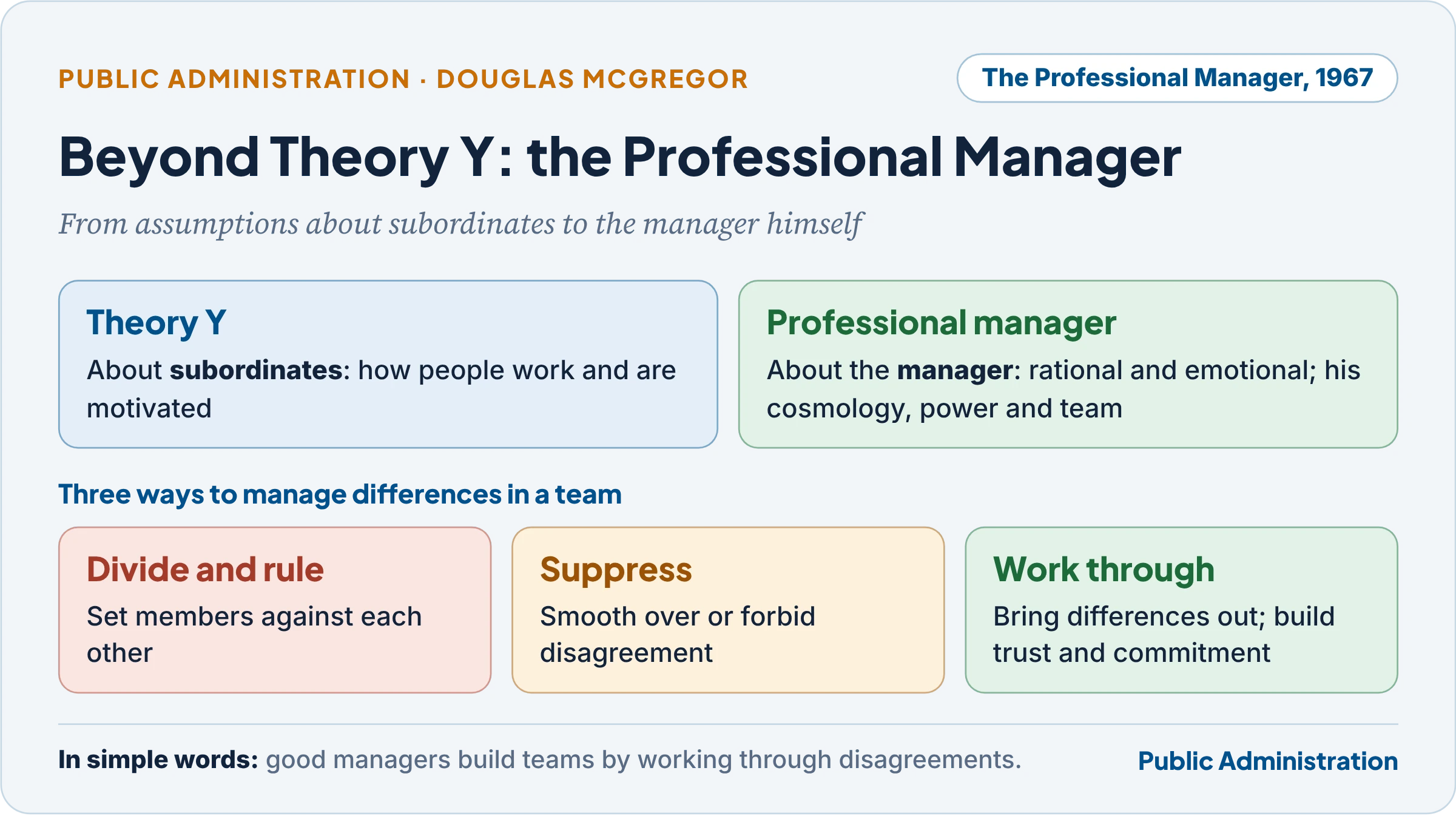
- Managerial cosmology: in The Professional Manager (1967), McGregor argued that every manager has a cosmology: a view of reality made up of his assumptions about human nature, the organisation, cause and effect, power and his own role. Managerial acts are shaped by these perceptions of organisational reality. A theory of management must therefore address the manager’s identity and role perceptions, not only techniques. This gives managers a frame through which their behaviour can be studied, analysed and corrected in the light of changing social values and organisational goals.
- The manager as a rational-emotive being: McGregor rejected the purely rational “economic man” not only for workers but for managers; managers are rational and emotional, and their feelings, fears and needs (for status, power, security) shape their decisions and relations.
- Transactional influence: power is not a fixed quantity held by the boss; influence is transactional, flowing both ways. Where trust and mutual support exist, there is no need for concern about “power equalisation” or loss of control.
- Managing differences: the central challenge of managerial work is building a managerial team and managing differences within it. McGregor discussed three strategies:
- divide and rule: setting members against one another (a Theory X strategy);
- suppression of differences: smoothing over or forbidding disagreement (also Theory X);
- working through differences: bringing differences into the open and resolving them so that interaction produces innovation, commitment and a climate of trust. Only the third builds an effective team. The professional manager must guard against antagonism, playing politics, secrecy and favouritism.
- Professional development: management development should grow from the capacities of each individual, through programmes involving many people, so that the organisation has a varied supply of talent for unpredictable needs.
4.8 How the Professional Manager differs from Theory Y
- Different focus: Theory Y is about the manager’s assumptions about subordinates (what workers are like and how they are motivated). The Professional Manager is about the manager himself: his cosmology, emotions, identity, use of power and relations with fellow managers.
- From individual motivation to team dynamics: Theory Y addresses the superior–subordinate relationship; the Professional Manager addresses the managerial team and the management of differences among peers.
- From optimism to realism: Theory Y is often read as an optimistic view of human nature; the Professional Manager recognises conflict, emotion and power as permanent features to be worked through, not wished away.
- From assumptions to role: the later work turns Theory Y into a view of management as a profession with its own identity, competences and ethics.
- Continuity: both rest on integration, self-control and trust; the Professional Manager extends Theory Y from the shop floor to the boardroom.
4.9 Has McGregor’s message become more relevant?
- More relevant: knowledge work, professional services and digital organisations depend on self-direction and creativity; flat structures, agile teams, remote work and objectives and key results reflect Theory Y; engagement research links trust and autonomy to performance; public sector reforms stress empowerment and capacity building.
- But challenged: algorithmic management, gig work and intensive monitoring (keystroke tracking, productivity dashboards) represent a digital Theory X; cost pressures and risk aversion in public organisations favour control.
- Verdict: McGregor’s core point, that assumptions shape practice and that control-based management wastes human potential, has grown in relevance; the specific dichotomy is better treated as a diagnostic lens than as a complete theory.
Indian Connect — Likert’s systems and McGregor’s assumptions in Indian offices
- System 2 as the norm: most government offices resemble Likert’s benevolent-authoritative system: decisions referred upward through several levels, information filtered on its way up, and consultation limited.
- Moving towards System 3 and 4: the Central Secretariat Manual of Office Procedure, 2022 stresses delayering, delegation of financial and administrative powers and the desk-officer system, reducing levels through which files pass; e-Office makes the flow visible.
- Theory X tools: detailed conduct rules, attendance monitoring and multiple approvals reflect control-based assumptions; they protect probity but discourage initiative.
- Theory Y tools: Mission Karmayogi’s competency-based, self-paced learning and awards for innovation in public administration rely on self-direction and recognition.
4.10 Critique of McGregor
- Rejection of control overstated: direction, control and the “carrot and stick” remain useful; Theory X has value in some situations.
- No proof: there is little evidence that either set of assumptions is valid or that adopting Theory Y always produces better results; critics told McGregor that his theories were fine but “did not work” or could not be put into practice.
- Oversimplification: people are complex and vary across situations (Schein’s “complex man”); a two-way choice is too crude.
- Contribution: nevertheless, McGregor exploded the myth of economic man and pure direction and control, gave managers a vocabulary for their assumptions, and shaped participative management, management by objectives, appraisal reform and organisational development.
5. Participative Management: Assessment and Application
In simple words
Letting people share in decisions works best where they are educated, trusted and protected. Where hierarchy, fear and inequality are strong, participation has to be built step by step.
5.1 Common contribution of Likert, Argyris and McGregor
| Thinker | Core idea | Main tool |
|---|---|---|
| Likert | Participative group system produces better results | Four systems; linking pins; survey feedback; human asset accounting |
| Argyris | Formal organisation stunts the mature personality; organisations must learn | Job enlargement; matrix; T-groups; Model II; double-loop learning |
| McGregor | Management practice rests on assumptions about people | Theory X and Y; integration; self-control; professional manager |
- Shared themes: trust, participation, integration of individual and organisational goals, self-control, growth, and redesign of structure and leadership.
- Shared limits: normative optimism, weak causal evidence, neglect of power and conflict of interests, and cultural assumptions drawn from post-war American corporations.
5.2 Participative management in developing countries
- Why it may be less useful:
- hierarchical cultures and high power distance make subordinates reluctant to speak and superiors reluctant to share power;
- low education and skills at lower levels, insecure employment and poverty make security and pay more pressing than self-actualisation (Maslow’s lower needs dominate);
- rule-bound, centralised bureaucracies inherited from colonial rule, with strong accountability through audit and vigilance, reward caution over initiative;
- political interference and patronage distort participation;
- urgency of development tasks may favour directive leadership.
- Why it is still useful, even necessary:
- development requires people’s participation and local knowledge; top-down implementation fails without it;
- democratic decentralisation, self-help groups and cooperatives show that participation can be built;
- the young, educated workforce of emerging economies increasingly expects voice and autonomy;
- participative methods improve implementation, reduce corruption through social audit and build legitimacy.
- Balanced conclusion: participative management must be adapted, not transplanted: introduced gradually (as Likert advised), combined with clear rules and accountability, supported by training (Argyris’s interpersonal competence), and backed by changes in managerial assumptions (McGregor).
Indian Connect — Participative management in Indian administration
- Democratic decentralisation: the 73rd and 74th Amendments (1992) created participatory local government; Kerala’s People’s Plan Campaign (1996) devolved planning to Gram Sabhas and panchayats, a large-scale experiment in participative planning.
- Social audit: Section 17 of the MGNREGA, 2005 mandates social audit by the Gram Sabha, giving citizens a direct part in monitoring.
- Theory Y in the civil services: Mission Karmayogi (2020) aims to move from “rule-based” to “role-based” functioning, with competency frameworks, continuous self-directed learning on the iGOT platform and annual capacity building plans.
- Participation inside government: the Joint Consultative Machinery (1966) and departmental councils consult staff; quality circles were adopted by public sector undertakings from the early 1980s.
- Theory X persists: detailed conduct rules, multiple layers of approval and fear of audit and vigilance encourage caution and upward referral; the 2nd ARC‘s reports on personnel administration and ethics called for delegation, performance orientation and protection of honest decisions.
5.3 Participative management and democracy within administration
- The claim (Argyris and Likert): participative management brings democracy inside the administrative system: consultation, group decisions, two-way communication and self-control mirror democratic values.
- Limits in public administration: officials are accountable upward to ministers and legislatures and outward to citizens and courts; internal democracy cannot override legal accountability, political direction or equal treatment of citizens. Participation must therefore be bounded by law and accountability.
- Contemporary echoes: New Public Service (citizens as partners), collaborative governance, co-production of services, employee engagement and agile teams in government digital units.
Common confusion
Is participative management the same as letting employees decide everything? No. Likert’s System 4 combines participation with high performance goals and clear group responsibility; McGregor’s Theory Y requires commitment to organisational objectives and self-control, not the absence of control; Argyris favoured a mix of structures, keeping the pyramid for routine work. Participation changes how decisions are made and goals set; it does not abolish authority, accountability or standards.
Criticism — The case against participative management
- Normative and optimistic: assumes everyone wants responsibility and growth.
- Weak causal evidence: success may cause participation rather than the reverse.
- Neglects power and conflicts of interest between employer and employee.
- Slow decisions; diffused accountability; unsuited to routine or emergency work.
- Culturally specific: assumes educated, secure, low-power-distance workforces.
Defence — The case for participative management
- Uses the knowledge and creativity of the whole workforce.
- Builds commitment, reduces resistance and improves implementation.
- Fits knowledge work, professional services and complex, uncertain tasks.
- Supports democratic values and legitimacy inside and outside organisations.
- Its tools (MBO, survey feedback, teams, learning) are now standard practice.
Key Terms
| Term | Meaning in simple words |
|---|---|
| Participative management | Managing by involving employees in goals and decisions |
| Organisational humanism | Approach that seeks to integrate human growth with organisational effectiveness |
| System 1 to System 4 | Likert’s continuum from exploitive-authoritative to participative group management |
| Employee-centred supervision | Supervision focused on people and group-building, with general oversight |
| Linking pin | A person who belongs to two groups and links them |
| Interaction–influence system | Network through which members influence one another and the organisation |
| Causal, intervening, end-result variables | Management actions, internal states, and results |
| Human asset accounting | Measuring the value of the people of an organisation |
| Supportive relationships | Interactions that build each member’s sense of worth |
| Immaturity–maturity continuum | Argyris’s seven dimensions of personal growth |
| Incongruence | Mismatch between formal organisation and mature personality |
| Job enlargement | Widening the range of tasks in a job |
| Interpersonal competence | Ability to be open, own one’s ideas and help others do the same |
| T-group | Sensitivity training in small groups |
| Espoused theory / theory-in-use | What people say guides them / what actually guides them |
| Single-loop learning | Correcting errors within existing rules and goals |
| Double-loop learning | Questioning and changing the rules and goals themselves |
| Skilled incompetence | Skilful behaviour that produces unintended poor outcomes |
| Theory X | Assumption that people dislike work and must be controlled |
| Theory Y | Assumption that people can direct themselves when committed |
| Principle of integration | Conditions in which members achieve their goals by working for the organisation |
| Managerial cosmology | A manager’s view of reality that shapes his acts |
| Transactional influence | Two-way influence between superiors and subordinates |
| Working through differences | Resolving disagreements openly to build a team |
Contemporary Developments
- 2020 onwards: Mission Karmayogi and the iGOT platform promote self-directed, role-based learning across the civil services, a Theory Y premise.
- 3 November 2025: the 8th Central Pay Commission‘s terms of reference include performance-linked incentives, reopening the debate between extrinsic rewards (Theory X tools) and intrinsic motivation.
- April 2025: Gallup’s global workplace report attributed falling engagement mainly to declining manager engagement, reaffirming Likert’s and McGregor’s focus on managerial behaviour.
- Continuing: agile teams, OKRs and hybrid work spread participative practices, while digital monitoring and algorithmic management revive control-based approaches.
Revision Grid
| Thinker / body | Work or report (year) | Key idea |
|---|---|---|
| Abraham Maslow | “A Theory of Human Motivation” (1943) | Hierarchy of needs |
| Peter Drucker | The Practice of Management (1954) | Management by objectives |
| Chris Argyris | Personality and Organization (1957) | Incongruence; immaturity–maturity |
| Frederick Herzberg | The Motivation to Work (1959) | Motivators and hygiene factors |
| Douglas McGregor | The Human Side of Enterprise (1960) | Theory X and Theory Y; integration |
| Rensis Likert | New Patterns of Management (1961) | Four systems; linking pin |
| Chris Argyris | Integrating the Individual and the Organization (1964) | Job enlargement; mixed structures |
| Rensis Likert | The Human Organization (1967) | Causal–intervening–end-result variables; human assets |
| Douglas McGregor | The Professional Manager (1967) | Cosmology; transactional influence; managing differences |
| Morse and Lorsch | “Beyond Theory Y” (1970) | Contingency fit |
| Argyris and Schön | Theory in Practice (1974); Organizational Learning (1978) | Model I and II; double-loop learning |
| Likert and Likert | New Ways of Managing Conflict (1976) | System 4 conflict resolution |
| William Ouchi | Theory Z (1981) | Japanese-style participative management |
Previous Year Questions
- 2026Douglas McGregor’s ‘Professional Manager’ is a rational, emotive individual whose primary role is to work through the differences and build a managerial team. Explain how his idea of the ‘Professional Manager’ is distinct from Theory ‘Y’.
- 2024McGregor’s Theory X and Theory Y provide insights into human motivation at the workplace differently. Examine in detail.
- 2022Every human organisation shall start from System-I and ultimately end up with System-IV. Comment on Likert’s statement.
- 2017The Participative Management School of Argyris and Likert advocates democracy within the administrative system. Will this approach be equally useful to developing countries with evolving democracies?
- 2016“Douglas McGregor’s Theory X and Theory Y describe two contrasting models of workforce motivation applied by managers in an organization.” Examine.
- 2014According to McGregor, “true professional help is not in playing God with the client, but in placing professional knowledge and skills at the client’s disposal.” In the light of above, justify how theory-y is indicative and not prescriptive.
- 2013The theory of ‘organizational incompetence has two separate and distinct faces. Examine Chris Argyris’ views on this.
- 2011Critically examine conflict resolution according to M.P. Follett. Explain how McGregor took forward her ideas to the context of complex organizations.
- 2010“In McGregor’s view, the managerial cosmology meaningfully addresses the understanding of manager and his role perceptions.” Explain.
- 2010“The successful management leaders are found in Likert’s ‘System-4’ approach to organisational leadership.” Examine.
- 2007Analyse McGregor’s Theory X and Theory Y. Do you agree with the view that with every passing year, McGregor’s message has become more relevant and more important? Substantiate your answer.