

Accountability and Control: Concepts of accountability and control; Legislative, Executive and Judicial control over administration; Citizen and Administration; Role of media, interest groups, voluntary organizations; Civil society; Citizen’s Charters; Right to Information; Social audit.
This article: Citizen and administration (the citizen as subject, client, customer, partner and co-producer; citizen-centric administration and the 2nd ARC’s Twelfth Report; interface problems and street-level bureaucracy; grievance redressal, CPGRAMS, Sevottam and right to services Acts; participation, Arnstein’s ladder, co-production and digital public infrastructure); the media (fourth estate, watchdog and agenda-setter, investigative journalism, media trials, paid news, misinformation, IT Rules 2021 and the fact-check unit ruling); interest groups (Almond’s types, pressure groups and lobbying, access points, Olson, capture and rent-seeking, Indian groups and the farm-laws repeal); voluntary organisations (roles, government–NGO relations, National Policy on the Voluntary Sector 2007, FCRA, NGO-DARPAN, CAPART, NGO accountability); civil society (Tocqueville, Hegel, Gramsci, Habermas, Putnam, Chatterjee; social accountability; Indian movements; shrinking civic space).
Official Syllabus: Paper I · Unit 1-05 Accountability and Control
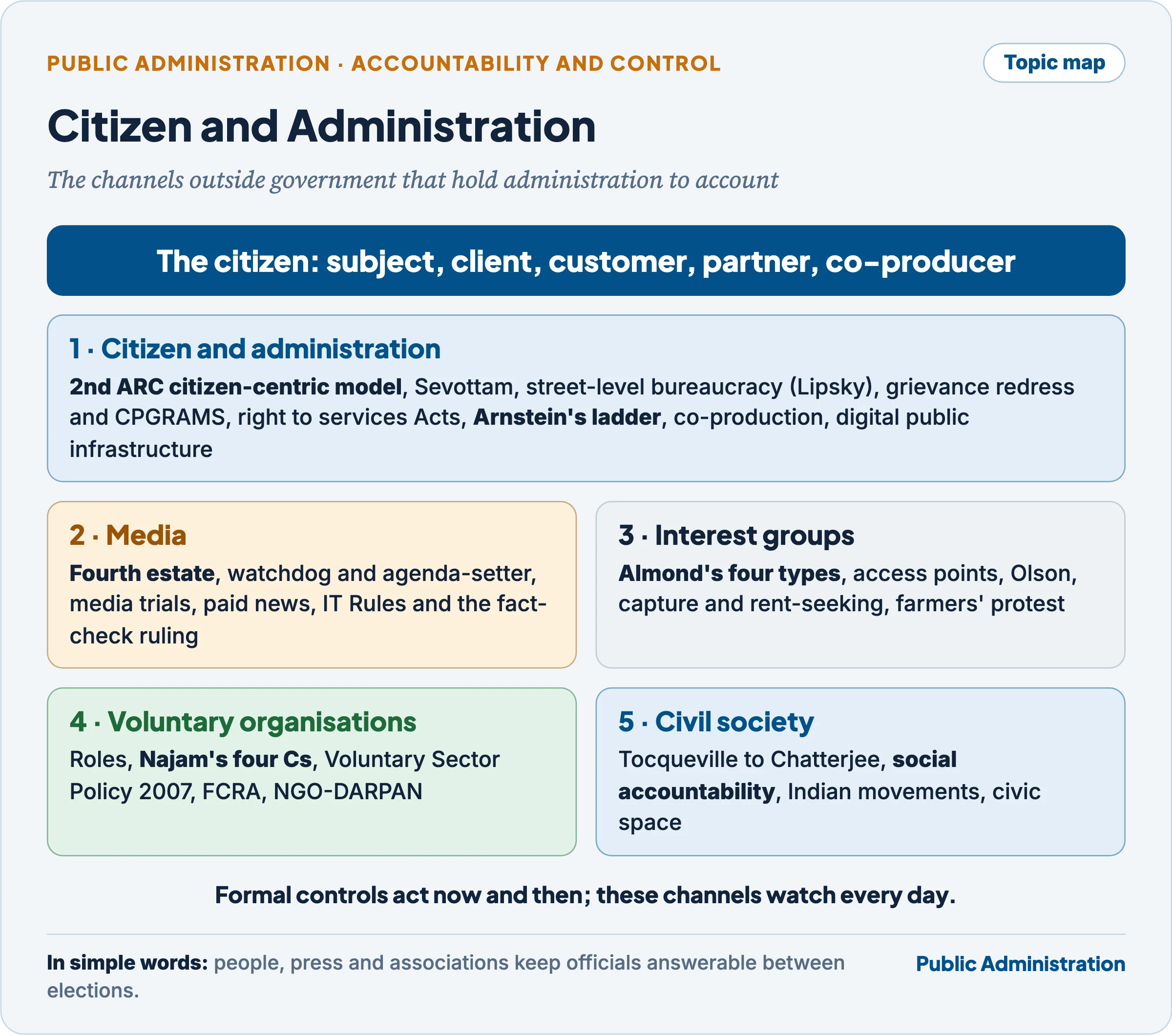
The formal controls over administration (Parliament, the political executive and the courts) work from inside the constitutional machinery. This article is about the controls that work from outside it: the citizen who uses public services and complains when they fail, the media that exposes and debates, interest groups that press their claims, voluntary organisations that deliver, advocate and watch, and the wider civil society in which all of these live. Together they make up what is often called external or social accountability: the citizen holding the state to account directly, between elections.
- Their importance has grown for three reasons:
- The administrative state has expanded into almost every part of life, so the number of daily contacts between officials and citizens has multiplied.
- The formal controls are slow and general: Parliament meets for a few weeks a year and courts act only when moved, while a ration card or a pension is needed now.
- The governance paradigm (good governance, New Public Service, New Public Governance) treats citizens and non-state bodies as partners in governing, not merely objects of administration.
In simple words
Think of a district hospital. The Health Secretary inspects it (internal control), an MLA can ask a question about it in the Assembly (legislative control) and a court can order it to supply medicines (judicial control). But the person who knows first that the doctor is absent is the patient. If that patient can complain on a portal, if a local newspaper reports the absence, if a patients’ group protests and if an NGO publishes a survey of absent doctors, the hospital is watched every day, not once a year. That daily watching by people outside government is what this article is about.
1. Citizen and Administration
In simple words
The citizen meets the state mostly through a clerk, a constable, a teacher or a nurse, not through a minister. How that meeting goes decides whether people trust government. Over time, administrations have treated people as subjects to be ruled, then as clients to be served, then as customers to be satisfied, and now, at least in theory, as partners who help make and deliver public services.
1.1 Why the citizen–administration relationship matters
- Growth of the interface. The welfare and development state supplies education, health, food, credit, housing, licences and certificates. Every new function creates new points of contact and new chances of friction.
- Legitimacy. A government’s legitimacy rests less on elections than on everyday experience of services. A citizen who pays a bribe for a caste certificate draws conclusions about the whole state.
- Effectiveness. Many programmes (immunisation, sanitation, school attendance) succeed only if citizens cooperate. Distrust lowers compliance and raises enforcement costs.
- Democratic theory. David H. Rosenbloom, the American scholar of public administration and law, argued in “Public Administrative Theory and the Separation of Powers” (1983) that public administration is pulled by three approaches:
- the managerial approach (efficiency, economy, effectiveness), rooted in the executive;
- the political approach (representativeness, political responsiveness and accountability through elected officials to the citizenry), rooted in the legislature;
- the legal approach (procedural due process, individual rights, equity), rooted in the courts.
- Rosenbloom’s political approach places the citizen at the centre: administration must be representative of the people (a socially diverse bureaucracy), responsive to their preferences, and answerable through elected representatives. Its weakness is that it can clash with the managerial demand for efficiency and the legal demand for equal treatment; a responsive official may favour the loudest voices.
Indian Connect — Citizen-administration relationship in India
- Colonial legacy. British administration related to Indians as rulers to the ruled. Citizens met the state mainly as taxpayers and law-breakers, and administration disclosed only what it chose. The habit of secrecy and distance survived 1947 in procedures, language and the posture of officials.
- Constitutional shift. The Preamble, Fundamental Rights and Directive Principles make the citizen a rights-bearer, and Articles 32 and 226 give a remedy against the state. The 73rd and 74th Amendments (1992) added the Gram Sabha and ward committees as forums of direct citizen participation.
- Persistent gap. Studies of Indian administration describe a socio-psychological gap between the educated, urban, English-speaking official and the poor, rural, often illiterate citizen. The relationship has changed in form more than in spirit: rules talk of service, while practice remains paternalistic.
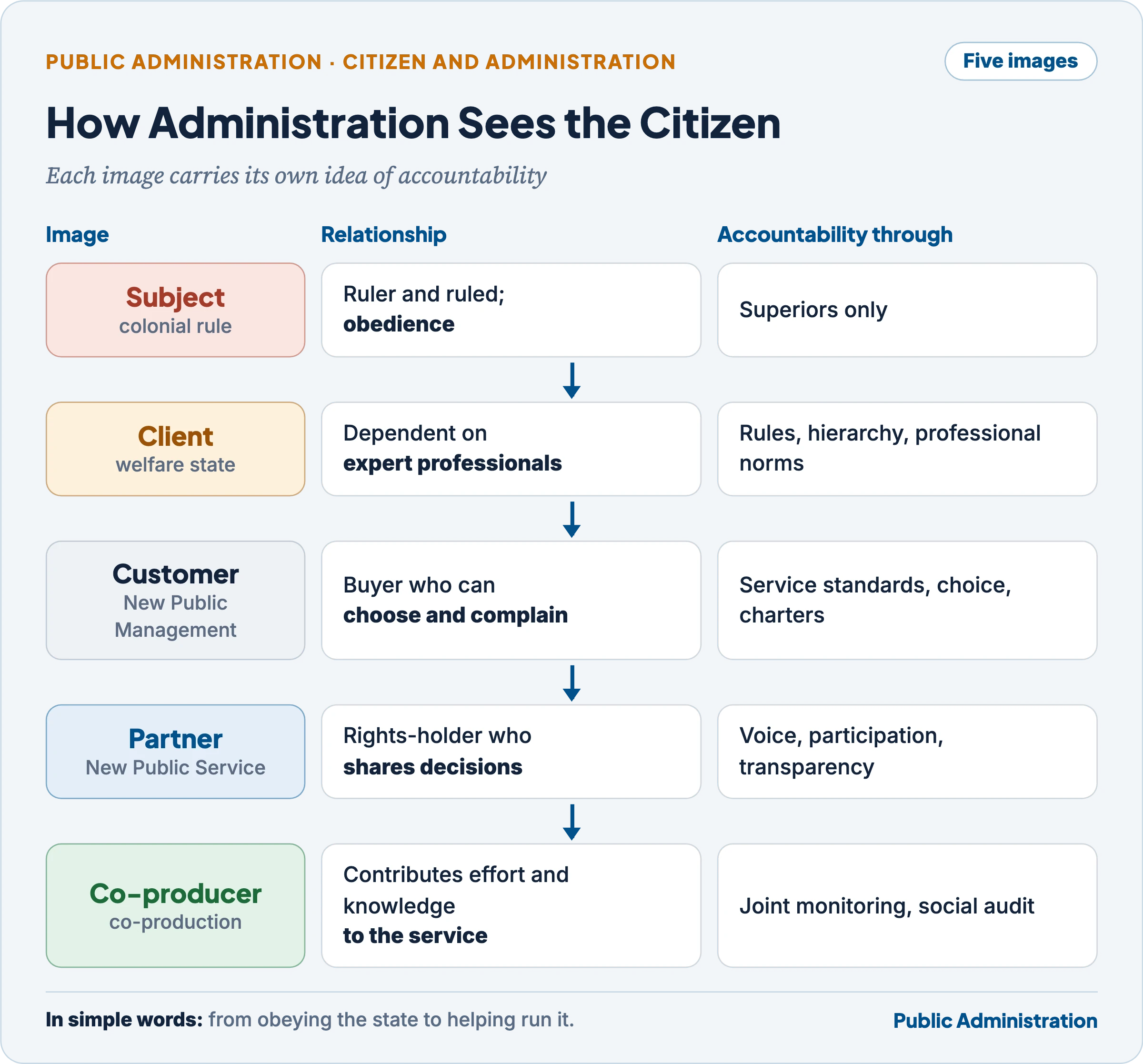
1.2 How administration sees the citizen: subject, client, customer, partner, co-producer
The relationship can be traced through five images of the citizen. Each image carries a theory of what government is for and of how it should be held to account.
| Image of the citizen | Relationship | Typical era and doctrine | Accountability runs through |
|---|---|---|---|
| Subject | Ruler and ruled; obedience to authority | Colonial and authoritarian administration | Almost none, except to superiors |
| Client | Dependent beneficiary of expert professionals | Welfare state, Weberian bureaucracy | Rules, hierarchy and professional norms |
| Customer | Buyer of services who can choose and complain | New Public Management (1980s–90s) | Service standards, choice, market tests |
| Citizen-partner | Rights-holder and stakeholder in decisions | Good governance, New Public Service | Voice, participation, transparency |
| Co-producer | Contributor of time, knowledge and effort to the service itself | New Public Governance, co-production | Shared responsibility and joint monitoring |
- Henry Mintzberg, the Canadian management thinker, in “Managing Government, Governing Management” (Harvard Business Review, 1996) pointed out that people stand in four relationships with government at once: as customers (buying discrete services such as a passport), clients (receiving professional services such as health care), citizens (holding rights such as voting and a share in public goods) and subjects (bound by duties such as paying taxes or obeying a policeman). His warning: calling everyone a “customer” hides the other three roles.
- Albert O. Hirschman, the economist, in Exit, Voice, and Loyalty (1970), offers the key distinction. A customer who is dissatisfied exits (goes to another shop). A citizen usually cannot exit a police station or a land registry, so must use voice (complaint, protest, participation). Public services therefore need strong voice mechanisms; market-style choice alone cannot discipline them.
Citizen versus customer: the NPM debate.
- New Public Management (Osborne and Gaebler’s Reinventing Government, 1992) asked government to be customer-driven: published standards, choice, user charges and complaint systems. The UK Citizen’s Charter (1991) and India’s charters (1997) came from this thinking (see the article on Citizen’s Charters, Right to Information and Social Audit).
- What it achieved: courtesy, time limits, single windows, attention to the user’s experience.
- What it missed:
- A customer has rights in proportion to purchasing power; a citizen has rights by membership. The poorest, who need public services most, are the weakest customers.
- Customers think of private benefit; citizens must also weigh the public interest (a road widening that inconveniences me may serve the town).
- Many public functions (policing, taxation, regulation) have no willing customer at all.
- It narrows accountability to service satisfaction, leaving out justice, equity and participation in deciding what services should exist.
- Janet and Robert Denhardt, in “The New Public Service: Serving Rather than Steering” (Public Administration Review, 2000) and the book The New Public Service (2003), answered NPM with seven principles:
- serve citizens, not customers;
- seek the public interest as a shared goal, built through dialogue;
- value citizenship over entrepreneurship;
- think strategically, act democratically;
- recognise that accountability is not simple (law, community values, professional norms and citizen interests all count);
- serve rather than steer;
- value people, not just productivity.
- In this view the official’s role is to facilitate opportunities for citizen engagement: to convene, broker and listen, not only to deliver. Active citizenship becomes the base of administrative theory.
Common confusion
Is citizen-centric administration the same as treating citizens as customers? No. Customer orientation is one part of citizen-centric administration (standards, courtesy, speed). Citizen-centric administration, as the 2nd ARC used the term, goes further: it treats the citizen as the owner of government, entitled to information, participation in decisions, redress as a right, and equal treatment regardless of ability to pay or to complain. A customer model can coexist with exclusion; a citizen model cannot.
1.3 Citizen-centric administration and the 2nd ARC’s Twelfth Report
The Second Administrative Reforms Commission (constituted August 2005, chaired by M. Veerappa Moily and later by V. Ramachandran) devoted its Twelfth Report, Citizen Centric Administration: The Heart of Governance (February 2009), to this relationship.
- Core idea: governance is citizen-centric when administration is transparent, accountable, responsive, participative and efficient, and when the citizen is treated as the reason for its existence, not as a petitioner.
- Building blocks identified by the Commission:
- Sound legal framework and institutional capacity;
- Decentralisation and delegation, so that decisions are taken close to the citizen;
- Transparency (backed by the Right to Information Act, 2005);
- Civil service reforms and incentives that reward responsiveness;
- Citizen participation, consultation and feedback;
- Simplification of procedures and the use of e-governance and single-window systems to reduce discretion and visits;
- Effective grievance redressal and periodic evaluation.
The ARC’s seven-step model for citizen centricity. The Commission asked every organisation with a public interface to follow seven steps:
- Define all the services it provides and identify its clients.
- Set standards and norms for each service.
- Develop the capability to meet the standards.
- Perform to achieve the standards.
- Monitor performance against the standards.
- Evaluate the impact through an independent mechanism.
- Improve continuously on the basis of monitoring and evaluation.
Other recommendations relevant here:
- Citizen’s Charters to be drafted after consulting citizens and front-line staff, with firm and measurable commitments, a remedy for default and periodic independent evaluation, rather than one-size-fits-all paper charters.
- Adoption of the Sevottam model (below) as the template for service delivery excellence.
- Grievance redressal to be strengthened: designated public grievance officers, time limits, analysis of grievance-prone areas, and follow-up on root causes rather than case-by-case disposal.
- Delegation of powers to the cutting edge, simplification of internal procedures, and monitoring and evaluation through citizens’ feedback and independent agencies.
- Special attention to the participation of women and persons with disabilities in service design.
- The Ninth Report, Social Capital: A Shared Destiny (2008), dealt with the voluntary sector: a new legal framework for charities, accreditation of voluntary organisations, review of the foreign-contribution regime, corporate social responsibility and expansion of the self-help group movement. (Section 4 takes these up.)
1.4 Problems at the interface
In simple words
Ask anyone who has tried to register a property or get a disability certificate. The common complaints are the same everywhere: no one tells you the procedure, you are sent from window to window, the file “is not traceable”, someone hints that money will speed things up, and nobody answers for the delay. These are not individual failings alone; they come from how the system is built.
The main problems:
- Red tape and proceduralism. Rules meant to ensure fairness become ends in themselves (Merton’s goal displacement). Multiple forms, affidavits, attestations and visits impose time and money costs that fall hardest on the poor.
- Corruption. The Santhanam Committee on Prevention of Corruption (1962–64) linked corruption to discretionary power and delay; “speed money” and middlemen are its everyday face. Corruption is the most common single grievance against Indian administration.
- Apathy and discourtesy. Officials feel accountable upward to superiors, not outward to citizens. W.A. Robson, the British scholar of public administration, listed the citizen’s complaints against bureaucracy: an excessive sense of self-importance among officials, indifference to the citizen’s convenience, a passion for regulations and formal procedure, and failure to see that dealing with the public is part of democracy itself.
- Delay and diffused responsibility. Files pass through many hands; no single official is answerable for the outcome.
- Information asymmetry. Citizens do not know their entitlements, the procedure or the time limit, which makes them dependent on intermediaries.
- Social distance and discrimination. Caste, class, gender and language shape who is heard. Officials often avoid the poor and attend to the influential.
- Colonial and hierarchical culture. A posture of authority rather than service, reinforced by frequent transfers that weaken local knowledge.
Lipsky’s street-level bureaucracy. Michael Lipsky, the American political scientist, in Street-Level Bureaucracy: Dilemmas of the Individual in Public Services (1980), showed why the interface behaves as it does.
- Who they are: teachers, police constables, health workers, social workers, ration-shop inspectors, patwaris: public employees who interact directly with citizens and have substantial discretion in delivering benefits and sanctions.
- Their working conditions:
- chronically inadequate resources (time, staff, information);
- demand that rises to meet supply (a better clinic attracts more patients);
- vague or conflicting goals (help the poor, but prevent fraud);
- performance that is hard to measure;
- non-voluntary clients, who cannot go elsewhere.
- Their coping mechanisms:
- rationing services by queues, waiting and complexity;
- routines and stereotypes that sort citizens into easy and difficult cases;
- creaming, i.e. selecting the clients most likely to succeed;
- lowering their own expectations of what the service can do.
- Central insight: the decisions of street-level bureaucrats, the routines they establish and the devices they invent to cope with uncertainty and work pressure effectively become the public policies they carry out. Policy is made at the counter as much as in the Secretariat.
- Implications for accountability:
- Control from the top through more rules has limits, because discretion cannot be eliminated where judgement about individual cases is required.
- Accountability has to work at the point of delivery: citizen feedback, social audit, community monitoring and professional norms.
- Better working conditions (manageable caseloads, clear goals) are themselves an accountability reform.
- Critique and update:
- Critics note that Lipsky underplays the positive discretion of front-line workers, who also bend rules to help citizens.
- Mark Bovens and Stavros Zouridis (2002) argued that information technology is turning street-level bureaucracy into “screen-level” and “system-level” bureaucracy, as discretion moves from the clerk into software design. In India, automated eligibility checks and biometric authentication show both effects: less petty discretion, but new exclusion when the system fails and no human can override it.
Indian Connect — Street-level administration in India
- The anganwadi worker, ASHA, patwari, village panchayat secretary and beat constable are India’s street-level bureaucrats. Large vacancies, multiple duties and data-reporting burdens push them into exactly the rationing and routine behaviour Lipsky described.
- Direct Benefit Transfer and Aadhaar-based authentication have cut leakages and middlemen in several schemes, but failures of biometric matching and connectivity have excluded some genuine beneficiaries. The shift from counter discretion to system design calls for grievance channels and human override at the last mile.
- The 2nd ARC therefore stressed delegation, simplification and feedback at the cutting edge, not just new rules from the top.
1.5 Grievance redressal machinery
A grievance is a feeling of being wronged by an administrative act or omission: a ground of complaint, a condition felt to be oppressive or unjust. Grievances arise from the gap between rising expectations and administrative performance, and they fall into three broad types: grievances against policies, against maladministration (delay, discourtesy, negligence), and against corruption.
Institutional devices across the world. Democracies have built three families of machinery for the citizen’s complaint against the administration:
| Device | Origin | How it works | Example |
|---|---|---|---|
| Ombudsman | Sweden, 1809 | An independent officer, usually appointed by the legislature, investigates complaints of maladministration on complaint or suo motu, and reports and recommends; cannot quash decisions | Finland (1919), Denmark (1955), New Zealand (1962), UK Parliamentary Commissioner for Administration (1967), India’s Lokpal and Lokayuktas |
| Administrative courts | France (Conseil d’État, 1799) | A separate hierarchy of courts with expert judges hears disputes between citizen and administration, cheaply and quickly | France, Belgium, Greece; India’s tribunals are a partial analogue |
| Procurator system | Former USSR and socialist states | A procurator supervises the legality of official acts and can prosecute officials | Russia’s Procurator-General still exists |
- Donald C. Rowat, the Canadian authority on the institution, described the Ombudsman as an officer appointed by the legislature to handle complaints against administrative and judicial action, and as a bulwark of democratic government against the tyranny of officialdom. Gerald Caiden called it an “institutionalised public conscience”.
- Features of the classical Ombudsman:
- independence from the executive;
- informal, cheap and quick procedure;
- access to all official files;
- power to investigate on its own initiative;
- reporting to the legislature and use of publicity as its main sanction.
India’s grievance machinery.
- Legislative channel: Question Hour, calling attention motions, half-hour discussions, the Committee on Petitions and the Committee on Government Assurances. Useful for grievances of a general kind; weak for individual cases and available only while the House sits (see the article on Concepts of Accountability and Legislative, Executive and Judicial Control).
- Judicial channel: writs under Articles 32 and 226, Public Interest Litigation (from the late 1970s), tribunals, consumer commissions under the Consumer Protection Act, 2019, and Lok Adalats under the Legal Services Authorities Act, 1987. Powerful but slow and costly.
- Ombudsman-type bodies:
- The First Administrative Reforms Commission (chaired by Morarji Desai, later K. Hanumanthaiya), in its interim report on the Problems of Redress of Citizens’ Grievances (1966), recommended a Lokpal and Lokayuktas.
- Maharashtra set up the first Lokayukta in 1971.
- After repeated failed bills, the Lokpal and Lokayuktas Act, 2013 (in force from January 2014) created the Lokpal; the first chairperson took office in March 2019.
- The Lokpal is essentially an anti-corruption body; it does not cover maladministration in general.
- Vigilance bodies: the Central Vigilance Commission (1964, statutory since 2003) and state vigilance commissions, which deal with corruption rather than service delivery.
- Executive machinery:
- the Department of Administrative Reforms and Public Grievances (DARPG), set up in 1985, is the nodal agency;
- the Directorate of Public Grievances (1988) in the Cabinet Secretariat handles selected grievances;
- grievance officers are designated in every ministry and department.
- CPGRAMS (Centralised Public Grievance Redress and Monitoring System):
- an online platform launched in 2007, available 24×7, that routes grievances to the ministry concerned and to States;
- grievances received rose from about 20 lakh in 2021 to about 26.15 lakh in 2024 and 22.78 lakh in 2025;
- DARPG’s Comprehensive Guidelines for Grievance Redressal (August 2024) cut the redress timeline from 30 to 21 days, required dedicated grievance cells and stressed root-cause analysis and action on citizen feedback;
- the average disposal time in central ministries was 15 days in 2025 (Parliament reply, March 2026).
- Sevottam (from seva, service, and uttam, excellence):
- a service-delivery excellence framework developed by DARPG (2006) and aligned with the Bureau of Indian Standards’ IS 15700:2005;
- it assesses an organisation on three components: implementation of a Citizen’s Charter with measurable standards, a working public grievance redress system, and service delivery capability (people, infrastructure and processes);
- the 2nd ARC endorsed it as the operating template for citizen-centric administration.
Right to services Acts.
- Madhya Pradesh passed the first Public Service Guarantee Act (Lok Sewaon ke Pradan ki Guarantee Adhiniyam) in August 2010; Bihar followed in 2011, and most States have since enacted similar laws.
- Core features:
- notified services (caste and income certificates, ration cards, mutation, water and electricity connections) with fixed time limits;
- a designated officer responsible for each service;
- an appeal to a higher officer if the deadline is missed;
- a penalty (often a daily fine) recovered from the officer at fault, sometimes paid to the citizen as compensation.
- Significance: they convert a charter’s promise into a legal entitlement, shifting the burden of delay from the citizen to the official.
- Limitations:
- penalties are often small and rarely imposed;
- services are notified selectively;
- back-office capacity is unchanged;
- citizens are unaware of their rights;
- appeals go to officers of the same department.
- The central Right of Citizens for Time Bound Delivery of Goods and Services and Redressal of their Grievances Bill, 2011 lapsed in 2014, so there is still no national statute.
How successful has the grievance machinery been?
- Gains:
- more channels than ever (online, phone, Lokayuktas, right-to-services appeals);
- time limits written into law;
- real-time dashboards and monthly rankings of ministries;
- wider use of feedback calls to complainants.
- Persistent weaknesses:
- disposal is not redress: grievances are often closed with a forwarding note, not a solution;
- weak root-cause analysis, so the same complaints recur;
- most grievance officers sit inside the department complained against;
- Lokayuktas vary widely in powers and independence, and some posts stay vacant for years;
- the poor and digitally excluded use online systems least;
- attitudes change more slowly than procedures. Studies of Indian administration conclude that without a change in the official’s outlook, new machinery achieves little.
Indian Connect — The citizen’s grievance in the Indian state
- The 2nd ARC’s Twelfth Report found that grievance systems were often intimidating to use and focused on the act of lodging a complaint rather than on resolving it. It recommended identifying grievance-prone areas, analysing root causes and evaluating redress through independent agencies.
- The 2017 question whether right to services Acts extend Citizen’s Charters has a clear answer: they convert the charter’s voluntary promise into an enforceable legal duty with penalties, but they cover fewer services and depend on the same administrative capacity.
- DARPG’s monthly CPGRAMS reports and the August 2024 guidelines show the state moving from counting grievances to analysing them, the direction the 2nd ARC proposed fifteen years earlier.
1.6 Citizen participation: from consultation to co-production
In simple words
Participation can mean very different things. A village may be “consulted” in a meeting whose decision was already taken in the district office. Or the Gram Sabha may decide which roads to build, check the bills and stop payment to a contractor who cheated. Both are called participation; only the second shares power.
Why participation.
- Instrumental reasons: local knowledge improves planning; people maintain what they help build; leakages fall under the “critical gaze” of local users; ownership reduces conflict.
- Intrinsic reasons: participation is a right of citizenship and a form of empowerment, a way for the voiceless to shape decisions about their own lives.
- Paulo Freire, the Brazilian educator, in Pedagogy of the Oppressed (1968), argued that development done for people by a bureaucracy is different from development done with them; genuine participation raises critical consciousness (conscientisation).
- Robert Chambers, in Rural Development: Putting the Last First (1983), and the Participatory Rural Appraisal methods he championed, treated villagers as experts on their own conditions.
- David Korten contrasted growth-centred with people-centred development.
Arnstein’s ladder of citizen participation. Sherry R. Arnstein, an American planning official, published “A Ladder of Citizen Participation” in the Journal of the American Institute of Planners (July 1969). Her central claim: participation without redistribution of power is an empty and frustrating ritual for the powerless; it lets power holders claim that all sides were heard while only some benefit.
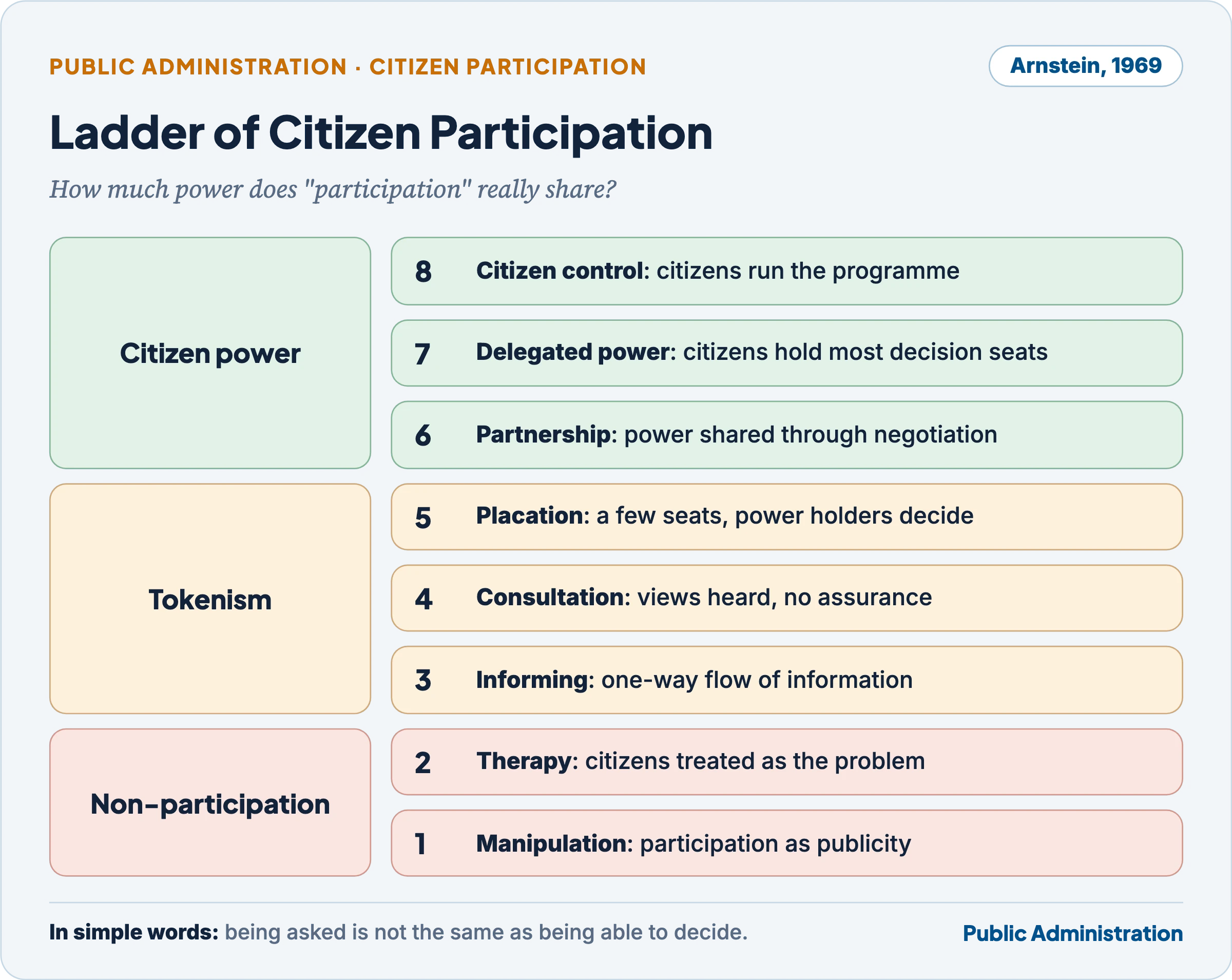
| Rung | Group | What happens | Indian illustration |
|---|---|---|---|
| 1. Manipulation | Non-participation | People are placed on advisory bodies to be “educated” or used for publicity | Hand-picked “beneficiary committees” that rubber-stamp a project |
| 2. Therapy | Non-participation | Citizens’ problems are treated as their own pathology to be cured | Awareness camps that blame villagers for poor hygiene while the water supply is broken |
| 3. Informing | Tokenism | One-way flow of information; no channel for feedback | Notice boards, press releases |
| 4. Consultation | Tokenism | Views are heard through surveys and hearings, but with no assurance they will count | Many environmental public hearings |
| 5. Placation | Tokenism | A few citizens get seats on boards, but power holders decide | Nominated members on committees without votes that matter |
| 6. Partnership | Citizen power | Power is shared through joint committees and negotiated rules | Joint Forest Management committees at their best |
| 7. Delegated power | Citizen power | Citizens hold a majority of decision seats on a plan or programme | Gram Sabha approval of MGNREGA works and social audit |
| 8. Citizen control | Citizen power | Citizens govern a programme or institution fully | Community-managed self-help group federations |
- Strengths: the ladder exposes the gap between rhetoric and power, and works as an evaluation tool for any “participatory” scheme: ask which rung it actually sits on.
- Criticisms:
- It is a simplification. It treats power as the only goal and assumes the top rung is always best; in technical matters (dam safety, epidemic control) expert decision may be right.
- It ignores differences within “citizens”: elite capture by dominant castes or men can make a high rung undemocratic.
- It says little about how to climb the ladder.
- Later writers (for example Cornwall and Gaventa of the Institute of Development Studies) proposed seeing citizens as makers and shapers of policy rather than users and choosers of predetermined services.
- Bill Cooke and Uma Kothari, in Participation: The New Tyranny? (2001), warned that participation can become a method of co-opting opposition and defusing resistance, a new orthodoxy that hides power.
Participation as shared power versus practical politics. If participation genuinely means sharing power, it is not a management technique that officials can switch on through workshops and committees. It changes who decides, so it is resisted by those who lose power (local elites, departments, sometimes elected representatives). Its success depends on political factors: devolution of funds, functions and functionaries, organised citizens, and leaders willing to give up control. This is why participation thrives where the state is strong enough to enforce rights and civil society is strong enough to use them. The two strengthen each other: an effective state guarantees the space and information that citizens need, and organised citizens press the state to perform. A weak state cannot protect participants from local power; a weak civil society leaves participatory forums captured.
Co-production.
- Elinor Ostrom, the American political economist (Nobel Prize in Economics, 2009), and her colleagues at Indiana University’s Workshop in Political Theory and Policy Analysis developed the idea of co-production in the 1970s while studying urban policing. They found that public services are produced jointly by regular producers (officials) and consumers or citizens: a police force cannot keep a neighbourhood safe without residents who report, watch and cooperate.
- Ostrom’s 1996 article in World Development on co-production in developing countries showed that services such as condominial sewerage in Brazil and primary education in Nigeria worked better where citizens and officials contributed complementary inputs.
- Forms: co-planning, co-design, co-delivery and co-assessment of services.
- Indian examples:
- Joint Forest Management (from 1990) and community forest rights under the Forest Rights Act, 2006;
- school management committees under the Right to Education Act, 2009;
- Mohalla Sabhas and resident welfare associations in urban services;
- self-help groups delivering livelihood programmes under the National Rural Livelihoods Mission;
- Jal Jeevan Mission‘s village water and sanitation committees, which plan, contribute to and maintain village water schemes.
- Risks:
- burden-shifting to the poor (asking them to contribute labour the state should pay for);
- capture by local elites;
- blurred accountability when “everyone” is responsible.
Participatory governance in India.
- Constitutional forums: the Gram Sabha (Article 243A), ward committees in municipalities, District Planning Committees (Article 243ZD), and the PESA Act, 1996, which makes the Gram Sabha central in Scheduled Areas.
- Kerala’s People’s Plan Campaign (1996) devolved about a third of plan funds to local bodies and built plans from Gram Sabha discussions, the most ambitious Indian experiment in participatory planning.
- Participatory budgeting, pioneered in Porto Alegre, Brazil (1989), has been tried in Pune and some other cities.
- Social audit under Section 17 of MGNREGA gives the Gram Sabha the right to scrutinise records of all works (see the article on Citizen’s Charters, Right to Information and Social Audit).
- Online consultation: MyGov (2014) invites suggestions on policies and drafts; pre-legislative consultation policy (2014) requires draft bills to be published for comment, though compliance is uneven.
Digital public infrastructure and the citizen interface.
- Digital public infrastructure (DPI) means shared, open, interoperable digital systems built as public goods: Aadhaar (digital identity), UPI (payments), DigiLocker (documents), UMANG (a single app for many services) and data-sharing layers.
- What DPI changes in the citizen–state relationship:
- it creates a direct, unmediated link between the state and the citizen, cutting out intermediaries and some petty corruption (benefits reach bank accounts through Direct Benefit Transfer);
- it makes service delivery faster, portable and trackable;
- it generates data for monitoring and grievance analysis.
- Effect on elected representatives: when a pension or a scholarship reaches the bank account directly and complaints go to a portal, the representative’s role as intermediary and fixer shrinks. It shifts towards policy, oversight and help for those the system excludes: the digitally illiterate, those with authentication failures, those outside the databases.
- Limits:
- the digital divide (connectivity, literacy, gender gaps in phone ownership);
- exclusion errors when authentication fails;
- privacy and surveillance concerns (addressed partly by K.S. Puttaswamy (2017) and the Digital Personal Data Protection Act, 2023);
- the risk of replacing voice with data: a dashboard may record a service as “delivered” when the citizen disagrees.
- Making e-governance participative means using digital tools for two-way engagement (consultations, citizen report cards, open data, public dashboards that citizens can contest), not only for one-way delivery.
2. The Media and Administration
In simple words
A minister can ignore a question in the Assembly for months, but not a front-page photograph of children studying under a leaking roof. The media turns private complaints into public issues, forces officials to explain themselves and decides, to a large extent, what the country talks about this week. That power can expose wrongdoing; misused, it can also convict the innocent or spread falsehood.
2.1 The fourth estate: meaning and constitutional basis
- The phrase. Thomas Carlyle, in On Heroes, Hero-Worship and the Heroic in History (1841), credited Edmund Burke with saying that besides the three estates in Parliament (Lords Spiritual, Lords Temporal and Commons) there sat in the reporters’ gallery a fourth estate more important than them all. The term now means the press as an informal but essential check on the three organs of government.
- Why the media is an accountability mechanism:
- Information: citizens cannot judge government without knowing what it does. James Madison’s warning that a popular government without popular information is a prologue to a farce or a tragedy is the classic statement.
- Checking function: reporting makes officials answer for decisions they would prefer to keep private.
- Representation of the unheard: the media carries grievances of groups that have no lobby.
- Constitutional basis in India. There is no separate press freedom clause; the Supreme Court has read it into Article 19(1)(a) (freedom of speech and expression), subject to reasonable restrictions under Article 19(2).
- Romesh Thappar v. State of Madras (1950): freedom of circulation is part of press freedom; pre-censorship of a journal was struck down.
- Sakal Papers v. Union of India (1962) and Bennett Coleman v. Union of India (1973): controls on pages, price and newsprint that curtail circulation violate Article 19(1)(a).
- Indian Express Newspapers v. Union of India (1985): the press plays a vital role in a democracy, and taxes that cripple it can be struck down.
- Shreya Singhal v. Union of India (2015): Section 66A of the IT Act, which criminalised “offensive” online messages, struck down as vague and overbroad; the Court distinguished discussion and advocacy (protected) from incitement.
- Anuradha Bhasin v. Union of India (2020): freedom of expression and of trade over the internet is protected; internet shutdowns must be necessary, proportionate and reviewable.
- Manohar Lal Sharma v. Union of India (2021, the Pegasus case): the Court described the press as the public watchdog of democracy and stressed the protection of journalistic sources.
- The Emergency lesson. Pre-censorship during the Emergency (1975–77) silenced the press, and the abuses of that period came to light only afterwards. It showed that when the media is controlled, administrative excess goes unchecked, and it is the main reason Indian courts guard press freedom closely.
“I would rather have a completely free press with all the dangers involved in the wrong use of that freedom than a suppressed or regulated press.” — Jawaharlal Nehru
2.2 What the media does for accountability
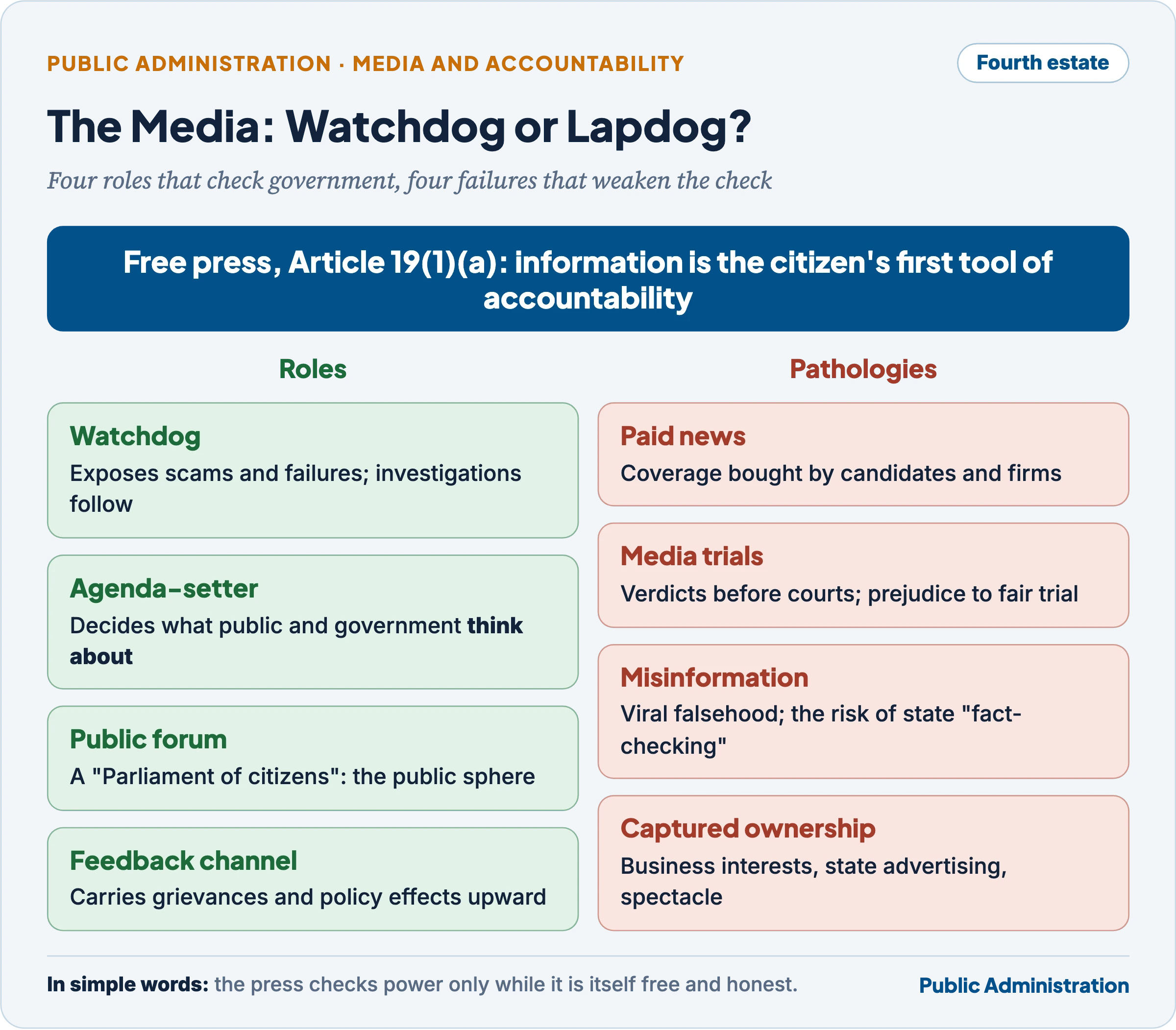
Watchdog. The media investigates and exposes corruption, waste, abuse of power and policy failure. Its effect is both direct (an inquiry, a resignation, a cancelled contract) and preventive (officials behave better when they expect scrutiny).
Agenda-setter. The media decides which problems reach public attention, and therefore which problems government must address.
- Walter Lippmann, the American journalist, in Public Opinion (1922), argued that people act not on the world as it is but on the “pictures in their heads”, and that the press supplies most of those pictures.
- Bernard Cohen (The Press and Foreign Policy, 1963) gave the classic formulation: the press may not often succeed in telling people what to think, but it is remarkably successful in telling them what to think about.
- Maxwell McCombs and Donald Shaw tested this in the 1968 US presidential campaign at Chapel Hill and published “The Agenda-Setting Function of Mass Media” (Public Opinion Quarterly, 1972): the issues voters ranked as important closely matched the issues the media emphasised.
- John Kingdon, in Agendas, Alternatives, and Public Policies (1984), showed that issues enter the policy agenda when the problem, policy and politics streams meet in a policy window; dramatic media coverage of a focusing event (a disaster, a scandal) often opens that window.
- Anthony Downs described the issue-attention cycle (1972): public alarm rises with media coverage and then fades before the problem is solved, so reforms launched in the alarm phase often lose momentum.
Does growing media influence get in the way of government’s own agenda-setting?
- Yes, in several ways:
- 24-hour television and social media compress decision time; governments respond to the day’s outrage rather than to priorities set in plans and budgets (the “CNN effect”).
- Media agendas favour the visible, dramatic and urban (a single crime) over the slow and structural (malnutrition, groundwater).
- Governments spend effort on managing perception rather than solving problems.
- Policy gets made by announcement.
- No, or only partly:
- Governments are themselves the largest source of news and use press conferences, advertising and digital campaigns to set the media’s agenda (agenda-building).
- Media influence is mostly over which issues get attention; the content of policy is still shaped by bureaucracies, experts and interest groups.
- Media pressure often helps government by building support for reforms. In India, a coalition of reformist officials, economists and journalists built opinion for the 1991 liberalisation over the preceding decade.
- Balance: in a democracy the relationship is two-way, a system of mutual checks. Government shapes opinion through the media, and public opinion, voiced through the media, shapes government.
Media as a “Parliament of citizens”.
- Meaning: Parliament is where representatives debate public affairs on behalf of citizens; the media is where citizens themselves debate, every day and not once in five years.
- How the media plays this role:
- it reports legislative debates and ministerial statements to the public;
- it carries letters, opinion pieces, phone-ins, debates and now social-media threads that let citizens question government;
- it represents regional, linguistic and social groups that are thinly represented in legislatures;
- it performs Parliament’s functions of deliberation, criticism and ventilation of grievances in continuous form.
- Theoretical root: this is Jürgen Habermas’s idea of the public sphere (section 5.2): a space between the state and private life where citizens reason together about public matters and form public opinion.
- Limits of the analogy:
- Parliament is elected and accountable; media owners and anchors are not.
- The loudest voices, not the most representative, dominate media debate.
- Commercial pressures favour spectacle over deliberation.
- Social media fragments the public into echo chambers, so there is no common floor on which citizens meet.
Other roles: feedback on how policies are working on the ground (a newspaper report of a scheme’s failure often reaches a Secretary faster than an official report); a grievance channel (departments track news reports and complaints carried in the press); education and mobilisation for public campaigns (immunisation, sanitation, voter awareness); and a link between citizens and civil society, giving NGOs and movements a voice.
2.3 Investigative journalism and accountability in India
| Exposure | Year | Outlet | Administrative consequence |
|---|---|---|---|
| Bofors howitzer kickbacks | 1987–88 | Swedish Radio broke the story; The Hindu published documents | Joint Parliamentary Committee, CBI case, a central issue in the 1989 election |
| Meham by-election violence, Haryana | 1990 | Indian Express and others | Poll countermanded; Chief Minister Om Prakash Chautala resigned |
| Securities scam (Harshad Mehta) | 1992 | The Times of India | Joint Parliamentary Committee; tightening of SEBI’s powers |
| Jain hawala payments to politicians | 1993–96 | A journalist’s reports and public interest petition | Vineet Narain v. Union of India (1997): Supreme Court placed the CBI under CVC superintendence for corruption cases, later written into the CVC Act, 2003 |
| Tehelka “Operation West End” on defence purchases | 2001 | Tehelka | Resignations of the defence minister and a party president; commission of inquiry |
| Adarsh housing society, Mumbai | 2010 | Indian Express | Chief Minister resigned; judicial commission; CBI case |
| Panama Papers (with the ICIJ) | 2016 | Indian Express | Multi-agency group set up to probe undisclosed foreign assets |
| Pegasus Project on spyware | 2021 | The Wire and global partners | Supreme Court appointed a technical committee (2021) |
- These cases show the media acting as an early-warning system for Parliament, courts and investigating agencies, which then take over.
- They also show its limits: few exposures end in conviction, and the media cannot itself enforce accountability; it depends on other institutions to act.
- Long-standing weaknesses of the press as a watchdog:
- it rarely follows up its own exposures once the story fades;
- crime, politics and disasters crowd out slow civic issues (water, schools, municipal finance);
- many papers carry near-identical headlines from the same official sources;
- as a business, it chases circulation and advertising, which favours the status quo over critical reporting;
- aggressive “sting” journalism sometimes invades privacy.
- Media and Parliament. Live broadcasts of proceedings (Lok Sabha Television from 2006, merged into Sansad TV in 2021) were meant to bring Parliament closer to the people and let citizens watch their representatives question the executive.
2.4 Pathologies: media trials, paid news, misinformation and concentrated ownership
Media trials.
- Meaning: coverage that pronounces guilt or innocence before a court does, through selective leaks, sensational debate and campaigns against named persons.
- Harms: it violates the presumption of innocence and the right to a fair trial; it pressures investigators, witnesses and judges; it destroys reputations that acquittal never restores.
- Courts’ response:
- In Sahara India Real Estate v. SEBI (2012), the Supreme Court held that courts may order postponement of reporting of specific matters for a limited time where publication would prejudice a fair trial.
- In Nilesh Navalakha v. Union of India (January 2021), arising from coverage of an actor’s death, the Bombay High Court held that a media trial interfering with an investigation can amount to contempt of court. It found parts of two channels’ coverage prima facie contemptuous and asked the media to follow the Press Council’s norms. It also noted that self-regulation by television channels lacked teeth.
Paid news.
- Meaning: news or analysis printed or broadcast in return for money or favours, presented as independent journalism. It usually appears around elections, as favourable “coverage” bought by candidates.
- Evidence:
- A Press Council of India sub-committee report (2010) documented the practice.
- The Election Commission disqualified Umlesh Yadav, an Uttar Pradesh MLA, in October 2011 for failing to account for election expenditure on paid news. She was the first legislator disqualified on this ground.
- The Parliamentary Standing Committee on Information Technology reported on the issue in 2013.
- Why it matters for administration: it corrupts the information base on which citizens judge government and blurs the line between advertising and scrutiny.
- Related practices include private treaties (media houses taking equity in companies in return for advertising space) and dependence on government advertising, which can soften criticism.
Fake news and misinformation.
- Social media and messaging platforms allow rumours to spread faster than corrections. Lynchings triggered by child-abduction rumours (2017–18) and health misinformation during COVID-19 showed the administrative cost: law and order, public health and trust in institutions.
- Responses:
- fact-checking (independent fact-checkers and the government’s PIB Fact Check unit, 2019);
- platform obligations under the IT Rules;
- temporary internet shutdowns (limited by Anuradha Bhasin);
- digital literacy campaigns.
- The dilemma: the cure must not become censorship. When the state decides what is “fake” about itself, the watchdog is placed under the watched.
Concentrated ownership and the “fourth estate in chains”.
- Much of India’s media is owned by large business groups with interests in other sectors, which may need government licences, contracts or goodwill. Media houses also depend on government advertising.
- Television is driven by TRP ratings that reward sensation. Journalists face legal harassment (defamation, sedition-type charges, anti-terror laws) and physical danger, especially in small towns.
- Edward Herman and Noam Chomsky, in Manufacturing Consent (1988), argued that news passes through five filters:
- ownership;
- advertising as the main income;
- reliance on official sources;
- “flak” (organised pressure against critical coverage);
- a dominant ideology.
The result is that the media tends to serve powerful interests without any formal censorship.
- Evidence of decline: Reporters Without Borders ranked India 151st of 180 in its 2025 World Press Freedom Index and 157th in 2026, citing concentrated ownership linked to political power, threats to journalists’ safety and the legal framework.
Media as a “societal lens” rather than an “institutional lens”.
- An institutional lens examines the working of institutions: budgets, procedures, regulatory failures, audit reports, the performance of a ministry over time.
- A societal lens reflects society’s moods, identities and emotions: outrage over a single crime, celebrity, religious and caste controversies, viral videos.
- The shift towards the societal lens is driven by commercial competition for attention, social-media algorithms that reward emotion, and the high cost of slow investigative work.
- Consequences for accountability: institutions escape sustained scrutiny; public debate becomes polarised; governments can steer attention through spectacle. On the positive side, the societal lens gives visibility to everyday experiences (a hospital’s neglect of a patient) that institutional reporting misses, and citizen journalism has widened who gets heard.
2.5 Regulating the media: self-regulation, the IT Rules and the courts
- Print: the Press Council of India (statutory, under the Press Council Act, 1978; first set up in 1966) frames Norms of Journalistic Conduct and can censure newspapers, but has no power to punish or fine.
- Broadcast:
- the Cable Television Networks (Regulation) Act, 1995 and its programme code;
- self-regulation through the News Broadcasters and Digital Standards Authority;
- public broadcasting under Prasar Bharati (Act of 1990, in force 1997), meant to give Doordarshan and All India Radio autonomy.
- Digital media and platforms: the IT Rules, 2021. The Information Technology (Intermediary Guidelines and Digital Media Ethics Code) Rules, 2021, notified in February 2021:
- require significant social media intermediaries to appoint grievance, compliance and nodal officers, take down unlawful content on orders, and (for messaging services) enable identification of the first originator of certain messages;
- impose a Code of Ethics and a three-tier grievance structure (publisher self-regulation, self-regulatory bodies, oversight by the Ministry of Information and Broadcasting) on digital news publishers and streaming platforms.
- Legal challenges:
- In August 2021 the Bombay High Court (in petitions by the company running a legal news portal and by a journalist) stayed Rules 9(1) and 9(3), which made digital news publishers adhere to the Code of Ethics under government oversight; the Madras High Court passed a similar interim order.
- The April 2023 amendment inserted Rule 3(1)(b)(v), under which intermediaries had to make reasonable efforts not to host information that a government Fact Check Unit (FCU) identified as “fake, false or misleading” about the business of the Central Government.
- The FCU was notified on 20 March 2024, and the Supreme Court stayed that notification the next day (21 March 2024) pending the High Court’s decision.
- The Bombay High Court’s fact-check unit ruling (Kunal Kamra v. Union of India):
- A division bench gave a split verdict in January 2024: Justice G.S. Patel would strike the rule down; Justice Neela Gokhale would uphold it.
- On 20 September 2024 the tie-breaking judge, Justice A.S. Chandurkar, held the rule unconstitutional, giving a 2:1 majority.
- Reasons:
- it violated Article 14, because the government became the judge in its own cause, deciding what was false about itself;
- it treated digital content differently from print without a rational basis;
- it restricted speech on grounds (falsity) not listed in Article 19(2);
- its terms “fake, false or misleading” were vague and overbroad, chilling speech and violating Article 19(1)(g) and the principle of proportionality.
- Significance: the ruling restated the core of the watchdog idea: the state can rebut and correct, but it cannot appoint itself the arbiter of truth about its own conduct.
- Social media and government more broadly:
- Governments use platforms for direct communication, grievance redress (ministries answering complaints on social media), service announcements and crisis information.
- The same platforms carry blocking orders under Section 69A of the IT Act (upheld in principle in Shreya Singhal) and takedown notices.
- In September 2025 the Karnataka High Court dismissed X Corp’s challenge to the government’s Sahyog portal, which lets authorities send takedown notices to platforms. The Court described it as an instrument of public good; critics argue that it bypasses the safeguards of Section 69A.
- Data protection and journalism: the Digital Personal Data Protection Rules, notified in November 2025 under the 2023 Act, drew objections from press bodies, including the Editors Guild of India, because they contain no specific exemption for journalistic processing of personal data.
2.6 Should media exposure be part of the rules of administrative accountability?
- Arguments for formalising it:
- Mandatory response: departments should be required to examine and act on credible media reports of wrongdoing or service failure, record the action taken and publish it. Many already monitor the press; making it a rule would make response systematic rather than selective.
- Proactive disclosure: Section 4 of the RTI Act already pushes departments to publish information suo motu; responding to media questions is a natural extension.
- Whistle-blower protection: officials who expose wrongdoing through proper channels should be protected (the Whistle Blowers Protection Act, 2014 remains un-operationalised).
- Arguments against making it a formal ground of action:
- media reports vary in accuracy and may be motivated (paid news, rival interests);
- action triggered by publicity may punish visible failures and ignore deeper ones;
- officials may become media-shy, avoiding decisions that could be reported badly;
- service conduct rules rightly bar officials from using the media to air personal grievances or criticise policy.
- Balanced position: media exposure should be a trigger for inquiry, not proof of guilt. Departments should have grievance cells that track media reports, timelines for a response, and published action-taken notes, while due process decides culpability.
Has the media given up its accountability role?
- Evidence of decline: falling press-freedom rankings, ownership concentration, dependence on official advertising, polarised television debate, and the weakening of slow, costly investigative reporting.
- Evidence of continuing vitality: regional newspapers, independent digital outlets, data journalism and fact-checkers continue to expose failures. The Pegasus, electoral bonds and pandemic-mortality debates were driven partly by journalists and researchers. Courts have repeatedly protected the press against executive overreach (the fact-check unit ruling).
- Conclusion: the media has not abandoned its role, but its capacity to perform it is uneven. It is strong where it is financially independent and legally protected, and weak where it depends on the state or on business patrons.
Common confusion
Did the Bombay High Court strike down the IT Rules, 2021? No. In September 2024 it struck down only Rule 3(1)(b)(v), added by the April 2023 amendment, which allowed a government Fact Check Unit to flag content about the Central Government as fake. The rest of the Intermediary Rules (grievance officers, takedown duties) continue. Separately, Rules 9(1) and 9(3), which bound digital news publishers to a government-overseen Code of Ethics, have been under an interim stay since August 2021.
3. Interest Groups and Pressure Groups
In simple words
When the government plans a new tax on cars, it hears quickly from car makers, dealers’ associations and auto-component unions, and slowly, if at all, from pedestrians or people breathing polluted air. Organised groups make sure their interests are counted. That is useful, because government learns what its policies will do; it is also dangerous, because the best-organised win more than their share.
3.1 Meaning and distinctions
- Interest group: an organised association of people who share an interest or attitude and try to influence public policy and its implementation, without seeking to capture formal political office themselves. David B. Truman, in The Governmental Process (1951), defined it as a shared-attitude group that makes claims upon other groups in society, and, when it makes them through government, becomes a political interest group.
- Pressure group: the same body seen in action, when it applies pressure on legislators, ministers or officials. Many writers use the two terms interchangeably. A useful distinction:
- interest group names the shared interest (all farmers have an interest in prices);
- pressure group names the organised activity (a farmers’ union blocking highways to demand a price guarantee).
Every pressure group is an interest group; not every interest is organised as a pressure group (Olson’s “latent groups”).
- S.E. Finer, the British political scientist, called the world of pressure groups the “anonymous empire” (Anonymous Empire, 1958), because so much of their influence is exercised quietly, out of public view.
The table below separates interest groups from the bodies they are most often confused with.
| Basis | Interest or pressure group | Political party | Lobbying |
|---|---|---|---|
| Goal | Influence specific policies | Capture and exercise power | Persuade decision-makers on a matter |
| Scope | Narrow, one sector or cause | Broad programme on all issues | A technique, not an organisation |
| Contests elections? | No (may support candidates) | Yes | No |
| Accountability | To members only | To voters | To the client who hires the lobbyist |
| Example | FICCI, AITUC, Bharatiya Kisan Union | Any national party | A firm or chamber meeting officials on a draft rule |
- The table shows that the difference between groups and parties is one of aim: groups want influence, parties want office. The line blurs in India, where many trade unions, farmers’ and student organisations are wings of political parties.
- Lobbying is the method of direct persuasion; the word comes from the lobbies of legislatures where members were approached. In the United States it is regulated (Lobbying Disclosure Act, 1995) and in the EU through a transparency register. India has no law on lobbying; the 2010 controversy over leaked conversations of a corporate lobbyist with politicians and journalists revived the demand for disclosure rules.
3.2 Types of interest groups
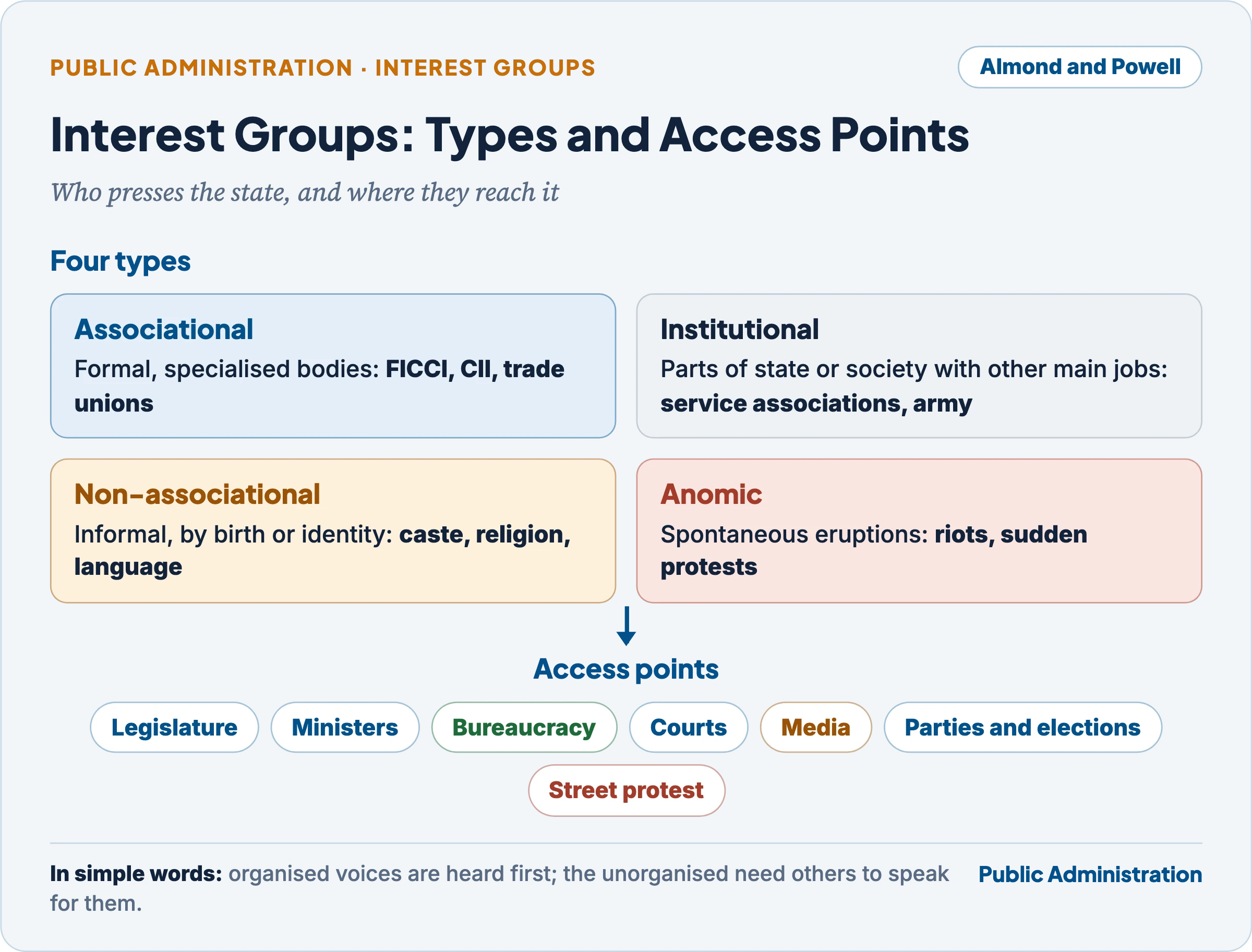
Gabriel Almond and G. Bingham Powell, in Comparative Politics: A Developmental Approach (1966), classified groups by how they are organised and how they articulate interests. The classification fits developing societies well, because it includes groups that the Western literature on organised lobbies ignored.
| Type | Features | Indian examples |
|---|---|---|
| Associational | Formally organised, specialised to represent members’ interests, with staff and procedures | FICCI, CII, trade unions, Indian Medical Association, Bar Councils, teachers’ associations |
| Institutional | Formal bodies with other main functions (part of state or society) that also press their own interests | Civil service associations, the armed forces, state governments, the judiciary on judicial appointments, religious institutions |
| Non-associational | Informal groups based on kinship, caste, religion, region or language, with no continuous organisation | Caste groups, linguistic communities, regional identities |
| Anomic | Spontaneous, unplanned eruptions such as riots and demonstrations | Sudden protests after a custodial death or an exam-paper leak |
- In developed democracies, associational groups dominate. In developing societies, non-associational and anomic forms are widespread, which makes interest articulation less predictable and often more confrontational.
- Other classifications:
- Sectional (interest) groups, which defend the interests of a section (business, labour, doctors), versus promotional (cause) groups, which promote a cause open to anyone (environment, human rights, anti-liquor campaigns).
- Insider groups, which are regularly consulted by government and play by its rules, versus outsider groups, which lack access and rely on protest and publicity (Wyn Grant, British political scientist). Groups move between the two; outsider status can be a choice (to keep independence) or a necessity.
- Fire-brigade groups, formed for a single issue and dissolved once it is resolved.
3.3 Theories of interest groups
- Group theory and pluralism.
- Arthur Bentley (The Process of Government, 1908) and David Truman (1951) saw politics as the interaction of groups, with public policy as the equilibrium reached among them at any moment.
- Robert Dahl (Who Governs?, 1961) found power in New Haven dispersed among competing groups, with no single ruling elite.
- Implication: groups are normal and healthy; competition among them protects liberty, and overlapping memberships moderate conflict.
- Critique of pluralism.
- E.E. Schattschneider (The Semisovereign People, 1960) pointed out that the pressure system has an upper-class accent: business and professionals are organised; the poor are not.
- C. Wright Mills (The Power Elite, 1956) argued that a small elite dominates key decisions.
- Mancur Olson and collective action. In The Logic of Collective Action (1965), the American economist showed that rational individuals will not contribute to a large group pursuing a common benefit, because they get the benefit anyway (the free-rider problem).
- Therefore small, concentrated groups (a few large firms) organise easily, while large, diffuse groups (consumers, taxpayers, unorganised workers) stay latent.
- Groups overcome free-riding through selective incentives: material benefits for members only (insurance, journals, discounts), solidary benefits (fellowship, status) and expressive benefits (the satisfaction of standing up for a cause).
- In The Rise and Decline of Nations (1982), Olson argued that stable societies accumulate distributional coalitions that lobby for a bigger share of the pie rather than a bigger pie, causing institutional sclerosis and slower growth.
- Capture and rent-seeking.
- George Stigler (“The Theory of Economic Regulation”, 1971) argued that regulation is often acquired by the industry and designed for its benefit (regulatory capture).
- Gordon Tullock (1967) and Anne Krueger (who coined “rent-seeking” in 1974) showed how resources are wasted competing for state-created rents: licences, quotas, tariffs and subsidies.
- India’s licence-quota-permit era was a textbook case. Stanley Kochanek (Business and Politics in India, 1974) found business the most successful interest group in influencing government.
- Corporatism. Philippe Schmitter (1974) described systems where a few peak associations of capital and labour are recognised by the state and given a monopoly of representation in return for discipline over members (Austria, Sweden). It is the opposite pole to pluralism.
- The Indian “demand polity”.
- Lloyd and Susanne Rudolph, in In Pursuit of Lakshmi (1987), contrasted demand groups (agitations, farmers’ movements, student mobilisation) with organised interest groups. They argued that India’s weak associational life produced a “demand polity” in which groups press the state through mobilisation rather than bargaining.
- Pranab Bardhan, in The Political Economy of Development in India (1984), identified three dominant proprietary classes: industrial capitalists, rich farmers and professionals including the bureaucracy. Their competing claims on subsidies and protection shaped policy.
3.4 Techniques and access points
Groups reach the state wherever decisions are made. The more open and fragmented the system, the more access points it offers (US federalism and separation of powers offer many; a centralised parliamentary system fewer).
- Legislature: lobbying members, briefing parliamentary committees, petitions, drafting amendments, funding campaigns.
- Political executive: delegations to ministers, representation in advisory and consultative bodies, pre-budget consultations by the Finance Ministry with industry, trade unions, farmers and economists.
- Bureaucracy: the most important access point in India, because most decisions on licences, rules, prices and implementation are taken here. Methods include liaison officers, technical submissions, comments on draft rules, and membership of committees. Indian groups often influence implementation more than formulation, which widens the gap between the policy as written and as applied.
- Judiciary: public interest litigation and test cases (environmental groups, consumer bodies, industry challenging regulations).
- Media and public opinion: advertising campaigns, press briefings, sponsored research, social-media mobilisation, framing private interests as the public interest.
- Parties and elections: funding (now through corporate donations and electoral trusts; electoral bonds were struck down by the Supreme Court in February 2024), vote mobilisation, party-affiliated wings.
- Expertise: many groups keep research cells and supply data and draft provisions; officials sometimes work from texts drafted by the industry or profession concerned.
- Direct action: petitions, processions, strikes, dharnas, rasta roko, bandhs, gherao, hunger strikes and, at the extreme, violence against property; typical of outsider and anomic groups.
What decides a group’s influence: size and spread; cohesion; financial resources; leadership and expertise; legitimacy (doctors are heard on health); strategic position (truckers or power-sector workers can halt the economy); links with parties and officials; and the political culture’s acceptance of group activity.
3.5 Role in policy and administration: positive and negative
In simple words
An industry body that tells the government a proposed rule will shut down small units is giving useful information. The same body quietly getting a tax exemption written for one company is capturing policy. The difference lies in openness, balance and whose interests are left out.
| Positive role | Negative role |
|---|---|
| Information and expertise: technical data that officials lack on costs, feasibility and effects | Capture: regulators and ministries serving the regulated rather than the public |
| Representation between elections, for interests that parties aggregate poorly | Rent-seeking: competing for subsidies, protection and exemptions that waste resources |
| Feedback on implementation problems | Unequal access: the organised and rich drown out the unorganised poor (Olson, Schattschneider) |
| Legitimacy and compliance: policies negotiated with stakeholders are easier to implement | Veto power: blocking reforms (land ceilings, labour law, tax reform) that hurt narrow interests |
| Political participation and education of members | Corruption and opacity: funding parties, “managing” officials, middlemen |
| Check on government: an organised counterweight to state power | Fragmentation and sclerosis: many narrow claims, no common good (Olson) |
- The table’s lesson is that groups are neither good nor bad in themselves; the issue is the rules of the game. Transparency (disclosure of lobbying and party funding), balanced consultation (hearing consumers and workers alongside industry), and independent regulators with cooling-off rules for staff reduce the negative side.
- In a democracy where politics is consultation, negotiation and bargaining, government must consult organised groups at both formulation and implementation, while protecting the unorganised. Harold Lasswell‘s point was that a democratic state limits organised groups so that the unorganised are not harmed.
3.6 Interest groups in India
- Business associations:
- ASSOCHAM (1920), FICCI (1927) and the CII, whose roots lie in engineering associations of the 1890s and which took its present name in 1992.
- They are the most organised and best-resourced groups, with sector councils, research wings and regular access to ministries.
- Methods: pre-budget memoranda, membership of advisory bodies, studies submitted to ministries, global summits, and the shaping of debates on reforms (deregulation in 1991, GST, the Insolvency and Bankruptcy Code, production-linked incentives).
- FICCI described its own role in the planning era as that of an adviser to government, submitting studies for successive Five-Year Plans.
- Trade unions:
- AITUC (1920), INTUC (1947), Bharatiya Mazdoor Sangh (1955) and CITU (1970); most are linked to parties.
- Strengths: concentration in the public sector, banks and transport; capacity for nationwide strikes.
- Weaknesses: fragmentation along party lines; leadership by outsiders; tiny coverage of the informal workforce (over 90% of workers).
- Their influence has declined since liberalisation; they opposed disinvestment and the four Labour Codes (enacted 2019–20) with limited effect on the final laws.
- Farmers’ organisations:
- From the late 1970s, “new farmers’ movements” of surplus-producing farmers pressed for remunerative prices, cheap inputs and loan waivers. Examples: Shetkari Sanghatana (Sharad Joshi, Maharashtra, 1979) and the Bharatiya Kisan Union (strong in western Uttar Pradesh under Mahendra Singh Tikait).
- The 2020–21 farm laws protests:
- In September 2020 Parliament passed three Acts: on trade outside regulated mandis, contract farming, and amendments to the Essential Commodities Act.
- Farmers’ unions, coordinated under the Samyukt Kisan Morcha, protested at Delhi’s borders from November 2020 for about a year.
- The Supreme Court stayed the laws in January 2021 and set up an expert committee.
- The Prime Minister announced repeal on 19 November 2021; the Farm Laws Repeal Act, 2021 received assent on 1 December 2021.
- Lessons for administration:
- the laws were passed without pre-legislative consultation or committee scrutiny, which hardened opposition;
- an organised, well-resourced and regionally concentrated interest could veto a policy it saw as a threat;
- the episode showed both the democratic value of group mobilisation and the difficulty of reforming sectors with powerful organised beneficiaries.
- Women’s organisations:
- the All India Women’s Conference (1927), the National Federation of Indian Women (1954) and the All India Democratic Women’s Association (1981) campaign for a gender-just society and mobilise opinion on atrocities, dowry and legal reform;
- the Self-Employed Women’s Association (SEWA), founded by Ela Bhatt in Ahmedabad and registered as a trade union in 1972, organises informal-sector women (vendors, home-based workers, dairy producers) through unions, cooperatives and a bank. Its litigation and advocacy for street vendors’ right to trading space fed into the Street Vendors (Protection of Livelihood and Regulation of Street Vending) Act, 2014. SEWA shows a group that is at once a union, a voluntary organisation and a movement.
- Professional bodies: the Indian Medical Association, Bar Councils and chartered accountants’ institute are statutory self-regulators as well as interest groups, which creates conflicts (the 2nd ARC’s Ninth Report examined self-regulatory bodies of this kind).
- Student, teacher and employee associations: most are affiliated to parties; government employee associations are institutional interest groups whose bargaining shapes pay commissions and service rules.
- Caste, religious and regional associations: non-associational interests organised as caste federations, religious bodies and regional movements. They press for reservations, recognition and resources, and are powerful in electoral politics.
Interest groups and agenda-setting in developing countries.
- Fewer but more dominant groups. Thomas R. Dye observed that poor, agrarian societies produce fewer organised groups than industrial societies, but those few have a greater chance to dominate policy. Business chambers, landed elites and organised public-sector employees set the agenda; the rural poor and informal workers seldom do.
- Personalised access. Groups work through personal networks and overlapping elites (officials, politicians and businessmen from the same social circles) rather than open, rule-bound lobbying.
- Agenda denial. Powerful groups not only push issues onto the agenda but keep others off it. Bachrach and Baratz called this the “second face of power” (“Two Faces of Power”, 1962), the power of non-decision-making: land reform and agricultural taxation stayed off effective agendas for decades.
- External actors. Donors, multilateral lenders and international NGOs are powerful agenda-setters in aid-dependent countries.
- Mobilisation as access. Where institutional access is closed, groups use agitation to force issues onto the agenda; the farmers’ protests and caste-based reservation agitations are Indian examples.
- The result: the agenda reflects organised power more than need, which is why social accountability and the representation of unorganised groups through civil society, courts and media matter so much.
4. Voluntary Organisations and NGOs
In simple words
A voluntary organisation is a group of people who come together, by their own choice and not for profit, to do something for others or for a cause: run a school for tribal children, teach farmers new methods, or fight for the rights of slum dwellers. Some work alongside government, some fill the gaps it leaves, and some challenge it.
4.1 Meaning and features
- Voluntarism comes from the Latin voluntas, will: action freely chosen, not commanded by the state or driven by profit.
- Lord William Beveridge, author of the British welfare-state report, in Voluntary Action (1948), described a voluntary organisation as one that, whether its workers are paid or unpaid, is initiated and governed by its own members without external control.
- Norman Johnson identified four distinguishing features: the method of formation (voluntary), of government (self-governing), of financing (at least partly from voluntary sources) and the motive (not profit).
- The National Policy on the Voluntary Sector, 2007 treats as voluntary organisations those that are:
- private, i.e. separate from government;
- not profit-distributing to owners or directors;
- self-governing, i.e. not controlled by government;
- registered organisations or informal groups with defined aims and objectives.
- Terminology:
- Voluntary organisation (VO) is the older Indian term.
- Non-governmental organisation (NGO) came from UN usage after 1945 and stresses independence from government.
- Civil society organisation (CSO) is the wider umbrella, covering NGOs, trade unions, professional bodies, religious and community associations and movements.
- Community-based organisation (CBO) is a membership body of the affected people themselves (a self-help group, a water users’ association).
- GONGO (“government-organised NGO”) is a body created or controlled by government but presented as non-governmental, a reminder that not all non-official bodies are voluntary.
- Scale: a CBI survey placed before the Supreme Court in 2015 counted about 31 lakh registered NGOs, of which only about a tenth filed annual financial statements.
4.2 Evolution in India
- Tradition of charity and reform: religious charity (daan), caste and community welfare, and the 19th-century reform bodies (Brahmo Samaj, Arya Samaj, Ramakrishna Mission, Servants of India Society, 1905).
- Gandhian constructive work: khadi, village industries, basic education and Harijan welfare as voluntary nation-building. Rabindranath Tagore’s Sriniketan (1922) experimented in rural reconstruction, and Gandhi’s ashram at Sevagram (from 1936) became a centre of constructive work.
- After 1947, through the Five-Year Plans:
- The First Plan (1951–56) recognised voluntary agencies in social welfare. The Central Social Welfare Board (1953, chaired by Durgabai Deshmukh) began grants to voluntary bodies for women’s and children’s welfare.
- The Sixth Plan (1980–85) identified new areas where NGOs could act in development.
- The Seventh Plan (1985–90) gave voluntary agencies a full role in rural development. It set criteria for identifying them (legal entity, rural base, non-profit, secular, non-partisan) and saw them as an alternative monitoring machinery for anti-poverty programmes and as the “eyes and ears” of the people.
- CAPART (Council for Advancement of People’s Action and Rural Technology) was formed in 1986 by merging two earlier bodies (PADI and CART) to fund and support voluntary action and rural technology. It became the largest government funder of rural NGOs. After allegations of poor monitoring it was dissolved and merged with the National Institute of Rural Development and Panchayati Raj in 2020.
- The Ninth and Tenth Plans sought NGO participation in implementation and in a nationwide network for rural development.
- The 1970s turn to activism: after the Emergency, many groups moved from welfare to rights and mobilisation (organising landless labourers, tribals, women). The state increasingly saw these groups as a threat, and some faced harassment.
- Liberalisation and after: NGOs became implementing partners and contractors for government schemes, donors and, after the Companies Act, 2013 (Section 135) made CSR spending mandatory for large companies, for corporate funds.
David Korten’s four generations of NGO strategy. David Korten, the American development thinker, in Getting to the 21st Century: Voluntary Action and the Global Agenda (1990), traced how NGO strategies evolve.
| Generation | Strategy | Problem definition | Role of NGO | Indian illustration |
|---|---|---|---|---|
| First | Relief and welfare | Shortage of goods | Doer: direct delivery | Disaster relief, charitable hospitals |
| Second | Small-scale, self-reliant local development | Local inertia | Mobiliser of community | Village development projects |
| Third | Sustainable systems development | Institutional and policy constraints | Catalyst for policy change | Advocacy for forest rights, RTI |
| Fourth | People’s movements | Inadequate mobilising vision | Activist and educator, networking | Coalitions on food, environment, information |
- The progression shows NGOs moving from filling gaps to changing systems, which is why the later generations inevitably come into tension with the state.
4.3 Roles of voluntary organisations
- Service delivery: schools, health centres, disability services, shelters and livelihood programmes, often in remote areas or for groups the state reaches poorly. Their claimed advantages are flexibility, closeness to the poor, low cost, commitment and freedom from rigid rules.
- Innovation and demonstration: they pilot models that the state later scales up. Examples:
- Pratham‘s Annual Status of Education Report (from 2005) shifted the national debate from enrolment to learning outcomes;
- community health worker models preceded the ASHA programme;
- SEWA‘s organisation of informal women workers.
- Advocacy and policy influence:
- NGOs and movements shaped the RTI Act (2005), MGNREGA (2005), the Forest Rights Act (2006), the Right to Education Act (2009) and the National Food Security Act (2013);
- they used research, budget analysis, public hearings and litigation.
- Watchdog and social accountability:
- social audits, public hearings (jan sunwai), citizen report cards and expenditure tracking;
- Public Affairs Centre in Bengaluru pioneered citizen report cards on public services (1994).
- Sensitising government agencies:
- acting as eyes and ears of the people and a feedback channel;
- pushing implementation of protective laws (minimum wages, bonded labour abolition) “in letter and spirit”;
- through PIL and persistent pressure, “activating the system” to respond.
This is the sense in which voluntary organisations have become tools for sensitising government: they bring to officials the experience of the people their schemes are meant for.
- Empowerment and conscientisation: organising the poor to know and claim their rights (Freire’s method), building local leadership, women’s self-help groups.
- Intermediary role: linking citizens to schemes, helping them with documents and applications, and conveying their demands upward.
- Disaster response: relief and rehabilitation after cyclones, floods, earthquakes and the COVID-19 lockdown, often faster than the state.
Limitations:
- dependence on government grants or foreign funds;
- lack of trained staff and professional management;
- limited scale and short project cycles;
- mushrooming of fake or “briefcase” NGOs created to capture grants;
- political and sectarian agendas in some bodies;
- resistance from local elites;
- co-optation into government’s agenda.
4.4 Government–NGO relations
In simple words
Government and NGOs can relate in four broad ways. They can work hand in hand on the same goal, divide the work between them, have one swallow the other, or openly clash. All four exist in India at the same time, sometimes with the same NGO.
Adil Najam, a Pakistani-American scholar, in “The Four C’s of Government–Third Sector Relations” (Nonprofit Management and Leadership, 2000), classified relations by whether the goals and the means of government and NGOs are similar or different.
| Relationship | Goals | Means | Indian illustration |
|---|---|---|---|
| Cooperation | Similar | Similar | NGOs implementing government health or education programmes as partners |
| Complementarity | Similar | Different | NGOs running bridge schools for out-of-school children while the state runs regular schools |
| Co-optation | Different | Similar | NGOs turned into contractors who deliver the state’s scheme and lose their independent voice |
| Confrontation | Different | Different | Movements against large dams or land acquisition |
- Amartya Sen described the state–NGO relationship as one of “cooperative conflict”: they need each other but also contest each other’s choices.
- H.R. Chaturvedi, an Indian scholar of voluntary action, noted both sides of state funding:
- Gains: it let NGOs expand, attract young professionals and become intermediaries between people and schemes.
- Losses: it bred dependence on grants, a tilt towards projects suggested by officials rather than felt needs, and NGOs formalising and bureaucratising themselves to meet grant rules, losing the very flexibility that justified them.
Institutional framework in India:
- National Policy on the Voluntary Sector, 2007 (approved by the Union Cabinet on 17 May 2007). Its four objectives:
- create an enabling environment that stimulates the effectiveness of VOs and safeguards their autonomy;
- enable VOs to mobilise resources legitimately from India and abroad;
- identify systems by which government may work with the sector;
- encourage transparent and accountable governance within VOs.
- Three instruments of partnership under the policy:
- consultation through formal processes at Centre, State and district levels;
- strategic collaboration on complex interventions needing long-term social mobilisation;
- project funding through standard schemes.
- Other commitments of the policy:
- consider a simple, liberal central law for registering societies, trusts and non-profit companies;
- Joint Consultative Groups of government and voluntary representatives;
- encourage an independent, national self-regulatory agency for the sector;
- leave accreditation methods to be developed and debated within the sector before applying them to government funding.
- NGO-DARPAN: a portal now run by NITI Aayog that gives each registered VO or NGO a unique ID. The ID is needed to apply for grants from many ministries and links the NGO’s registration, PAN and office-bearers. It is a database for transparency, not a licence or an approval.
- 2nd ARC, Ninth Report (Social Capital: A Shared Destiny, 2008): recommended a new legal framework for charities, accreditation of voluntary organisations through an independent body, review of the foreign-contribution law, and support for self-help groups and CSR. It saw social capital, the trust and networks of associational life, as a resource for governance.
4.5 Regulating foreign funding: FCRA
- History:
- The first Foreign Contribution (Regulation) Act was passed in 1976, during the Emergency, to stop foreign money from influencing politics.
- A 1984 amendment required all NGOs receiving foreign funds to register with the Ministry of Home Affairs.
- The FCRA, 2010 replaced the 1976 Act. It requires registration (valid for five years) or prior permission, bars certain persons (election candidates, legislators, judges, public servants, political parties, news media) from receiving foreign contributions, and allows cancellation for activities “detrimental to the national interest”.
- The 2020 amendment:
- sub-granting prohibited: one registered NGO can no longer pass foreign funds to another;
- the cap on administrative expenses cut from 50% to 20%;
- all foreign contributions must first arrive in a designated FCRA account at the State Bank of India, New Delhi Main Branch;
- Aadhaar (or passport) identification of office-bearers made mandatory;
- public servants added to those barred;
- longer suspension periods.
- Rules of 2022 and 2024–25: the limit for gifts from relatives abroad was raised from Rs 1 lakh to Rs 10 lakh; unspent administrative allocations may be carried forward.
- Data (Ministry of Home Affairs, July 2026):
- about 16,200 associations were actively registered in 2024–25 and received about Rs 22,963 crore in foreign contributions;
- over the last decade nearly 22,000 registrations were cancelled and about 15,000 deemed to have ceased (mostly on non-renewal);
- FCRA-registered bodies are under 1% of all NGOs in India.
- The 2026 changes:
- The FCRA (Amendment) Bill, 2026, introduced in the Lok Sabha on 25 March 2026, proposes a Designated Authority to take over assets created from foreign funds after registration ends, with restoration if registration is regained, an appeal to the district judge, lower maximum imprisonment, and central approval before State agencies investigate FCRA cases.
- Revised Rules (June 2026) require certificates to name specific purposes and States of operation, a minimum utilisation of Rs 10 lakh over two years for renewal, and ultimate-donor disclosure.
- Government’s case: transparency and sovereignty. Foreign money must not influence elections, public order, conversions or protests against strategic projects; the law is a disclosure regime comparable to foreign-influence laws in the US, Australia, the UK and Canada; most genuine NGOs continue to receive funds.
- Critics’ case:
- the ban on sub-granting cuts off small grassroots NGOs, which used to receive foreign funds through larger intermediaries;
- the 20% cap ignores that research and advocacy organisations spend mostly on staff;
- the SBI-only account and Aadhaar rules raise compliance costs;
- broad grounds such as “public interest” give wide discretion; licences of several well-known rights and environmental organisations were cancelled or not renewed;
- the result is a chilling effect on advocacy that criticises government.
- Courts: in Noel Harper v. Union of India (2022), the Supreme Court upheld the 2020 amendment. It held that receiving foreign contributions is not an absolute right and that Parliament may regulate foreign funding to protect sovereignty and to prevent dependence on foreign donors.
4.6 Accountability of NGOs
- The problem:
- NGOs demand accountability from government but are often weakly accountable themselves;
- accountability tends to run upward to funders (reports, audits, results frameworks) rather than downward to the people they serve (Michael Edwards and David Hulme, Too Close for Comfort?, 1996);
- governance is often concentrated in a founder or family;
- financial reporting is poor: only about a tenth of NGOs filed returns, as the CBI survey found.
- Mechanisms:
- legal: registration laws (Societies Registration Act, 1860; trusts; Section 8 companies), income-tax exemptions with audit requirements, FCRA returns;
- funder: grant conditions, audits and evaluations;
- government: NGO-DARPAN, social audit of NGO-run programmes, and the Lokpal Act, 2013, which brings office-bearers of bodies receiving substantial government funds or foreign contributions within its definition of public servants for corruption cases;
- self-regulation: codes of conduct and accreditation by peer networks, as the 2007 Policy envisaged;
- downward: public disclosure, beneficiary feedback, social audits of NGOs’ own work.
- Balance: regulation should target misuse, not dissent. Excessive control turns NGOs into agents of the state and destroys their value as independent voices; too little invites fraud and erodes public trust.
Indian Connect — Are NGOs replacing government?
- The claim: from the 1990s, NGOs have implemented a growing share of programmes (health outreach, skill training, school management, shelter homes). Donors and governments favoured them as cheaper, more flexible and closer to the poor, and New Public Management encouraged contracting out. This rise is often linked to the declining legitimacy of the state: fiscal crises, corruption and failed top-down development led donors and citizens to look for alternatives.
- The reality:
- NGOs work through and alongside the state rather than replacing it. Most of their money for large programmes is public money; their reach is uneven and project-bound; they lack the state’s legal authority, universality and accountability to voters.
- Programmes such as MGNREGA, the National Food Security Act and the Right to Education strengthened the state’s obligations, often at NGOs’ own urging.
- Why “voluntarism is not the antithesis of state-centrism”:
- in India the state has promoted voluntary action (grants from the First Plan, CAPART, the 2007 Policy) and regulated it (FCRA);
- NGOs’ greatest successes came when they changed state policy rather than bypassing it.
- The better view: the two are complementary. NGOs are useful instruments of decentralisation (working with Gram Sabhas and self-help groups) and of de-bureaucratisation (flexible, people-centred delivery), but only when they do not themselves become bureaucratic, grant-dependent contractors.
5. Civil Society
In simple words
Between the family and the government lies a large space: clubs, unions, religious bodies, residents’ associations, NGOs, social movements, online campaigns. In this space people organise themselves, argue about public matters and press the state. That space is civil society. When it is strong and free, the state is watched; when it is weak, captured or suppressed, the state answers to no one between elections.
5.1 Meaning and definitions
- Larry Diamond, the American democracy scholar (“Rethinking Civil Society”, Journal of Democracy, 1994): civil society is the realm of organised social life that is open, voluntary, self-generating, at least partially self-supporting, autonomous from the state and bound by a legal order or set of shared rules. Its members act collectively in a public sphere to express interests and ideas, make demands on the state and hold state officials accountable, but they do not seek to win formal power.
- Common elements in most definitions:
- an intermediate sphere between the family (private) and the state (political);
- voluntary association, not ascription or command;
- autonomy from the state (and, in most modern accounts, from the market);
- concern with public rather than purely private ends;
- pluralism and acceptance of legal rules (which separates it from armed or criminal groups).
- Components: NGOs, community-based organisations, trade unions, professional associations, cooperatives, farmers’ and women’s organisations, religious bodies, social movements, independent media and academia, and online networks.
- Two conceptions:
- the political (liberal-democratic) conception, in which civic associations underpin citizenship, rights and representation;
- the sociological conception, in which civil society is simply the associational realm between individual and state, whatever its values.
The second raises hard cases: is a caste panchayat that enforces social boycotts part of civil society? Some call such bodies “uncivil society”.
Civil society, state and market. Modern governance theory distinguishes three sectors, each with its own logic.
| Feature | State | Market | Civil society |
|---|---|---|---|
| Organising principle | Authority and law | Exchange and profit | Voluntary association and solidarity |
| Main resource | Coercion, taxation | Money | Trust, commitment, legitimacy |
| Accountability | To voters, courts, legislature | To owners and customers | To members, supporters and the public |
| Typical failure | Bureaucratism, abuse of power | Inequality, externalities | Fragmentation, amateurism, capture by elites |
| Role in governance | Rules, provides public goods | Produces goods, jobs, revenue | Voice, watch, deliver, build social capital |
- Each sector corrects the failures of the others: the state regulates the market, the market limits an all-powerful state, and civil society checks both while depending on the state for legal protection.
- Civil society therefore defends people against the state (arbitrary power, rights violations) and against the market (consumer exploitation, environmental damage, labour abuse), and channels the democratic will into pressure on the state.
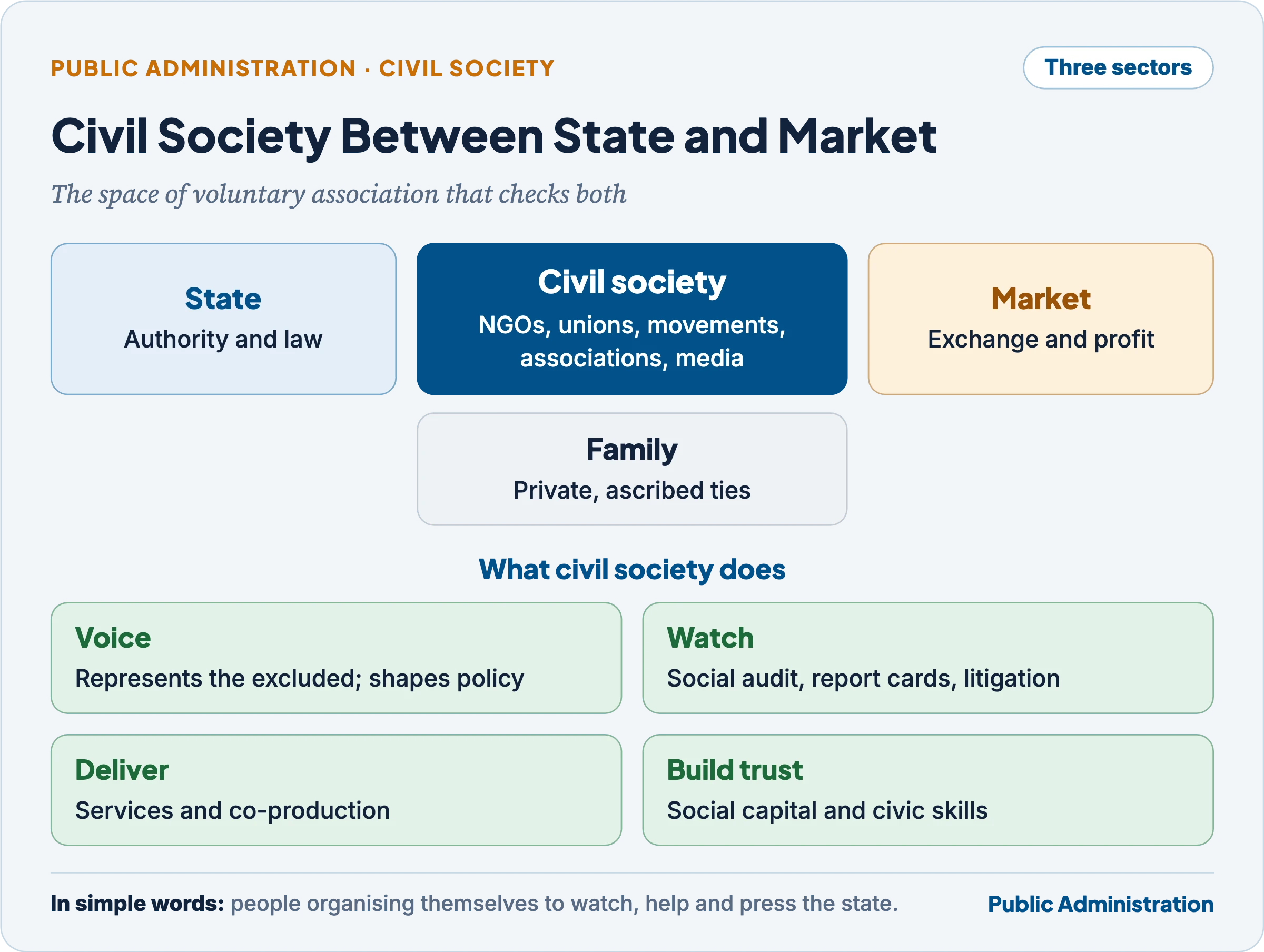
5.2 The concept through thinkers
| Thinker | Work (year) | Idea of civil society |
|---|---|---|
| John Locke | Second Treatise of Government (1689) | Civil society is political society itself, formed by contract to protect life, liberty and property, as opposed to the state of nature |
| Adam Ferguson | An Essay on the History of Civil Society (1767) | Civil society as refined, commercial society; warned that commerce can erode civic virtue |
| G.W.F. Hegel | Elements of the Philosophy of Right (1820) | Civil society as the sphere between family and state, the “system of needs” where self-interested individuals meet through markets, corporations and courts; it needs the state to reconcile its conflicts |
| Karl Marx | On the Jewish Question (1843), German Ideology (1846) | Civil society as bourgeois society, the realm of economic relations and class interest that the state serves |
| Alexis de Tocqueville | Democracy in America (1835, 1840) | Voluntary associations as schools of democracy and a barrier against the tyranny of the majority and a centralised state |
| Antonio Gramsci | Prison Notebooks (written 1929–35) | Civil society (churches, schools, media, parties) as the sphere where the ruling class secures hegemony through consent; also the terrain for counter-hegemony |
| Jürgen Habermas | The Structural Transformation of the Public Sphere (1962) | The public sphere, where private citizens reason together on public matters and form public opinion, checks the state; commercial media and bureaucratisation “refeudalise” it |
| Robert Putnam | Making Democracy Work (1993), Bowling Alone (2000) | Social capital (networks, norms of reciprocity, trust) built in civic associations makes government effective |
| Partha Chatterjee | The Politics of the Governed (2004) | In India, civil society proper is a small, elite domain; most people deal with the state through “political society”: negotiation, mobilisation and claims as populations to be governed |
- Tocqueville observed that Americans constantly formed associations for every purpose, and that this habit taught citizens how to cooperate, pursue common goals and resist a centralising state. For him, the art of association was the key to democracy.
- Gramsci reversed the liberal view: civil society is not just a shield against the state but the place where the state’s power is naturalised through ideas and institutions. In the West, he argued, the state was only an outer trench behind which stood a sturdy system of fortresses in civil society; social change required a long “war of position” within civil society, not just a seizure of the state.
- Habermas gave the media its theoretical place. The 18th-century coffee houses, salons and newspapers created a public of private persons debating public affairs. When media becomes mass commercial entertainment and public relations, the public sphere declines into a space of managed opinion. This is the root of the “media as Parliament of citizens” idea and of its present crisis.
- Putnam’s social capital. Studying Italy’s regional governments created in 1970, Putnam found that northern regions with dense networks of choral societies, football clubs and cooperatives had far more effective governments than the south, which had few horizontal associations and more patron-client ties. His conclusion was that civic traditions predict economic development better than economics predicts civic traditions.
- Bonding social capital ties similar people (caste, kin); bridging social capital links different groups. Bonding without bridging can deepen division.
- Critics:
- it ignores power and inequality (dense networks can serve exclusion);
- it neglects the state’s role in creating trust (Peter Evans argued that state action can build social capital);
- Putnam’s history of Italy is contested.
- The 2nd ARC’s Ninth Report used social capital as its organising idea for voluntary action and self-help groups.
- Chatterjee’s distinction explains why Indian civil society looks strong in metropolitan advocacy (petitions, PILs, campaigns by educated professionals) but thin in associational life among the poor. The poor negotiate with officials as slum dwellers, beneficiaries and voters, often through political parties and patronage, not through formal voluntary associations. Niraja Gopal Jayal made a similar observation: civil society in the sense of opposition to the state is developed in India, while civil society in the sense of a dense associational life is not.
5.3 Civil society in governance and accountability
Roles in governance:
- Voice and representation: mobilising the marginalised (dalits, adivasis, women, informal workers) whose interests parties and lobbies neglect.
- Policy influence: research, consultation, campaigns and litigation that shape laws and programmes. Civil society shapes public policy through agenda-setting, expert input, coalition-building and policy entrepreneurship (Kingdon’s term for those who push solutions when a policy window opens).
- Watchdog and accountability: monitoring, exposing and litigating against failures.
- Service delivery and co-production where the state is absent or weak.
- Democratic education: associations teach skills of deliberation, compromise and leadership (Tocqueville, Putnam), and recruit future leaders.
- Conflict mediation and social cohesion, especially in divided societies.
- Norm-setting: campaigns on environment, gender and transparency change what society expects of government.
Social accountability. The World Bank (2004) defined social accountability as an approach to building accountability that relies on civic engagement: ordinary citizens and civil society organisations participate directly or indirectly in exacting accountability from the state.
- It complements supply-side (government-side) accountability (audit, legislature, vigilance, courts) with demand-side pressure from citizens. The World Development Report 2004, Making Services Work for Poor People, called this the short route of accountability: citizens holding providers to account directly, rather than only through the long route of electing politicians who then control providers.
- Core elements:
- information (budgets, records, audit reports, made available through transparency laws);
- voice (forums, media, campaigns);
- negotiation (interface meetings, public hearings, legal remedies) that lead to an official response.
- Tools:
- citizen report cards (Public Affairs Centre, Bengaluru);
- community scorecards with interface meetings between users and providers;
- social audits and public hearings (MKSS; MGNREGA Section 17);
- public expenditure tracking surveys (pioneered in Uganda’s primary education);
- participatory budgeting (Porto Alegre);
- budget analysis by civil society groups;
- RTI-based investigation.
- Conditions for success:
- access to information;
- capacity and autonomy of civic groups;
- a receptive state: officials and political leaders willing to respond, and institutions that act on findings;
- legal backing (statutory social audit, RTI).
Social accountability works best when it connects with formal institutions (an audit department that acts on social audit findings) rather than standing alone.
Indian Connect — Civil society and accountability in India
- The RTI Act, 2005 grew directly out of civil society action: MKSS’s public hearings in Rajasthan and the national campaign that followed.
- MGNREGA’s Section 17 made social audit by the Gram Sabha a statutory duty, and several States set up independent social audit units; the CAG and the Ministry of Rural Development issued joint auditing standards for social audit in 2016.
- Citizen report cards in Bengaluru (from 1994) led utilities and the municipality to improve services and inspired similar exercises elsewhere.
- The details of these instruments are covered in the article on Citizen’s Charters, Right to Information and Social Audit.
5.4 Civil society movements in India
| Movement | Period | Issue and method | Outcome for governance |
|---|---|---|---|
| Chipko (Garhwal Himalaya) | From 1973 (Mandal 1973; Reni 1974, led by Gaura Devi) | Villagers, especially women, hugged trees to stop commercial felling; Chandi Prasad Bhatt and Sunderlal Bahuguna | A 15-year ban on green felling in the Himalayan forests of Uttar Pradesh (1980); influenced the Forest (Conservation) Act, 1980 and community forestry |
| Narmada Bachao Andolan | From the mid-1980s (led by Medha Patkar) | Against displacement by the Sardar Sarovar and other dams; rallies, satyagraha, litigation | World Bank withdrew from the project (1993) after an independent review; Supreme Court allowed construction with resettlement conditions (2000); shaped debate leading to the Right to Fair Compensation and Transparency in Land Acquisition, Rehabilitation and Resettlement Act, 2013 |
| MKSS and the right to information movement | MKSS formed 1990 in Rajasthan (Aruna Roy, Nikhil Dey, Shankar Singh); public hearings from 1994; Beawar dharna 1996 | Demand for copies of panchayat records to verify wages and works; jan sunwai | Rajasthan RTI Act (2000), national RTI Act (2005), social audit under MGNREGA |
| India Against Corruption | 2011 (Anna Hazare’s fasts in April and August) | Mass protests for a strong, independent Lokpal (the “Jan Lokpal” draft) | Lokpal and Lokayuktas Act, 2013; first Lokpal appointed 2019 |
| Farmers’ protest | November 2020 to December 2021 | Sit-ins at Delhi’s borders against three farm laws; Samyukt Kisan Morcha | Repeal of the laws (December 2021) |
The Jan Lokpal episode and civil society’s role in accountability.
- Contribution:
- it broke four decades of inaction on the Lokpal;
- it put corruption at the top of the national agenda;
- it mobilised the urban middle class and youth through media and social media;
- it forced a joint drafting committee of ministers and civil society representatives (April 2011), an unusual form of participation in law-making.
- Criticisms:
- a small, unelected group claimed to speak for “the people” and set deadlines for Parliament, raising questions about representative democracy;
- the demand for an all-powerful Lokpal risked creating an unaccountable super-agency;
- the movement’s urban, upper-caste base and its later turn into a party blurred the line between civil society and political society;
- the eventual Act was weaker than demanded, and the Lokpal’s working since 2019 has been modest.
- Lesson: civil society can set the agenda and break deadlock, but legislation and accountability institutions still have to pass through representative and constitutional processes. The movement worked because it pushed the state, not because it replaced it.
5.5 State and civil society: partners, rivals or mirror images?
- Complement and supplement. Civil society supplements the state where it is absent (relief, services) and complements it by adding voice, local knowledge and monitoring. But its capacity and role depend heavily on the state:
- the legal framework for association, registration and funding (FCRA, tax laws);
- access to information (RTI);
- space for protest (police powers, Section 144-type orders now under Section 163 of the Bharatiya Nagarik Suraksha Sanhita, 2023);
- willingness of officials to engage;
- public funding of NGO programmes.
A state can enable civil society (RTI, social audit, the 2007 Policy) or disable it (licence cancellations, surveillance, sedition-type charges).
- Strong state, strong society.
- Joel Migdal (Strong Societies and Weak States, 1988) showed how, in many developing countries, powerful social organisations (landlords, clans, local strongmen) fragment social control and leave the state unable to implement policy.
- Peter Evans (Embedded Autonomy, 1995) argued that effective developmental states combine autonomy from capture with dense ties to society.
- The lesson: the aim is neither a strong state over a weak society nor the reverse, but both strong together, with the state providing rights, rules and resources and civil society providing participation, information and checks. Participatory democracy and responsive government then reinforce each other.
- Why state–civil society interaction was neglected in developing countries:
- the post-colonial model of development was state-led and bureaucracy-led, with donors funding governments directly;
- planners saw civil society as either traditional (caste, religion) and therefore an obstacle, or as an object of mobilisation for state programmes;
- development administration theory (Riggs, Weidner) studied the bureaucracy and its environment but treated society mainly as the ecology of administration, not as a partner;
- authoritarian and one-party regimes distrusted independent associations;
- only after the failures of top-down development, democratic transitions (the “third wave”), and the good-governance agenda of the 1990s did donors and scholars turn to civil society. Even then, attention went mostly to NGOs, not to the wider web of associations and their interaction with the state.
- When does civil society improve development? Only when state institutions are receptive to its inputs:
- consultation is genuine;
- findings of social audits are acted upon;
- grievances lead to change;
- officials are rewarded for responsiveness.
Without receptive institutions, civic energy dissipates in protest or is co-opted. Kerala’s decentralised planning and MGNREGA social audits in Andhra Pradesh and Telangana worked because state governments built institutions to act on civic inputs.
- Do CSOs restrict government programmes in practice? Sometimes:
- litigation and protests delay infrastructure projects;
- some groups oppose technology or scheme design on ideological grounds;
- foreign-funded campaigns against particular projects have been alleged by government (one reason for FCRA’s tightening).
But much “restriction” is accountability doing its job: insisting on environmental clearance, consent and fair compensation. The test is whether objections rest on evidence and rights and use lawful means, and whether government engages with them early rather than treating every objection as obstruction.
- Is civil society an effective organ to control administration?
- It is effective as an informal, continuous and decentralised control, strongest when combined with formal levers (RTI, courts, audit, media).
- It is weak as a substitute for those levers, because it lacks legal authority, is uneven across regions and classes, and can itself be captured.
Criticism — The case that civil society weakens governance
- Unrepresentative: NGOs and activist groups are self-appointed; they claim to speak for the people but are accountable to no electorate, and often only upward to funders.
- Elite capture: urban, English-speaking, upper-caste professionals dominate visible civil society; the poor are spoken for rather than speaking.
- Obstruction: litigation and agitation stall development projects and raise their costs; single-issue campaigns ignore trade-offs.
- Foreign influence: foreign-funded groups may advance external agendas on energy, religion or trade.
- Uncivil society: caste panchayats, communal organisations and vigilante groups also live in civil society and can undermine rights.
- Fragmentation: thousands of small, competing groups with narrow agendas (“silo mentality”) cannot offer coherent alternatives.
Defence — The case that civil society strengthens governance
- Continuous accountability: elections come once in five years; civil society watches every day and reaches the places formal controls do not (the Gram Sabha, the ration shop).
- Voice for the excluded: movements of dalits, adivasis, women and informal workers have won rights that parties and lobbies ignored.
- Policy innovation: RTI, MGNREGA, forest rights, right to education and food security all owe much to civil society research and campaigning.
- Legitimacy for the state: consultation and co-production make policies more acceptable and easier to implement (the farm-laws episode shows the cost of skipping it).
- Social capital: associations build trust and cooperation that make government work better (Putnam).
- Self-correction: the answer to unrepresentative or irresponsible groups is transparency and self-regulation, not suppression of civic space.
5.6 Challenges before civil society
- Shrinking civic space.
- The CIVICUS Monitor rates India’s civic space as “repressed” (score 30/100 in its 2025 report), citing FCRA cancellations, use of anti-terror and sedition-type laws against activists, internet shutdowns and restrictions on protests.
- Government’s position is that the measures target illegality and foreign interference, not dissent.
- Dependence:
- on state grants (which encourages self-censorship);
- on foreign funds (now tightly regulated);
- on CSR money (which favours safe service-delivery projects over rights-based advocacy).
- Elite capture and representativeness: leadership by founders and professionals, weak internal democracy, and a large gap between metropolitan advocacy and rural associational life.
- Professionalisation and NGO-isation: movements turning into project-driven NGOs that deliver outputs to donors and lose their mobilising edge.
- Polarisation and identity politics: civil society itself is divided along ideological, religious and caste lines; social media amplifies division.
- Legitimacy and accountability deficit of NGOs (section 4.6).
- The 2nd ARC’s view: its Ninth Report recommended an enabling legal framework, accreditation, a review of foreign-contribution regulation and support for self-help groups. Its Twelfth Report called for citizen participation and independent evaluation of charters by civil society. Both treat civil society as a partner in governance to be enabled and made accountable, not controlled.
Common confusion
Are civil society, NGOs and interest groups the same thing? No. Civil society is the whole associational space between family and state. NGOs are one part of it: formally organised, non-profit bodies usually working for others or for a cause. Interest groups are associations that press the state for their members’ interests; trade unions and business chambers are part of civil society but are not usually called NGOs. Social movements are looser, broader mobilisations that may include NGOs, unions and unorganised citizens. A useful test is whose interest the body serves (members or others) and how it is organised (formal or loose).
Key Terms
| Term | Meaning in simple words |
|---|---|
| External (social) accountability | Accountability of the administration to citizens and groups outside government, beyond legislature, executive and courts |
| Citizen-centric administration | Administration designed around the needs, rights and participation of citizens, not the convenience of offices |
| Sevottam | DARPG’s service-excellence framework: charter, grievance redress and service delivery capability |
| CPGRAMS | The central online system for lodging and tracking public grievances against government departments |
| Right to services Act | State law that gives citizens a legal right to notified services within fixed time limits, with penalties on defaulting officers |
| Street-level bureaucracy | Front-line officials who deal directly with citizens and whose discretion in practice makes policy (Lipsky) |
| Exit and voice | Two responses to poor service: leaving for another provider (exit) or complaining and participating (voice) (Hirschman) |
| Co-production | Joint production of a public service by officials and citizens (Ostrom) |
| Ladder of participation | Arnstein’s eight-rung scale from manipulation to citizen control, showing how much power participation really shares |
| Digital public infrastructure | Shared digital systems such as identity, payments and document platforms built as public goods |
| Fourth estate | The press as an informal fourth power that checks the three organs of government |
| Agenda-setting | The media’s power to decide which issues the public and government think about |
| Media trial | Coverage that pronounces guilt before a court decides, prejudicing a fair trial |
| Paid news | News or analysis published for payment and presented as independent journalism |
| Fact Check Unit | A government body empowered by the 2023 IT Rules amendment to flag content about the Centre as false; the provision was struck down in 2024 |
| Interest group | An organised body that seeks to influence policy for its members or cause without seeking office |
| Anomic group | Spontaneous, unorganised eruption of interest, such as a riot or sudden protest (Almond) |
| Insider and outsider groups | Groups regularly consulted by government versus those relying on protest and publicity |
| Free-rider problem | The tendency of individuals to enjoy a group’s gains without contributing, which keeps large groups unorganised (Olson) |
| Regulatory capture | Regulation serving the industry it is meant to regulate (Stigler) |
| Rent-seeking | Spending resources to obtain state-created privileges such as licences and subsidies |
| Voluntary organisation | A private, self-governing, non-profit body formed by choice to serve others or a cause |
| GONGO | A government-organised body presented as non-governmental |
| FCRA | The law regulating foreign contributions to NGOs and others |
| NGO-DARPAN | NITI Aayog’s portal giving NGOs a unique ID for transparency and grant applications |
| Civil society | The sphere of voluntary association between family, state and market |
| Public sphere | The space where citizens reason together about public matters and form opinion (Habermas) |
| Social capital | Networks, norms and trust that make cooperation easier (Putnam) |
| Hegemony | Rule by consent, secured through institutions of civil society (Gramsci) |
| Political society | Chatterjee’s term for the way most Indians deal with the state through negotiation and mobilisation rather than formal associations |
| Civic space | The freedom to associate, assemble and speak that civil society needs to function |
Commissions, Committees and Judgments
The bodies and cases that anchor this article, in date order:
| Body or case | Year | Key point |
|---|---|---|
| Romesh Thappar v. State of Madras | 1950 | Press freedom, including circulation, is part of Article 19(1)(a) |
| Santhanam Committee on Prevention of Corruption | 1962–64 | Linked corruption to discretion and delay; led to the CVC (1964) |
| First ARC, interim report on redress of citizens’ grievances | 1966 | Recommended Lokpal and Lokayuktas |
| Indian Express Newspapers v. Union of India | 1985 | Press vital to democracy; burdens that cripple it can be struck down |
| Vineet Narain v. Union of India | 1997 | Arising from the hawala exposure; CBI placed under CVC superintendence |
| National Policy on the Voluntary Sector | 2007 | Autonomy, resources, partnership (consultation, collaboration, funding) and accountability of VOs |
| 2nd ARC, Ninth Report (Social Capital) | 2008 | Charities law, accreditation of VOs, review of FCRA, SHGs, CSR |
| 2nd ARC, Twelfth Report (Citizen Centric Administration) | 2009 | Seven-step model, Sevottam, effective charters and grievance redress |
| Sahara India Real Estate v. SEBI | 2012 | Courts may postpone reporting to protect a fair trial |
| Shreya Singhal v. Union of India | 2015 | Section 66A of the IT Act struck down |
| Anuradha Bhasin v. Union of India | 2020 | Internet restrictions must be necessary, proportionate and reviewable |
| Nilesh Navalakha v. Union of India (Bombay HC) | 2021 | Media trials that interfere with investigation can amount to contempt |
| Manohar Lal Sharma v. Union of India (Pegasus) | 2021 | Press as public watchdog; protection of journalistic sources |
| Noel Harper v. Union of India | 2022 | FCRA amendments of 2020 upheld |
| Kunal Kamra v. Union of India (Bombay HC) | 2024 | Fact Check Unit rule (Rule 3(1)(b)(v)) struck down, 2:1 |
| X Corp v. Union of India (Karnataka HC) | 2025 | Challenge to the Sahyog takedown portal dismissed |
Contemporary Developments
- August 2024: DARPG’s Comprehensive Guidelines for Grievance Redressal cut the time limit for redressing grievances on CPGRAMS from 30 to 21 days and required dedicated grievance cells and root-cause analysis. CPGRAMS received about 26.15 lakh grievances in 2024 and 22.78 lakh in 2025, with average disposal in central ministries of 15 days in 2025.
- 20 September 2024: the Bombay High Court (Justice A.S. Chandurkar, as tie-breaker) struck down the IT Rules provision for a government Fact Check Unit, holding that the government cannot be the judge of truth about its own business.
- 24 September 2025: the Karnataka High Court dismissed X Corp’s challenge to the government’s Sahyog portal for takedown requests; appeals by digital publishers followed.
- November 2025: the Digital Personal Data Protection Rules, 2025 were notified; the Editors Guild of India and other press bodies objected that they contain no exemption for journalistic work.
- 2025–2026: India ranked 151st (2025) and then 157th of 180 (2026) in the RSF World Press Freedom Index, which cites concentrated ownership and pressure on journalists. The CIVICUS Monitor’s 2025 report kept India’s civic space rating at “repressed”.
- 25 March 2026: the FCRA (Amendment) Bill, 2026 was introduced in the Lok Sabha (asset vesting through a Designated Authority, appeal to the district judge, central approval for State probes). Revised FCRA Rules followed in June 2026 (purpose- and State-specific registration, minimum utilisation for renewal, ultimate-donor disclosure).
- July 2026: the Ministry of Home Affairs reported about 16,200 active FCRA registrations receiving about Rs 22,963 crore (2024–25), and nearly 22,000 cancellations over the past decade.
Revision Grid
| Thinker or body | Work or report (year) | Key idea |
|---|---|---|
| David Rosenbloom | “Public Administrative Theory and the Separation of Powers” (1983) | Managerial, political and legal approaches; political approach values representativeness, responsiveness, accountability |
| Albert Hirschman | Exit, Voice, and Loyalty (1970) | Citizens of monopoly services must rely on voice, not exit |
| Henry Mintzberg | “Managing Government, Governing Management” (1996) | People are customers, clients, citizens and subjects of government |
| Janet and Robert Denhardt | The New Public Service (2000, 2003) | Serve citizens, not customers; serve rather than steer |
| Michael Lipsky | Street-Level Bureaucracy (1980) | Front-line discretion makes policy in practice |
| Sherry Arnstein | “A Ladder of Citizen Participation” (1969) | Eight rungs; participation without power is empty ritual |
| Elinor Ostrom | Co-production studies (1970s); World Development (1996) | Services produced jointly by officials and citizens |
| 2nd ARC | Twelfth Report (2009); Ninth Report (2008) | Seven-step model, Sevottam; social capital and voluntary sector reform |
| Walter Lippmann | Public Opinion (1922) | The press supplies the pictures in our heads |
| McCombs and Shaw | “The Agenda-Setting Function of Mass Media” (1972) | Media set the public’s priorities |
| Herman and Chomsky | Manufacturing Consent (1988) | Five filters make the media serve power |
| Almond and Powell | Comparative Politics: A Developmental Approach (1966) | Associational, institutional, non-associational, anomic groups |
| Mancur Olson | The Logic of Collective Action (1965); The Rise and Decline of Nations (1982) | Free riders; small groups organise; distributional coalitions cause sclerosis |
| S.E. Finer | Anonymous Empire (1958) | Pressure groups’ hidden influence |
| George Stigler | “The Theory of Economic Regulation” (1971) | Regulatory capture |
| Rudolph and Rudolph | In Pursuit of Lakshmi (1987) | Demand groups and India’s demand polity |
| David Korten | Getting to the 21st Century (1990) | Four generations of NGO strategy |
| Adil Najam | “The Four C’s” (2000) | Cooperation, complementarity, co-optation, confrontation |
| Alexis de Tocqueville | Democracy in America (1835, 1840) | Associations as schools of democracy |
| Antonio Gramsci | Prison Notebooks (1929–35) | Civil society as the terrain of hegemony |
| Jürgen Habermas | Structural Transformation of the Public Sphere (1962) | Public sphere of rational-critical debate |
| Robert Putnam | Making Democracy Work (1993) | Social capital makes democracy work |
| Partha Chatterjee | The Politics of the Governed (2004) | Civil society versus political society in India |
| Larry Diamond | “Rethinking Civil Society” (1994) | Voluntary, self-generating, autonomous realm that holds the state accountable |
Previous Year Questions
- 2025Has the media nixed its role in holding the governments accountable and ensuring transparency? Argue.
- 2025The effectiveness of civil society in development process is only when state institutions are receptive to inputs from the civil society organizations. Discuss.
- 2024Media has become more of a societal lens than an institutional lens. Analyse.
- 2022Interaction between the State and Civil society has hitherto been largely neglected, especially in developing countries. Examine.
- 2021In theory, the ‘civil society organizations’ promote cooperation between people and public service organizations, but in practice, their activities restrict the promotion of government programmes. Analyze.
- 2021Groups work to elevate issues on the policy agenda or seek to deny other groups the opportunity to place issues. In this background, discuss the role of interest groups in agenda setting in the developing countries.
- 2021The new public service model approaches governance on the premises of an active and involved citizenship, wherein the role of public officials is to facilitate opportunities for citizens’ engagement in governance. Explain.
- 2020Thrust on the citizen centricity and right based approaches, aim to empower the citizens. In the light of the above, has the administrative accountability improved? Justify your argument
- 2020New Public Service emphasizes democracy and citizenship as the basis for public administration theory and practice. Elucidate.
- 2019Has New Public Management failed in promoting a democratic polity? Analyse in the contexts of individual as a citizen and individual as a customer.
- 2019“Media the Fourth estate is in chains.” Examine the statement in the context of governmental accountability.
- 2018“The political approach to Public Administration stresses on the values of representativeness, political responsiveness and accountability through elected officials to the citizenry” (David H. Rosenbloom). Comment.
- 2018To what extent has e-governance made the administrative system more citizen-oriented? Can it (e-governance) be made more participative?
- 2017When the media is controlled by vested interests, how can it control the vested interests in the government? How can the media become more responsible and impartial?
- 2017Civil Society supplements and complements the State. However, its capacity and role depend upon the will of the State. Comment
- 2016“Civil society performs a key role in defending people against the State and market and in asserting the democratic will to influence the State.” Analyze the statement with suitable examples.
- 2015How far do you agree with the view that the growing influence of media comes in the way of agenda-setting by the Government?
- 2015“E-Governance creates a direct relationship between the Citizen and the State.” In this context, explain the changing role of the elected representatives.
- 2014“Voluntary organizations nave become tools of sensitization of governmental agencies.” Comment.
- 2013“For those who use the euphemism of ‘shared power’ for participation, the appro-priate literature for guidance is practical politics, not organization and management.” “Strong state and strong civil society are the need to develop both participatory democracy and responsive government as mutually reinforcing and supportive.
- 2012Should media exposure be included in rules for administrative accountability in India? State your views.
- 2012Comment on the role of Civil Society in facilitating administrative accountability with special reference to the ‘Janlokpal’ issue in India.
- 2011‘Media is a Parliament of citizens’. Explain.
- 2008“Instruments of public accountability can be truly effective only if the people and their associations, backed by a responsible media, are assertively pro-active.” Comment.
- 2006Define the term ‘civil society’. How does civil society influence the public policy?
- 2003What are the various institutional devices available for the redressal of citizen’s grievances against the excesses and malfunctioning of administration? How successful have they been?
- 2002“Civil society exists to ensure that government does provide good governance.” Discuss.
- 1999“Voluntarism is not anti-thesis of state-centricism.” Comment.
- 1987Define Public Policy. How does its formulation and implementation involve participation by administrators, voluntary agencies and pressure groups in a democracy?
- 2025While the Constitution offers a strong framework for decentralized and accountable governance, the real test lies in how institutions, civil society and citizens uphold constitutional values in practice. Examine.
- 2020Ideally citizen-administration interface is supposed to be based on trustworthiness and purposefulness, in reality it is observed to be plagued by suspicion, conflicts, stresses and strains. Do you agree? Elaborate.
- 2018“Autonomy of civil society is crucial for responsive and effective administration.” Examine the statement
- 2017Do you think that the Public Service Guarantee Acts passed by various State Governments are an extension of the Citizen Charters? Give reasons.
- 2016“The growing prominence of NGOs in development areas is strongly related to the declining legitimacy of the State.” Explain.
- 2013“Public Administration today tends to be less public in quantitative terms, but more responsive to public needs than before in qualitative terms.” Examine with reference to citizen-centric administration.
- 2012NGOs demand greater autonomy from the State and are now ‘new actors’ in development. How effective are they as instruments of decentralisation and debureaucratisation? Critically evaluate.
- 2007Define civil Society. Is it an effective organ to control administrative machinery? Comment.
- 2003“NGOs are fast replacing the government in the implementation of a large number of programmes.” Elucidate.
- 2003“A distinctive feature of the Indian administration, since Independence, has been the noticeable efforts undertaken to make the administrative system effectively reach and respond to citizens’ grievances.” Comment.
- 1992Peoples participation in administration is a democratic rhetoric, which when translated into action, tends to become mere redressal of citizen’s grievances.’ Discuss.
- 1989The Ombudsman, The Parliamentary Commissioner, The People’s Procurator General, the Consell d’etat and the Lokpal represent some of the major experiments in designing a “Machinery for Redress of Citizen’s Grievances.” Comment.
- 1987What do you understand by ‘Peoples’ participation in administration’? Suggest measures to sensitise administrators to citizen’s grievances and enlist co-operation from voluntary agencies.