

Official syllabusPaper II · Unit 6 · Community Psychology
Arousing community consciousness and action for handling social problems.
Definition
“Critical consciousness (CC) describes how oppressed or marginalized people learn to critically analyze their social conditions and act to change them.”
Watts, Diemer and Voight (2011)
Community consciousness grows as people come to see a private trouble as shared, unjust and changeable. Its psychology draws on Freire’s education for freedom, on research into why people join collective action, and on participatory methods that turn awareness into organised action.
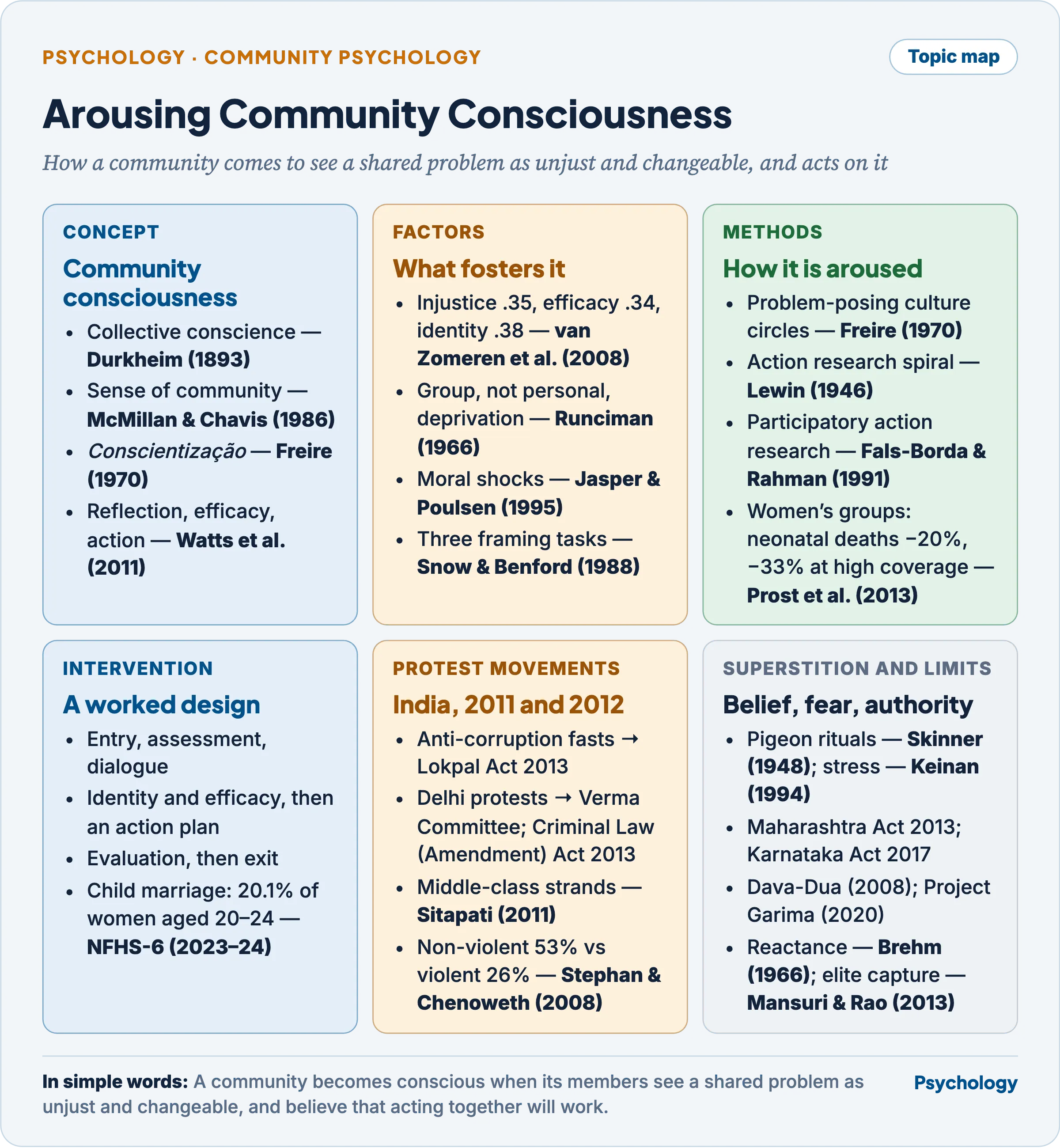
Awareness becomes action only when three things meet: a shared identity, a felt injustice and a belief that acting together will work.
Community consciousness and collective consciousness: meaning
- Durkheim (1893) supplied the background: “The totality of beliefs and sentiments common to average citizens of the same society forms a determinate system which has its own life; one may call it the collective or common conscience.”
- It binds a society by likeness, his mechanical solidarity.
- Community consciousness is a community’s shared awareness on three levels.
- “We”: belonging and interdependence, the sense of community of Sarason (1974) and McMillan and Chavis (1986), set out in Community Psychology: Definition, Concept and Values.
- “Our problem”: a common difficulty seen as unjust and as caused from outside the individual.
- “We can”: the belief that members acting together can change it.
- Freire (1970) called its critical form conscientização; Watts and colleagues split it into critical reflection, political efficacy (perceived capacity to effect change) and critical action.
- McAdam (1982) called this shift cognitive liberation: people collectively redefine their situation as unjust and open to change.
- Simon and Klandermans (2001) traced politicised collective identity through shared grievances, blame placed on an adversary, and a bid for wider society’s support.
| Construct | Level | Content | Link to action |
|---|---|---|---|
| Collective conscience (Durkheim, 1893) | Whole society | Shared beliefs and sentiments | Conformity; punishing deviance |
| Sense of community (McMillan and Chavis, 1986) | Local group | Belonging, mattering, shared faith | Mutual help, participation |
| Critical consciousness (Freire, 1970) | Oppressed group | Structural causes of suffering | Transforming conditions |
| Politicised identity (Simon and Klandermans, 2001) | Group in conflict | “We” against an adversary | Protest, claims on the state |
Factors that foster collective consciousness
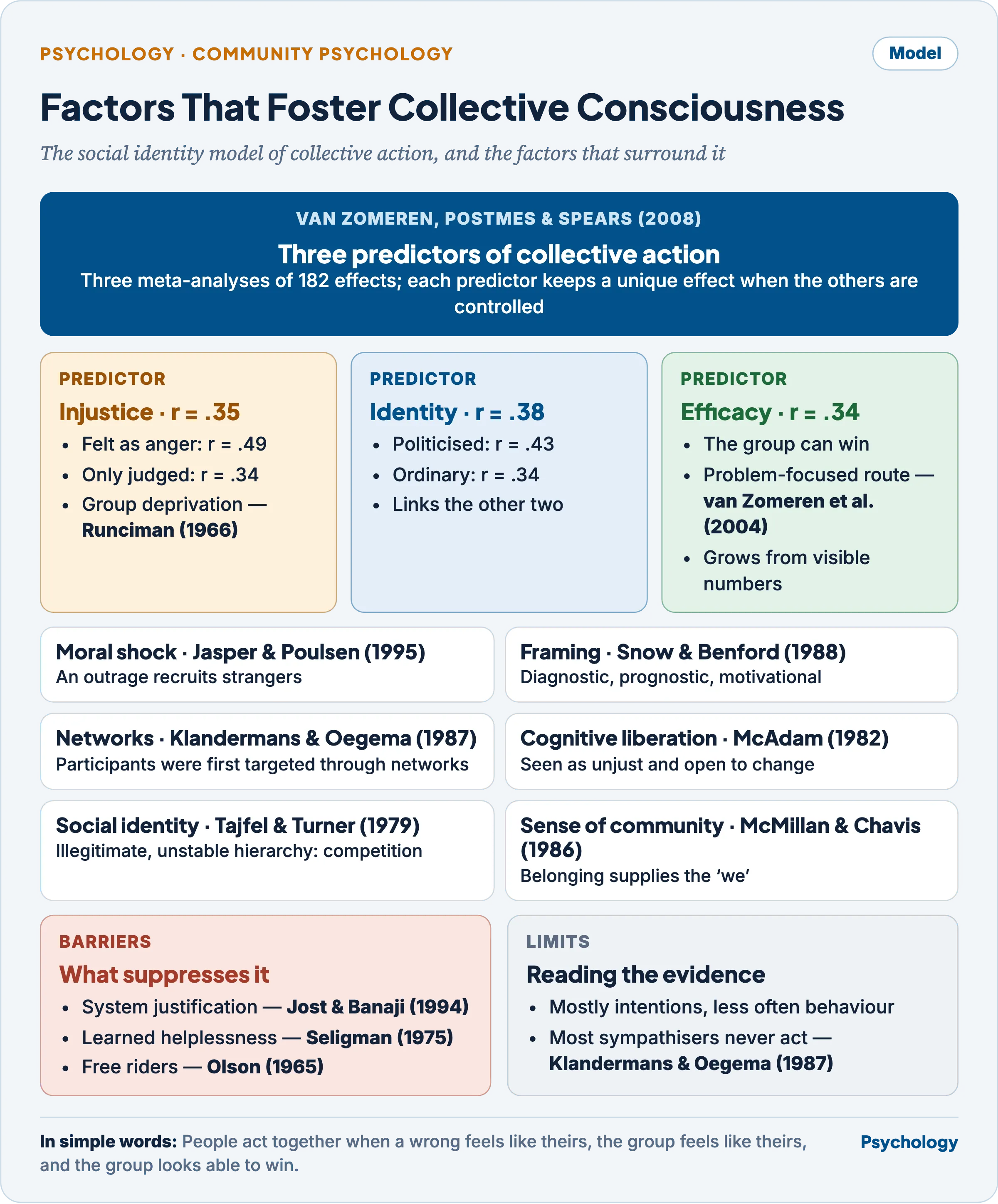
Identity sits in the middle: it makes an injustice feel like “ours” and makes efficacy a property of the group.
- Van Zomeren, Postmes and Spears (2008) built the social identity model of collective action (SIMCA) from three meta-analyses of 182 effects.
- Perceived injustice (r = .35), group efficacy (r = .34) and social identity (r = .38) each predicted collective action, and each kept a unique effect when the others were controlled.
- Injustice felt as anger predicted more strongly than injustice merely judged (r = .49 against .34); politicised identity more strongly than ordinary identification (r = .43 against .34).
- Identity also linked the other two. Limitation: most effects concern intentions, and behaviour is predicted less well.
- Relative deprivation. Runciman (1966) separated egoistic (personal) from fraternalistic (group) deprivation.
- Smith, Pettigrew, Pippin and Bialosiewicz (2012) found in a meta-analysis that group deprivation best predicted collective action, and measures carrying resentment predicted better than bare comparisons. Deprivation is treated in Unit 8.
- Social identity. Tajfel and Turner (1979) held that a disadvantaged group chooses social mobility when boundaries seem permeable, social creativity when the hierarchy seems stable and legitimate, and social competition when it seems illegitimate and unstable.
- The theory is set out in Formation of Stereotypes and Prejudice (Paper I) and Unit 9.
- Anger and efficacy. Van Zomeren, Spears, Fischer and Leach (2004) proposed a dual pathway: group-based anger drives emotion-focused action, group efficacy drives problem-focused action.
- Triggering events. Jasper and Poulsen (1995) showed that a moral shock, an event outrageous enough to demand a response, recruits strangers with no prior network ties.
- Framing. Snow and Benford (1988) named three tasks: diagnostic (what is wrong, who is to blame), prognostic (what to do) and motivational (why act now). Leaders’ part is in Leadership for Social Change.
- Networks. Klandermans and Oegema (1987), studying a Dutch peace demonstration, found that most sympathisers never took part; those who did had first been targeted through recruitment networks.
- Barriers. System justification (Jost and Banaji, 1994) leads the disadvantaged to defend the order that harms them; learned helplessness (Seligman, 1975) and fatalism suppress efficacy; the free-rider problem (Olson, 1965) tempts each member to let others act.
Arousing community consciousness: Freire’s critical consciousness
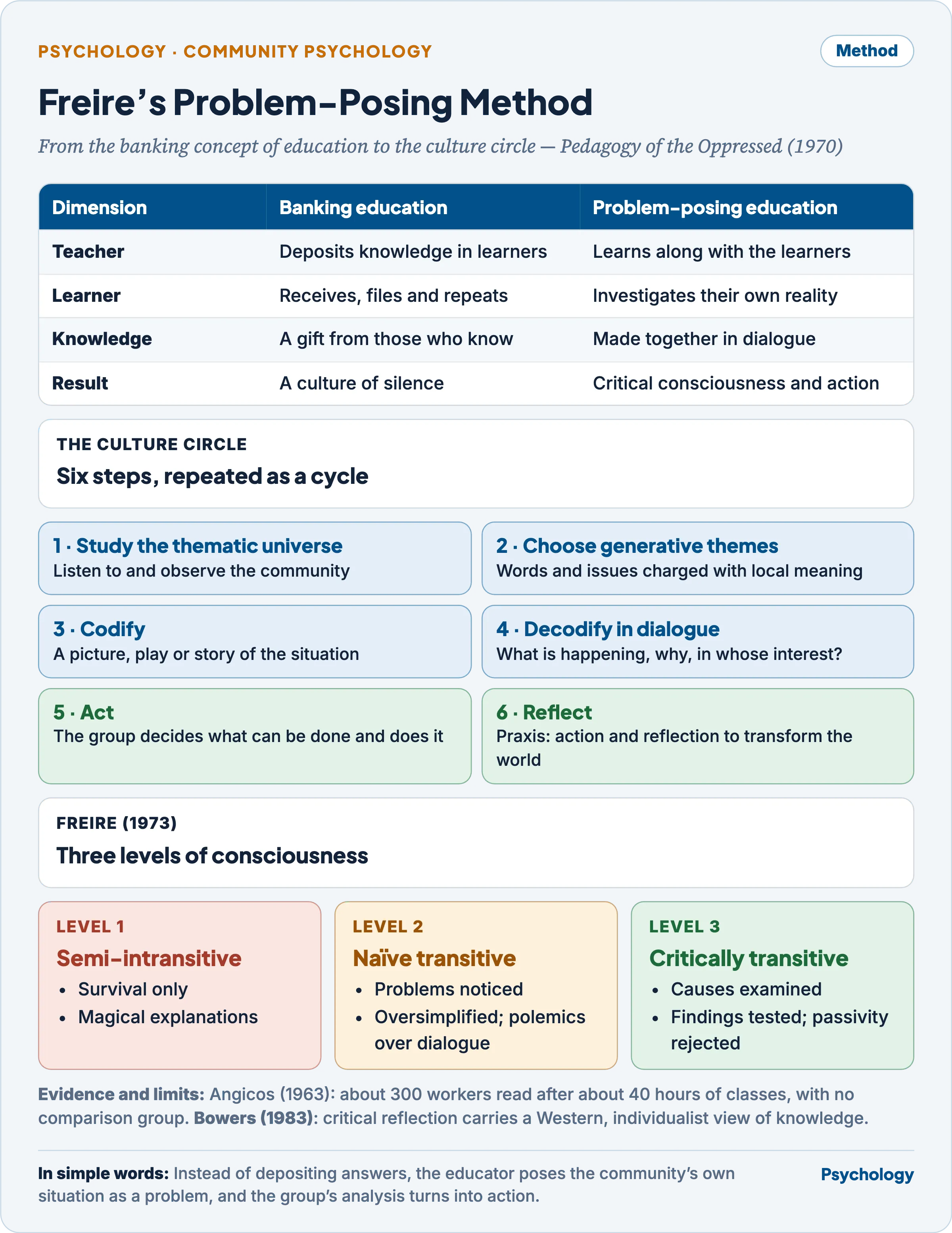
Each step of the culture circle moves a group from describing its situation to explaining it, and from explaining it to acting on it.
- Freire described the oppressed as living in a culture of silence; Pedagogy of the Oppressed (1970) shows them internalising the oppressor’s image of themselves.
- He rejected the banking concept of education, in which “knowledge is a gift bestowed by those who consider themselves knowledgeable upon those whom they consider to know nothing.”
- Problem-posing education puts dialogue in place of deposits: teacher and learners investigate their own reality as a problem to solve together.
- Freire (1973) described three levels of consciousness: semi-intransitive (survival only; magical explanations), naïve transitive (problems noticed but oversimplified; polemics instead of dialogue) and critically transitive (causes examined, findings tested, passivity rejected).
- The method is the culture circle.
- Study the community’s thematic universe, then select generative words and themes charged with local meaning.
- Codify a theme in a picture, play or story; decodify it in dialogue: what is happening, why, in whose interest, what can be done.
- Act, then reflect. “Liberation is a praxis: the action and reflection of men upon their world in order to transform it” (Freire, 1970).
- At Angicos, Brazil (1963), Freire’s team taught about 300 workers to read in about 40 hours of classes. Limitation: there was no comparison group and the record is the programme’s own.
- Martín-Baró (1986) carried the approach into liberation psychology in El Salvador: recover historical memory, de-ideologise everyday experience, build on the people’s virtues.
- Limitation: Bowers (1983) argued that Freire’s critical reflection carries a Western, individualist view of knowledge and can become cultural invasion of its own. A facilitator can also steer “dialogue” to a conclusion chosen in advance.
Methods of arousing community consciousness and action for handling social problems
- Action research. Lewin (1946) proposed “a spiral of steps each of which is composed of a circle of planning, action, and fact-finding about the result of the action.”
- Participatory action research. Fals-Borda convened the 1977 Cartagena symposium, and Fals-Borda and Rahman (1991) argued that the poor produce knowledge, so research must break the experts’ monopoly.
- Participatory learning and action groups cycle through four phases: identify and prioritise problems, plan strategies, carry them out, evaluate.
- Prost and colleagues (2013) pooled seven trials with 119,428 births: neonatal mortality fell 20 per cent overall and 33 per cent where at least 30 per cent of pregnant women joined, so coverage decided the effect.
- The Ekjut trial (Tripathy and colleagues, 2010) is set out in Fostering Mental Health (Unit 3).
- Trusted messengers. Coates, Waisbord, Awale, Solomon and Dey (2013) described the Social Mobilization Network, formed in Uttar Pradesh in 2003: mobilisers recruited from the high-risk communities tracked missed children and enlisted religious leaders against vaccine rumours.
- Resistance is analysed in Resistance to Change and the Community Psychologist’s Role.
- Entertainment-education. Hum Log (Doordarshan, 1984–85, 156 episodes) wove women’s status and family size into a soap opera (Singhal and Rogers, 1999).
- Limitation: the family-planning theme was soon diluted, and its effects rest on what viewers said. Media are treated in Unit 10.
- Small-group discussion and public commitment are set out in Small Groups and Their Use in Social Action and Group Decision Making for Social Change.
A community-based intervention programme for handling social problems
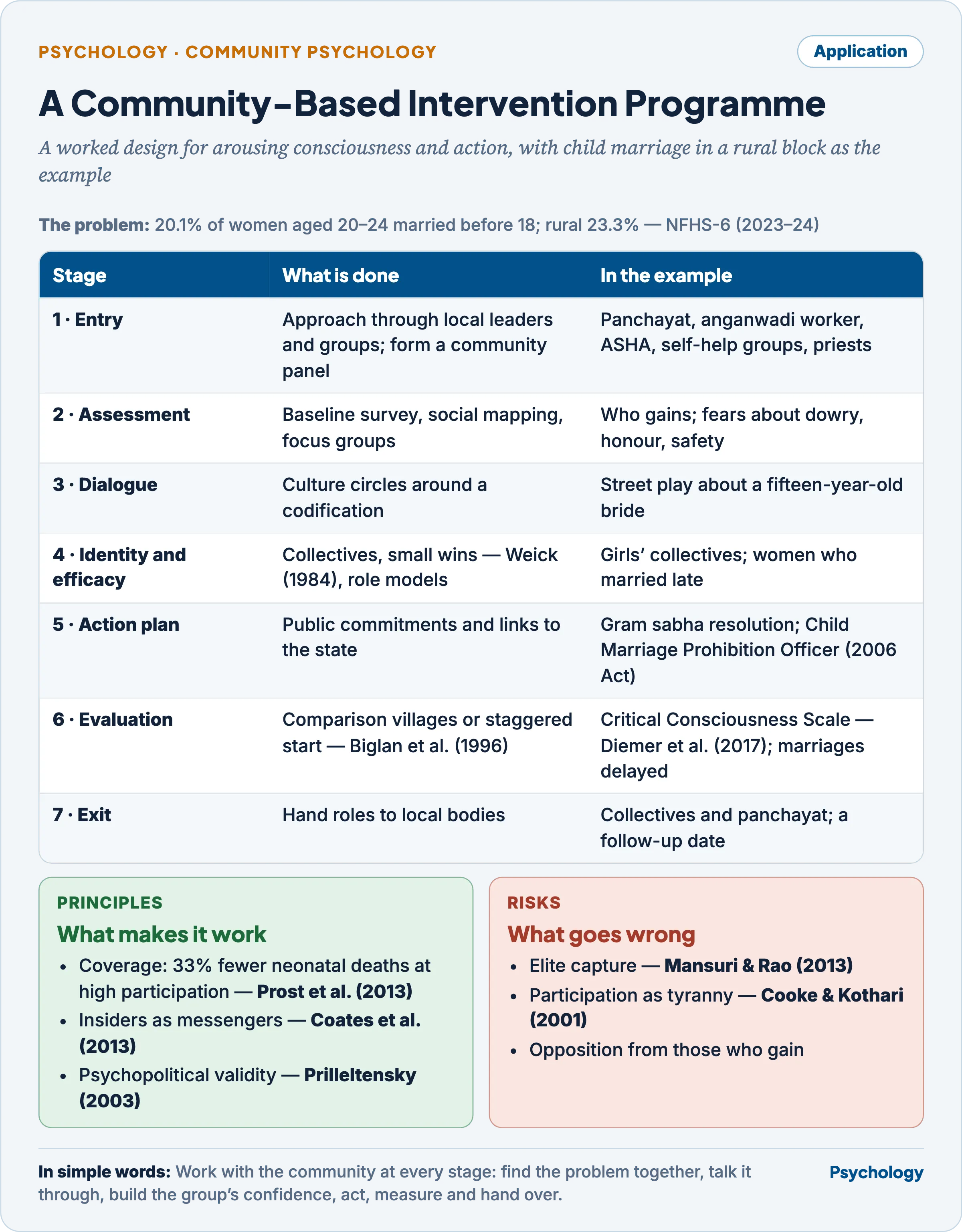
The community takes part in every stage, and the last stage hands the programme to its own institutions.
A worked design, using child marriage in a rural block: 20.1 per cent of women aged 20–24 had married before 18 nationally, 23.3 per cent in rural areas (NFHS-6, 2023–24).
- Entry and relationship. Approach through the gram panchayat, anganwadi worker, ASHA, self-help groups and respected religious figures; form a community panel that holds the team to account.
- Participatory assessment. Baseline survey of marriages and school drop-out; social mapping and focus groups with girls, mothers, fathers and priests; find who gains from the practice and what fears sustain it (dowry, honour, safety).
- Problem-posing dialogue. Culture circles around a codification, such as a street play about a fifteen-year-old bride, move the group from “it is our custom” to causes and costs.
- Identity and efficacy. Form adolescent girls’ collectives; publicise early successes, the small wins of Weick (1984); bring in local women who married late as role models.
- Collective action plan. Public family commitments, a gram sabha resolution, a vigilance group linked to the Child Marriage Prohibition Officer under the Prohibition of Child Marriage Act, 2006, and enrolment in scholarship schemes.
- Evaluation. Mixed methods with comparison villages, or a staggered start across villages, the multiple-baseline logic of Biglan and colleagues (1996).
- Measure consciousness (the Critical Consciousness Scale of Diemer, Rapa, Park and Perry, 2017), behaviour (marriages delayed, girls kept in school) and process.
- Check psychopolitical validity (Prilleltensky, 2003): did participants come to understand the forces acting on them?
- Sustainability and exit. Hand roles to the collectives and the panchayat, and set a follow-up date.
Recent protest movements in India: a psychological analysis
The anti-corruption movement of 2011
- India Against Corruption mobilised support for a Jan Lokpal (citizens’ ombudsman) Bill around Anna Hazare’s fasts of April and August 2011.
- The Lokpal and Lokayuktas Act, 2013 received assent on 1 January 2014; the first chairperson took office on 23 March 2019.
- Injustice: a run of corruption scandals turned an everyday irritant into moral anger.
- Identity: participants cast themselves as the “common man”. Sitapati (2011) traced the movement to middle-class strands: Gandhians conferred legitimacy, the corporate middle class supplied energy and money, activist lawyers found the legislative route.
- Framing and leadership: the fast gave a diagnosis (corruption), a remedy (an ombudsman) and a motive (the sacrifice of a veteran Gandhian).
- Media: Khandekar and Reddy (2015) argued that intense coverage created “the sense, if not the reality” of a united India Against Corruption.
- Limit: the Act came more than two years after the fasts, and the ombudsman more than five years after the Act.
The Delhi protests of December 2012
- The gang rape and death of a young woman in Delhi in December 2012 kept students and women’s groups on the streets for weeks.
- The Justice Verma Committee, constituted on 23 December 2012, reported on 23 January 2013; the Criminal Law (Amendment) Act, 2013 received assent on 2 April 2013.
- A moral shock (Jasper and Poulsen, 1995) drew in people with no organisational ties.
- Identity widened from one family’s tragedy to a shared category, women’s safety in public space, with anger as the emotional pathway (van Zomeren and colleagues, 2004).
- Efficacy grew from visible numbers and a quick official response: a committee within a week of the protests, a new law within four months.
- Limit: a statute changes penalties faster than the attitudes that sustain violence.
Strategies for handling social problems drawn from these movements
- Turn anger into a specific, legislatable demand.
- Keep the identity inclusive; a cause seen as one class’s loses support outside it.
- Stay non-violent: Stephan and Chenoweth (2008) found that, of 323 campaigns from 1900 to 2006, non-violent ones succeeded 53 per cent of the time and violent ones 26 per cent.
- Build organisation that outlasts the trigger, since recruitment runs through networks (Klandermans and Oegema, 1987).
- Pair the street with institutional channels: committees, consultations, the gram sabha.
The role of a community psychologist in arousing community consciousness and action
General roles are in Community Psychology: Definition, Concept and Values and Resistance to Change and the Community Psychologist’s Role. Arousing consciousness adds these.
- Dialogue facilitator: poses problems instead of delivering answers, as Mahila Samakhya’s collectives did (Indian context).
- Co-researcher: the community produces and owns the evidence on its own problem, as in participatory learning and action groups.
- Framer and communicator: turns scattered complaints into a shared diagnosis in local idiom, theatre and media, as the science movements did.
- Network builder: links households to groups and groups to federations, since recruitment runs through networks; the polio mobilisers worked this way.
- Bridge to institutions: connects collectives to panchayats, police and health services, as the Central Institute of Psychiatry, Ranchi, does for survivors of witch-hunting (below).
- Evaluator: measures change in consciousness and in living conditions, beyond counting who attended.
- Ethical guard: avoids manipulation and Freire’s “cultural invasion”; the community decides what counts as its problem.
The relevance of community psychology in India for eradicating superstitions
Why superstitions persist: belief, fear and authority
- Accidental reinforcement. Skinner (1948) fed hungry pigeons every 15 seconds whatever they did; six of eight developed rituals.
- Limitation: Staddon and Simmelhag (1971) explained the rituals better as anticipation of food.
- Illusion of control. Langer (1975) showed people treating chance outcomes as controllable when skill cues, such as choice, are present.
- Acquiescence. Risen (2016) proposed that people often recognise a superstition as irrational and act on it anyway, so correcting the belief need not change the act.
- Fear and uncertainty. Malinowski (1948) observed Trobriand Islanders using magic for dangerous open-sea fishing but not in the safe lagoon.
- Keinan (1994) surveyed 174 Israelis during the 1991 Gulf War: magical thinking was higher in areas hit by missiles, especially among people intolerant of ambiguity.
- Authority. Beliefs come through socialisation and are endorsed by healers and godmen; public doubt carries a social cost.
- Harm in India.
- NCRB data record 590 people, mostly women, murdered in Jharkhand on charges of witchcraft between 2001 and 2020 (Alagarasami, Kannekanti, Sharma and Bhattacharjee, 2023).
- At Erwadi, Tamil Nadu, on 6 August 2001, 28 people with mental illness chained at a shrine-side asylum died in a fire.
What community psychology adds
- A superstition is held by a community, so change has to work through its norms, its trusted insiders and the alternatives open to it.
- Dava-Dua (Government of Gujarat, from 2008) runs a psychiatric clinic at the Mira Datar Dargah, Mehsana.
- Saha and colleagues (2021), analysing records for 2008–2018, found that 37 per cent of referrals came through the shrine’s own healers, the mujavars, so treatment reached patients through people they already trusted.
- Limitation: mujavar referrals declined over the decade, and there was no control group.
- Project Garima (Jharkhand State Livelihood Promotion Society, 2020) uses women’s self-help groups and street plays against witch-branding; the Central Institute of Psychiatry, Ranchi, agreed in November 2021 to treat survivors (Alagarasami and colleagues, 2023).
- Science movements. The Kerala Sasthra Sahithya Parishad (1962) carried science to villages in Malayalam and powered mass literacy campaigns; Narendra Dabholkar founded the Maharashtra Andhashraddha Nirmoolan Samiti (1989) to expose “miracle cures” and godmen.
The limits of legal and rationalist approaches
- The law punishes harmful acts and leaves belief alone. Maharashtra’s Act punishes paid “miracles” but exempts astrology, vastu and festivals, so tradition draws the line as much as harm does.
- The Maharashtra Bill, promised from 1995 and amended 29 times, passed only after Dabholkar’s murder on 20 August 2013, having met organised religious opposition.
- Ridicule invites reactance (Brehm, 1966) and threatens religious and caste identity. Nyhan and Reifler (2010) reported corrections that strengthened misperceptions, though Wood and Porter (2019) found no backfire from corrections across 52 issues.
- Not all superstition harms. Damisch, Stoberock and Mussweiler (2010) found that a good-luck belief improved performance, though Calin-Jageman and Caldwell (2014) failed to replicate it; eradicating all belief is neither feasible nor necessary.
- “Superstition” is partly an outsider’s label; respect for diversity requires the community to name its harmful practices itself.
- Community psychology is most relevant where it targets harm, works through insiders, supplies alternatives such as accessible health care, and evaluates what changed.
Criticisms and limitations
- Consciousness does not guarantee action: most sympathisers never participate (Klandermans and Oegema, 1987), and SIMCA’s predictors are weaker for behaviour than for intentions.
- Measurement is young: the Critical Consciousness Scale dates only from 2017.
- Induced participation can be hollow. Cooke and Kothari (2001) called participation “the new tyranny”, and Mansuri and Rao (2013) found outside-induced participation often captured by local elites.
- “Community” hides hierarchy: caste, gender and age decide who speaks (Group Decision Making for Social Change).
- The identity processes that mobilise reform can also mobilise exclusion (Leadership for Social Change).
Indian context
- Article 51A(h) of the Constitution (42nd Amendment, 1976) makes it a fundamental duty “to develop the scientific temper, humanism and the spirit of inquiry and reform”, operationalising a social norm set by the state.
- Maharashtra’s anti-superstition Act, 2013: the Maharashtra Prevention and Eradication of Human Sacrifice and other Inhuman, Evil and Aghori Practices and Black Magic Act (ordinance August 2013; assent 20 December 2013).
- A twelve-entry Schedule of cognisable, non-bailable offences carries six months to seven years’ imprisonment, enforced by vigilance officers; Section 12 exempts customary rites.
- Its long title seeks “social awakening and awareness”, pairing deterrence with norm-setting.
- Karnataka’s Act, 2017: the Karnataka Prevention and Eradication of Inhuman Evil Practices and Black Magic Act (in force from January 2020) follows the same harm-based model.
- Mahila Samakhya (Department of Education, Ministry of Human Resource Development, launched April 1989 under the National Policy on Education 1986) formed sanghas in which poor rural women discussed and acted on their own problems.
- It had 55,402 sanghas and 1.4 million women in 2014, was merged into the National Rural Livelihoods Mission in 2015, and survives on state funds in Kerala and Karnataka (Bhuwania, Mukherji and Swaminathan, 2024).
- Bhuwania and colleagues (2024) found more schooling for women in programme districts, with larger gains where gender norms were worse. It operationalises conscientisation through collectives.
- National Literacy Mission (1988): Ernakulam became India’s first totally literate district on 4 February 1990, in a campaign with the Kerala Sasthra Sahithya Parishad as its volunteer backbone; Kerala followed on 18 April 1991. It treats literacy as a route to consciousness.
Previous Year Questions
- 2026Analyse the factors that foster collective consciousness and propose a well structured community based intervention program.
- 2024What is community consciousness? How can it be aroused for handling social problems.
- 2013Identify the factors in arousal of community consciousness and also the strategies for handling social problems keeping in view some of the recent protest movements in India.
- 2010Discuss critically the relevance of community psychology in India for the eradication of superstitions.
- 2006Describe the concept of Community Psychology. Explain some of the important factors responsible for arousing community consciousness and action plan in handling social problems.
- 2003Evaluate the role of a community psychologist in arousing community consciousness and action for handling social problem. Give suitable examples to substantiate your arguments.
