

Official syllabusPaper II · Unit 6 · Community Psychology
Arousing community consciousness and action for handling social problems – community action.
Definition
“Empowerment is a process by which people, organizations, and communities gain mastery over issues of concern to them (Rappaport, 1987). It is a multilevel construct in which each level of analysis is interdependent with the others.”
Zimmerman (1995)
Community action is what a community does once it has recognised a problem as its own: residents and their organisations act together on it instead of waiting to be acted upon. Empowerment is the method, and its test is whether the community is better placed to handle the next problem. Crime against women is the hardest case, because much of it happens inside homes that neighbours are taught not to enter.
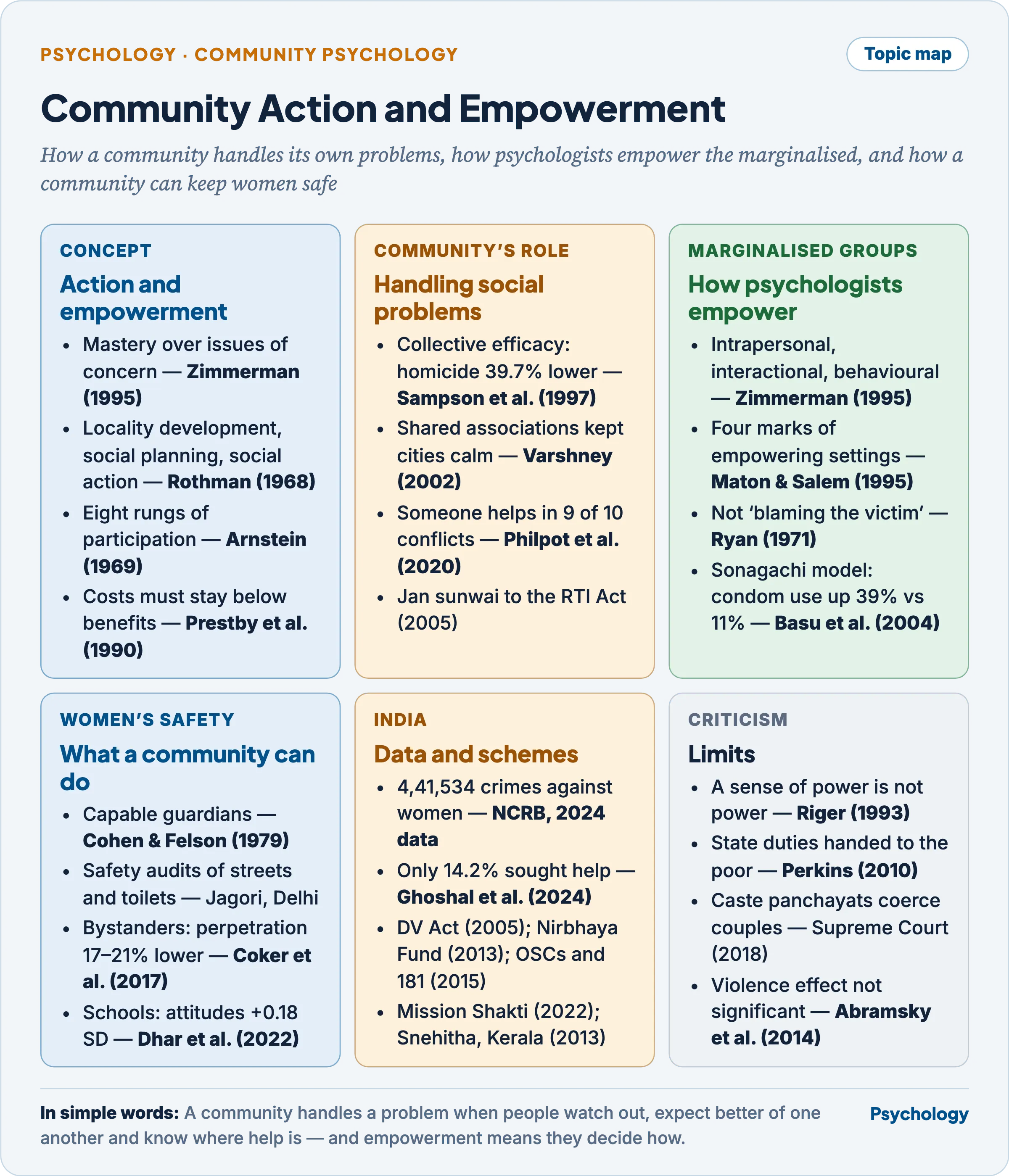
Every box comes back to who is watching, what the group expects and how close help is.
Community action: from arousing community consciousness to handling social problems
- Arousing community consciousness turns private troubles into a shared problem with outside causes, as set out in Arousing Community Consciousness; community action is what the aroused community then does.
- Community action is organised, collective effort by residents and their associations to change a condition they define as a problem.
- Rothman (1968) distinguished three models of community organisation:
- Locality development — broad participation, self-help and consensus, as when a village desilts its own tank.
- Social planning — experts gather data and design services for the community.
- Social action — a disadvantaged group organises to shift power or resources, accepting conflict.
- Crime, alcoholism, corruption and violence against women are community problems because their causes and remedies lie in settings, as argued in Community Psychology: Definition, Concept and Values.
- Cogan and Sharpe (1986) listed the gains of participation: information, public support, fewer protracted conflicts, goodwill and trust.
- Participation also has costs. Prestby, Wandersman, Florin, Rich and Chavis (1990) found that New York block associations whose leaders failed to manage members’ costs and benefits grew less active, and many went dormant.
The role of the community in handling social problems
Informal social control and collective efficacy
- Informal social control is regulation of conduct by residents themselves (a word to truanting children, stepping into a street fight) rather than by police or courts.
- Sampson, Raudenbush and Earls (1997) defined collective efficacy as social cohesion among neighbours combined with their willingness to intervene on behalf of the common good.
- Design: a 1995 survey of 8,782 residents in 343 Chicago neighbourhoods, with five informal-control items (would neighbours act if children sprayed graffiti?) and five cohesion-and-trust items.
- Finding: a two-standard-deviation rise in collective efficacy went with a 39.7 per cent lower expected homicide rate and about 30 per cent lower odds of victimisation (Sampson and colleagues, 1997).
- It largely mediated the link between concentrated disadvantage or residential instability and violence.
- Limitation, as the authors note: a cross-sectional design in one city, with control and cohesion inferred from informant accounts rather than observed.
Social capital
- Putnam (2000) described social capital as networks among people and the norms of reciprocity and trust they generate, separating bonding capital within a group from bridging capital across groups.
- Varshney (2002) compared three pairs of Indian cities with similar Muslim population shares but different riot histories: Aligarh and Calicut, Hyderabad and Lucknow, Ahmedabad and Surat.
- In the peaceful city of each pair, Hindus and Muslims belonged to the same associational bodies (trade unions, business associations, political parties), which restrained politicians who tried to polarise them.
- Limitation: six cities compared after the fact, and civic networks cannot by themselves withstand a state bent on polarisation.
Bystander norms
- Latané and Darley (1970) showed that the presence of others diffuses responsibility: a bystander must notice, interpret the event as an emergency, accept responsibility, know how to help and decide to act.
- Fischer and colleagues (2011), pooling 105 effect sizes from more than 7,700 participants, found the bystander effect weaker in dangerous emergencies and when the perpetrator was present.
- Philpot, Liebst, Levine, Bernasco and Lindegaard (2020) coded 219 real public conflicts filmed by CCTV in the UK, the Netherlands and South Africa: in 9 of 10, at least one bystander intervened, and more bystanders made intervention more likely.
- Limitation: public disputes in general, not harassment of women, and the footage records what bystanders did but not why.
- Intervention is therefore a norm a community can cultivate, as bystander training does.
Mutual help, accountability and norm change
- Communities supply social support and mutual aid, which buffer stress; the buffering account is in Resistance to Change and the Community Psychologist’s Role.
- They also hold institutions to account. The Mazdoor Kisan Shakti Sangathan’s public hearings (jan sunwai) in mid-1990s Rajasthan read official records aloud to villagers and exposed payments for work never done.
- The campaign fed into the Right to Information Act, 2005; the Mahatma Gandhi National Rural Employment Guarantee Act, 2005 made social audit by the gram sabha a statutory duty (Section 17).
- Its successor, the Viksit Bharat–Guarantee for Rozgar and Ajeevika Mission (Gramin) (VB-G RAM G) Act, 2025, repealed it from 1 July 2026 and keeps mandatory social audits (PIB, 2026).
- Limitation: a community can enforce harm as readily as prevent it. After caste panchayats punished couples for inter-caste marriage, the Supreme Court in Shakti Vahini v. Union of India (2018) laid down preventive, remedial and punitive guidelines.
Empowering communities marginalised by society
Empowerment as the aim of community action
- Rappaport (1981), in “In praise of paradox”, argued that expert-run prevention treats people in distress as personified needs, passive objects of help, and called for people to design and control their own help (Perkins, 2010).
- Rappaport (1987) then proposed empowerment as community psychology’s central phenomenon of interest, with prevention as one exemplar of it.
- Zimmerman (1995) gave psychological empowerment three components:
- Intrapersonal — how people think about themselves: perceived control in a domain, self-efficacy, motivation to control, perceived competence.
- Interactional — understanding of the community and its politics: critical awareness, understanding of causal agents, skill in mobilising resources, decision-making and leadership.
- Behavioural — action to influence outcomes: joining organisations, community participation, coping.
- He also separated an empowering organisation, which builds members’ skills and mutual support, from an empowered organisation, which competes for resources and extends its influence.
- Maton and Salem (1995), studying a religious fellowship, a mutual-help organisation and an educational programme, found four marks of an empowering setting:
- a strengths-based belief system focused beyond the self;
- an opportunity role structure that is pervasive and easy to enter;
- a peer-based support system that gives a sense of community;
- inspiring, talented and shared leadership.
- Arnstein (1969) ranked participation on eight rungs: manipulation and therapy (non-participation); informing, consultation and placation (tokenism); partnership, delegated power and citizen control (citizen power).
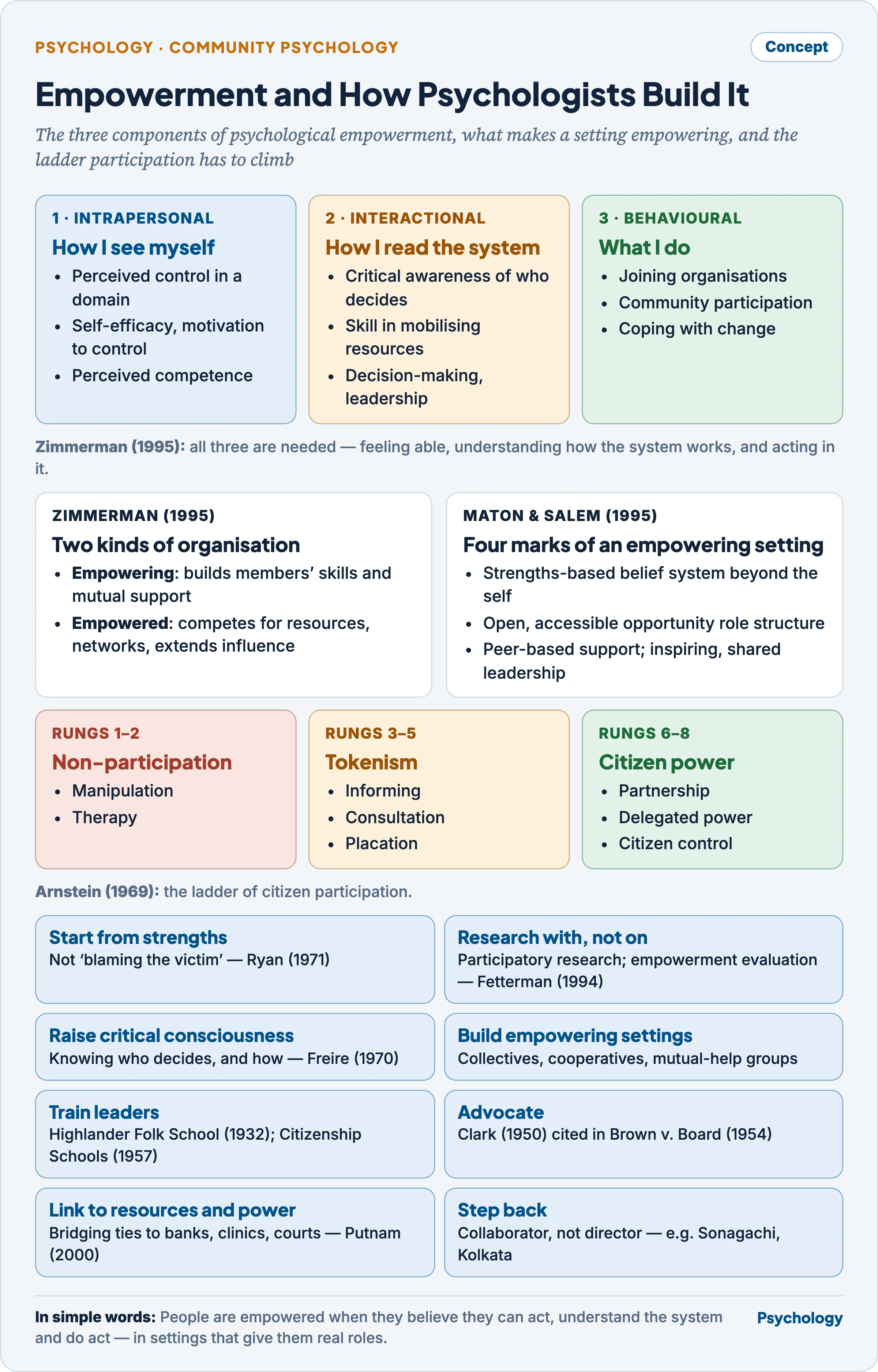
A person can feel in control and still change nothing; the three components add up to empowerment only when the setting lets them act.
Specific ways psychologists work for empowering marginalised communities
- Start from strengths, not deficits. Ryan (1971) named “blaming the victim”: explaining a group’s problems by its supposed defects while ignoring the conditions imposed on it.
- Research with the community, not on it. In participatory action research the community chooses the questions and owns the data; empowerment evaluation (Fetterman, 1994) hands evaluation to participants.
- Raise critical consciousness in Freire’s (1970) sense, so that the interactional component (knowing who decides, and how) develops; consciousness-raising is treated in Arousing Community Consciousness.
- Build settings with Maton and Salem’s four marks: collectives, cooperatives, mutual-help groups. Self-help groups are covered in Small Groups and Their Use in Social Action.
- Train leaders and manage participation, sharing roles and keeping costs below benefits (Prestby and colleagues, 1990).
- The Highlander Folk School, co-founded by Myles Horton (1932) in Tennessee, trained union and civil-rights organisers; from 1957 its Citizenship Schools, led by Septima Clark, taught adult literacy as a route to the vote.
- Advocate and inform policy. Kenneth Clark’s (1950) report on prejudice and children, drawing on the doll studies of Clark and Clark (1947), was cited in Brown v. Board of Education (1954).
- Link the group to resources and power (banks, clinics, courts, officials) through bridging ties (Putnam, 2000), then step back as the group steps up.
- Jana, Basu, Rotheram-Borus and Newman (2004) documented the Sonagachi Project with sex workers in Kolkata, a heavily stigmatised group.
- It treated HIV as an occupational health problem and worked at community, group and individual levels; empowerment was not planned but emerged as members voiced their needs (Jana and colleagues, 2004).
- Basu and colleagues (2004) replicated it in two small towns in north-eastern India (100 sex workers each): over 15 months, condom use rose by 39 per cent in the intervention town against 11 per cent in the control.
- Limitation: one community per arm, and condom use as stated by the women themselves.
Crime against women as a community problem
- Crime in India 2024 (NCRB, 2026) recorded 4,41,534 crimes against women (4,48,211 in 2023), a rate of 64.6 per lakh women.
- Cruelty by husband or relatives was the largest head (1,20,227 cases, 27.2 per cent), ahead of kidnapping and abduction (15.4 per cent) (NCRB, 2026).
- The Bharatiya Nyaya Sanhita replaced the Indian Penal Code on 1 July 2024, so 2024 figures are not strictly comparable with earlier years.
- Much violence never reaches the record. Ghoshal and colleagues (2024), analysing NFHS-5 (2019–21), found that of 17,765 women who had ever faced intimate partner violence, only 14.2 per cent sought any help.
- Most help sought was informal, three in five from the woman’s natal family; the police were the main formal source (Ghoshal and colleagues, 2024).
- In a Delhi baseline survey (October–November 2012) of 2,001 women and girls and 1,003 men and boys, only 5 per cent of women rated public spaces safe (UN Women, 2013).
- In the same survey, 51 per cent of men admitted harassing women in public (UN Women, 2013).
- Heise (1998) nested the causes of violence against women in four levels: personal history, the microsystem (the relationship), the exosystem (isolation of the woman and family, delinquent peer associations) and the macrosystem (male ownership of women, rigid gender roles).
- Community action works chiefly at the exosystem level.
How the community can provide safety to women
- Capable guardianship. In Cohen and Felson’s (1979) routine activity theory, crime needs a motivated offender, a suitable target and the absence of a capable guardian. Jacobs (1961) held that a safe street needs “eyes upon the street”, belonging to its “natural proprietors”.
- Shopkeepers, vendors, transport crews and residents become guardians once they see themselves in that role.
- Safety audits. Women walk an area and record what makes it unsafe. Jagori’s Delhi audits found poor lighting near bus stops and subways, and a lack of public toilets for women, the main concerns (UN Women, 2013).
- Bystander intervention. Coker and colleagues (2017) randomised 26 Kentucky high schools to Green Dot (school-wide talks plus bystander training for popular peer leaders) or a wait-list control.
- Anonymous surveys of 89,707 students (2010–14) showed sexual violence perpetration 17 and 21 per cent lower in years three and four (prevalence ratios 0.83 and 0.79) (Coker and colleagues, 2017).
- Harassment, stalking and dating violence fell similarly. Limitation: self-report, one US state, and effects only once the programme was fully running.
- Changing norms. Abramsky and colleagues (2014) ran a pair-matched cluster randomised trial of SASA!, a community-mobilisation programme, in eight Kampala communities (2007–12).
- Women in intervention communities were significantly less likely to find partner violence acceptable (adjusted risk ratio 0.54), and women facing violence more often met supportive responses.
- Past-year physical violence was 52 per cent lower, but the estimate was imprecise and not statistically significant (Abramsky and colleagues, 2014).
- Women’s collectives and help desks. Kerala’s Snehitha gender help desks, run by Kudumbashree since 23 August 2013 and now in all 14 districts, offer round-the-clock counselling, legal and medical aid and short-stay shelter.
- They anchor local vigilant groups and gender point persons, and had handled 60,889 cases by April 2025 (Government of Kerala, 2025).
- Men and boys. Men’s Action to Stop Violence Against Women has organised men in Uttar Pradesh since about 2002; Edström, Shahrokh and Singh (2015) documented it as a case study, without an outcome trial.
- Schools. Dhar, Jain and Jayachandran (2022) evaluated Breakthrough’s classroom gender-attitudes programme for grades 7 to 10 in 314 government schools in Haryana, 150 randomised to receive it.
- Gender-equal attitudes rose by 0.18 standard deviations and were still 0.16 higher two years later; gender-equitable behaviour rose by 0.20 (Dhar and colleagues, 2022).
- Limitation: both were measured by the pupils’ own answers, which social desirability can inflate.
- First responders. Because women who seek help go first to family (Ghoshal and colleagues, 2024), training families, neighbours, ASHAs and SHG members to believe, support and refer, rather than counsel silence, belongs in any safety plan.
A plan for involving the community to handle crime against women
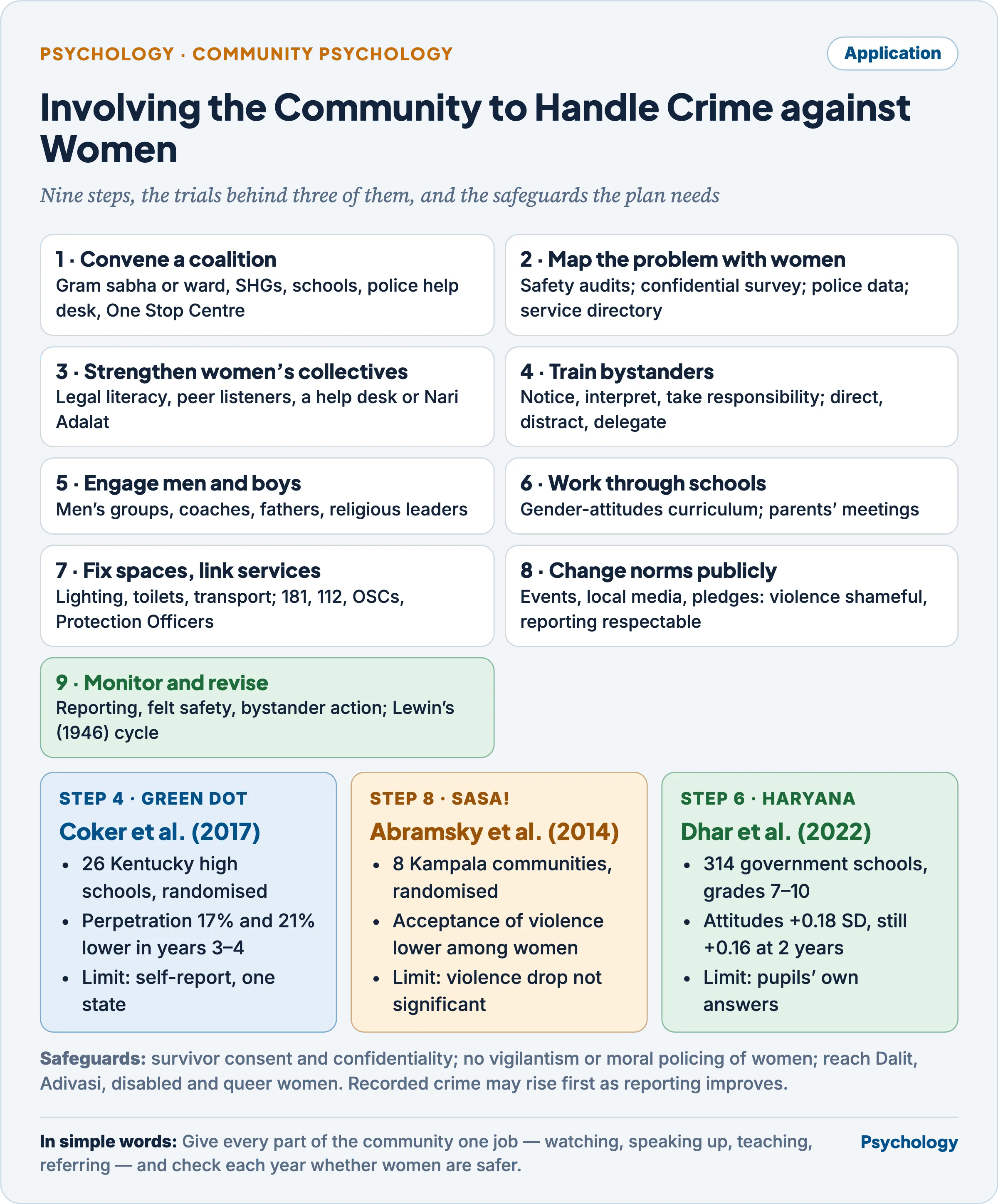
Each step gives a different part of the community one task; the last decides whether the plan is kept.
- Convene a coalition. Gram sabha or ward committee, resident associations, women’s SHGs, schools, the police women help desk, the One Stop Centre and local leaders agree an aim and divide roles.
- Map the problem with women. Safety audits of streets, transport and toilets; a confidential survey of experience, help-seeking and norms; police data; a directory of services.
- Strengthen women’s collectives. Legal literacy in SHGs on the Domestic Violence Act and helplines, trained peer listeners, and a forum of their own such as a help desk or Nari Adalat.
- Train bystanders. Green Dot-style training for youth, shopkeepers, auto and bus crews: notice, interpret, take responsibility, then act directly, distract or delegate.
- Engage men and boys through men’s groups, coaches, fathers and religious leaders, so that non-violence becomes the male norm.
- Work through schools with a gender-attitudes curriculum on the Haryana model and parents’ meetings.
- Fix the environment and link services. Lighting, toilets and safe transport; a referral chain to 181, 112, women help desks, One Stop Centres and Protection Officers, with accompaniment for survivors.
- Change norms publicly through events, local media and pledges that make violence shameful and reporting respectable, as SASA! did.
- Monitor and revise. Track reporting, perceived safety, bystander action and completed referrals, and return results to the community in Lewin’s (1946) cycle of planning, action and fact-finding.
- Safeguards run through every step: confidentiality and the survivor’s consent; no vigilantism or moral policing of women’s dress or movement; attention to Dalit, Adivasi, disabled and queer women.
- Recorded crime may rise first, because reporting improves before offending falls.
Criticisms and limitations
- Feeling empowered is not having power. Riger (1993) argued that empowerment research measures a sense of empowerment while actual power stays unchanged, and that its stress on mastery and control sidelines communion and cooperation.
- Shifting the burden. Perkins (2010) traces how small-government advocates took up the word to justify replacing public programmes with local voluntarism; “community” can become a way of handing the state’s duties to the poor.
- Tokenism and capture. Participation often stops at Arnstein’s tokenism rungs, with the articulate and powerful speaking for everyone else; exclusion inside groups is examined in Small Groups and Their Use in Social Action.
- Communities can harm. Strong cohesion can enforce exclusion, caste panchayats have coerced couples (Shakti Vahini, 2018), and “protecting” women slides easily into restricting them.
- Thin evidence. Few Indian programmes have outcome trials, and counts of cases handled measure activity, not safety; SASA!’s effect on violence was not significant (Abramsky and colleagues, 2014).
- Implementation gaps. By March 2025, about 76 per cent of the ₹7,712.85 crore allocated to the Nirbhaya Fund had been released and utilised (PIB, 2025); police and public order are State subjects.
Indian context
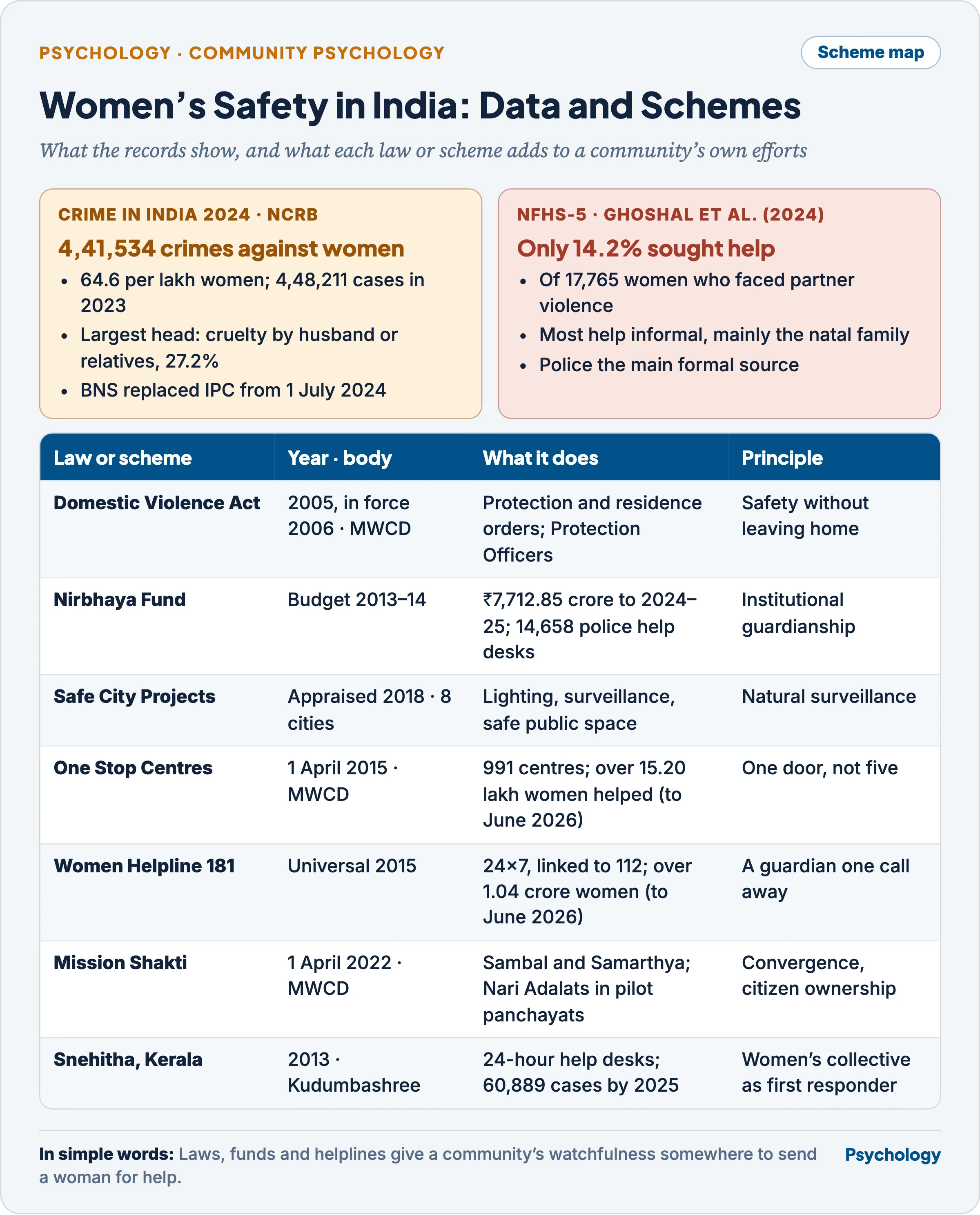
Each scheme supplies something a community cannot provide alone: a law, money, a building or a phone line.
- Protection of Women from Domestic Violence Act, 2005 (Ministry of Women and Child Development; in force 26 October 2006) — civil protection, residence and monetary orders for a woman in a “shared household”, with district Protection Officers and registered service providers.
- It operationalises legal leverage for safety without leaving home, where the largest NCRB head arises.
- Nirbhaya Fund (Union Budget 2013–14, ₹1,000 crore in its first year) — projects appraised by an Empowered Committee; ₹7,712.85 crore allocated up to 2024–25 and 14,658 police Women Help Desks set up (PIB, 2025).
- It operationalises institutional guardianship.
- Safe City Projects (appraised under the Nirbhaya Fund in March 2018, ₹2,919.55 crore) in Ahmedabad, Bengaluru, Chennai, Delhi, Hyderabad, Kolkata, Lucknow and Mumbai operationalise design of the environment for natural surveillance.
- One Stop Centres (Sakhi) (Ministry of Women and Child Development, from 1 April 2015) — medical, legal, shelter, police and psychosocial help under one roof; 991 operational, over 15.20 lakh women assisted to 30 June 2026 (Lok Sabha reply, 7 August 2026).
- They operationalise lower barriers to help-seeking, one door instead of five; the Stree Manoraksha project (with NIMHANS, March 2022) trains their staff in psychosocial care.
- Women Helpline 181 (universalised from 1 April 2015) — a 24×7 line integrated with the emergency number 112, which had assisted over 1.04 crore women by 30 June 2026 (Lok Sabha reply, 7 August 2026).
- It operationalises immediate access to a capable guardian.
- Mission Shakti (Ministry of Women and Child Development; umbrella scheme effective 1 April 2022) — Sambal (One Stop Centres, Women Helpline, Beti Bachao Beti Padhao, new Nari Adalats) and Samarthya (shelter homes, hostels, crèches, maternity benefit).
- Nari Adalats, piloted in 50 gram panchayats each in Assam and Jammu and Kashmir in 2023–24, now run in 10 gram panchayats in each of 13 more States (Lok Sabha reply, 7 August 2026).
- The Mission operationalises convergence and citizen ownership, its own stated aim.
- The Criminal Law (Amendment) Act, 2013 is treated in Arousing Community Consciousness.
Previous Year Questions
- 2019How can community play an important role in providing safety to women? Discuss.
- 2018In what specific ways can psychologists work for empowering the communities that have been marginalized by the society?
- 2017What is the role of the community in handling social problems? Prepare a plan for involving the community to handle crime against women.
