

Official syllabusPaper II · Unit 6 · Community Psychology
Group decision making and leadership for social change – group decision making.
Definition
“It should be emphasized that the procedure described here is not merely a group ‘discussion,’ but a discussion leading to a decision. … The group setting gives the incentive for the decision, and facilitates and reinforces it.”
Lewin (1943)
Group decision making carries two meanings: how a group turns its members’ views into one choice, which can be wiser or worse than one person’s; and, in Lewin’s sense, a method of change in which people who decide together go on to act. Social change needs a sound decision that people carry out.
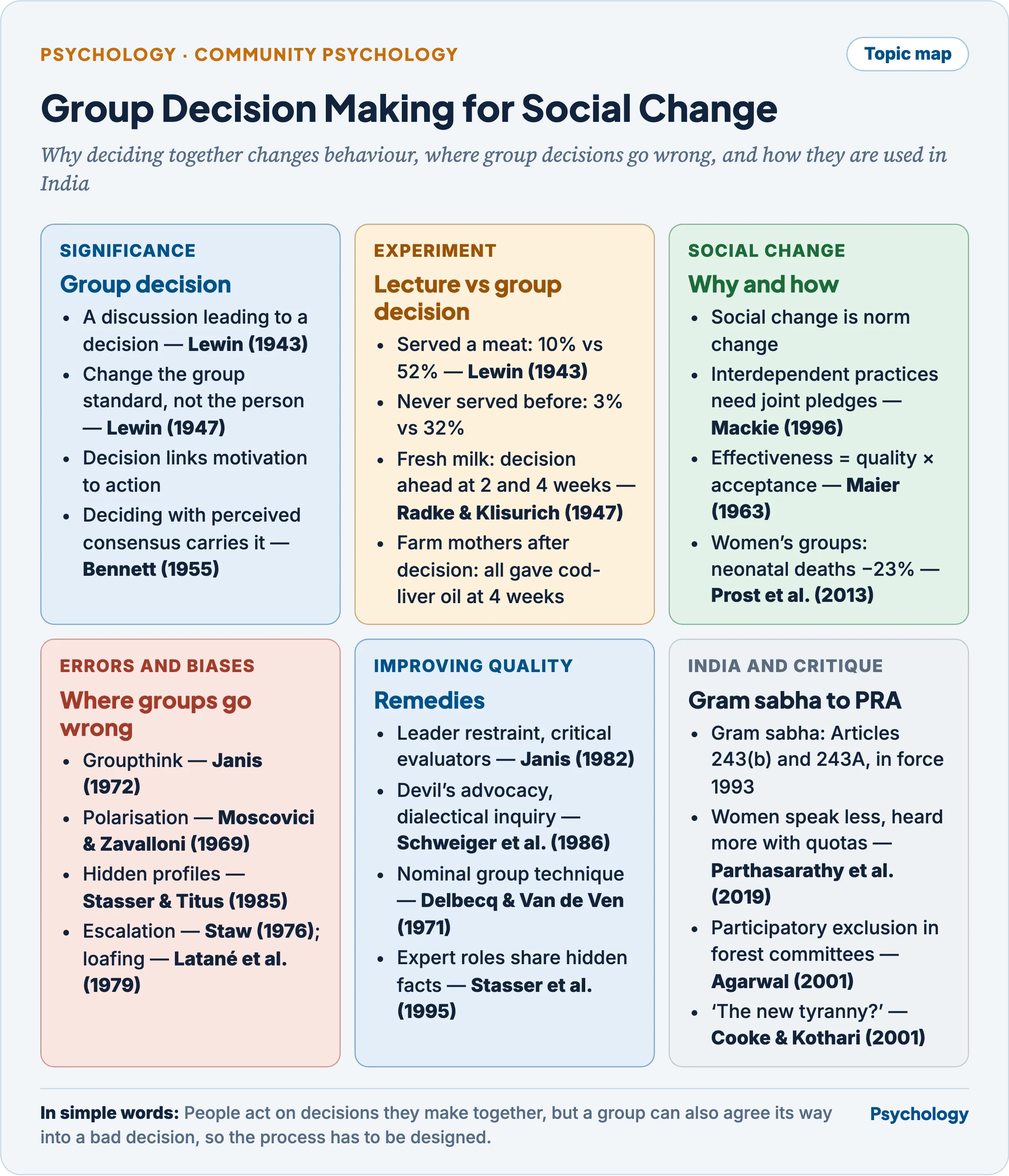
The top row shows why joint decisions get carried out; the bottom row, where group pressure distorts them, what corrects it, and the Indian case.
The psychological significance of group decision
Lewin’s food-habit experiments
- Lewin (1943) ran the founding study in Cedar Rapids, Iowa, for the National Research Council’s Committee on Food Habits, during wartime meat shortages.
- Design: six Red Cross home-nursing groups of 13–17 women, about thirty minutes each. Three heard a nutritionist lecture on beef hearts, kidneys and brains; three, led by Alex Bavelas, discussed the obstacles facing “housewives like themselves”, then voted.
- Result a week later: 52 per cent of group-decision women (23 of 44) had served one of the meats, against 10 per cent (4 of 41); 32 against 3 per cent served one never served before (Lewin, 1943).
- Limitation: six intact groups, a trained leader in the decision groups only, self-reported serving (Lewin, 1943).
- Radke and Klisurich (1947) repeated it for fresh milk with equal time in both conditions; group decision produced the larger rise at two and four weeks (Lewin, 1947).
- Farm mothers in an Iowa maternity ward got about 25 minutes of individual instruction, or the same time shared by a group of six; at four weeks every decision-group mother gave the advised cod-liver oil (Lewin, 1947).
- Willerman (1943), asking student cooperatives to switch to whole-wheat bread, found members’ eagerness tracked their own taste after a request but not after a group decision, when they acted as group members (Lewin, 1947).
Why a group decision changes conduct
- Group standards. Resistance grows the further a member strays from the group’s standard, so changing the standard turns resistance into support: it is “usually easier to change individuals formed into a group than to change any one of them separately” (Lewin, 1947).
- Decision links motivation to action. A lecture can motivate, but “the decision links motivation to action and, at the same time, seems to have a ‘freezing’ effect” (Lewin, 1947), from sticking to one’s decision and from commitment to the group.
- Force field. Conduct is a quasi-stationary equilibrium of driving and restraining forces; a lecture adds a driving force and meets counter-pressure, while a group decision removes a restraint (Lewin, 1947).
- Unfreezing, moving, freezing. A change lasts only if the new level is secured; the three steps are in Sensitivity Training and Organisational Development (Unit 4).
- Participation. Members name the obstacles themselves, so defensiveness falls; Coch and French (1948) carried this into a factory, treated in Leadership and Participatory Management (Unit 4).
- Bennett (1955) separated the ingredients: the act of deciding, with a high perceived group consensus, carried the effect, while discussion and public commitment added little.
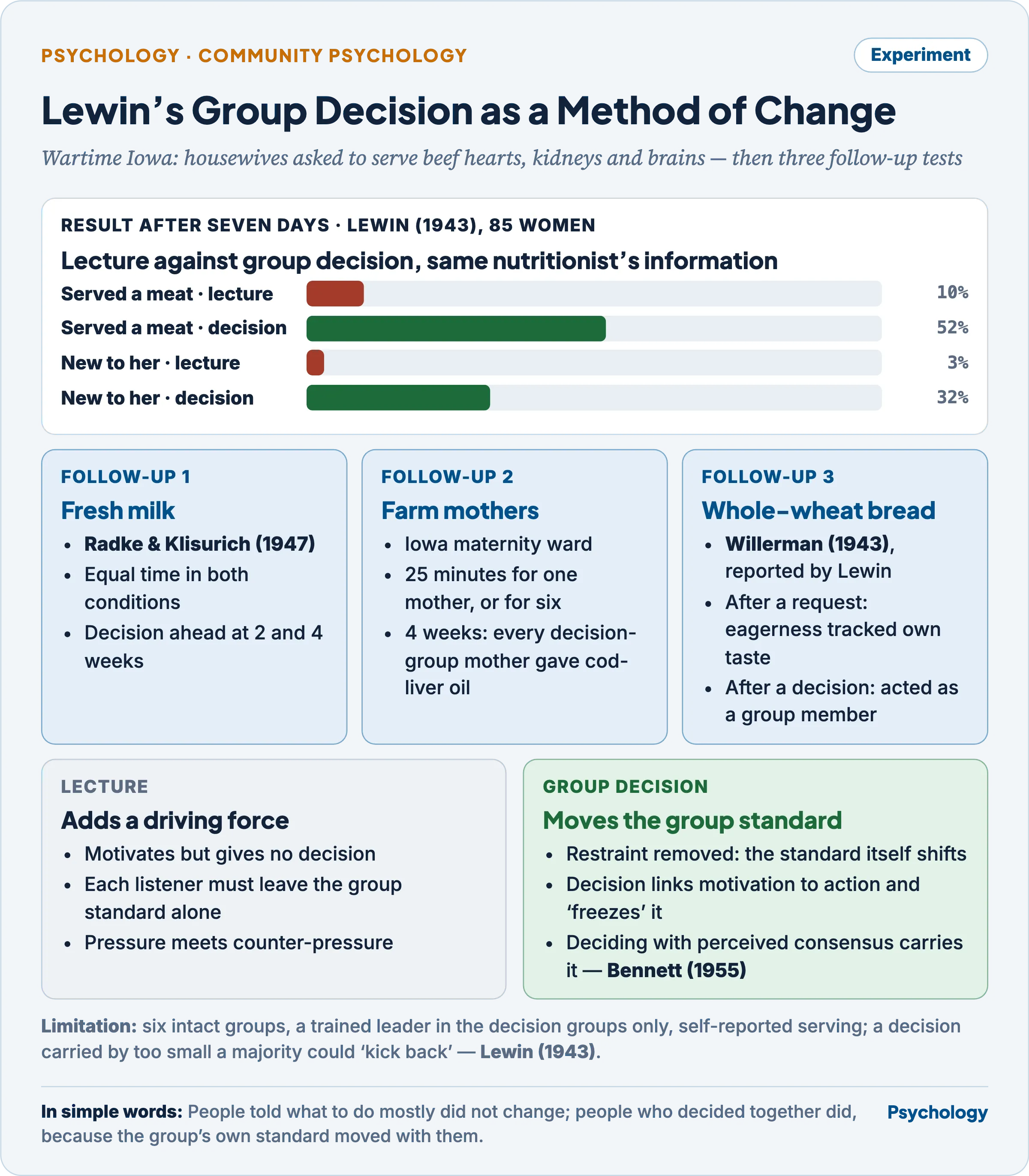
With the same information in the same time, group decision got five times as many women to serve the meats.
Why group decision making is important for social change
- Social change is norm change. Dowry, open defecation and stigma persist as shared standards; a message to individuals pushes against the standard, while a group decision moves it (Lewin, 1947).
- Interdependent practices need collective decisions. Mackie (1996) showed footbinding ended in China when families pledged together neither to bind daughters nor to marry sons to bound women; no family could stop alone. A Senegalese village, Malicounda Bambara, renounced female genital cutting publicly in 1997.
- Acceptance. Maier (1963) wrote decision effectiveness as quality multiplied by acceptance: a technically perfect plan the community rejects achieves nothing.
- Legitimacy. People comply with rules whose making they see as fair, and a voice in the process raises perceived fairness even when the outcome goes against them (Thibaut and Walker, 1975; Tyler, 1990).
- Local knowledge. Villagers know things experts do not, about land, water and who is left out; participatory rural appraisal is built to surface it.
- Arnstein (1969) set the limit: on her eight-rung ladder, from manipulation through tokenism to citizen control, these gains arise only when the group really decides (see Community Action and Empowerment for Handling Social Problems).
How group decision making can be used effectively for social change
- A worked procedure:
- Diagnose the force field with the community: list driving and restraining forces, and identify the gatekeepers.
- Use natural groups (self-help groups, mahila mandals, youth clubs, ward meetings) small enough for everyone to talk.
- Facilitate, do not lecture. Pose the problem for “people like us”, let members raise objections, and give expert information once they are involved (Lewin, 1943).
- Pool what only some know: round-robin turns, community maps, women and lower-status members heard first.
- Reach an explicit decision with visible consensus, by a show of hands or a written resolution (Bennett, 1955).
- Make it collective and public where the practice is interdependent: a joint declaration or a gram sabha resolution (Mackie, 1996).
- Freeze the change in structures: committees, by-laws, monitoring, a social audit.
- Follow up and revise through Lewin’s (1946) cycle of planning, action and fact-finding.
- The wider campaign is designed in Effective Strategies for Social Change.
- Prost and colleagues (2013) pooled trials of women’s groups meeting monthly to identify maternal and newborn problems, choose strategies, act and review.
- Design: seven randomised trials in Bangladesh, India, Malawi and Nepal; 119,428 births.
- Result: neonatal mortality fell 23 per cent and maternal mortality 37 per cent; where at least 30 per cent of pregnant women joined, the falls were 33 and 55 per cent (Prost and colleagues, 2013).
- Limitation: high heterogeneity; the mechanism is inferred.
- Pickering and colleagues (2015) randomised 121 villages in Koulikoro, Mali, to no programme or to community-led total sanitation, which mobilises a village to decide together to end open defecation.
- Private latrine access was 65 against 35 per cent; open defecation by women 9 against 33 per cent; children grew taller; diarrhoea was unchanged (Pickering and colleagues, 2015).
- Limitation: self-reported open defecation, in one district (Pickering and colleagues, 2015).
Advantages and disadvantages against individual decisions
| Dimension | Group decision | Individual decision |
|---|---|---|
| Information | Pooled knowledge, more alternatives | One person’s knowledge |
| Accuracy | Above the average member, rarely above the best (Hill, 1982) | Varies with the person |
| Acceptance | High where members took part (Maier, 1963) | Must be won afterwards |
| Speed and cost | Slow; many person-hours | Fast, cheap |
| Accountability | Diffused | Clear |
- Hill (1982): groups usually beat their average member but seldom their best; beating the best is the assembly effect (Collins and Guetzkow, 1964).
- Laughlin and Ellis (1986) showed that the task sets the rule: on intellective tasks with a demonstrable answer one correct member can carry the group (“truth wins”); on judgemental tasks the majority wins.
- Steiner (1972): actual productivity equals potential productivity minus process losses, such as coordination failures, waiting for a turn to speak (production blocking; Diehl and Stroebe, 1987), conformity and reduced effort.
- Conformity to a majority (Asch, 1951; Changing Others’ Behaviour, Paper I) lets a group pool opinion without pooling judgement. When to involve a group at all: Leadership and Participatory Management (Unit 4).
Errors and biases in group decision making
Groupthink
- Janis (1972) defined groupthink as “a mode of thinking that people engage in when they are deeply involved in a cohesive in-group, when the members’ strivings for unanimity override their motivation to realistically appraise alternative courses of action.”
- Antecedents: high cohesiveness; structural faults (an insulated group, a leader who promotes a preference, no norms of methodical procedure, members of similar background); and a provocative context (external threat, recent failure, a hard choice).
- Symptoms, in three types (Janis, 1982):
- Overestimation of the group: illusion of invulnerability; belief in the group’s inherent morality.
- Closed-mindedness: collective rationalisation; stereotyped views of opponents.
- Pressure towards uniformity: self-censorship; illusion of unanimity; direct pressure on dissenters; self-appointed mindguards.
- How it lowers quality: Janis (1982) listed seven defects: incomplete survey of alternatives and of objectives, unexamined risks of the preferred choice, no reappraisal of rejected options, poor information search, selective processing and no contingency plans.
- Bay of Pigs (April 1961): Kennedy’s advisers approved a CIA-trained exile brigade’s invasion of Cuba, which collapsed within days; doubters stayed silent and unanimity was illusory (Janis, 1972). In the 1962 missile crisis the same group, inviting dissent, reasoned better.
- Evidence: Esser (1998), reviewing 25 years of work, found only a handful of tests, with partial support, and called it too early to judge the theory. Flowers (1977) found closed leadership, not cohesiveness, cut the facts and solutions groups used.
- Reappraisals: Kramer (1998) read the Bay of Pigs as political calculation; Aldag and Fuller (1993) proposed a value-neutral general group problem-solving model; Glen Whyte (1998) blamed inflated collective efficacy.
Group polarisation
- Stoner (1961), in a master’s thesis at MIT, found that groups discussing choice dilemmas recommended riskier options than their members’ prior average, the risky shift.
- Moscovici and Zavalloni (1969) showed the shift is general: after discussion, French secondary-school students grew more favourable to de Gaulle and more negative towards Americans. Discussion pushes a group further the way it already leaned: group polarisation.
- Myers and Bishop (1970) found that high-prejudice students who discussed racial issues together grew more prejudiced and low-prejudice groups less, so the gap between them widened.
- Two mechanisms: persuasive arguments, new arguments for the favoured side (Burnstein and Vinokur, 1977), and social comparison, shifting to appear at least as committed as others. Isenberg (1986) found support for both in a meta-analysis.
- Like-minded groups harden, so deliberating bodies need mixed membership.
Hidden profiles and the common-knowledge effect
- Stasser and Titus (1985) gave four-person student groups facts about three candidates for student-body president, the best candidate’s strengths split so that each member saw only part of them.
- With all facts shared, 83 per cent of 18 groups chose the best candidate; with them unshared, 18 per cent of 38 groups did (Stasser and Titus, 1985).
- Discussion dwelt on what everyone already knew and confirmed first preferences. Limitation: short laboratory sessions with students.
- Lu, Yuan and McLeod (2012), pooling 65 studies, found hidden-profile groups eight times less likely to reach the best solution than groups with full information.
Escalation of commitment and social loafing
- Staw (1976) found business students responsible for a failing investment put more money into it, an effect called escalation of commitment. Whyte (1993) found groups amplified members’ escalation in frequency and severity, as discussion polarised the risk-seeking a loss frame induces.
- Latané, Williams and Harkins (1979) found individual effort at clapping and shouting fell as group size rose, which they called social loafing. Karau and Williams (1993) confirmed it across 78 studies, strongest when individual contributions cannot be identified.
- Diffusion of responsibility also explains part of the risky shift: no single member bears the cost of a bad choice (Wallach, Kogan and Bem, 1964).
- Members’ own heuristics are set out in Decision Making, Heuristics and Biases (Paper I).
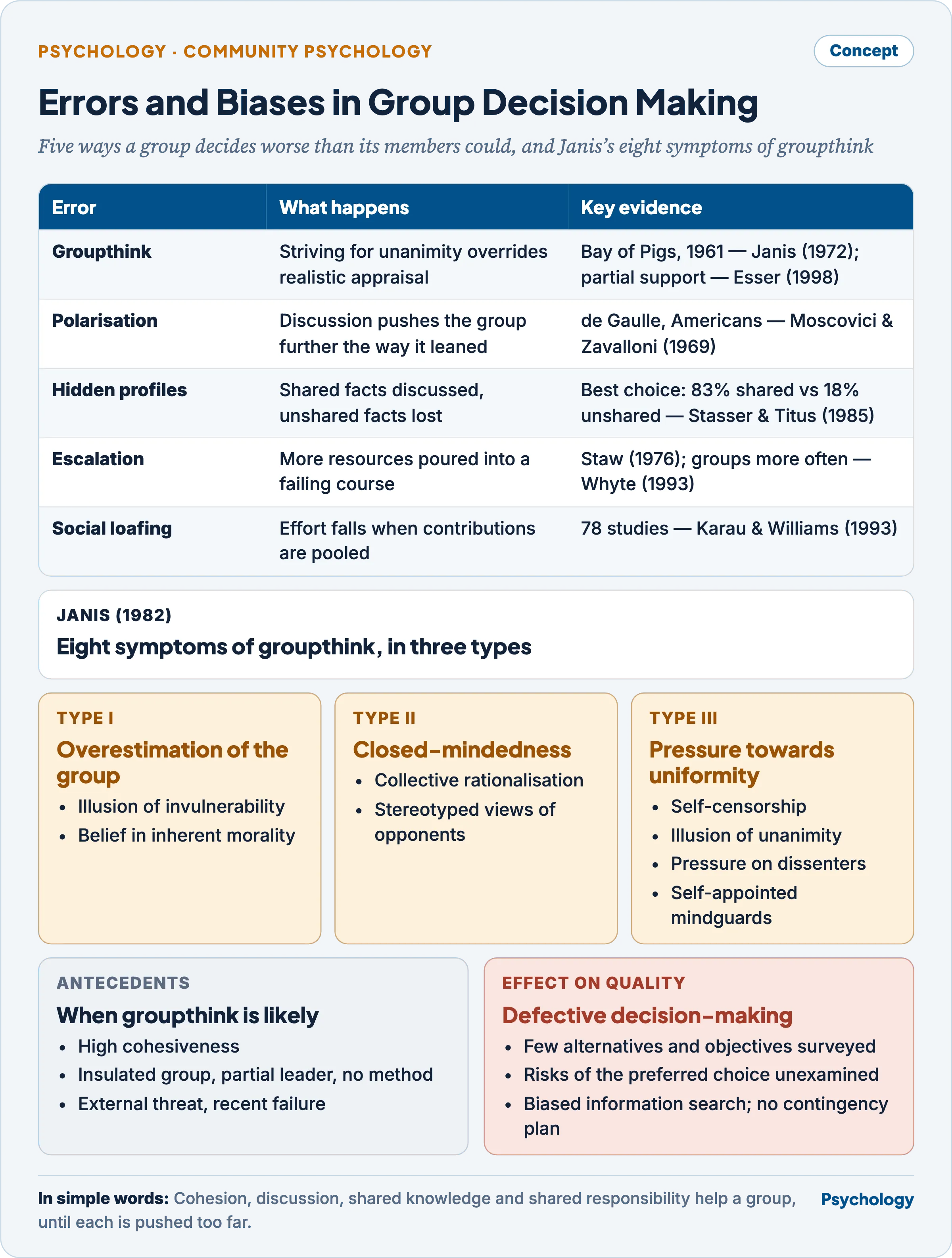
Each error begins as a useful group process (cohesion, discussion, shared knowledge, shared responsibility) carried too far.
Steps to improve the quality of group decision making
- Leader restraint: the leader withholds a preference at the start, invites objections and makes every member a critical evaluator (Janis, 1982); Flowers (1977) supports it.
- Devil’s advocacy and dialectical inquiry: one member attacks the favoured plan, or two subgroups argue rival plans and their assumptions. Schweiger, Sandberg and Ragan (1986) found both gave better recommendations than consensus groups, at some cost to satisfaction.
- Authentic dissent: Nemeth, Brown and Rogers (2001) found a genuine dissenter stimulated more and better thinking than an assigned devil’s advocate, which favours diverse membership over assigned roles.
- Nominal group technique (Delbecq and Van de Ven, 1971): silent individual writing, round-robin listing, discussion of each idea, then private ranking. It removes status pressure and production blocking.
- Delphi technique (Dalkey and Helmer, 1963): anonymous rounds of expert judgement with summarised feedback until views converge. Both are compared in Focussed Group Discussions, Brain Storming and the Grounded Theory Approach (Paper I).
- Structured information exchange: framing the task as a problem with a correct answer (Stasser and Stewart, 1992) and telling members who holds which expertise (Stasser, Stewart and Wittenbaum, 1995) both raised the pooling of unshared facts.
- Outsiders, subgroups, a second chance: outside experts, independent subgroups and a “second-chance” meeting before finalising (Janis, 1982); anonymous voting protects low-status members.
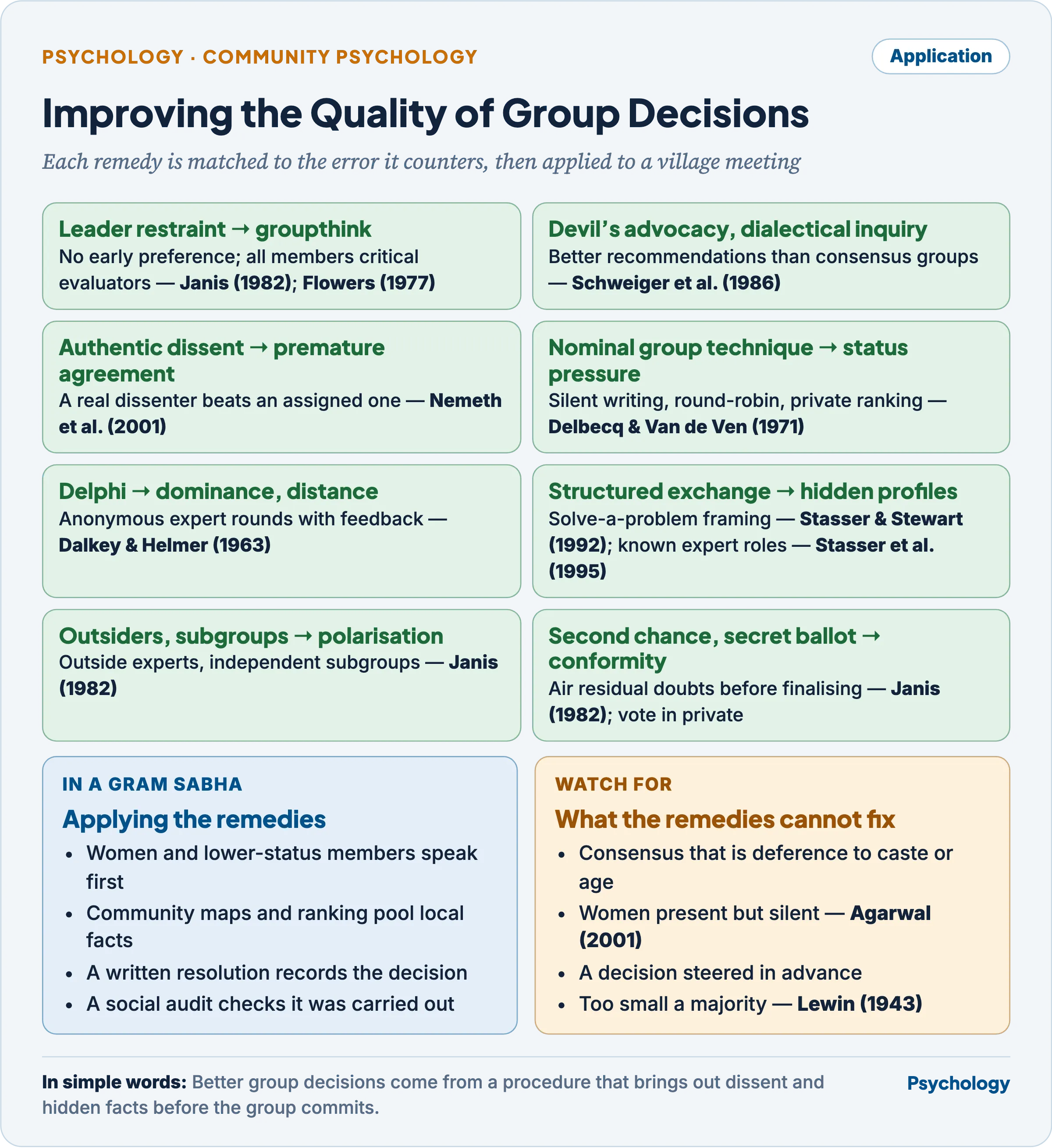
Each remedy is paired with the error it counters, and the lower panel applies them to a gram sabha.
Group decision making in development: the Indian context
The cultural setting: collectivism, hierarchy and consensus
- Sinha and Tripathi (1994) found individualist and collectivist orientations coexisting in Indian respondents, so a village meeting mixes group loyalty with self-interest.
- Triandis (1995) called the pattern vertical collectivism: in-group loyalty with acceptance of hierarchy. A consensus may then be deference to elders, men or the dominant caste: the conditions for groupthink.
- Women, Dalits, Adivasis and minorities need protected voice: separate meetings, reserved places, anonymous methods.
Gram sabhas: who speaks and who is heard
- Besley, Pande and Rao (2005) found that only about a fifth of South Indian respondents had ever attended a gram sabha, but attenders were disproportionately disadvantaged, and meetings improved welfare targeting.
- Ban and Rao (2009), from 131 meeting transcripts matched to household surveys, found the more land villagers owned, the likelier their preferences were raised and acted on; low castes were heard but Muslims got less time.
- Parthasarathy, Rao and Palaniswamy (2019), from Tamil Nadu gram sabha transcripts, found women less likely to speak, set the agenda or get a relevant reply; a woman-reserved village presidency raised women’s chance of being heard, not of speaking (see Leadership for Social Change).
- A Ministry of Panchayati Raj study (30 June 2026) traced low gram sabha participation to livelihood pressures, weak awareness and unresponsive officials; women also faced household duties and male dominance of discussion (PIB, 11 August 2026).
Participatory rural appraisal and Joint Forest Management
- Chambers (1994) described participatory rural appraisal: villagers map, rank, score and plan in groups, with outsiders as facilitators.
- Mosse (1994), from a tribal project in western India, argued that PRA is a public event: what is said reflects local authority and gender relations, and women’s knowledge is often left out, a village-scale hidden profile.
- Joint Forest Management began with the Ministry of Environment and Forests’ circular of 1 June 1990, under which village committees protect degraded forest in return for a share of its produce.
- Agarwal (2001) found such committees in India and Nepal excluding women: many were not members, members rarely attended, and norms about public space and men’s control kept them silent, which she called participatory exclusions.
Schemes that institutionalise group decision
- 73rd Constitutional Amendment, 1992 (in force 24 April 1993) — Article 243(b) defines the gram sabha as a village’s registered voters; Article 243A leaves its powers to state law. It operationalises voice and procedural legitimacy.
- People’s Plan Campaign, Sabki Yojana, Sabka Vikas (Ministry of Panchayati Raj, annual since 2 October 2018) — special gram sabhas prepare and approve the Gram Panchayat Development Plan. It operationalises participation as ownership.
- Swachh Bharat Mission (Grameen) (2014; now Ministry of Jal Shakti) — open-defecation-free status starts with a gram sabha resolution, then independent verification. It operationalises public collective commitment to a new group standard.
- Forest Rights Act, 2006 (Ministry of Tribal Affairs) — Section 6(1) makes the gram sabha the authority to initiate the determination of forest rights. It operationalises collective self-determination.
- Niyamgiri (Supreme Court, 18 April 2013): the gram sabhas were to decide whether bauxite mining harmed Dongria Kondh religious and cultural rights, and they rejected it.
- VB-G RAM G Act, 2025 (Ministry of Rural Development) — in force from 1 July 2026, replacing MGNREGA, 2005, it keeps the social audit of works by the gram sabha. It operationalises public accountability, a check on elite capture.
Group decision in fostering mental health in a community
- An existing group (a women’s collective, caregivers’ circle or youth club) names a problem such as drinking or stigma, decides publicly what members will do, and returns to review.
- What changes is the group standard: once “people like us” decide to talk about distress and go to services together, seeking help no longer breaks the norm.
- Coverage matters: in Prost and colleagues (2013) effects grew with the share of women in groups. Groups decide about norms, never about a named member’s illness.
- The Ekjut women’s-group and Atmiyata volunteer trials, and the community psychologist’s role, are set out in Fostering Mental Health (Unit 3).
Criticisms and limitations
- The founding study was small and non-randomised (Lewin, 1943), and Lewin (1947) himself warned that managers “rushing into a factory to raise production by group decisions are likely to encounter failure”.
- Too small a majority backfires: in Willerman’s study it risked a “kick-back”, worse than a plain request (Lewin, 1943).
- Groupthink rests largely on historical cases read with hindsight (Esser, 1998), and Bennett (1955) leaves it unclear whether participation itself matters.
- Participation can manipulate: steering a group towards a decision already taken uses its commitment without giving it a choice. In Participation: The New Tyranny? (Cooke and Kothari, 2001), group dynamics are one tyranny, social-psychological limits that participatory development had largely ignored (Cooke, 2001).
- Meetings reproduce caste, gender and religious hierarchies, so elites capture them and others are excluded (Agarwal, 2001; Parthasarathy and colleagues, 2019).
- Group decision is slow and suits questions of values and acceptance; on technical questions it may only pool error.
- Most findings come from Western student groups, not hierarchical village assemblies. Resistance to change is treated in Resistance to Change and the Community Psychologist’s Role.
Previous Year Questions
- 2021Why is group decision making important for social change? What errors and biases occur during the process of group decision making?
- 2017Discuss the advantages and disadvantages of group decision-making over decisions made by individuals.
- 2016Discuss how the process of group decision making can be used effectively in bringing about social change.
- 2015What is the phenomenon of ‘group think’? How can it influence the quality of group decision making?
- 2014Discuss the implications of employing group decision-making in issues involving development in the Indian cultural context.
- 2013Discuss the steps that can be taken to improve the quality of group decision-making.
- 2009Discuss the psychological significance of ‘group decision’. How can this be applied in fostering mental health in a Community?
