

Official syllabusPaper II · Unit 6 · Community Psychology
Use of small groups in social action.
Definition
“We mean by a group a number of persons who communicate with one another often over a span of time, and who are few enough so that each person is able to communicate with all the others, not at secondhand, through other people, but face-to-face.”
Homans (1950)
Most organised social action, from a savings group to a women’s sangha or a mothers’ group on newborn care, is carried by small groups, because only at that scale can every member see and answer every other. Face-to-face contact, interdependence, cohesion and visibility make such groups work for change; the same features also breed conformity and loafing, and let better-off members take over.
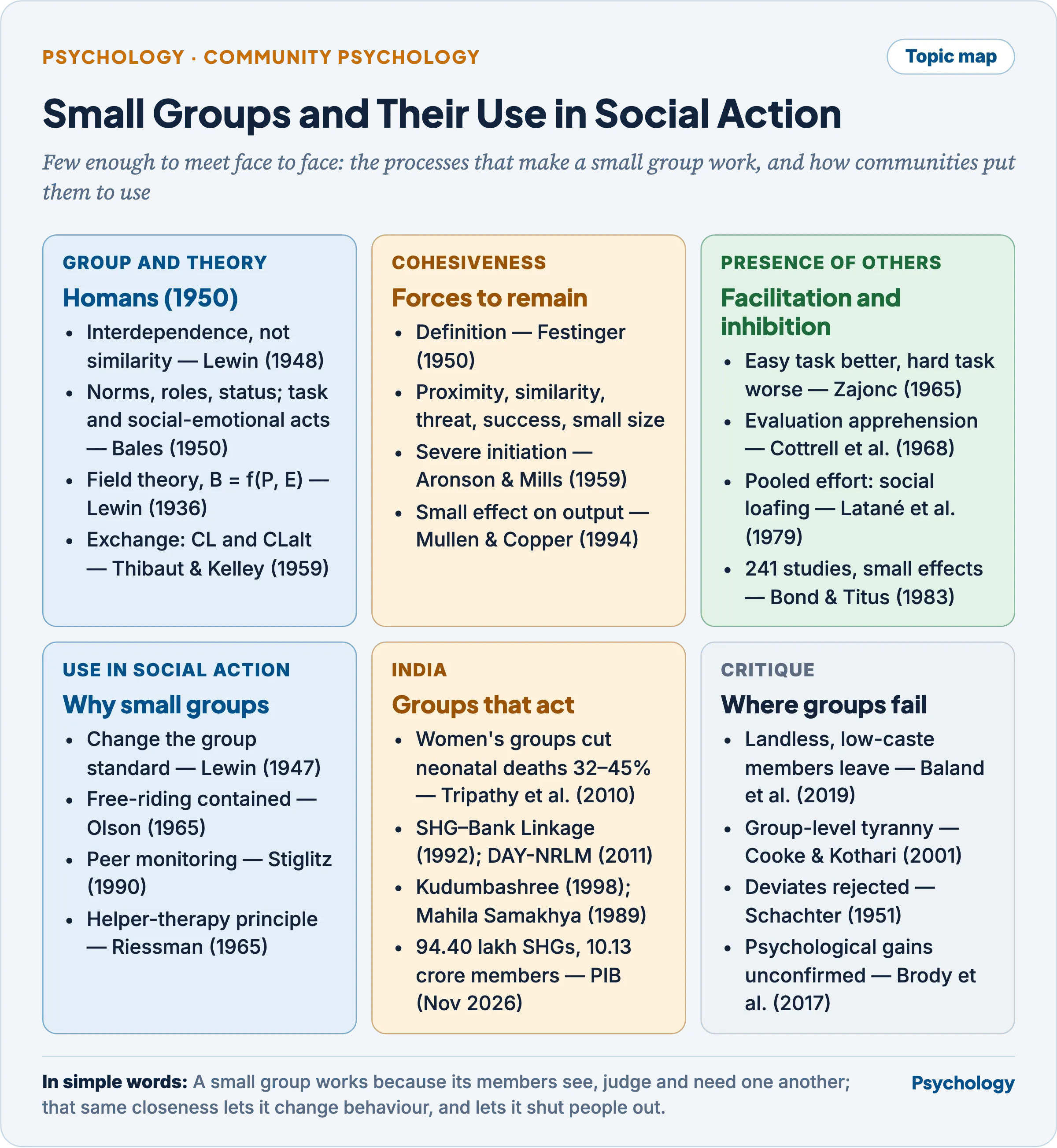
The three process boxes in the top row are what make the bottom row work, and also what make it fail.
Small groups: chief characteristics
- Lewin (1948) placed a group’s essence in interdependence, not likeness: “A group is best defined as a dynamic whole based on interdependence rather than on similarity.”
- Bales (1950) set the test: each member must form an impression of every other distinct enough to react to them as an individual. A lecture audience is not a small group.
- Chief characteristics:
- Size: small enough for each member to reach every other directly; interdependence depends on “the size, organization, and intimacy of the group” (Lewin, 1948).
- Face-to-face interaction, repeated over time, which separates a group from a crowd or a category.
- Interdependence of fate and task, and shared goals with a felt “we”.
- Norms: Sherif (1936) watched them form as members judging the apparent movement of a still light in the dark converged on one estimate and kept it when later tested alone.
- Roles: task roles, group-building and maintenance roles and self-serving individual roles (Benne and Sheats, 1948).
- Status and structure: who speaks to whom and whose word counts; and cohesiveness, treated below.
- Primary groups: “By primary groups I mean those characterized by intimate face-to-face association and cooperation” (Cooley, 1909); family, play group and neighbourhood produce “a certain fusion of individualities in a common whole”. Secondary groups are larger, formal and instrumental.
The quality of interpersonal interactions and relations
- Interaction process analysis (Bales, 1950) codes every act in a meeting into twelve categories in four sets: positive reactions (solidarity, tension release, agreement), attempted answers (suggestion, opinion, orientation), questions asking for these, and negative reactions (disagreement, tension, antagonism).
- The middle six form the task area, the outer six the social-emotional area; paired categories serve communication, evaluation, control, decision, tension reduction and reintegration.
- Bales (1950) described an equilibrium: task work strains relations, activity swings to expressive acts that repair them, then returns to the task.
- Bales and Slater (1955) found the member with the best ideas was seldom the best liked, so groups split leadership between a task specialist and a socio-emotional specialist.
- Limitation: built on short-lived laboratory groups; coding records a remark’s form but misses its content and the power behind it.
- Structure shapes quality: Leavitt (1951) found the centralised wheel network fastest on simple problems but least satisfying for peripheral members, the decentralised circle slower and most satisfying.
- “If the frequency of interaction between two or more persons increases, the degree of their liking for one another will increase, and vice versa” (Homans, 1950). Sociometry (Moreno, 1934) is set out in Managerial Effectiveness (Unit 4).
A theory of group behaviour
Lewin’s field theory and group dynamics
- Field theory (Lewin, 1936): behaviour is a function of person and environment, B = f(P, E), read together as the life space, everything that influences a person at a given moment as that person perceives it.
- The group is a dynamic whole: “a change in the state of any subpart changes the state of any other subpart” (Lewin, 1948). Behaviour is explained by the forces acting at the moment; members’ traits and histories matter only through them.
- Working concepts: group goals, whose tension persists until reached; group standards, from which departing carries a cost; cohesiveness, formalised by his student Festinger (1950); and quasi-stationary equilibrium between driving and restraining forces, set out in Sensitivity Training and Organisational Development (Unit 4).
- Lewin named the field group dynamics and founded the Research Center for Group Dynamics at the Massachusetts Institute of Technology in 1945.
- Lewin, Lippitt and White (1939) ran clubs of ten-year-old boys, five to a club, under adult leaders trained to lead autocratically, democratically or in laissez-faire fashion.
- Autocracy produced passive submission or aggressive domineering; democracy more friendliness and only moderate aggression. The same boys changed as the style changed.
- Limitation: four clubs of five boys is a tiny sample, and the styles were staged by adults trained to enact them; the lessons for change are in Leadership for Social Change.
- For social action, Lewin (1947) concluded that “it is usually easier to change individuals formed into a group than to change any one of them separately”; the food-habits experiments are in Fostering Mental Health (Unit 3).
- Criticism: the topological constructs were spatial metaphors rarely made measurable (London, 1944), so the theory names forces more easily than it predicts their strength.
Homans, social exchange, group development and social identity
| Theory | Mechanism | Prediction | Limitation |
|---|---|---|---|
| Homans (1950) | Activity, interaction and sentiment are mutually dependent, within an external and an internal system | More interaction, more liking and norms beyond the task | Generalised after the fact from case studies such as the Bank Wiring Room |
| Thibaut and Kelley (1959), exchange | Satisfaction judged against the comparison level (CL); staying against the comparison level for alternatives (CLalt) | Members stay in unsatisfying groups when alternatives are worse | Assumes calculation; neglects identity |
| Tuckman (1965), development | Forming, storming, norming, performing; adjourning added by Tuckman and Jensen (1977) | Norms form before productive work | Drawn mainly from therapy and training groups; Gersick (1988) found one midpoint shift |
| Tajfel and Turner (1979), social identity | A group exists once members categorise themselves as one | Attraction to the group prototype (Hogg, 1992) binds even scattered groups | Says little about face-to-face process |
Group cohesiveness
- “Cohesiveness of a group is here defined as the resultant of all the forces acting on the members to remain in the group” (Festinger, 1950), forces arising from attraction to the members, the activities and the group’s prestige.
- Most research measured one force, mutual liking; Lott and Lott (1965) adopted cohesiveness as “that group property which is inferred from the number and strength of mutual positive attitudes among the members of a group” (Lott, 1961).
- Social cohesion (liking among members) is now separated from task cohesion (shared commitment to the goal).
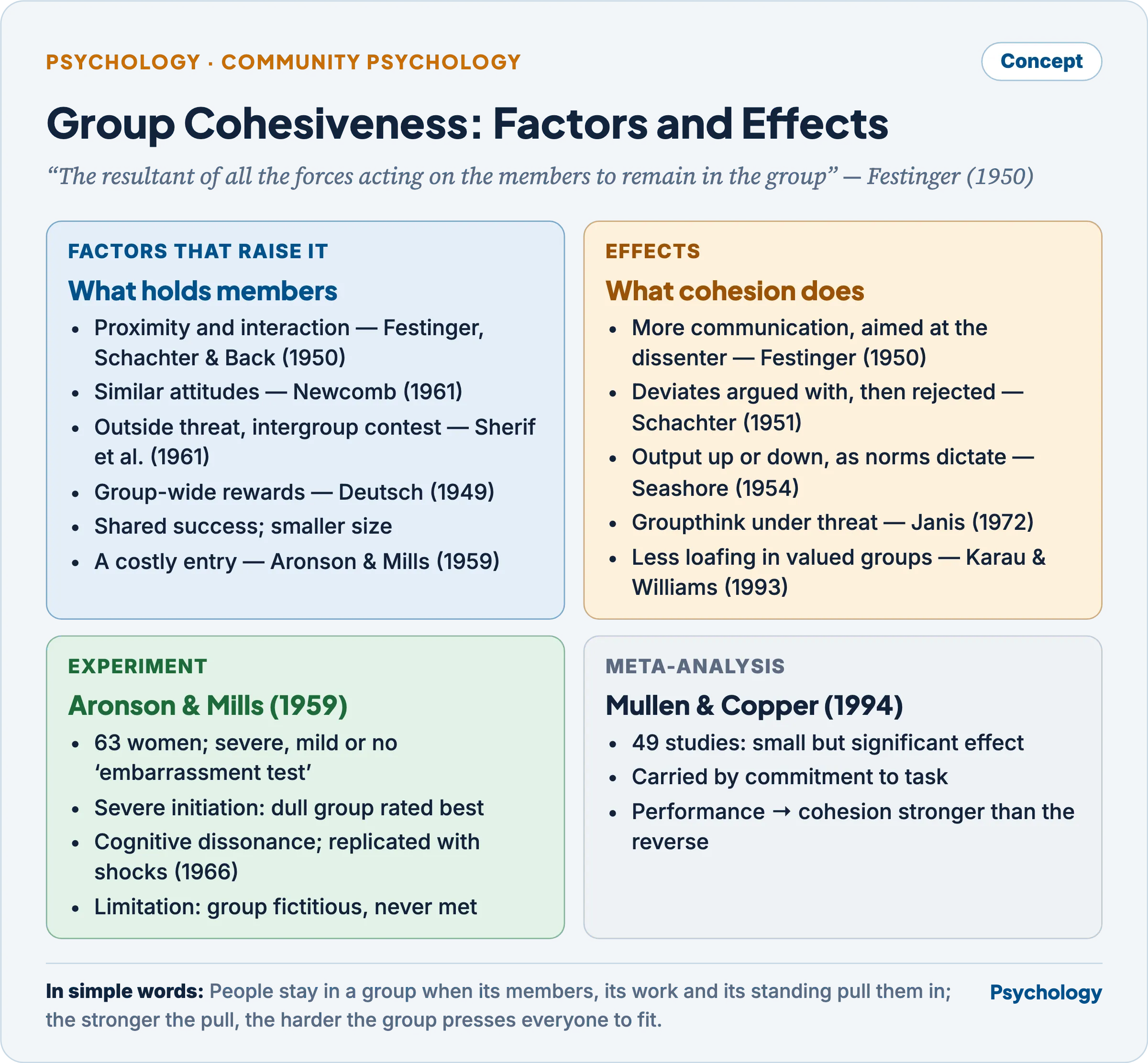
Cohesion strengthens whatever norm the group already holds: a high-output norm raises output, a restrictive one restricts it.
Factors affecting group cohesiveness
- Interaction and proximity: in Westgate, housing for married student veterans, friendships followed physical and functional distance between doors (Festinger, Schachter and Back, 1950).
- Similarity: Newcomb (1961) found 17 transfer students sharing a house liked those nearby at first and those sharing their attitudes by the end.
- External threat and competition: at Robbers Cave two groups of eleven-year-old boys grew more united, and hostile, once set to compete (Sherif and colleagues, 1961).
- Cooperative rewards: student groups graded as a whole coordinated better and were friendlier than groups competing for individual grades (Deutsch, 1949).
- Success raises attraction and failure lowers it (Lott and Lott, 1965); size loosens it as interaction per member falls (Lewin, 1948).
- Difficulty of entry: Aronson and Mills (1959) gave 63 women students volunteering for a discussion group on sex a severe “embarrassment test”, a mild one or none, then a dull recorded discussion.
- The severely initiated rated the group best: cognitive dissonance turns suffering for a worthless group into valuing it.
- Gerard and Mathewson (1966) replicated it with electric shocks, ruling out sexual arousal. Limitation: the group was fictitious and the initiation mild.
Effects of cohesiveness
- Uniformity: pressure to communicate rises with cohesion and targets the most divergent member (Festinger, 1950); Schachter (1951) found clubs first argued with, then rejected, a planted deviate, most sharply in cohesive clubs.
- Performance: Mullen and Copper (1994), meta-analysing 49 studies, found a small but significant effect resting chiefly on commitment to task, with performance predicting later cohesion more strongly than the reverse.
- Norms decide direction: cohesion amplifies the group’s standard, high output or restriction (Seashore, 1954, in Managerial Effectiveness).
- Groupthink (Janis, 1972) under threat and directive leadership, set out in Group Decision Making for Social Change; on the positive side, members of valued groups loaf less (Karau and Williams, 1993).
Social facilitation and social inhibition
- Social facilitation: better performance when others are present, as co-actors or an audience. Social inhibition (social impairment): worse performance in their presence. Zajonc (1965) argued they are one process.
- Triplett (1898) had 40 children turn a fishing reel alone and in competition, and judged that about half sped up, ten slowed as if “overstimulated” and ten were unaffected.
- Strube (2005) reanalysed the data: effects in the expected direction, not statistically significant. McHugh and colleagues (2025), in a pre-registered replication with 445 children, found them faster together.
- Early results conflicted: a spectator hindered the learning of nonsense syllables (Pessin, 1933).
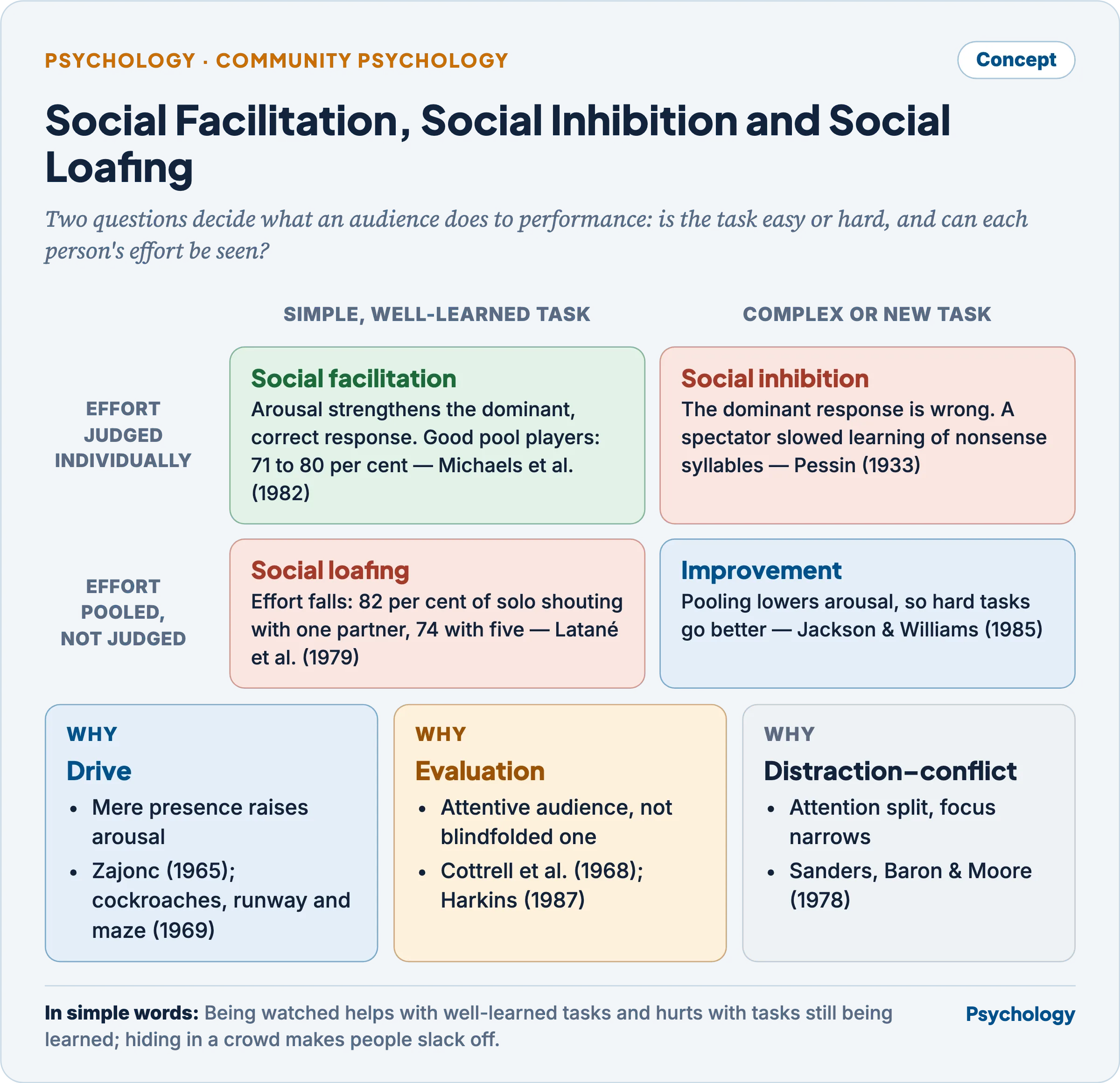
The same audience helps or hurts depending on how well-learned the task is and whether each person’s effort can be seen.
Explaining facilitation and inhibition
- Drive theory (Zajonc, 1965): others’ presence raises arousal, which strengthens the dominant response. On simple or well-learned tasks it is correct, so performance improves; on complex or new tasks it is often wrong, so performance worsens.
- Zajonc, Heingartner and Herman (1969): cockroaches ran a straight runway faster but a maze more slowly when watched by other cockroaches; a pre-registered replication found an audience slowed both (Halfmann and colleagues, 2020).
- Markus (1978): people put on their own shoes faster, but an unfamiliar lab coat more slowly, beside another person, even one ignoring them.
- Evaluation apprehension (Cottrell and colleagues, 1968): 45 male students gave more dominant responses before an attentive audience, but not before two blindfolded people.
- Distraction-conflict (Sanders and colleagues, 1978): attention torn between others and the task raises drive and narrows focus.
- Michaels and colleagues (1982): good pool players rose from 71 to 80 per cent accuracy when four observers watched; poor players became less accurate.
- Bond and Titus (1983), meta-analysing 241 studies with over 20,000 participants, found presence raised the speed of simple performance and lowered the speed and quality of complex performance; the effects were small.
Social loafing: the contrast case
- Social loafing is reduced effort when contributions are pooled. Ringelmann‘s rope-pulling studies of the 1880s, published in 1913, found group pull well short of the sum of individual pulls.
- Latané, Williams and Harkins (1979): blindfolded students shouting in pseudogroups produced 82 per cent of solo effort with one supposed partner and 74 per cent with five, a pure motivation loss; real groups fell further.
- Karau and Williams (1993), meta-analysing 78 studies, found less loafing when the task was meaningful and contributions identifiable, and among women and in collectivist cultures; their collective effort model ties effort to its expected value.
- Harkins (1987) traced both effects to evaluation potential: where output is judged individually, presence arouses; where it is pooled, presence relaxes, producing loafing on easy tasks and better performance on hard ones (Jackson and Williams, 1985).
Use of small groups in social action
- Social action is organised, collective effort by the people affected by a problem to change its conditions. Small groups are its usual unit because each mechanism below depends on members seeing and answering one another.
Why small groups work in community interventions
- Group standards: public decision in a small group shifts the standard itself, so members change together (Lewin, 1947).
- Free-riding: “unless the number of individuals in a group is quite small, or unless there is coercion or some other special device to make individuals act in their common interest, rational, self-interested individuals will not act to achieve their common or group interests” (Olson, 1965).
- Peer monitoring: joint liability gives members a stake in watching one another, so local knowledge replaces collateral (Stiglitz, 1990); communities sustain shared resources through their own rules, monitoring and graduated sanctions (Ostrom, 1990).
- Mutual aid: the helper-therapy principle (Riessman, 1965), experiential knowledge (Borkman, 1976) and comparison with similar others (Festinger, 1954).
- Kelly, Humphreys and Ferri (2020), reviewing 27 studies with 10,565 participants, found manualised Alcoholics Anonymous and twelve-step facilitation gave higher continuous abstinence than other treatments, though many studies risked bias.
- Consciousness raising: private troubles become a named, shared grievance, as followed in Arousing Community Consciousness.
- Collective efficacy: members’ shared belief in their joint power (Bandura, 2000), built by recasting a large problem as small wins, concrete completed outcomes of moderate importance (Weick, 1984); see Community Action and Empowerment for Handling Social Problems.
- Commitment: among accepted applicants to the 1964 Mississippi Freedom Summer, prior activism and strong ties to other participants predicted who went (McAdam, 1986).
- New settings: two or more people coming together in new and sustained relationships for shared goals (Sarason, 1972); a small group is the simplest setting a community can create for itself.
Evidence: participatory women’s groups in eastern India
- Tripathy and colleagues (2010): Ekjut’s cluster-randomised trial in Jharkhand and Odisha placed 244 women’s groups in 18 of 36 clusters, each running a 20-meeting participatory learning and action cycle to identify, plan for and act on problems of pregnancy and newborn care.
- Neonatal mortality fell 32 per cent over three years and 45 per cent in years two and three; moderate maternal depression fell 57 per cent in year three (Tripathy and colleagues, 2010).
- The process evaluation credited critical consciousness, meetings with the wider community, a focus on marginalised communities and high coverage (Rath and colleagues, 2010). Limitation: mechanisms were inferred from process data.
- Groups facilitated by ASHA workers repeated the effect: 30 against 44 neonatal deaths per 1,000 live births (Tripathy and colleagues, 2016).
- Prost and colleagues (2013), pooling seven trials with 119,428 births, found neonatal mortality 23 per cent lower, and 33 per cent lower where at least 30 per cent of pregnant women joined.
Indian context: self-help groups and women’s collectives
- SHG-Bank Linkage Programme, 1992 (NABARD, in consultation with the Reserve Bank): a pilot linking about 500 groups to banks in 1992-93. Members save and lend internally, then borrow without collateral, operationalising social collateral and peer monitoring.
- DAY-NRLM (Ministry of Rural Development), launched as Aajeevika in June 2011, federates women’s SHGs into village organisations and cluster-level federations, with trained members as Krishi, Pashu and Bank Sakhis; 10.13 crore members in 94.40 lakh SHGs by 12 November 2026 (PIB, 2026).
- It operationalises graduated federation, face-to-face accountability at the base and bargaining power above, and peer modelling by trained members.
- Kudumbashree (Kerala State Poverty Eradication Mission, launched 17 May 1998) nests women’s neighbourhood groups in ward and local-body societies tied to local planning; it reports 48.08 lakh women in 3.17 lakh neighbourhood groups (Kudumbashree, 2026).
- Mahila Samakhya (Department of Education, 1989) gathered poor rural women in sanghas to challenge gender norms: 55,402 active sanghas with over 1.4 million women in 2014; by its evaluators’ account it lost central funding in 2015, when it was merged with the livelihoods mission.
- Bhuwania, Mukherji and Swaminathan (2024) found that girls youngest at its rollout gained schooling and less often married before 15, which they read as the work of sanghas challenging gender norms.
- Hoffmann and colleagues (2021), randomising JEEViKA across 180 Bihar panchayats, found informal borrowing down 14.5 per cent and average loan interest down from 69 to 58 per cent, with no change in consumption.
- Kumar and colleagues (2019), matching members with non-members in five states, found SHG members more politically engaged, more likely to use public entitlements and more mobile.
- Sanyal (2009), interviewing 400 women in 59 West Bengal groups, found one-third of groups had undertaken collective action, built on the social capital and normative influence of meetings.
- Brody and colleagues (2017) found economic SHGs raised women’s economic and political empowerment and mobility without raising domestic violence; psychological empowerment was unconfirmed.

Each tier rests on a group process; the lower boxes show what those processes deliver and whom they leave out.
Criticisms and limitations
- Thin laboratory groups: many classic findings come from strangers in brief, artificial groups; Aronson and Mills’ group never met.
- Small or fragile effects: facilitation explains little (Bond and Titus, 1983); Triplett’s data barely support it (Strube, 2005); cockroach facilitation failed to replicate (Halfmann and colleagues, 2020).
- Cohesion’s cost: the group that sustains members presses dissenters to conform or leave (Schachter, 1951).
- Exclusion: across a census of SHGs in 386 villages of eastern India, landless and disadvantaged-caste members left more and borrowed less, and groups with no educated member were four times likelier to become inactive (Baland and colleagues, 2019).
- Group-level tyranny: participatory practice ignores known group dynamics and can deepen local power differences behind consensus (Cooke and Kothari, 2001).
- Invited spaces: Kudumbashree succeeded in scale and in women’s public participation, but the autonomy of its “invited spaces” remains in question (Williams and colleagues, 2011).
- Limited depth: groups changed borrowing more than consumption (Hoffmann and colleagues, 2021), and an audit found at least 35 per cent of Kudumbashree’s micro-enterprises inactive (Comptroller and Auditor General, 2018).
- Structural limits: landholding, caste and markets, which set members’ conditions, lie largely beyond what a group of ten or twenty can change by itself.
Previous Year Questions
- 2025Explain the concepts of social facilitation and social inhibition in the context of group processes.
- 2016Discuss the usefulness of small groups in community interventions for social development.
- 2012Discuss the merits of the role of small groups in social actions and community handling of social problems.
- 2004Write a short note on: The role of small groups in social action.
- 2000Show your acquaintance with at least one theory of group behaviour.
- 1997What is group cohesiveness? Discuss the factors affecting group cohesiveness.
- 1995Describe the chief characteristics of a small group with a special reference to the quality of interpersonal interactions and relations.
