

Official syllabusPaper II · Unit 6 · Community Psychology
Definition and concept of community psychology.
Definition
“Community psychology concerns the relationships of the individual to communities and society. Through collaborative research and action, community psychologists seek to understand and to enhance quality of life for individuals, communities, and society.”
Dalton, Elias and Wandersman (2001)
Community psychology moved the unit of study from the person in distress to the person in context, and the point of intervention from the consulting room to the settings where problems arise. It defines itself by its values as much as by its methods, and much criticism of the field targets those values.
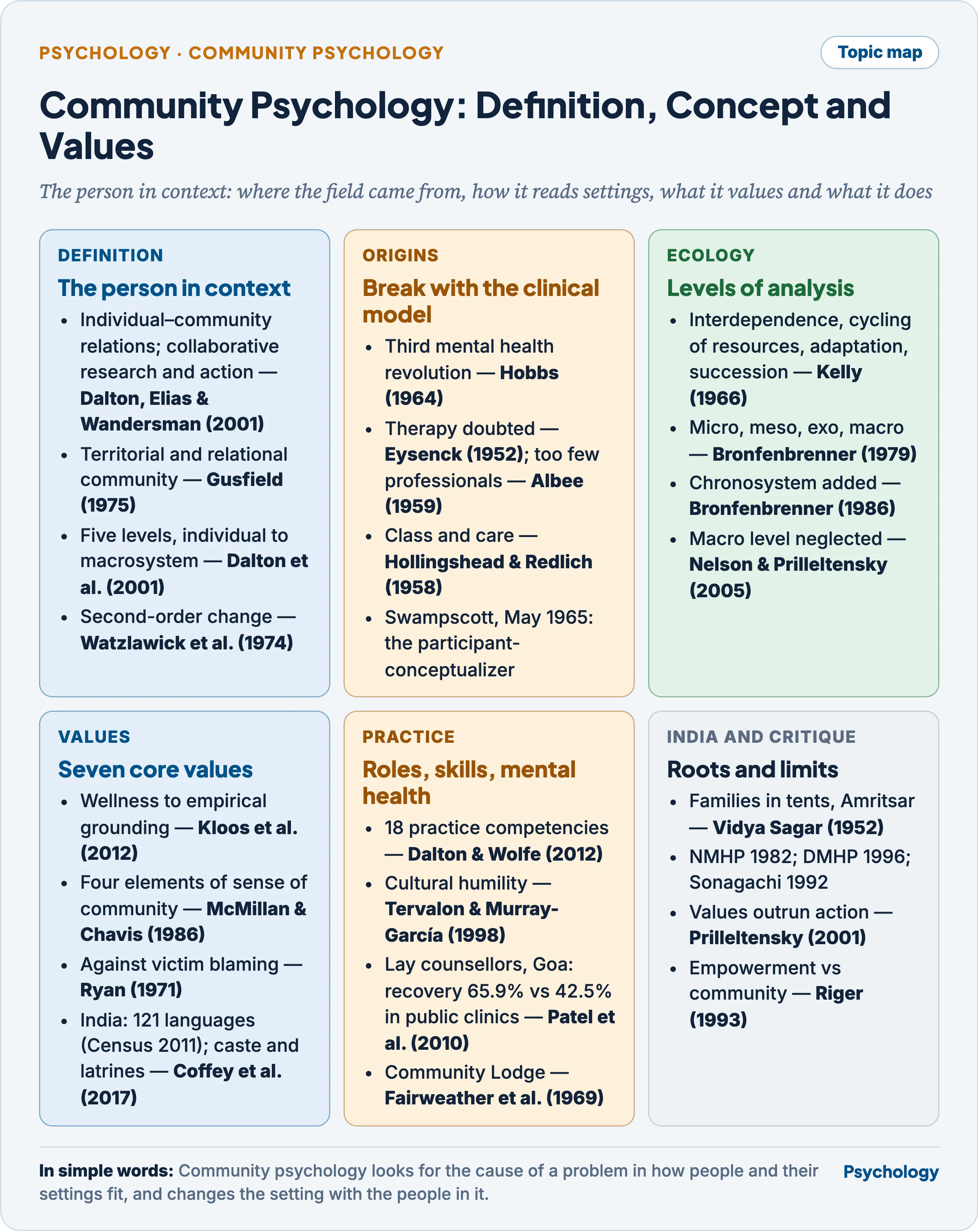
The field’s history, levels, values and roles all follow from one move: locating problems in how people and their settings fit, not inside the person.
Definition and concept of community psychology
- Community has two senses (Gusfield, 1975): territorial, such as a village, ward or neighbourhood; and relational, a network held together by shared identity or interest, such as a caste association, a self-help group or a caregivers’ forum.
- Dalton and colleagues’ definition has three working parts.
- People in context: behaviour is read as a product of person-environment relations, not of the individual alone.
- Collaborative research: research is done with communities, which help set the questions and use the findings.
- Action: knowledge is judged by whether it improves quality of life.
- Its targets are levels of analysis, not only individuals: individuals, microsystems (families, classrooms, self-help groups), organisations, localities (villages, wards, cities) and macrosystems (policy, economy, culture) (Dalton, Elias and Wandersman, 2001).
- The aim is second-order change, altering a setting’s roles, rules and relationships, rather than first-order change, which rearranges people inside an unchanged setting (Watzlawick, Weakland and Fisch, 1974): housing policy rather than another shelter bed.
- Sarason (1972), in The Creation of Settings and the Future Societies, made the building of new settings (a school, a clinic, a group home) a subject of study in its own right.
| Clinical psychology | Community psychology | |
|---|---|---|
| Unit of analysis | The individual | The person in context, at several levels |
| Where the problem lies | Within the person | In person-setting fit and social conditions |
| Timing | After disorder appears | Before it: prevention and promotion |
| Service mode | Waits for clients to seek help | Reaches out to the settings where problems arise |
| Focus | Deficits and symptoms | Strengths, competence, wellness |
| Professional role | Expert who treats | Collaborator, consultant, advocate |
| Change sought | First-order: the person adjusts | Second-order: the setting changes |
Origins: the break with the clinical model and the Swampscott Conference
- Hobbs (1964) called community mental health the third mental health revolution: after humane care and psychological treatment came prevention through social and community intervention.
- Four discontents with the clinical model drove it.
- Doubts about psychotherapy: Eysenck (1952) reviewed 19 studies of over 7,000 cases and argued that about two-thirds of neurotic patients improved with or without therapy. Smith and Glass (1977), pooling nearly 400 evaluations, later rejected the claim; the question of efficiency stayed.
- Manpower: Albee (1959), writing for the Joint Commission on Mental Illness and Health, concluded that the United States could never train enough professionals to treat all in need.
- Class inequity: Hollingshead and Redlich (1958) found in New Haven that lower-class patients received more severe diagnoses and custodial or physical treatment, while psychotherapy went to the affluent.
- Custodial hospitals: overcrowded asylums and new antipsychotic drugs drove deinstitutionalisation, and the Community Mental Health Centers Act (1963) moved care into community centres.
- The Swampscott Conference (Swampscott, Massachusetts, 4–8 May 1965), on educating psychologists for community mental health, brought together about 39 psychologists and is treated as the field’s founding event (Bennett and colleagues, 1966).
- Its report cast the new professional as a participant-conceptualizer: a change agent who takes part in community action and researches it.
- Kloos and colleagues (2012) trace five formative forces: public health’s preventive perspective (Caplan, 1964); mental health system reform; group dynamics and action research (Lewin, 1946); social movements for civil rights, women’s liberation and peace; and optimism about solving social problems.
- Institutions followed: Kelly (1966) published the ecological analogy, two journals began in 1973, and Rappaport (1977) wrote Community Psychology: Values, Research, and Action.
Ecological levels of analysis: Kelly’s analogy and Bronfenbrenner
- Kelly (1966) borrowed four principles from biological ecology, the ecological analogy.
- Interdependence: a setting is a system, so change in one part ripples through the rest. A counselling service for “difficult” pupils can lead teachers to stop managing them.
- Cycling of resources: every setting holds people, skills, time and goodwill that can be found and circulated, so interventions build on local strengths rather than imported ones.
- Adaptation: behaviour adapts to a setting’s demands and settings adapt to their members; what reads as deficit in one setting can be competence in another.
- Succession: settings have histories and futures, so an intervention must learn the setting’s history and leave it able to meet later change.
- Bronfenbrenner (1979) nested the person in four systems.
- Microsystem: settings of direct interaction, such as family, classroom and peer group.
- Mesosystem: links between microsystems, as when home and school agree or clash on values.
- Exosystem: settings the person never enters that still act on them, such as a parent’s workplace or a panchayat’s budget.
- Macrosystem: culture, ideology, law and economy. Bronfenbrenner (1986) later added the chronosystem, change over time.
- The levels multiply points of entry: adolescent drug use can be met through peers and family (micro), a school drug policy (exo), and limits on availability (macro).
- Criticism: community psychologists have worked mostly at micro and meso levels, neglecting macro-level structures such as economic inequality, and ecology’s stress on circular causality hides who holds power (Nelson and Prilleltensky, 2005).
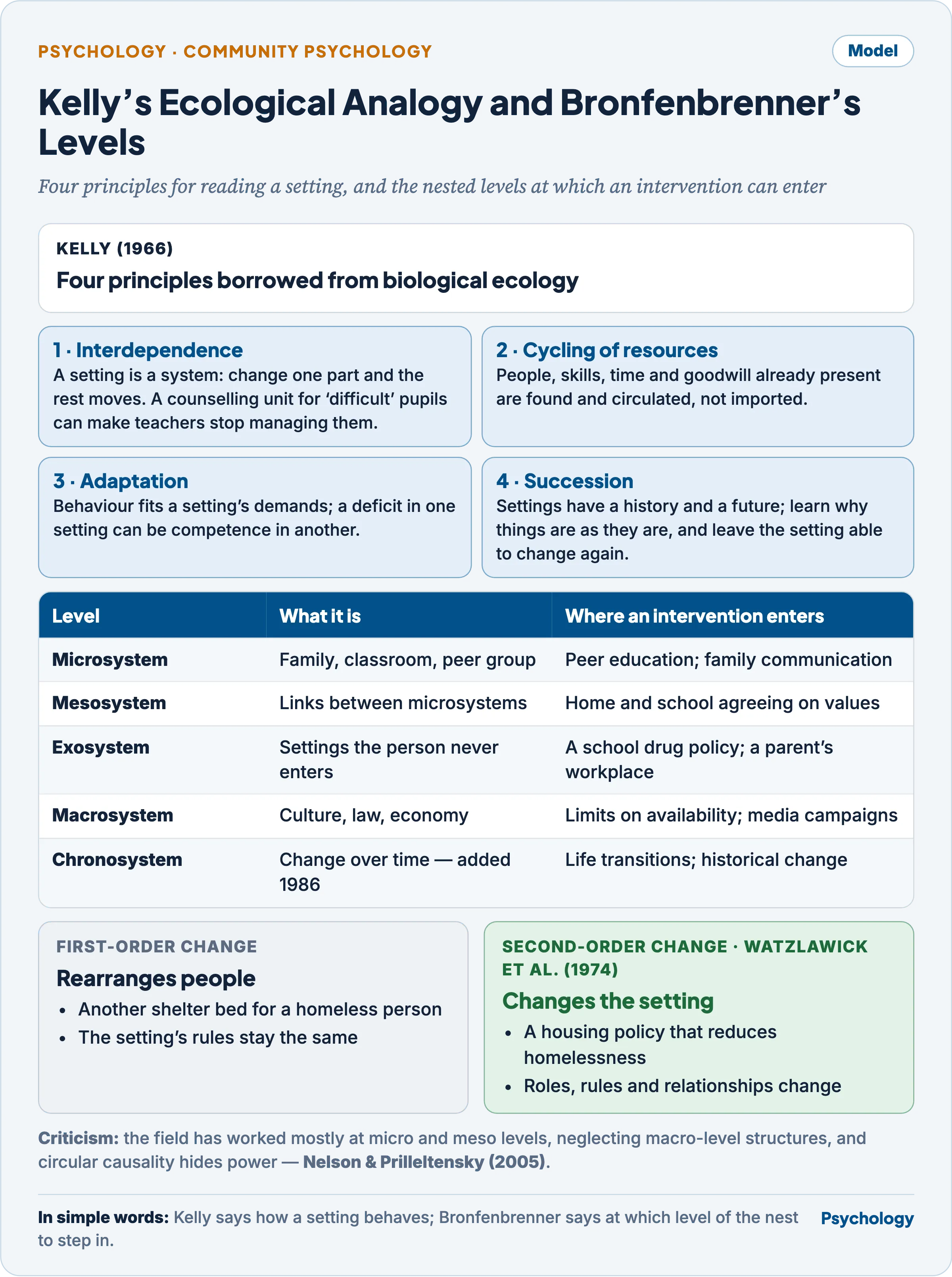
Kelly’s principles say how a setting behaves; Bronfenbrenner’s levels say where in the nest an intervention can enter.
Core values of community psychology
- Rappaport (1977) argued that explicit values should guide the field: diversity, collaboration, social justice, strengths over deficits. Kloos and colleagues (2012) set out seven core values.
- Individual and family wellness: positive health, not only absence of disorder; Cowen (1994) traced five pathways to it, from early attachment and competence to empowering settings and coping skills.
- Sense of community: belonging, interdependence and mutual commitment.
- Respect for human diversity: understanding people in their own cultural terms.
- Social justice: fair allocation of resources, opportunities, obligations and power.
- Empowerment and citizen participation: people gaining control over decisions that affect their lives.
- Collaboration and community strengths: working with communities as partners and building on their assets.
- Empirical grounding: testing action against evidence, so values do not excuse ineffective work.
- Together the values stand against victim blaming. Ryan (1971), in Blaming the Victim, showed how explaining poverty or school failure by the defects of the poor turns attention away from the conditions that produce them.
- The values pull against each other. Rappaport (1981) preferred empowerment to expert-led prevention, which can treat communities as passive recipients; Riger (1993) argued that empowerment, framed as mastery and control, sits uneasily with the communion that sense of community needs.
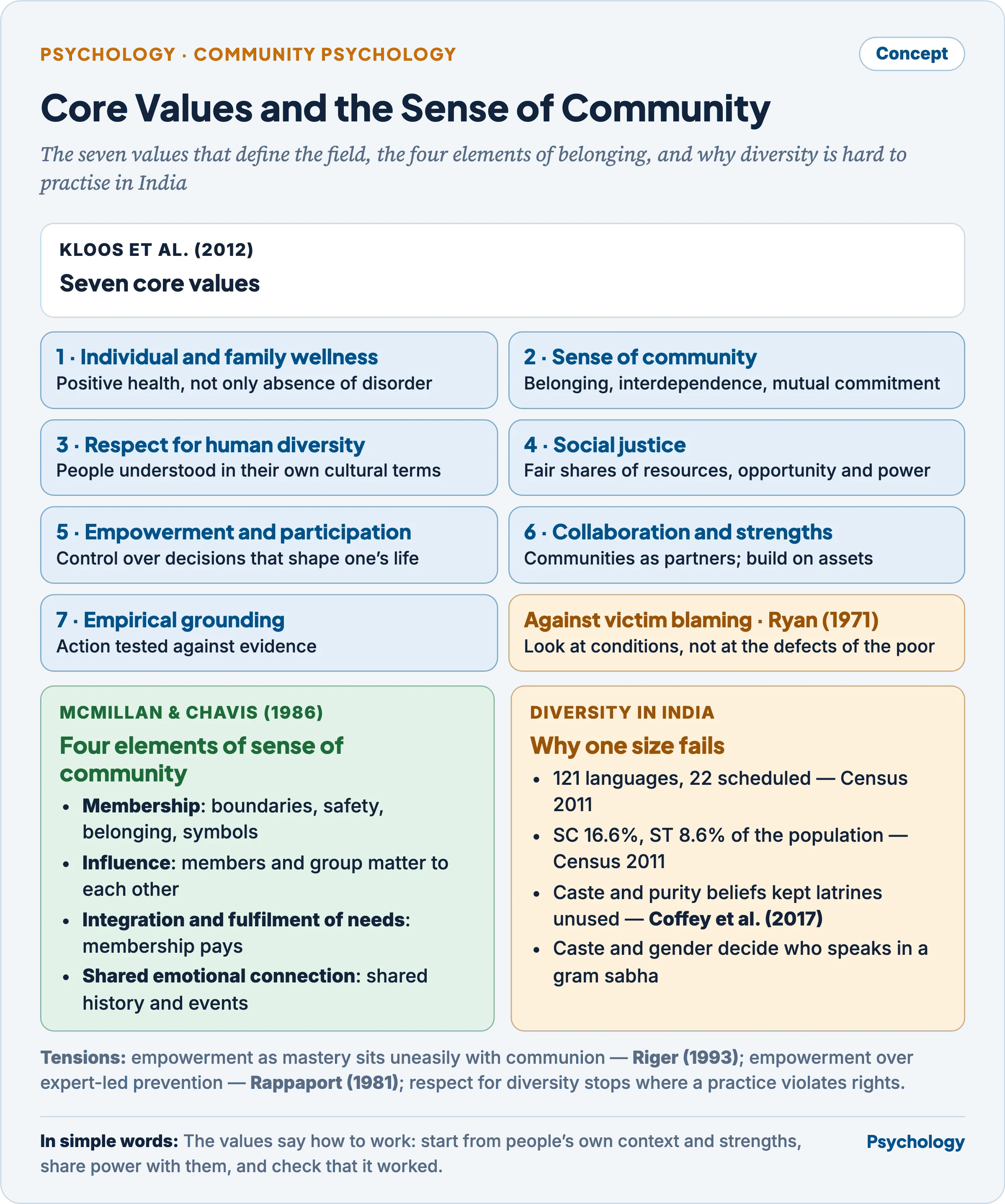
The values decide how a programme runs: whose account of the problem counts, who takes part, and how results are checked.
Sense of community
- Sarason (1974) made the psychological sense of community the field’s conceptual centre.
- His definition: “the perception of similarity to others, an acknowledged interdependence with others, a willingness to maintain this interdependence by giving to or doing for others what one expects from them, the feeling that one is part of a larger dependable and stable structure”.
- McMillan and Chavis (1986) defined sense of community as “a feeling that members have of belonging, a feeling that members matter to one another and to the group, and a shared faith that members’ needs will be met through their commitment to be together”.
- Membership: boundaries, emotional safety, belonging and identification, personal investment and a common symbol system.
- Influence: members matter to the group and the group matters to its members.
- Integration and fulfilment of needs: membership pays, through status, the group’s success and members’ competence.
- Shared emotional connection: a shared history, built by contact, good-quality interaction and shared events of high importance.
- Chavis, Hogge, McMillan and Wandersman (1986) built the Sense of Community Index on this theory.
- Design: 21 judges from four professions in three cities rated 100 sense-of-community profiles of randomly selected residents.
- Finding: the judges agreed closely, and 23 profile items accounted for 96 per cent of the variance in their mean ratings (Chavis and colleagues, 1986).
- Limitation: the criterion was expert judgement, not residents’ experience, and confirmatory factor analysis found poor fit for the four elements, yielding an eight-item, three-factor Brief SCI (Long and Perkins, 2003).
- Limitation: boundaries that include also exclude, so a strong sense of community in a jati panchayat or a gated colony can coexist with shutting out everyone else.
Appreciating diversity as a core value in India
- The 2011 Census grouped 19,569 raw mother-tongue returns into 121 languages with 10,000 or more speakers each, 22 of them scheduled (Census of India, 2011).
- Scheduled Castes formed 16.6 per cent and Scheduled Tribes 8.6 per cent of the population; Hindus were 79.8 and Muslims 14.2 per cent (Census of India, 2011).
- Diversity is a core value there for four reasons.
- Problems are named differently: the same distress can be called bodily weakness, a family matter or a spiritual affliction, so programmes must start from local meanings.
- Hierarchy shapes participation: caste and gender decide who speaks in a gram sabha and who is heard, so “the community’s view” can be its dominant members’ view.
- Uniform programmes fail: Coffey, Gupta, Hathi, Spears, Srivastav and Vyas (2017) found that open defecation in rural India persisted because beliefs about purity, pollution and untouchability made pit latrines, which need manual emptying, unacceptable.
- Diversity runs within groups: gender, age and disability divide every caste and religion, and the route to help (a temple, a sangha, an ASHA) differs by community.
- Marín (1993) held an intervention culturally appropriate when it rests on the group’s values, reflects its attitudes, expectancies and norms, and fits its behavioural preferences.
- The limit is cultural relativism: respect for diversity does not extend to practices that violate rights, such as untouchability, child marriage or dowry, where social justice takes precedence.
Role, skills and qualities of a community psychologist
- The roles follow from the values.
- Participant-conceptualizer (Bennett and colleagues, 1966): joins community action and researches it.
- Consultant: strengthens the teachers, health workers, police and clergy who meet distress first, through mental health consultation (Caplan, 1970).
- Programme developer and evaluator: designs preventive programmes and tests them.
- Creator of settings (Sarason, 1972): builds new settings where existing ones fail.
- Advocate and policy analyst: carries evidence into law and policy.
- The Society for Community Research and Action (APA Division 27) listed 18 practice competencies in four groups (Dalton and Wolfe, 2012).
- Foundational principles: ecological perspectives; empowerment; sociocultural and cross-cultural competence; community inclusion and partnership; ethical, reflective practice.
- Community programme development and management: programme development, implementation and management; prevention and health promotion; community leadership and mentoring; small and large group processes; resource development; consultation and organisational development.
- Community and social change: collaboration and coalition development; community development; community organising and advocacy; public policy analysis and advocacy; community education and public awareness.
- Community research: participatory community research; programme evaluation.
- Five qualities go with the skills.
- Cultural humility (Tervalon and Murray-García, 1998): lifelong self-critique, attention to power imbalances and non-paternalistic partnership, in place of a claim to finished “competence”.
- Reflexivity: awareness of one’s own caste, class, gender and urban vantage point.
- Patience: Kelly’s succession principle implies a long horizon.
- Tolerance of conflict: communities disagree, and the psychologist mediates between factions.
- Commitment to justice, held with the scepticism about one’s own programmes that empirical grounding requires.
The role of community psychology in handling community mental health problems
- India has Albee’s manpower problem in sharper form. The National Mental Health Survey 2015–16 put the treatment gap at 84.5 per cent for any mental disorder (Gautham and colleagues, 2020).
- The Rehabilitation Council of India’s register held 3,795 clinical psychologists at 31 March 2024 (RCI Annual Report 2023–24).
- Community psychology answers with five strategies, set out more fully in Fostering Mental Health and Prevention and Rehabilitation of the Mentally Ill (both Unit 3).
- Prevention and promotion, cutting incidence before disorder (Caplan, 1964).
- Task-sharing with lay counsellors and volunteers.
- Alternative settings: community living in place of custodial wards.
- Mutual help: self-help groups of users and caregivers.
- Consultation, crisis intervention, stigma reduction and advocacy through institutions people already use.
- Patel and colleagues (2010) tested task-sharing in the MANAS trial in Goa.
- Design: 24 primary-care facilities, half public and half private, were randomised; 2,796 adults screening positive for common mental disorders took part; lay health counsellors gave case management and psychosocial care under specialist supervision.
- Finding: six-month recovery was 65.0 against 52.9 per cent overall, and 65.9 against 42.5 per cent in public facilities, with no effect in private ones (Patel and colleagues, 2010).
- Limitation: the overall effect was modest and confined to public clinics.
- Fairweather and colleagues (1969) tested an alternative setting, the Community Lodge.
- Design: male volunteers from a Veterans Administration psychiatric hospital were randomly assigned to a shared lodge running its own janitorial and gardening business, or to usual aftercare.
- Finding: lodge members relapsed less, spent fewer days in hospital and more in work, at lower cost, over five years of follow-up, and later ran the lodge without professionals (Fairweather and colleagues, 1969; Fairweather, 1979).
- Limitation: an all-male veteran sample, and mental health systems never widely adopted the model; lodges ran in ten US states in 2010 (Kloos and colleagues, 2012).
- Limitation: task-sharing can become a cheap substitute for services the state owes.
Community psychology in India
History and distinct emphases
- Indian community psychology grew from two roots, the first being community psychiatry.
- In 1952 Vidya Sagar at Amritsar mental hospital lodged patients’ families in tents in the hospital grounds and ran group sessions for patients and families together (Chadda, 2012).
- The Raipur Rani (Haryana) and Sakalwara (Karnataka) projects of the 1970s trained primary-health staff to detect and treat mental illness (Wig, Murthy and Harding, 1981) and shaped the National Mental Health Programme (1982).
- A NIMHANS pilot in Bellary district (1985–1990) led to the District Mental Health Programme (1996) (Gupta and Sagar, 2018).
- The second is social and development psychology. Durganand Sinha (1969), in Indian Villages in Transition: A Motivational Analysis, studied how villagers’ motives shape their response to rural development programmes.
- Hence its emphases on development, poverty and women’s collectives over clinical services, and much practice in social work departments and voluntary bodies. The Community Psychology Association of India publishes the Indian Journal of Community Psychology.
- The Sonagachi Project (Kolkata, 1992) began as an HIV programme for sex workers and became an empowerment model run by the women through the Durbar Mahila Samanwaya Committee.
- Condom use among Kolkata’s sex workers rose from 3 per cent in 1992 to 90 per cent in 1999, an observational trend (Basu and colleagues, 2004).
- Basu and colleagues (2004) replicated the model in two matched towns, Cooch Behar and Dinhata, randomised to intervention or control, sampling 100 sex workers in each over 16 months: condom use rose 39 per cent with the intervention against 11 per cent without.
- Limitation: only two towns, and condom use was self-reported (Basu and colleagues, 2004).
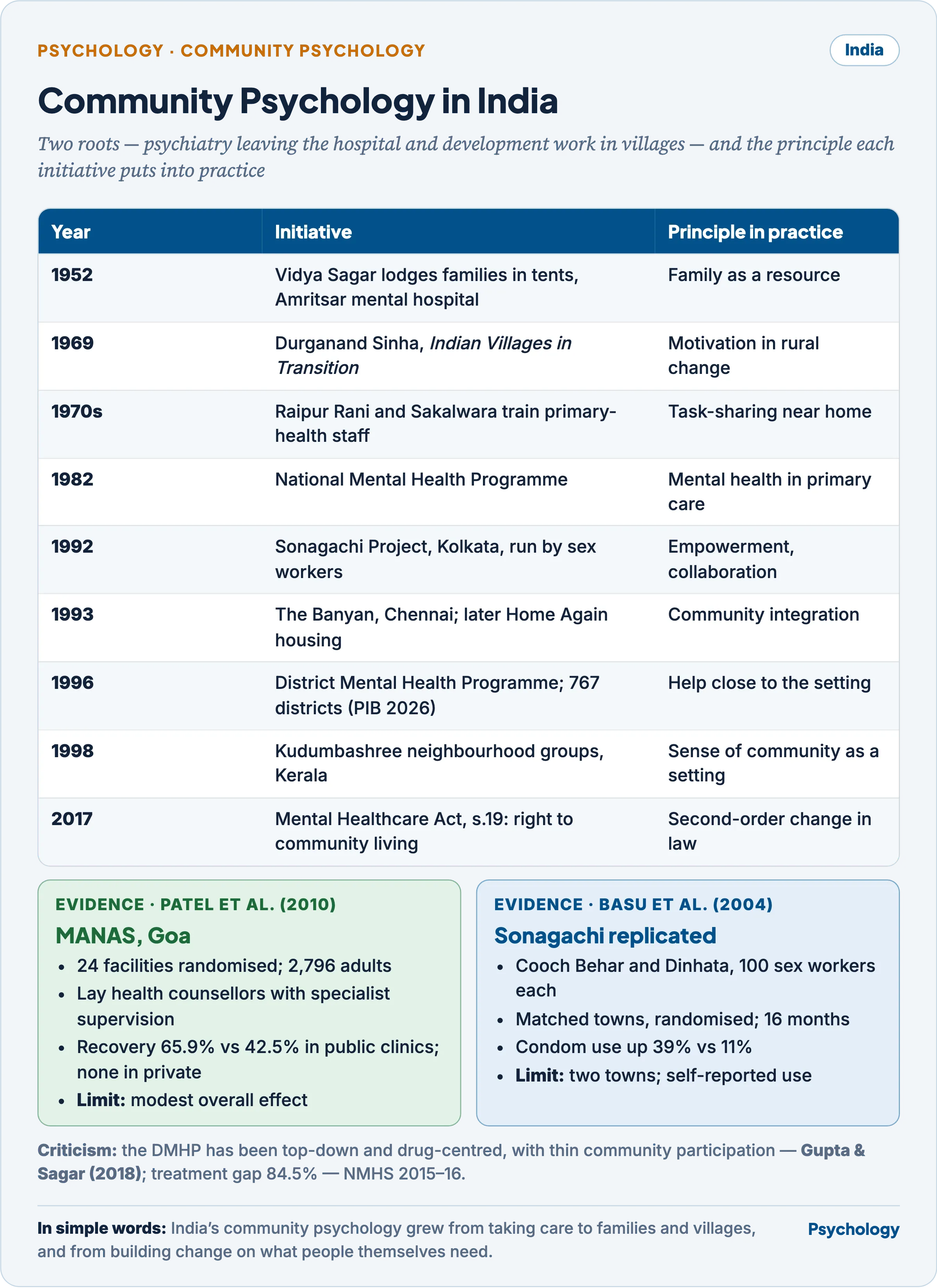
Indian community psychology came through psychiatry leaving the hospital and development work in villages; each scheme puts one principle into practice.
Indian context: programmes and settings
- District Mental Health Programme (Ministry of Health and Family Welfare, 1996): district teams, outreach clinics and primary-care integration; sanctioned in 767 districts (PIB, 2026).
- It operationalises help close to where problems arise. Gupta and Sagar (2018) criticised its top-down, drug-centred design and thin community participation.
- Mental Healthcare Act, 2017, Section 19: a right to community living. No one may remain in a mental health establishment merely for want of family or community facilities, and government must support half-way and group homes. It writes second-order change into law.
- Kudumbashree (Government of Kerala, inaugurated 17 May 1998): neighbourhood groups of 10–20 women, one per household, federated at ward and local-government level; Kerala’s livelihoods mission under NRLM since 2011. It operationalises sense of community as a standing setting.
- The Banyan (Chennai, founded 27 August 1993 by Vandana Gopikumar and Vaishnavi Jayakumar) serves homeless people with mental illness; its Home Again programme moves them into small shared homes in ordinary neighbourhoods, the community integration Fairweather’s lodge tested.
- Atmiyata (Mehsana, Gujarat): trained village volunteers offer basic counselling and links to welfare benefits, operationalising cycling of community resources; its trial is described in Fostering Mental Health (Unit 3).
Criticisms and limitations
- Vague boundaries: the field overlaps clinical psychology, public health, social work and community development, and its disciplinary identity is contested.
- Value-laden: an open commitment to social justice invites the charge of ideology, and leaves open whose justice counts and who speaks for “the community”.
- Weak evidence base: Sonagachi’s headline gains rested on observational data until a controlled replication (Basu and colleagues, 2004), and MANAS worked only in public clinics (Patel and colleagues, 2010).
- Gap between values and practice: Prilleltensky (2001) argued that the field puts more resources into reflection and research than into social action; the DMHP left little room for local voice (Gupta and Sagar, 2018).
- Values in tension: empowerment against community (Riger, 1993), prevention against empowerment (Rappaport, 1981), and diversity against justice.
- Romanticised community: villages and wards carry caste, gender and class hierarchies, participation can be captured by the powerful, and “community care” can shift the state’s duty onto poor families and unpaid women.
- Macro-level neglect: the field has worked mostly at micro and meso levels, seldom on policy or the economy (Nelson and Prilleltensky, 2005).
- Western origins: Gergen, Gülerce, Lock and Misra (1996) argued that exporting Western psychology unreflectively yields research of little relevance to other cultures and undermines their own traditions, so imported concepts need local reworking.
Previous Year Questions
- 2023“Appreciating diversity is considered as a core value for a community psychologist in India.” Justify.
- 2022What is community psychology? Mention few skills and qualities a community psychologist should have.
- 2021Discuss the role of community psychology for handling community mental health problems.
- 2006Describe the concept of Community Psychology. Explain some of the important factors responsible for arousing community consciousness and action plan in handling social problems.
