

Official syllabusPaper II · Unit 5 · Application of Psychology to Educational Field
Use of psychological tests in educational institutions.
Definition
“A psychological test is essentially an objective and standardized measure of a sample of behavior.”
Anastasi and Urbina (1997)
Schools test children to decide things: whom to admit, whom to examine further, where to place a pupil, what to teach next, which careers to explore and whether a programme works. A test earns its place only if its score improves one of those decisions, so the same instrument can be sound for guidance and unsound for selection. Indian policy is moving from marks-based examination towards assessment for learning.
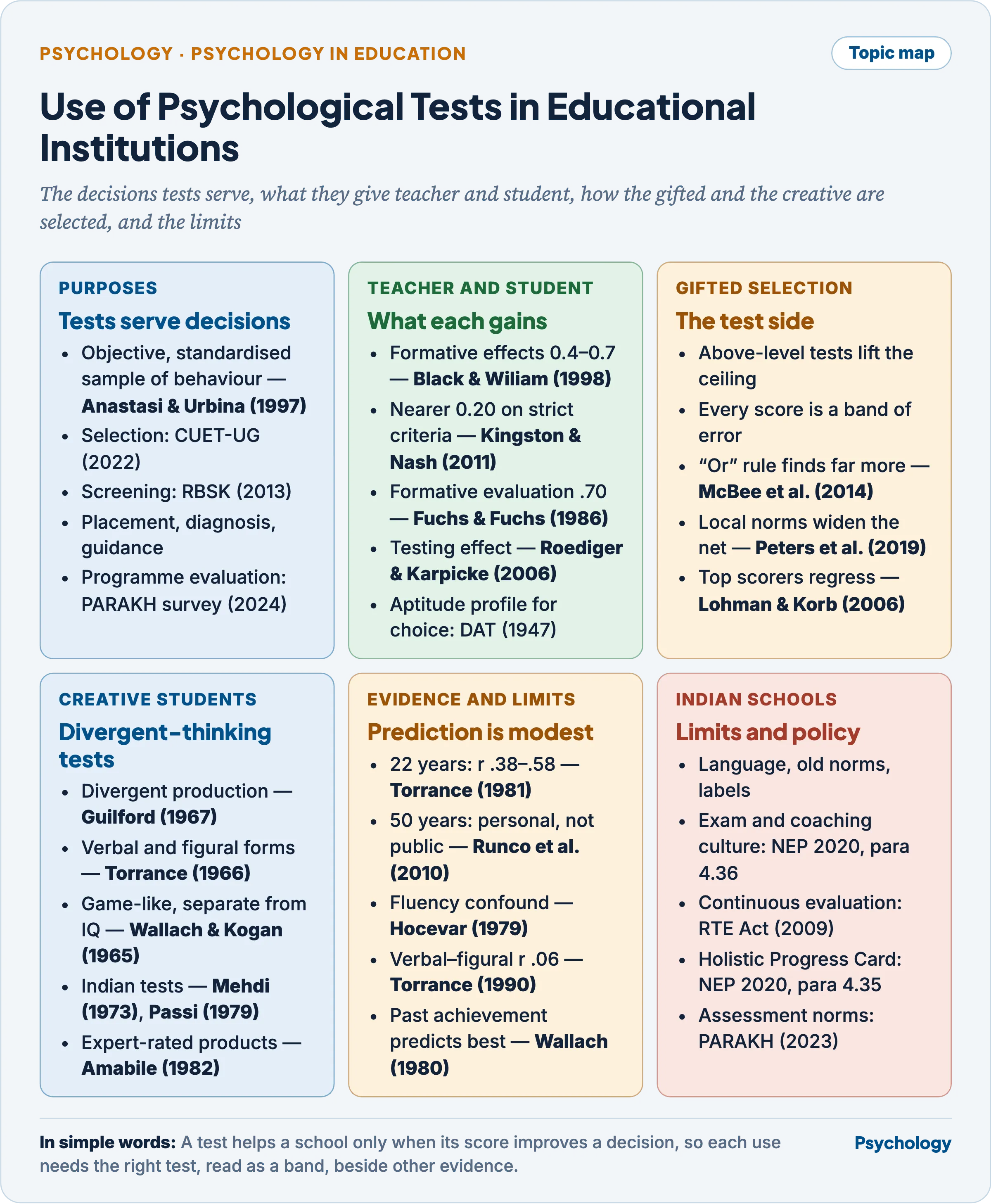
Gifted and creative selection use the same fallible scores as everyday school decisions, so they inherit the same limits.
Use of psychological tests in educational institutions: the major purposes
- Purposes are best sorted by the decision each test serves, since the decision fixes which evidence matters: predictive validity for selection, sensitivity for screening, a fine-grained profile for diagnosis, content validity for achievement.
| Purpose | Decision served | Typical test | Example |
|---|---|---|---|
| Selection | Who is admitted | Aptitude or entrance test | CUET-UG (2022) |
| Screening | Who needs fuller assessment | Short checklist or developmental screen | RBSK school screening (2013) |
| Placement | Which level, group or course | Readiness or placement test | Metropolitan Readiness Tests (1995) |
| Diagnosis | What exactly is going wrong | Diagnostic achievement test, individual scale | Curriculum-based measurement |
| Guidance | Which subjects and careers to explore | Aptitude battery, interest inventory | DAT (1947); Tamanna (2019) |
| Evaluation of achievement | What a pupil has learnt | Achievement or teacher-made test | Holistic Progress Card |
| Programme evaluation | Whether a system works | Sample survey of achievement | PARAKH Rashtriya Sarvekshan (2024) |
| Research | What changes, and why | Any standardised measure | Creativity norm trends (Kim, 2011) |
Selection, screening and placement
- Selection ranks applicants for scarce places, so its test must predict a later criterion. The SAT (first given in 1926) and India’s Common University Entrance Test (CUET-UG, from July 2022) put pupils from incomparable boards on one scale.
- NEP 2020 (para 4.42) wants such tests to examine conceptual understanding and application, explicitly so that coaching becomes unnecessary.
- Screening sorts a whole population cheaply into “probably fine” and “look closer”. It must be sensitive, missing few true cases, and can tolerate false alarms because a fuller assessment follows.
- Early-years scales such as the Bayley Scales of Infant Development (Bayley, 1969) flag developmental delay before school entry.
- Placement assigns a pupil to a level or group; readiness tests such as the Metropolitan Readiness Tests (Nurss and McGauvran, 1995), covering beginning reading and mathematics, place children at school entry.
- Placement must stay provisional: most children in the top few percentiles in one grade lost that standing within a year or two (Lohman and Korb, 2006), through regression to the mean. The case against fixed streaming is in Aptitude and Its Measurement (Paper I).
Diagnosis, guidance and evaluation
- Diagnosis asks what exactly is going wrong. A diagnostic achievement test breaks a subject into sub-skills (place value, carrying, borrowing) so that errors cluster; an individual scale such as the WISC adds an index profile.
- Curriculum-based measurement samples the pupil’s own syllabus every week and graphs the trend. Fuchs and Fuchs (1986), pooling 21 controlled studies, found such systematic formative evaluation raised achievement by an average effect size of .70.
- Diagnosing a specific learning disability takes more than a score; see Learning Disabilities and Their Training.
- Guidance reads the whole profile of scores. The Differential Aptitude Tests (Bennett, Seashore and Wesman, 1947) report eight aptitudes, from verbal and numerical reasoning to mechanical reasoning, space relations and language usage, as peaks and troughs for subject and career choice.
- An Indian adaptation and a higher-secondary revision are held in NCERT’s National Library of Educational and Psychological Tests (about two thousand tests; catalogue, 2025).
- Adjustment inventories flag pupils for counselling: the Bell Adjustment Inventory (1934) and Sinha and Singh’s (1993) Adjustment Inventory for School Students, 60 yes/no items on emotional, social and educational adjustment for Hindi-speaking pupils aged 14–18.
- Interest inventories are in Interests: Nature, Structure and Measurement (Paper I); guidance services in Educational and Vocational Guidance.
- Evaluation of achievement measures what was taught. A standardised battery compares a pupil with a norm group; a criterion-referenced or teacher-made test compares the pupil with the syllabus (see Test Norms and Norm-Referenced Measurement).
- Programme evaluation tests samples to judge systems, not children.
- NCERT’s PARAKH Rashtriya Sarvekshan of 4 December 2024 tested Grades 3, 6 and 9 across 781 districts.
- ASER 2024 found 23.4 per cent of rural government-school Class III children able to read a Class II text, up from 16.3 per cent in 2022 (ASER Centre, 2025).
- Research uses tests as measures: Torrance norm samples let Kim (2011) track creative thinking across four decades.
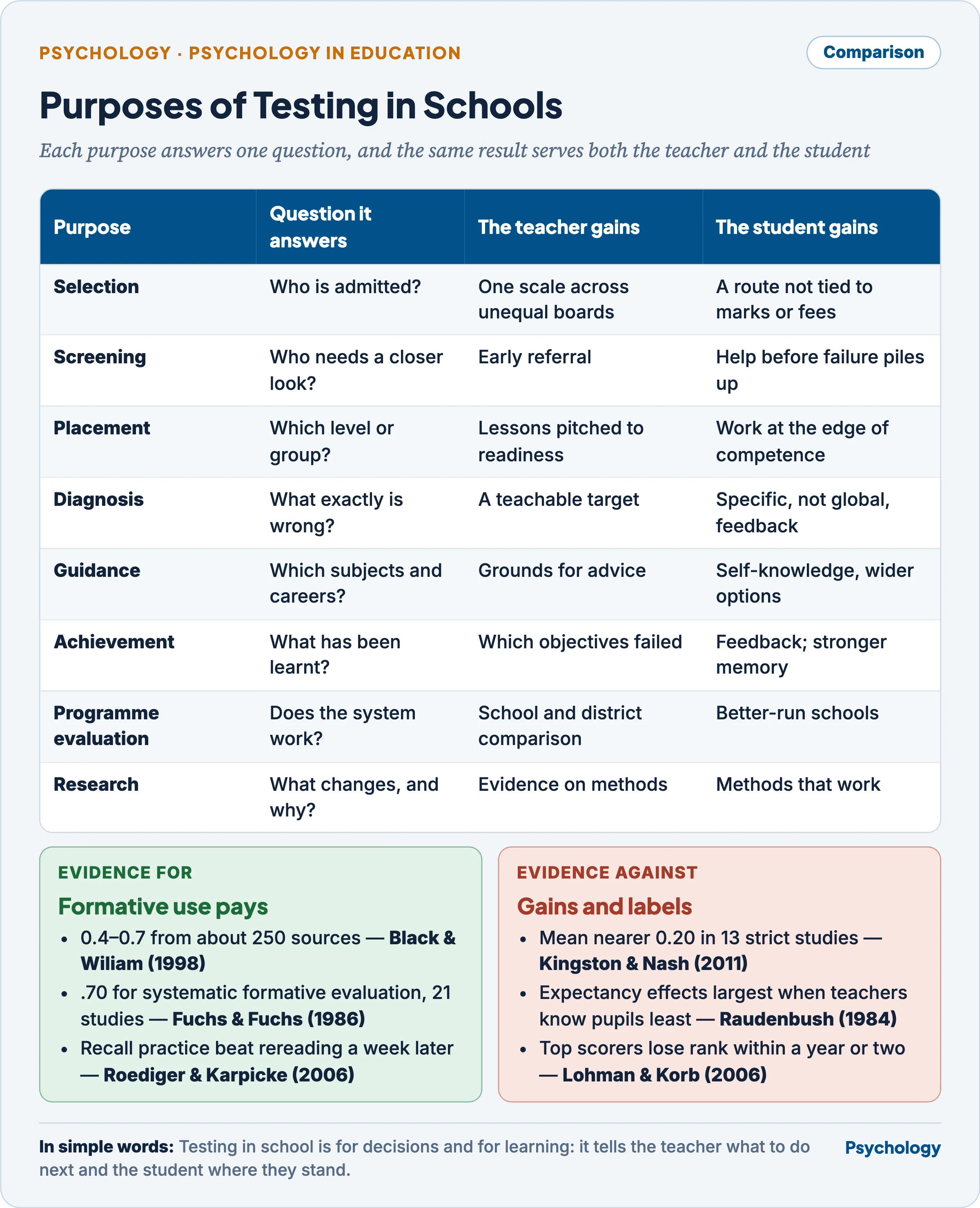
Read along any row: one test result informs both the teacher’s next lesson and the student’s next choice.
How psychological testing helps the teacher and the student
- NEP 2020 (para 4.34) states the principle: assessment is primarily for learning, and should help teacher and student keep revising the teaching-learning process.
The teacher
- Knows the class: an ability and achievement profile shows the spread, so lessons can be pitched and differentiated.
- Adjusts teaching: Black and Wiliam (1998), drawing on about 250 sources, reported formative-assessment effects of 0.4–0.7; Kingston and Nash (2011), pooling 13 studies that met stricter criteria, put the mean nearer 0.20, smaller but still worthwhile.
- Detects and refers early: a screen catches sensory, language and learning problems before failure accumulates.
- Corrects impressions: teacher judgement proved a poor way of finding gifted children in Pegnato and Birch (1959), a verdict Gagné (1994) disputed on method; expectation effects are largest when teachers know pupils least (Raudenbush, 1984, synthesising 18 experiments).
- Checks the teaching and informs parents: results show which objectives failed, and the Holistic Progress Card links home and school (NEP 2020, para 4.35).
The student
- Self-knowledge for choice: an aptitude and interest profile widens the options a pupil considers.
- Early, specific help: a diagnostic profile turns “weak in mathematics” into “does not yet understand place value”, which can be taught.
- Feedback and memory: low-stakes tests strengthen learning itself, the testing effect; in Roediger and Karpicke (2006), students who practised recall retained more a week later than students who reread.
- Self-regulation: the progress card’s self- and peer assessment trains pupils to judge their own work.
- Fairer access: universal screening raised gifted placement of disadvantaged pupils (Card and Giuliano, 2016).
Tests used in schools
- Classification and construction are set out in Types of Psychological Tests and Construction and Standardization of Psychological Tests (Unit 1).
- Intelligence: individual scales (Stanford–Binet, 1916; WISC, 1949; India’s MISIC, 1969) for diagnosis; group non-verbal tests such as Raven’s Progressive Matrices (1938) for screening.
- Aptitude: the DAT and special mechanical, clerical or scientific aptitude tests. Achievement: standardised batteries, teacher-made tests, board examinations.
- Diagnostic: sub-skill tests in reading and arithmetic. Interest, personality and adjustment inventories. Creativity: divergent-thinking batteries.
Selection of gifted children on the basis of psychological tests
- Who counts as gifted, the staged identification procedure and schooling are set out in Gifted Children: Identification and Training.
- Match test to conception: an individual scale for general ability; a non-verbal test where language or schooling would depress a verbal score; a creativity test and rating scale for creative-productive giftedness.
- Above-level testing gives a test meant for older pupils to a child who tops the grade test, so the ceiling stops hiding differences among the ablest.
- Cut-offs are policy, from an IQ of 140 in Terman (1925) to the 15–20 per cent talent pool of Renzulli and Reis’s (1985) Schoolwide Enrichment Model, and every score is a band.
- Classical test theory (Gulliksen, 1950) gives the band through the standard error of measurement: with reliability .95 and SD 15 it is 15 × √0.05 ≈ 3.4, so a 95 per cent band is about ±6.6, and 126 and 132 are indistinguishable.
- The combination rule decides who is chosen: simulating Georgia’s multiple-criteria system, McBee, Peters and Waterman (2014) showed that an “or” rule (qualify on any measure) identifies far more pupils than an “and” rule (qualify on all).
- Nomination is a weak first gate: requiring a nomination before testing can miss over 60 per cent of gifted pupils (McBee, Peters and Miller, 2016), so everyone should be screened first.
- Local norms compare a child with the school’s own pupils: Peters and colleagues (2019), using third-grade scores from ten states, found school-level norms identified far more African American and Hispanic pupils, though still not proportionally.
- The process, step by step:
- Every pupil takes a group non-verbal test in the language of instruction, and teachers complete a checklist.
- The talent pool from that screen takes an individual scale, an above-level achievement test and a creativity test.
- A child qualifies on any strand, judged against local and national norms and read as bands.
- Placement matches the strand, with yearly re-testing because high scores regress; India’s Navodaya (1986) entry test is led by a non-verbal mental ability test.
- Schooling then follows the profile: acceleration, on which accelerated pupils outscored same-age peers (g = 0.70; Steenbergen-Hu, Makel and Olszewski-Kubilius, 2016), enrichment, cluster grouping, mentoring and counselling (see Gifted Children: Identification and Training).
- NEP 2020 (paras 4.43–4.45) adds supplementary enrichment material, topic-centred clubs and circles, and Olympiads offered in rural areas and regional languages.
Psychological tests in the selection of creative students
- Torrance (1966) defined creativity as a process: sensing problems and gaps, guessing or hypothesising about them, testing and revising the guesses, and communicating the results. Tests sample this process through divergent thinking.
Divergent production and the Torrance Tests
- Guilford (1967), in the structure-of-intellect model, separated divergent production, generating many varied answers to an open problem, from convergent production, and built tests such as Alternate Uses, Consequences and Plot Titles.
- Four scores: fluency (number of ideas), flexibility (number of categories), originality (statistical rarity) and elaboration (detail), defined in Creativity – Concept, Attributes and Convergent-Divergent Thinking (Paper I).
- The Torrance Tests of Creative Thinking (Torrance, 1966) are the most used battery.
- Verbal form, as now used: Asking, Guessing Causes, Guessing Consequences, Product Improvement, Unusual Uses, Just Suppose. Figural form: Picture Construction, Picture Completion, and Lines or Circles.
- The 1984 figural scoring dropped flexibility, which correlated too highly with fluency, and added abstractness of titles, resistance to premature closure and 13 creative strengths (Alabbasi, Paek, Kim and Cramond, 2022).
- Renormed in 1974, 1984, 1990, 1998 and 2008 (Kim, 2011); in 2016 reliability was 0.87–0.97 and scorer agreement 90 per cent or more across 60,917 pupils (figural norms-technical manual, Torrance, 2017).
- Wallach and Kogan (1965) gave 151 fifth-graders untimed, game-like association tasks scored for number and uniqueness of ideas.
- The creativity measures correlated strongly with one another and hardly at all with intelligence measures, including the WISC, which they read as a trait separate from intelligence.
- Limitation: setting and task type were varied together; Wallach (1980) later judged the setting mattered little.
- Mednick’s (1962) Remote Associates Test works convergently: the testee finds one word that links three given words.
- Person and product measures complete Rhodes’s (1961) four Ps of person, process, press and product.
- The Creative Personality Scale of the Adjective Check List (Gough, 1979) and the Creative Achievement Questionnaire (Carson, Peterson and Higgins, 2005).
- The consensual assessment technique (Amabile, 1982): experts rate real products independently, usually agreeing above .70.
- PISA 2022 (OECD, 2024) tested the generation and improvement of ideas in 64 systems; Singapore averaged 41 of 60 against an OECD mean of 33.
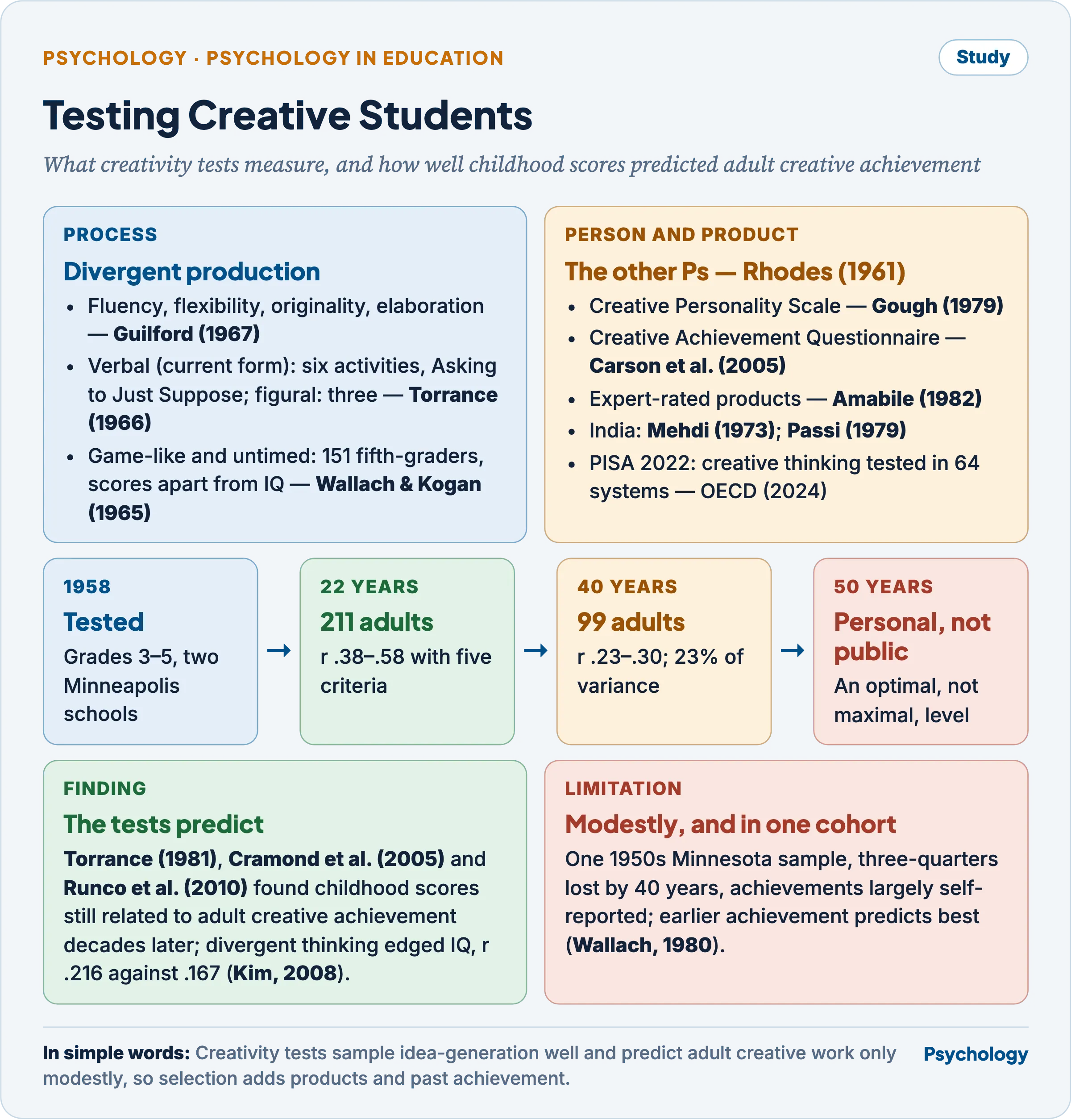
Fifty years on, childhood scores still tracked personal creative achievement but not public eminence.
Longitudinal validity of the Torrance Tests
- Torrance (1981): in 1958 children in grades 3–5 at two Minneapolis elementary schools took the tests and an intelligence measure.
- At 22 years, 211 adults aged 30–32 were rated on five creative-achievement criteria; correlations with the tests ran .38 to .58.
- Cramond and colleagues (2005), at 40 years with 99 respondents, found childhood fluency, originality and IQ predicted adult achievement at .23–.30; the tests explained 23 per cent of variance in creative productivity.
- Runco, Millar, Acar and Cramond (2010), at 50 years, found moderate correlations with personal achievement, none with public achievement, and an optimal rather than maximal level of divergent thinking.
- Limitation: one 1950s Minnesota cohort, three-quarters lost by 40 years (Cramond and colleagues, 2005), and largely self-reported achievements.
- Torrance (1972) followed Minnesota high-school students tested in 1959: seven years later fluency, flexibility and originality predicted creative achievement at .34–.48, against .09–.37 for intelligence, school achievement and peer nomination.
- Kim (2008), meta-analysing the field, found divergent-thinking scores predicted creative achievement slightly better than IQ (r = .216 against .167).
Indian creativity tests
- Mehdi (1973), the Verbal Test of Creative Thinking: Consequences, Unusual Uses, New Relationships and Product Improvement, scored for fluency, flexibility and originality, with a companion Non-Verbal Test of Creative Thinking in Hindi and English.
- Passi (1979), the Passi Tests of Creativity for school pupils, in Hindi and English: Seeing Problems, Unusual Uses and Consequences (verbal); Inquisitiveness, Square Puzzle and Blocks (largely non-verbal); scored for fluency, flexibility and originality.
- NCERT’s test library also lists scientific- and language-creativity tests.
Selecting creative students: a test-based procedure
- Fix the domain (verbal, figural, scientific) and the service: enrichment, a tinkering lab, a mentor.
- Screen the whole class with a divergent-thinking battery in the mother tongue (Mehdi, Passi or the Torrance figural form), in a relaxed session with generous time.
- Score with two trained raters and check agreement; rate originality from each pupil’s two best ideas (Silvia and colleagues, 2008) rather than their sheer number.
- Add a product, a portfolio or a made object rated by expert judges (Amabile, 1982), and a creative-activity checklist.
- Select on any strong strand, not on IQ, and re-assess yearly, since one sitting predicts only modestly.
Limitations of creativity tests
- Fluency confound: originality counts rise with the sheer number of ideas (Hocevar, 1979), so a fast, wordy child looks original.
- Scoring reliability depends on training: among 35 Turkish scorers, ambiguous responses and the scorers’ own cultural and linguistic backgrounds produced disagreement (Yarbrough, 2016).
- Domain specificity: verbal and figural Torrance scores correlate about .06 (Torrance, 1990), so Baer (2011) argued there is no general creativity score to select on.
- Modest prediction: about .2 (Kim, 2008), and personal but not public achievement at 50 years. Wallach (1980): “What best predicts creative achievements in the world is earlier achievements of similar kinds.”
- Test conditions: a wish to please the tester by producing more ideas adds variance unrelated to creativity (Wallach, 1980).
- Culture and language: the norms are American, Indian tests carry older and smaller norms, and translation changes which answers count as rare.
- Construct: divergent thinking is one component of creativity, leaving knowledge, motivation and opportunity unmeasured.
- Contested trends: Kim (2011) reported American scores falling since 1990 across 272,599 records; Barbot and Said-Metwaly (2021), re-analysing over 330,000, found no generational decline.
Criticisms and limitations of testing in Indian schools
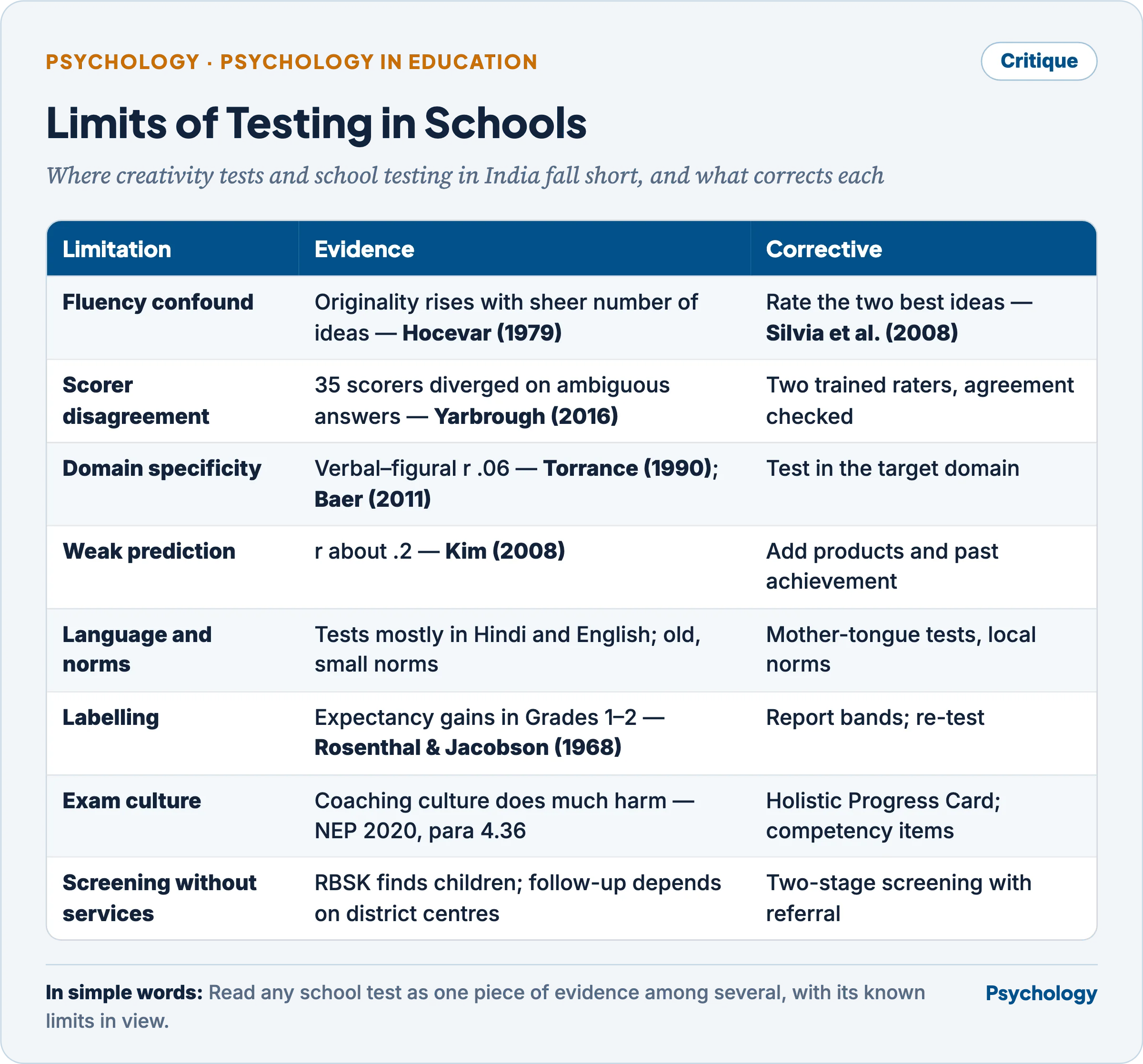
Each limitation has a corrective, and several correctives are already written into Indian policy.
- General misuse of tests is set out in Use, Misuse and Limitations of Psychological Tests.
- Language: most standardised tests exist in Hindi and English while pupils learn in many mother tongues; a translated test needs fresh evidence of equivalence.
- Norms: many Indian norms are decades old, urban and small, and a child compared with the wrong group is misclassified.
- Labelling and expectancy: a label from one score travels in the cumulative record. Rosenthal and Jacobson (1968) reported gains, mainly in Grades 1–2, for random pupils teachers expected to bloom; the effect fades when teachers already know their pupils (Raudenbush, 1984).
- Examination culture: NEP 2020 (para 4.36) blames board and entrance examinations, and the coaching culture they breed, for much harm; high stakes reward drill and narrow teaching to the tested.
- Too few trained users: untrained staff read a profile of strengths as a fixed verdict on the child.
- Screening without services: RBSK identification helps only if District Early Intervention Centres and special educators follow up.
- Policy swings: examinations with possible detention in Classes 5 and 8 (2019) re-attached high stakes to young children’s results.
- Thin evidence: formative-assessment gains shrink under strict designs (Kingston and Nash, 2011), and Indian outcome studies of school testing are few.
Indian context: tests in school policy
- RTE Act, 2009 (Ministry of Education): evaluation must take into account comprehensive and continuous evaluation of the child’s understanding and ability to apply it (s. 29(2)(h)), with no board examination before elementary education ends. Principle: assessment as continuous feedback to the learner.
- The 2019 Amendment (in force 1 March 2019) allows examinations in Classes 5 and 8, a re-examination within two months and, if a State chooses, holding back; December 2024 rules apply this to central government schools.
- National Education Policy, 2020 (Ministry of Education), paras 4.34–4.42: formative, competency-based assessment and a Holistic Progress Card, a 360-degree report of cognitive, affective and psychomotor progress drawing on self, peer and teacher assessment.
- School examinations in Grades 3, 5 and 8 are to be used only developmentally (para 4.40). Principle: multi-source, multi-trait assessment.
- PARAKH (NCERT’s National Assessment Centre, notified 2023) sets assessment norms across boards, has issued Holistic Progress Cards for all four stages, and ran the 2024 Rashtriya Sarvekshan. Principle: criterion-referenced monitoring of systems.
- Rashtriya Bal Swasthya Karyakram (Ministry of Health and Family Welfare, National Health Mission; 2013; RBSK 2.0 guidelines, 2026): Mobile Health Teams screen for the 4Ds twice a year in anganwadis and yearly in government and aided schools.
- Screened conditions include cognitive and language delay, ADHD, autism and specific learning disorders, confirmed at District Early Intervention Centres. Principle: two-stage screening, sensitive first, specific second.
- CUET-UG (University Grants Commission and National Testing Agency, 2022): one computer-based test in 13 languages for admission to central universities. Principle: a common scale across unequal boards.
Previous Year Questions
- 2020Enumerate the major purposes of psychological testing in educational settings and discuss ways in which psychological testing helps both the teacher and student.
- 2011Discuss the process of selection of ‘gifted children’ on the basis of psychological tests. Make recommendations for their proper schooling.
- 2010Discuss the application of psychological tests in the selection of creative students. Elucidate their limitations.
