

Official syllabusPaper II · Unit 5 · Application of Psychology to Educational Field
Gifted, retarded, learning disabled and their training – the retarded.
Definition
“Intellectual disability is characterized by significant limitations both in intellectual functioning and adaptive behavior as expressed in conceptual, social, and practical adaptive skills. This disability originates during the developmental period, which is defined operationally as before the individual attains age 22.”
Schalock, Luckasson and Tassé (2021)
The syllabus word “retarded” is dated; the condition is now called intellectual disability, and its diagnosis needs limited adaptive behaviour as well as a low IQ. The educational questions follow from that double criterion: which low achievers have the condition, why the first years matter, and how teaching must fit the way these children attend, remember and generalise.
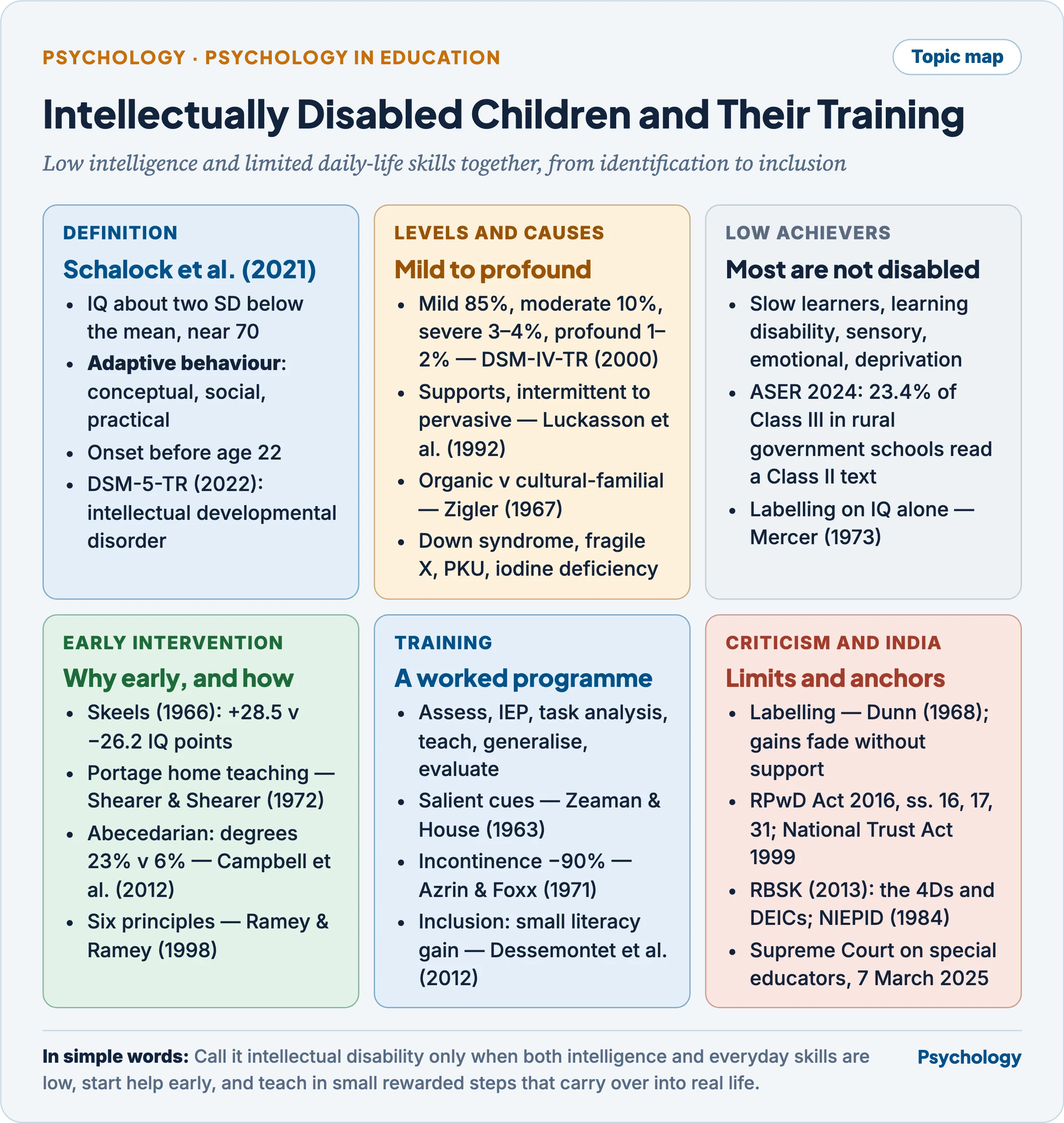
Every box after the first rests on the double criterion: intelligence and adaptive behaviour together decide who is identified, how early, and what is taught.
Intellectual disability: from “mental retardation” to the current term
- Three criteria define the condition (Schalock, Luckasson and Tassé, 2021).
- Intellectual functioning about two standard deviations below the mean, an IQ near 70 read with a confidence band of two standard errors (Schalock and colleagues, 2021).
- Adaptive behaviour as far below in at least one domain: conceptual (language, money, time), social (responsibility, gullibility, rules) or practical (self-care, safety, work).
- Onset in the developmental period, now before 22 rather than 18.
- The two measures are separate and only moderately correlated (Schalock and colleagues, 2021), so an IQ score alone never makes the diagnosis.
- The American Association on Mental Retardation became the American Association on Intellectual and Developmental Disabilities in 2007, and Rosa’s Law (2010) removed “mental retardation” from US federal health, education and labour law.
- DSM-5-TR (2022) lists intellectual developmental disorder; ICD-11 (in force 2022) uses disorders of intellectual development (6A00).
- India’s Rights of Persons with Disabilities Act (2016) adopted the term, defining it as “a condition characterised by significant limitation both in intellectual functioning (reasoning, learning, problem solving) and in adaptive behaviour which covers a range of every day, social and practical skills”.
- Maulik, Mascarenhas, Mathers, Dua and Saxena (2011) pooled 52 population studies to 10.37 per 1,000, highest in low- and middle-income countries.
- Indian estimates run from 1 to 32 per 1,000 (Kishore, Udipi and Seshadri, 2019); Census 2011 recorded about 15 lakh persons with “mental retardation”.
Levels of retardation and the older educational categories
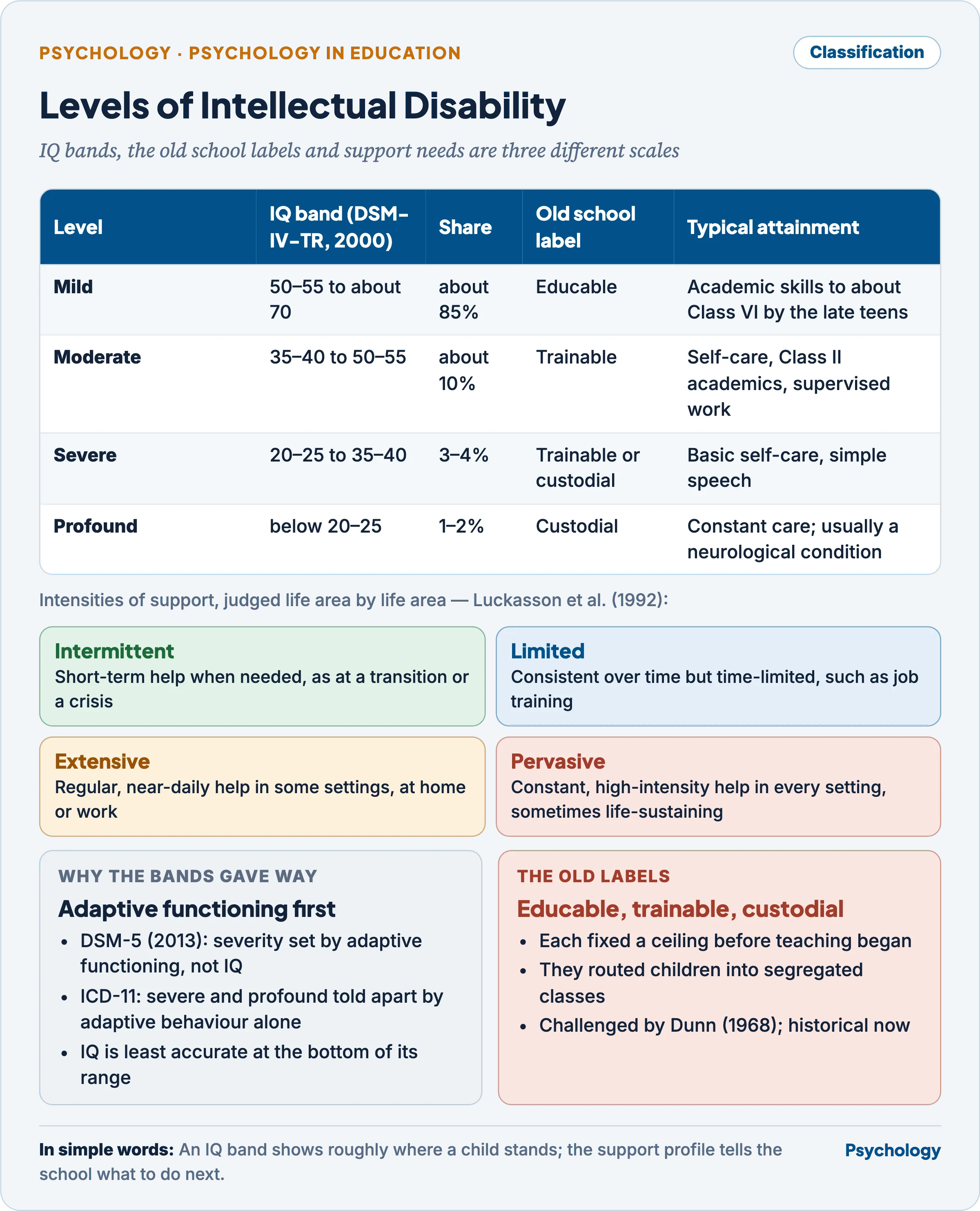
One child can be described three ways, and only the support profile says what the classroom must provide.
| Level | IQ band (DSM-IV-TR, 2000) | Share of cases | Older school label | Typical attainment |
|---|---|---|---|---|
| Mild | 50–55 to about 70 | about 85% | Educable | Academic skills to about Class VI by the late teens |
| Moderate | 35–40 to 50–55 | about 10% | Trainable | Self-care, academics to about Class II, supervised work |
| Severe | 20–25 to 35–40 | 3–4% | Trainable or custodial | Basic self-care, simple speech, a few survival words |
| Profound | below 20–25 | 1–2% | Custodial | Constant care; usually a neurological condition |
- Since DSM-5 (2013), severity is graded by adaptive functioning, not IQ, because IQ is least accurate at the bottom of its range; ICD-11 separates severe from profound by adaptive behaviour alone.
- The AAMR (Luckasson and colleagues, 1992) replaced levels with four intensities of support: intermittent, limited, extensive and pervasive, judged life area by life area.
- Educable, trainable and custodial were mid-twentieth-century special-education labels. Each set a ceiling in advance and routed children into segregated classes, the practice Dunn (1968) attacked.
Causes of mental retardation
- Zigler’s (1967) two-group approach divides cases by cause. Organic disability has an identifiable biological cause, often with IQ below 50 and physical signs; cultural-familial disability is mild (IQ about 50–70), has no identified cause and clusters in poor, low-IQ families.
- Prenatal, genetic: Down syndrome, described by Langdon Down (1866) and traced to an extra chromosome 21 by Lejeune, Gautier and Turpin (1959), is the commonest chromosomal cause.
- Fragile X syndrome, over 200 CGG repeats in the FMR1 gene (Verkerk and colleagues, 1991), is the commonest inherited cause.
- Phenylketonuria (Følling, 1934) is a recessive enzyme defect whose damage a low-phenylalanine diet prevents once newborn blood-spot screening (Guthrie and Susi, 1963) detects it.
- Prenatal, environmental: maternal rubella, alcohol (fetal alcohol spectrum disorder), iodine deficiency, untreated congenital hypothyroidism.
- Perinatal: birth asphyxia, prematurity, severe neonatal jaundice. Postnatal: meningitis, head injury, lead, severe malnutrition, prolonged deprivation.
- Several causes can be prevented or treated, the first argument for early identification.
Learning in intellectually disabled children: principles for their training
- Zigler (1969) framed the developmental–difference debate.
- Developmental position: familial cases pass through the normal cognitive sequence more slowly, so teaching follows that sequence at the child’s mental age.
- Difference position: specific deficits remain at matched mental age and must be targeted.
- Zeaman and House (1963) traced poor discrimination learning to attention: a low initial probability of attending to the relevant stimulus dimension, after which the cue is learnt quickly. Training: make the relevant cue salient, remove irrelevant ones, then fade the aid.
- Belmont and Butterfield (1971) attributed weak short-term recall to absent rehearsal strategies rather than a smaller store. Strategies can be taught but seldom transfer unaided, so instruction must be explicit, overlearned and practised across tasks.
- Stokes and Baer (1977) argued that generalisation must be programmed, through multiple examples, natural reinforcers and cues shared with real settings.
- Zigler’s motivational factors, expectancy of failure, outer-directedness (reliance on others’ cues) and positive and negative reaction tendencies towards adults, grow from repeated failure and deprivation.
- Training: graded tasks with near-errorless success (Terrace, 1963), frequent reinforcement, and choices that build self-direction.
- Limitation: Rondal (1980) argued that the motivational account of differences at matched mental age lacked empirical support.
- General principles of effective teaching are in Psychological Principles Underlying Effective Teaching-Learning; reinforcement and modelling in Reinforcement, its Types and Schedules and Observational Learning and Modelling (Paper I).
Are all low achievers mentally retarded?
- No. In ASER 2024, only 23.4 per cent of Class III children in rural government schools could read a Class II text; with intellectual disability near 1 per cent (Maulik and colleagues, 2011), most of that gap is instructional.
| Group | Intelligence | Adaptive behaviour | Pattern of failure |
|---|---|---|---|
| Intellectual disability | about 70 or below | significantly limited | Global: every subject and daily-living skill |
| Slow learner (borderline intellectual functioning) | about 70–85 | adequate | Slow in all subjects; keeps up with time and repetition |
| Specific learning disability | average or above | adequate | Unexpected failure in reading, writing or arithmetic |
| Sensory impairment | normal | normal | Missed instruction; improves with aids |
| Emotional or attention problems | normal | variable | Fluctuating, situation-bound |
| Deprivation, language mismatch, poor teaching | normal | adequate at home | School-specific; improves with good teaching |
- A slow learner has no specified disability under the RPwD Act and needs remedial teaching and pacing. The learning disabled are treated in Learning Disabilities and Their Training; deprivation and underachievement in Better Academic Achievement and Underachievement and Unit 8.
- Mercer (1973), in her Riverside study, found the schools were the chief labellers; relying on IQ alone, they labelled disproportionately many Mexican-American and Black children. Nobody measured adaptive behaviour, so she urged the two-dimensional definition.
- In Larry P. v. Riles (1979) a federal court in California barred IQ tests from placing Black children in classes for the educable mentally retarded.
How the low achievers are actually identified
- Screening and referral: teacher observation, records, developmental history. RBSK Mobile Health Teams screen anganwadi children twice a year and government-school children yearly; the Trivandrum Developmental Screening Chart (Nair and colleagues, 1991) covers the first two years in 17 items.
- Medical and sensory check: vision, hearing, thyroid, nutrition, seizures.
- Intelligence, individually tested: the Binet-Kamat Test (Kamat, 1934), Malin’s Intelligence Scale for Indian Children (Malin, 1969), the Wechsler scales; the Bayley Scales (Bayley, 1969) for infants.
- Adaptive behaviour: the Vineland Social Maturity Scale (Doll, 1935; adapted by Malin), the only standardised adaptive measure available in India (Kishore and colleagues, 2019).
- Educational assessment: curriculum-based tests, error analysis, NIEPID’s Grade Level Assessment Device.
- Integration: intellectual disability only if both scores fall about two standard deviations below the mean with developmental onset; otherwise slow learning, a specific learning disability or another cause.
- BASIC-MR (Peshawaria and Venkatesan, 1992), from NIEPID, then rates skills (Part A) and problem behaviours (Part B) for the education plan.
- Under India’s January 2018 assessment guidelines a child aged one to five is certified with global developmental delay; intellectual disability is certified after five (Kishore and colleagues, 2019).
Need for early identification of mentally challenged children
- Preventable damage: phenylketonuria, congenital hypothyroidism and iodine deficiency harm only when missed; RBSK 2.0 adds optional hypothyroidism screening.
- Timing: earlier and longer programmes have larger effects, though there is no absolute critical period, only relative timing (Ramey and Ramey, 1998).
- Secondary handicaps: unaddressed delay compounds into behaviour problems, expectancy of failure and exclusion.
- Families: an early, accurate diagnosis replaces blame, false hope and faith-healers’ “cures” with counselling and a home programme.
- School outcomes: intensive early programmes reduced later grade retention and special-education placement (Ramey and Ramey, 1998, reviewing Campbell and Ramey, 1995).
- Skeels and Dye (1939) moved 13 orphanage infants judged retarded to an institution where older residents gave them affection and stimulation; 12 stayed behind.
- The moved group gained 28.5 IQ points and the contrast group lost 26.2. As adults all 13 were self-supporting, with median schooling to Class XII; only one of the 12 was (Skeels, 1966).
- Limitation: no random assignment, small samples, unstable infant IQ scores.
Strategies for early intervention
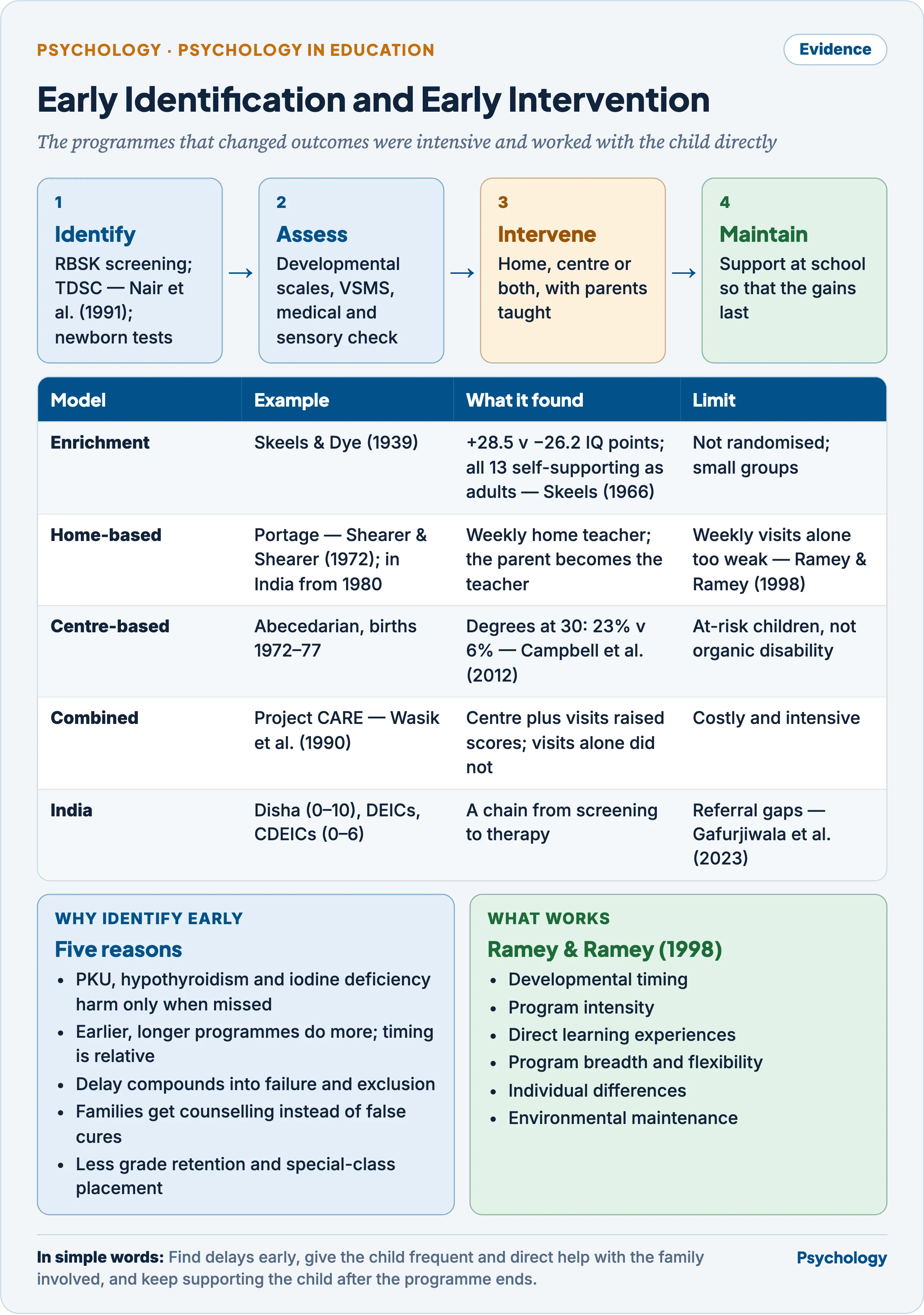
Intensity and direct contact with the child separate the programmes that changed outcomes from those that did not.
- Home-based: the Portage Project (Shearer and Shearer, 1972) taught 75 rural preschool children with multiple handicaps at home; a home teacher visited weekly for about 90 minutes, set targets from a checklist and taught the parent to teach.
- Tehal Kohli of Panjab University began Portage training in India in 1980, with Hindi and Punjabi kits funded by UNICEF; Chennai’s Upanayan programme (Krishnaswamy, 1992) serves children from birth to six.
- Centre-based: the Abecedarian Project randomised 57 of 111 low-income infants, born 1972–77, to full-day educational care until five.
- At 30, 23 per cent of the treated group held a bachelor’s degree against 6 per cent of controls (Campbell and colleagues, 2012); children of mothers with IQs below 70 each scored at least 20 points above controls (Martin, Ramey and Ramey, 1990).
- Limitation: it prevented cultural-familial delay in at-risk children, not organic disability; compensatory education is treated in Early Childhood Deprivation and Compensatory Education (Unit 8).
- Combined: in Project CARE (Wasik and colleagues, 1990) daily centre care plus weekly home visits raised cognitive scores; five years of weekly home visits alone did nothing measurable.
- Parent counselling and training: facts about the condition, an end to mutual blame, behaviour management, daily therapy at home.
- Multidisciplinary therapy: paediatrician, psychologist, special educator, speech, physio- and occupational therapists and social worker, as in District Early Intervention Centres.
- Ramey and Ramey (1998) distilled six principles: developmental timing, program intensity, direct learning experiences, program breadth, individual differences and environmental maintenance.
- Shonkoff and Hauser-Cram (1987), meta-analysing 31 studies of disabled children under three, found structured curricula working with parents and children together the most effective.
A training programme for the mentally retarded
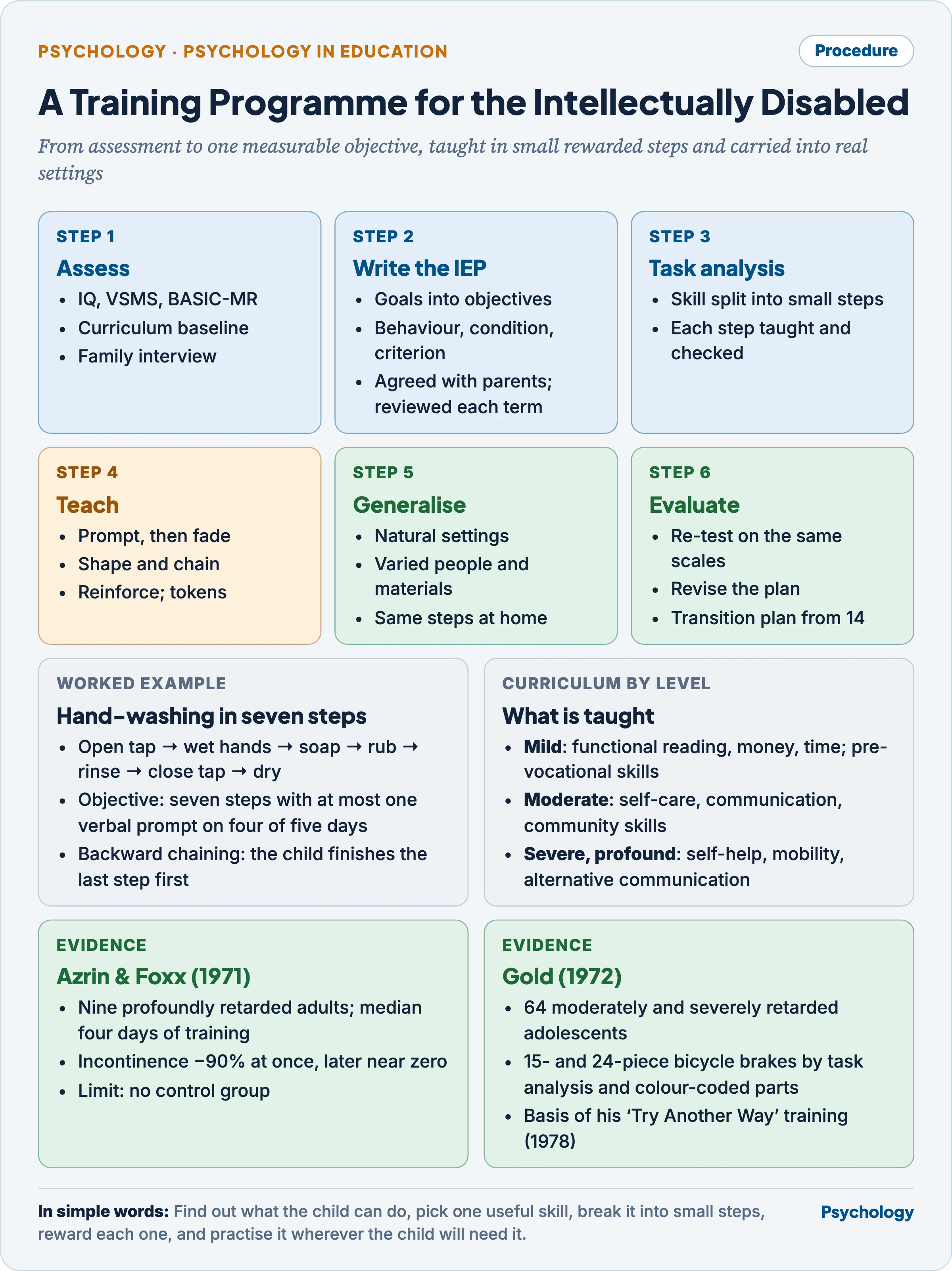
Each step narrows a broad goal into a behaviour that can be prompted, counted and, in the end, done without help.
- Assess: IQ, VSMS, BASIC-MR, a curriculum baseline, a family interview.
- Write an Individualised Education Programme (US Education for All Handicapped Children Act, 1975), turning goals into objectives with behaviour, condition and criterion: “given soap and a towel, Ravi washes his hands in seven steps with at most one verbal prompt on four of five days”.
- Task analysis: split the skill into steps (open tap, wet, soap, rub, rinse, close tap, dry).
- Teach by applied behaviour analysis: prompting (physical, gestural, verbal) and fading, shaping, forward or backward chaining, positive reinforcement and token economy, modelling, errorless learning, and self-instructional training (Meichenbaum and Goodman, 1971).
- Functional curriculum by level: functional academics (signs, money, time) and pre-vocational skills for mild; self-care, communication and community skills for moderate; self-help, mobility and alternative communication for severe and profound.
- Programme generalisation: natural settings, varied materials and people, the same steps given to parents.
- Manage problem behaviour by functional analysis (what precedes it, what it obtains) and teach a replacement.
- Prepare for work: pre-vocational training and a transition plan from about 14; adult rehabilitation is in Rehabilitation of the Mentally and Socially Challenged (Unit 7).
- Evaluate: re-test on the same scales and revise the plan each term.
- Azrin and Foxx (1971) cut incontinence in nine profoundly retarded institutionalised adults by about 90 per cent at once, and later to near zero.
- Intensive training (median four days) artificially raised urination frequency, reinforced correct toileting, signalled elimination with an automatic apparatus and shaped independent toileting.
- Limitation: nine adults, no control group, one ward.
- Gold (1972) taught 64 moderately and severely retarded adolescents in sheltered workshops to assemble 15- and 24-piece bicycle brakes through task analysis and colour-coded parts, the basis of his “Try Another Way” training (Gold, 1978).
Can a normal school handle gifted as well as retarded children with equal justice?
- Equal justice here means equity: each child gets the support it needs. The gifted side is treated in Gifted Children: Identification and Training.
- The RPwD Act (2016) requires it.
- Section 16: government-funded and recognised schools must admit without discrimination, make reasonable accommodation and give “necessary support individualised or otherwise” towards full inclusion.
- Section 17: a survey every five years and teachers “trained in teaching children with intellectual disability”. Section 31: free education from 6 to 18 for children with benchmark disabilities, in a neighbourhood or special school of choice.
- NEP 2020 (6.11–6.12) offers regular or special schooling, home-based education for severe and profound disability, resource centres and special educators with cross-disability training.
- Multi-level instruction serves both: in one fractions lesson the gifted child extends to proportion while the child with intellectual disability matches halves and wholes with real objects. Co-teaching, a resource room, peer tutoring and individual plans complete it.
- Dessemontet, Bless and Morin (2012) followed 34 Swiss pupils with intellectual disability included with support and 34 in special schools for two years.
- Included pupils gained slightly more in literacy; mathematics and adaptive behaviour did not differ.
- Limitation: a small, non-random sample in a well-resourced system.
- In India these conditions are not yet met: in Rajneesh Kumar Pandey v. Union of India the Supreme Court on 7 March 2025 ordered sanctioned special-educator posts notified by 28 March and filled only with RCI-certified teachers.
- By July 2025 no state had made such appointments; a November 2025 interim order added the Teacher Eligibility Test, pending clarification.
- Singal (2008), studying Indian schools moving towards inclusion, concluded that teachers need more than skills: their beliefs about who can learn must change.
- A normal school can do justice to both only with differentiated teaching, trained special educators and resource support; a child with severe or profound disability may still need a special school or home-based education.
Criticisms and limitations
- Test bias: tests normed on one population misclassify another (Mercer, 1973; Larry P. v. Riles); Indian norms are dated, and the Flynn effect (Flynn, 1984) inflates scores on old norms (Kishore and colleagues, 2019).
- Labelling: Dunn (1968) judged most special classes for the mildly retarded unjustifiable; many children placed in them were poor or from minorities, and the classes had not been shown to raise achievement.
- Early intervention evidence is narrow: the strongest trials prevented delay in at-risk children, and children at greater biological risk gained less in the Infant Health and Development Program (Ramey and Ramey, 1998).
- None of 16 low-intensity randomised trials at the Utah State Early Intervention Research Institute changed children’s competence (White, 1991), and gains fade without later support.
- Applied behaviour analysis: gains can stay tied to the training setting (Stokes and Baer, 1977); drill can neglect choice; older aversive procedures raise ethical objections.
- Theory: the developmental–difference question is unresolved (Rondal, 1980).
- Inclusion: evidence for severe disability is thin, and a class without trained staff seats the child without teaching the child.
- Implementation in India: District Early Intervention Centres show referral gaps and uneven reporting (Gafurjiwala, Kumar and Nirupama, 2023).
Indian context
- RPwD Act (2016) (Ministry of Social Justice and Empowerment): 21 specified disabilities, benchmark disability at 40 per cent, the education duties above. Principle: disability as a mismatch between person and setting, met by reasonable accommodation.
- National Trust Act (1999) (same ministry), for autism, cerebral palsy, mental retardation and multiple disabilities. Principle: family support across the lifespan.
- Disha: early intervention and school readiness for 0–10 years, with a special educator or early-intervention therapist, a physio- or occupational therapist and a counsellor.
- Vikaas (day care above 10), Samarth (respite care), Gharaunda (lifelong group homes), Niramaya (health insurance).
- NIEPID, Secunderabad, set up in 1984 as the National Institute for the Mentally Handicapped, trains special educators and produced BASIC-MR.
- Rashtriya Bal Swasthya Karyakram (Ministry of Health and Family Welfare; launched 6 February 2013, Palghar) screens children from birth to 18 for the 4Ds: defects at birth, deficiencies, diseases, developmental delays. Principle: secondary prevention by universal screening.
- RBSK 2.0 (guidelines, 2026) lists cognitive delay and global developmental delay and keeps District Early Intervention Centres as multidisciplinary hubs, with psychologists, for 0–18.
- Cross-Disability Early Intervention Centres (Department of Empowerment of Persons with Disabilities; inaugurated 2021; 28 operating) serve birth to six. Principle: one window for families.
- Samagra Shiksha (Ministry of Education, since 2018; continued into 2026-27) supports children with special needs in Classes I–XII: identification, aids, home-based education for severe disability, stipends for girls. Principle: the least restrictive environment.
- UDISE+ 2024-25 counted 21.49 lakh children with special needs among 24.69 crore enrolled (0.87 per cent), under the 1 per cent expected for intellectual disability alone (Maulik and colleagues, 2011), pointing to under-identification and exclusion.
Previous Year Questions
- 2021What is the need of early identification of mentally challenged children? Write about the strategies for early intervention.
- 2006What are the important psychological principles responsible for effective teaching and learning processes? Discuss in detail as to how Gifted and Retarded can be trained.
- 1996Can a normal school handle gifted as well as retarded children with equal justice?
- 1995Do you think all low achievers in school are mentally retarded? How are the low achievers actually identified? Suggest training programme for the mentally retarded.
