

Official syllabusPaper II · Unit 5 · Application of Psychology to Educational Field
Gifted, retarded, learning disabled and their training – the gifted.
Definition
“Gifted behavior consists of behaviors that reflect an interaction among three basic clusters of human traits—these clusters being above average general and/or specific abilities, high levels of task commitment, and high levels of creativity.”
Renzulli (1998)
Gifted children are those whose ability or performance in some domain runs so far ahead of age-peers that the ordinary curriculum underserves them. The field argues over whom to count (a high IQ, a pattern of behaviour or a developing talent) and what to do for them (acceleration, enrichment or grouping). In India language, poverty and an examination culture complicate both.
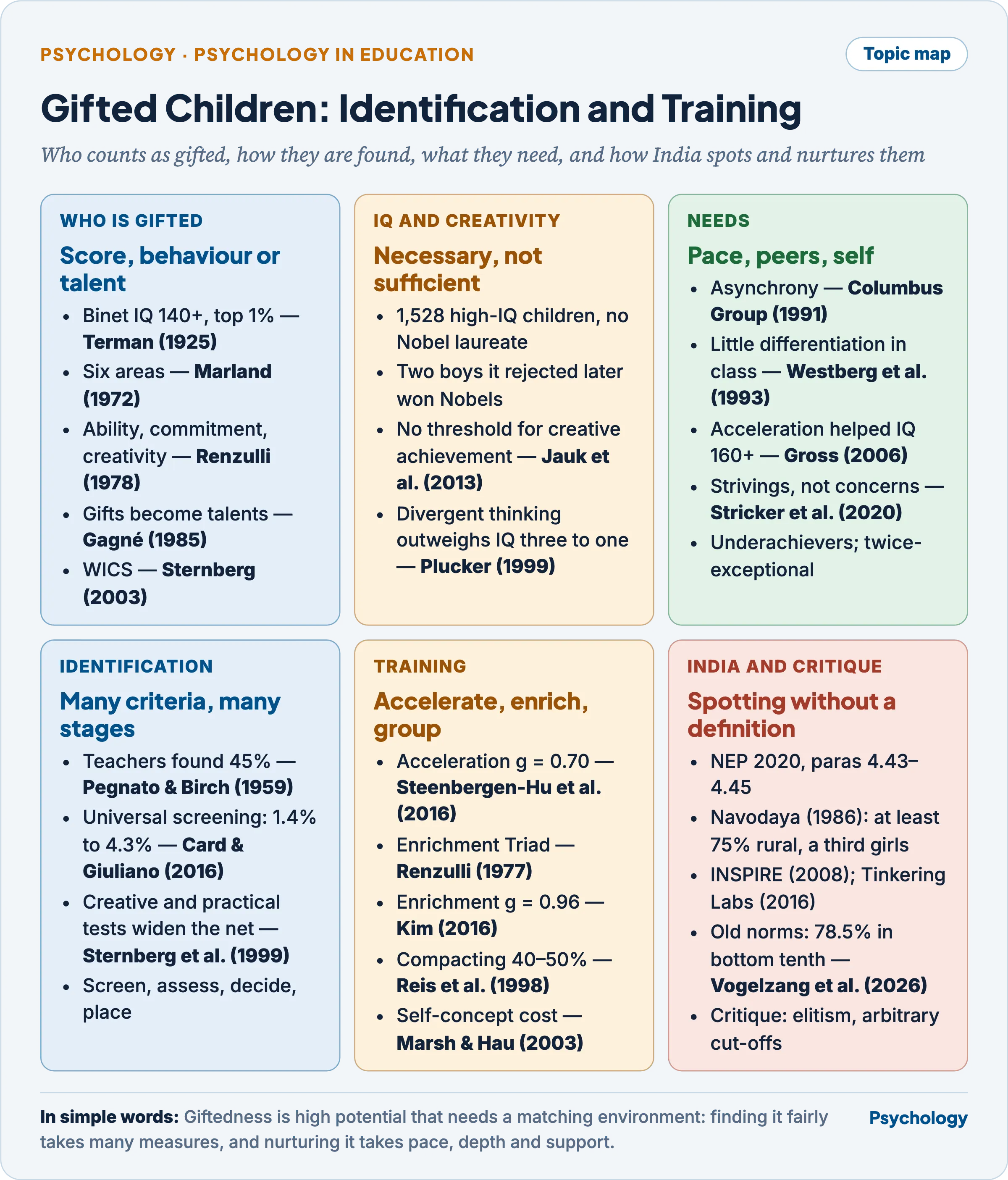
Each conception on the top row implies its own way of identifying the gifted and its own kind of training.
Who are the gifted children: conceptions of giftedness
- Terman (1925), in Genetic Studies of Genius, set the first operational criterion: a Stanford–Binet IQ of 140 or more, or a top-1-per-cent group-test score for older pupils.
- Design: California teachers nominated their brightest and youngest pupils for testing; the cohort reached 1,528 and was followed into old age (Terman and Oden, 1947, 1959; Holahan and Sears, 1995).
- Finding: the children were at least as healthy as average, socially well adjusted and taller, contradicting the stereotype of the sickly, inept prodigy.
- Limitation: a 95–99 per cent white, mostly middle-class sample, no comparison group followed alongside, and Terman’s meddling in his subjects’ careers (Leslie, 2000); Sorokin (1956) held that a random group of similar background would have done as well.
- William Shockley and Luis Alvarez, tested and rejected, later won the Nobel Prize in Physics; no member of the cohort did.
- Marland (1972), a report to the US Congress, widened giftedness to demonstrated or potential ability, singly or combined, in six areas: general intellectual ability, specific academic aptitude, creative or productive thinking, leadership ability, visual and performing arts and psychomotor ability, the last later dropped.
- It asked schools to identify a minimum of 3–5 per cent of pupils (McClain and Pfeiffer, 2012).
- Renzulli (1978) made giftedness a property of behaviour rather than of persons: the overlap of above-average ability (the top 15–20 per cent of a field, not necessarily superior), task commitment and creativity (Renzulli, 1998).
- He separated schoolhouse giftedness (test-taking and lesson-learning, which IQ tests capture) from creative-productive giftedness, the making of original products for real audiences.
- Objection: Gagné (1985) argued that writing motivation into the definition excludes the gifted underachiever, and moved it outside as a catalyst.
- Gagné (1985), revised as the Differentiating Model of Giftedness and Talent (DMGT 2.0, 2008), separates potential from achievement.
- Gifts are outstanding natural abilities in six domains (intellectual, creative, social and perceptual in the mental realm; muscular and motor control in the physical), placing a child in the top 10 per cent of age-peers (Gagné, 2021).
- Talents are outstanding mastery of systematically developed skills in a field, again in the top 10 per cent of learning peers (Gagné, 2021).
- A developmental process turns gifts into talents, driven by intrapersonal catalysts (temperament, motivation, volition) and environmental catalysts (family, school, programmes), with chance behind both.
- Gagné puts the overlap of intellectually gifted and academically talented pupils at no more than 30 per cent, hence gifted underachievers (Gagné, 2021).
- Objection: Baer and Kaufman (2004) called the 10 per cent cut “completely arbitrary” and the gift–talent split little more than aptitude and achievement renamed.
- Sternberg (2003) proposed WICS (wisdom, intelligence and creativity, synthesised): ideas are generated, judged, put into practice and aimed at a common good. Wisdom is the hardest part to assess in children.
- The Columbus Group (1991) defined giftedness from the inside, as asynchronous development: advanced cognition and heightened intensity make inner experience qualitatively different from the norm.
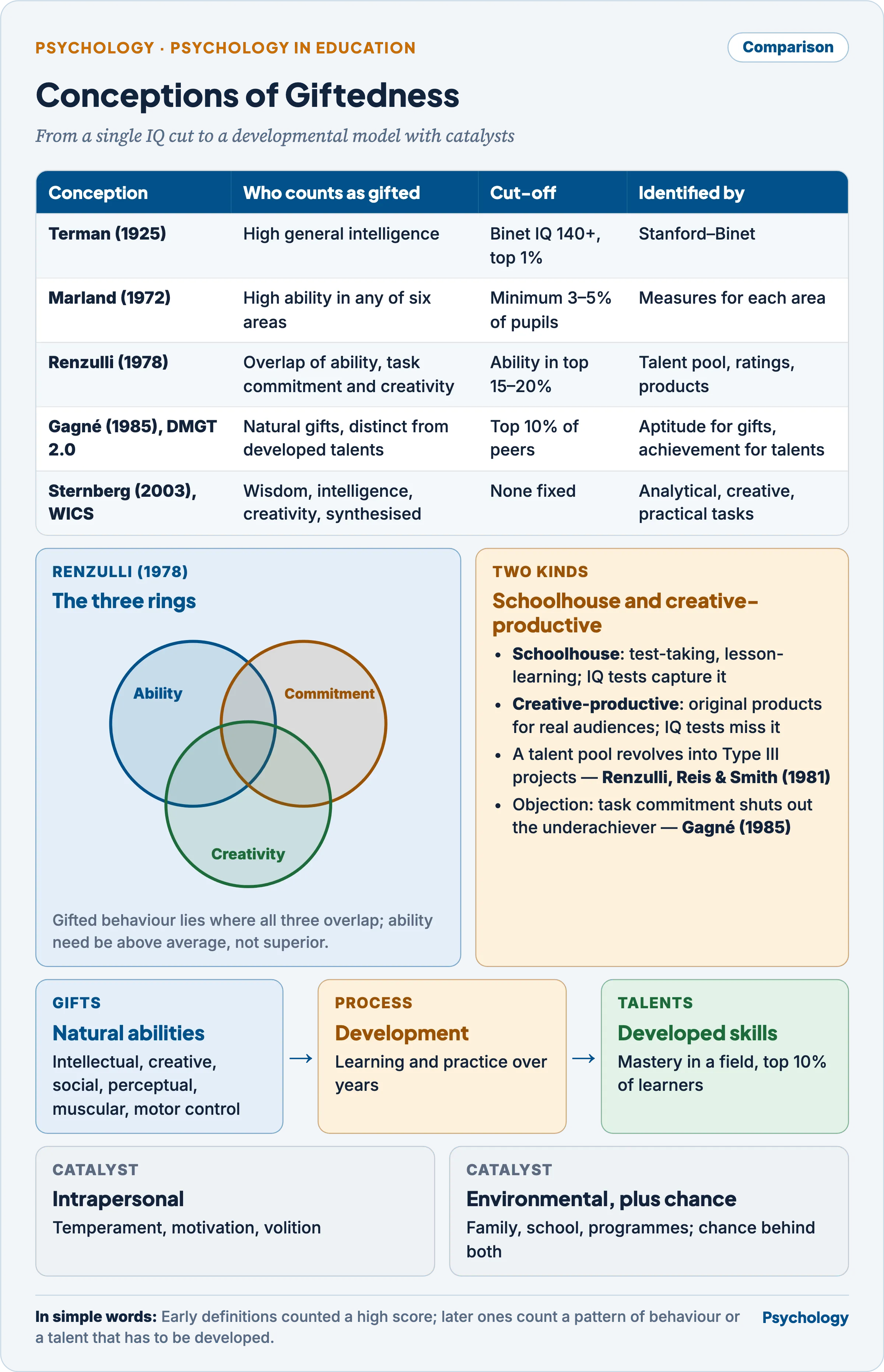
Terman’s single IQ cut gives way, by Gagné’s model, to a developmental account in which catalysts decide whether gifts become talents.
Giftedness, IQ and creativity
- High IQ is necessary but not sufficient for creative eminence; Terman’s cohort, successful but without a Nobel laureate, illustrates both halves (Terman, 1925).
- The threshold hypothesis (creativity rises with IQ to about 120 and then decouples from it) is set out with its evidence and critique in Creativity and Intelligence (Paper I).
- Jauk, Benedek, Dunst and Neubauer (2013), using breakpoint analysis on 297 participants, found the threshold depends on the criterion: about IQ 85 for fluency, 100–120 for originality, and no threshold for real creative achievement.
- Plucker (1999), re-analysing the longitudinal study of Torrance (1972), begun in 1958, found divergent-thinking scores explained just under half the variance in adult creative achievement, more than three times the contribution of IQ.
Needs of gifted children
Intellectual needs
- Pace, depth and complexity: Reis, Westberg, Kulikowich and Purcell (1998) showed that teachers could remove 40–50 per cent of the regular curriculum for 336 high-ability pupils with no loss on achievement tests.
- Westberg, Archambault, Dobyns and Salvin (1993), observing 46 American third- and fourth-grade classrooms, found little or no differentiation for gifted pupils whether or not the school ran a gifted programme.
Social-emotional needs
- Asynchrony: a ten-year-old who reasons like a fifteen-year-old still has a ten-year-old’s emotions and motor skills, and few true peers.
- Gross (2006) followed 60 Australian children of IQ 160 and above for 20 years: the radically accelerated reported high life satisfaction, research degrees and good relationships, while those kept with age-peers more often reported social difficulty.
- Perfectionism: Stricker, Buecker, Schneider and Preckel (2020), meta-analysing 32 effect sizes, found gifted pupils higher in perfectionistic strivings but not in maladaptive perfectionistic concerns.
- Adjustment: Francis, Hawes and Abbott (2016), reviewing 18 studies, found gifted children on average better adjusted, with fewer behavioural difficulties, though programme-based samples bias the picture.
Underachievement and twice-exceptionality
- Underachievement is a severe discrepancy between expected achievement (ability scores) and actual achievement (grades), not caused by a diagnosed disability and persisting over time (Reis and McCoach, 2000).
- Twice-exceptional children are gifted and also have a learning disability, ADHD or autism, so each condition masks the other. Baum (1988) found six of seven bright learning-disabled pupils gained in self-esteem and creative productivity through enrichment projects.
Identification of gifted children
- Sound identification uses multiple criteria and multiple stages, is domain-specific, uses local norms, is repeated, and leads to a matched service.
| Tool | What it captures | Example | Main weakness |
|---|---|---|---|
| Individual intelligence scale | General ability, index profile | Wechsler; Stanford–Binet | Costly; verbal and cultural load |
| Group non-verbal test | Reasoning with little language | Raven’s Matrices; NNAT; Culture Fair Test | Misses verbal and creative gifts |
| Achievement and above-level tests | Mastery, with the ceiling removed | SAT at 12–13 in talent searches | Rewards schooling and coaching |
| Creativity tests | Divergent thinking | Torrance Tests of Creative Thinking (1966) | Predictive validity long disputed |
| Teacher, parent, peer nomination | Behaviour, motivation | Renzulli’s rating scales | Misses quiet, poor, second-language pupils |
| Portfolios and products | Creative-productive giftedness | Science-fair models, art, written work | Hard to standardise |
- Pegnato and Birch (1959), comparing seven screening methods in junior high schools, found teacher judgement 45 per cent effective (naming 45 per cent of pupils with Binet IQs above 136) and 27 per cent efficient (most nominees were not gifted).
- Objection: Gagné (1994) showed the two indices trade off as cut-offs move; reanalysed, teachers did no worse than most other sources.
- Card and Giuliano (2016): a Florida district added universal screening of every second-grader on the non-verbal NNAT in 2005. With rules unchanged, gifted placement of disadvantaged pupils rose from 1.4 to 4.3 per cent; minorities and girls had been under-referred.
- Sternberg, Grigorenko, Ferrari and Clinkenbeard (1999) selected 199 high-school students with analytical, creative and practical tests: the analytical test picked mostly white, middle- to upper-middle-class pupils, the other two a far more mixed group by ethnicity and income.
The process of selection on the basis of psychological tests
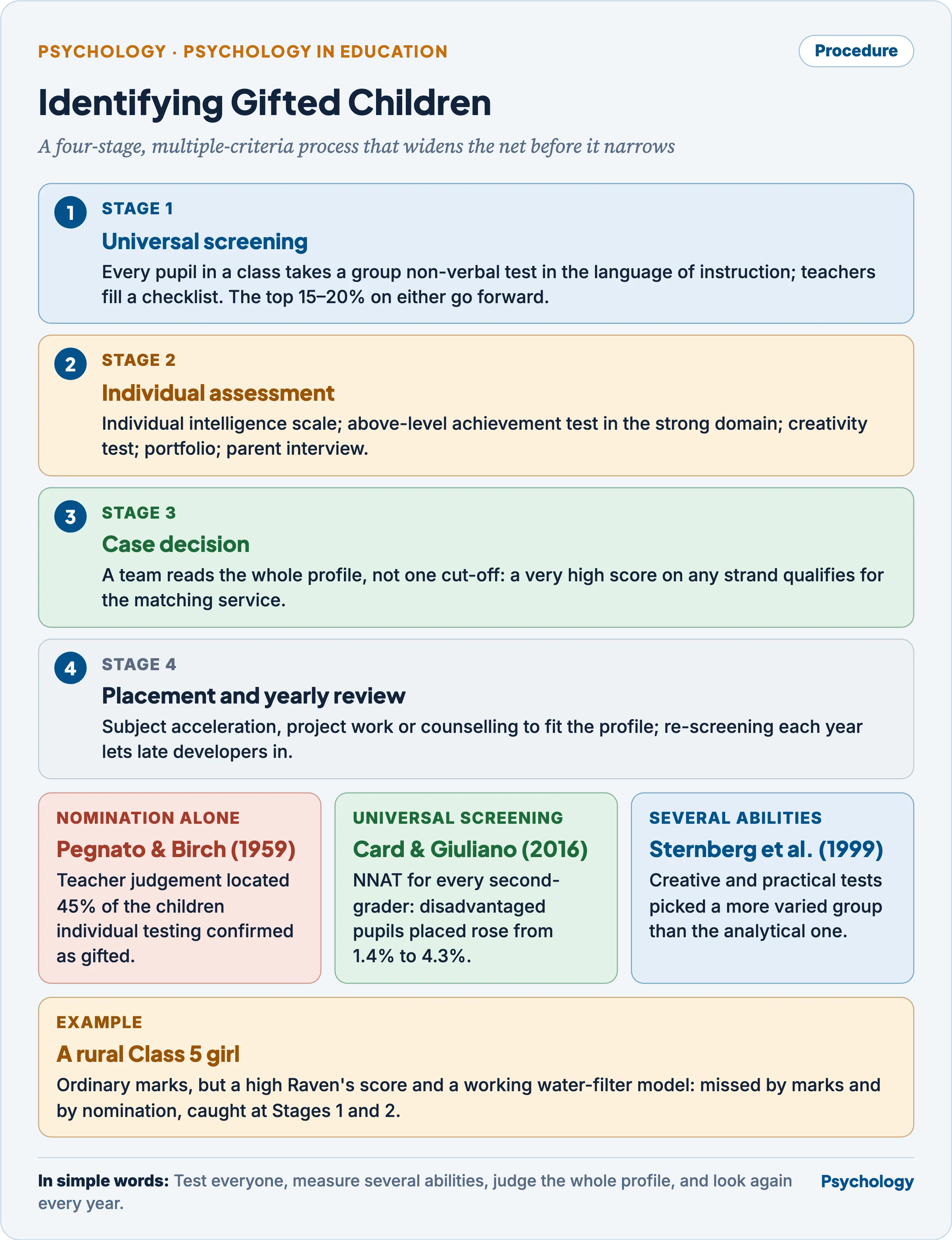
Every stage widens the net before the next one narrows it, so no single score can exclude a child.
- Stage 1, universal screening. Every pupil in a chosen class takes a group non-verbal test in the language of instruction, and teachers complete a checklist; the top 15–20 per cent on either go forward, as in Renzulli’s talent pool (Renzulli, 1998).
- Stage 2, individual assessment. An individual intelligence scale; an achievement test in the strong domain, above grade level if the child reaches the ceiling; a creativity test; a portfolio; a parent interview.
- Stage 3, case decision. A team reads the whole profile: a very high score on any one strand qualifies for the service matching it, and the reason is recorded.
- Stage 4, placement and review. Subject acceleration for a mathematical profile, project work for a creative one, counselling for an underachieving one; re-screening every year lets late developers in.
- Example: a rural Class 5 girl with ordinary marks, a high Raven’s score and a working water-filter model would be missed by marks and nomination but caught at Stages 1 and 2.
Issues in identification in the Indian context
- No national definition. The National Education Policy 2020 (para 4.43) asks NCERT and NCTE to frame guidelines for educating gifted children but gives no definition, so each programme sets its own criterion.
- Language and norms: Vogelzang, Wigdorowitz and Tsimpli (2026) tested 1,752 government-school children in Delhi, Hyderabad and Patna: on existing Indian norms for Raven’s Coloured Matrices, 78.5 per cent fell in the bottom tenth, the norms having come from a small private-school sample.
- Rural, poor and girl children are under-identified: nomination reflects what teachers notice; of 16 STEM-gifted children identified through a multistage protocol in Karnataka, 12 were boys (Kurup, Chandra and Binoy, 2015).
- Coaching inflation: coached scores on high-stakes talent tests yield false positives and shut out children who cannot pay; ending the KVPY test in 2022, the Department of Science and Technology cited costs, fees and examination stress.
- A marks gate: Delhi’s Project Abhishikt (2024) shortlisted about 6,000 Class 6 and 9 pupils by academic performance before a Culture Fair Intelligence Test and an IQ test, and chose 82 (2025); such a gate excludes precisely the gifted underachiever.
- Narrow domains: most national searches target science and mathematics, leaving Marland’s arts and leadership areas little attended.
Training of gifted children: modifications to their educational environment
- Training rests on the zone of proximal development (Vygotsky, 1978), which for a fast learner lies above the ordinary lesson, and on challenge matched to skill, the condition of flow (Csikszentmihalyi, 1990); see Psychological Principles Underlying Effective Teaching-Learning.
Acceleration
- Acceleration moves a child through the curriculum earlier or faster: early entrance, grade-skipping, subject acceleration, early college.
- Colangelo, Assouline and Gross (2004), in A Nation Deceived, listed 18 forms and found fears of hurried childhood and social harm unsupported by fifty years of research.
- Steenbergen-Hu, Makel and Olszewski-Kubilius (2016), synthesising three meta-analyses, found accelerated students clearly outperformed same-age non-accelerated peers (g = 0.70) and did as well as older peers (g = 0.09).
- Stanley (1971) founded the Study of Mathematically Precocious Youth, which found talented 12–13-year-olds by above-level SAT testing and gave them fast-paced courses.
- Wai, Lubinski, Benbow and Steiger (2010), following 1,467 of the top 0.5 per cent for 25 years, found that a higher dose of advanced pre-college STEM experience predicted more doctorates, publications and patents.
Enrichment
- Enrichment deepens and broadens learning without moving the child ahead. Renzulli’s (1977) Enrichment Triad has three types.
- Type I: general exploratory experiences such as speakers, visits, interest centres.
- Type II: group training in thinking, research and how-to-learn skills.
- Type III: individual or small-group investigation of a real problem, the child acting as a first-hand inquirer.
- The Schoolwide Enrichment Model (Renzulli and Reis, 1985) gives Types I and II and compacting to a talent pool, from which children enter Type III by interest and commitment, through the revolving door (Renzulli, Reis and Smith, 1981).
- Burns (1987) found pupils given Type II training 64 per cent more likely to start a Type III investigation, though most of this research is non-experimental (Renzulli and Reis, 1994).
- Kim (2016), meta-analysing 26 studies, found a large effect of enrichment on achievement (g = 0.96) and a moderate one on socio-emotional development (g = 0.55), largest for summer residential programmes.
Ability grouping, compacting, differentiation and mentoring
- Ability grouping: special grouping for the gifted (g = 0.37), within-class grouping (0.19–0.30) and cross-grade subject grouping (0.26) raised achievement; between-class streaming did not (Steenbergen-Hu and colleagues, 2016).
- The cost is the big-fish–little-pond effect: among 103,558 fifteen-year-olds in 26 countries, higher school-average ability lowered academic self-concept in every country (Marsh and Hau, 2003).
- Curriculum compacting: pretest, skip what is mastered, and spend the saved time on enrichment or acceleration (Reis and colleagues, 1998).
- Differentiated curriculum: adjust content, process, product and learning environment to each pupil’s readiness, interests and learning profile (Tomlinson, 1999).
- Mentoring by an expert in the child’s field, and counselling for perfectionism, isolation and underachievement.
Ways to enhance cognitive skills of gifted children in the light of research
- Match instruction to the ability profile. In Sternberg and colleagues (1999), students taught to their analytical, creative or practical strength outperformed mismatched students; Sternberg, Torff and Grigorenko (1998) found triarchic teaching beat memory-based and critical-thinking-only teaching, even on memory items.
- Train creative thinking explicitly. Scott, Leritz and Mumford (2004), reviewing 70 studies, found creativity training effective, most of all when it taught cognitive skills and the heuristics for applying them.
- Use real problems: Type III projects train problem finding and self-directed inquiry; Type II training raises their uptake (Burns, 1987).
Can a normal school handle gifted and retarded children with equal justice?
- The current term for the syllabus’s “retarded” is intellectual disability (DSM-5-TR; the RPwD Act 2016); its training is set out in Intellectually Disabled Children and Their Training.
- Justice here means equity: each child taught at the edge of present competence, not identical treatment, so one pace for all is unjust to both ends of the distribution.
- For inclusion: Kalambouka, Farrell, Dyson and Kaplan (2007) found 81 per cent of reported outcomes of including pupils with special needs positive or neutral for their classmates.
- Against complacency: regular classrooms rarely differentiate for the gifted (Westberg and colleagues, 1993), and the profoundly gifted need acceleration beyond any single class (Gross, 2006).
- What makes it work: multi-level lessons; cluster grouping of the gifted in one section; compacting and pull-out enrichment; individualised plans, task analysis and a resource teacher for children with intellectual disability; peer tutoring.
- Section 16 of the Rights of Persons with Disabilities Act, 2016 directs governments to endeavour that institutions they fund or recognise provide inclusive education; NEP 2020 (para 4.44) asks teachers to enrich within the classroom.
- Verdict: a normal school can do equal justice if it varies pace, depth and support within one setting, with trained teachers and manageable classes; otherwise it fails both groups.
Criticisms and limitations
- Programmes tend to select privilege: Terman’s sample was overwhelmingly white and middle class (Leslie, 2000), and referral systems miss poor and minority children (Card and Giuliano, 2016).
- The cut-offs (top 1 per cent for Terman, 3–5 per cent for Marland, 10 per cent for Gagné, 15–20 per cent for Renzulli) are conventions set by policy, the point Baer and Kaufman (2004) pressed against Gagné.
- Much programme research uses volunteers, short follow-ups and no random assignment (Renzulli and Reis, 1994), and grouping costs academic self-concept (Marsh and Hau, 2003).
- The large effect sizes come from American, Australian and European samples; Indian outcome evidence is thin.
Indian context: spotting and nurturing gifted children
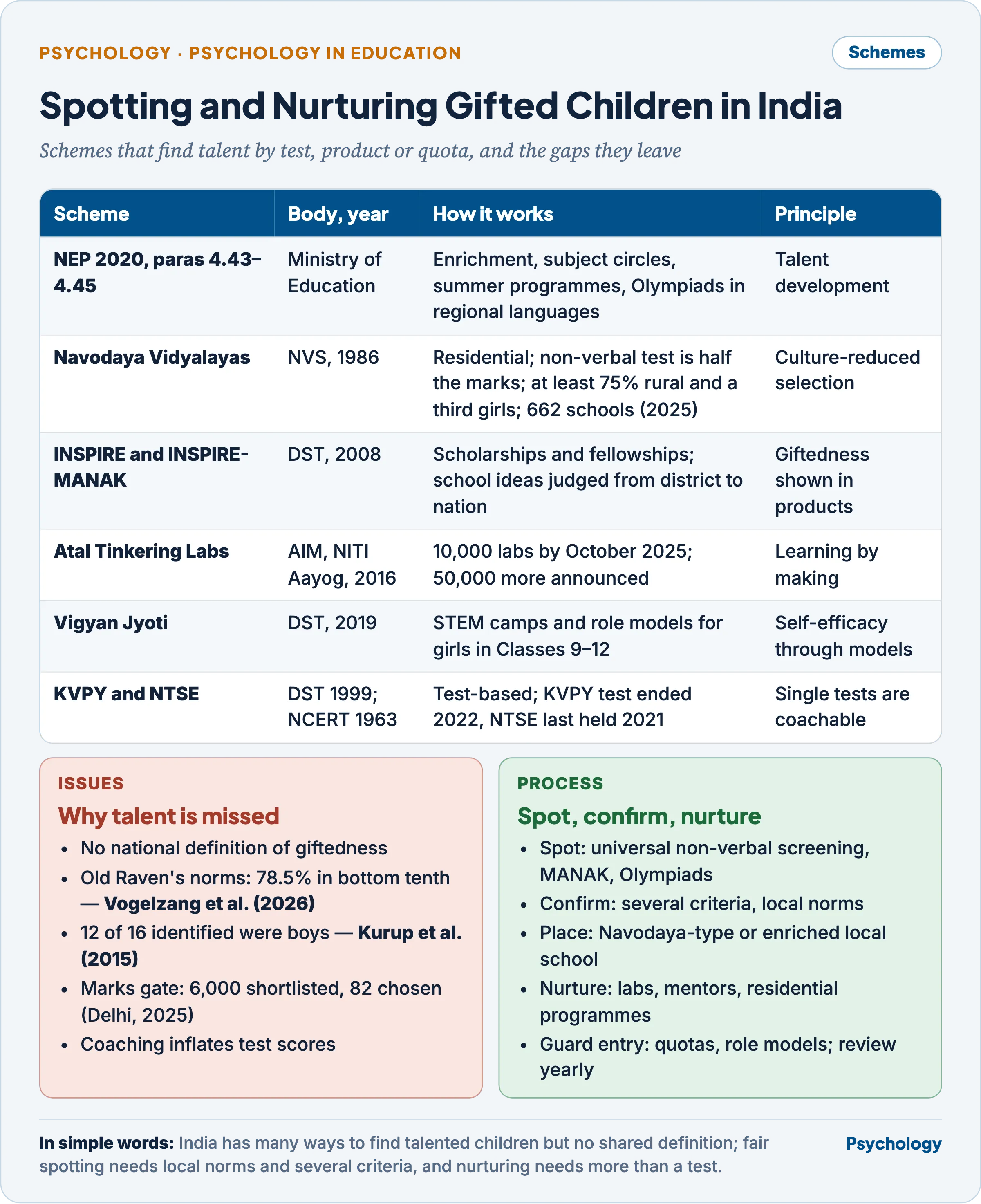
Each scheme finds talent by a different route: a test, a product, or a quota for rural children and girls.
- National Education Policy 2020 (Ministry of Education), paras 4.43–4.45: talents in every student must be “discovered, nurtured, fostered, and developed”; teacher training to recognise them, a B.Ed. specialisation, enrichment material and subject circles.
- Also national residential summer programmes with merit-based but equitable admission, and Olympiads in regional languages. Principle: talent development (Gagné, 1985).
- Jawahar Navodaya Vidyalayas (Navodaya Vidyalaya Samiti, Ministry of Education; 1986) are free residential schools for talented rural children, entered in Class VI through a test whose non-verbal mental ability section carries half the marks.
- At least 75 per cent of seats are rural and at least a third go to girls; 662 schools ran in October 2025 (PIB, 2025). Principle: culture-reduced testing with equal opportunity.
- INSPIRE (Department of Science and Technology; December 2008) combines awards for school pupils, natural-science scholarships and research fellowships.
- Its INSPIRE-MANAK strand, with the National Innovation Foundation, invited up to five ideas per school from Classes 6–12 in 2025–26, aiming at a million (CBSE, 2025). Principle: creative-productive giftedness spotted by product (Renzulli, 1978).
- KVPY (DST, 1999) and NTSE (NCERT, 1963), test-based talent searches, have lapsed: the KVPY test ended in 2022, its fellowship subsumed in INSPIRE, and NTSE, last held in 2021, stalled pending review.
- Atal Tinkering Labs (Atal Innovation Mission, NITI Aayog; 2016) numbered 10,000 in schools by October 2025, and 50,000 more for government schools announced in the Union Budget 2025–26. Principle: Type III enrichment at scale.
- Vigyan Jyoti (DST; December 2019) runs camps, role-model sessions and laboratory visits for meritorious girls in Classes 9–12 through Navodaya Vidyalayas. Principle: self-efficacy through modelling (Bandura, 1977).
- Smaller models: Project Abhishikt (Delhi, 2024) gives its selected pupils a specialised curriculum; Jnana Prabodhini Prashala, Pune (1969), admits by psychological tests and an interview.
- The National Institute of Advanced Studies, Bengaluru, identifies under-eights and marginalised children by rating scale and portfolio, not psychometric tests.
- Spotting and nurturing, put together: spot by universal non-verbal screening in the mother tongue and by product nets such as MANAK and Olympiads; confirm with multiple criteria on local norms.
- Then place in Navodaya-type schools or enrich in the neighbourhood school; nurture through tinkering labs, mentors and residential programmes; guard rural children’s and girls’ entry with quotas and role models; review yearly.
Previous Year Questions
- 2026Who are the gifted children? Discussing the needs of gifted children, suggest the modifications required in their educational environment.
- 2022Comment on: In the light of research, discuss various ways to enhance cognitive skills of the gifted children.
- 2018How is giftedness identified and what are the issues in such identification in Indian context? How is giftedness related to IQ and creativity?
- 2017Elaborate the process of spotting and nurturing gifted children in the Indian context.
- 2013How would you identify gifted children? Explain with examples.
- 2011Discuss the process of selection of ‘gifted children’ on the basis of psychological tests. Make recommendations for their proper schooling.
- 2006What are the important psychological principles responsible for effective teaching and learning processes? Discuss in detail as to how Gifted and Retarded can be trained.
- 1996Can a normal school handle gifted as well as retarded children with equal justice?
