

Official syllabusPaper II · Unit 5 · Application of Psychology to Educational Field
Gifted, retarded, learning disabled and their training – the learning disabled.
Definition
“Recently, I have used the term ‘learning disabilities’ to describe a group of children who have disorders in development in language, speech, reading, and associated communication skills needed for social interaction. … I also exclude from this group children who have generalized mental retardation.”
Kirk (1963)
A learning disability is unexpected failure: a child with adequate intelligence, sight, hearing and schooling who still cannot learn to read, write or calculate at the expected level. Because the condition is defined largely by what it is not, it is identified through case study and trained through explicit, structured teaching with accommodation.
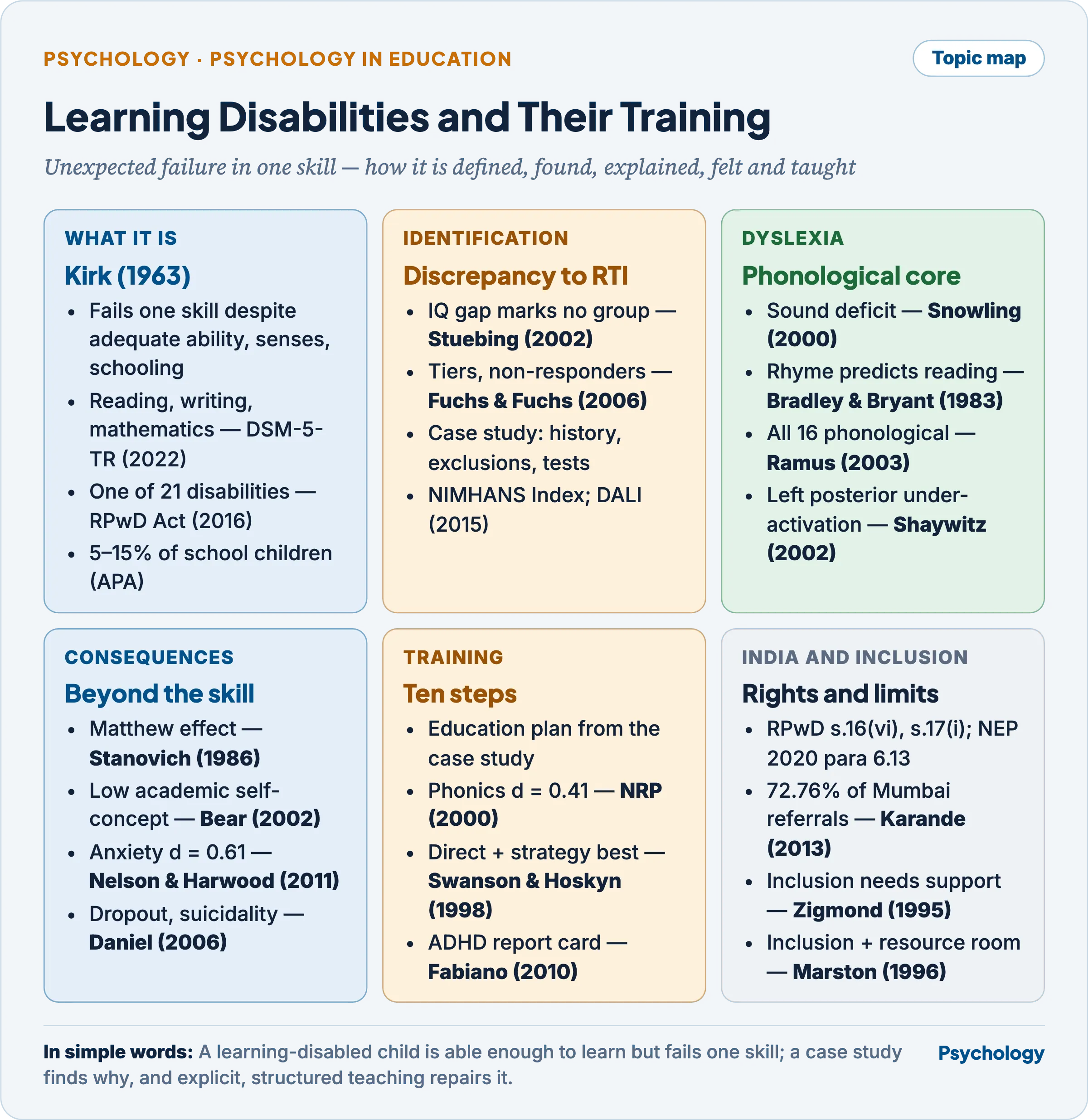
The case study that diagnoses the child also supplies the training plan, so the map runs from identification straight into teaching.
Learning disabled children: concept and definition
- Kirk proposed “learning disabilities” at a parents’ conference in Chicago on 6 April 1963, replacing medical labels such as brain injury and minimal brain dysfunction; the parents’ group became today’s Learning Disabilities Association of America.
- His definitions set elements that later ones kept: specificity (a narrow deficit with intact general ability), intrinsic origin (a possible cerebral dysfunction) and exclusion of intellectual disability, sensory loss, and cultural or instructional causes. Together they make the failure unexpected.
- DSM-5 (2013), retained in DSM-5-TR (2022), merged the reading, mathematics and written-expression disorders into one specific learning disorder (American Psychiatric Association).
- Difficulty persists six months despite targeted help; skills fall well below age level on standardised tests; onset is in the school years; intellectual disability, uncorrected senses, adversity, language of instruction or poor teaching do not explain it better.
- Specifiers: with impairment in reading, in written expression and in mathematics; severity is mild, moderate or severe.
- ICD-11 (World Health Organization, 2019) calls it developmental learning disorder. The Rights of Persons with Disabilities Act, 2016 defines specific learning disabilities as “a heterogeneous group of conditions wherein there is a deficit in processing language, spoken or written”.
- The learning-disabled child differs from the intellectually disabled child, whose limitation is global (Intellectually Disabled Children and Their Training), from the uniformly low slow learner, and from the child failing through absence or a mismatched medium (Better Academic Achievement and Underachievement).
- Prevalence is 5–15 per cent of school-age children, about 80 per cent of them with reading impairment (American Psychiatric Association, 2024).
- Mogasale and colleagues (2012) found 15.17 per cent of 8–11-year-olds in Belgaum affected: dysgraphia 12.5, dyslexia 11.2, dyscalculia 10.5 per cent, overlapping.
- Arora and colleagues (2018), examining 3,964 children in five districts, found learning disorders among the commonest neurodevelopmental disorders at ages 6–9.
- Rutter and colleagues (2004) found reading disability commoner in boys in all four epidemiological samples studied (odds ratios 1.39 to 3.19).
The discrepancy model and response to intervention
- The IQ–achievement discrepancy model diagnoses a disability when achievement falls well below measured intelligence, an approach Bateman (1965) reintroduced from Monroe’s earlier work.
- Stuebing and colleagues (2002), meta-analysing 46 studies, found negligible differences between IQ-discrepant and IQ-consistent poor readers in behaviour and achievement, and small, inconsistent ones in cognitive ability: the discrepancy marks no distinct group.
- It is also a wait-to-fail model, since a young child’s gap is too small to measure.
- Response to intervention (RTI) (Fuchs and Fuchs, 2006) screens every child, adds small-group teaching with progress monitoring (Tier 2) and intensive teaching (Tier 3) to good classroom teaching (Tier 1), and assesses only non-responders.
- The US IDEA (2004) barred states from requiring the discrepancy and let districts use RTI.
- Balu and colleagues (2015), evaluating 146 US schools, found first-graders just below the intervention cut-off read worse after assignment (−0.17 SD).
- Current practice combines low achievement, poor response to good teaching, exclusion of other causes and a processing profile from the case study.
Different learning disabilities and their educational and psychological consequences
| Disability | Core deficit | Signs in class | Educational consequence |
|---|---|---|---|
| Dyslexia (reading) | Phonological processing, decoding | Slow, inaccurate reading; guessing; avoids reading aloud | Lags in every text-based subject |
| Dysgraphia (writing) | Spelling, handwriting, organising text | Illegible, slow writing; omitted long answers | Marks lost despite sound oral knowledge |
| Dyscalculia (mathematics) | Number sense (Butterworth, 2005) | Finger counting; poor fact recall; place-value errors | Mathematics and science avoided |
| Non-verbal learning disability (Rourke, 1989) | Visuospatial, motor, social perception | Good rote memory; poor maps, geometry, social cues | Peer isolation |
| Dyspraxia | Motor planning | Clumsy, laboured handwriting | Slow written work |
- The disorders co-occur. Karande and colleagues (2013), studying 246 Mumbai children referred for poor school performance, found a learning disability in 72.76 per cent and ADHD in 40.6 per cent of those diagnosed.
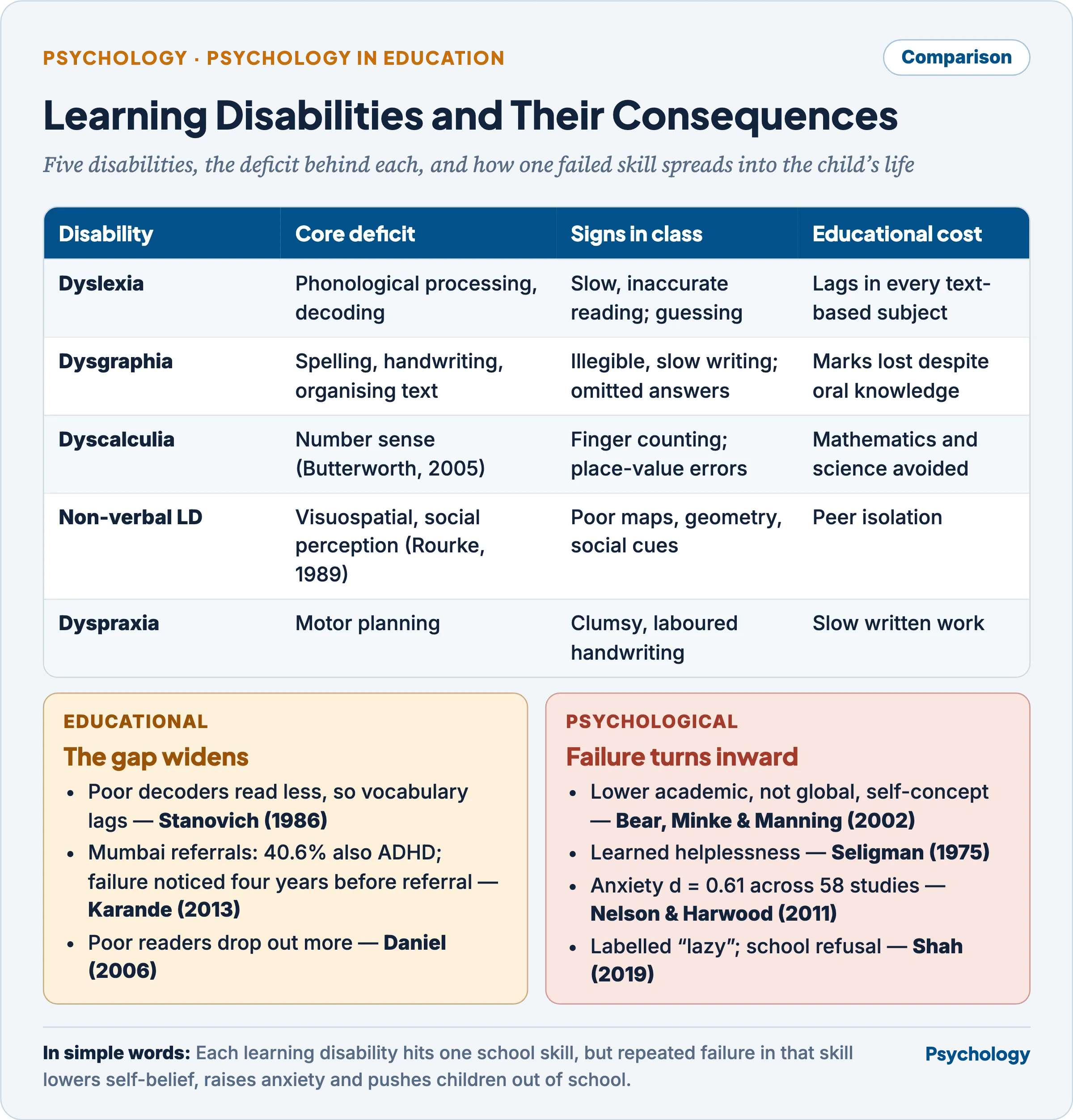
Each disability strikes one academic skill, but the consequences spread from that skill to self-concept, mood and staying in school.
Psychological consequences
- Matthew effect (Stanovich, 1986): poor early decoders read less, so vocabulary and knowledge grow more slowly and the gap widens with age.
- Bear, Minke and Manning (2002), meta-analysing 61 studies, found lower academic self-concept in children with learning disabilities, while differences in global self-concept were too small to matter: the harm is confined to school-related self-belief.
- Learned helplessness (Seligman, 1975) follows when failure is blamed on low ability; such children are called “lazy” or “stupid” and punished at home and school (Shah and colleagues, 2019).
- Nelson and Harwood (2011), meta-analysing 58 studies, found higher anxiety in students with learning disabilities (d = 0.61); school refusal, somatic complaints and oppositional behaviour also present (Shah and colleagues, 2019).
- Daniel and colleagues (2006) followed 188 adolescents recruited at age 15: poor readers more often reported suicidal thoughts or attempts and dropped out, with psychiatric disorder controlled.
- Karande and colleagues (2013) found poor performance noticed about four years before referral, at a mean age of 12.1.
Nature of dyslexia and how it is diagnosed
Nature of dyslexia
- Lyon, Shaywitz and Shaywitz (2003) define dyslexia as neurobiological in origin, marked by inaccurate or slow word recognition and poor spelling and decoding, typically from a phonological deficit unexpected given the child’s abilities and teaching.
- Developmental dyslexia appears while learning to read; acquired dyslexia follows brain damage in a skilled reader.
- The phonological deficit hypothesis (Snowling, 2000; Shaywitz, 2003): weak representation of speech sounds blocks letter–sound mapping, so decoding and spelling fail while listening comprehension is intact.
- Bradley and Bryant (1983) tested about 400 four- and five-year-olds on rhyme and alliteration before they could read.
- Sound categorisation predicted later reading; poor categorisers trained over two years gained most when sound training used plastic letters.
- Limitation: small training groups make the causal effect’s size imprecise.
- Ramus and colleagues (2003) studied 16 dyslexic and 16 control university students case by case.
- All 16 dyslexics had a phonological deficit; ten had auditory, four motor and two visual magnocellular deficits, so rival magnocellular and cerebellar theories cover a minority.
- Limitation: high-achieving adults may not represent children.
- Wolf and Bowers (1999) added a double deficit: slow rapid naming is a second core deficit, and children with both are most impaired. Pennington (2006) proposed a multiple-deficit model, which also explains comorbidity with ADHD.
- Shaywitz and colleagues (2002) scanned 144 children aged 7–18: dyslexic readers under-activated left parieto-temporal and occipito-temporal areas, and older ones showed more inferior frontal activity, read as compensation.
- Paulesu and colleagues (2001) found Italian dyslexics, with a regular spelling system, read better than English and French ones, yet all showed reduced left temporal activity; Siok and colleagues (2004) found a frontal deficit in Chinese readers instead.
- Nag and Snowling (2012): in Kannada, an alphasyllabary, phoneme awareness, rapid naming and akshara knowledge each predicted reading, so the phonological core holds in Indian scripts.
- Boder (1973) described dysphonetic, dyseidetic and mixed reading–spelling patterns; Castles and Coltheart (1993) sorted clinic cases into phonological and surface profiles.
How dyslexia is diagnosed
- Screening: teachers note poor rhyming, letter–sound confusion and slow reading. PRASHAST (CIET–NCERT, 6 September 2022) screens for the 21 RPwD conditions; DALI (National Brain Research Centre, 2015) screens Classes 1–5 in English, Hindi, Marathi and Kannada.
- Exclusion: vision and hearing checks; an intelligence test (Malin’s Intelligence Scale for Indian Children, WISC, Binet–Kamat); attendance, emotional state and medium of instruction. Karande and colleagues (2013) traced 8.54 per cent of referrals to a language barrier alone.
- Achievement testing: the NIMHANS Index for SLD has Level I (5–7 years) and Level II (8–12 years: reading, spelling, comprehension, arithmetic, Bender Gestalt); performance about two classes below expectation qualifies (Shah and colleagues, 2019).
- Processing tests: phonological awareness, rapid naming and verbal working memory, with error analysis of reversals, omissions and guessing.
- Certification: under S.O. 4501(E) (Ministry of Social Justice and Empowerment, 2020), a positive NIMHANS battery means a benchmark disability (over 40 per cent); the March 2024 guidelines also accept the curriculum-based Grade Level Assessment Device (GLAD).
- No validated adult tool exists yet (NIMHANS to the Supreme Court, 2026).
The role of case study in understanding learning disabilities
- A case study is the intensive, multi-method study of one child (history, observation, tests and school work) integrated into a formulation. A disability defined by unexpectedness and exclusion cannot be established by any single test.
- Morgan (1896) described Percy F., a bright 14-year-old who could not learn to read, as “congenital word blindness”; Witmer (1896) opened the first psychological clinic in Pennsylvania with a 14-year-old “chronic bad speller”, examined and taught remedially.
- Its roles in learning disability:
- establishing unexpectedness, by setting achievement against intelligence and opportunity;
- documenting exclusions of sensory, medical, attendance, language and emotional causes;
- building an idiographic profile, such as sound oral comprehension with poor decoding;
- triangulating parents, teachers, child and records, including the family history of reading difficulty;
- revealing secondary consequences such as anxiety and helplessness;
- supplying goals and a baseline for the individualised education programme, so repeated measures during teaching form a single-case design.
- Limitations: time, dependence on recall and examiner judgement, and weak generalisation, reduced by standardised tests and several informants.
Proforma for the case study of a dyslexic child
| Section | What is recorded |
|---|---|
| 1. Identifying data | Name, age, sex, class, school, medium of instruction, mother tongue, informants, date |
| 2. Referral | Who referred; complaint in the informant’s words; duration; help already tried |
| 3. Developmental history | Pregnancy and birth (prematurity, asphyxia, low birth weight); milestones, especially speech and language |
| 4. Medical history | Vision, hearing, ear infections, seizures, head injury, medication |
| 5. Family history | Reading difficulty in relatives; home languages; parental education and income; parenting; stresses |
| 6. Educational history | School entry, school and medium changes, attendance, subject-wise marks, teacher reports, tuition |
| 7. Behavioural observation | Rapport, attention, frustration; finger-pointing, guessing, reversals while reading |
| 8. Test results | Intelligence (verbal, performance); NIMHANS Index reading accuracy, rate, comprehension, spelling, writing, arithmetic; phonological awareness; rapid naming; error analysis; anxiety and self-concept |
| 9. Diagnosis | Specific learning disorder with impairment in reading, severity; comorbidity; exclusions; strengths |
| 10. Recommendations | Education-programme goals, remedial method, accommodations, parent and teacher guidance, counselling, certification, review date |
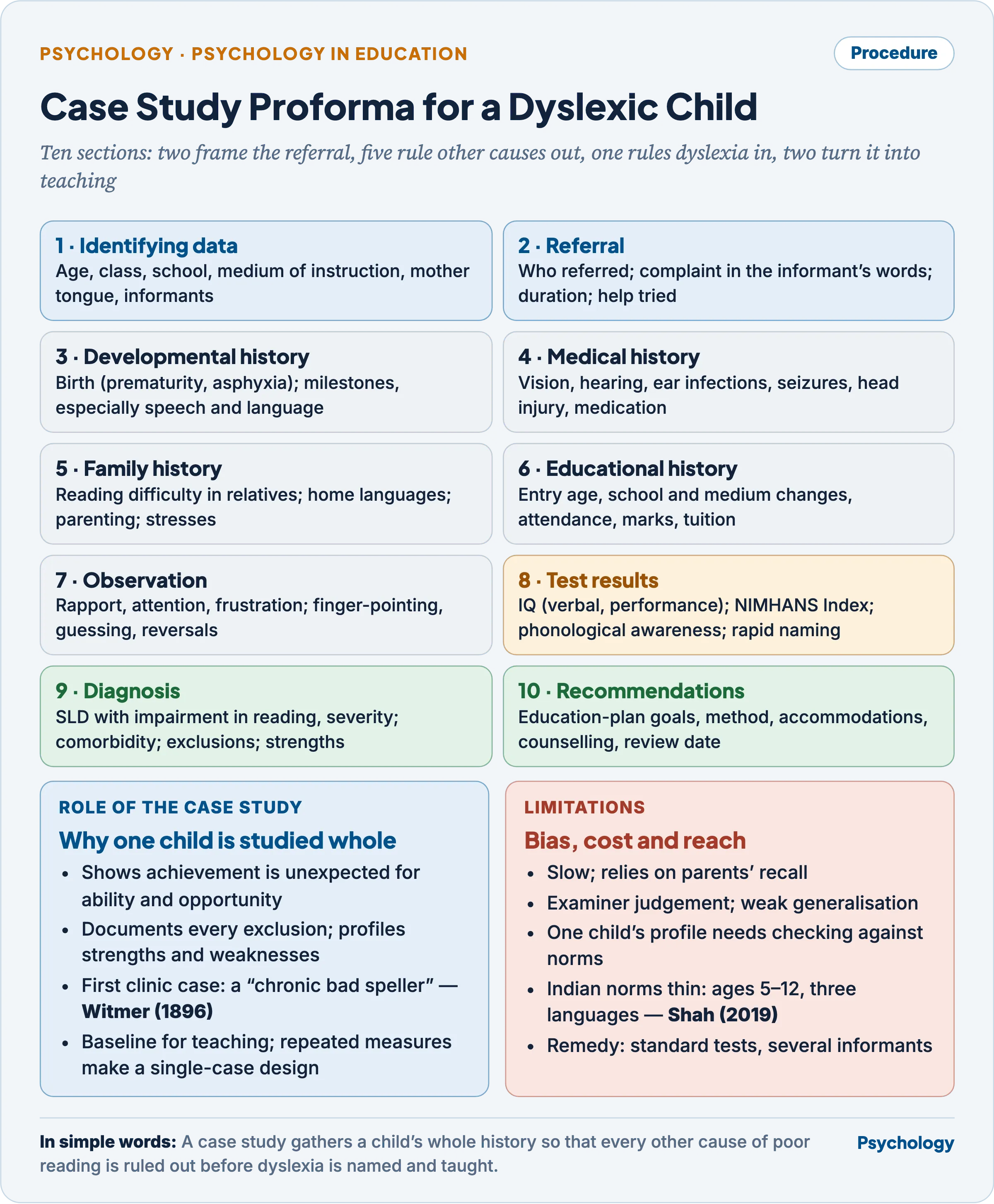
Sections 3 to 7 exist to rule causes out; only section 8 rules the disability in.
Steps in training children with learning disabilities
- Early identification, since the earlier support begins, the better the progress (National Education Policy 2020, para 6.13).
- Individualised education programme: measurable goals from the case study, methods, responsibilities and review dates, cycling through assessing, setting objectives, adapting the curriculum, teaching and re-planning (Shah and colleagues, 2019).
- Explicit phonics and phonological training: the National Reading Panel (2000) found systematic phonics effective (d = 0.41), more so begun early (0.55) than after first grade (0.27) (Ehri and colleagues, 2001); repeated guided oral reading builds fluency.
- Multisensory structured teaching: the Orton–Gillingham approach (Orton, 1937; manual by Gillingham and Stillman, 1936) teaches letter–sound links by seeing, saying, hearing and tracing, in a fixed sequence; Fernald (1943) used whole-word tracing.
- Stevens and colleagues (2021), pooling 16 studies, found a non-significant effect of 0.32 on foundational skills, from small and methodologically weak studies. Every child gets the same multisensory routine, unlike style-matching (Learning Styles).
- Direct instruction: scripted lessons, groups by level, immediate correction, frequent assessment (Carnine and colleagues, 2004).
- Strategy training: metacognitive planning, self-questioning and checking. Swanson and Hoskyn (1998) found a mean effect of 0.79, highest when direct and strategy instruction were combined; writing-strategy instruction gives d = 0.82 (Graham and Perin, 2007). See Metamemory (Paper I).
- Mathematics remediation: concrete materials for place value, the number line, procedures spoken aloud, and drill for facts (Shah and colleagues, 2019).
- Accommodations and assistive technology: extra time, a reader or scribe, oral tests, calculators, text-to-speech and audio books. An accommodation changes access; a modification, such as dropping a language, changes content.
- Motivation and emotion: graded success, praise for effort, attribution retraining, counselling and parent guidance (Reinforcement, its Types and Schedules, Paper I).
- Progress monitoring: brief curriculum-based probes decide whether to intensify, change or fade teaching.
- Strong and colleagues (2011) found no significant effect of the Fast ForWord auditory-training programme on reading or oral language.
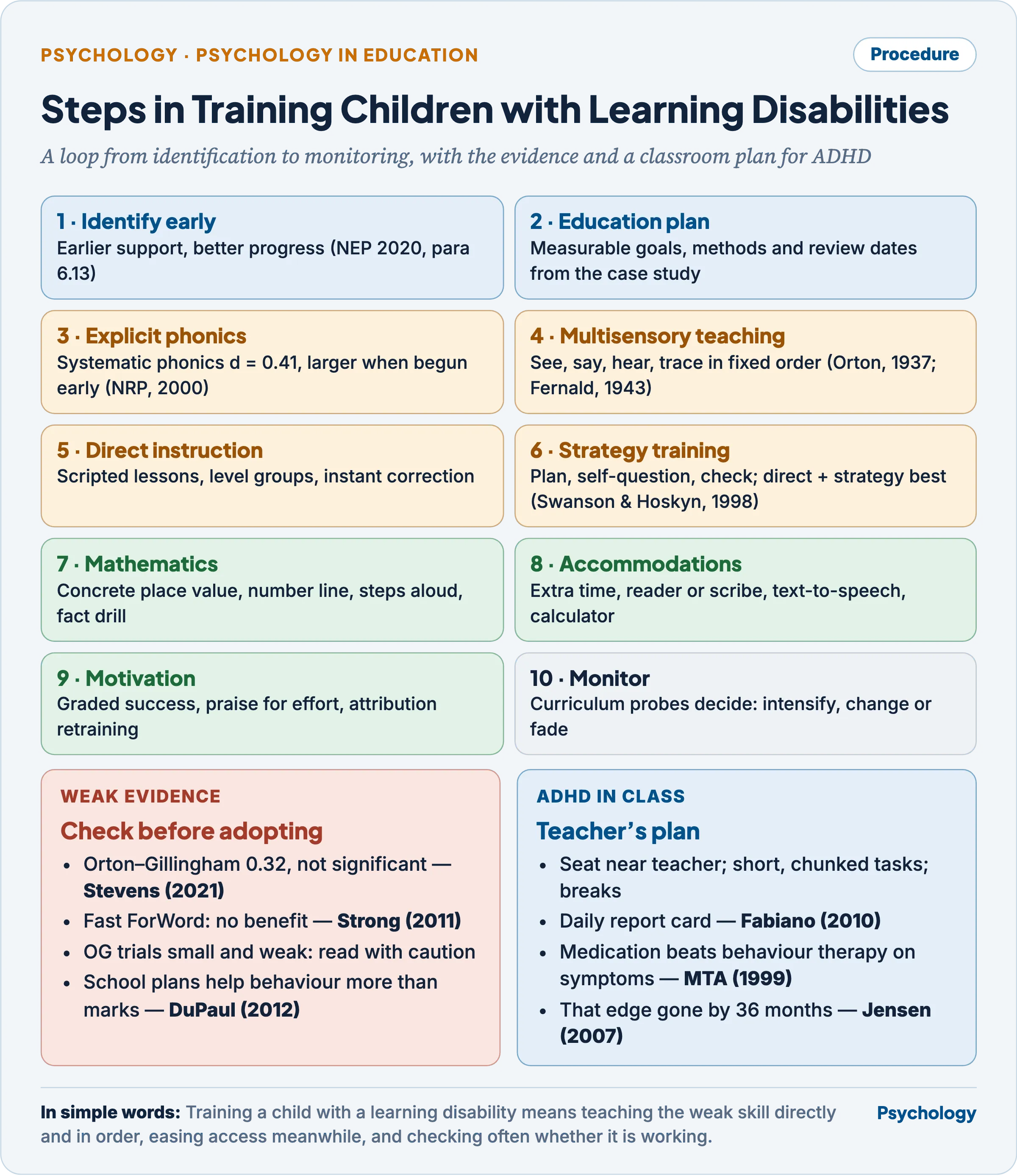
The steps form a loop: monitoring sends the child back to the plan for another round of teaching.
Meeting the educational needs of a child with ADHD
- ADHD (DSM-5-TR) is persistent inattention and/or hyperactivity–impulsivity: six or more symptoms (five from age 17) for six months, several before age 12, in two or more settings; presentations are combined, predominantly inattentive or predominantly hyperactive–impulsive.
- Thomas and colleagues (2015), pooling 175 studies, put prevalence at 7.2 per cent; Chauhan and colleagues (2022) pooled Indian school studies at 75.1 per 1,000.
- Barkley (1997) traced it to weak behavioural inhibition, which disrupts working memory and self-regulation.
- Environment: seat the child near the teacher, away from doors and windows; keep routines predictable and rules visible.
- Instruction: short assignments broken into steps with checklists; varied formats; immediate feedback; demanding work early in the day; movement breaks.
- Behavioural management: specific praise, token economy, response cost and planned ignoring.
- Fabiano and colleagues (2010) randomised 63 children to a daily report card or usual practice, the card linking school targets to home rewards: classroom behaviour, goal attainment and productivity improved, achievement scores did not.
- Self-management and peers: self-monitoring cues, peer tutoring, structured group roles.
- Medication liaison: the MTA Cooperative Group (1999), treating 579 children for 14 months, found medication beat intensive behavioural treatment on core symptoms; by 36 months groups no longer differed (Jensen and colleagues, 2007).
- DuPaul, Eckert and Vilardo (2012), reviewing 60 school-based studies, found reliable behavioural gains but academic gains significant only in single-case designs, so instruction needs its own support.
- ADHD is not among the RPwD Act’s specified disabilities; Rashtriya Bal Swasthya Karyakram 2.0 (Ministry of Health and Family Welfare, 2026) screens for ADHD and specific learning disorders, with District Early Intervention Centre care.
Should learning disabled children be taught in mainstream schools?
- The case for inclusion:
- the RPwD Act defines inclusive education as “a system of education wherein students with and without disability learn together”, and section 16 directs governments to see that schools they fund or recognise provide it;
- children with learning disabilities have average intelligence and need the full curriculum, and separation stigmatises;
- Ruijs and Peetsma (2009) found neutral-to-positive academic effects of inclusion for pupils with and without special needs.
- The case against unsupported inclusion:
- Zigmond and colleagues (1995) found 63 per cent of students with learning disabilities in three US inclusion models made less than average gains, though each class had a special educator beside the class teacher;
- Ruijs and Peetsma (2009) found them less socially accepted, and Lindsay (2007) found no clear endorsement of inclusion’s effects;
- Indian teachers’ awareness of learning disability is described as near-absent (Shah and colleagues, 2019).
- Judgement: mainstream placement with specialised teaching. Marston (1996) found inclusion combined with resource-room hours gave better reading gains than either alone; a special school suits only severe co-occurring needs.
Criticisms and limitations
- The construct rests on exclusion and unexpectedness, and the discrepancy that once operationalised it lacks validity (Stuebing and colleagues, 2002).
- First-generation learners and children taught in a second language are over-identified, while late referral hides others for years (Shah and colleagues, 2019; Karande and colleagues, 2013).
- Indian norms are thin: the NIMHANS Index covers ages 5–12 in English, Kannada and Hindi only (Shah and colleagues, 2019).
- Imaging differences are group averages that vary with the script (Siok and colleagues, 2004), so no scan diagnoses a child.
- Popular branded methods have weaker evidence than their reputation (Stevens and colleagues, 2021; Strong and colleagues, 2011).
Indian context
- Rights of Persons with Disabilities Act, 2016 (Ministry of Social Justice and Empowerment): specific learning disabilities are among the 21 specified disabilities. It operationalises reasonable accommodation.
- Section 16(vi) requires that they be detected “at the earliest” and met with suitable teaching; section 17(i) provides extra examination time, a scribe and exemption from second and third languages.
- In Avni Prakash v. National Testing Agency (2021) the Supreme Court held a NEET candidate with dysgraphia, a 40 per cent benchmark disability, was wrongly denied an hour’s compensatory time, and that denying reasonable accommodation is discrimination.
- National Education Policy 2020 (Ministry of Education), paras 6.13–6.14: early identification by teachers, flexible curricula and technology, PARAKH guidelines for assessment and certification up to entrance examinations, and learning disability in all teacher education. It operationalises early intervention.
- Samagra Shiksha (Ministry of Education, 2018), 2021–26 norms: up to Rs 3,500 per child with special needs a year for aids, teaching material and home-based education, a Rs 200 monthly stipend for girls, and block identification camps. It operationalises the least restrictive environment.
- CBSE circular (24 January 2017): a scribe, 60 extra minutes on a three-hour paper, or both, and exemption from the third language in Classes VI–VIII. It separates the skill examined from the disability.
- Maharashtra was an early mover on such concessions (Shah and Trivedi, 2017); it told the Bombay High Court (2025) that its board gives 30 extra minutes in SSC papers and a writer.
Previous Year Questions
- 2023Explain the nature of dyslexia. How can it be diagnosed?
- 2021Explain the major steps to be taken for the training of children with learning disabilities.
- 2014How can teachers help in meeting the educational needs of a child suffering from ADHD?
- 2012Discuss different learning disabilities and their educational and psychological consequences. Suggest relevant remedial measures in this context.
- 2010Explain the role of case study in understanding the learning disabilities in school children. Prepare a proforma for the case study of a dyslexic child.
- 2009Should children with learning disabilities be taught in mainstream schools? Critically examine.
