

Official syllabusPaper II · Unit 5 · Application of Psychology to Educational Field
Training for improving memory and better academic achievement – memory.
Definition
“The primary goal of instruction should be to facilitate long-term learning—that is, to create relatively permanent changes in comprehension, understanding, and skills of the types that will support long-term retention and transfer.”
Soderstrom and Bjork (2015)
Training cannot enlarge the memory store; it changes what a learner does while encoding, when material is revisited and how it is retrieved. Each technique is therefore judged by what is retained and transferred weeks later, and on that measure the techniques students prefer are mostly the weakly supported ones. The encoding theory behind them is in Levels of Processing, Organisation and Mnemonic Techniques and Metamemory (Paper I).
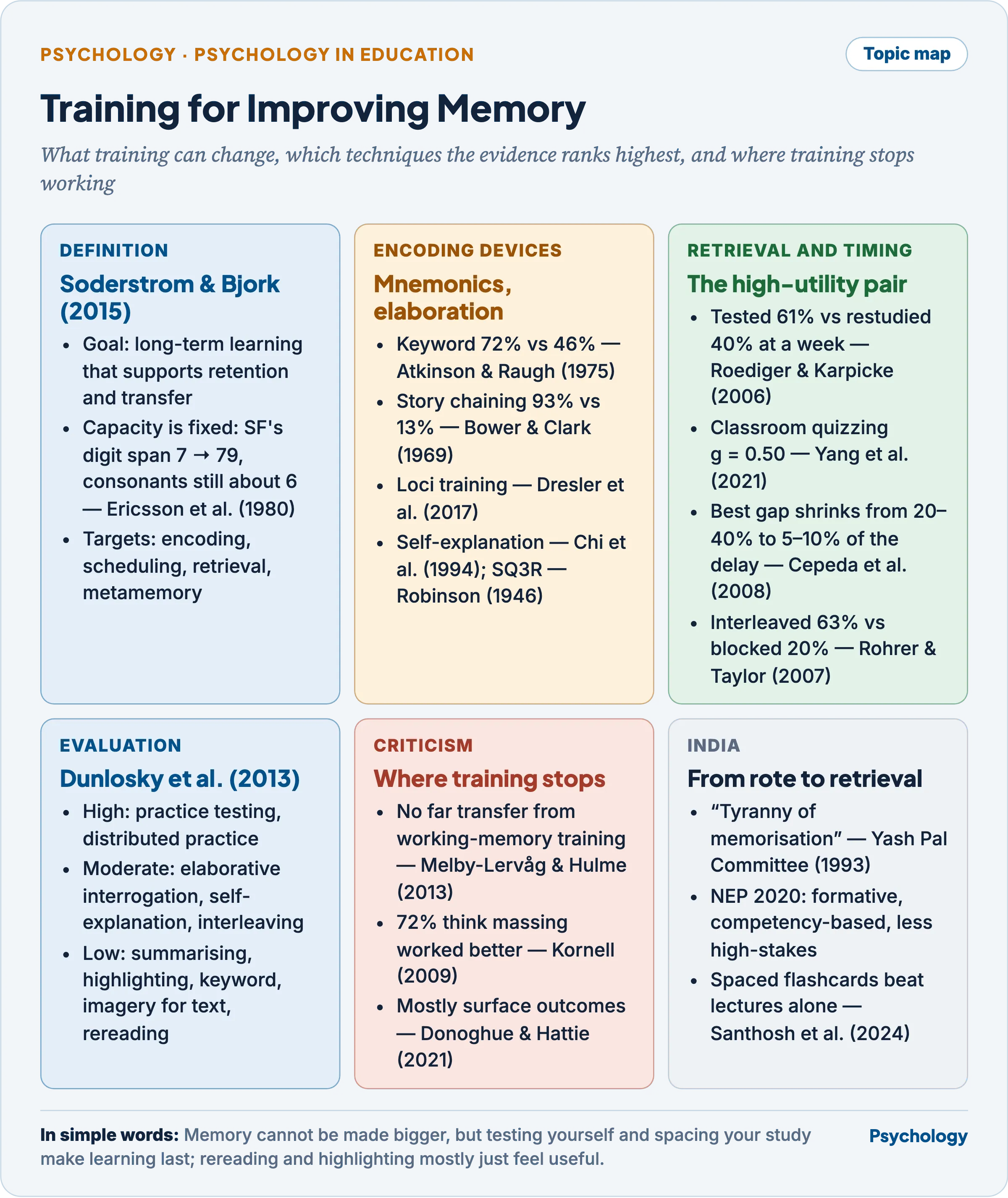
Students rely most on the techniques with the weakest evidence, and the best-supported ones are those that feel hardest.
Training for improving memory: what can be trained
- Practice improves strategy; capacity stays fixed. Ericsson, Chase and Faloon (1980): over 230 hours of practice raised an undergraduate’s digit span from 7 to 79 by recoding digits as running times; tested on consonants, his span stayed about six (Organisation and Mnemonic Techniques, Paper I).
- Training therefore works on four targets.
- Encoding — how material is processed at study: organisation, elaboration, imagery, mnemonics.
- Scheduling — when material is revisited: spacing and interleaving.
- Retrieval — practising recall instead of re-reading.
- Metamemory control — the learner’s monitoring of learning and the study decisions based on it (Nelson and Narens, 1990).
- Three principles explain why the techniques work.
- Depth of processing: meaning-based encoding outlasts encoding of sound or appearance (Craik and Lockhart, 1972).
- Encoding specificity (Tulving and Thomson, 1973) and transfer-appropriate processing (Morris, Bransford and Franks, 1977): memory is best when the processes used at test match those used at study, so practice should take the form the later use will take.
- The forgetting curve: loss is steepest soon after learning, and relearning is faster than first learning (Ebbinghaus, 1885), which is why revisiting pays.
- Desirable difficulties (Bjork, 1994) are conditions that slow acquisition but strengthen later retention and transfer: spacing, interleaving, varied practice and tests used as learning events. In Bjork’s words, “Manipulations that speed the rate of acquisition during training can fail to support long-term posttraining performance.”
- Students resist them because of the learning–performance distinction: performance during practice is an unreliable index of learning, yet learners read it as a reliable one (Soderstrom and Bjork, 2015).
Techniques and devices used to improve memory for better academic achievement
Mnemonic devices
- A mnemonic device is a cognitive cuing structure the learner builds at study and regenerates at recall; it must be constructible, discriminable, associable and invertible from cue to item (Bellezza, 1981).
- Method of loci — items are imaged at successive places on a familiar route and recalled by a mental walk; Cicero tells its origin, from Simonides, in De Oratore. It preserves order as well as content.
- Dresler and colleagues (2017) compared 23 memory athletes with matched controls and gave 51 mnemonic-naive men six weeks of daily loci training, n-back training or none.
- Loci trainees improved 72-word recall significantly more than both control groups, kept the gain four months later, and their connectivity shifted towards the athletes’ pattern; limitation: an all-male sample, word lists only.
- Peg-word system — a pre-learned rhyming list (one–bun, two–shoe) to which items are attached by images, giving direct access to any numbered position.
- Keyword method — a familiar word that sounds like part of a foreign word, linked to its meaning by an interacting image (Atkinson, 1975).
- Atkinson and Raugh (1975) taught 120 Russian words over three days: the keyword group recalled 72 per cent against 46 per cent on the comprehensive test, and 43 against 28 per cent six weeks later.
- Limitation: the experimenters supplied the keywords; the method is rated low utility because it helps with few materials and over short intervals (Dunlosky and colleagues, 2013).
- Narrative chaining — learners who wove 12 lists of 10 nouns into stories recalled 93 per cent on the final test against 13 per cent for controls (Bower and Clark, 1969).
- Verbal devices — acronyms, acrostics and rhymes, and chunking of items into meaningful units within the limit Miller (1956) described.
- Merits: quick, large gains for arbitrary material such as terminology, lists, classifications and dates. Demerits: they aid recall rather than comprehension, take time to construct, and help only with the items coded.
Organisation, elaboration and imagery
- Organisation — words presented in a conceptual hierarchy were recalled two to three times as well as the same words in random order (Bower, Clark, Lesgold and Winzenz, 1969); headings, tables and outlines do the same for a syllabus.
- Elaborative interrogation — asking why a stated fact is true, which ties it to prior knowledge (studied by Pressley, McDaniel, Turnure, Wood and Ahmad, 1987); it depends on the learner knowing enough to answer.
- Self-explanation — explaining each line or step to oneself.
- Chi, de Leeuw, Chiu and LaVancher (1994): 14 eighth-graders prompted to self-explain each line of a text on the circulatory system gained more than 10 who read it twice, and the high explainers all reached the correct mental model.
- Limitation: a tiny sample and a single text.
- Imagery — verbal and visual codes give two routes to retrieval (Paivio, 1971); imagery for text learning is low utility because it helps only some learners on some tasks (Dunlosky and colleagues, 2013).
- Concept mapping — node–link diagrams of concepts and their relations (Novak and Gowin, 1984).
- Nesbit and Adesope (2006), across 55 studies with 5,818 learners from Grade 4 to postsecondary, linked concept maps with better retention, with effects varying by use and comparison.
- Karpicke and Blunt (2011) found retrieval practice beat concept mapping, even on inference questions and on a final test that required drawing a concept map.
- SQ3R — Survey, Question, Read, Recite, Review (Robinson, 1946). Its working part is Recite, which is retrieval practice.
- McDaniel, Howard and Einstein (2009): read–recite–review beat rereading and note-taking on free recall, and matched note-taking on problem-solving in less study time.
- Nguyen and McDaniel (2016): it did not improve inference over note-taking unless learners also judged how well they could draw inferences.
Retrieval practice
- Retrieval practice produces the testing effect: recalling material strengthens it more than restudying it for the same time.
- Roediger and Karpicke (2006) had undergraduates study short science passages on the sun and on sea otters.
- Experiment 1, 120 students: restudying won at five minutes, 81 against 75 per cent; testing won at two days and at one week, 56 against 42 per cent (Roediger and Karpicke, 2006).
- Experiment 2, 180 students: four study periods (SSSS) gave 83 per cent at five minutes but 40 at a week; one study and three tests (STTT) gave 71 and 61 per cent; the SSSS group predicted the best recall (Roediger and Karpicke, 2006).
- Limitation: short texts, free recall, a laboratory.
- Karpicke and Roediger (2008): once a foreign word had been recalled, further study added nothing to delayed recall while further testing added a large gain; students’ predictions bore no relation to their performance.
- In classrooms, Yang and colleagues (2021) pooled 222 studies with 48,478 students: quizzing raised achievement by g = 0.499, more with corrective feedback and when quiz and examination formats matched.
- Recall tests give larger benefits than recognition tests (Rowland, 2014), and retrieving with varied examples improves transfer to new cases (Butler and colleagues, 2017).
- Objection: the effect may shrink as material grows more complex (van Gog and Sweller, 2015); Karpicke and Aue (2015) reply that retrieval practice still improves meaningful learning of complex material.
Spaced (distributed) practice
- Distributed practice spreads the same study time across sessions; massed practice is cramming.
- Cepeda and colleagues (2006) synthesised 839 assessments from 317 experiments: the gap that gives the best retention grows as the retention interval grows.
- Cepeda and colleagues (2008), with more than 1,350 learners tested up to a year later: the best gap was about 20–40 per cent of a one-week test delay but only 5–10 per cent of a one-year delay.
- Bahrick, Bahrick, Bahrick and Bahrick (1993): four family members relearnt 300 foreign-word pairs over nine years; 13 sessions 56 days apart matched 26 sessions 14 days apart, with retention tested up to five years later.
- Kornell (2009): spacing beat massing for 90 per cent of participants, yet 72 per cent believed massing had worked better.
- Mechanism: a spaced repetition forces partial retrieval of the earlier trace and stores it in a new context, whereas a massed repetition meets a trace that is still active and gets shallow processing.
- Limitation: acquisition is slower (Bahrick and colleagues, 1993), schedules are hard to keep, and the best gap depends on when the knowledge will be needed.
Interleaved practice
- Interleaving mixes problem types within a session; blocking finishes one type before starting the next.
- Rohrer and Taylor (2007) taught students to find the volumes of four solids.
- Blocked practice scored higher during practice, 89 against 60 per cent; a week later interleaved learners scored 63 per cent and blocked learners 20 (Rohrer and Taylor, 2007).
- Interleaving makes the learner choose the method, which blocking does for them; limitation: only 18 undergraduates (Rohrer and Taylor, 2007).
- Kornell and Bjork (2008): interleaving paintings by different artists improved identification of new paintings, yet learners rated blocking more effective even after their own scores showed the opposite.
- Brunmair and Richter (2019), 59 studies: g = 0.42 overall, 0.67 for paintings and 0.34 for mathematics, but blocking was better for word learning.
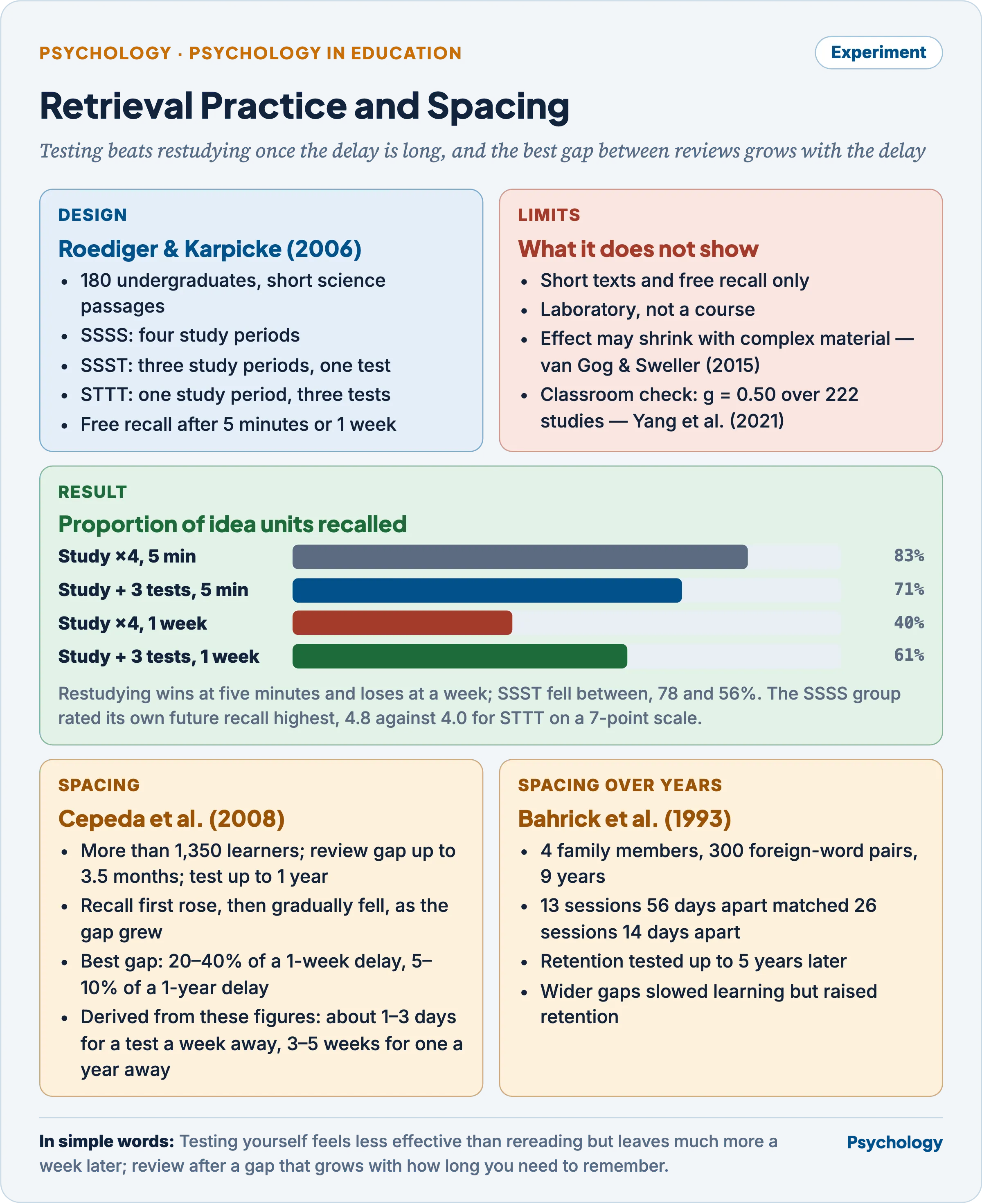
Restudying wins at five minutes and loses at a week, and the best gap between sessions widens as the test moves further away.
Evaluation of the techniques for academic achievement
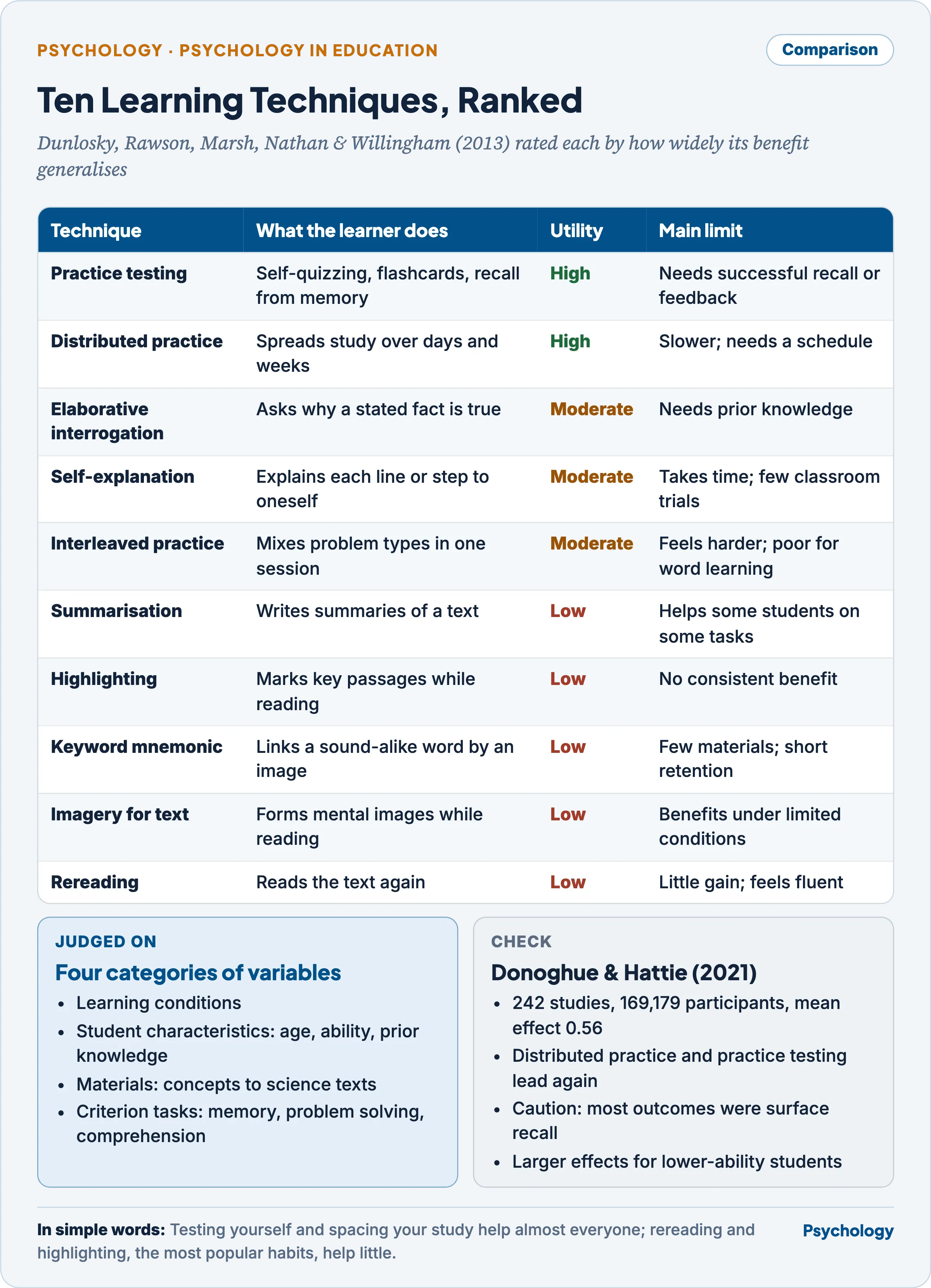
A technique ranks high when its benefit holds across learners, materials and kinds of test.
- Dunlosky, Rawson, Marsh, Nathan and Willingham (2013) rated ten techniques by whether their benefits generalise across four categories of variables: learning conditions, student characteristics, materials and criterion tasks.
- High utility: practice testing and distributed practice, which help learners of different ages and abilities, on many tasks, including in classrooms.
- Moderate utility: elaborative interrogation, self-explanation and interleaved practice, promising but little tested in educational settings.
- Low utility: summarisation, highlighting, the keyword mnemonic, imagery for text and rereading. Highlighting and rereading do not consistently help, so techniques such as practice testing should replace them.
- Donoghue and Hattie (2021) meta-analysed the same ten (242 studies, 169,179 participants, mean effect 0.56): distributed practice and practice testing again led, but most outcomes measured surface recall, and effects were larger for lower-ability students.
- Criticisms of the ranking: it rests mainly on laboratory studies with short delays, a low rating can mean too few studies rather than no effect, and motivation is left out.
Merits and demerits for teaching undergraduate students
- Deep and surface approaches — Marton and Säljö (1976) found Swedish university students reading the same prose either for its meaning (deep) or to reproduce it (surface); Biggs (1987) measured the approaches with the Study Process Questionnaire.
- Memorising can serve understanding. In the paradox of the Chinese learner (Watkins and Biggs, 1996), repetition is used to deepen understanding, with memorising and understanding alternating (Marton, Dall’Alba and Tse, 1996).
- The illusion of competence keeps undergraduates on weak strategies: of 177 college students surveyed, most reread their notes or textbook and few practised recall (Karpicke, Butler and Roediger, 2009).
- On transfer, Hattie, Biggs and Purdie (1996), from 51 studies, concluded that training “other than for simple mnemonic performance should be in context, use tasks within the same domain as the target content, and promote a high degree of learner activity and metacognitive awareness.”
- Constructive alignment (Biggs, 1996): students learn what assessment rewards, so an examination that asks for reproduction undoes any training in deep strategies.
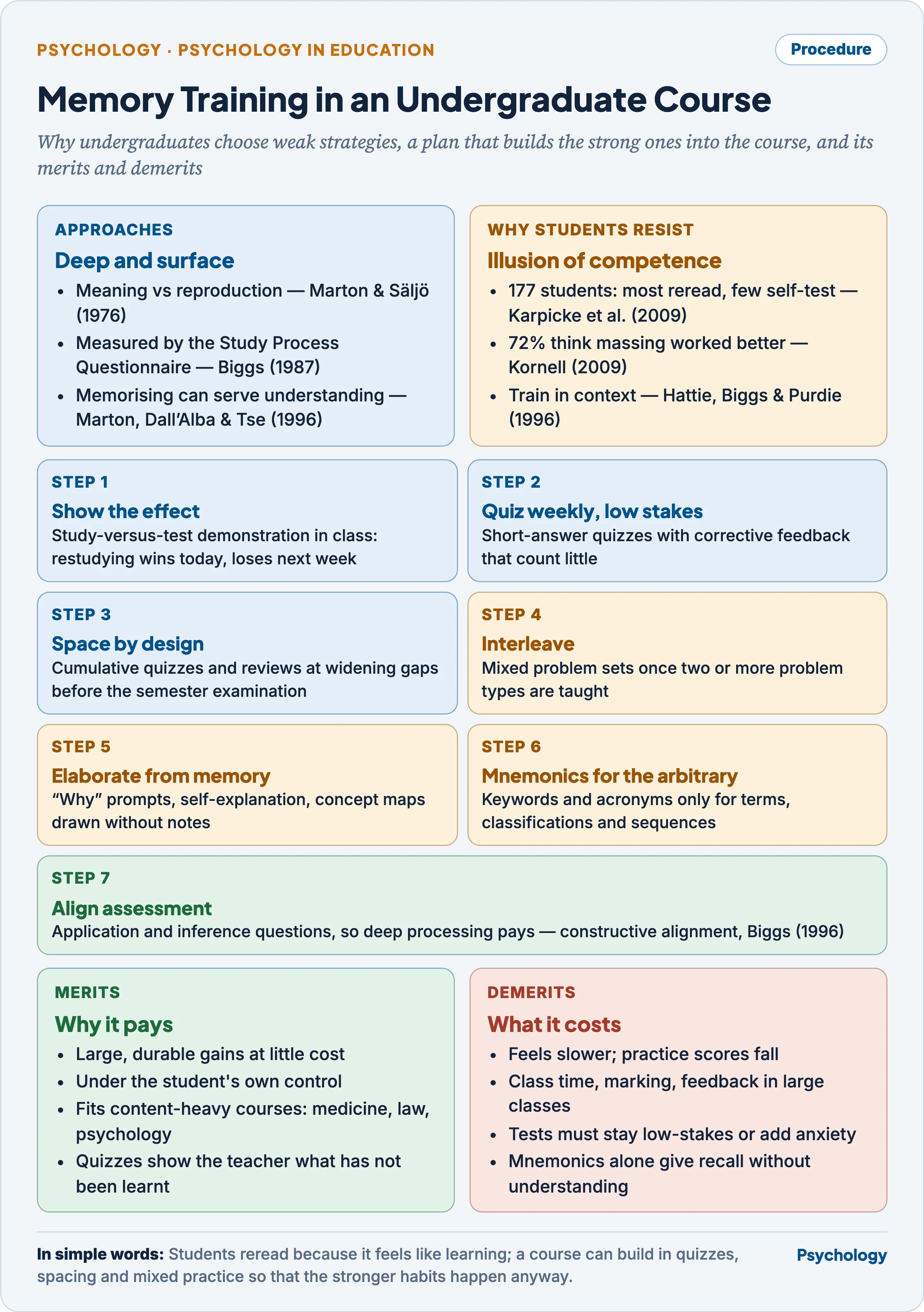
Each step makes a high-utility technique part of the course routine, so students use it even when rereading feels more productive.
A memory-training plan for an undergraduate course
- Show the effect: an in-class study-versus-test demonstration, restudying winning today and losing next week.
- Low-stakes quizzing: weekly short-answer quizzes with corrective feedback, counting little towards the grade.
- Spacing by design: cumulative quizzes and reviews at widening gaps, timed against the semester examination.
- Interleaving: mixed problem sets once two or more problem types have been taught.
- Elaboration from memory: “why” prompts, self-explanation of worked examples, concept maps drawn without notes.
- Mnemonics for the arbitrary: keywords and acronyms only for terminology, classifications and sequences.
- Aligned assessment: application and inference questions, so that deep processing pays.
- Merits: large, durable gains at little cost; techniques under the student’s own control; a good fit for content-heavy courses such as medicine, law and psychology; and quizzes show the teacher what has not been learnt.
- Demerits: the techniques feel slower and harder, so students resist them and practice scores fall; quizzing costs class time and marking, and feedback is hard in large classes.
- Frequent tests must stay low-stakes or they add to examination anxiety, and mnemonics used in place of understanding give recall without competence.
Memory-training programmes and the far-transfer debate
- Working-memory training practises span tasks to raise capacity itself; the model it targets is in Short-Term and Working Memory (Paper I).
- Jaeggi, Buschkuehl, Jonides and Perrig (2008) reported that dual n-back training raised fluid intelligence, and that gains rose with the amount of training.
- Redick and colleagues (2013) gave 20 sessions of adaptive dual n-back against an active visual-search control and a no-contact group: both trained tasks improved, and no cognitive ability test showed transfer.
- Melby-Lervåg and Hulme (2013), 23 studies: short-term near transfer to working memory and no convincing far transfer to verbal or non-verbal ability, word decoding or arithmetic. Melby-Lervåg, Redick and Hulme (2016), 87 publications and 145 comparisons, found the same against treated controls.
- Simons and colleagues (2016) found extensive evidence of gains on trained tasks, less on closely related tasks and little on distant tasks or everyday cognition; Gobet and Sala (2023) describe the overall far-transfer effect as null.
- ACTIVE trial (Ball and colleagues, 2002): 2,832 adults aged 65–94 had ten sessions of memory, reasoning or speed training; each improved its own ability for two years, but only 26 per cent of memory trainees improved reliably, and everyday functioning did not benefit.
- Lumosity’s makers paid $2 million to settle charges of claiming that their games improved school and work performance (US Federal Trade Commission, 2016).
Criticisms and limitations
- Most studies use word lists and short texts, delays of days or weeks, and undergraduate volunteers; classroom trials are fewer (Dunlosky and colleagues, 2013).
- Outcomes are mostly factual recall, so gains in understanding and transfer are less certain (Donoghue and Hattie, 2021).
- Learners rate the effective techniques as the weaker ones (Kornell and Bjork, 2008), so explaining them may not change habits, and courses have to build them in.
- Mnemonics help retain arbitrary items without building understanding, and over-use feeds rote learning.
- Retrieval practice needs successful retrieval or feedback, and its advantage with very complex material is disputed (van Gog and Sweller, 2015).
- No technique trains memory as a general capacity, and working-memory training does not transfer (Melby-Lervåg, Redick and Hulme, 2016).
- Memory is one input to achievement among several; motivation, prior knowledge, teaching and home background are treated in Better Academic Achievement and Underachievement.
Indian context
- Rote memorisation and its critique. The Yash Pal Committee report Learning Without Burden (1993) judged that “the more pernicious burden is that of non-comprehension”.
- It recommended concept-based board questions to save children “from the tyranny of memorisation”; the classroom side of this critique is in Constructivist Teaching and the Indian Classroom.
- Memorisation as a trained skill. Hartzell and colleagues (2016), with the National Brain Research Centre, Manesar, scanned 21 Vedic Pandits, trained for about ten years to recite texts of 40,000–100,000 words, against 21 matched controls.
- Grey-matter density and cortical thickness were greater in lateral temporal language cortex, the anterior cingulate and the hippocampus (Hartzell and colleagues, 2016).
- Limitation: a cross-sectional design cannot separate training from selection; the tradition itself is in Organisation and Mnemonic Techniques (Paper I).
- Indian studies of the techniques with students:
- Santhosh and colleagues (2024), KLE VK Institute of Dental Sciences, Belagavi: a randomised trial with 90 dental students, in which lecture plus spaced-repetition flashcards gave higher retention than lecture alone at one and three months.
- Vagha and colleagues (2025), Jawaharlal Nehru Medical College, Wardha, with 90 final-year medical students: flashcards reviewed at 1, 3, 7, 14 and 28 days lifted post-test scores to 16.24 of 20 against 11.89 for controls; quasi-experimental, not randomised.
- Bobby and Meiyappan (2018), JIPMER, Puducherry: an open-book short-answer examination after biochemistry lectures produced larger gains than self-study among first-year MBBS students.
- Kancharla, Kanagaraj and Gopal (2023) surveyed 350 South Indian medical students: most believed they had an exceptional memory although most reported forgetting information, a metamemory blind spot.
- National Education Policy 2020 (Ministry of Education; Union Cabinet, 29 July 2020) aims to move education “towards real understanding and towards learning how to learn – and away from the culture of rote learning” (para 4.4).
- Assessment is to become “more regular and formative” and “competency-based” (para 4.34), and colleges are to “move away from high-stakes examinations towards more continuous and comprehensive evaluation” (para 12.2).
- Principle: frequent, low-stakes, application-level assessment is spaced retrieval practice with transfer-appropriate processing, built into the institution.
- Two Class 10 board examinations (Central Board of Secondary Education, first held in 2026): a compulsory February sitting and an optional May sitting to improve up to three subjects, as NEP 2020 allows “up to two occasions” (para 4.37).
- Principle: a second sitting lowers the stakes of any one examination; whether it reduces cramming has not yet been evaluated.
Previous Year Questions
- 2020Describe and evaluate the techniques used in the training for memory development.
- 2011What are the techniques and devices used in improving memory to ensure better academic achievements? Discuss.
- 2008Describe the various techniques used in improving memory. Discuss their merits and demerits for teaching students in undergraduate courses.
- 2006Write a short note on: Training for improving memory and better academic achievement.
