

Official syllabusPaper II · Unit 5 · Application of Psychology to Educational Field
Learning styles.
Definition
“Learning styles are characteristic cognitive, affective, and physiological behaviors that serve as relatively stable indicators of how learners perceive, interact with, and respond to the learning environment.”
Keefe (1979)
Learners plainly differ in how they prefer to take in and work on material, and dozens of models classify those differences. Whether teaching each learner in a matched mode improves learning is a separate, empirical question, and controlled experiments answer it largely in the negative. Knowledge of style still has uses in teaching, guidance and counselling, but they are narrower than classroom folklore claims.
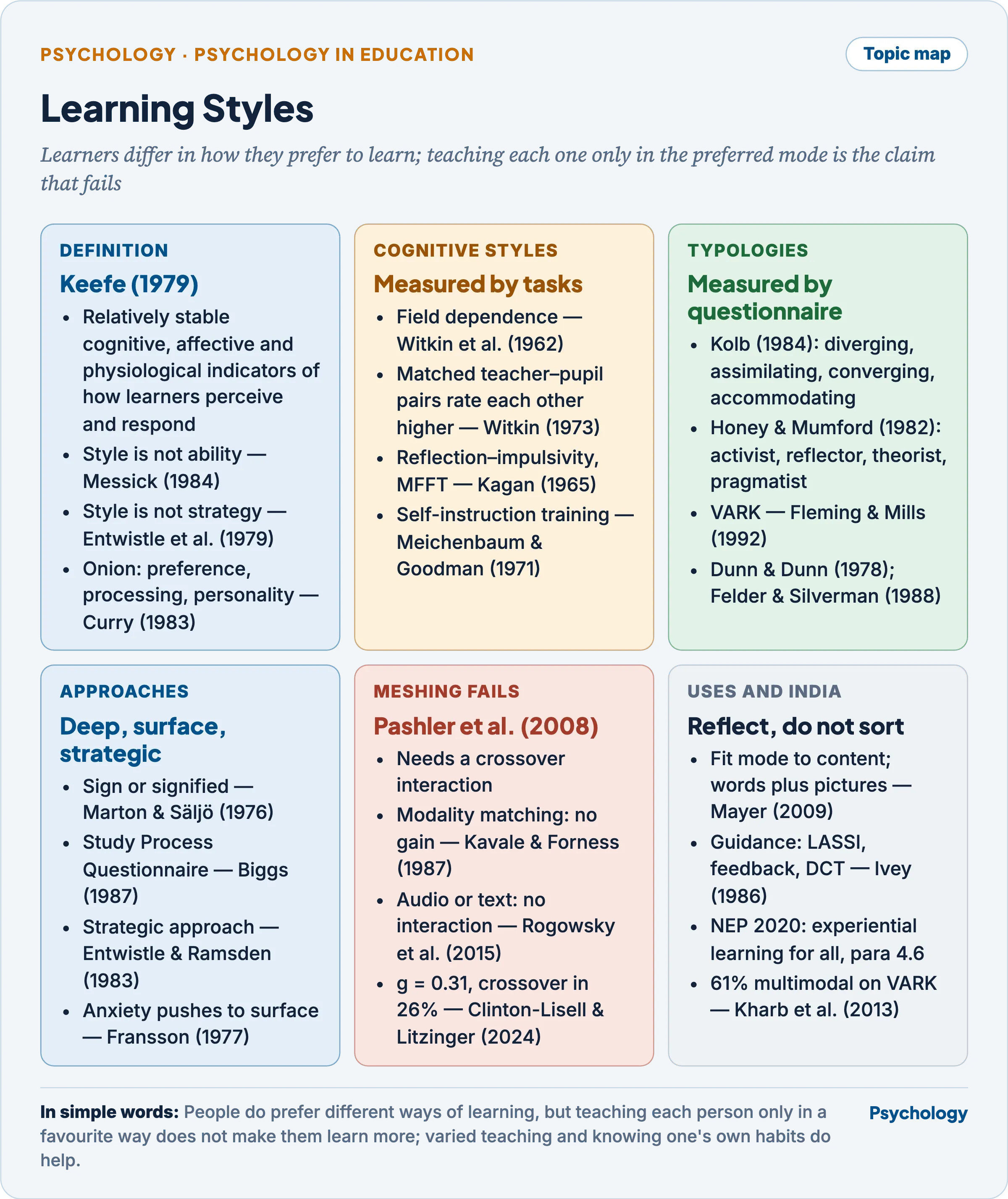
The top row describes how learners differ; the bottom row shows style knowledge helping reflection and guidance while matching fails its tests.
Learning styles: meaning, and style versus ability
- A learning style is a learner’s habitual preference in perceiving, organising and engaging with material. Keefe adds two claims the research then tests: that the preference is relatively stable, and that it spans cognitive, affective and physiological behaviour.
- Style versus ability: Messick (1984) held that abilities are unipolar and value-directional, so more is better, whereas styles are bipolar, each pole adaptive somewhere. Field dependence is tested against this in Perceptual Defence, Perceptual Styles and Personality (Paper I).
- Style versus strategy, as Entwistle, Hanley and Hounsell (1979) put it:
- a strategy is the way “a student chooses to deal with a specific learning task in the light of its perceived demands”;
- a style is “a broader characterisation of a student’s preferred way of tackling learning tasks generally”.
- Curry’s (1983) onion model orders the constructs by stability.
- Instructional preference — the outer layer: preferred setting and medium; easiest to change, least important for learning.
- Information-processing style — the middle layer: habitual ways of taking in and organising information.
- Cognitive personality style — the core, such as field dependence: most stable, most consequential in complex learning.
The various learning styles
Cognitive styles: field dependence–independence and reflection–impulsivity
- Field dependence–independence (Witkin, Dyk, Faterson, Goodenough and Karp, 1962) is the extent to which perception is governed by the surrounding field; its tests are in the Paper I article.
- Witkin, Moore, Goodenough and Cox (1977) reviewed how students learn, how teachers teach, how the two interact, and how students choose fields of study.
- Field-independent learners restructure material for themselves; field-dependent learners attend more to social cues and lean towards people-oriented fields.
- Teacher and student matched in style rated each other positively, and mismatched pairs negatively (Witkin, 1973, drawing on DiStefano, 1969); the finding concerns mutual liking.
- A longitudinal study found field dependence unrelated to school and college grade-point average, though field-dependent students favoured interpersonal fields such as elementary education (Witkin, Moore, Oltman and colleagues, 1977).
- Reflection–impulsivity (Kagan, Rosman, Day, Albert and Phillips, 1964) is the tendency, when the answer is uncertain, to respond fast with errors or slowly with accuracy.
- The Matching Familiar Figures Test (Kagan, 1965) shows a standard picture beside six variants, one identical, over twelve items scored for latency and errors.
- Impulsive children are fast and inaccurate, reflective children slow and accurate; Kagan (1965) linked impulsivity to more errors in primary-grade reading.
- Limitation: many children are fast and accurate, or slow and inaccurate, and the construct does not explain them.
- The tempo is trainable: Meichenbaum and Goodman (1971) taught impulsive children to talk themselves through tasks, the method set out in Programmed, Probability and Self-Instructional Learning (Paper I).
Kolb’s experiential learning styles
- Kolb (1984): “learning is the process whereby knowledge is created through the transformation of experience”, a theory built on Dewey, Lewin and Piaget.
- Four modes form a cycle: concrete experience (CE), reflective observation (RO), abstract conceptualisation (AC) and active experimentation (AE).
- Two bipolar dimensions underlie them: grasping experience by apprehension (CE) or comprehension (AC), and transforming it by intention (RO) or extension (AE).
- A style is the pair of modes a person relies on.
- Diverging (CE and RO): imaginative, sees many perspectives, interested in people and feelings.
- Assimilating (AC and RO): builds theoretical models, reasons inductively, values logical soundness over practicality.
- Converging (AC and AE): problem solving, decision making, practical application; prefers technical to interpersonal problems.
- Accommodating (CE and AE): learns by doing and new experience, solves problems by trial and error.
- The Learning Style Inventory (1976; revised 1985 and 1999) has respondents rank four endings to each of nine items (twelve from 1985), an ipsative format in which a high score on one mode forces lower scores on the others.
- Kolb (1984) mapped disciplines onto styles: business and management students accommodating; engineering converging; history, English and psychology diverging; mathematics, chemistry and sociology assimilating.
- Kolb’s teaching rule is to take every learner round the whole cycle (experience, reflection, theory, application), since effective learning needs all four modes.
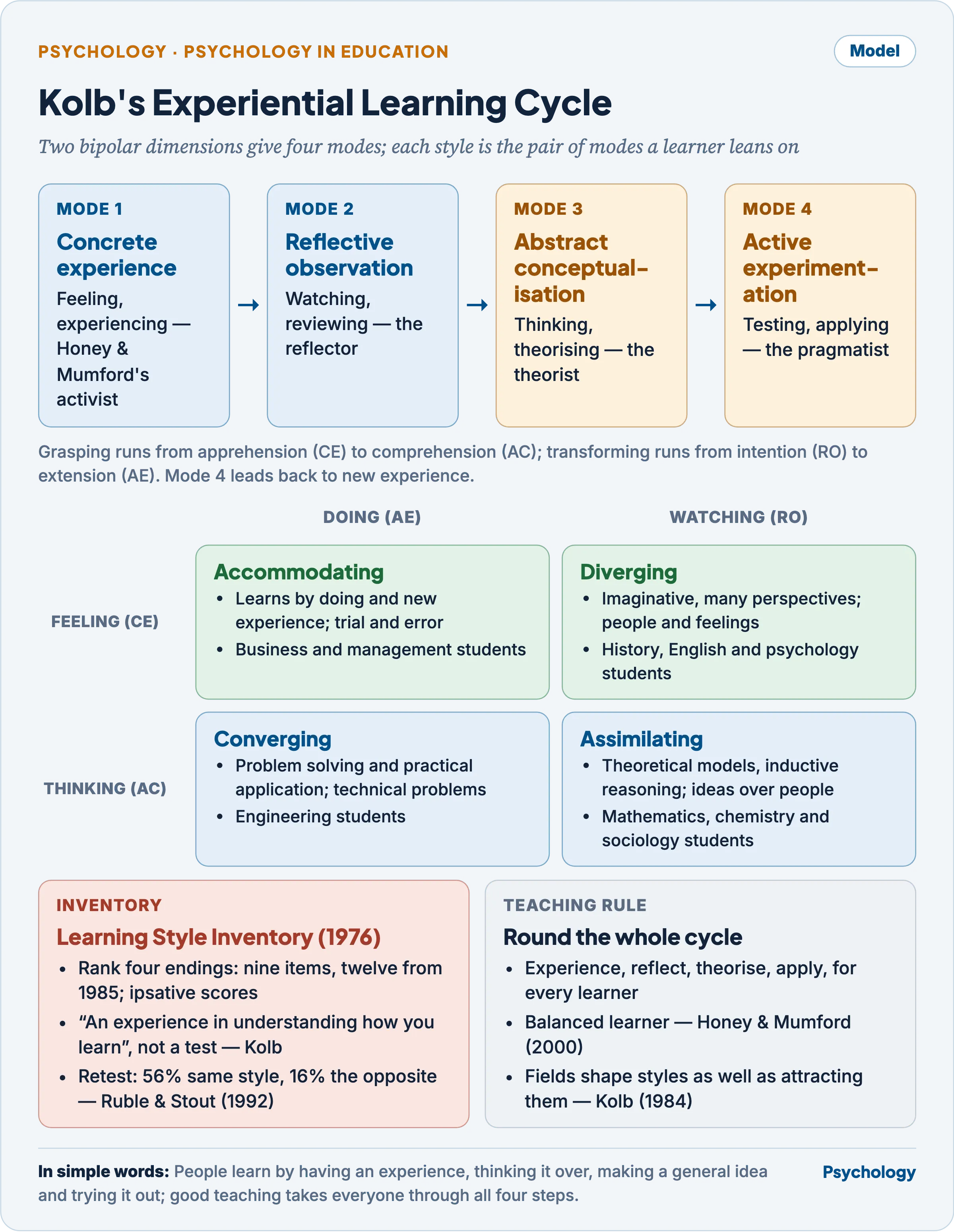
Each style is two adjacent modes, and the cycle asks every learner to pass through all four, so it tells a teacher how to sequence a lesson for the whole class.
Honey and Mumford’s learning styles
- Honey and Mumford (1982) found Kolb’s inventory had low face validity with managers and built the Learning Styles Questionnaire: 80 items, 20 per style, ticked or crossed, probing everyday behaviour rather than asking how people learn.
- A learning style is “a description of the attitudes and behaviour which determine an individual’s preferred way of learning” (Honey and Mumford, 1992). The styles align with Kolb’s stages.
- Activist — experiencing; plunges into new tasks.
- Reflector — reviewing experience and mulling over data before acting.
- Theorist — drawing conclusions into logical models.
- Pragmatist — planning the next step and testing whether ideas work.
- The aim is the balanced learner, proficient at every stage; styles are “modifiable at will” (Honey and Mumford, 2000).
Modality models: VARK and the Dunn and Dunn model
- VARK (Fleming and Mills, 1992), devised at Lincoln University, New Zealand, split the visual channel of the older visual–aural–kinaesthetic scheme in two.
- Visual — graphs, charts and symbols; Aural — lectures and discussion; Read/write — printed words; Kinaesthetic — experience and practice, real or simulated.
- Respondents could tick several answers to each of thirteen questions, twelve set in everyday situations, so many profiles are multimodal.
- The authors called it a “catalyst for reflection”, judged testing its validity and reliability “unnecessary and inappropriate”, and doubted that teachers could match a class’s diversity; students were to adjust their own learning metacognitively.
- Dunn and Dunn (1978) built the most elaborate matching model in schools, defining style as “the way in which individuals begin to concentrate on, process, internalise and retain new and difficult academic information” (Dunn and Dunn, 1992).
- Environmental — sound, light, temperature, seating.
- Emotional — motivation, persistence, responsibility, need for structure.
- Sociological — alone, in pairs, with peers, in a team, with an adult.
- Physiological — perceptual modality (visual, auditory, tactile, kinaesthetic), intake, time of day, mobility.
- Psychological — global or analytic, impulsive or reflective; added later.
- The model prescribes rearranging rooms, grouping and materials to fit measured preferences; Dunn (2003) claimed matched students score three-quarters of a standard deviation higher.
Felder and Silverman’s model
- Felder and Silverman (1988), writing for engineering teachers, classified how students receive and process information on five dimensions: sensing–intuitive (from Jung), visual–auditory, inductive–deductive, active–reflective (from Kolb) and sequential–global.
- Felder (2002) dropped the inductive–deductive dimension, judging induction the better method below graduate level, and renamed visual–auditory as visual–verbal.
- The prescription was balance: teaching to “both poles of each of the given dimensions” serves most students. Its Index of Learning Styles was, by Felder’s 2002 account, not yet validated.
Approaches to learning: deep, surface and strategic
- Marton and Säljö (1976) had Swedish university students read prose passages, then asked what the passages meant and how they had read them.
- Surface-level processing: attention to the text itself, “the sign”.
- Deep-level processing: attention to what is signified, what the author means.
- In a follow-up, two groups of 20 first-year students received factual or meaning questions after two of three textbook sections, and adapted their learning to what they thought was required.
- Limitation of both studies: small samples, and reading processes inferred from what students said about themselves.
- Biggs (1987) measured surface, deep and achieving approaches with the Study Process Questionnaire; the revised two-factor version keeps deep and surface, ten items each (Biggs, Kember and Leung, 2001).
- Entwistle and Ramsden (1983) described the strategic approach: organising effort around assessment cues, using deep or surface processing as the task rewards.
- Approaches shift with context: Fransson (1977) found test anxiety and lack of interest pushed students towards surface processing.
- Problem-based curricula raise deep approaches slightly, an effect size of .11 across 21 studies (Dolmans, Loyens, Marcq and Gijbels, 2016). The underlying theory is in Levels of Processing (Paper I).
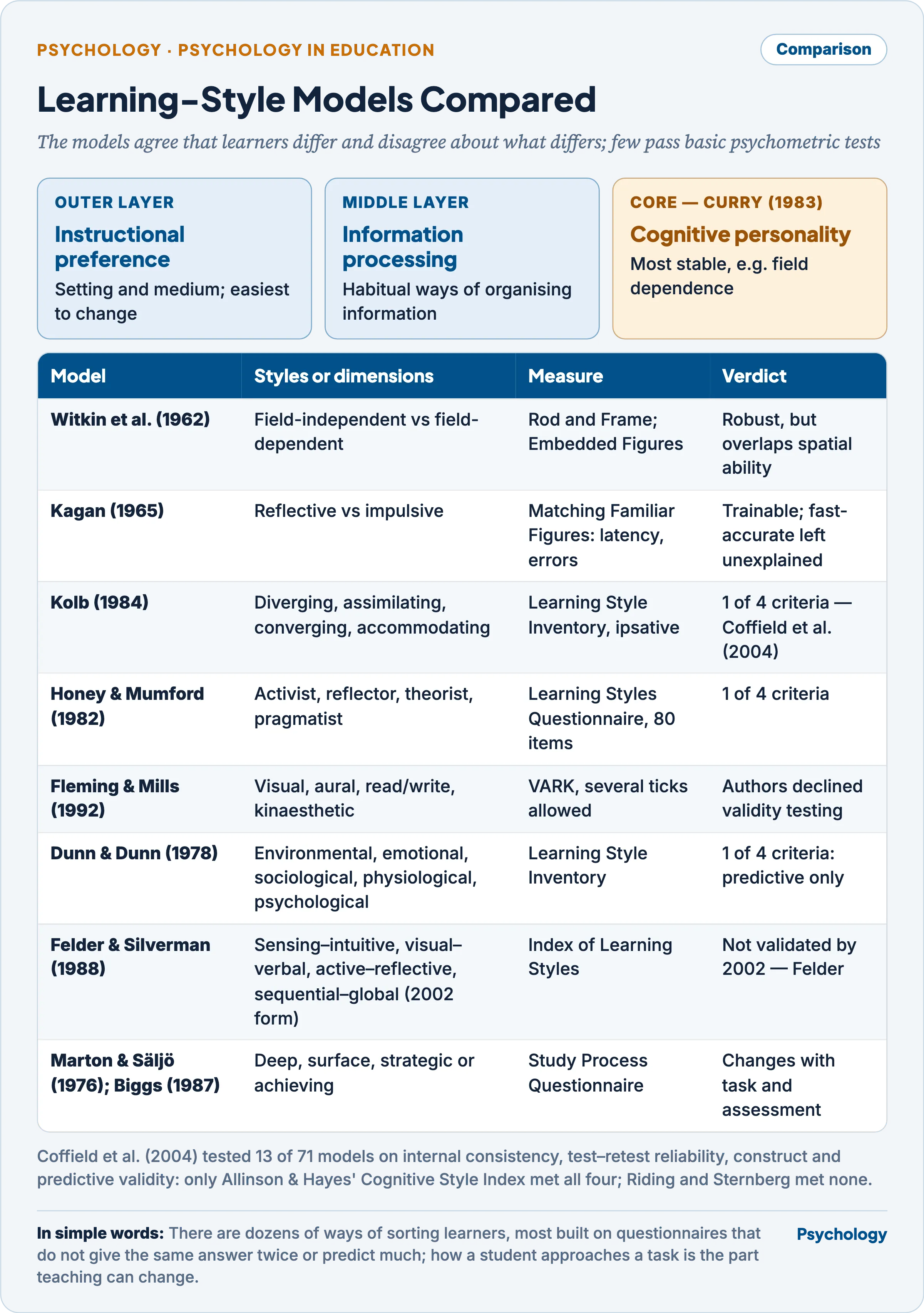
The models agree that learners differ but each measures a different thing, and only the approaches row describes something teaching and assessment can change.
Learning styles and effective teaching-learning
The conditions under which teaching-learning occurs are set out in Psychological Principles Underlying Effective Teaching-Learning. Here the question is what knowledge of style adds.
How knowledge of learning style is claimed to contribute
- Matching, the strong claim: teach each learner in the preferred mode and learning improves. Dunn and Dunn prescribe it.
- Balance: vary methods so every style is served some of the time, as in Kolb’s cycle and Felder and Silverman’s two poles.
- Learner self-knowledge: learners who know their habits can adjust their strategies, Fleming and Mills’ purpose for VARK.
- Teacher self-knowledge: Honey and Mumford (2000) observed that managers who encourage learning do so in ways consistent with their own styles; teachers do the same unless they notice it.
- Belief in matching is near universal.
- 93% of British and 96% of Dutch teachers agreed that individuals learn better in their preferred style (Dekker, Lee, Howard-Jones and Jolles, 2012).
- Across 37 studies of 15,405 educators in 18 countries the figure was 89.1% (Newton and Salvi, 2020).
The meshing hypothesis and its evidence
- Pashler, McDaniel, Rohrer and Bjork (2008) named the matching claim the meshing hypothesis and specified the experiment it needs.
- Classify learners by style, randomly assign each style group to each method, and give everyone the same test.
- Support requires a crossover interaction: the method best for one style must not be best for the other.
- Very few studies used this design, and several of those that did contradicted the hypothesis: “there is no adequate evidence base to justify incorporating learning-styles assessments into general educational practice”.
- They did not deny that preferences and aptitude differences exist, and noted that many versions were untested.
- Kavale and Forness (1987), pooling 39 aptitude–treatment studies in special education, found neither modality assessment nor modality-matched instruction efficacious.
- Massa and Mayer (2006) found no aptitude–treatment interaction for verbalisers and visualisers in a multimedia lesson, and pictures aided adults’ recall whatever their imagery preference (Constantinidou and Baker, 2002).
- Rogowsky, Calhoun and Tallal (2015) ran Pashler’s design with adults classed as auditory or visual learners and taught by audiobook or e-text: no style-by-method interaction on immediate or two-week comprehension. The result held with 125 fifth graders (Rogowsky, Calhoun and Tallal, 2020).
- Knoll, Otani, Skeel and Van Horn (2017) found that style predicted how confident learners felt about remembering matched material; their actual recall of it was no better.
- Of 426 anatomy students, most did not study in line with their VARK result, and those who did fared no better; particular strategies tracked grades (Husmann and O’Loughlin, 2019).
- Clinton-Lisell and Litzinger (2024) meta-analysed 21 studies with 1,712 participants: a small pooled benefit (g = 0.31), but only 26% of outcome measures showed the crossover, and the authors judged the gain too small and infrequent to justify the cost.
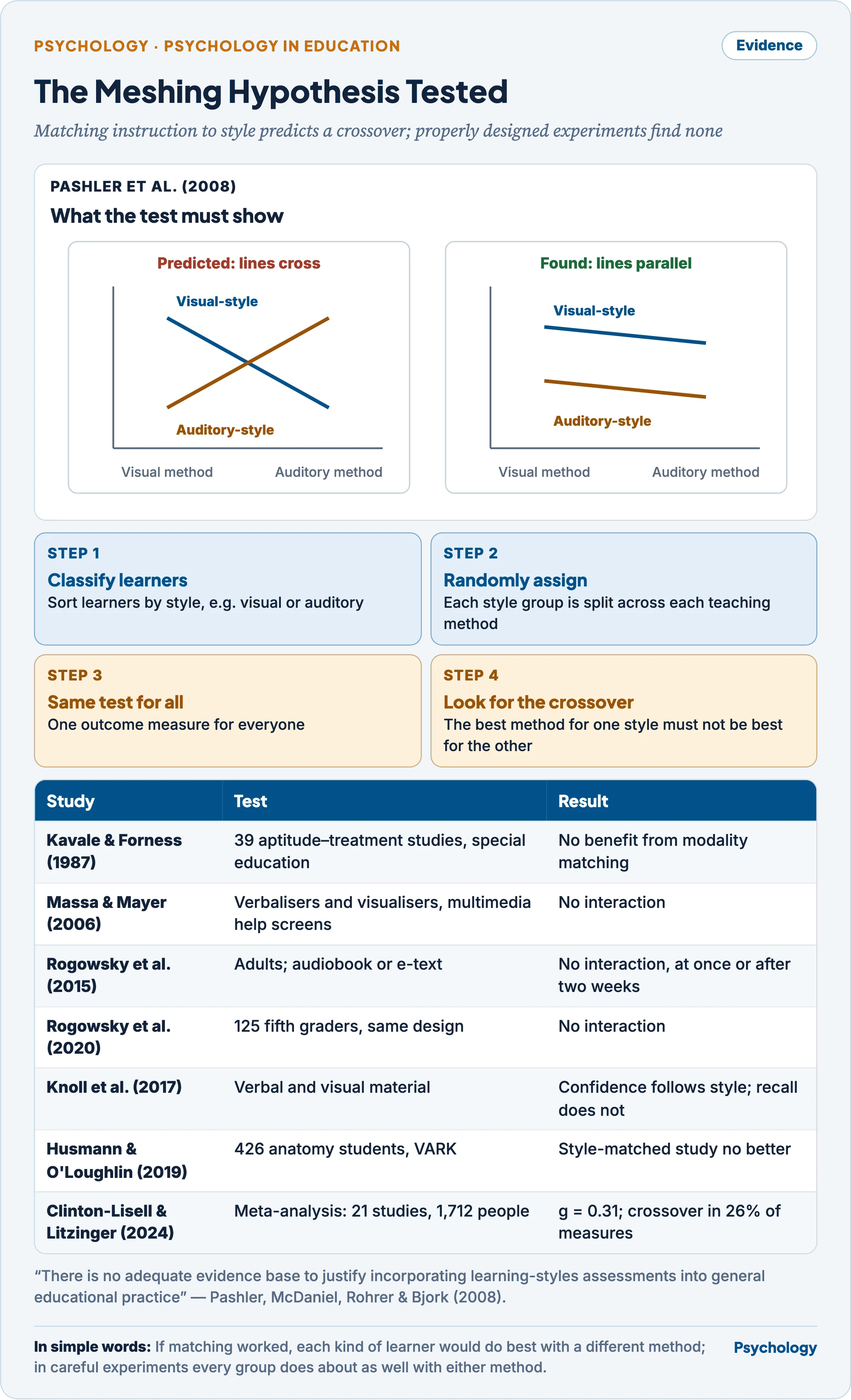
Meshing predicts lines that cross; the experiments that test it keep finding lines that run parallel.
What survives: what knowledge of learning style can contribute
- Fit the mode to the content, for everyone: maps for geography, diagrams for circuits, spoken models for pronunciation. Coffield, Moseley, Hall and Ecclestone (2004) found no evidence that matching to sensory strengths beats content-appropriate presentation for all.
- Several representations for all: words with pictures beat words alone across learners, the multimedia principle (Mayer, 2009) resting on dual coding (Paivio, 1971).
- Metacognitive awareness: an inventory used as a prompt gives a vocabulary for how learning happens (see Metamemory, Paper I). Study-skills training works best in context, within the subject, with active learners and metacognitive awareness (Hattie, Biggs and Purdie, 1996, 51 studies).
- Assessment design: students study for the test they expect, so constructive alignment (Biggs, 1996) builds assessment that rewards deep processing.
- Universal Design for Learning (Rose and Meyer, 2002) gives every learner multiple means of representation, engagement and expression instead of diagnosing and sorting.
Use of learning styles in educational guidance and counselling
- Step 1 — Referral and need: study difficulties, poor results despite effort, subject or stream choice, friction with a teacher.
- Step 2 — Assessment for reflection, not diagnosis: VARK or the Learning Styles Questionnaire opens the conversation.
- The two-factor Study Process Questionnaire and the Learning and Study Strategies Inventory (Weinstein, Schulte and Palmer, 1987; ten scales from anxiety to self-testing) locate teachable gaps; the tests are treated in Use of Psychological Tests in Educational Institutions.
- Step 3 — Feedback interview: preferences presented as current habits, not a fixed type, with the goal of a wider repertoire, Honey and Mumford’s balanced learner.
- Step 4 — Study-skills counselling: replace surface habits with self-explanation, retrieval and spaced practice and concept maps (Training for Improving Memory); self-instruction for impulsive pupils; study schedules (Better Academic Achievement and Underachievement).
- Step 5 — Teacher consultation: help teachers vary methods, present content in the mode that suits it, and notice when a style mismatch colours their judgement of a pupil.
- Step 6 — Educational and vocational guidance: style is one input beside interests (Interests: Nature, Structure and Measurement, Paper I), aptitude and values.
- Kolb (1984) adds that people “are further shaped to fit the learning norms of their field once they are in it”, so a profile partly records training rather than predicting fit.
- Step 7 — The counselling relationship: Developmental Counselling and Therapy (Ivey, 1986) identifies a client’s dominant style — sensorimotor, concrete, formal or dialectic/systemic — works within it, then helps the client use less-used styles, so matching serves only as the opening phase.
- Step 8 — Follow-up: judge success by study behaviour and results rather than by a retested style score.
- Limits: unreliable self-report instruments, labels that become excuses (“I am not a reading learner”), weak prediction of career success, Western norms. Programme design is in Educational and Vocational Guidance; career theories in Career Counselling.
Criticisms and limitations
- Too many models: Coffield and colleagues (2004) identified 71 and evaluated the 13 most influential in depth.
- Weak psychometrics: judged on internal consistency, test–retest reliability, construct and predictive validity, only Allinson and Hayes’ Cognitive Style Index met all four; Dunn and Dunn, Honey and Mumford and Kolb met one each; Riding and Sternberg none (Coffield and colleagues, 2004).
- On retest of Kolb’s inventory, 56% kept the same style and 16% switched to the opposite one (Ruble and Stout, 1992).
- The central claim fails: matching has not survived properly designed tests (Pashler and colleagues, 2008; Clinton-Lisell and Litzinger, 2024).
- Labelling: Kolb warned against “the reification of learning styles into fixed traits, such that learning styles become stereotypes used to pigeonhole individuals and their behaviour” (Kolb, 1981).
- Style or ability: field independence correlates with verbal, mathematical and spatial skills (Kogan, 1973), and Messick (1984) conceded that field dependence is “essentially measured by default”, undercutting the value-neutral pole his definition needs.
- Partisan evidence: about a third of the Dunn and Dunn bibliography is doctoral and master’s dissertations, and its originator called external criticism “biased” (Coffield and colleagues, 2004).
- Cultural bias: the deep–surface contrast files memorising under surface learning.
- Among 48 Chinese and 18 German students in Hong Kong, the Chinese sometimes paired repetition with “attentive effort” to deepen understanding; the Germans played down its role in understanding (Dahlin and Watkins, 2000).
- The 1985 Kolb inventory gave no stable measure with a non-Western sample (Lam, 1997).
- Opportunity cost: Willingham, Hughes and Dobolyi (2015) argue that educators’ time and energy are better spent on other theories that might aid instruction.
- On balance, preferences are real and an inventory can open a conversation about learning, but measurable gains come from work on approaches to learning and metacognition.
Indian context
- National Education Policy, 2020 (Ministry of Education; approved by the Union Cabinet on 29 July 2020) never uses the term “learning styles”, committing instead to “recognizing, identifying, and fostering the unique capabilities of each student”.
- Para 4.6 makes experiential learning — hands-on, arts-integrated, sports-integrated and storytelling-based — standard pedagogy in each subject, so every learner meets several modes.
- Para 4.34 moves assessment from rote memorisation towards higher-order skills, and para 4.35’s holistic progress card adds self- and peer-assessment.
- Principle operationalised: varied representation for all plus metacognitive self-assessment, with an assessment shift that changes which approach to learning pays.
- Kharb, Samanta, Jindal and Singh (2013) gave VARK to 100 first-semester medical students at Sharda University: 61% multimodal, 39% unimodal, kinaesthetic the commonest single preference. They recommended matching teaching to style, but measured preference only and never tested matching.
- Durganand Sinha (1980) compared nomadic Birhors, transitional sedentary Birhors, agricultural Oraons and urban schoolchildren on psychological differentiation.
- Sex differences in field independence were small or absent in the tribal groups and significant only among urban children, boys higher; Sinha traced this to socialisation and sex-role specialisation.
- Style is shaped by ecology and upbringing, a reason not to stream children by it.
- Ismail-Khan, Kumari, Panda, Abdullah and Abdalla (2026) followed 109 first-year medical students at a South Indian college: in descriptive answers higher surface scores predicted lower marks, while in matched multiple-choice tests neither approach predicted marks.
- Test format moderated the link: descriptive answers separated deep from surface learners, multiple-choice tests did not.
- Memorisation in Indian classrooms is not by itself a surface approach, since repetition can serve understanding; the rote-learning critique is treated in Constructivist Teaching and the Indian Classroom.
Previous Year Questions
- 2004Describe the various learning styles. How are/can they be used in educational guidance and counselling?
- 2002Discuss the various conditions under which the teaching-learning process occurs. Defining learning styles indicate how knowledge of learning style of student would contribute to more effective teaching-learning process.
