

Official syllabusPaper II · Unit 5 · Application of Psychology to Educational Field
Psychological principles underlying effective teaching-learning process – constructivist teaching.
Definition
“Knowledge is not passively received but actively built up by the cognizing subject.”
von Glasersfeld (1989)
If learners build knowledge from what they already know, teaching moves from delivering content to arranging the experiences, conflicts and conversations in which knowledge gets built. Indian policy has endorsed that move since the National Curriculum Framework of 2005, yet most classrooms remain teacher-centred. The gap is widest in rural schools, which are often multigrade, multilingual and short of resources.
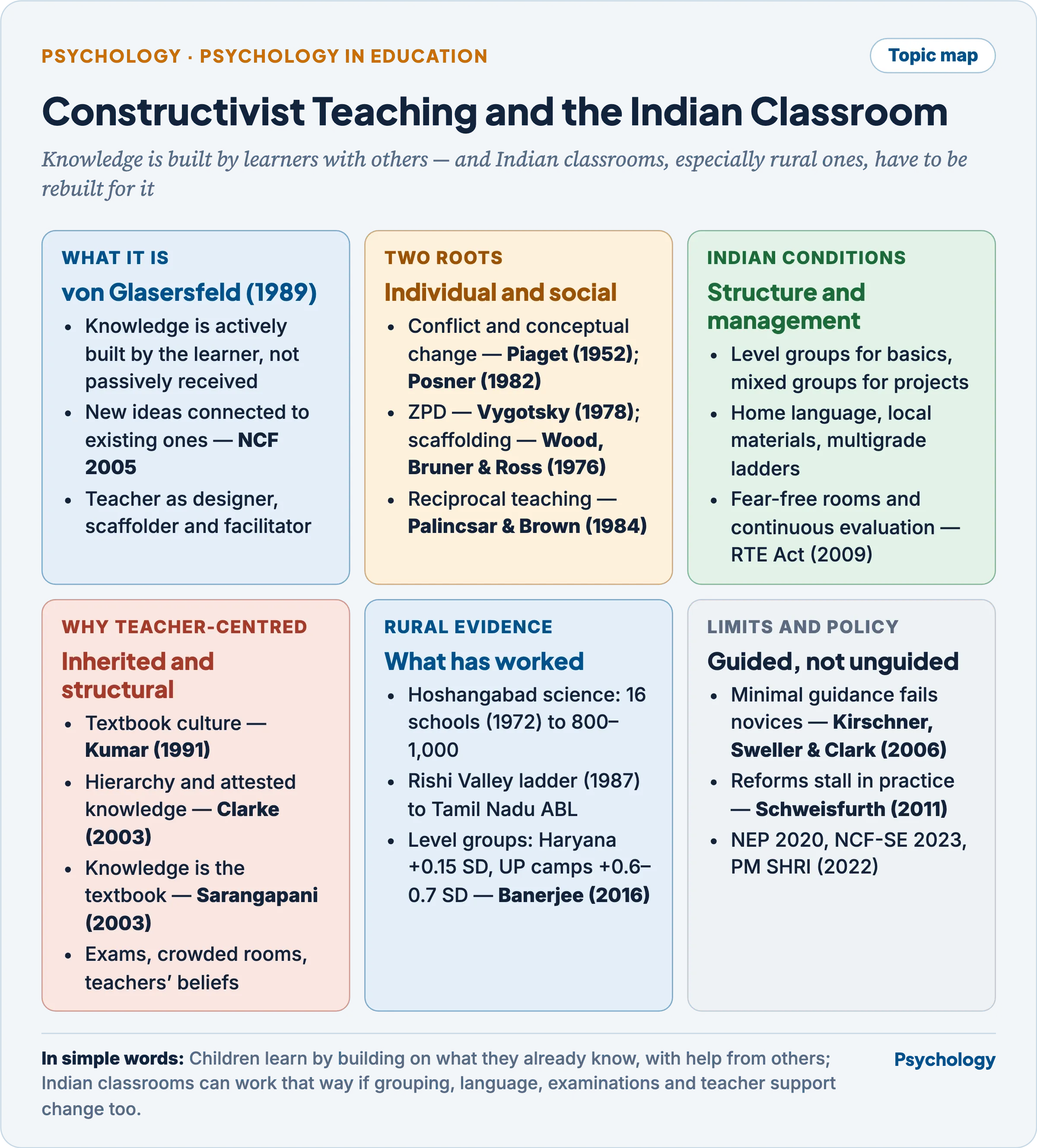
The top row is theory and policy; the bottom row shows why classrooms, rural ones most of all, lag behind.
Effective teaching-learning process as collaborative construction of knowledge
- Cognitive constructivism places the building inside the individual learner; social constructivism places it in interaction with more skilled others.
Cognitive constructivism: Piaget
- For Piaget (1952) the learner assimilates experience to existing schemes and accommodates them when the fit fails; the resulting disequilibrium drives reorganisation (Piaget’s Theory of Cognitive Development, Paper I).
- So teaching surfaces what children already believe and confronts it with evidence it cannot absorb: cognitive conflict used on purpose.
- Posner, Strike, Hewson and Gertzog (1982) named four conditions for conceptual change: dissatisfaction with the existing idea, and a new one that is intelligible, plausible and fruitful.
- A child sure that a heavier stone falls faster drops two stones from a rooftop and watches them land together.
- Limitation: Piaget’s learner is a lone scientist. Peers matter mainly as a source of conflict, and the teacher’s role is left vague.
Social constructivism: Vygotsky and after
- Vygotsky (1978) held that higher mental functions appear first between people and only later within the child, so instruction should aim at the zone of proximal development, just beyond solo performance (Socio-Cultural Theory and Multicultural Socialisation, Paper I).
- Scaffolding comes from Wood, Bruner and Ross (1976), not from Vygotsky. A tutor helped thirty children aged three to five build a block pyramid.
- Six functions: recruitment, reduction in degrees of freedom, direction maintenance, marking critical features, frustration control and demonstration. Support is faded as competence grows.
- Freund (1990): sixty three- and five-year-olds sorted doll’s-house furniture into rooms. Those who first worked with their mothers later made more correct groupings alone than those who practised alone with corrective feedback. Limitation: a laboratory task.
- Rogoff (1990) widened scaffolding into guided participation: joining culturally organised activity beside skilled partners. Rogoff and colleagues (1993) saw the Western stress on talk as a possible cultural bias; elsewhere children learn by watching and joining in.
- Lave and Wenger (1991): newcomers move by legitimate peripheral participation from the edge to the centre of a community of practice, as apprentices do.
- Brown and Campione (1994) built Fostering a Community of Learners: groups research subtopics, teach one another and present, so expertise is spread across the class.
- Palincsar and Brown (1984) devised reciprocal teaching for poor readers in Grade 7. The teacher models predicting, questioning, clarifying and summarising, then hands the dialogue to students in turn.
- Across 16 studies the median effect was 0.32 on standardised tests and 0.88 on experimenter-made tests (Rosenshine and Meister, 1994).
- Aronson and colleagues (1978) built the jigsaw classroom for desegregated Austin schools: each child holds one piece of the lesson, so every group needs every member. Within eight weeks jigsaw pupils showed less prejudice, more self-confidence and fewer absences than controls.
Psychological principles underlying constructivist teaching
- Prior knowledge: “The most important single factor influencing learning is what the learner already knows” (Ausubel, 1968).
- Active engagement: understanding comes from acting on materials and ideas.
- Cognitive conflict: a mismatch between expectation and evidence drives conceptual change (Posner and colleagues, 1982).
- Social negotiation of meaning: talk, argument and explanation turn private ideas into shared, tested knowledge (Vygotsky, 1978).
- Scaffolding and fading: graded help, withdrawn as the learner takes over (Wood and colleagues, 1976).
- Situated learning: knowledge is anchored in the context of use and transfers poorly out of it (Lave and Wenger, 1991).
- Banerjee and colleagues (2025): 201 Kolkata market children solved transaction sums 95–98 per cent of the time by the second try, yet only 32 per cent managed written three-digit-by-one-digit division. Delhi schoolchildren showed the reverse gap.
- Metacognition: learners monitor and repair their own understanding, as the clarifying step of reciprocal teaching trains.
- Assessment for learning: feedback given while learning is still under way. Black and Wiliam (1998) reported effect sizes of 0.4 to 0.7 for stronger formative assessment; a later meta-analysis put the average nearer 0.2 (Kingston and Nash, 2011).
- The National Curriculum Framework 2005 (section 2.4.1) adopted the view: “Learners actively construct their own knowledge by connecting new ideas to existing ideas on the basis of materials/activities presented to them (experience).”
- Effective teaching-learning can therefore be described as collaborative construction. The evidence supports a guided form; unguided discovery fails novices. Behaviourist and information-processing principles sit in Psychological Principles Underlying Effective Teaching-Learning.
Teacher-centred and constructivist classrooms compared
| Dimension | Teacher-centred classroom | Constructivist classroom |
|---|---|---|
| Knowledge | Fixed content in the textbook | Built and revised by learners |
| Learner | Receiver; memorises | Builder; explains and questions |
| Teacher | Transmitter and examiner | Designer, scaffolder, facilitator |
| Talk | Teacher asks, class answers in chorus | Pupils talk in pairs and groups |
| Grouping | Whole class by grade | Level groups; mixed-ability projects |
| Assessment | Annual recall test | Continuous, formative, open-ended |
| Discipline | Obedience, often through fear | Shared norms, self-regulation |
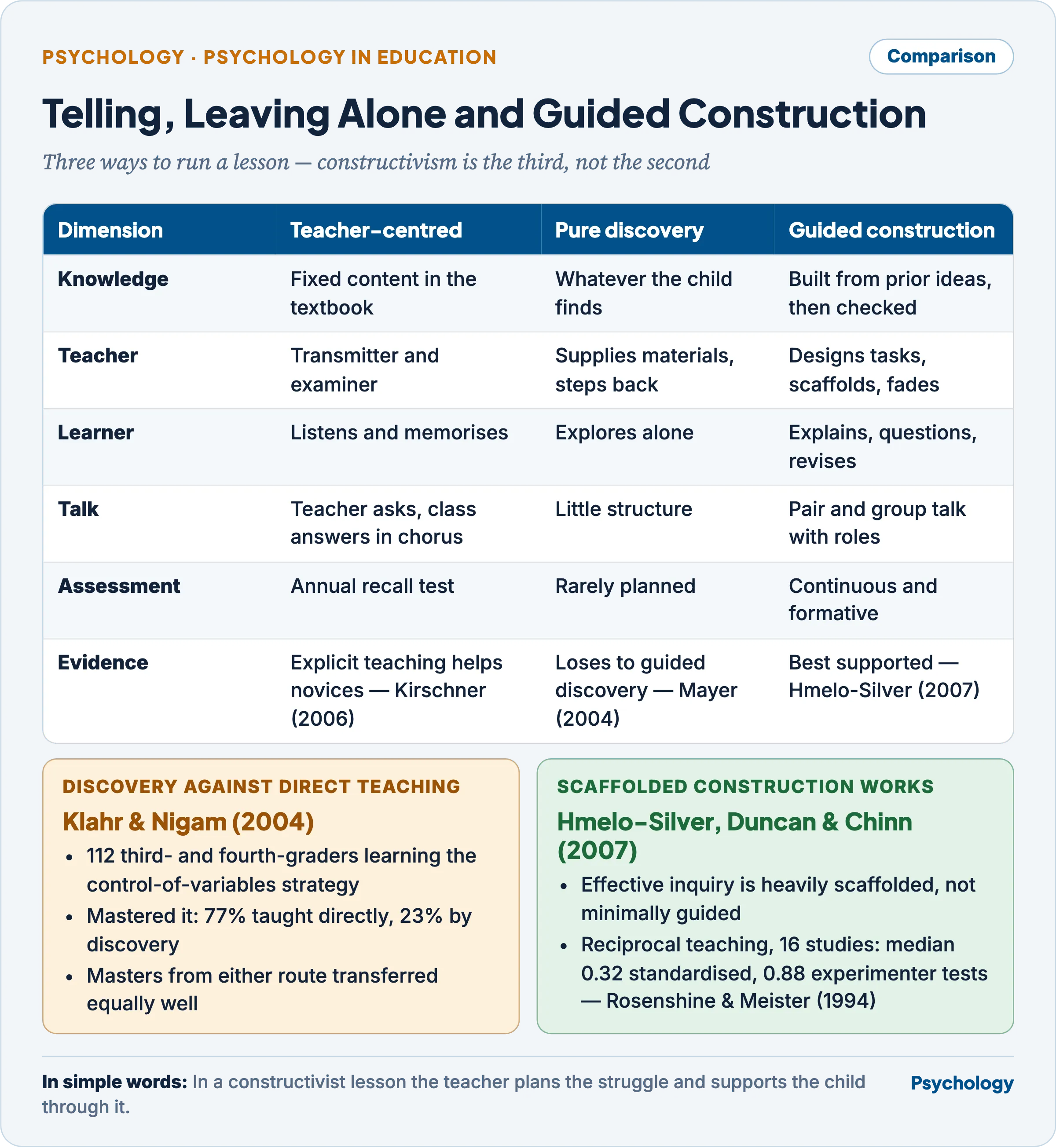
Of the three ways to run a lesson, only guided construction has consistent experimental support.
Implications for classroom structure and management in Indian conditions
Classroom structure
- Grouping: level-based groups for basic reading and arithmetic; mixed-ability groups for projects, where Vygotsky’s (1978) “more capable peers” can scaffold.
- Space: mats in facing groups, children’s work and a progress chart on the walls; none of it costs money.
- Time: a fixed daily hour for regrouping; in Haryana it marked the method as government policy and made compliance visible (Banerjee and colleagues, 2016).
- Materials: local objects, stories, songs and a low-cost science kit, as in Hoshangabad.
- Language: children think in the home language and bridge to the school language, as the RTE Act, 2009 (section 29(2)(f)) and NEP 2020 (paragraph 4.11) prefer. The tribal case is in Tribal Deprivation and the Education of Tribal Children (Unit 8).
- Large classes: pair talk before whole-class answers, group leaders, and demonstration followed by group tasks. NEP 2020 sets a pupil–teacher ratio under 30:1, and under 25:1 in disadvantaged areas.
- Multigrade rooms: older children tutor younger ones, and self-paced activity cards let each child resume where they stopped.
Classroom management
- Self-regulation under class-made norms replaces control by fear. The RTE Act (section 17) bans physical punishment and mental harassment and asks that children be free of “fear, trauma and anxiety” (section 29(2)(g)).
- The teacher’s authority comes from expertise and care. Tamil Nadu teachers using activity-based learning spoke of “learning without fear” and close bonds with pupils (Singal and colleagues, 2016).
- Activity alone does not guarantee thinking: 54.4 per cent of observed teacher talk in those classes was not directly about learning, mostly management and task supervision (Singal and colleagues, 2016).
- Assessment moves into the lesson through observation notes, progress folders and open-book or practical tasks, matching the RTE Act’s “comprehensive and continuous evaluation” and NEP 2020’s assessment “for learning” (paragraph 4.34).
- School Management Committees (RTE Act, section 21), three-quarters of them parents, bring the community in.
- Teachers need continuing mentoring. In the Haryana scale-up, 80 per cent of schools had a resource coordinator’s visit in the previous 30 days (Banerjee and colleagues, 2016).
Why teaching-learning processes in Indian classrooms tend to be teacher-centred
- Textbook culture. Krishna Kumar (1991) traced to colonial schooling the norm “to treat the prescribed textbook as the de facto curriculum, rather than as an aid”. Centralised, secret examinations, kept from distrusted teachers, reduced teaching to rehearsing the text.
- The meek dictator. Kumar (1991) described the teacher as a powerless subordinate of inspectors whose safest course was to stick to the text and finish the fixed syllabus; large classes made textbook instruction look “the only practical method”.
- Cultural constructs. Clarke (2003), studying District Primary Education Programme reform in Karnataka, named holism, hierarchical social structure, collectively attested knowledge and the teacher’s sense of duty. Aids and activities were added, but “rote and repetition” remained.
- Children’s epistemology. Sarangapani (2003), in a government boys’ school in a village near Delhi, found that children counted as knowledge only what teacher and textbook supplied, and that remembering (yaad karna) was the central learning act.
- Teachers’ beliefs. Brinkmann (2016) studied 60 government primary teachers in three states and found eight beliefs, about equality, knowledge, the purpose of education and responsibility for outcomes, that contradict learner-centred policy and go with less learner-centred practice. Many were rooted in caste ideology.
- Examinations and overload. The Yash Pal Committee’s Learning Without Burden (1993) blamed a system that treats information as knowledge; NCF 2005 saw in oversized textbooks a “systemic failure to address children in a child-centred manner”.
- Training alone does not change practice. Teachers in Bihar and Uttarakhand trained in level-based teaching did not regroup their classes, and learning did not improve (Banerjee and colleagues, 2016).
- Psychologically, inspection and examinations reinforce coverage and recall, a hierarchy schema casts the teacher as the one who knows, and crowded multigrade rooms make lecturing the cheapest form of control.
A constructivist classroom suitable for rural Indian schools
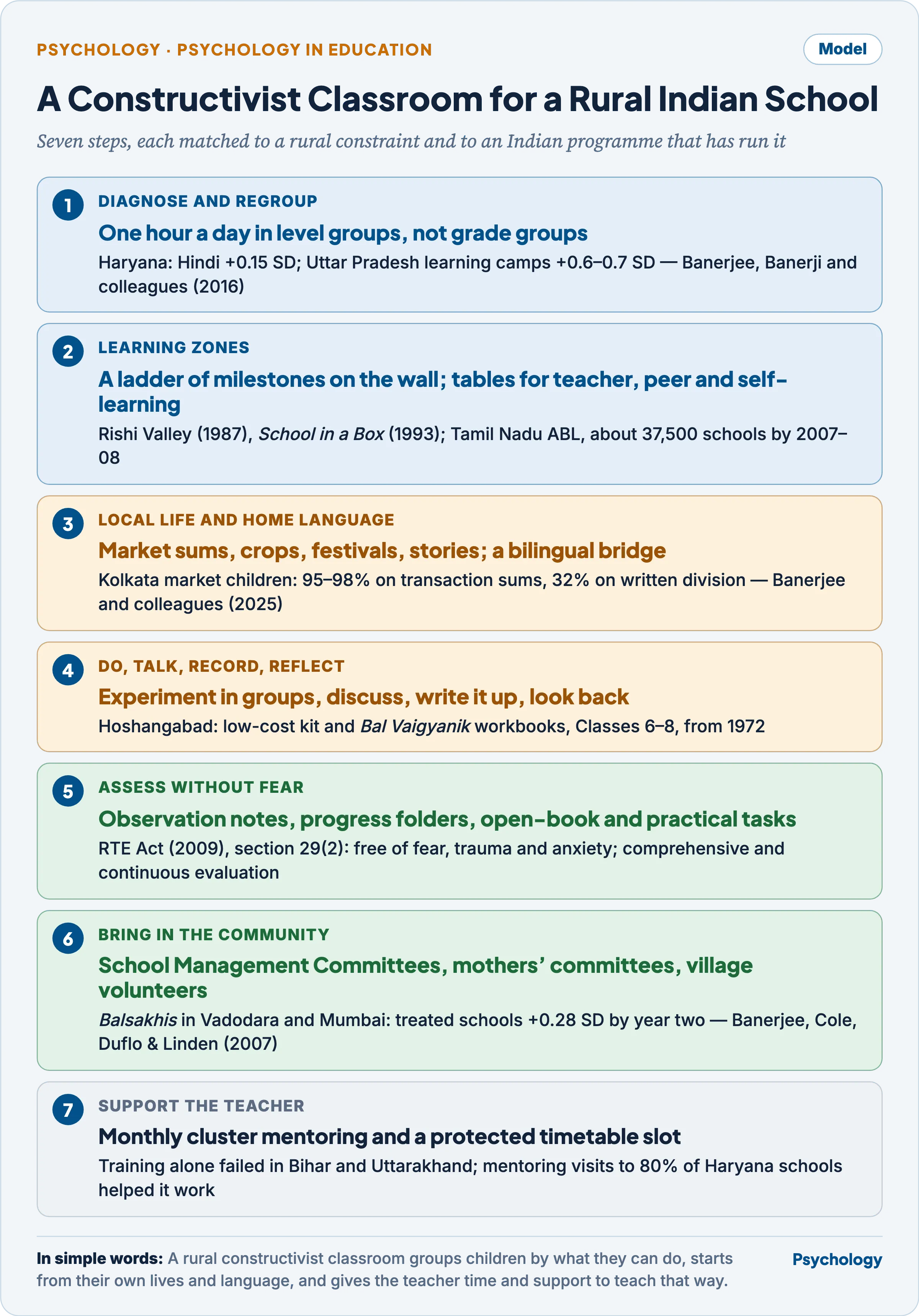
Each step answers a rural constraint, and an Indian programme has already run each one at scale.
- Diagnose and regroup: a short oral test places each child by level, not grade, for a daily hour of level-group teaching.
- Learning zones: a wall-chart learning ladder of milestones; tables for teacher-supported, peer-supported and self-learning work let several grades learn at once.
- Local life and home language: market arithmetic, crops, festivals and local stories as entry points, with a bilingual bridge to textbook language.
- Do, talk, record, reflect: each concept moves through an activity, group discussion, a written record and reflection; reciprocal-teaching roles for reading.
- Assess without fear: observation, a progress folder, open-book and practical tasks; an absent child resumes at their milestone.
- Community: School Management Committees, mothers’ committees and village volunteers run reading camps and chase dropout.
- Teacher support: monthly cluster mentoring, a protected timetable slot and teacher meetings.
The Hoshangabad Science Teaching Programme
- Hoshangabad Science Teaching Programme (1972–2002): began in 1972 in 16 rural middle schools of Hoshangabad district, Madhya Pradesh, led by Kishore Bharti and Friends Rural Centre (Rasulia) with university scientists; Eklavya took it over in 1982.
- Method: children in Classes 6–8 experimented in groups with a low-cost kit, recorded findings in Bal Vaigyanik workbooks, and sat an open-book Class 8 board examination with a practical test.
- By 2002 it ran in 800 to 1,000 schools across 15 districts. Class 8 science results in Hoshangabad and Harda beat most districts, though Class 10 results showed little difference (Eklavya, 2002).
- Limitation: the evaluations were largely the programme’s own. Critics said it had no link with teaching before Class 6 or after Class 8, and a state order of 3 July 2002 reduced it to a supplement.
Rishi Valley’s multigrade methodology and activity-based learning
- Rishi Valley Institute for Educational Resources, Andhra Pradesh, began its multigrade model in 1987 with a Government of India grant and published School in a Box in Telugu in 1993 (Blum and Diwan, 2007).
- Textbook chapters became activity cards of five types (introductory, reinforcement, evaluation, remedial and enrichment), climbed at each child’s pace as a learning ladder of milestones.
- A 2003 agreement with the Government of India and UNICEF set out to take it to 12,000 government schools in 12 states (Blum and Diwan, 2007).
- Tamil Nadu’s Activity Based Learning grew from 13 Chennai Corporation schools in 2002–03 to about 37,500 schools by 2007–08 (Aslam and colleagues, 2016).
- A difference-in-differences comparison with Karnataka found no gain in basic reading or arithmetic, though the data measured only mechanical skills (Aslam and colleagues, 2016).
- Children worked independently for 54.2 per cent of class time (Singal and colleagues, 2016).
- Karnataka’s Nali Kali (pilot 1995, statewide 2009), modelled on Rishi Valley, was reported in 2025–26 to be ending from 2026–27 for single-grade classes; officials cited weak learning and multigrade rooms too large for one teacher.
Teaching at the Right Level
- Banerjee, Cole, Duflo and Linden (2007): in Vadodara and Mumbai, local young women (balsakhis) taught lagging third- and fourth-graders two hours a day; average scores in treated schools rose 0.14 standard deviations in year one and 0.28 in year two.
- Banerjee, Banerji and colleagues (2016) followed Pratham’s level-grouping method to scale.
- Materials and teacher training inside regular Bihar and Uttarakhand classes had no effect.
- In Haryana (2012–13), a mandated daily hour of level groups in 200 of 400 schools raised Hindi scores by 0.15 standard deviations.
- In Uttar Pradesh (2013–14), ten- or twenty-day in-school learning camps raised scores by 0.6 to 0.7 standard deviations.
- Limitation: the gains are in basic literacy and numeracy, and appear only with protected time, an official mandate and mentoring.
Factors affecting the teaching-learning process in rural India
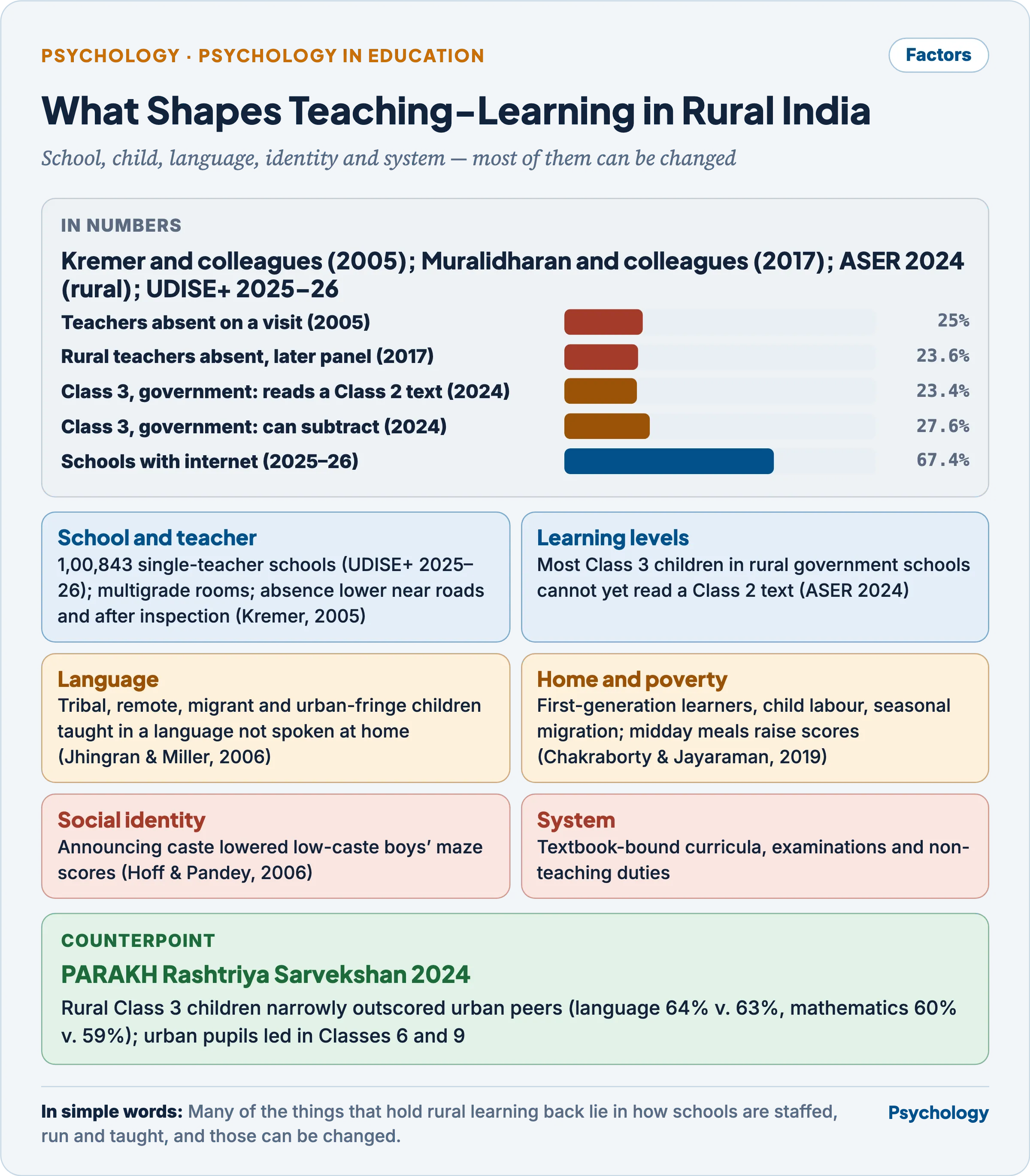
Most of these factors are features of schools and systems, so they can be changed.
- Teachers and schools.
- 1,00,843 single-teacher schools remained, while 69.9 per cent of schools had computers and 67.4 per cent internet (UDISE+ 2025–26).
- In unannounced visits to over 3,700 schools, 25 per cent of teachers were absent and only 45 per cent were teaching (Kremer and colleagues, 2005); a panel of 1,297 villages later found rural absence at 23.6 per cent (Muralidharan and colleagues, 2017).
- Absence was lower where schools had been inspected recently, had better infrastructure or lay near a paved road (Kremer and colleagues, 2005).
- Learning levels. Only 23.4 per cent of Class 3 children in rural government schools could read a Class 2 text, and 27.6 per cent could subtract (ASER 2024).
- Language. Scheduled Tribe, remote, migrant and urban-fringe children are often taught in a language they do not speak at home (Jhingran and Miller, 2006).
- Home and poverty. First-generation learners lack homework help and print at home; child labour and seasonal migration break attendance. Longer exposure to the midday meal raised reading and mathematics scores (Chakraborty and Jayaraman, 2019).
- Social identity. Hoff and Pandey (2006) had village boys solve mazes for pay; announcing caste publicly lowered low-caste boys’ scores and widened the gap, a pattern consistent with stereotype threat.
- Community and system. Parental literacy and aspiration, School Management Committees, textbook-bound curricula, examinations and non-teaching duties. Remedial programmes are in Educating the Disadvantaged (Unit 8).
- Counterpoint. In PARAKH Rashtriya Sarvekshan 2024, rural Class 3 children narrowly outscored urban peers (language 64 against 63 per cent, mathematics 60 against 59), though urban pupils led in Classes 6 and 9 (Ministry of Education, 2025). Location alone does not explain low learning.
Criticisms and limitations of constructivist teaching
- Kirschner, Sweller and Clark (2006) argued that minimally guided discovery, problem-based and inquiry teaching overloads novices’ working memory; worked examples and explicit instruction work better until expertise builds.
- Mayer (2004) reviewed three decades of studies: pure discovery repeatedly lost to guided discovery.
- Klahr and Nigam (2004): among 112 third- and fourth-graders, 77 per cent of those directly taught mastered the control-of-variables strategy, against 23 per cent of discovery learners, though masters from either route transferred equally well.
- Hmelo-Silver, Duncan and Chinn (2007) replied that effective inquiry teaching is heavily scaffolded. On this reading constructivism describes how learners build knowledge; teaching still has to guide the building.
- Schweisfurth (2011) reviewed 72 articles on learner-centred reform in developing countries and found recurring failure, traced to how reforms were implemented, scarce resources, clashing cultures, and power and agency in the process.
- Cultural fit. Talk-heavy scaffolding assumes a verbal style of interaction (Rogoff and colleagues, 1993), and hierarchy and collectively attested knowledge resist it (Clarke, 2003).
- Islands in a rote system. A constructivist middle school feeds into rote secondary schooling and board examinations, as Hoshangabad found, and basic-skills tests miss gains in understanding (Aslam and colleagues, 2016).
- Equity. Learners with the least prior knowledge gain most from explicit guidance (Kirschner and colleagues, 2006), and in rural India these are often first-generation learners, so unstructured discovery widens gaps.
Indian context
- National Curriculum Framework 2005 (NCERT) — five guiding principles: connect knowledge to life outside school, move away from rote, go beyond textbooks, make examinations flexible, and nurture a caring democratic identity.
- The teacher is “a facilitator who encourages learners to reflect, analyse and interpret”. Principle: knowledge built from experience.
- RTE Act, 2009 (Right of Children to Free and Compulsory Education; Ministry of Education) — section 29(2) requires “learning through activities, discovery and exploration” in a child-friendly, child-centred manner. Principle: activity and safety as conditions of learning.
- National Education Policy 2020 — moves pedagogy “away from the culture of rote learning” (paragraph 4.4) towards experiential, competency-based learning (4.6) and home-language teaching to at least Grade 5 (4.11). Principle: prior knowledge and language as the base for construction.
- NCF-FS (2022) and NCF-SE (23 August 2023), the National Curriculum Frameworks for the Foundational Stage and for School Education (NCERT; steering committee under K. Kasturirangan) — play-based, experiential learning across the 5+3+3+4 stages. Principle: stage-matched active learning.
- NIPUN Bharat (Ministry of Education, July 2021) — foundational literacy and numeracy by Grade 3, targeted for 2026–27. Principle: mastery of basics before abstraction.
- Samagra Shiksha (2018–19), which merged Sarva Shiksha Abhiyan, Rashtriya Madhyamik Shiksha Abhiyan and Teacher Education, funds NISHTHA (21 August 2019), integrated training for about 42 lakh teachers and heads. Principle: changing practice needs sustained support.
- PM SHRI Schools (Union Cabinet, 7 September 2022; 2022–23 to 2026–27) — over 14,500 exemplar schools whose pedagogy is to be “experiential, holistic, integrated, play/toy-based” and inquiry-driven. Principle: model schools demonstrate practice to their neighbours.
Previous Year Questions
- 2018Can effective teaching-learning be viewed as a process of collaborative construction of knowledge? What are the implications of such a view on classroom structure and management in Indian conditions?
- 2015Why do teaching-learning processes in Indian classrooms tend to be teacher-centred? If knowledge is viewed as a constructive process, what kind of classroom would be suitable for rural Indian schools?
- 2014Enumerate the factors that can impact upon the teaching-learning process in rural India.
