

Official syllabusPaper II · Unit 4 · Work Psychology and Organisational Behaviour
Leadership and participatory management.
Definition
“Leadership may be considered as the process (act) of influencing the activities of an organized group in its efforts toward goal setting and goal achievement.”
Stogdill (1950)
Leadership research moved from who leaders are, to what they do, to when a style works; once the contingency theories made subordinates’ share in decisions a leader’s choice, participation became a management technique. In India the inquiry runs twice over: whether Western styles fit a workforce shaped by hierarchy and personalised relationships, and whether participation survives in organisations built on rules.
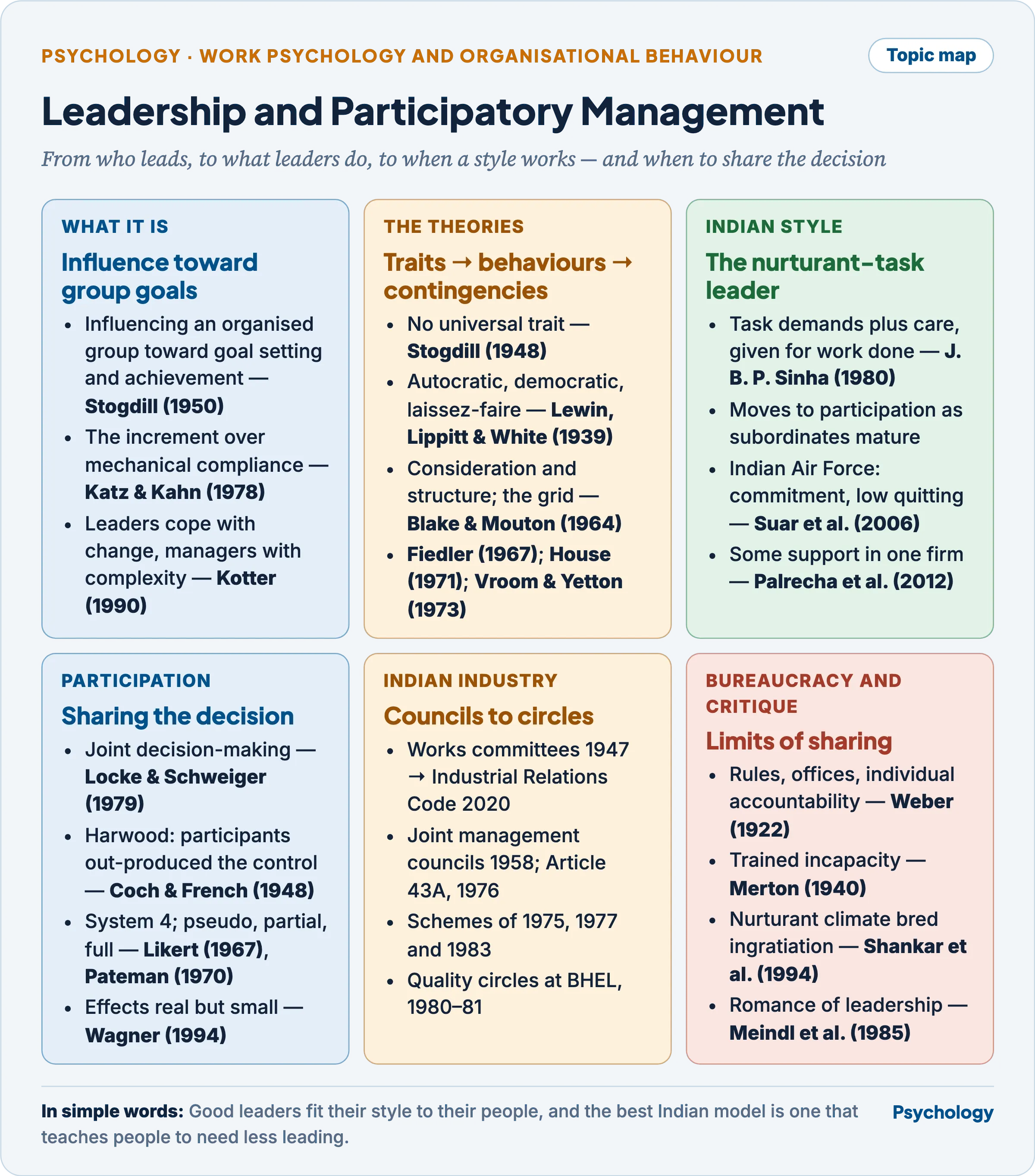
The leadership row ends where the participation row begins: Sinha’s leader is built to hand decisions over as subordinates mature.
Leadership in organisations
- The definition carries three elements — influence, an organised group and a goal — and so excludes compliance obtained only by force or by office.
- Katz and Kahn (1978) located organisational leadership in “the influential increment over and above mechanical compliance with the routine directives of the organization.”
- Kotter (1990) separated the functions: management copes with complexity by planning, budgeting and controlling; leadership copes with change by setting direction, aligning people and motivating them.
- Formal leaders are appointed and draw on position power; informal (emergent) leaders rise from the group on competence and acceptance, and can strengthen or undercut the formal line. Power bases are treated in Power and Politics in Organizations; managerial roles in Managerial Effectiveness.
Theories of leadership
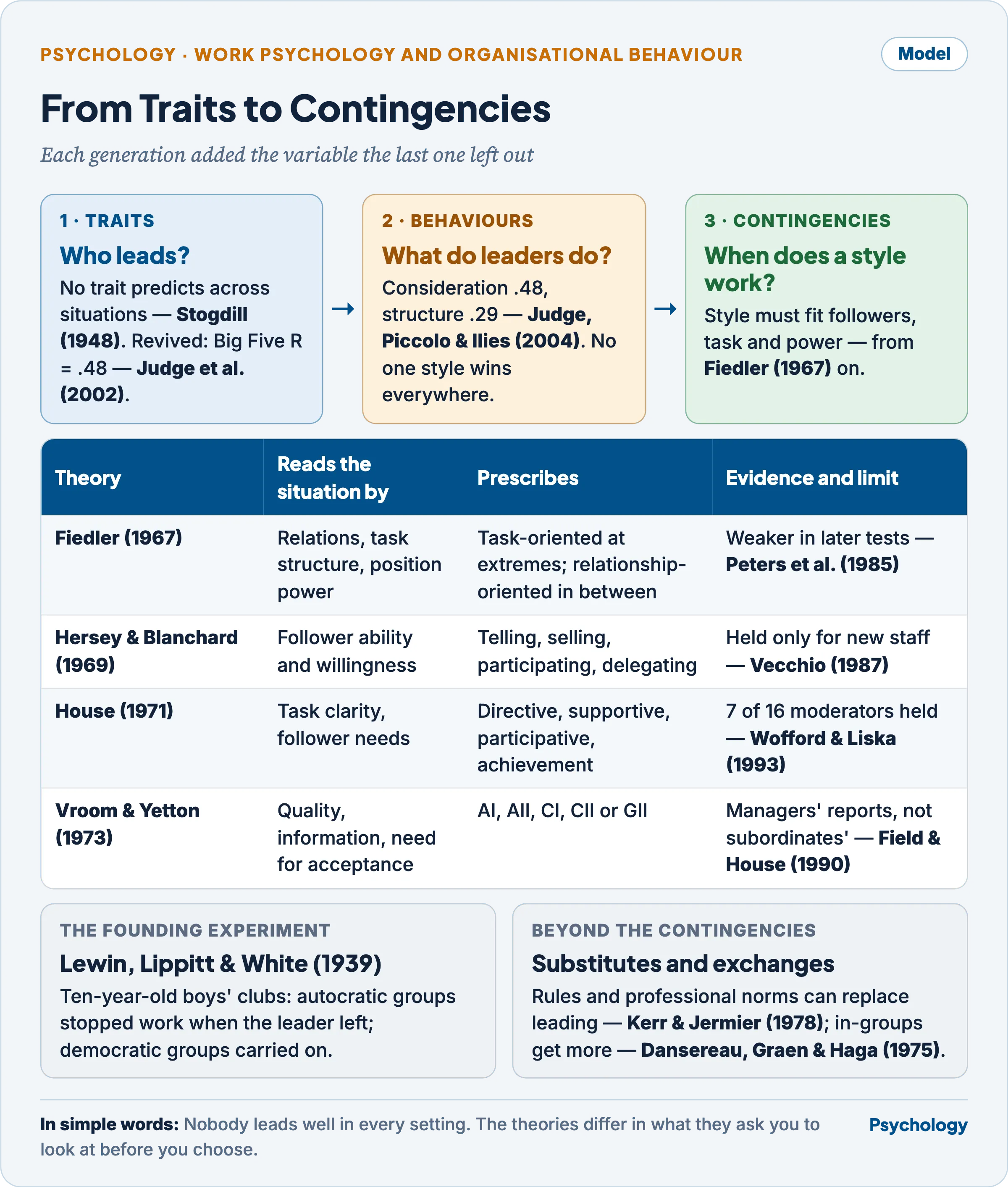
Each generation added the variable its predecessor left out; the situation entered only after traits and behaviours both failed to generalise.
Trait theories
- The trait approach assumed leaders are born with distinguishing qualities — intelligence, dominance, self-confidence — so that leaders could be selected rather than developed.
- Stogdill (1948) reviewed 124 trait studies from 1904 to 1947 and found no trait or cluster that predicted leadership across situations: “A person does not become a leader by virtue of the possession of some combination of traits.”
- Judge, Bono, Ilies and Gerhardt (2002) revived the approach: across 222 correlations from 73 samples the five-factor model had a multiple correlation of .48 with leadership, extraversion the most consistent correlate.
- Limitation: Lord, De Vader and Alliger (1986) found intelligence a key predictor of being perceived as a leader, and stressed that such findings concern perceptions, not effectiveness; a trait list also prescribes nothing for a given situation.
Behavioural theories
- Lewin, Lippitt and White (1939) — four after-school clubs of five ten-year-old boys, led in turn by adults trained to act autocratic, democratic or laissez-faire.
- Autocratic clubs worked while watched, turned aggressive or apathetic, and stopped when the leader left.
- Democratic clubs were preferred, less hostile, and kept working in his absence; laissez-faire clubs did less and poorer work.
- Limitation: tiny samples of American boys, and labels that shaped how the results were read.
- Ohio State studies: ratings on the 150-item Leader Behavior Description Questionnaire (Hemphill, 1950) reduced chiefly to two factors (Halpin and Winer, 1957) — consideration (trust, respect, concern for feelings) and initiating structure (defining roles, procedures, standards).
- Judge, Piccolo and Ilies (2004) found consideration correlating .48 and initiating structure .29 with leadership outcomes; consideration tied more to satisfaction, structure slightly more to performance.
- Michigan studies: Katz, Maccoby and Morse (1950) contrasted employee-centred with production-centred supervisors; Likert (1961) reported employee-centred, generally supervised sections as the more productive.
- Blake and Mouton (1964) put concern for production on the horizontal axis and concern for people on the vertical, each 1–9.
- Styles, in their later labels: impoverished (1,1), authority-compliance (9,1), country club (1,9), middle-of-the-road (5,5) and team (9,9), which they held best.
- Limitation: Korman (1966) found the two dimensions’ links to performance inconsistent and seldom tested; behaviour that works with one group fails with another.
Contingency theories
- Fiedler (1967) treated style as fixed, measured by the Least Preferred Co-worker (LPC) scale: a harsh rating of that co-worker marks a task-oriented leader, a lenient one a relationship-oriented leader.
- Situational control combines leader–member relations, task structure and position power; task-oriented leaders do best at very high and very low control, relationship-oriented leaders at moderate control.
- Peters, Hartke and Pohlmann (1985) found meta-analytic support stronger in the studies that built the model than in later tests; what LPC measures remains disputed.
- Fiedler and Garcia (1987) extended it into cognitive resource theory: a leader’s intelligence aids performance under low stress, experience under high stress.
- Hersey and Blanchard (1969) matched style to follower maturity (later readiness): telling (unable, unwilling), selling (willing, unable), participating (able, unwilling), delegating (able, willing).
- Vecchio (1987), with over 300 teachers, found the prescription held only for newly hired, low-readiness teachers.
- House (1971) built path–goal theory on expectancy theory (set out in Theories of Work Motivation: Vroom, Adams’ Equity Theory and Porter-Lawler): the leader clarifies paths to valued goals. House and Mitchell (1974) named directive, supportive, participative and achievement-oriented behaviour.
- Wofford and Liska (1993), across 120 studies, found 7 of 16 moderator hypotheses supported and much of the testing flawed.
- Vroom and Yetton (1973) made participation itself the leader’s decision. Their normative decision model offers AI and AII (autocratic), CI and CII (consultative) and GII (group decision), chosen by diagnostic questions on quality, information and the need for acceptance.
- Seven rules prune the set: if acceptance is critical and an autocratic decision would not secure it, AI and AII drop out; if subordinates do not share the organisation’s goals, GII drops out.
- Field and House (1990), with 44 manager–subordinate pairs, found the model supported by managers’ accounts but not subordinates’.
- Dansereau, Graen and Haga (1975), in what became leader–member exchange theory (Graen and Uhl-Bien, 1995), dropped the assumption that a leader treats all subordinates alike: an in-group receives trust and latitude, an out-group a contractual exchange.
- Kerr and Jermier (1978) added substitutes for leadership — professional orientation, intrinsically satisfying tasks, formalised rules — that make leader behaviour redundant.
- Charismatic and transformational leadership are treated in Transformational Leadership; training in these models in Leadership Training.
Leaders in organisations and leaders in other fields
- Authority differs at source. Weber (1922) separated traditional, charismatic and legal-rational authority; the organisational leader holds legal-rational authority vested in an office, political and religious leaders lean on charisma or tradition.
- Compliance differs. Etzioni (1961) classified organisations by the power that secures it — coercive (prisons), utilitarian (firms), normative (religious and political bodies) — so managers lead chiefly through exchange, movement leaders through shared values.
- Followers differ. Employees are recruited and paid and rarely choose their leader; a district officer inherits a staff where a party leader builds a cadre.
- Structure substitutes for persuasion: rules and procedures do much of what a political leader must win by influence (Kerr and Jermier, 1978), leaving the leader the increment beyond them.
- Accountability runs both ways. Likert (1961) called the manager a linking pin, member of the group below and the group above, answerable for results while representing subordinates.
- Goals are set from outside and measured over quarters; a political leader is judged at elections.
- Hence organisational leaders rely more on structuring, transactional exchange, consultation and delegation. Limitation: the boundary is porous — military and sports leaders join formal authority to strong normative appeal.
Leadership style suited to Indian conditions: the nurturant-task leader
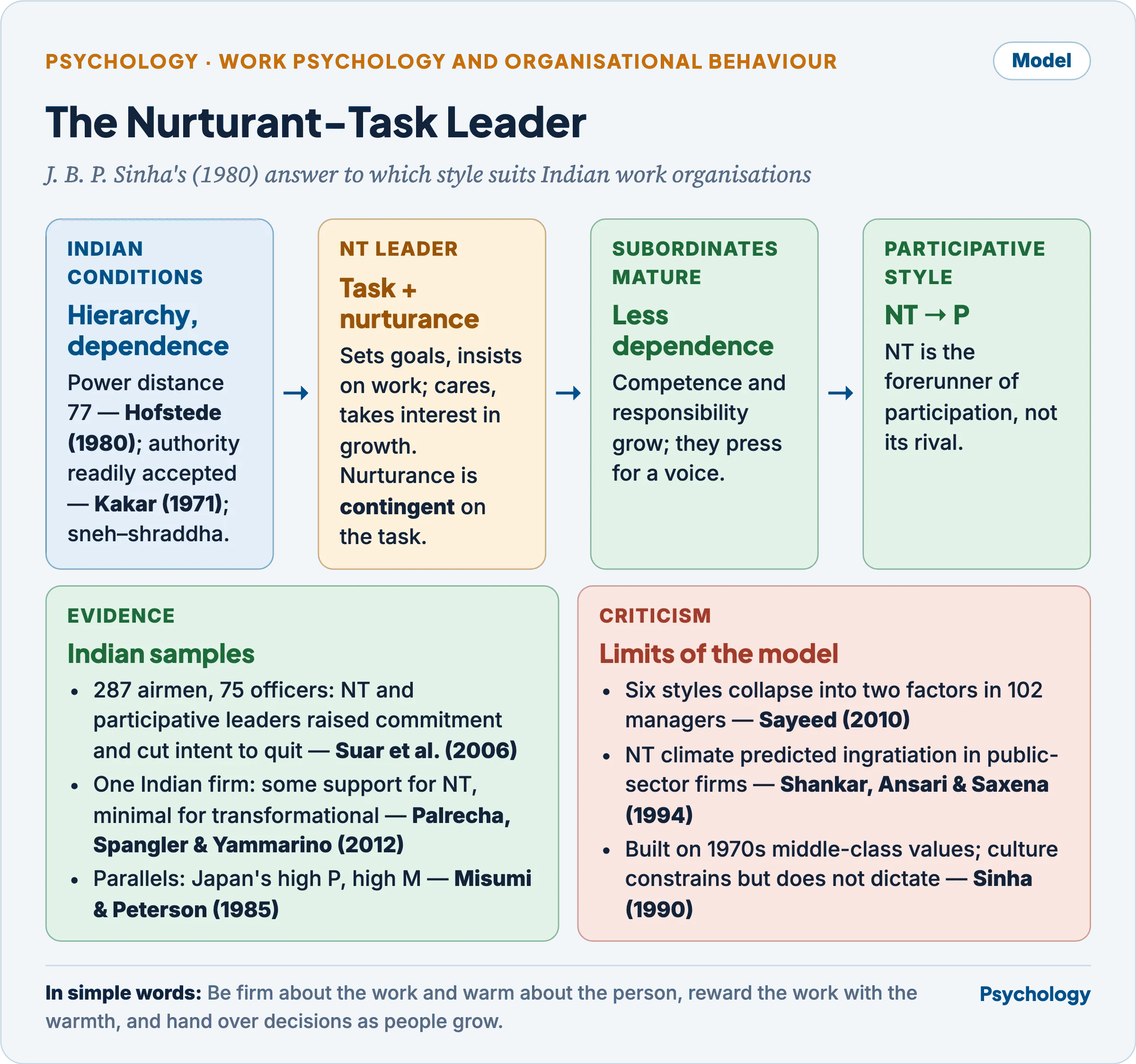
Nurturance is paid for in task performance, and the model is built to end: success is a subordinate who no longer needs it.
- Indian conditions. Kakar (1971) described Indian subordinates as readily accepting a superior’s authority; Hofstede (1980) placed India at 77 on power distance; Aycan, Kanungo and Sinha (1999) found Indian managers higher than Canadian on paternalism and power distance.
- J. B. P. Sinha (1980), in The Nurturant-Task Leader, grounded the model in middle-class values of personalised relationships, dependence proneness and sneh–shraddha — the superior’s affection met by the subordinate’s deference.
- The nurturant-task (NT) leader joins two components.
- Task orientation: structuring work, setting goals, insisting on hard work and discipline.
- Nurturance: he “cares for his subordinates, shows affection, takes personal interest in their well-being, and above all, is committed to their growth” (Sinha, 1980).
- Contingent nurturance is the mechanism: affection is given in return for task accomplishment, so dependence, a cultural given, becomes a motive for work rather than for sycophancy.
- NT to participative (NT–P). As subordinates mature and accept responsibility they press for a share in decisions; the NT style is a forerunner of the participative style, not its rival.
- Parallel findings: Misumi and Peterson (1985) found Japan’s most productive groups led by supervisors high on both performance and maintenance behaviour; Ayman and Chemers (1983) found Iranian structuring and consideration merging into one benevolent paternalism factor.
- Evidence:
- Suar, Tewari and Chaturbedi (2006) — 287 airmen and 75 officers of the Indian Air Force: under nurturant-task and participative leaders, commitment, satisfaction and performance rose and intention to quit fell; authoritarian leadership did the reverse.
- Palrecha, Spangler and Yammarino (2012), in one Indian organisation, found strong support for a locally derived model, some for nurturant-task leadership, minimal for transformational leadership.
- Criticisms:
- Sayeed (2010), with 102 middle managers, found Sinha’s six style dimensions collapsing into two — participative–nurturant-task and authoritarian–bureaucratic — so NT may not be distinct from participation.
- Shankar, Ansari and Saxena (1994) — 294 managers, seven manufacturing firms: a nurturant-task climate predicted ingratiation in the public sector, the favouritism risk of nurturance.
- The value base was described for a salaried middle class of the 1970s; knowledge workers may need less of it.
- Sinha (1990) later showed that the same values sustain either a soft work culture (pliant management, non-work concerns dominant) or a synergetic one (firm management, rewarded effort): culture constrains style but does not dictate it.
- Hence NT leadership for dependent or inexperienced subordinates, moving to participative and transformational styles as readiness grows — close to Hersey and Blanchard (1969), but grounded in Indian evidence.
Participatory management: principles and evidence
- Participative decision-making is joint decision-making by superior and subordinates (Locke and Schweiger, 1979): influence shared among people who are otherwise hierarchical unequals.
- Its principles rest on three mechanisms, central to the human-relations tradition since the Hawthorne studies (Roethlisberger and Dickson, 1939).
- Cognitive: those who do the work hold information the manager lacks.
- Motivational: involvement meets needs for autonomy and esteem — McGregor’s (1960) Theory Y, set out in Theories of Motivation (Paper I).
- Commitment: people resist changes imposed on them and carry out decisions they helped make.
- Coch and French (1948) — Harwood pyjama factory, Marion, Virginia; four groups facing a job change.
- The control group was told of it; one elected representatives to plan it; two participated in full.
- Results (1948): control output fell from about 60 to 50 units an hour and stayed there 32 days; 17 per cent quit within 40 days; the representative group recovered in 14 days; full participants ended about 14 per cent above pre-change level.
- Later re-transferred by total participation, the same control group recovered fast: procedure, not personnel, made the difference.
- Limitation: Bartlem and Locke (1981) credited perceived pay fairness and trust, not participation; replications elsewhere, including Norway (French, Israel and Ås, 1960), were less successful (Desmond and Wilson, 2018).
- Vroom (1959), with 108 supervisors, found participation helped most those high in need for independence and low in authoritarianism.
- Pateman (1970) graded participation: pseudo-participation (persuading workers to accept decisions already made), partial (influence without equal power) and full (equal power over the outcome).
- Likert (1967) ranked management from System 1 (exploitative authoritative) through System 2 (benevolent authoritative) and System 3 (consultative) to System 4 (participative group); his surveys tied System 4 to productivity, but the data were correlational.
- Wagner (1994), reanalysing the reviews, concluded that participation’s effects on performance and satisfaction are statistically significant but small.
Techniques of participatory management
- Quality circles — small voluntary groups from one work area meeting regularly to find and solve work problems; Ishikawa and the Union of Japanese Scientists and Engineers launched them in 1962 through the magazine Gemba to QC.
- Scanlon plan — Joseph Scanlon’s union–management production committees, begun at a Mansfield, Ohio steel mill in the late 1930s; the later plan added a plant-wide bonus whenever labour cost falls below its historical ratio to sales value.
- Self-managed teams — groups that plan, allocate and check their own work. Trist and Bamforth (1951) showed mechanised longwall mining destroying the small self-regulating groups of older coal-getting, founding the sociotechnical case for autonomous groups.
- Representative participation (works committees, joint councils, worker-directors) and financial participation (profit-sharing, employee share ownership) complete the range.
Indian context: participative management in Indian industry
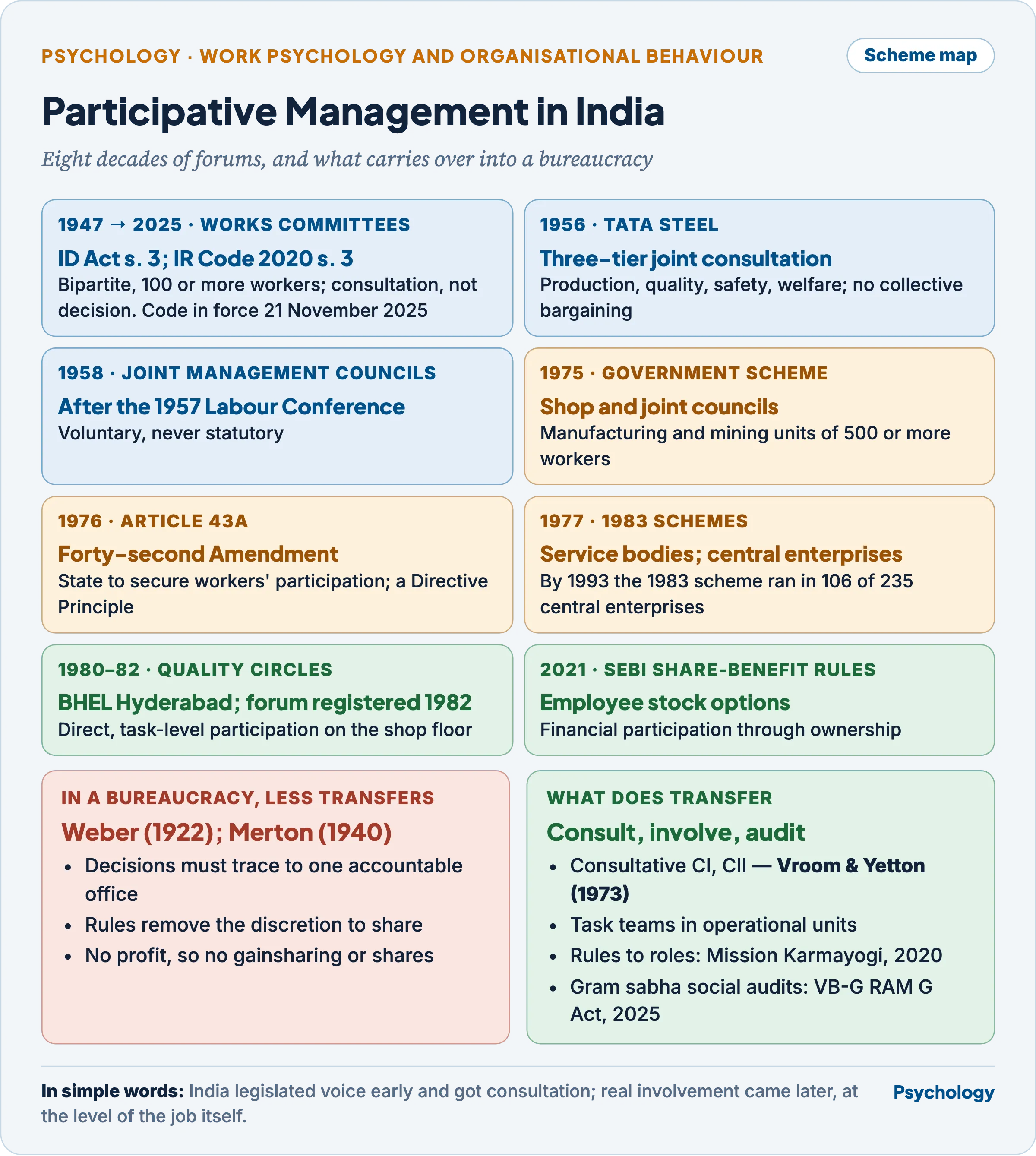
Eight decades of schemes moved from consultative councils decreed from above to task-level involvement on the shop floor.
Traditional techniques
- Works committees, Industrial Disputes Act 1947, Section 3 (Ministry of Labour and Employment) — where 100 or more workmen are employed, the government may require a bipartite committee to promote amity and comment on common concerns: joint consultation, voice without decision rights.
- The Industrial Relations Code, 2020, Section 3, keeps it at 100 or more workers; the Code came into force on 21 November 2025, replacing the 1947 Act.
- Tata Steel’s three-tier joint consultation system (1956) covered production, quality, safety, welfare and training, excluding collective bargaining.
- Joint management councils (1958), following the 15th Indian Labour Conference (1957), were voluntary and never statutory.
- Article 43A, inserted by the Forty-second Amendment (1976), directs the State to secure workers’ participation in the management of undertakings, establishments or other organisations engaged in any industry — a Directive Principle that treats voice as a right rather than a concession.
- Government schemes:
- 1975 — shop councils and joint councils in manufacturing and mining units of 500 or more workers.
- 1977 — a parallel scheme for public-sector commercial and service organisations of 100 or more employees.
- 1983 — resolution of 30 December 1983 for central public enterprises: shop and plant forums, board-level participation at the ministry’s discretion; a ministerial reply in the Rajya Sabha (1993) reported it working in 106 of 235 enterprises.
- The Participation of Workers in Management Bill, introduced in the Rajya Sabha on 30 May 1990, was never enacted.
Modern techniques
- Quality circles — begun at BHEL’s Hyderabad unit in 1980–81; the Quality Circle Forum of India was registered on 31 December 1982. They operationalise direct, task-level participation where the councils were representative.
- Employee share ownership — the SEBI (Share Based Employee Benefits and Sweat Equity) Regulations, 2021 (Securities and Exchange Board of India, 13 August 2021) govern listed companies’ stock-option and share-purchase schemes; financial participation works through identification with the firm’s results.
- Relevance: the traditional forums still carry collective voice and industrial peace in unionised plants; the modern techniques carry quality and innovation. Tata Steel layers the two.
Importance of participatory management in Indian industry
- It meets a constitutional direction (Article 43A) and the tripartite tradition of Indian industrial relations.
- It lowers resistance to technological change and restructuring, the mechanism Coch and French (1948) isolated.
- It completes Sinha’s developmental logic: participation is the stage a nurtured, maturing workforce is meant to reach.
- The traditional schemes underperformed because they were voluntary, consultative and often pseudo-participative in Pateman’s sense, divided by inter-union rivalry and managerial reluctance.
Participatory management in bureaucratic and industrial organisations
- Weber’s (1922) bureaucracy rests on a hierarchy of offices, written rules, files, impersonality and trained officials; each decision must be traceable to an authorised office.
| Dimension | Industrial organisation | Bureaucratic organisation |
|---|---|---|
| Source of legitimacy | Results for owners | Rules and an authorised office |
| Accountability | To the board, judged on results | To ministers and legislature, judged on procedure |
| Output | Measurable, sold | Diffuse, a public service |
| Gain to share | Profit, cost saving | None that can be distributed |
| Fitting forms | Circles, teams, gainsharing, councils | Consultation, task teams, citizen audit |
- Why the principles transfer imperfectly:
- Accountability: officials answer to ministers and legislatures, so a jointly made decision blurs responsibility.
- Rules over discretion: participation needs discretion that rules remove; Merton (1940) described the resulting trained incapacity and goal displacement, rule-following becoming an end.
- No gain to share: without profit or measurable unit output, gainsharing and share ownership have no equivalent.
- Structure: Burns and Stalker (1961) found organic, participative structures suited to changing environments and mechanistic ones to stable, rule-bound tasks.
- In Indian public-sector firms, nurturant-task climates fostered ingratiation (Shankar, Ansari and Saxena, 1994).
- Where they work:
- Kim (2002) found managers’ participative style and participative strategic planning associated with higher job satisfaction in American local-government agencies.
- Consultative processes (Vroom and Yetton’s CI and CII) draw on subordinates’ knowledge while the official stays accountable.
- Quality circles and task teams suit operational units — workshops, hospitals, service counters — where policy is not at stake.
- Mission Karmayogi (National Programme for Civil Services Capacity Building, approved 2 September 2020) moves human-resource management from rules-based to roles-based, the precondition for delegated discretion.
- Citizens can participate where employees cannot: the Viksit Bharat — Guarantee for Rozgar and Ajeevika Mission (Gramin) Act, 2025 (Ministry of Rural Development), in force from 1 July 2026 in place of MGNREGA, mandates social audits through gram sabhas — participation as external accountability.
- Judgement: the principles are less effective in their decision-sharing form, because hierarchy and individual accountability are what make a bureaucracy legitimate; they work in consultative, task-level and citizen-facing forms, and the need for them is greater where rules have displaced goals.
Criticisms and limitations
- Meindl, Ehrlich and Dukerich (1985) described a romance of leadership: observers over-credit leaders for organisational outcomes, especially extreme ones.
- Eden and Leviatan (1975) obtained the usual factor structure of supervisory-behaviour scales from ratings of an imaginary manager, so questionnaires such as the LBDQ partly measure raters’ implicit theories; most samples were also American.
- Contingency models trade usability for complexity — Fiedler’s eight octants, a decision tree — and their field support is thin (Peters, Hartke and Pohlmann, 1985; Wofford and Liska, 1993).
- Participation’s effects are small (Wagner, 1994), depend on personality (Vroom, 1959) and trust (Bartlem and Locke, 1981), and cost time.
- Participation can manipulate: pseudo-participation secures consent for decisions already taken (Pateman, 1970), and cohesive groups can slide into groupthink, set out in Decision Making, Heuristics and Biases (Paper I).
- Empowerment without training or clear limits risks inconsistent decisions, reluctant managers and confusion over who decides.
Previous Year Questions
- 2016Critically evaluate whether the principles of participatory management are equally effective in bureaucratic organizations as in industrial organizations.
- 2007Evaluate the applications of any two theories of Work Motivation in modern organizations. State the importance of Participatory Management in Indian Industry.
- 2003Leaders in the organizational set up work with different kinds of strategies than leaders in other fields. Comment.
- 2000There have been various leadership and management theories and styles. Which one of them do you consider to be the most suitable in the Indian condition? Give reasons.
- 1999Discuss the relevance of traditional and modern participative management techniques in the Indian industry.