

Official syllabusPaper II · Unit 4 · Work Psychology and Organisational Behaviour
Theories of work motivation – Adam Equity theory, Porter and Lawler, Vroom.
Definition
“motivation has to do with a set of independent/dependent variable relationships that explain the direction, amplitude, and persistence of an individual’s behavior, holding constant the effects of aptitude, skill, and understanding of the task, and the constraints operating in the environment”
Campbell and Pritchard (1976)
Process theories ask how a worker decides how much effort to give, not which needs drive it. Vroom supplies the calculation, Adams the comparison that makes a reward feel fair, and Porter and Lawler the chain from effort to satisfaction — explaining why pay schemes, appraisals and promotion rules work or misfire.
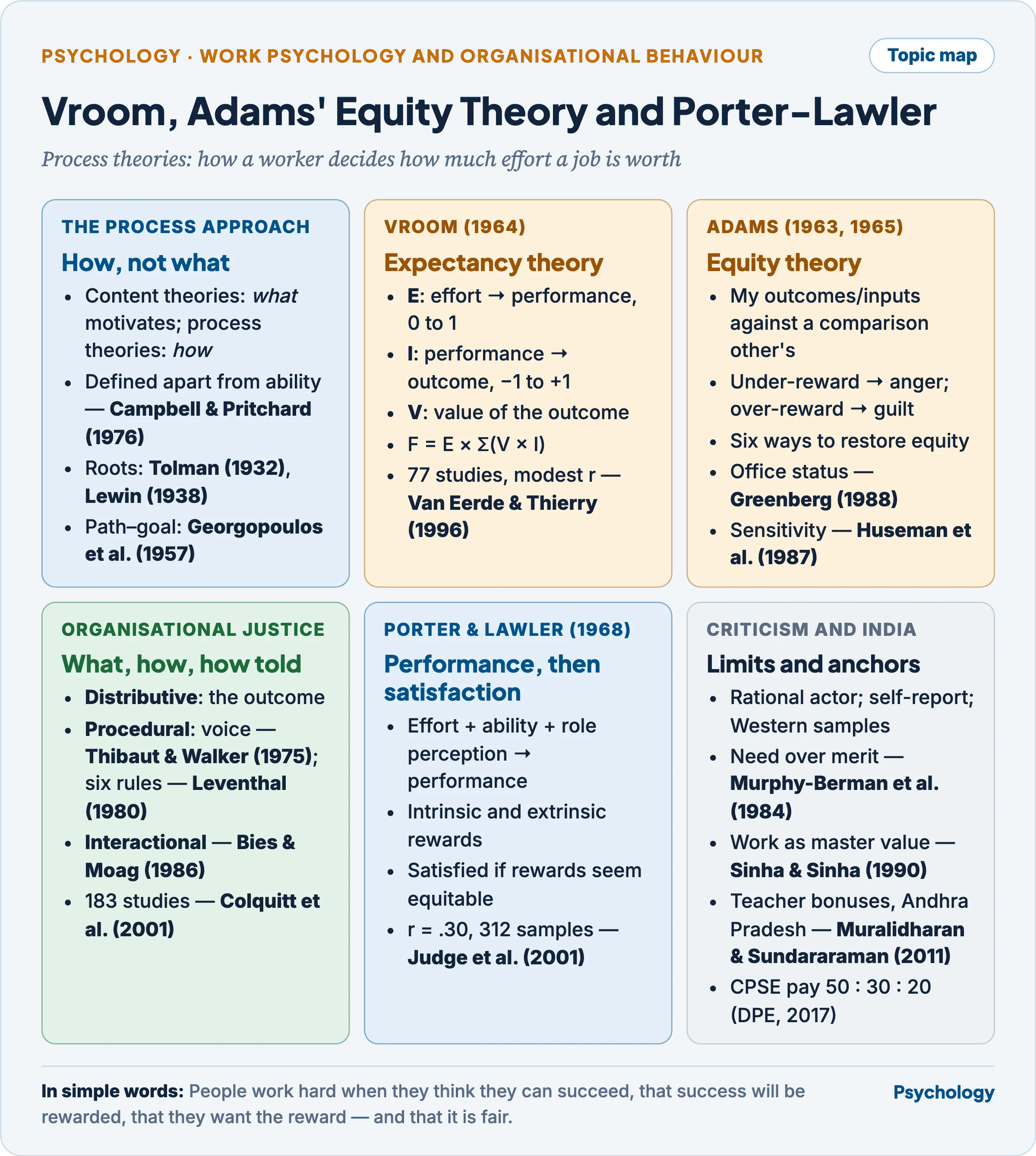
Each theory adds the link the previous one left out: Vroom the calculation, Adams the comparison, Porter and Lawler the route from performance back to effort.
Theories of work motivation: content and process
- Content theories ask what motivates — the needs a job must meet — and are set out in Theories of Work Motivation: Maslow and Herzberg.
- Process theories ask how motivation operates: how a person chooses among actions, how much effort to spend and how long to persist.
- Their roots are cognitive: Tolman (1932) and Lewin (1938) tied behaviour to expected outcomes, and Georgopoulos, Mahoney and Jones (1957) proposed a path–goal account of productivity before Vroom (1964) gave expectancy theory its first systematic workplace form.
Vroom’s expectancy theory
Components of Vroom’s theory
- Vroom treated motivation as the process governing choice among voluntary activities; VIE theory is named after its three components.
- Expectancy (E) — the perceived probability that effort will produce a given level of performance, an action–outcome belief running from 0 to 1.
- Instrumentality (I) — the perceived link between that performance, a first-level outcome, and second-level outcomes such as pay, promotion, approval or fatigue. Vroom scaled it from −1 to +1, since performance can make an outcome less likely as well as more.
- Valence (V) — the anticipated satisfaction from an outcome, positive, zero or negative; its value to this person, not to the employer.
- Two propositions combine them.
- The valence of performance is the sum, across its second-level outcomes, of valence times instrumentality: Σ(V × I).
- The motivational force to act is F = E × Σ(V × I). The terms multiply, so a zero anywhere — an impossible target, an unrewarded result, an unwanted reward — removes the force.
- A worked example. A sales executive weighs extra effort to meet a quarterly target she judges attainable, E = 0.8.
- Bonus: V = +0.9, I = 0.9, giving 0.81. Promotion: V = +0.7, I = 0.5, giving 0.35. Peers’ resentment: V = −0.4, I = 0.3, giving −0.12.
- Σ(V × I) = 1.04, so F = 0.8 × 1.04 = 0.83.
- If the bonus becomes discretionary (I = 0.2), Σ falls to 0.41 and F to 0.33. The bonus is unchanged; only belief in its delivery fell.
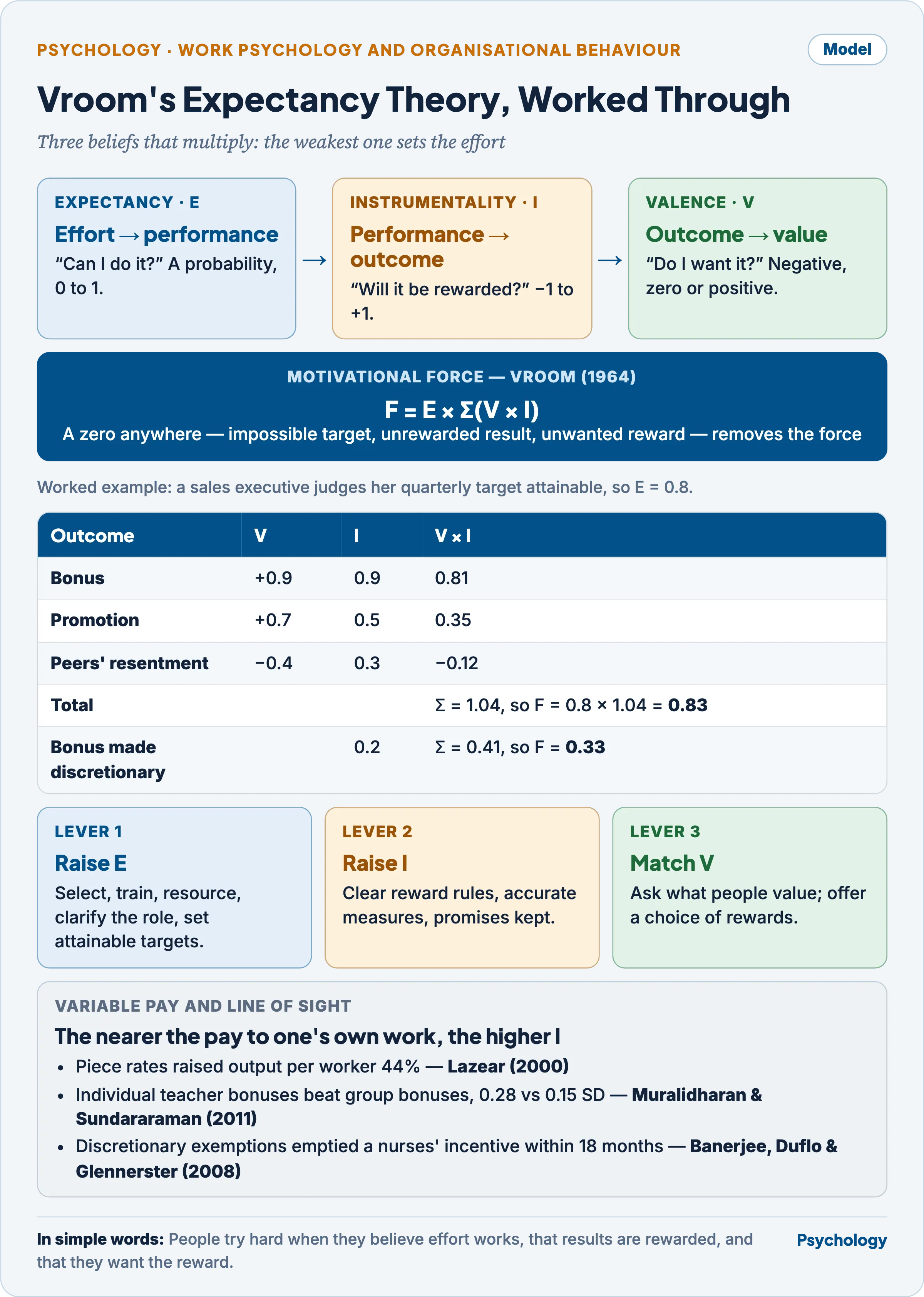
The three beliefs multiply, so the weakest link sets the effort: a bigger bonus does nothing while the target looks impossible.
How it is used to increase the performance of workers
- First find the weak link.
- Raising expectancy — select for ability, train, supply tools and information, clarify the role, and set hard but attainable targets (see Training and Human Resource Development).
- Raising instrumentality — publish the rule linking performance to reward, measure accurately, and pay as promised; one broken promise lowers it for everyone who watched.
- Matching valences — ask employees what they value and offer choice among rewards: cafeteria benefits, leave, recognition, training.
- Lawler (1971) carried the theory into pay: pay motivates only when it is valued and visibly tied to a measure the employee can influence.
Vroom’s theory and variable-pay programmes
- Variable pay makes part of earnings depend on measured performance: individual (piece rates, commissions, merit pay, bonuses), group (team bonuses, gainsharing) or organisational (profit-sharing, stock ownership).
- The further the pay unit from the person, the weaker the line of sight between one’s own effort and the reward, so instrumentality falls from individual to organisation-wide schemes.
- Lazear (2000) — at Safelite Glass, moving windscreen installers from hourly wages to piece rates raised output per worker by 44 per cent, about half from greater effort and the rest from who joined and stayed — one firm, one easily counted task.
- Muralidharan and Sundararaman (2011) — a randomised trial in government rural primary schools in Andhra Pradesh; teacher bonuses averaging about 3 per cent of pay were tied to pupils’ test gains.
- After two years incentive schools scored 0.27 and 0.17 standard deviations higher in mathematics and language, with no adverse effects detected.
- Individual bonuses beat school-level group bonuses, 0.28 against 0.15 standard deviations: instrumentality weakens as line of sight lengthens. Limitation: test scores are only part of a teacher’s output.
- Duflo, Hanna and Ryan (2012) — in NGO-run schools in rural Udaipur, pay tied to camera-verified attendance cut teacher absence by 21 percentage points.
- Banerjee, Duflo and Glennerster (2008) — pay cuts for absent nurses in Rajasthan first raised attendance, but administrators granted “exempt days” and within eighteen months the scheme was ineffective: discretion destroyed instrumentality.
- Jenkins, Mitra, Gupta and Shaw (1998), pooling 39 studies, found incentives correlated .34 with performance quantity but not with quality; contingent rewards can also undermine intrinsic interest (Deci, Koestner and Ryan, 1999), as set out in Intrinsic and Extrinsic Motivation (Paper I).
Evaluation of expectancy theory
- Strengths: individual differences enter through valence, each component is a lever, and it underpins path–goal leadership (House, 1971).
- Van Eerde and Thierry (1996) meta-analysed 77 studies against five criteria — performance, effort, intention, preference, choice. Correlations were lower than narrative reviews had claimed, and the full model predicted no better than its single components.
- It assumes conscious calculation; the model describes the structure of a choice rather than its mental steps.
- It names no content — which outcomes carry valence must come from need theories — so it complements Maslow and Herzberg rather than replacing them.
Adams’ equity theory
- Adams (1963, 1965) built on Festinger’s (1957) cognitive dissonance and Homans’ (1961) distributive justice: perceived unfairness is a tension people act to remove.
- Inputs are what a person brings — effort, education, experience, skill, time. Outcomes are what they receive — pay, benefits, status, recognition, interesting work. Both count as perceived, not as measured.
- The person compares own outcome-to-input ratio with a comparison other‘s; Goodman (1974) found employees use several referents at once — other people, the self, and the system’s promised rules.
- Equal ratios: equity, and satisfaction.
- A lower ratio: under-reward inequity, felt as anger.
- A higher ratio: over-reward inequity, felt as guilt, with a higher threshold, so more of it is tolerated (Adams, 1965).
- Adams (1965) listed six ways of reducing inequity: altering inputs; altering outcomes; cognitively distorting one’s own inputs or outcomes; leaving the field; acting on the other; and changing the comparison other.
- Over-reward is the distinctive prediction, tested in the field by Greenberg (1988): 198 life-insurance underwriting employees, displaced by office refurbishment, were randomly moved to offices of higher-, equal- or lower-status colleagues.
- Performance rose in higher-status offices and fell in lower-status ones, in proportion to the status gap.
- Limitation: the reassignment was temporary, and status rather than pay was varied.
- Huseman, Hatfield and Miles (1987) added equity sensitivity: benevolents are content to give more than they get, equity sensitives follow the theory, and entitleds prefer over-reward.
- Criticisms: the referent and the response chosen are not predicted, over-reward effects are weak, and equity is only one allocation norm beside equality and need (Deutsch, 1975).
- Murphy-Berman, Berman, Singh, Pachauri and Kumar (1984) had Indian and American respondents divide a bonus or a pay cut between a meritorious and a needy worker; Indians favoured the needy worker more.
Procedural and distributive justice and their effect on employee motivation
- Distributive justice is the perceived fairness of outcomes — Adams’ question, though he answered it by equity alone.
- Procedural justice is the perceived fairness of the process that decides outcomes. Thibaut and Walker (1975), studying legal disputes, separated process control (a say in presenting one’s case) from decision control; people accepted losing the second if they kept the first.
- This fair process or voice effect (Folger, 1977) is among the most replicated findings on justice.
- Leventhal (1980) carried the idea into organisations with six rules: consistency, bias suppression, accuracy, correctability, ethicality and representativeness.
- Bies and Moag (1986) added interactional justice, the quality of treatment when procedures are applied; Greenberg (1993) split it into interpersonal justice (dignity, respect) and informational justice (adequate explanation).
| Dimension | Distributive justice | Procedural justice | Interactional justice |
|---|---|---|---|
| Question asked | Is what I got fair? | Was the deciding fair? | Was I treated and told decently? |
| Criteria | Equity, equality or need | Voice, consistency, accuracy, correctability | Respect; honest, timely explanation |
| Predicts best | Satisfaction with the outcome | Job satisfaction, commitment, performance | Evaluation of the supervisor |
| Violation provokes | Lowered effort, pay dissatisfaction, withdrawal | Lowered commitment and trust in the system | Negative reactions to the supervisor |
- McFarlin and Sweeney (1992) found distributive justice predicted personal outcomes (pay and job satisfaction) and procedural justice organisational ones (commitment, evaluation of the supervisor), later named the two-factor model (Sweeney and McFarlin, 1993).
- Colquitt, Conlon, Wesson, Porter and Ng (2001) meta-analysed 183 studies (corrected correlations).
- Distributive justice: .61 with outcome satisfaction. Procedural justice: .62 with job satisfaction and .57 with commitment.
- Procedural justice correlated .36 with performance against .15 for distributive; informational justice .65 with evaluation of the supervisor.
- Limitation: the dimensions are moderately to highly intercorrelated, though each adds explained variance.
- Brockner and Wiesenfeld (1996) showed the two interact: a fair procedure matters most when the outcome is unfavourable.
- Lind and Tyler’s (1988) group-value model explains why: a fair procedure tells people they are valued members, sustaining commitment beyond the specific reward.
- Greenberg (1990) — manufacturing plants cut pay by 15 per cent temporarily.
- Theft rose against periods before and after the cut and against a control group whose pay was unchanged; where the cut was explained thoroughly and sensitively, felt inequity and theft were both lower.
- Limitation: plants, not individuals, received the conditions, and the explanation came with expressed regret, confounding informational and interpersonal justice.
- Bakhshi, Kumar and Rani (2009), with 128 employees of an Indian medical college, found distributive justice predicted job satisfaction while procedural did not; both predicted organisational commitment.
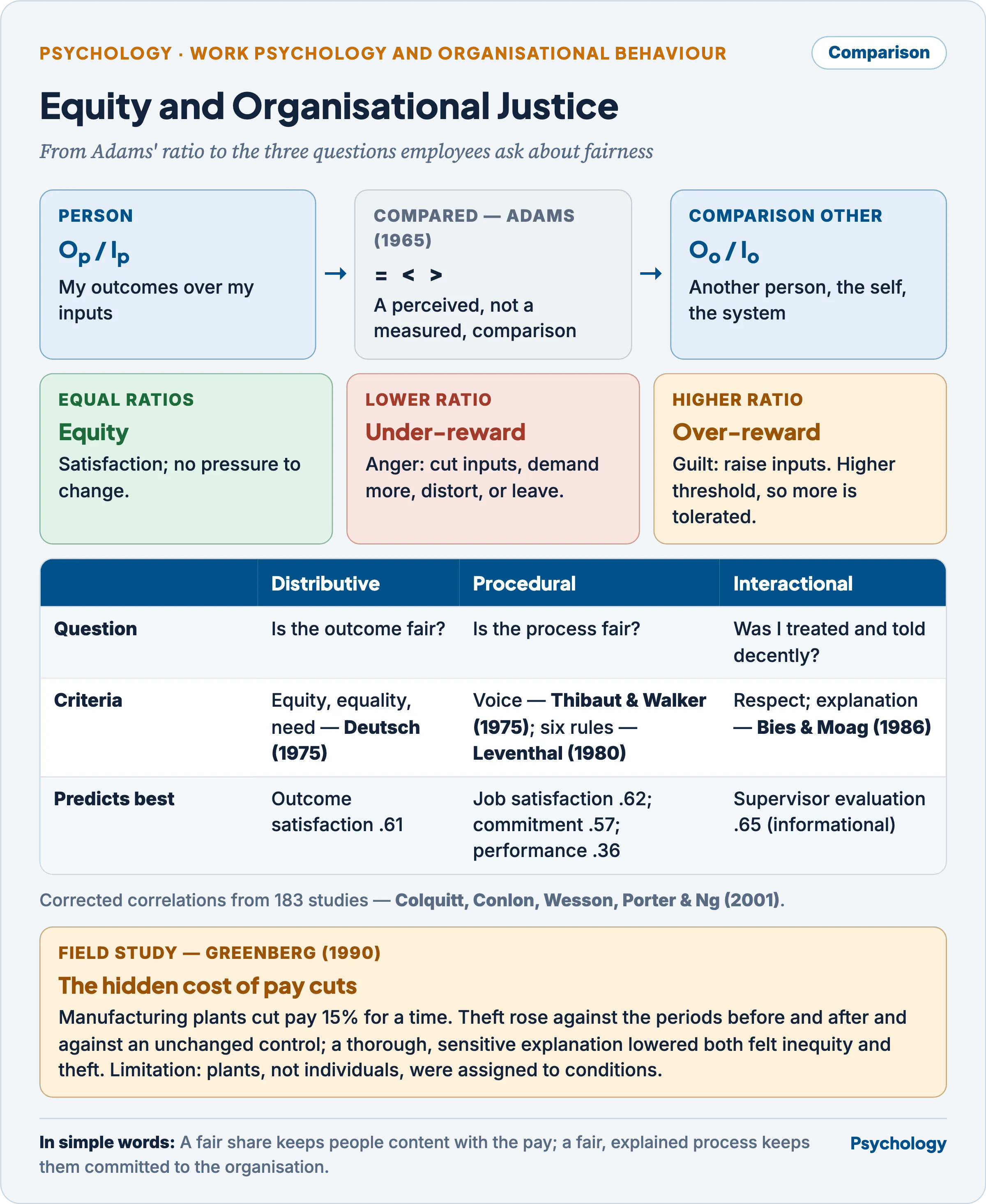
What a person gets decides satisfaction with the pay; how it was decided, and how they were told, decides commitment to the organisation.
The Porter and Lawler model
- Porter and Lawler (1968), in Managerial Attitudes and Performance, extended Vroom by adding what stands between effort and results.
- The model runs through nine variables.
- Value of reward and perceived effort–reward probability — Vroom’s valence and expectancy — determine effort, the energy spent, which is not yet performance.
- Abilities and traits and role perceptions — what the person can do and believes the job requires — convert effort into performance.
- Performance earns intrinsic rewards (accomplishment, self-given) and extrinsic rewards (pay, promotion, given by the organisation and more loosely tied to performance).
- Perceived equitable rewards, Adams’ idea, set what performance deserves; satisfaction is the extent to which actual rewards meet or exceed them.
- Two feedback loops close the cycle: whether performance was rewarded revises the effort–reward probability, and satisfaction revises the future value of rewards.
- The central claim is that satisfaction follows performance, through rewards, rather than causing it — reversing the human-relations belief that a happy worker is a productive one.
- Judge, Thoresen, Bono and Patton (2001), pooling 312 samples (N = 54,417), put the satisfaction–performance correlation at .30, though correlational evidence leaves the direction unsettled.
- Evaluation: it integrates expectancy, equity and ability, and explains why effort fails without role clarity. Against it: complexity, piecemeal rather than whole-model testing, and the rational-actor assumption.
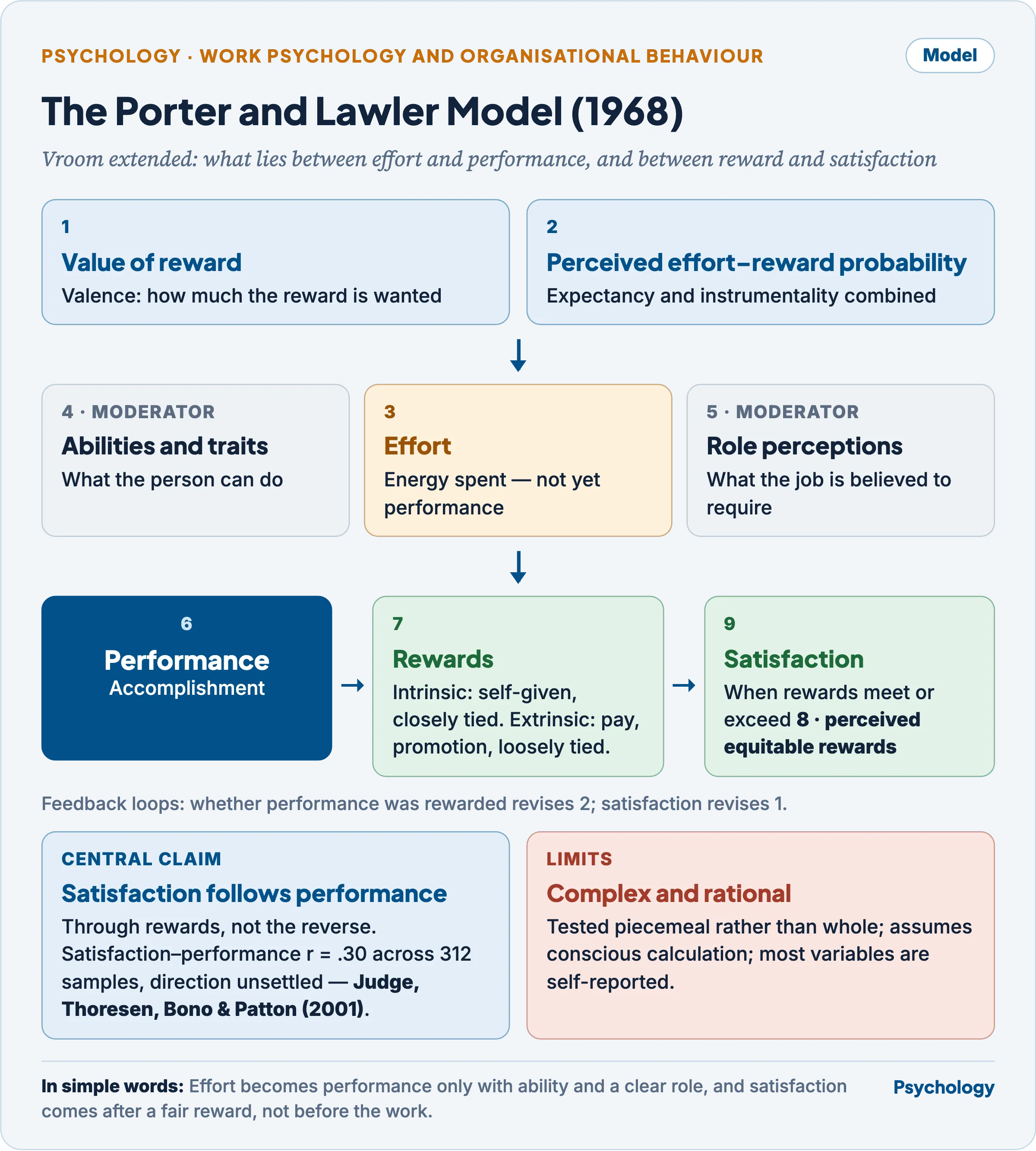
Effort reaches performance only through ability and a correct reading of the role, and satisfaction comes after the reward, not before the work.
Applications of equity and Porter-Lawler theories in modern organisations
- Equity theory underlies pay structure: internal equity through job evaluation, external equity through market pay surveys, individual equity through performance differences within a grade, plus explained pay decisions and gender pay audits.
- Porter and Lawler become a performance-management cycle.
- Selection and training raise ability (see Personnel Selection and the Use of Psychological Tests in Industry); job descriptions and key result areas correct role perceptions.
- Appraisals must actually reward performance, keeping the feedback loop credible, and mix intrinsic with extrinsic rewards; satisfaction is read as a result of the reward system.
- Goal setting completes the process family. Locke and Latham (1990) showed that specific, difficult, accepted goals with feedback beat “do your best”.
- Latham and Baldes (1975) set logging crews a specific hard target for truck loads; performance improved at once, sparing the firm about a quarter of a million dollars in extra trucks.
Managerial implications and programmes drawn from motivation theories
| Programme | Theory drawn on | Mechanism | Where applied |
|---|---|---|---|
| Management by objectives | Goal setting; Drucker (1954) | Agreed, measurable targets with review | CPSE Memoranda of Understanding (1987–88) |
| Pay for performance | Vroom; Lawler (1971) | Raises instrumentality | Safelite Glass; CPSE performance-related pay |
| Recognition schemes | Porter and Lawler | Valued non-financial reward | PM’s Awards for Excellence in Public Administration |
| Employee stock ownership | Equity; expectancy | Shared gains, weak line of sight | Listed Indian companies under SEBI rules (2021) |
| Quality circles | Procedural justice (voice) | Participation in decisions | BHEL Hyderabad (1980–81) |
- Rodgers and Hunter (1991) reviewed 70 studies of management by objectives: 68 showed productivity gains, averaging 56 per cent gains under high top-management commitment against 6 per cent under low.
- The implications: diagnose the weak link first; make reward rules transparent and keep them; give voice in setting targets; explain adverse decisions.
- Job enrichment and the job characteristics model (Hackman and Oldham, 1976) are developed in Theories of Work Motivation: Maslow and Herzberg, and participative management in Leadership and Participatory Management.
Factors affecting work motivation in Indian organisations
- Cultural values — Hofstede (2001) scored India 77 on power distance and 48 on individualism, so recognition by superiors and personal ties carry high valence.
- Allocation norms — a preference for need-based allocation (Murphy-Berman and colleagues, 1984) means equity’s input–outcome rule does not transfer unchanged.
- Motive pattern — Pareek (1968) made development depend on achievement multiplied by extension motivation, concern for goals beyond oneself, minus dependency, which lowers self-generated expectancy.
- Reward systems — seniority-based promotion and security weaken instrumentality in much of the public sector, and discretion erodes even formal incentives (Banerjee and colleagues, 2008).
- Justice — distributive fairness predicts satisfaction in Indian samples (Bakhshi and colleagues, 2009), so transparent appraisal is a motivational tool.
- J. B. P. Sinha’s (1980) nurturant-task leader, fitted to these conditions, is in Leadership and Participatory Management.
Work culture as a component of work motivation in public and private industry in India
- Work culture is the shared set of values, norms and practices about work in an organisation. J. B. P. Sinha (1990), in Work Culture in the Indian Context, described two profiles.
- Soft work culture — pliant management, with non-work activities and influences dominating employees’ lives; studied in banking organisations among others.
- Synergetic work culture — assertive management, rewards for hard work, ample welfare and cultivated union relations.
- Sinha and Sinha (1990) found the same Indian socio-cultural values supported either profile; the critical difference was establishing work as the master value, which other social values then served.
- Work culture is therefore an essential component of motivation: it decides whether expectancy and instrumentality are believed, whatever the formal scheme says.
- Public industry offers security and time-bound advancement, protecting equity but weakening instrumentality; reforms add performance-related pay, targets and appraisal reform (see Indian context).
- Private industry ties more pay to performance and ownership, strengthening instrumentality at the cost of insecurity, and buying quantity more readily than quality (Jenkins and colleagues, 1998).
- Leadership and supervision, culture’s managerial carriers, are treated in Managerial Effectiveness.
Criticisms and limitations
- All three theories assume a conscious, calculating actor, leaving habit, emotion and social pressure outside.
- Their evidence rests on self-reported valences, probabilities and fairness measured at one time, so causal direction is often unknown (Judge and colleagues, 2001).
- They were built in individualist Western workplaces; need-based allocation (Murphy-Berman and colleagues, 1984) and relationship-centred work culture (Sinha and Sinha, 1990) qualify each.
Indian context
- Performance-related pay in central public sector enterprises (Department of Public Enterprises) — introduced on the Second Pay Revision Committee’s advice by memoranda of 26 November 2008 and 9 February 2009, and revised on 3 August 2017.
- Weights of 50 per cent for the enterprise’s MoU rating, 30 per cent team and 20 per cent individual, from a pool capped at 5 per cent of core-business profit (DPE, 2017).
- It operationalises instrumentality at three lines of sight.
- Memorandum of Understanding system (DPE, 1987–88) — annual targets agreed between each enterprise and its ministry, rated from excellent to poor. It operationalises goal setting.
- Seventh Central Pay Commission (report, 19 November 2015) — recommended performance-related pay for all central employees, based on Results-Framework Documents and reformed APARs; the government raised the promotion benchmark to “very good” and accepted withholding increments from those missing it within 20 years (Rajya Sabha, 2016).
- Eighth Central Pay Commission (constituted 3 November 2025; Justice Ranjana Prakash Desai) — its terms include an incentive scheme to reward excellence in productivity and performance: instrumentality as pay policy.
- Annual Performance Appraisal Report reforms (Department of Personnel and Training) — Dev Dutt v. Union of India (Supreme Court, 2008) held non-communication of an entry arbitrary; numerical grading followed from 2009–10, online filing for IAS officers (SPARROW) from 1 April 2014.
- It operationalises procedural justice: accuracy, voice, correctability.
- Code on Wages, 2019 (Ministry of Labour and Employment; in force 21 November 2025) — subsumes four Acts, including the Payment of Bonus and Equal Remuneration Acts; Section 3 bars gender discrimination in wages for the same or similar work. It operationalises distributive justice.
- Prime Minister’s Awards for Excellence in Public Administration (Department of Administrative Reforms and Public Grievances, 2006) — presented on Civil Services Day; it operationalises recognition as an extrinsic reward.
Previous Year Questions
- 2024What are the components of Vroom’s theory of motivation? How can it be used to increase the performance of workers?
- 2021Explain the factors affecting the work motivation within work organization in India.
- 2012Explain Vroom’s expectancy theory of work motivation and link this theory with variable-pay programs.
- 2011Compare procedural and distributive justice, and present their effect on employees motivation.
- 2010Evaluate the applications of equity theory and Porter-Lawler’s theory in modern organizations.
- 2007Evaluate the applications of any two theories of Work Motivation in modern organizations. State the importance of Participatory Management in Indian Industry.
- 2004Discuss the managerial implications of motivation theories. State the specific programmes drawn from these theories giving examples of organizations in which they are applied.
- 1996Is work culture an essential component of effective work motivation? Discuss its operation in public and private industrial set-up in India.