

Official syllabusPaper II · Unit 4 · Work Psychology and Organisational Behaviour
Theories of work motivation – Herzberg, Maslow.
Definition
“Work motivation is a set of energetic forces that originate both within as well as beyond an individual’s being, to initiate work-related behavior, and to determine its form, direction, intensity, and duration.”
Pinder (1998)
Maslow and Herzberg give the two founding answers to the first question of work motivation: what, in the person or in the job, energises effort. Maslow wrote about human motivation in general and managers carried his hierarchy into industry; Herzberg built his theory from accounts of work and argued that what removes discontent is not what creates motivation. Both changed management practice more than their evidence could support, and the evidence belongs in any account of either.
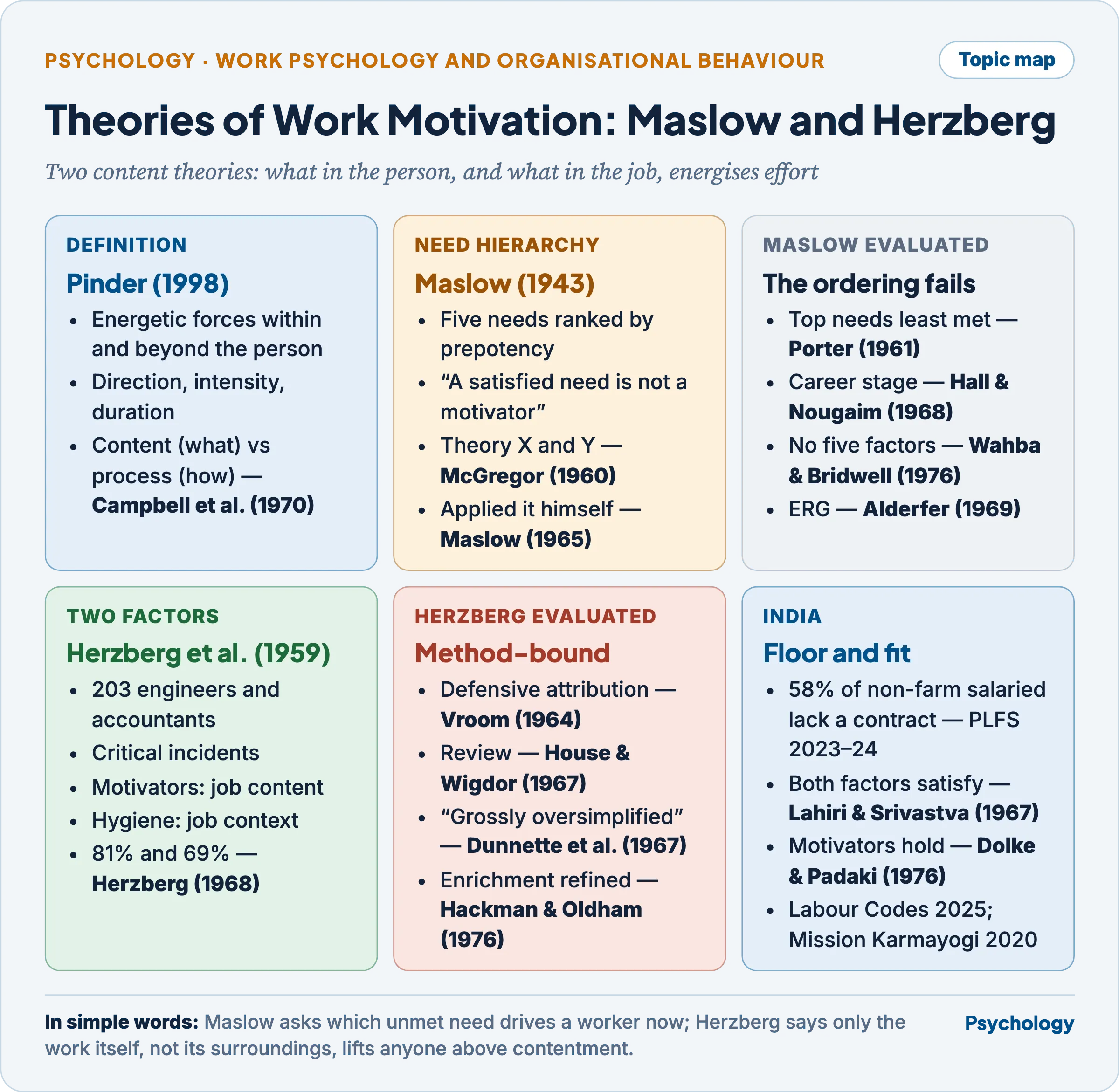
Two content theories with one shared fate: each changed how jobs are managed more than its own evidence could justify.
Work motivation: content and process theories
- Pinder’s definition locates the forces both inside the person (needs, values) and outside (the job, pay, the supervisor), and names the three dimensions on which motivation is judged: direction (which task), intensity (how hard) and duration (how long).
- Content theories ask what energises behaviour — the needs, motives or job features that make an outcome worth working for. Process theories ask how behaviour is started, directed and sustained, from expectation to choice (Campbell, Dunnette, Lawler and Weick, 1970).
| Content theories | Process theories | |
|---|---|---|
| Core question | What motivates? | How does motivation operate? |
| Unit of analysis | Needs, motives, job factors | Expectations, comparisons, goals |
| Image of the worker | Driven by deficits or growth needs | A deliberate chooser |
| Members | Maslow (1943), Herzberg (1959), Alderfer (1969), McClelland (1961) | Vroom (1964), Adams (1963), Porter and Lawler (1968), Locke (1968) |
| Manager’s lever | Supply what is lacking; redesign the job | Tie effort to reward; keep rewards fair |
| Typical weakness | Assumes needs are universal and ranked | Assumes conscious calculation |
- The families are complementary: content theories explain why outcomes attract, which process theories take as given — hence Porter and Lawler (1968) placed intrinsic and extrinsic rewards inside an expectancy model, set out in Theories of Work Motivation: Vroom, Adams’ Equity Theory and Porter-Lawler.
Maslow’s need hierarchy theory
- Maslow (1943), restated in Motivation and Personality (1954), arranged five basic needs by prepotency: the most pressing unmet need dominates consciousness and organises behaviour until fairly well satisfied, and then the next need emerges. At work each level takes a recognisable form.
- Physiological — a wage sufficient for food, rest and shelter.
- Safety — tenure, pension, insurance and safe conditions; Maslow cited “the common preference for a job with tenure and protection” (Maslow, 1943).
- Belongingness and love — acceptance by the work group and a supportive supervisor.
- Esteem — achievement and competence from within, and recognition, status and reputation from others.
- Self-actualisation — “What a man can be, he must be” (Maslow, 1943): work that uses one’s full capacity.
- The working rule is that “a satisfied need is not a motivator” (Maslow, 1943), so pay rises do little for an employee whose lower needs are secure.
- For one whose needs are not, money dominates: “It is quite true that man lives by bread alone — when there is no bread” (Maslow, 1943).
- The hierarchy was never a staircase. Maslow illustrated the average citizen as satisfied perhaps 85 per cent in physiological, 70 in safety, 50 in love, 40 in esteem and 10 per cent in self-actualisation needs, with higher needs emerging gradually (Maslow, 1943).
- Deficiency needs — the first four — motivate by lack and fall silent when met; growth needs strengthen as they are gratified (Maslow, 1962). The general theory, its instinctoid needs and the pyramid Maslow never drew are treated in Theories of Motivation (Paper I).
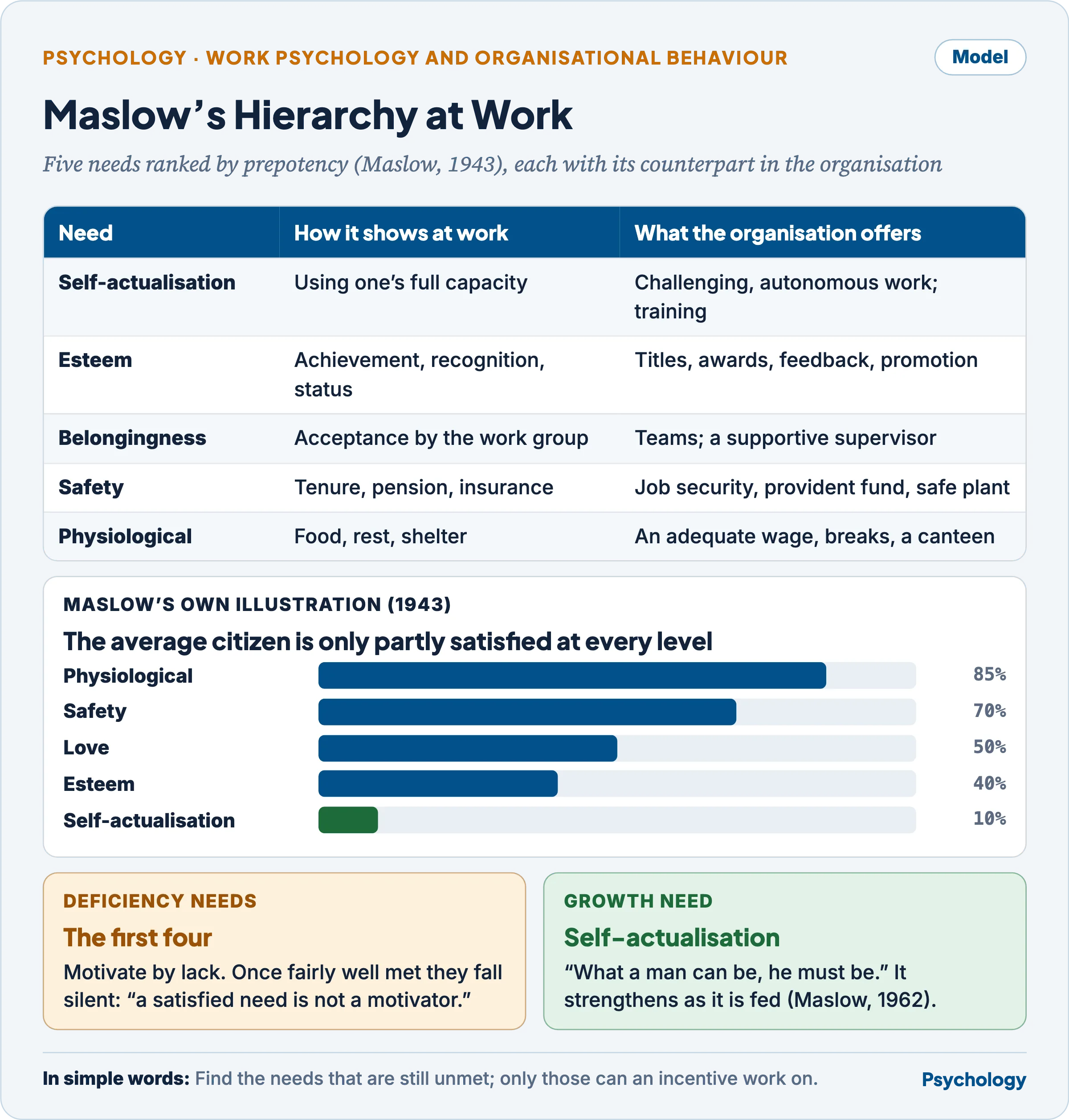
Maslow’s own figures describe overlapping, partly met needs, and every level has an organisational counterpart.
Application of Maslow’s theory in industry
- The theory is used diagnostically: find the prepotent unmet need of a group and supply the incentive that meets it — wages and canteens, then tenure, provident fund and safety equipment, then teams, then titles, awards and feedback, then autonomy, training and stretching assignments.
- Porter (1961) built a Need Satisfaction Questionnaire, dropped the physiological level, inserted autonomy between esteem and self-actualisation, and surveyed 139 managers — 64 bottom-level and 75 middle — in three companies.
- Self-actualisation was the least satisfied and among the most important needs at both levels; middle managers were more satisfied than bottom managers on esteem, security and autonomy.
- Implication: managers’ deficits lie at the top, beyond the reach of pay and security schemes. Limitation: cross-sectional self-report.
- McGregor (1960) carried Maslow’s hierarchy into management (Baard, Deci and Ryan, 2004): Theory X treats workers as moved only by lower needs and needing control; Theory Y assumes higher needs that work itself can satisfy, and so recommends delegation, participation and larger jobs.
- Maslow (1965) applied the theory himself in Eupsychian Management, a journal kept at Non-Linear Systems, a Californian plant, in the summer of 1962: management that trusts employees serves their growth and the firm’s output at once. It was reissued as Maslow on Management (1998).
- The practical limit is that one incentive serves several levels: pay buys food, security and status, so mapping incentives onto needs is loose.
Critical evaluation of Maslow’s theory
- Wahba and Bridwell (1976) reviewed the research: ten factor-analytic studies failed to recover five distinct need categories, with needs loading on more than one factor; support for a hierarchy was only partial, and longitudinal tests found none.
- Hall and Nougaim (1968) followed 49 management trainees in one company for five years.
- Satisfaction of a need correlated positively, not negatively, with that need’s strength, and the shifts tracked career stage rather than gratification of lower needs (Hall and Nougaim, 1968).
- Limitation: Lawler and Suttle (1972) noted the small sample, post hoc coding of interviews and low agreement between coders.
- Lawler and Suttle (1972), with managers in two organisations measured twice, found that satisfying a need did not lower its later importance or raise that of the next level; at most a two-level hierarchy, lower against higher needs, survived.
- The field study that fits best is Aronoff (1967) in the British West Indies: more group-paid cane cutters were still preoccupied with safety, while fishermen, who worked alone for higher but uncertain earnings, more often operated at the esteem level. Limitation: one small society.
- Tay and Diener (2011), using Gallup data from 123 countries, found the needs universal and each predictive of well-being — but people reported fulfilment of higher needs while lower ones were unmet, and the order of fulfilment had little bearing on well-being.
- The concepts are loose: “fairly well satisfied” is unquantified, the needs were never defined for the workplace, and self-actualisation was characterised from exemplars Maslow chose. Hofstede (1980) argued that the ordering mirrors American culture, and that security or social needs can outrank self-actualisation elsewhere.
- Alderfer (1969) compressed the hierarchy into existence, relatedness and growth (ERG), allowed several needs to operate at once, and added frustration–regression: an employee denied a challenging role may press harder for pay or company.
- McClelland (1961) replaced a universal ladder with learned needs for achievement, power and affiliation, derived from Murray’s (1938) needs rather than from Maslow; it is set out in Achievement Motivation and the Measurement of Motivation (Paper I).
Herzberg’s two-factor theory of work motivation
- Herzberg, Mausner and Snyderman (1959), The Motivation to Work, proposed the motivation–hygiene theory.
- Design: 203 engineers and accountants in Pittsburgh-area firms; the critical incident technique asked each to recall a time they felt exceptionally good or bad about their job, what happened, and how long the feeling and its effect on their work lasted.
- Finding: good feelings were about job content, bad feelings about job context.
- Limitation: two professional occupations from one region; stories coded by the researchers.
- Motivators, or satisfiers, are intrinsic to the job: achievement, recognition for achievement, the work itself, responsibility, and growth or advancement (Herzberg, 1968).
- Hygiene factors, or dissatisfiers, are extrinsic: company policy and administration, supervision, interpersonal relationships, working conditions, salary, status and security (Herzberg, 1968).
- The two sets lie on separate continua: “the opposite of job satisfaction is not job dissatisfaction but, rather, no job satisfaction” (Herzberg, 1968). Good hygiene brings a worker to no dissatisfaction, which is not motivation.
- Herzberg (1968), across 12 investigations of 1,685 employees — from nurses and food handlers to military officers and Finnish foremen — found that 81 per cent of the factors contributing to satisfaction were motivators and 69 per cent of those contributing to dissatisfaction were hygiene.
- Rewards and punishments he called KITA, a kick in the pants: they produce movement, which stops when the kick stops, not motivation, which is self-generated (Herzberg, 1968).
- The theory rests on a view of human nature: an Adam nature that avoids pain, served by hygiene, and an Abraham nature that seeks growth, served only by motivators (Herzberg, 1966).
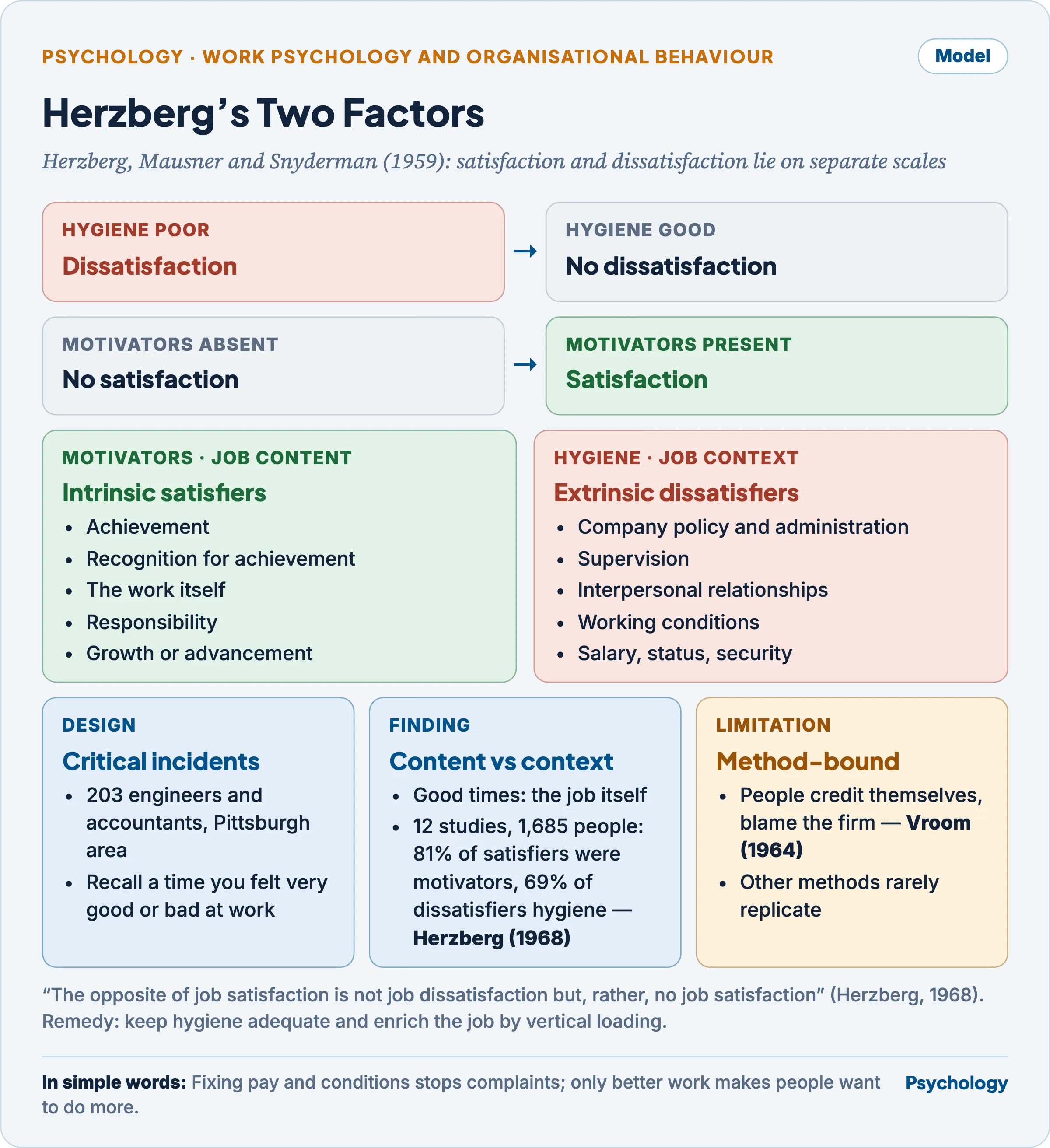
Hygiene can at best bring a worker up to zero; only the work itself moves anyone above it.
Techniques of motivating industrial employees: job enrichment
- Herzberg’s prescription is to keep hygiene adequate and enrich the job by vertical loading — adding responsibility and control — not horizontal loading or job enlargement, which adds tasks of the same kind and makes a job only structurally bigger (Herzberg, 1968).
- His seven principles of vertical loading: remove some controls while keeping accountability; increase accountability for one’s own work; give a complete natural unit of work; grant more authority; report results to the worker directly; add new, harder tasks; and assign specialised tasks that build expertise.
- Herzberg (1968) reported the test on stockholder correspondents in a very large corporation.
- An achieving unit received the seven changes over two months; a control unit continued as before, and two further groups checked for a Hawthorne effect and behaved like the control.
- After six months the achievers outperformed the controls on a service index of letter quality and speed, liked their jobs more, were absent less and were promoted more; performance dipped first and rose from the third month.
- Limitation: one unit in one firm, randomisation not described, written up by the theory’s own author.
- Hackman and Oldham (1976) turned enrichment into the job characteristics model. Five core dimensions — skill variety, task identity, task significance, autonomy and feedback — create three psychological states (experienced meaningfulness, experienced responsibility, knowledge of results) that raise internal motivation, satisfaction and quality.
- Growth need strength moderates the effect: enrichment pays most for people who want growth from work.
- The motivating potential score is the mean of the first three dimensions multiplied by autonomy and by feedback (Hackman and Oldham, 1975), so a job without autonomy or feedback has none.
- Humphrey, Nahrgang and Morgeson (2007), meta-analysing 259 studies and 219,625 participants, found motivational job characteristics explained 34 per cent of the variance in job satisfaction and 25 per cent in subjective performance.
- Herzberg (1968) classed job rotation as horizontal loading and job participation as a positive KITA: only changes that add responsibility enrich a job. Participation is treated in Leadership and Participatory Management.
Critical examination of Herzberg’s theory
- Method-bound. Vroom (1964) argued that critical incidents invite defensive attribution: people credit themselves for good events and blame policy or supervisors for bad ones, so the two-factor split may be produced by the method.
- House and Wigdor (1967), reviewing the evidence, concluded that a factor can satisfy one person and dissatisfy another, and that studies using other methods rarely reproduce the split.
- Dunnette, Campbell and Hakel (1967) had six occupational groups Q-sort two 36-statement decks, of satisfying and of dissatisfying job situations.
- Both satisfaction and dissatisfaction arose from content and from context, and achievement, responsibility and recognition mattered more for both than working conditions, policy or security.
- They called the theory a “grossly oversimplified portrayal” of how satisfaction comes about (Dunnette, Campbell and Hakel, 1967).
- King (1970) distinguished five versions of the theory in the literature: some were invalid, and the rest had limited or untested support.
- Satisfaction is not performance. Herzberg measured feelings, not output, and Judge, Thoresen, Bono and Patton (2001) put the true satisfaction–performance correlation at .30 across 312 samples — real but moderate.
- Individual differences are ignored: enrichment helps those high in growth need strength and can burden those who want security (Hackman and Oldham, 1976).
- What survives is the claim that job content matters. On pay the theory is partly right: pay level correlated only .15 with job satisfaction across 92 samples (Judge, Piccolo, Podsakoff, Shaw and Rich, 2010).
How Herzberg’s theory differs from Maslow’s theory
- Both are content theories, and they overlap: hygiene factors correspond roughly to Maslow’s physiological, safety and social needs, and motivators to esteem and self-actualisation.
| Dimension | Maslow (1943) | Herzberg (1959) |
|---|---|---|
| Scope | Human motivation in general | Motivation at work |
| Evidence base | Clinical observation, chosen exemplars | Critical incidents from 203 professionals |
| Structure | One ladder of five needs | Two independent continua |
| What motivates | Any unmet need, lowest first | Only motivators |
| A met lower need | Stops motivating; the next emerges | Never motivated; only prevents dissatisfaction |
| Money | Motivates while lower needs are unmet | Hygiene; short-lived effect |
| Social relations | A need level of their own | Hygiene factor |
| Prescription | Meet needs in sequence | Keep hygiene adequate; enrich the job |
| Chief criticism | Ordering unsupported | Split produced by the method |
Highly skilled professionals: motivation from within or from the situation?
- The evidence supports an interaction: the motive is the person’s, but whether it is expressed is set by the situation.
- Herzberg’s own respondents were professionals, and their satisfying incidents centred on achievement and the work itself (Herzberg, Mausner and Snyderman, 1959) — motivation from the content of work, which the organisation designs.
- Deci and Ryan (1985) hold that autonomy, competence and relatedness are innate needs; Gagné and Deci (2005) add that work environments satisfy or thwart them, producing autonomous or controlled motivation. This is set out in Intrinsic and Extrinsic Motivation (Paper I).
- Baard, Deci and Ryan (2004), in two American banking firms, found that employees’ own autonomy orientation and their managers’ autonomy support independently predicted need satisfaction, which predicted performance ratings and adjustment — person and situation together.
- Amabile (1993) argued that extrinsic motivators which inform or enable — resources, useful feedback — combine with intrinsic motivation, while controlling ones undermine it.
- Amabile and Kramer (2011) analysed nearly 12,000 diary entries from 238 professionals in 26 project teams in seven companies.
- The most powerful positive event was progress in meaningful work, and setbacks weighed more than twice as heavily on happiness as progress.
- Limitation: self-rated diaries from creative projects only.
- Ariely, Gneezy, Loewenstein and Mazar (2009) gave 87 participants in Madurai six tasks of memory, motor skill and creativity, with top bonuses per task near the rural monthly per capita expenditure; the highest incentive produced the worst performance. Limitation: games, not jobs.
- Conclusion: for complex, discretionary work, motivation from within drives quality and creativity, but it depends on situational supports — autonomy, feedback, progress, and hygiene that is fair enough not to distract.
Indian context
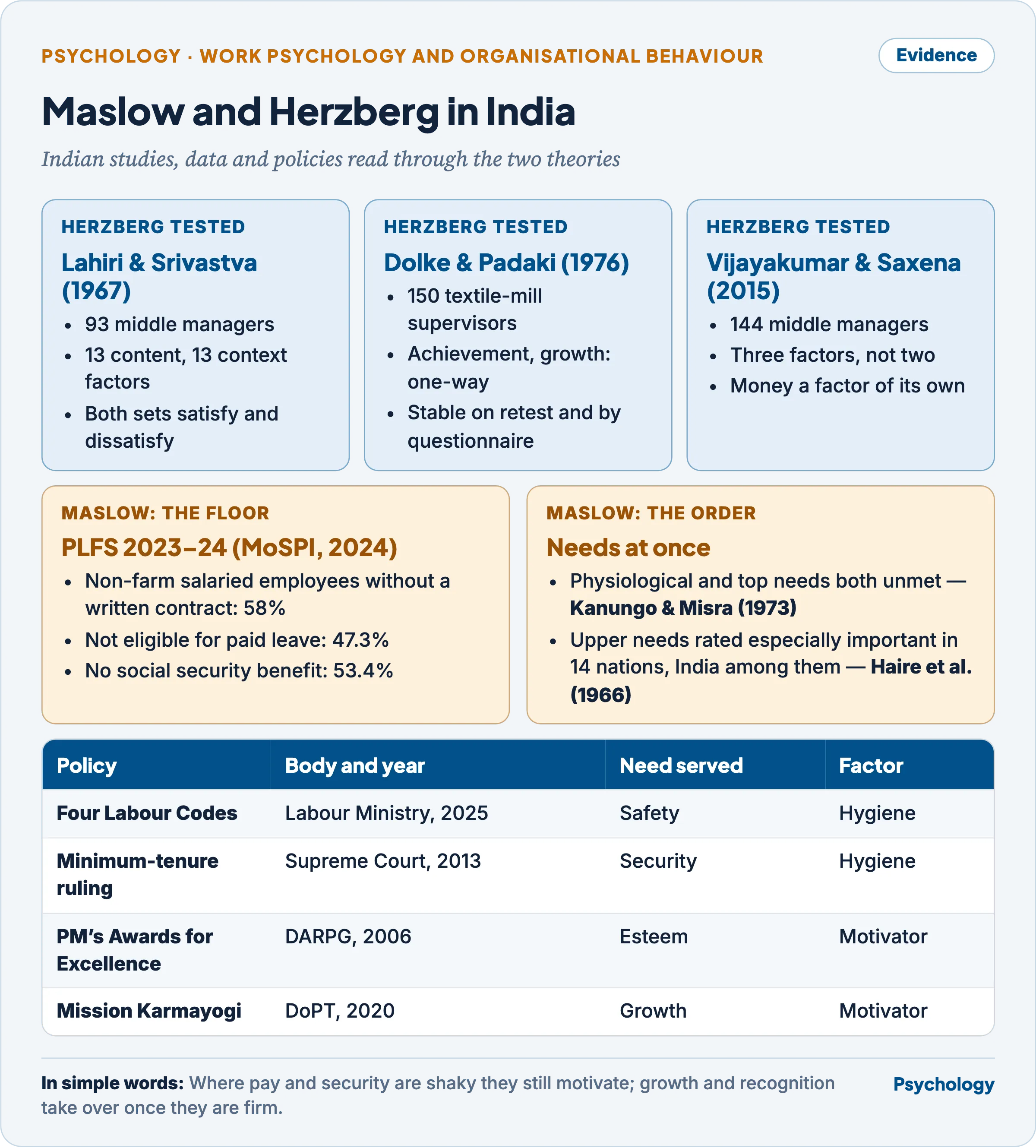
Indian studies keep Herzberg’s motivators and lose his clean split: where security is precarious, hygiene motivates too.
Maslow’s theory in the Indian context
- Among non-agricultural regular wage and salaried employees, 58 per cent had no written contract, 47.3 per cent no paid leave and 53.4 per cent no social security benefit (PLFS 2023–24; MoSPI, 2024). Safety is prepotent.
- Haire, Ghiselli and Porter (1966) surveyed 3,641 managers in 14 countries, India among them; the managers rated the upper needs especially important, so higher needs are not a Western luxury at managerial level.
- Kanungo and Misra (1973) studied 141 employees in two Indian organisations: both high- and low-involvement groups were least satisfied in, and felt the strongest need in, the physiological and self-actualisation areas at once, and several predictions from the hierarchy failed.
- Sinha (1980) described Indian subordinates as preferring personalised, dependent relationships with a superior, so belonging and esteem are sought through the superior’s nurturance; his nurturant-task leader makes that nurturance contingent on task performance, as set out in Leadership and Participatory Management.
- Judgement: the needs are universal, but economic insecurity and collectivism raise the weight of safety and relatedness, so a strict Western ordering does not transfer.
Herzberg’s theory in Indian organisations
- Lahiri and Srivastva (1967) had 93 middle managers rate 13 content and 13 context factors; both sets acted as satisfiers and as dissatisfiers, which they read as casting serious doubt on the theory’s generality.
- Dolke and Padaki (1976) gave Herzberg’s interview to 150 textile-mill supervisors: achievement, advancement, responsibility and growth were constant satisfiers, the pattern held on retest and by questionnaire, and some findings contradicted Herzberg’s.
- Vijayakumar and Saxena (2015) factor-analysed 14 job attributes rated by 144 middle managers and found three factors — job content, organisational context, and rewards and working conditions — with money forming its own factor and many attributes loading on both content and context.
- Judgement: the motivators replicate in India, but the claim that hygiene never motivates does not; context factors, salary above all, also satisfy.
Schemes and law
- Four Labour Codes (Ministry of Labour and Employment; in force 21 November 2025) consolidate 29 central laws, extend minimum wages to all workers, require appointment letters and cover gig and platform workers. They operationalise safety needs and the hygiene floor: removing dissatisfaction, not creating motivation.
- T. S. R. Subramanian v. Union of India (Supreme Court, 31 October 2013) directed minimum tenure for civil servants and Civil Services Boards to handle transfers. It operationalises security as hygiene: arbitrary transfers are a dissatisfier that no motivator offsets.
- Prime Minister’s Awards for Excellence in Public Administration (Department of Administrative Reforms and Public Grievances, 2006) reward extraordinary and innovative work by districts and organisations. They operationalise recognition for achievement, Herzberg’s motivator and Maslow’s esteem need.
- Mission Karmayogi (Department of Personnel and Training; approved 2 September 2020) supports a move from “rules based” to “roles based” HR management through competency-linked learning on iGOT Karmayogi. It operationalises growth and advancement, but enriches jobs only if roles gain responsibility, not merely courses.
Previous Year Questions
- 2023Explain Maslow’s need hierarchy theory. Critically evaluate the same.
- 2020In case of highly skilled professionals does their motivation come from within or is it the result of situational factors? Explain this in the light of theories of motivation.
- 2019Critically examine Herzberg’s two-factor theory of motivation and point out that in what way Herzberg’s theory is different from Maslowian theory?
- 2018Explain Herzberg’s theory of work-motivation. Critically comment on its relevance in Indian context.
- 2017Distinguish between content and process theories of work motivation. Comment on the applicability of Maslow’s theory of work motivation in the Indian context.
- 2016Is Herzberg’s theory relevant for understanding work motivation in Indian organizations? Explain.
- 2000Discuss Maslow’s theory of need-hierarchy. Can Maslow’s theory be applied to industries?
- 1999Discuss the techniques of motivating industrial employees with particular reference to Herzberg’s theory of work motivation.
- 1998What do you understand by work motivation? Discuss the Maslow’s theory of need hierarchy. How can Maslow’s theory be applied in industrial situations?