

Official syllabusPaper II · Unit 4 · Work Psychology and Organisational Behaviour
Transformational leadership.
Definition
“[Transforming leadership] occurs when one or more persons engage with others in such a way that leaders and followers raise one another to higher levels of motivation and morality.”
Burns (1978)
Transformational leadership names the leader who changes what followers want, not only what they do, and so obtains performance beyond the terms of the employment bargain. Its counterpart, transactional leadership, runs the organisation through that bargain. The practical questions are when each works, whether the two can be combined, and how far an organisation’s settled norms allow a leader to change anything at all.
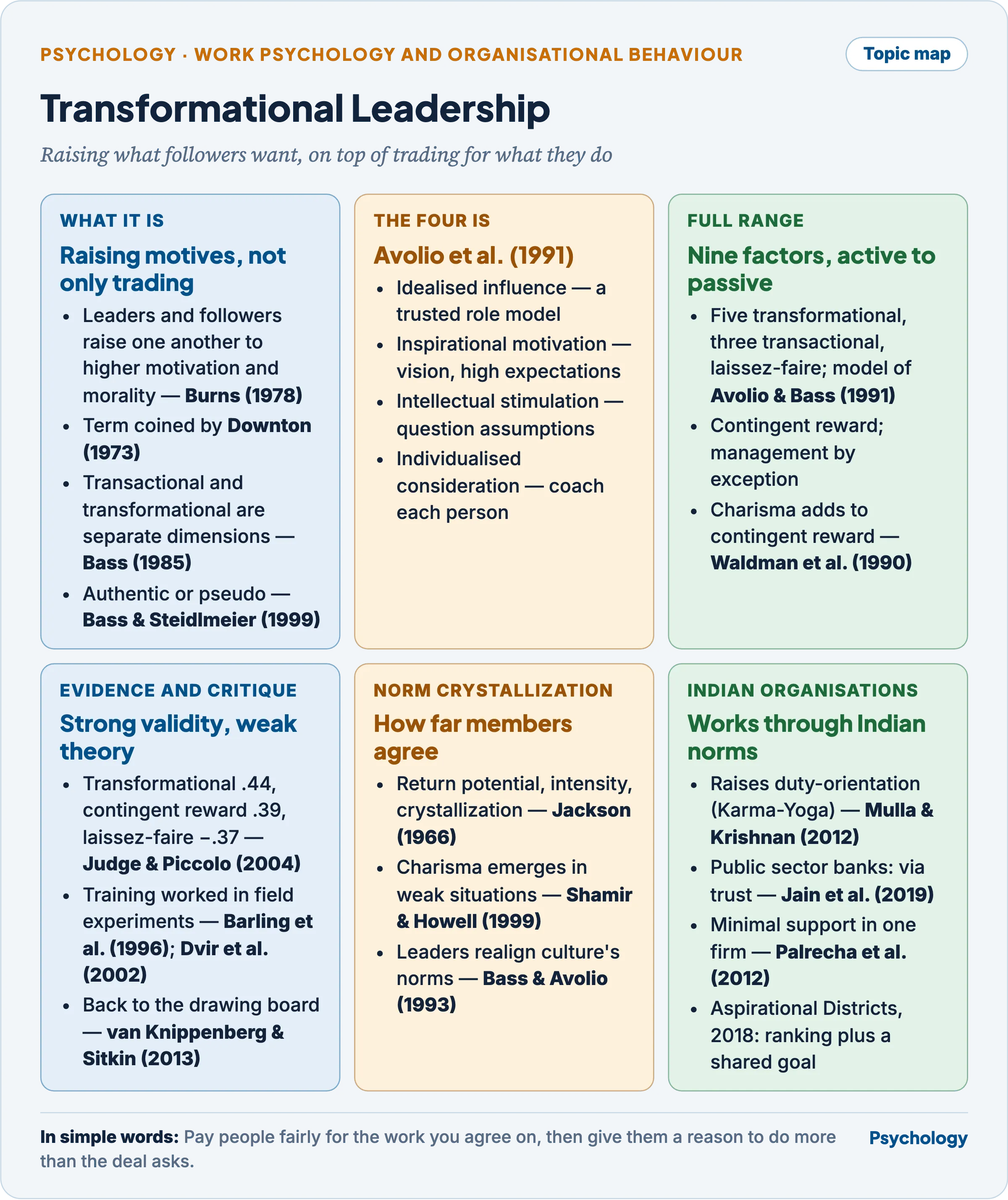
The two styles are not rivals on one scale: the evidence, the norm question and the Indian findings all turn on how they combine.
Transformational leadership: Burns’s transforming and transactional leaders
- The term was coined by Downton (1973) in a study of rebel leadership; James MacGregor Burns (1978), in Leadership, a study of political leaders, gave it its modern form.
- Transactional leadership (Burns, 1978) is an exchange of valued things — economic, political or psychological — in which leader and follower each pursue their own interests. The relationship lasts as long as the bargain does and changes neither party.
- Transforming leadership engages followers’ higher needs and values, so that both sides are changed: followers become leaders, and leaders may become moral agents. Burns called Gandhi “perhaps the best modern example”.
- Burns placed the two at opposite ends of one continuum and judged transforming leadership by its moral ends, so a leader who moves people for private gain is not transforming.
- Bass (1985), in Leadership and Performance Beyond Expectations, changed both points.
- The styles became separate dimensions: one leader can be high on both, and Bass held that the best leaders are.
- Bass treated the behaviours as morally neutral. Bass and Steidlmeier (1999) later separated authentic transformational leadership from pseudo-transformational leadership, which uses the same behaviours for self-serving ends.
- Bass (1990) located superior leadership in leaders who “broaden and elevate the interests of their employees” and lead them to look beyond self-interest to the group’s mission.
- Trait, behavioural and contingency theories, and the nurturant-task model, are treated in Leadership and Participatory Management.
The four Is of transformational leadership
- Bass’s (1985) factor analysis yielded three transformational factors — charisma, individualised consideration and intellectual stimulation. Inspirational motivation was separated later, and the set was named the four Is (Avolio, Waldman and Yammarino, 1991).
- Idealised influence — the leader as a role model whom followers admire, trust and want to emulate. It has a behavioural side (putting the group before self, consistent ethics) and an attributed side (the charisma followers ascribe).
- Inspirational motivation — a compelling vision, high expectations voiced with confidence that followers can meet them, and work given meaning beyond the task.
- Intellectual stimulation — inviting followers to question assumptions, reframe old problems and try new methods, without public criticism of their mistakes.
- Individualised consideration — attention to each follower’s needs and growth: coaching, mentoring and delegation chosen to develop the person.
- The proposed mechanism is identification. Shamir, House and Arthur (1993) argued that such leaders engage followers’ self-concepts in the mission, so effort expresses who the follower is rather than what the follower is paid for.
The full-range leadership model and the MLQ
- The full-range leadership model of Avolio and Bass (1991), in its current nine-factor form, orders the factors from active and effective to passive and ineffective.
- Transformational: idealised influence (attributed), idealised influence (behaviour), inspirational motivation, intellectual stimulation, individualised consideration.
- Transactional: contingent reward, management by exception (active), management by exception (passive).
- Laissez-faire: the absence of leadership.
- The model holds that leaders are most effective when they use the transformational behaviours regularly on a base of contingent reward, and least effective when passive (Bass and Avolio, 1994).
- It is measured by the Multifactor Leadership Questionnaire (MLQ), developed by Bass (1985) and refined into Form 5X, rated by the leader and by followers, peers or superiors.
- Antonakis, Avolio and Sivasubramaniam (2003) tested the structure on 2,279 male and 1,089 female raters and found support for nine factors. Across 18 further samples (6,525 raters) it held only within homogeneous contexts of environmental risk, gender and hierarchical level.
- The augmentation effect is the model’s central claim: transformational leadership adds to the effect of transactional leadership rather than replacing it.
- Waldman, Bass and Yammarino (1990) — 186 United States Navy officers. In hierarchical regression, charisma added unique variance in leader effectiveness beyond contingent reward; contingent reward added nothing beyond charisma.
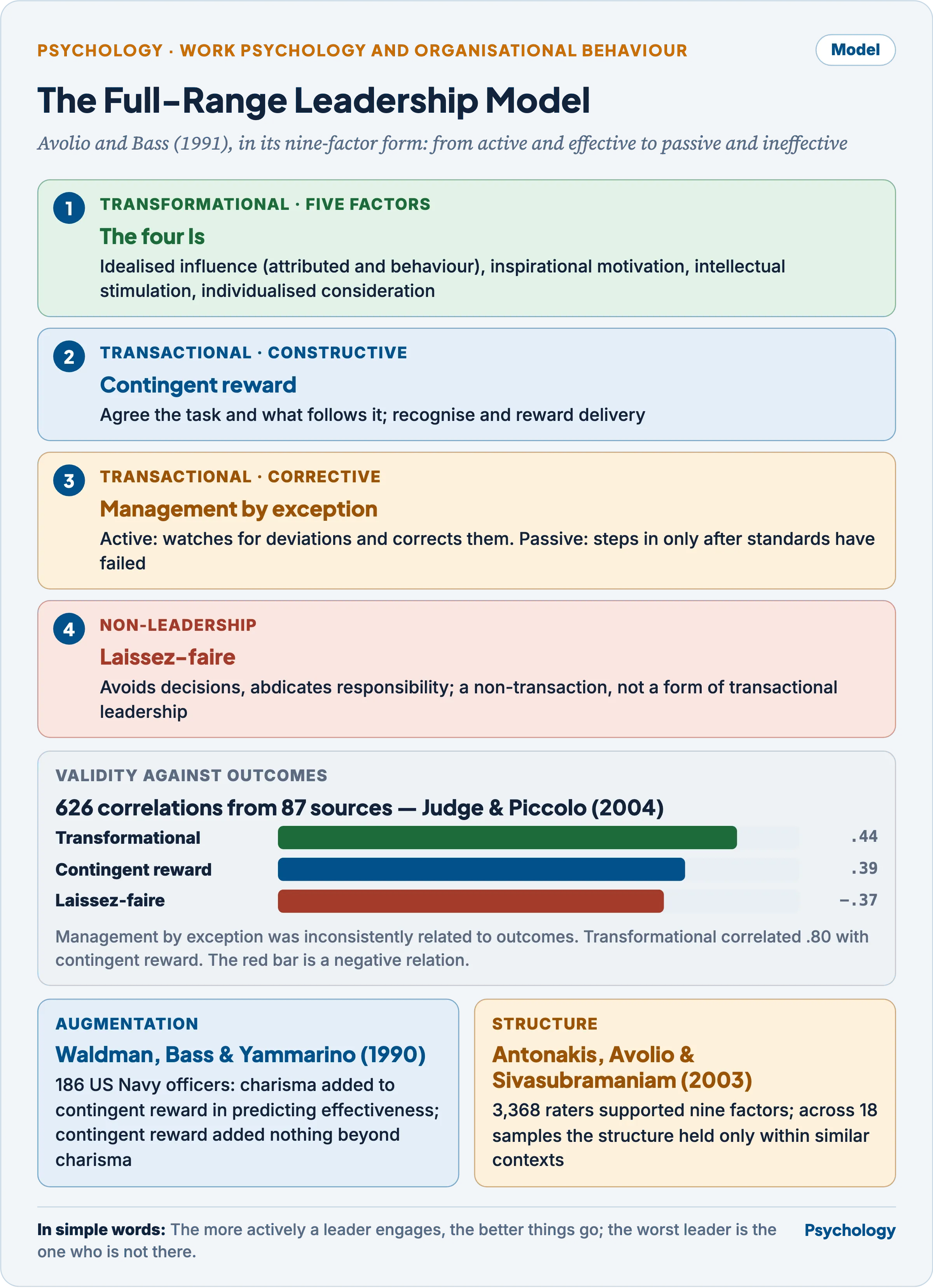
Effectiveness falls as leadership grows more passive, and laissez-faire carries the strongest negative relation to outcomes.
Transactional leadership: contingent reward, management by exception and laissez-faire
- Contingent reward — the leader agrees what is to be done and what follows, then recognises and rewards delivery. It is the constructive transaction.
- Management by exception (active) — the leader monitors for deviations, errors and rule-breaking and corrects them as they occur.
- Management by exception (passive) — the leader waits, and intervenes only after standards have not been met.
- Laissez-faire — avoiding decisions and abdicating responsibility. It is a separate factor, a non-transaction, not a form of transactional leadership.
- The assumptions are behaviourist: people respond to reward and sanction, need a clear chain of command, and are monitored against set standards.
- Bass and Avolio (1993) put the cultural difference plainly: transactional leaders work within the existing culture, its rules and procedures, whereas transformational leaders diagnose the culture and then realign it with a new vision and revised shared values and norms.
Transactional and transformational leaders compared
| Dimension | Transactional leader | Transformational leader |
|---|---|---|
| Basis of influence | Exchange: rewards and sanctions for compliance | Identification with the leader and a shared mission |
| Motives engaged | Self-interest and lower-order needs | Higher-order needs, values and collective interest |
| Outcome sought | Expected performance | Performance beyond expectations (Bass, 1985) |
| Time frame | Short-term targets | Long-term vision |
| Stance to culture | Works within its rules and norms | Diagnoses and realigns it (Bass and Avolio, 1993) |
| Typical tools | Targets, incentives, audit, correction | Vision, role modelling, challenge, coaching |
| Failure mode | Compliance without commitment; gaming the measure | Dependence, manipulation, pseudo-transformation |
| Fits best | Stable, routine, rule-bound work | Change, crisis, innovation |
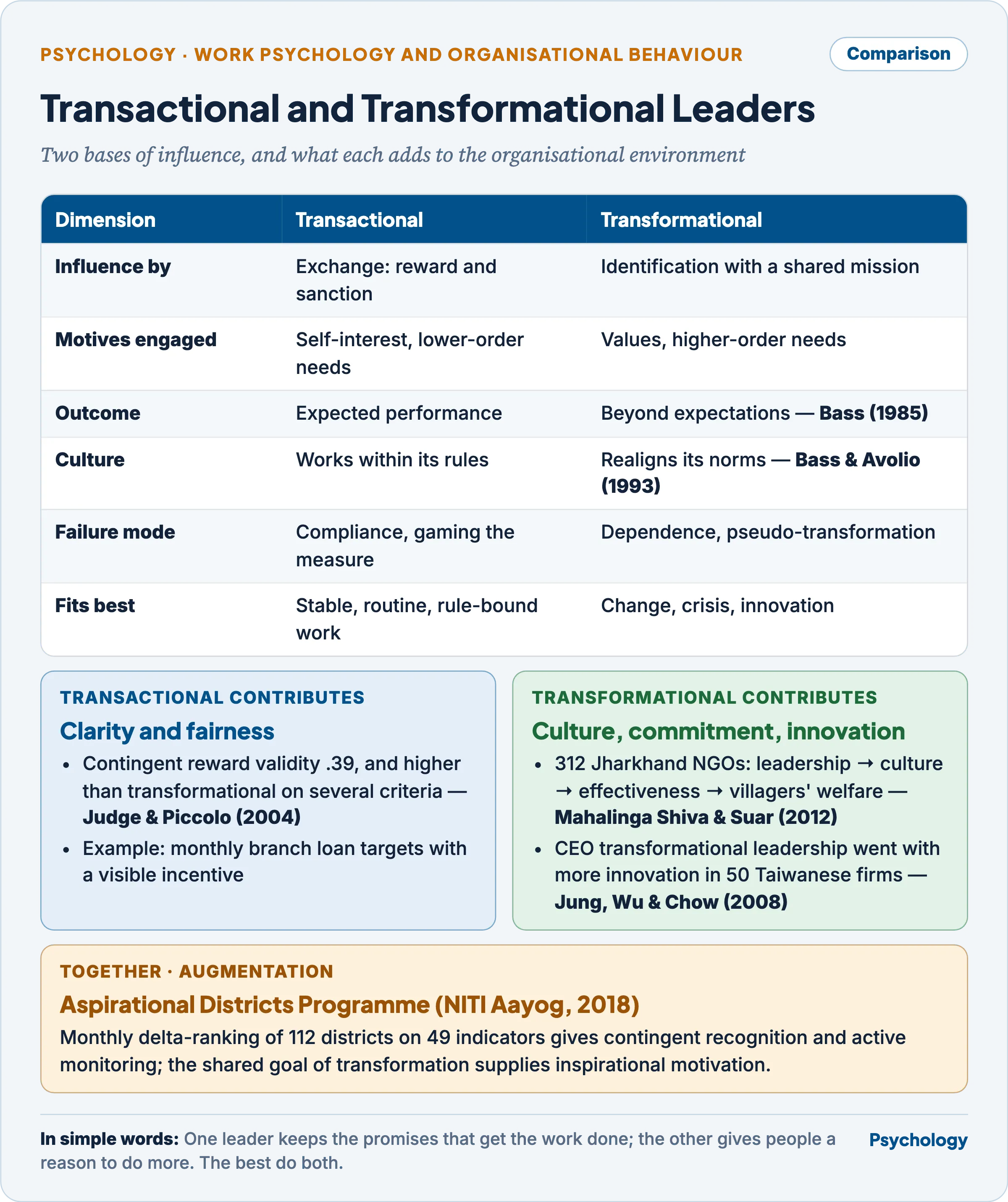
Each style supplies something the other cannot, which is why the effective profile uses both.
How each contributes to an effective organisational environment
- Transactional leadership supplies clarity and fairness. Agreed targets, rewards that follow performance and prompt correction make the environment predictable and just.
- Judge and Piccolo (2004) found an overall validity of .39 for contingent reward, and several criteria on which it predicted better than transformational leadership.
- Example: a bank branch that sets monthly loan targets and pays a visible incentive on reaching them.
- Transformational leadership supplies commitment, culture and innovation.
- Mahalinga Shiva and Suar (2012) — 312 non-governmental organisations in Jharkhand. Transformational leadership built organisational culture, culture raised NGO effectiveness, and effectiveness improved villagers’ health, income, education and happiness.
- Transformational leadership had no direct effect on effectiveness: it worked through culture.
- Limitation: leadership, culture and effectiveness were all rated by NGO personnel.
- Jung, Wu and Chow (2008) — 50 Taiwanese electronics and telecommunications firms: CEO transformational leadership was positively related to organisational innovation.
- Zhu, Chew and Spangler (2005) — transformational CEOs were more likely to adopt human-capital-enhancing human-resource practices.
- Mahalinga Shiva and Suar (2012) — 312 non-governmental organisations in Jharkhand. Transformational leadership built organisational culture, culture raised NGO effectiveness, and effectiveness improved villagers’ health, income, education and happiness.
- Combined, they make the effective environment. Contingent reward secures the expected performance; transformational behaviour then adds effort beyond it (Waldman, Bass and Yammarino, 1990).
- Example: a district collector who publishes monthly progress rankings (contingent recognition, active monitoring) while rallying departments and citizens to a shared development goal — the design of the Aspirational Districts Programme described below.
Evidence on transformational and transactional leadership
- Judge and Piccolo (2004) — meta-analysis of 626 correlations from 87 sources.
- Transformational leadership .44 overall, generalising across longitudinal and multisource designs; contingent reward .39; laissez-faire −.37; management by exception inconsistent.
- Judge and Piccolo (2004) also found transformational leadership correlated .80 with contingent reward and −.65 with laissez-faire, and it failed to predict leader job performance once the other dimensions were controlled.
- Limitation: at a .80 correlation with contingent reward, the two styles’ separate effects are hard to isolate (Judge and Piccolo, 2004).
- Lowe, Kroeck and Sivasubramaniam (1996) — MLQ meta-analysis: the transformational scales were reliable and predicted work-unit effectiveness; effects varied with public or private setting, leader level, and whether subordinates or organisational records measured effectiveness.
- Barling, Weber and Kelloway (1996) — field experiment in a Canadian bank.
- Twenty branch managers randomly assigned: nine to a one-day workshop plus four monthly individual booster sessions, eleven to a control.
- Subordinates of trained managers saw them as more transformational and became more committed, and two branch-level financial outcomes improved.
- Limitation: twenty managers in one organisation.
- Dvir, Eden, Avolio and Shamir (2002) — randomised field experiment in the Israel Defence Forces: 54 leaders, 90 direct followers and 724 indirect followers.
- Leaders given transformational training, against eclectic training, produced more development in direct followers and better performance in indirect followers.
- Limitation: military recruits in training, a setting of unusual hierarchy.
- Bono and Judge (2004) found only small correlations between the Big Five traits and transformational leadership, extraversion strongest — consistent with the training results in treating it as learnable behaviour.
Charismatic leadership, servant leadership and authentic leadership
- Weber (1922) described charisma as a quality by which a person is set apart and treated as exceptionally gifted; the authority rests on followers’ recognition, emerges in crisis and is later routinised.
- House (1977) brought it into organisational theory, specifying the leader characteristics, behaviours and situational conditions that produce charismatic effects on followers.
- Conger and Kanungo (1987) treated charisma as an attribution followers make from behaviour. Their scale (Conger and Kanungo, 1994) settled into five dimensions: strategic vision and articulation, sensitivity to the environment, sensitivity to member needs, personal risk and unconventional behaviour.
- Conger, Kanungo, Menon and Mathur (1997) confirmed the five factors and found the scale reliable and valid in American, Canadian and Indian samples.
- Charisma and transformation overlap without being identical. Bass treats charisma as one component; Yukl (1999) argued that transformational leaders empower followers and reduce their dependence, whereas charismatic leaders foster dependence on an extraordinary leader, so the two processes may not be fully compatible.
- The danger lies in the dependence. Tourish and Vatcha (2005) showed how charismatic leadership at Enron eliminated dissent and promoted conformity on the way to collapse.
- Servant leadership — Greenleaf (1970): “The servant-leader is servant first.” His test is whether those served grow as persons and become more likely themselves to serve.
- Authentic leadership — Walumbwa and colleagues (2008) measured four components: self-awareness, relational transparency, internalised moral perspective and balanced processing.
- Hoch, Bommer, Dulebohn and Wu (2018) found authentic and ethical leadership so highly correlated with transformational leadership that they added little; servant leadership was the most distinct.
Norm crystallization and transformational leadership
- Cialdini and Trost (1998) define social norms as rules and standards, understood by a group’s members, that guide or constrain behaviour without the force of law.
- Jackson’s (1966) return potential model represents a group norm as a curve: the amount of a behaviour on one axis, and the approval or disapproval members would give it on the other.
- Point of maximum return — the amount of the behaviour that draws most approval.
- Range of tolerable behaviour — the span of behaviour that draws net approval.
- Norm intensity — how strongly members approve and disapprove across the scale, whatever the direction.
- Norm crystallization — the degree of agreement among members about how much approval a given behaviour earns; low variance means high crystallization.
- Jackson (1975) added that normative power rises with intensity and crystallization together, whereas high intensity with low crystallization carries conflict potential: members care strongly but disagree, so the norm is liable to dispute and change.
- Crystallization therefore affects transformational leadership, in both directions.
- Highly crystallized, intense norms make a psychologically strong situation (Mischel, 1977), which leaves little room for any individual’s influence. Shamir and Howell (1999) proposed that charismatic leadership is more likely to emerge and succeed in weak situations.
- The rule-compliance norms of a bureaucracy are usually of this kind, which is why active management by exception fits them easily and transformation struggles.
- Where crystallized norms already favour the leader’s vision, they amplify it: members sanction deviation themselves. Schaubroeck, Lam and Cha (2007) found transformational leadership’s effect on team potency stronger in teams higher in power distance and collectivism.
- Where crystallization is low but intensity high, the conflict potential is an opening for intellectual stimulation to reframe the issue — though Shamir and Howell (1999) held crisis to be neither necessary nor sufficient for charismatic leadership.
- Transformation works by re-crystallizing norms. Culture affects leadership about as much as leadership affects culture (Bass and Avolio, 1993); Schein (2009) called culture and leadership “two sides of the same coin”, and warned that as organisations age, culture becomes a constraint on strategy.
- Schein’s three levels of culture are set out in Managerial Effectiveness; Lewin’s unfreezing of settled norms, in Sensitivity Training and Organisational Development.
- Work-group inertia is crystallization seen from below: group norms make members resist changes that disturb their normative expectations.
- A transformational leader facing crystallized norms can proceed in five steps.
- Map the curve: survey members anonymously on how far they approve of graded amounts of the target behaviour, such as disposing of a file within a week.
- Read crystallization: influence is cheapest where agreement is low; where agreement is high and opposed, unfreeze first.
- Model and frame: enact the new behaviour visibly (idealised influence) and present it in the group’s own values (inspirational motivation).
- Question and enlist: invite the group to examine the assumption behind the old norm (intellectual stimulation) and coach early adopters (individualised consideration).
- Re-crystallize: tie recognition to the new norm (contingent reward) and resurvey to confirm the curve has moved.
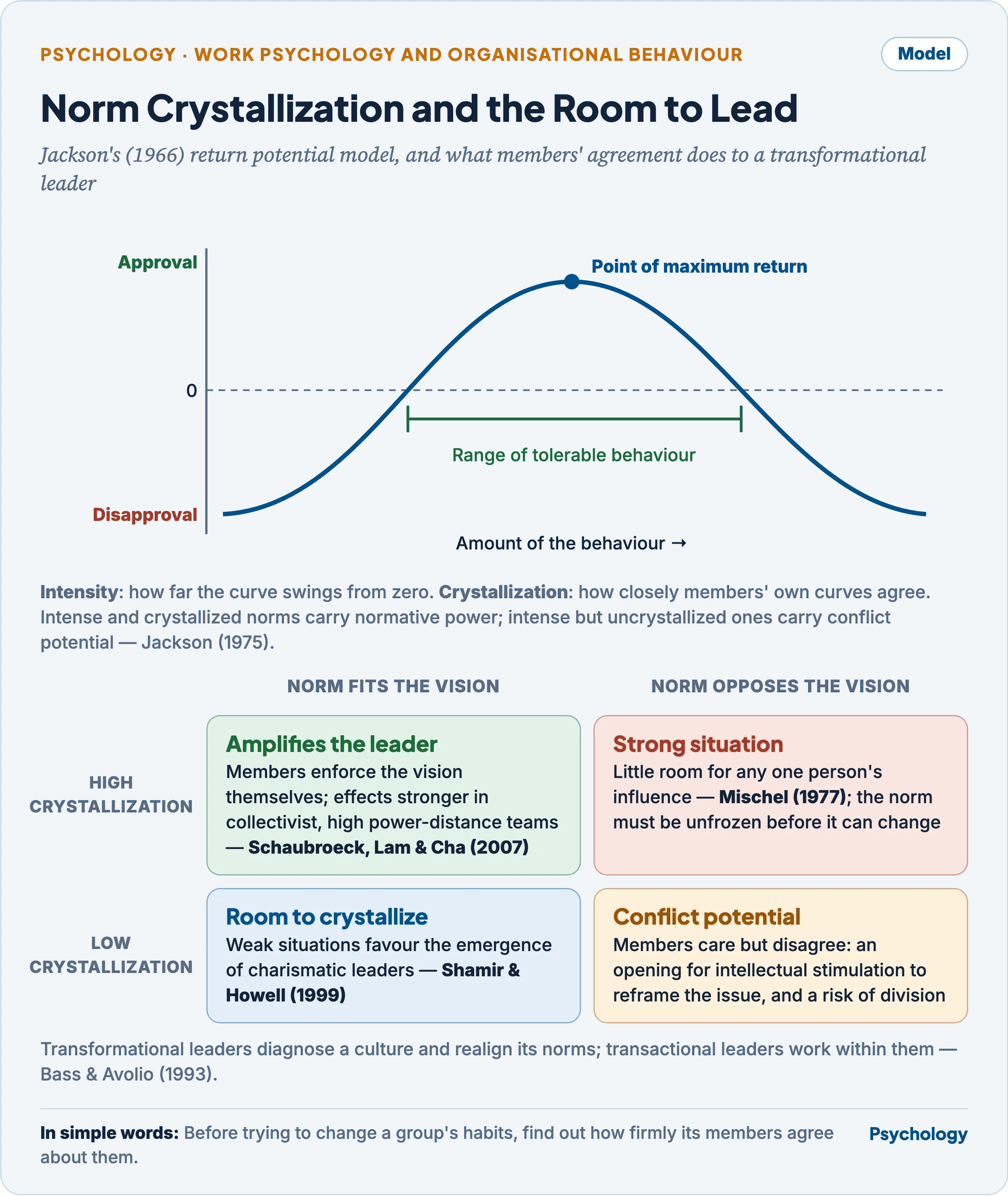
The same leader meets four different situations depending on how strongly members agree, and whether their agreement runs with the vision or against it.
Criticisms and limitations
- Van Knippenberg and Sitkin (2013) identified four problems and recommended abandoning the label.
- No clear conceptual definition independent of effects.
- No causal model of how each dimension works and under which moderators.
- Definition confounded with outcome: leaders are called transformational because they succeed.
- Invalid measures, which neither reproduce the theorised dimensions nor separate from other leadership.
- Measurement. Tracey and Hinkin (1998) found the MLQ’s proposed dimensions unsupported and its scales highly related to ordinary managerial practices, and the .80 correlation with contingent reward (Judge and Piccolo, 2004) blurs the transformational–transactional line itself.
- Heroic bias. Yukl (1999) criticised the theories for crediting the leader with outcomes owed to followers and situations, and for concentrating on dyads rather than group and organisational processes.
- Lost sociology. Beyer (1999) argued that the psychological version tamed Weber’s charisma by dropping its precipitating crisis, radical vision and systemic change, leaving a set of rateable behaviours.
- Moral neutrality. The behaviours serve bad ends as well as good, as pseudo-transformational leadership (Bass and Steidlmeier, 1999) and Enron (Tourish and Vatcha, 2005) show.
- Context. The factor structure holds only within homogeneous contexts (Antonakis and colleagues, 2003), and a Western construct may not travel intact, as the Indian evidence below shows.
Indian context: relevance of transformational and transactional leadership to Indian organisations
- Walumbwa, Wang, Lawler and Shi (2004) — 402 banking and finance employees in China and India: transformational leadership raised commitment and satisfaction and lowered job and work withdrawal, partly through collective efficacy.
- Jain, Duggal and Ansari (2019) — 236 professionals in Indian public sector banks: trust and psychological well-being partly mediated the link between transformational leadership and organisational commitment.
- Mulla and Krishnan (2012) tested Burns’s moral-elevation claim with an Indian construct, Karma-Yoga — duty-orientation, indifference to rewards and equanimity.
- 329 executives across India: transformational leadership predicted followers’ duty-orientation and indifference to rewards, though not equanimity.
- Longer relationships and more frequent contact strengthened the effect; as a survey regression, it cannot show that the leader caused the change (Mulla and Krishnan, 2012).
- Singh and Krishnan (2008), surveying 127 Indian managers, found that leaders’ self-sacrifice made them appear more transformational through perceived altruism, and that transformational leadership strengthened followers’ collective identity.
- Palrecha, Spangler and Yammarino (2012) — a competitive test within one Indian organisation found strong support for a locally derived leadership model, some for the nurturant-task model, and minimal support for transformational leadership.
- Cultural fit cuts both ways.
- India is among the tightest cultures measured — strong norms, low tolerance of deviance: Gelfand and colleagues (2011) scored it 11.0, third of 33 nations (mean 6.5) — in Jackson’s terms, intense and widely shared norms.
- Transformational leadership is therefore likelier to succeed by working through such norms, as the duty-orientation finding suggests, than by defying them.
- The nurturant-task leader of J. B. P. Sinha (1980) sits between the two styles: nurturance given contingent on task performance is a transactional exchange joined to individualised consideration, meant to give way to participation as subordinates mature.
- Comparative relevance. Transactional leadership fits the rule-bound hierarchy of Indian public organisations, but where it decays into avoiding decisions it becomes laissez-faire, negatively related to outcomes (Judge and Piccolo, 2004). Transformational leadership matters most where change is the task.
- Aspirational Districts Programme (NITI Aayog; launched by the Prime Minister, January 2018) — 112 participating backward districts ranked monthly on incremental progress across 49 indicators in five themes, published on the Champions of Change dashboard, under the principles of convergence, collaboration and competition.
- The psychological principle is augmentation: public delta-ranking is contingent recognition with active monitoring, while the collective goal of transformation supplies inspirational motivation.
- UNDP India’s appraisal (December 2020) credited the competitive culture with lifting baseline laggards such as Simdega, Chandauli, Sonbhadra and Rajgarh among the top performers on progress.
- Mission Karmayogi — the National Programme for Civil Services Capacity Building (approved by the Union Cabinet, 2 September 2020) — moves civil-service human-resource management from rules-based to roles-based, through the iGOT Karmayogi platform and a Capacity Building Commission.
- The principle is norm re-crystallization: replacing compliance norms with ownership of a defined role; its name invokes the Karma-Yoga ideal whose link to transformational leadership Mulla and Krishnan (2012) measured.
- Programme detail is in Leadership Training.
Previous Year Questions
- 2026Distinguish between Transactional and Transformational Leaders. Suggest how can they contribute towards creating an effective organizational environment. Give examples.
- 2025Can the applicability of concept of norm crystallization in an organization affect transformational leadership in that organization?
- 2011Comment on: Provide comparison between transformational and transactional leadership for their relevance to Indian organizations.