

Official syllabusPaper II · Unit 4 · Work Psychology and Organisational Behaviour
Advertising and marketing.
Definition
“Advertising is any paid form of nonpersonal presentation and promotion of ideas, goods, or services by an identified sponsor.”
Kotler and Armstrong (2018)
Advertising is the part of marketing that persuades at a distance, through paid media, people the seller never meets. Its psychology asks how such a message wins attention, is understood, liked, remembered and acted on, and whether it serves the buyer or only the seller.
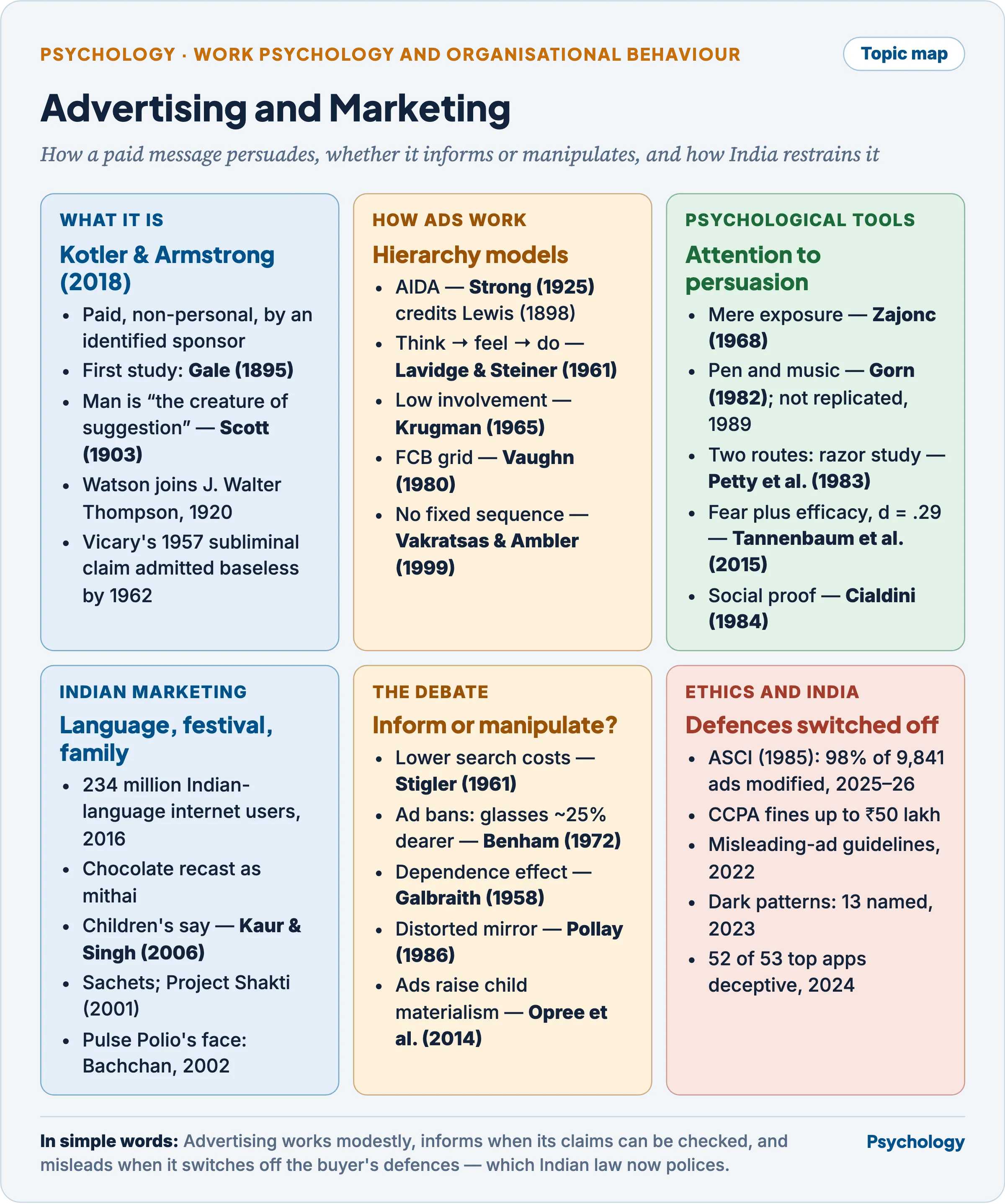
Top row: how a paid message works on a mind; bottom row: what it does to Indian buyers and who restrains it.
The psychology of advertising and marketing
- Marketing creates, communicates and delivers value to customers; advertising is one tool of its promotion mix, beside personal selling, sales promotion, public relations and direct and digital marketing (Kotler and Armstrong, 2018).
- The psychology of advertising applies the study of attention, perception, learning, memory, motivation and attitude to designing and evaluating paid persuasive messages and their effects on buyers and society.
- Harlow Gale (1895) mailed a questionnaire on advertising from the University of Minnesota, usually counted the first study in the field.
- Walter Dill Scott (1903), director of Northwestern’s psychological laboratory, wrote the first book applying psychology to advertising, building it on suggestion.
- “Man has been called the reasoning animal, but he could with greater truthfulness be called the creature of suggestion.” — Scott (1903)
- John B. Watson joined J. Walter Thompson in 1920, worked on accounts such as Pond’s and urged appeals to emotion; Kreshel (1990) argues his chief service was lending the agency science’s legitimacy.
- Dichter (1960) used depth interviews to uncover unconscious buying motives (motivation research); Packard (1957) had already branded such research manipulation.
- James Vicary (1957) claimed that flashing “Eat popcorn” and “Drink Coca-Cola” during a film raised sales; by 1962 he admitted the claim had no basis.
- Psychology enters all five decisions of an advertising programme — mission, money, message, media, measurement, the five Ms of Kotler (2003) — most heavily the message and its testing by recall, recognition and attitude change.
Psychological theories and contributions to effective advertising
Hierarchy-of-effects models
- Hierarchy models assume the buyer climbs fixed steps from noticing a brand to buying it, each step a measurable objective.
- AIDA — attention, interest, desire, action — was credited by Strong (1925) to E. St. Elmo Lewis (1898); Iwamoto (2024) finds no evidence for the credit and names Arthur Frederick Sheldon instead.
- Lavidge and Steiner (1961) set six steps in three components.
- Cognitive: awareness, knowledge. Affective: liking, preference. Conative: conviction, purchase.
- Colley (1961), in DAGMAR, made the steps measurable communication goals, so effectiveness could be judged short of sales.
- Krugman (1965) described learning without involvement: repeated television exposure shifts what is salient about a brand, and attitude forms only after trial.
- Vaughn (1980), in the FCB grid, crossed involvement (high, low) with thinking and feeling, giving four orders of the same steps: learn, feel, do.
- Ehrenberg (1974) proposed awareness–trial–reinforcement: advertising mostly reminds and reassures buyers who already rotate among a few brands rather than converting them.
- Vakratsas and Ambler (1999), reviewing more than 250 studies, found “little support for any hierarchy, in the sense of temporal sequence, of effects”; affect, cognition and experience interact.
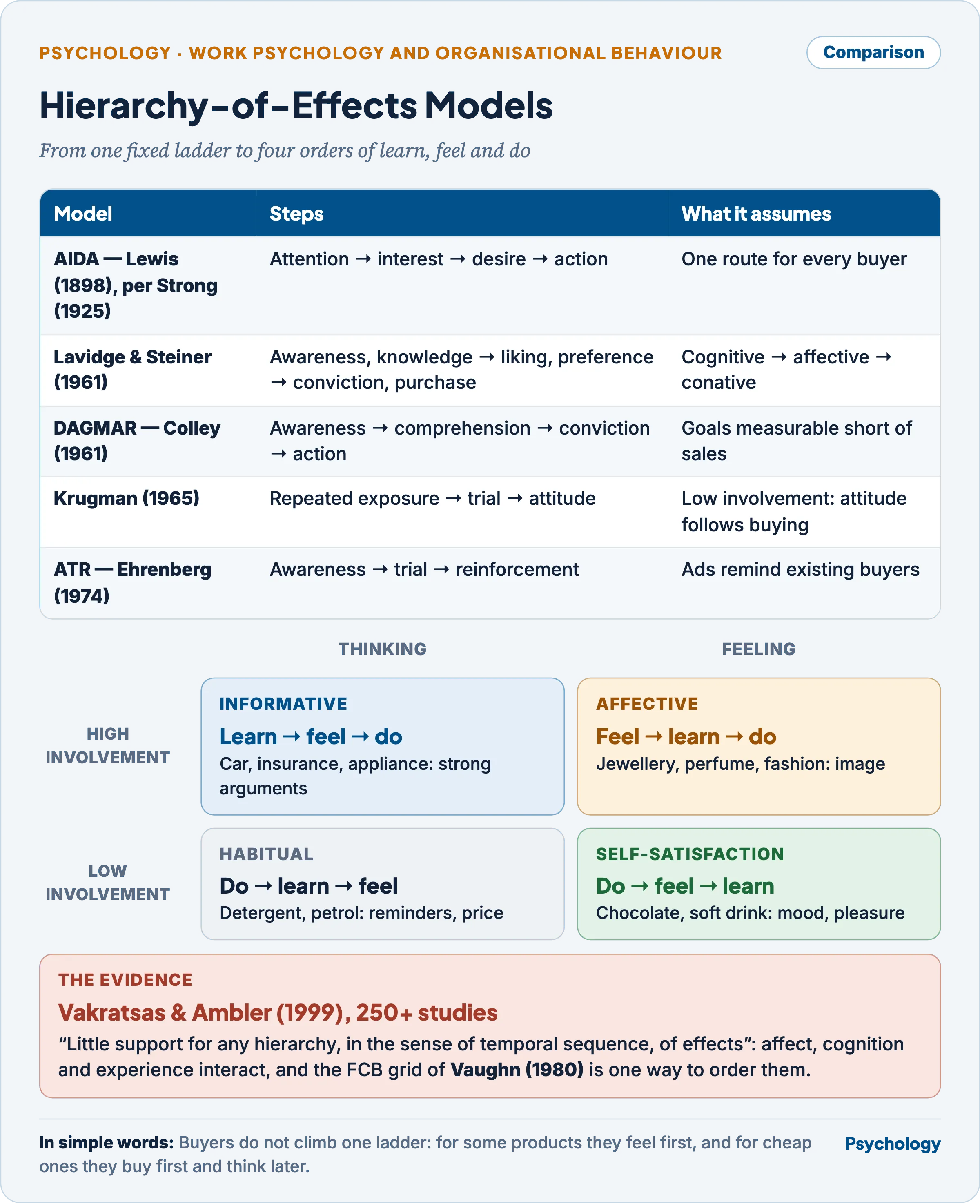
The grid’s four corners reorder the same three steps, so no single ladder fits every product.
Attention, perception and repetition
- Attention is the first bottleneck: size, contrast, movement, novelty and relevance capture it against clutter.
- Zajonc (1968) showed the mere exposure effect: repeated exposure alone raises liking for a neutral stimulus; Bornstein (1989), across 208 experiments, found it robust.
- Cacioppo and Petty (1979) found agreement first rose, then fell with repetition: early exposures allow fuller processing (wear-in), later ones breed tedium and counter-arguing (wear-out).
- Subliminal advertising lacks support at mass scale: Karremans and colleagues (2006) found a subliminal brand prime raised iced-tea choice only among participants already thirsty.
Learning and memory: conditioning brands
- Classical conditioning pairs a neutral brand with something already liked — music, a star, a festive scene — until the brand alone evokes the warmth; mechanism in Classical Conditioning (Paper I).
- Gorn (1982) showed 244 undergraduates a slide of a light-blue or beige pen while liked music (from Grease) or disliked music (classical Indian music) played.
- Offered a pen, 79 per cent took the colour paired with liked music, 30 per cent the one paired with disliked music (Gorn, 1982).
- Limitation: Kellaris and Cox (1989) failed to replicate it in three experiments; demand characteristics were suspected.
- Hofmann and colleagues (2010) meta-analysed 214 studies of evaluative conditioning: mean d = .52, larger when people noticed the pairing, so learned liking is not wholly automatic.
- Keller (1993) defined brand knowledge as brand awareness (recall, recognition) plus brand image, a network of associations; jingles, mascots and slogans cue retrieval at the point of purchase.
Persuasion: the elaboration likelihood model and the source
- Lasswell’s (1948) formula — who says what, in which channel, to whom, with what effect — framed the Yale programme on source, message and audience (Hovland, Janis and Kelley, 1953).
- The elaboration likelihood model (Petty and Cacioppo, 1986): motivation and ability decide whether a message is scrutinised (central route, durable change) or judged by cues (peripheral route, fragile change); theory in Persuasion and Attitude Change through Communication (Paper I).
- Petty, Cacioppo and Schumann (1983) had undergraduates read a magazine advertisement for a disposable razor under high involvement (they would soon choose a razor) or low involvement.
- It carried strong or weak arguments and was endorsed by sports celebrities or by average citizens.
- Argument quality moved attitudes more under high involvement; the endorser moved them more under low involvement.
- Limitation: students, one forced exposure, and attitudes measured at once rather than purchases.
- Source credibility rests on expertise and trustworthiness (Hovland, Janis and Kelley, 1953); Ohanian (1990) added attractiveness in a validated three-factor endorser scale.
- McCracken (1989) proposed meaning transfer: meanings pass from a celebrity’s roles to the product, then to its buyer. Kamins (1990) found attractiveness helps only when it fits the product (match-up hypothesis).
- Knoll and Matthes (2017), meta-analysing 46 studies (10,357 participants), found fitting male actors most effective (d = .90), mismatched female models least (d = −.96), and celebrities weaker than quality seals or awards.
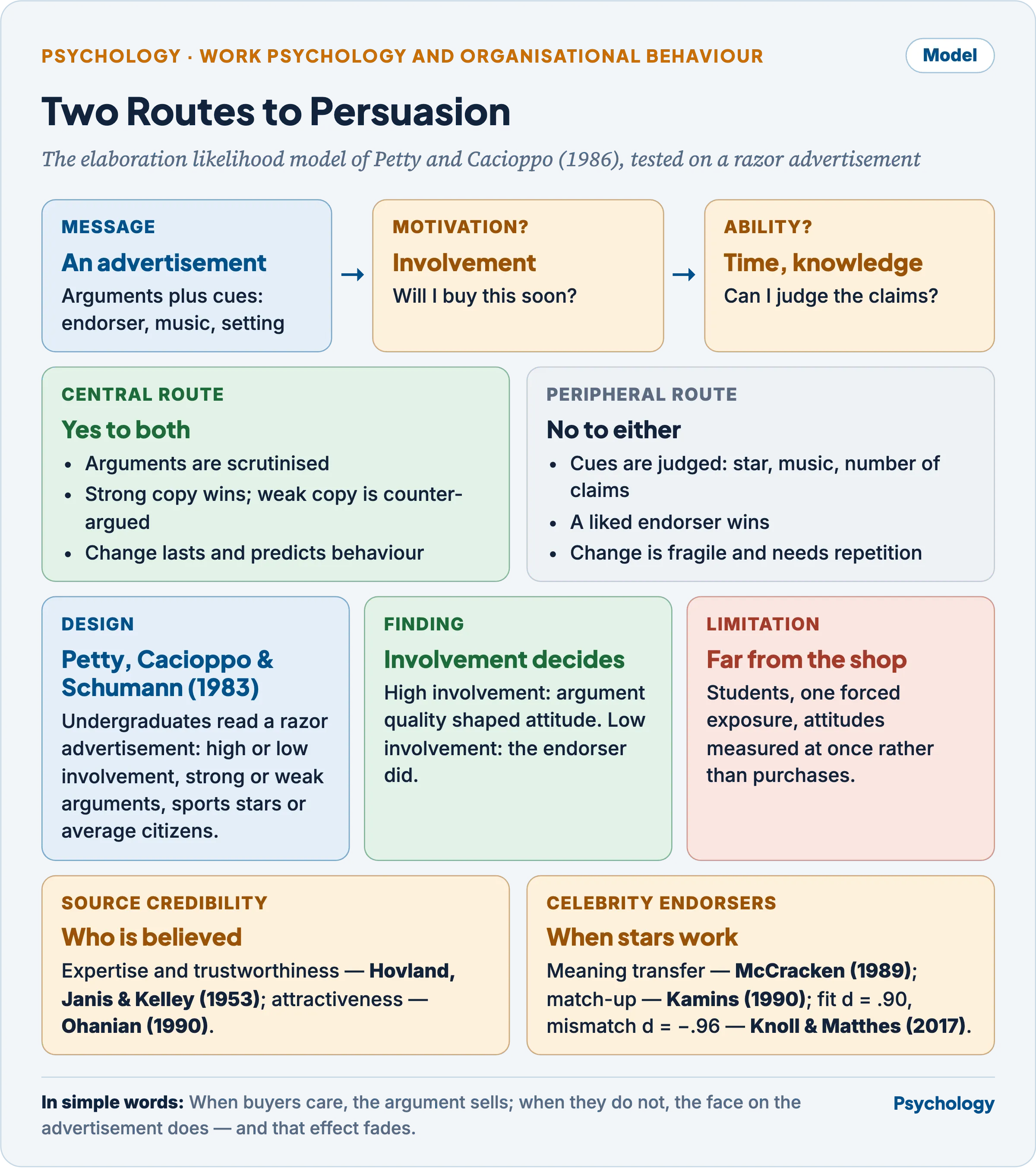
The same razor advertisement persuaded by its arguments or its celebrities, depending only on whether readers expected to buy a razor soon.
Appeals: fear, emotion and social proof
- Janis and Feshbach (1953) found a mild-fear dental-hygiene lecture produced more reported compliance than a strong-fear one, the source of the belief that moderate fear works best.
- Witte (1992), in the extended parallel process model, argued fear persuades only with efficacy, a doable action; without it people control the fear by denial.
- Tannenbaum and colleagues (2015), meta-analysing 127 articles (27,372 participants), found fear appeals effective (d = .29), stronger with efficacy statements, and identified no circumstances in which they backfired.
- Puto and Wells (1984) separated informational advertising, which offers verifiable facts, from transformational advertising, which makes using the brand feel warmer or more exciting.
- Cialdini (1984) named six principles of influence: reciprocity, commitment and consistency, social proof, liking, authority and scarcity.
- Goldstein and colleagues (2008) found hotel signs saying most guests reused towels beat a plain environmental appeal; “guests in this room” worked best.
The psychosocial components of advertising and marketing
- The psychosocial components are the processes inside the buyer and social forces around the buyer that an advertisement must engage; buying’s determinants are developed in Consumer Psychology.
| Component | Psychological principle | Marketing use | Indian illustration |
|---|---|---|---|
| Needs and motives | Maslow (1943); Dichter (1960) | Security, belonging, esteem appeals | Life insurance as protecting the family |
| Perception | Left-digit effect, Thomas and Morwitz (2005) | Packaging, price endings | ₹499 feels well below ₹500 |
| Learning and memory | Conditioning; repetition | Jingles, mascots, festive pairing | Chocolate paired with celebration |
| Attitude and emotion | Elaboration likelihood; fear with efficacy | Arguments for the involved, mood for the rest | Tobacco-pack warnings |
| Self-concept | Symbolic consumption | Aspirational lifestyles | Fairness creams sold as routes to jobs and marriage |
| Reference groups | Social proof; two-step flow, Katz and Lazarsfeld (1955) | Testimonials, influencers | Village women as sellers |
| Family and culture | Joint decisions; ritual; language | Parent-and-child appeals; festive timing | Diwali, Eid, wedding seasons |
Psychological principles in marketing: Indian illustrations
- Language segmentation: Indian-language internet users reached 234 million in 2016, outnumbering English users (KPMG and Google, 2017); vernacular copy and regional stars add comprehension and source similarity, which raise liking.
- Festivals and occasions: Cadbury Dairy Milk’s “Kuch Meetha Ho Jaaye” recast chocolate as the mithai of celebrations, pairing the brand with festive warmth.
- Family decisions: Kaur and Singh (2006), reviewing Indian and Western studies, found children’s influence varies with product, sub-decision and decision stage, strongest for child-centred items, and noted how thin Indian research then was.
- Rural marketing: CavinKare’s Chik shampoo (launched 1983) sold cheap sachets to people who washed hair with soap; a tiny price cuts the risk of first trial. Prahalad (2004) generalised this to the “bottom of the pyramid”.
- Hindustan Unilever’s Project Shakti (2001) recruits village women to sell its goods: a trusted, similar source and word of mouth replace mass media where it reaches thinly.
Does advertising help people buy intelligently and raise their standard of living?
The information argument
- Stigler (1961) treated advertising as cheap information that lowers buyers’ search costs, so advertised markets should show lower, less dispersed prices.
- Nelson (1970) separated search goods, checkable before purchase, from experience goods; for the latter, heavy advertising itself signals a seller who expects repeat purchase (Nelson, 1974).
- Benham (1972) found eyeglasses cost about 25 per cent more in US states that banned optometrists’ advertising than in states that allowed it.
- Wider markets allow mass production, lower unit costs and faster diffusion of new goods, the route by which advertising is said to raise living standards.
The manipulation critique
- Galbraith (1958) named the dependence effect: “As a society becomes increasingly affluent, wants are increasingly created by the process by which they are satisfied.” Created wants cannot justify the production that creates them.
- Pollay (1986), reviewing humanities and social-science critics, called advertising a distorted mirror reinforcing materialism, anxiety, social competitiveness and loss of self-respect.
- Opree and colleagues (2014) surveyed 466 Dutch children aged 8–11 twice, a year apart: advertising exposure raised materialism, fully through desire for advertised products.
Evaluation
- Hayek (1961) replied that nearly all wants beyond bare necessity are learnt from others, so a socially created want is not unreal; Holbrook (1987) answered Pollay that advertising mirrors values more than it moulds them.
- Advertising helps buyers choose intelligently where claims are verifiable, goods are search goods and buyers know the tactics; it helps least with children and emotionally framed categories, and can equate living standards with consumption.
Enhancing consumer awareness through advertising
- Social marketing (Kotler and Zaltman, 1971) applies marketing planning to selling a social idea, so public-service advertising uses commercial advertising’s psychology.
- Jago Grahak Jago (Department of Consumer Affairs, 2005) carries consumer-rights messages across media and promotes the National Consumer Helpline, 1915; the rights are covered in Consumer Rights and Consumer Awareness (Unit 11).
- Pulse Polio (from December 1995): UNICEF made Amitabh Bachchan its face in 2002 (“Do Boond Zindagi Ki”), pairing a credible source with an efficacy message — two drops at a nearby booth.
- India’s last case came on 13 January 2011; the region was certified polio-free on 27 March 2014 (WHO, 2014). Advertising ran alongside house-to-house vaccination, so its share cannot be isolated.
- Sood and colleagues (2006) evaluated a mass-media entertainment-education campaign on HIV/AIDS over three survey waves in Delhi, Rajasthan and Uttar Pradesh.
- Exposed viewers knew more about sexually transmitted infections and condoms, held fewer misconceptions and discussed them more.
- Limitation: condom use changed little — awareness without behaviour.
- Friestad and Wright (1994) proposed the persuasion knowledge model: people learn advertisers’ goals and tactics and use them to cope, so disclosure labels and literacy campaigns switch on a defence.
- An American Psychological Association task force (Kunkel and colleagues, 2004) concluded children below about 7–8 years do not understand advertising’s persuasive intent.
- An awareness campaign built on these principles:
- Set one hierarchy step as the goal: from knowing the helpline exists to calling it (Colley, 1961).
- Segment by language and medium: radio and wall paintings in villages, short video online.
- Choose a credible, similar source, such as a local buyer who won a refund.
- Pair threat with efficacy (Witte, 1992) — “a fake discount costs you; dial 1915” — plus a descriptive norm of how many have complained.
- Repeat to wear-in, rotating executions before wear-out (Cacioppo and Petty, 1979).
- Measure awareness and calls before and after, against matched districts without the campaign.
Mass media, television and the spread of consumerism in India
- Doordarshan began carrying commercials in 1976 and went colour on 15 August 1982; Hum Log (1984), sponsored by Nestlé’s Maggi, was its first sponsored serial.
- Liberalisation brought Star TV (1991) and Zee TV (2 October 1992); cable spread so fast that regulation followed in 1995.
- Television spreads consumerism by modelling urban lifestyles, supplying upward comparisons and cultivating beliefs about affluence; Shrum and colleagues (2005) found it cultivates materialism, most in viewers who process actively.
- Mazzarella (2003), an ethnography of Bombay agencies, found the 1990s opening to foreign brands turned admen into custodians of Indianness, selling “the Indian consumer” to multinational clients.
- Digital took 60 per cent of India’s ₹1,55,105 crore advertising spend in 2025 (a measure including quick-commerce and small-business digital), while linear television’s ₹32,855 crore fell 5 per cent (Pitch Madison Advertising Report, 2026).
- Cultivation (Gerbner and Gross, 1976) and cable television’s effects in rural India (Jensen and Oster, 2009) are set out in Impact of Television and Mass Media (Unit 10).
Ethical considerations in advertising and marketing
- Deception: 27.5 per cent of the violative advertisements ASCI found in 2025–26 misled consumers (ASCI, 2026); since June 2024 advertisers must self-declare compliance before publishing (Indian Medical Association v. Union of India, 2024).
- Surrogate advertising: liquor and tobacco brands advertise unrelated goods under the same name, relying on stimulus generalisation; offshore betting sites use surrogate news sites (MIB advisory, 2022) and made up 6,933 of ASCI’s 11,581 cases in 2025–26 (ASCI, 2026).
- Children cannot discount what they do not recognise as selling (Kunkel and colleagues, 2004), yet their requests shape family purchases.
- Stereotyping narrows self-concept: ASCI issued guidelines on fairness products (2014) and harmful gender stereotypes (2022); Fair & Lovely became Glow & Lovely on 2 July 2020 amid colourism criticism.
- Micro-targeting uses behavioural data to predict needs before the buyer states them, pre-empting deliberation.
- Dark patterns: Mathur and colleagues (2019) found 1,818 instances on 1,254 of about 11,000 shopping websites; 52 of 53 top Indian apps used one, privacy deception in 79.2 per cent (ASCI Academy and Parallel, 2024).
- Undisclosed endorsement passes advertising off as peer opinion, so persuasion knowledge never activates; 97.3 per cent of 1,609 influencer advertisements ASCI processed in 2025–26 needed modification (ASCI, 2026).
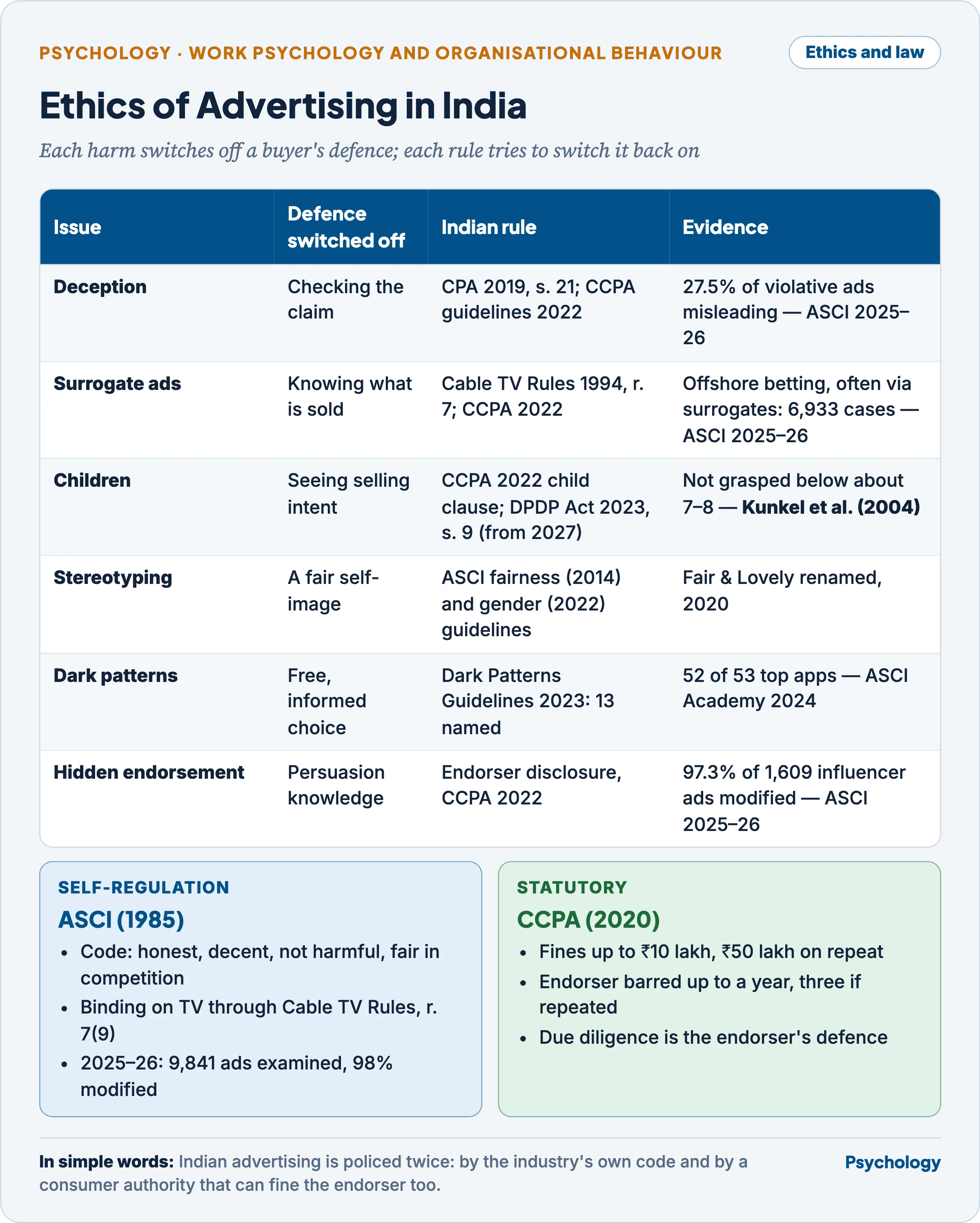
Each harm switches off a defence the buyer would otherwise use; each Indian rule tries to switch it back on.
Criticisms and limitations
- Effects are modest: Sethuraman and colleagues (2011), pooling 751 short-term elasticities from 56 studies, found a mean of .12 — 10 per cent more advertising, about 1.2 per cent more sales — and a long-term .24.
- Korkames, Stanley and Stremersch (2025), correcting 538 elasticities for publication bias, cut the average more than fivefold; estimates shrank with better methods while effectiveness itself rose, most online.
- The step models behind practice lack evidence of a fixed sequence (Vakratsas and Ambler, 1999).
- Laboratory findings travel poorly: students, single forced exposures, immediate measures (Petty and colleagues, 1983), failed replications (Kellaris and Cox, 1989); and sales also move with price and distribution, so field effects are hard to isolate.
- Indian evidence is thin and mostly industry-generated — campaign histories, complaint counts — rather than peer-reviewed tests of Indian audiences.
- The contribution is double-edged: the principles that make an awareness campaign work also power dark patterns, so psychology supplies both the tools and the case for regulating them.
Indian context: regulating advertising
- Advertising Standards Council of India (self-regulatory, 1985) — a Code in four chapters: truthful and honest representation, non-offensive to the public, against harmful products and situations, fair in competition; rule 7(9) of the Cable Television Networks Rules, 1994 bars broadcasting breaches.
- In 2025–26 it examined 9,841 advertisements, 98 per cent needing modification (ASCI, 2026). It operationalises social accountability: peer review makes deception costly.
- Consumer Protection Act, 2019 (Ministry of Consumer Affairs) — the Central Consumer Protection Authority (24 July 2020) may fine manufacturers or endorsers of misleading advertisements up to ₹10 lakh (₹50 lakh if repeated) and bar endorsers up to a year (three if repeated) (s. 21).
- It operationalises source accountability: an endorser lends credibility, so shares liability unless diligent.
- Misleading Advertisements Guidelines (CCPA, 9 June 2022) — rules on bait and “free” claims, surrogate and child-directed advertising, disclaimers in the advertisement’s language, and disclosure of endorsers’ material connections.
- It operationalises persuasion knowledge: disclosure lets the buyer recognise the attempt.
- Dark Patterns Guidelines (CCPA, 30 November 2023) — thirteen named patterns, among them false urgency, basket sneaking, confirm shaming, subscription traps, drip pricing and disguised advertisement.
- It operationalises autonomy: design may not exploit scarcity, default and guilt.
- Cable Television Networks (Regulation) Act, 1995 (Ministry of Information and Broadcasting) — section 6 binds television advertising to rule 7 of the 1994 Rules, which bars direct or indirect promotion of tobacco and liquor, save certified brand extensions, protecting a captive mass audience.
- Cigarettes and Other Tobacco Products Act, 2003 (Ministry of Health and Family Welfare) — bans tobacco advertising (s. 5); from 1 April 2016 warnings cover 85 per cent of the front and back of packs (MoHFW rules, 2014), a mandated fear appeal.
- Digital Personal Data Protection Act, 2023 (Ministry of Electronics and IT), with Rules notified in November 2025 — from May 2027, verifiable parental consent for children’s data and no tracking or targeted advertising directed at children (s. 9), whose persuasion knowledge is weakest.
Previous Year Questions
- 2023Describe the applications of psychological principles in the field of marketing. Cite illustrations from Indian context.
- 2022How does advertising help people to buy intelligently and enable them to take a step in the direction of a higher standard of living? Critically examine.
- 2021What do you understand by psychology of advertising? How can consumer awareness be enhanced through advertising?
- 2012What are the psychosocial components of advertising and marketing? Identify and discuss the relevant ethical considerations.
- 2006Write a short note on: Advertising and marketing.
- 2000Discuss the psychological theories and contributions of psychology in effective advertising.
- 1996Discuss the role of mass media with a special reference to television in spreading the idea of consumerism in India.