

Official syllabusPaper II · Unit 4 · Work Psychology and Organisational Behaviour
Leadership and participatory management – leadership training.
Definition
“Leadership development is defined as expanding the collective capacity of organizational members to engage effectively in leadership roles and processes.”
Day (2000)
Leadership training is the planned, programme-based part of that development: it sets out to change what individual leaders know, notice and do, so that the units they lead perform better. Whether it can work depends on whether leadership is an inborn trait or a learnable set of behaviours; whether it does work depends largely on the organisation the trained leader returns to.
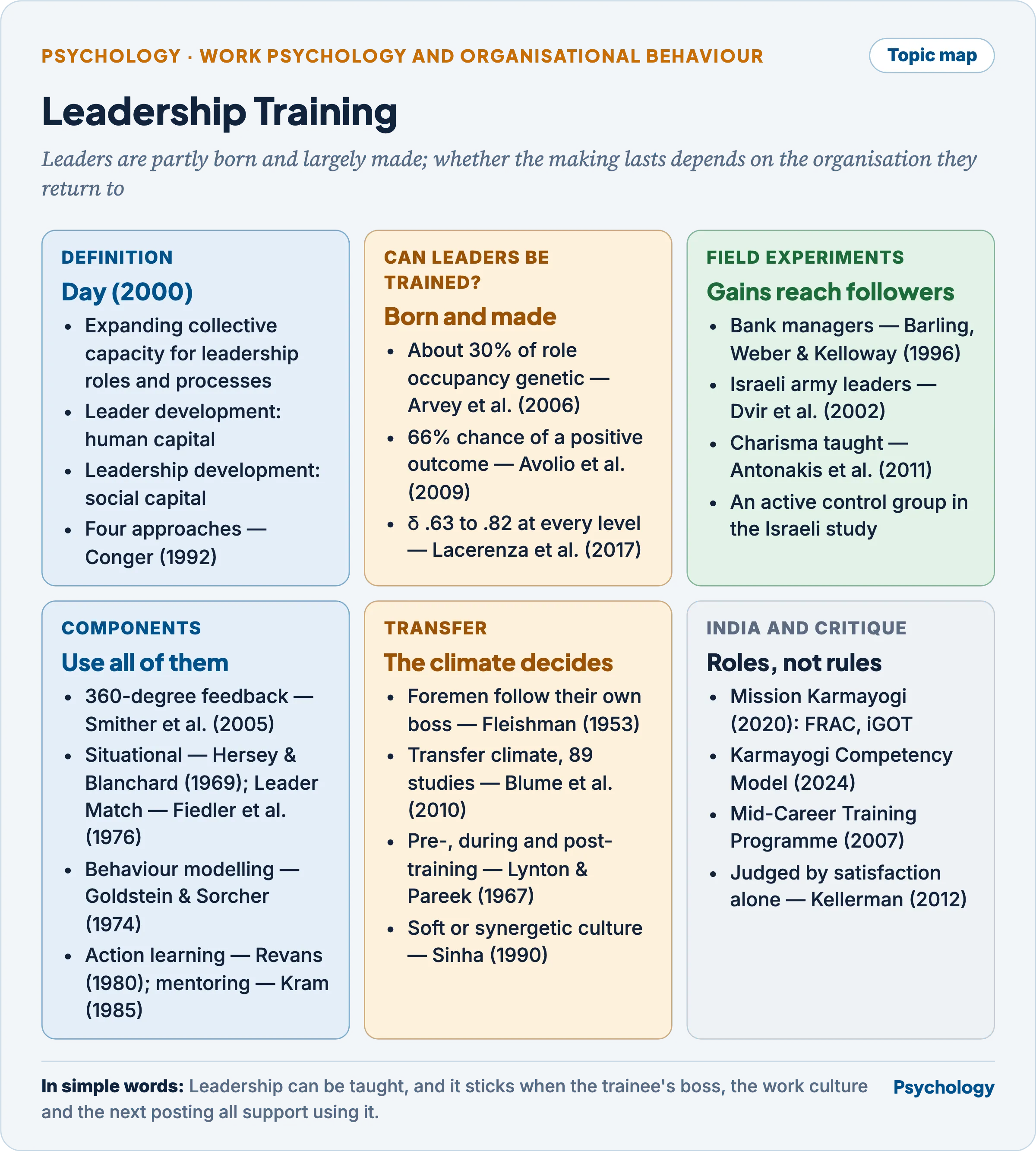
The programme occupies the middle of the map, but its outcomes are settled by the work climate on the right.
Can leaders be trained? The born-versus-made debate
- The trait approach implied that leaders should be selected; the behavioural approach of the Ohio State and Michigan studies implied trainability, since styles such as consideration and initiating structure are behaviours, not endowments. Both are set out in Leadership and Participatory Management.
- Day (2000), citing McCauley and colleagues (1998) for the definition above, separated two targets that programmes often blur.
- Leader development builds an individual’s human capital: knowledge, skill and self-awareness.
- Leadership development builds social capital: the relationships, trust and networks through which a group leads itself.
What is inherited
- Arvey, Rotundo, Johnson, Zhang and McGue (2006) compared 238 identical and 188 fraternal male twins and estimated that about 30 per cent of the variance in leadership role occupancy — holding supervisory and managerial posts — was genetic.
- The rest was attributed to non-shared environment, the experiences that differ even between twins: the space that training and job assignments occupy.
- Genes also shaped social potency and achievement, and overlapped with the genetic effect on role occupancy, but Arvey and colleagues (2006) found no definitive evidence that these traits mediated it.
- Limitation: occupying a leadership post is not the same as leading well, and the sample was male and American.
- The Big Five correlate with leadership at a multiple R of .48 (Judge, Bono, Ilies and Gerhardt, 2002), which leaves over three-quarters of the variance unexplained by the Big Five.
Evidence that training works
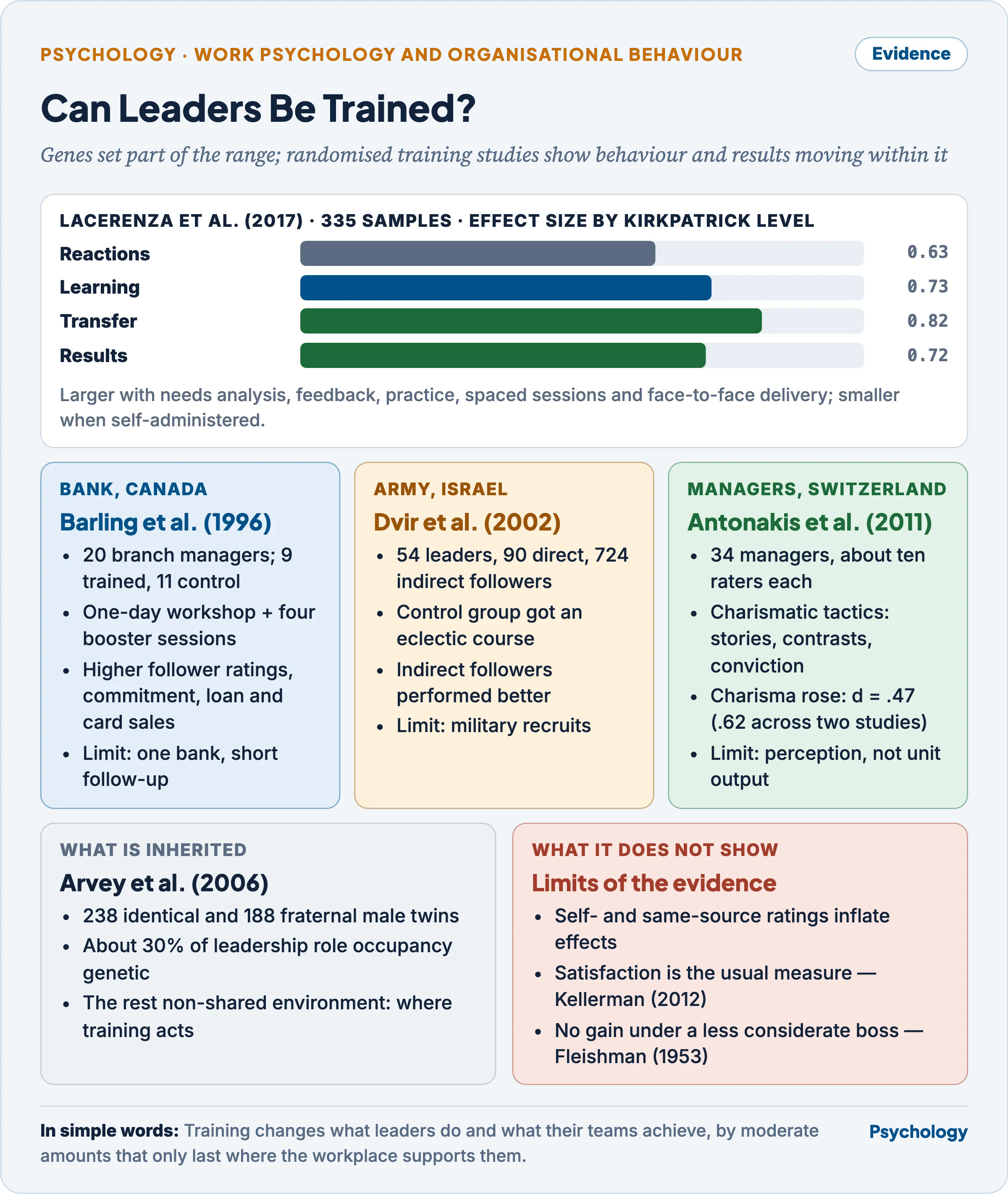
The meta-analytic effects are moderate at every level, and the field experiments show the gains reaching followers who were never trained.
- Avolio, Reichard, Hannah, Walumbwa and Chan (2009) pooled 200 laboratory and field studies that manipulated leadership by training, assignment or scenario: treated participants had a 66 per cent probability of a positive outcome against 50 per cent by chance.
- Lacerenza, Reyes, Marlow, Joseph and Salas (2017), across 335 independent samples, found leadership training “substantially more effective than previously thought”: reactions δ = .63, learning δ = .73, transfer δ = .82 and results δ = .72.
- Effects rose with a needs analysis, feedback, several delivery methods (especially practice), spaced sessions, an on-site location, and face-to-face rather than self-administered delivery.
- Barling, Weber and Kelloway (1996) — 20 Canadian bank branch managers randomly assigned to training (9) or control (11).
- Training: a one-day transformational-leadership workshop followed by four individual booster sessions.
- Result (Barling and colleagues, 1996): subordinates rated trained managers higher on transformational leadership and reported more commitment; their branches sold more personal loans and credit cards.
- Limitation: twenty managers in one bank, with a short follow-up.
- Dvir, Eden, Avolio and Shamir (2002) — a randomised field experiment in the Israel Defense Forces with 54 military leaders, 90 direct and 724 indirect followers.
- Experimental leaders received transformational-leadership training; controls received an eclectic leadership course, so both groups were trained.
- Experimental leaders had more impact on direct followers’ development and on indirect followers’ performance — the gain travelled two levels down.
- Limitation: a military setting with recruits on short courses.
- Antonakis, Fenley and Liechti (2011) asked whether charisma can be taught.
- Thirty-four middle managers of a large Swiss company were rated by about ten co-workers each, then randomly assigned to a waiting control or training in charismatic leadership tactics — metaphors, stories, contrasts, lists, expressed moral conviction, animated voice and gesture.
- Three months later the trained managers’ charisma ratings had risen relative to the controls (d = .47); a second study re-rated 41 MBA students’ speeches (d = .75), a mean of d = .62 (Antonakis and colleagues, 2011).
- Limitation: tactics change how a leader is perceived, not necessarily what the unit achieves.
- The conclusion the evidence supports: leaders can be trained, and the live questions are which design and which work context let the gain survive.
Components of leadership training
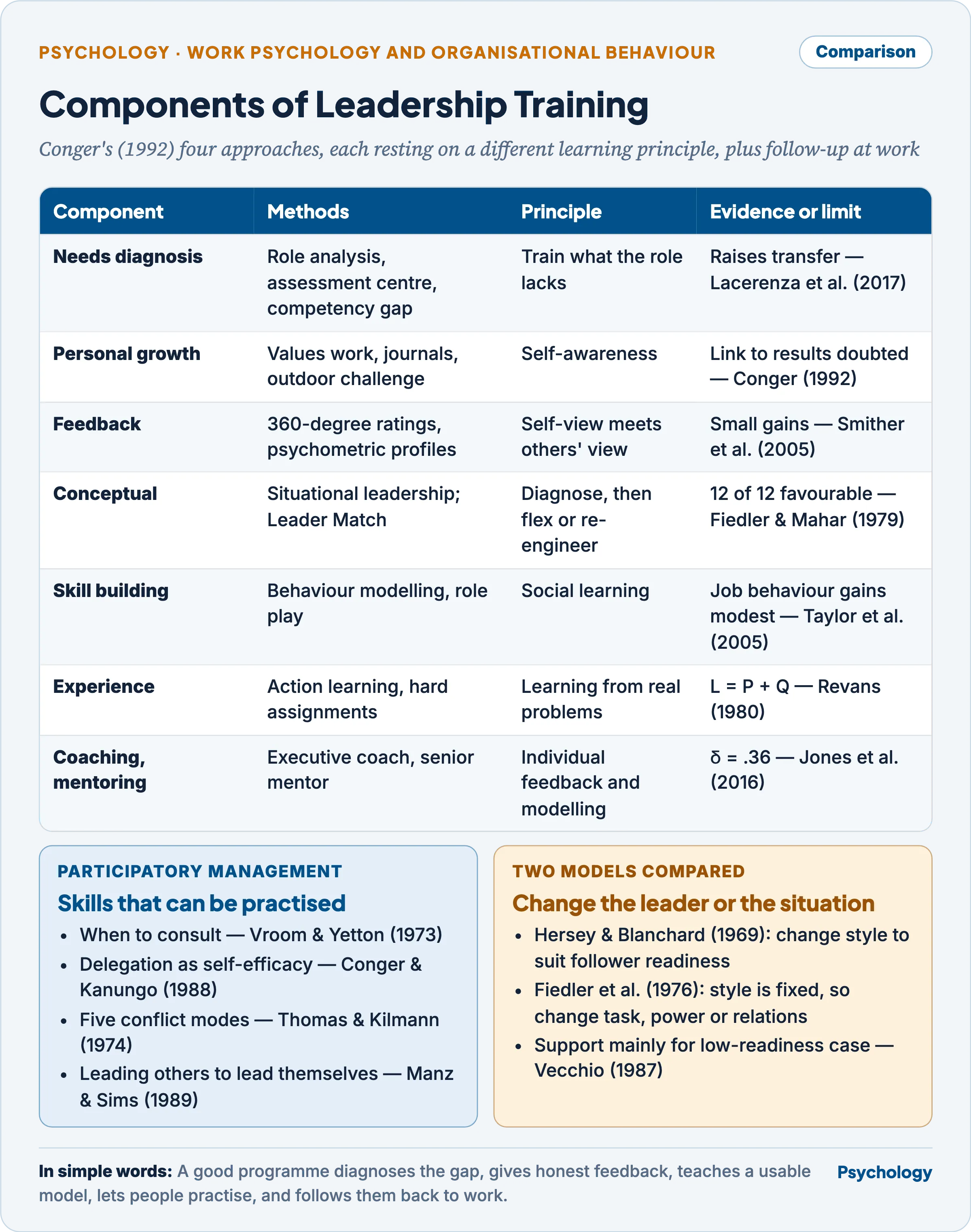
Each component rests on a different learning principle, which is why a programme that uses only one of them stalls.
- Conger (1992), after attending five leading programmes himself, sorted leadership training into four approaches: personal growth, conceptual understanding, feedback and skill building. Each alone was partial; he argued for combining all four and adding follow-up at work.
- A programme starts from a needs and competency diagnosis of the role and the person, set out in Training and Human Resource Development; needs analysis raised transfer in Lacerenza and colleagues (2017).
Self-awareness and feedback
- 360-degree feedback compares a leader’s self-ratings with those of superiors, peers and subordinates. Smither, London and Reilly (2005), across 24 longitudinal studies, found later improvement generally small; their model predicts most change when feedback signals a need for it.
- Feedback can backfire: Kluger and DeNisi (1996) found it lowered performance in over a third of cases, and traced the harm to feedback that turns attention to the self rather than the task.
- Psychometric profiles, reflective journals and values exercises serve the same end: a leader who cannot see their own pattern cannot change it.
Conceptual frameworks: situational leadership and Leader Match
- Hersey and Blanchard (1969) train leaders to diagnose follower readiness and flex between telling, selling, participating and delegating; Vecchio (1987) found support mainly for the directive prescription with low-readiness subordinates.
- Leader Match (Fiedler, Chemers and Mahar, 1976) inverts the logic. Style being fixed, a programmed self-instruction text teaches leaders to measure their style and situational control, then engineer the situation — task structure, position power, relations — to fit it.
- Fiedler and Mahar (1979) reviewed twelve validation studies comparing 423 trained leaders with 484 randomly assigned controls; all twelve favoured training.
- Jago and Ragan (1986), by simulation, estimated that its instruments would misclassify almost a quarter of users against the contingency model itself; Chemers and Fiedler (1986) disputed the assumptions.
- The programmed-instruction format is discussed in Programmed, Probability and Self-Instructional Learning (Paper I).
- Transformational, full-range content is set out in Transformational Leadership; its trainability is shown above.
Skills for participatory management
- Participation is a set of skills, not an attitude, and each can be practised.
- Decision-making: when to decide alone, consult or let the group decide, the choice formalised in the normative model of Vroom and Yetton (1973).
- Delegation and empowerment: Conger and Kanungo (1988) defined empowerment as strengthening subordinates’ self-efficacy, so delegation is taught as giving information, authority and coaching, not just tasks.
- Conflict handling: the five modes of Thomas and Kilmann (1974) — competing, collaborating, compromising, avoiding and accommodating — practised in role plays.
- Communication: listening, giving feedback, running meetings; the training of these is set out in Effective Communication and Its Training (Paper I).
- Manz and Sims (1989) described SuperLeadership: leading others to lead themselves, the end point of participatory management.
Behaviour modelling, action learning, coaching and mentoring
- Behaviour modelling (Goldstein and Sorcher, 1974) uses learning points, a filmed model, rehearsal and feedback; the method is set out in Training and Human Resource Development.
- Taylor, Russ-Eft and Chan (2005), meta-analysing 117 studies, found large gains in knowledge and skill, modest gains in job behaviour, and better transfer when trainees’ own supervisors were also trained.
- Action learning (Revans, 1980) puts small sets of managers on real organisational problems, summarised as L = P + Q: learning is programmed knowledge plus questioning insight.
- Coaching gives individual, goal-focused feedback; Jones, Woods and Guillaume (2016) found an overall effect of δ = .36 on organisational outcomes.
- Mentoring, in Kram’s (1985) analysis, serves career functions (sponsorship, exposure, challenging work) and psychosocial functions (role modelling, counselling, acceptance).
Experiential and developmental methods
- McCall, Lombardo and Morrison (1988), interviewing successful executives about the events that taught them most, found challenging assignments, other people and hardships far ahead of formal coursework.
- The later “70-20-10” rule (assignments, people, programmes) came from these data, but McCall (2010) found no published source for it and warned that it presents coaching, mentoring and programmes as stand-alone, when they work best supporting on-the-job experience.
- Hence developmental assignments — job rotation, a turnaround posting, a task force — and outdoor or simulation exercises that put a leader under uncertainty. Group-feedback laboratories are treated in Sensitivity Training and Organisational Development.
Evaluation of leadership training
- Kirkpatrick’s (1959) four levels, set out in Training and Human Resource Development, apply with one adjustment: because leadership is defined by its effect on others, behaviour is best measured by subordinates and peers, months later, not by the trainee.
- Reactions: satisfaction and perceived usefulness. Learning: knowledge tests, situational judgement items, role-play ratings.
- Behaviour: 360-degree ratings at six and twelve months. Results: unit output, absenteeism, grievances, attrition, citizen satisfaction.
- Kellerman (2012) observed that leadership programmes are usually judged by one subjective measure, whether participants were satisfied.
- The designs that convince are those of Barling and colleagues (1996) and Dvir and colleagues (2002): random or matched control groups, follower-rated outcomes and organisational results.
A leadership training programme for civil servants
- Civil-service leadership differs from corporate leadership in ways the design must answer: authority bounded by rules, accountability to a political executive and the public, frequent transfers, crisis decisions under scrutiny, and citizens rather than customers.
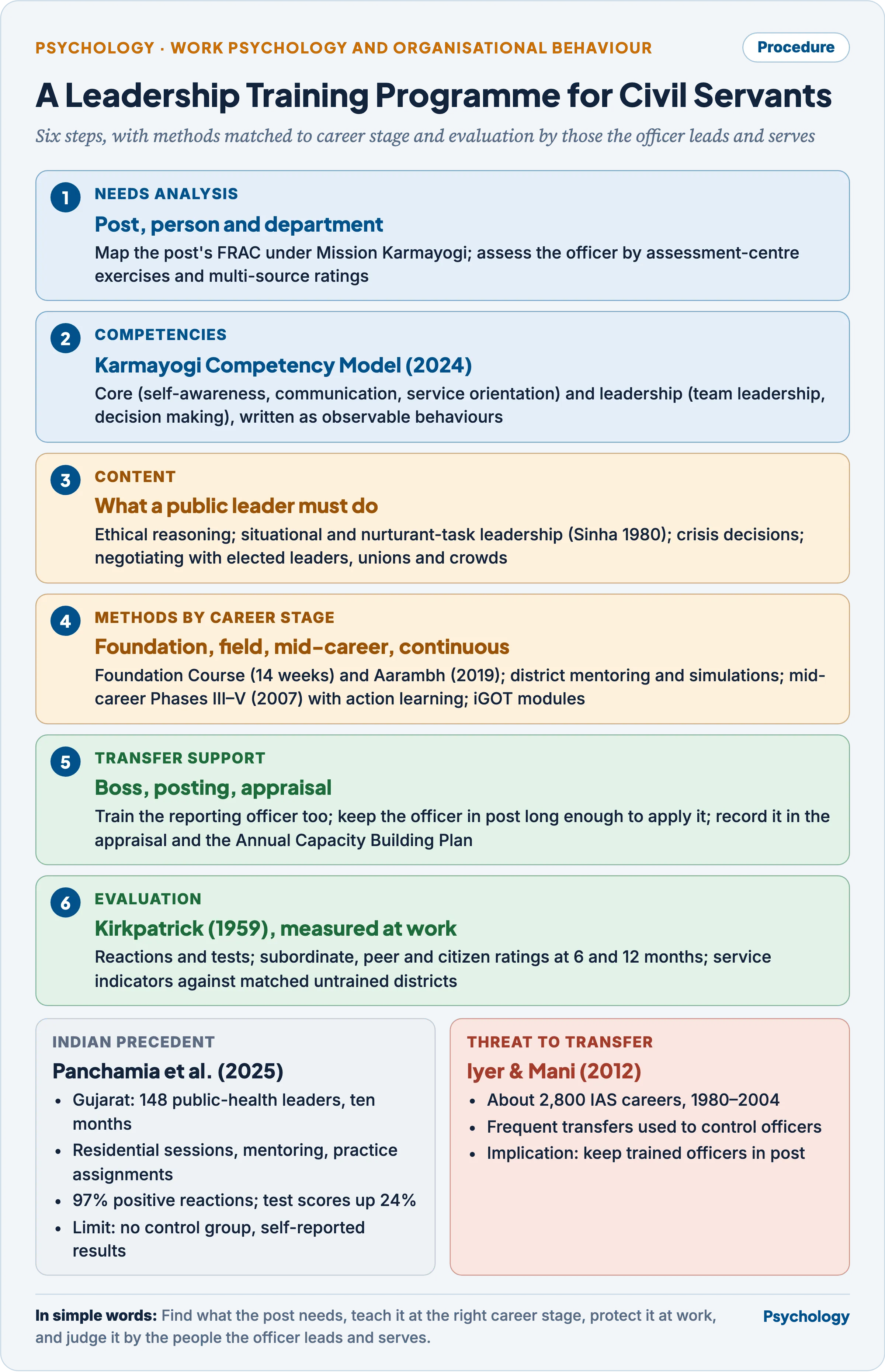
Each stage of a civil servant’s career gets the method suited to it, and the loop closes only when changed behaviour is measured at work.
- Step 1 — Needs analysis. Map the post against its Framework of Roles, Activities and Competencies (FRAC) under Mission Karmayogi; assess the officer by assessment-centre exercises and multi-source ratings; add the department’s priorities.
- Step 2 — Competencies. Behavioural competencies from the Karmayogi Competency Model — core ones such as self-awareness, communication and service orientation, and leadership ones such as team leadership and decision making — written as behaviours: “consults affected groups before deciding”, “delegates with stated limits”.
- Step 3 — Content. Self-awareness and ethical reasoning; situational and participative leadership, including Sinha’s (1980) nurturant-task style for dependent field staff; transformational behaviours; decisions under ambiguity; crisis leadership; negotiation with elected representatives, unions and protesting groups.
- Step 4 — Methods by career stage.
- Foundation: the Lal Bahadur Shastri National Academy of Administration’s Foundation Course (14 weeks, with a Himalayan trek and a village visit) and the cross-service Aarambh component since 2019 — experiential learning and esprit de corps.
- Field: district attachment with the collector as mentor; case studies and simulations of flood relief or law-and-order situations; role plays of meeting an agitating crowd.
- Mid-career: the mandatory Mid-Career Training Programme (2007) for IAS officers — Phase III at seven to nine years, IV at fifteen to sixteen, V at twenty-six to twenty-eight — plus action-learning projects on a live district problem and executive coaching.
- Continuous: iGOT Karmayogi modules for knowledge, spaced across the year.
- Step 5 — Transfer support. Train the officer’s reporting officer too (Taylor and colleagues, 2005); keep the trained officer in post long enough to apply the learning; record training in the annual appraisal and the department’s Annual Capacity Building Plan.
- Step 6 — Evaluation. Reactions; pre- and post-tests; subordinate, peer and citizen ratings at six and twelve months; service-delivery indicators — grievance disposal time, scheme coverage — compared with matched untrained districts.
Limiting and facilitative factors in leadership training for a public sector industrial set-up in India
- Baldwin and Ford (1988) traced transfer to trainee characteristics, training design and the work environment, as set out in Training and Human Resource Development. In a public-sector plant the work environment is usually the binding constraint.
- Fleishman (1953) — International Harvester; 122 foremen given human-relations (consideration) training away from the plant, then followed back to work 2–24 months later.
- Back at work, Fleishman (1953) found, behaviour followed the superior’s leadership climate: foremen returning to considerate superiors showed more consideration; those returning to less considerate superiors showed no such change.
- Limitation: one American company in the early 1950s; but the transfer-climate effect recurs across 89 studies in Blume, Ford, Baldwin and Huang (2010).
- Lynton and Pareek (1967), writing from Indian development training, divided training into pre-training, training and post-training phases and warned that “something is often not better than nothing”: a course cut off from organisational goals and top-management commitment wastes the trainee’s learning.
| Level | Limiting factors | Facilitative factors |
|---|---|---|
| Trainee | Nominated by availability or seniority; promotion by length of service weakens motivation | Selected on assessed need; training tied to career progression |
| Programme | Generic, imported, lecture-based, one-off | Needs analysis, practice, spaced sessions; content fitted to Indian work relationships |
| Superior and climate | Authoritarian superiors; high power distance (Hofstede, 1980); deference to rank | Superiors trained first or alongside; visible top-management support |
| Organisation | Rule-bound centralisation; soft work culture; frequent change of top management | Synergetic culture; delegated financial and personnel powers; an in-house apex institute |
| Industrial relations | Rival unions reading participative programmes as manipulation | Joint councils; union representatives included in design |
| Follow-up | None after the course | Coaching, action-learning projects, 360-degree review at six months |
- Sinha (1990) contrasted a soft work culture — pliant management, non-work concerns dominant — with a synergetic one of assertive management, rewarded hard work, welfare and cultivated union relations; trained behaviour survives in the second. See Managerial Effectiveness.
- Public-sector enterprises have in-house apex institutes, such as the Power Management Institute of NTPC at Noida and the Management Training Institute of the Steel Authority of India at Ranchi: an asset when their courses are tied to plant problems.
Criticisms and limitations of leadership training
- Evaluation is thin. Kellerman (2012) found satisfaction the usual measure; Pfeffer (2015) argued that decades of the leadership industry had not measurably improved workplaces.
- Measurement flatters. Self-ratings and same-source ratings inflate effects, and Avolio and colleagues (2009) found effects varying significantly with the theory taught.
- Context. Trained behaviour appears only where the superior’s climate supports it (Fleishman, 1953), so a programme can succeed in the classroom and fail at work.
- Weak theories taught as settled. Situational leadership has limited support (Vecchio, 1987) and Leader Match’s classifications are disputed (Jago and Ragan, 1986).
- Feedback can harm (Kluger and DeNisi, 1996), and 360-degree gains are small (Smither and colleagues, 2005).
- Individual, not collective. Courses build leader rather than leadership capacity (Day, 2000).
- Cultural fit. Western models assume low power distance and open feedback upward; Indian hierarchical relationships, described by Sinha and Kanungo (1997) as context-sensitive, resist both.
- Ethics. Charisma training teaches influence tactics that serve any goal, so it needs ethical content alongside.
Indian context
- Mission Karmayogi — National Programme for Civil Services Capacity Building (Department of Personnel and Training; approved by the Union Cabinet on 2 September 2020).
- Mechanism: every post calibrated to a FRAC; behavioural, functional and domain competencies; on-site learning to complement off-site courses; ₹510.86 crore over 2020–21 to 2024–25 for about 46 lakh central employees.
- Principle: training matched to the demands of the role rather than to seniority — person–job fit applied to development.
- Capacity Building Commission (constituted 1 April 2021) — assists the Prime Minister’s Public Human Resources Council in approving Annual Capacity Building Plans, supervises central training institutions and sets norms for common mid-career programmes. Principle: organisational-level needs analysis.
- Karmayogi Competency Model (Capacity Building Commission, launched 19 October 2024 at the first Karmayogi Saptah) — 34 competencies: 13 behavioural (five leadership, eight core) and 21 functional, drawing on Indian ideas of sankalpa and guna.
- Principle: a shared behavioural vocabulary makes modelling and multi-source assessment possible.
- iGOT Karmayogi had more than 1.70 crore registered users and over 5,600 courses (PIB, 5 August 2026). Principle: spaced, self-paced learning — though Lacerenza and colleagues (2017) found self-administered delivery the weaker form, so it supplements face-to-face practice.
- Mid-Career Training Programme (2007): completing Phase III is a condition of appointment to the Junior Administrative Grade under the IAS (Pay) Rules, 2016. Principle: linking training to reward raises motivation to transfer.
- Iyer and Mani (2012), with the career histories of about 2,800 IAS officers between 1980 and 2004, showed that politicians use frequent transfers to control bureaucrats — the condition that most threatens Step 5 above.
- Panchamia, Chavda, Sharma, Kadri and Iyer (2025) — the Health Leadership Enhancement Program of the Indian Institute of Public Health Gandhinagar with Gujarat’s health department.
- 148 mid-level public-health leaders, ten months: four residential sessions, virtual mentoring, practice assignments and an exposure visit; evaluated on Kirkpatrick’s four levels.
- Over 97 per cent positive reactions and test scores up 24 per cent (Panchamia and colleagues, 2025); self-reported gains in delegation and situational leadership; local results such as more tuberculosis notifications from private providers.
- Limitation: no comparison group and largely self-reported results; Panchamia and colleagues (2025) add self-selected participants, an end-of-programme follow-up only, and evaluators who also ran the programme.
Previous Year Questions
- 2014Can leaders be trained? What will be the essential components of a leadership training programme for the civil servants?
- 1998Show your acquaintance with the components of leadership training.
- 1995What are the components of leadership training? Discuss the limiting and facilitative factors in leadership training for a public sector industrial set-up in India.