

Official syllabusPaper II · Unit 4 · Work Psychology and Organisational Behaviour
Training and human resource development.
Definition
“HRD is the integrated use of training and development, organization development, and career development to improve individual, group, and organizational effectiveness.”
McLagan (1989)
Training is the planned, job-tied end of learning; human resource development widens it into a continuing system that also builds careers, climate and the organisation itself. The hard part is rarely the teaching: it is diagnosing the need, getting learning used at work, and showing that it was.
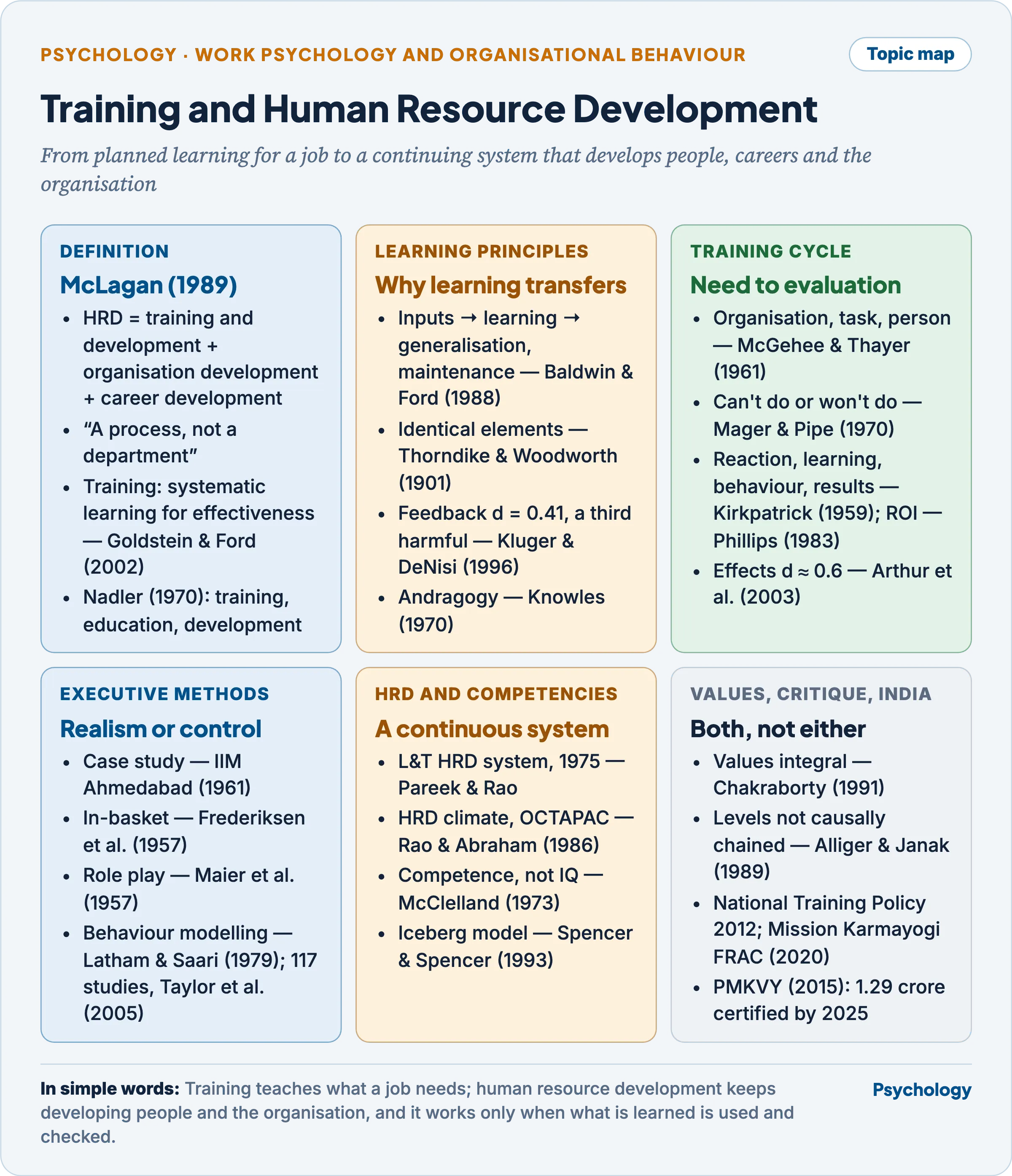
The map runs from how people learn to what the organisation keeps, ending in the values debate.
Learning and training
- Learning is a relatively permanent change in behavioural potentiality produced by reinforced practice — Kimble (1961), defined in Classical Conditioning (Paper I).
- Training is a systematic approach to learning aimed at individual, team and organisational effectiveness (Goldstein and Ford, 2002).
- Nadler (1970), who named the field, separated training (the present job), education (a future job) and development (growth not tied to any job).
| Dimension | Learning | Training |
|---|---|---|
| Nature | A psychological process | An organised intervention using that process |
| Initiator | Anyone; often incidental | The employer, for its purposes |
| Goal | Any lasting change, wanted or not | Specified knowledge, skills, attitudes |
| Time frame | Lifelong, open-ended | A bounded programme |
| Success criterion | Change in the person | Change in job performance and results |
| Example | A clerk copies colleagues’ shortcuts | A structured e-office file-handling course |
Learning principles that make training work
- Baldwin and Ford (1988) modelled transfer of training: trainee characteristics, training design and work environment produce learning and retention, which become generalisation to the job and maintenance over time. Trainee characteristics and the work environment also act on transfer directly.
- Identical elements — Thorndike and Woodworth (1901): transfer rises with the overlap between training and job situations, the logic of simulators.
- Saks and Belcourt (2006), surveying training professionals in 150 organisations, estimated that 62 per cent of trainees applied training immediately, 44 per cent at six months, 34 per cent at a year.
- The familiar “only 10 per cent transfers” traces to a 1982 remark by Georgenson, not to data (Ford, Yelon and Billington, 2011).
- Practice — spaced beats massed practice (Donovan and Radosevich, 1999); overlearning past first mastery slows forgetting (Driskell, Willis and Copper, 1992).
- Feedback — Kluger and DeNisi (1996), across 607 effect sizes, found an average gain of d = 0.41, yet over a third of feedback interventions lowered performance, chiefly when feedback drew attention to the self rather than the task.
- Andragogy — Knowles (1970): adults are self-directing, use experience as a resource, become ready to learn through life roles and want problem-centred learning; internal motivation was added in 1984.
- Criticism: Hartree (1984) asked whether it is a theory of learning or a set of teaching guidelines, and many of its assumptions hold for children too.
Importance of training in industry
- Arthur, Bennett, Edens and Bell (2003) meta-analysed organisational training and found medium-to-large effects at every level: d = 0.60 for reactions, 0.63 for learning, 0.62 for behaviour and 0.62 for results.
- Aguinis and Kraiger (2009) traced benefits beyond the trainee to teams, organisations and national economies — performance, innovation and human capital, a workforce’s job-relevant capability.
The training process: needs analysis, design and delivery
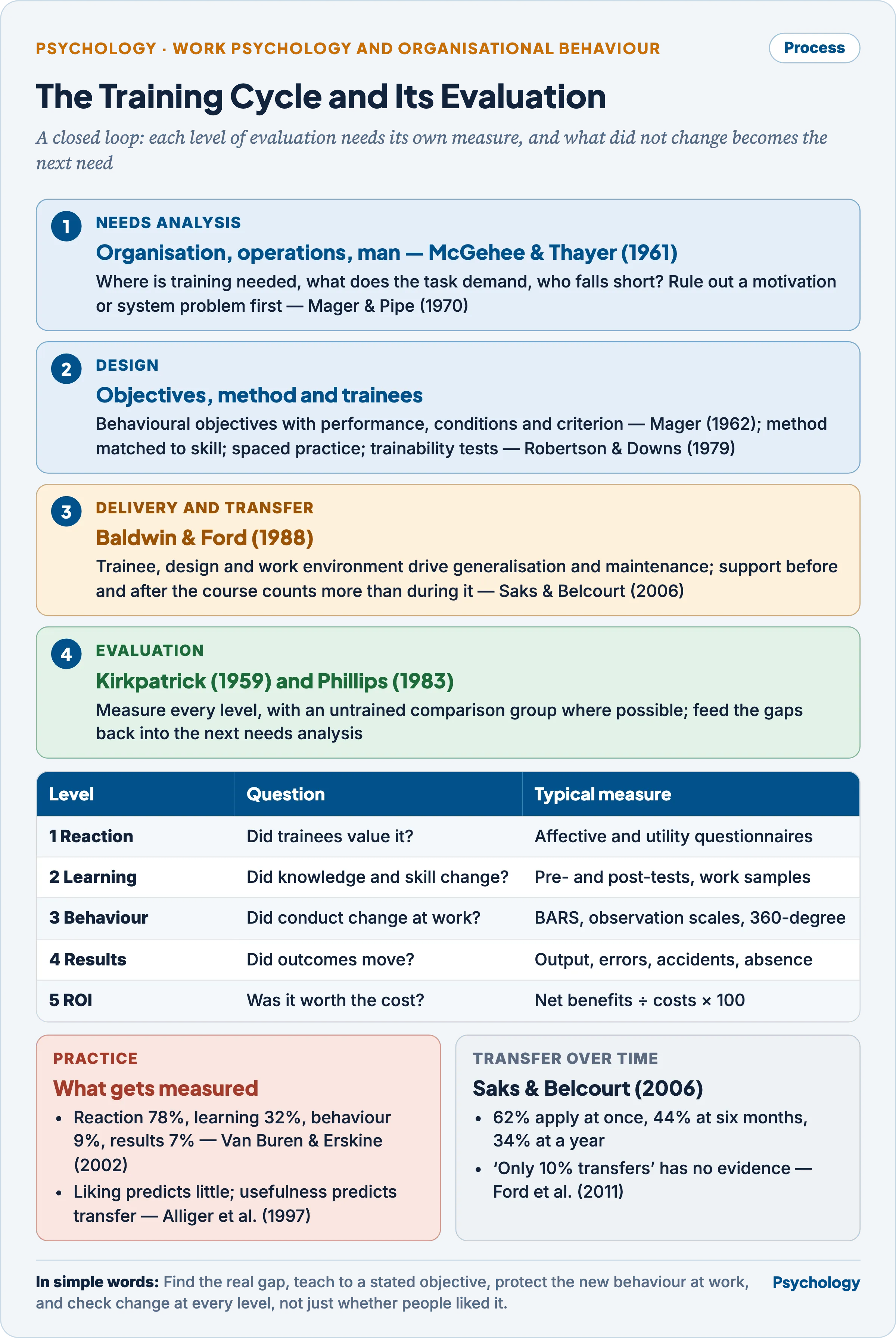
Evaluation closes the loop: what the last cycle failed to change becomes the next cycle’s need.
- McGehee and Thayer (1961) set the three levels of training needs analysis.
- Organisation analysis — where training is needed and whether goals, resources and climate will support its use.
- Operations (task) analysis — what the job demands, in knowledge, skills and attitudes.
- Man (person) analysis — who falls short, from appraisals, records, observation, tests and self-report.
- Mager and Pipe (1970) separated “can’t do” from “won’t do”: a deficit of motivation, tools or rewards needs a management remedy, not a course.
- Design turns needs into behavioural objectives stating performance, conditions and criterion (Mager, 1962), then matches method to content; method–skill fit predicted effectiveness (Arthur and colleagues, 2003).
- Trainability tests — a short taught work sample performed unaided — select those likely to profit from a course (Robertson and Downs, 1979).
- Delivery extends beyond the course: activities before and after it, such as supervisor briefing and reinforcement, mattered more for transfer than those during it (Saks and Belcourt, 2006).
Evaluation of training effects
- Kirkpatrick (1959), in a series of articles, set four levels.
- Reaction — did trainees value it;
- Learning — did knowledge and skill change;
- Behaviour — did conduct change on the job;
- Results — did the outcomes the training served move.
- Phillips (1983) added a fifth level, return on investment: ROI (%) = net programme benefits ÷ programme costs × 100, after isolating training’s share of the gain (Phillips, 1996).
- Kraiger, Ford and Salas (1993) split learning into cognitive, skill-based and affective outcomes, each needing its own measure.
- In practice, 78 per cent of benchmarked organisations measured reactions, 32 per cent learning, 9 per cent behaviour and 7 per cent results (Van Buren and Erskine, 2002).
- Alliger, Tannenbaum, Bennett, Traver and Shotland (1997), pooling 115 correlations from 34 studies, found liking a course barely related to anything else; utility reactions — judged usefulness — predicted transfer better than learning scores did.
- “Reaction measures are not a suitable surrogate for other indexes of training effectiveness” — Tannenbaum and Yukl (1992).
| Level | Tests and measures | Design requirement |
|---|---|---|
| Reaction | Affective and utility reaction questionnaires | Usefulness, not only liking |
| Learning | Criterion-referenced achievement tests, work samples, situational judgement tests, in-basket scores | Parallel pre-test and post-test forms |
| Behaviour | Behaviourally anchored rating scales (Smith and Kendall, 1963), behavioural observation scales (Latham and Wexley, 1977), 360-degree ratings | Other observers, months later |
| Results | Output, error, accident, absence and grievance records; Job Descriptive Index (Smith, Kendall and Hulin, 1969) for attitude change | Untrained comparison group or time series |
| ROI | Benefit–cost analysis | Training’s share isolated |
- Design decides the conclusion: a pre-test–post-test design with an untrained control group rules out maturation and outside events; Solomon’s (1949) four-group design also detects pre-test sensitisation; a time series substitutes where no control exists.
Executive training methods
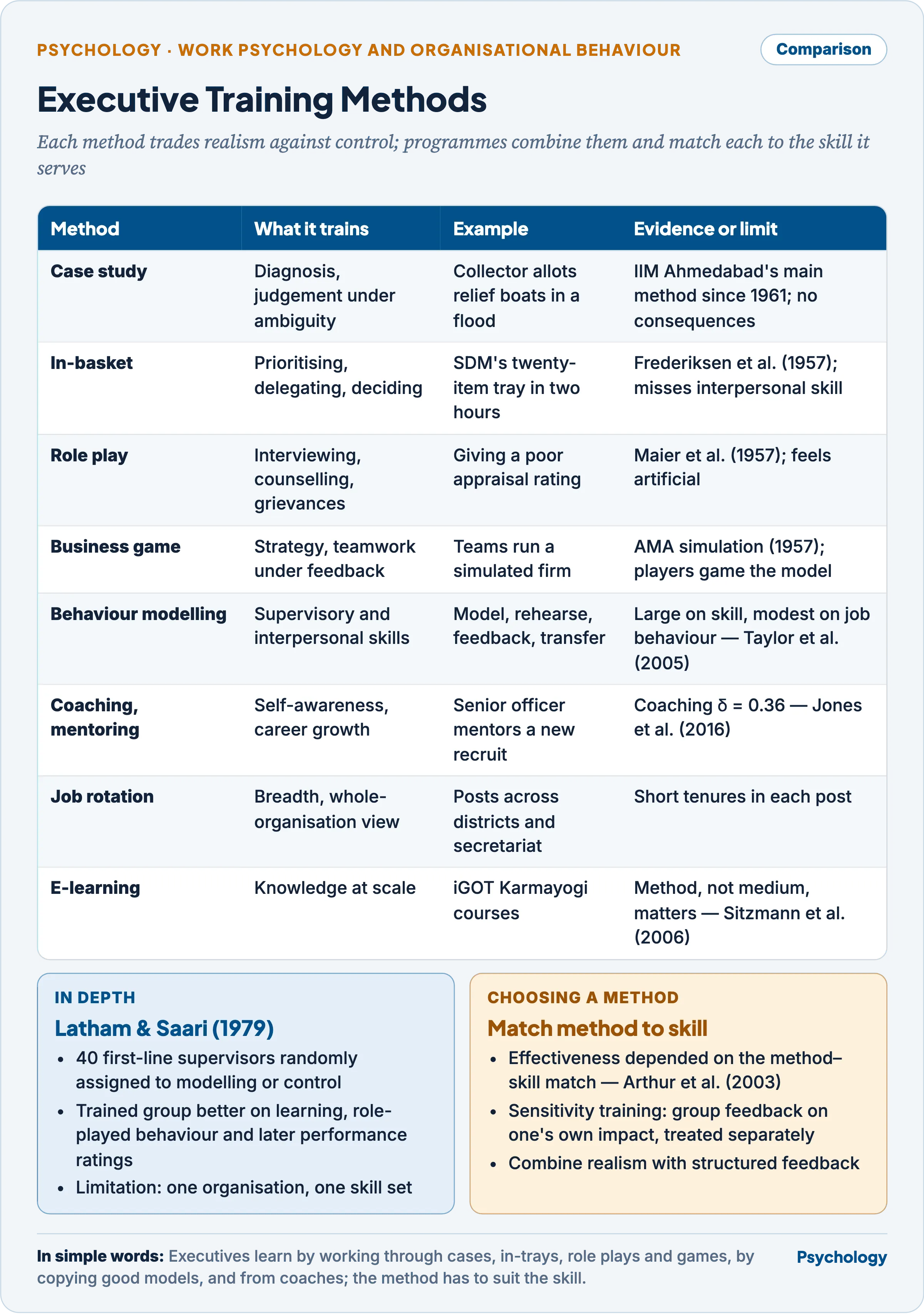
Each method buys realism or control at the price of the other, which is why programmes combine them.
Case study
- A written account of a real situation with no single right answer is analysed alone, then argued in a group; it trains diagnosis and judgement under ambiguity.
- Harvard Business School built its teaching on cases from the 1920s; the Indian Institute of Management Ahmedabad (December 1961), founded with Harvard’s collaboration, adopted the case method as its primary teaching instrument.
- Example: a district collector must allot scarce relief boats between a flooded town and remote villages; trainees defend a decision and are cross-examined on its costs.
- Limitation: decisions carry no consequences, data arrive pre-sorted, and fluent talkers dominate.
In-basket exercise
- Frederiksen, Saunders and Wand (1957) developed the in-basket: the trainee takes over an absent manager’s tray of letters, memos and files and must act on each item in a fixed time.
- Responses are scored for prioritisation, delegation, decisiveness, use of information and follow-up.
- Example: a new Sub-Divisional Magistrate faces twenty items in two hours — a flood warning, a court date clash, a minister’s visit, an RTI appeal deadline.
- Limitation: written and solitary, it under-samples interpersonal skill, and scoring needs trained raters.
Role play and business games
- Maier, Solem and Maier (1957) brought role playing into supervisory training, fusing the case method with Moreno’s psychodrama; in multiple role playing many groups enact one scenario at once.
- The Top Management Decision Simulation of the American Management Association (Ricciardi and colleagues, 1957) launched business games: teams run simulated firms over rounds, and a model returns each decision’s consequences.
Behaviour modelling
- Goldstein and Sorcher (1974) built behaviour modelling on social learning theory, set out in Observational Learning and Modelling (Paper I): learning points, a model, rehearsal, social reinforcement and transfer planning.
- Latham and Saari (1979) randomly assigned 40 first-line supervisors to modelling training or a control group.
- Trained supervisors outperformed controls on learning, on role-played handling of problems with employees and on superintendents’ job-performance ratings a year later.
- Limitation: one organisation and one skill set.
- Taylor, Russ-Eft and Chan (2005), meta-analysing 117 studies, found large effects on knowledge and skill and modest effects on attitudes and job behaviour.
- Transfer was greatest with positive and negative models together, trainee-generated scenarios, goal-setting, trained superiors and rewards at work.
- The full programme sequence is set out in Effective Communication and Its Training (Paper I).
Other methods
- Sensitivity training — unstructured group feedback on one’s interpersonal impact — is treated in Sensitivity Training and Organisational Development.
- Coaching: Jones, Woods and Guillaume (2016), across 17 studies, found an overall effect of δ = 0.36, stronger with internal coaches. Mentoring serves career and psychosocial functions (Kram, 1985).
- E-learning: Sitzmann, Kraiger, Stewart and Wisher (2006) found web-based instruction 6 per cent more effective than classroom teaching for declarative knowledge and equal for procedural; with identical methods the gap vanished — method, not medium, does the work.
Human resource development as a continuous process
- McLagan (1989) placed HRD’s three development-centred areas on an eleven-area human resource wheel and insisted “It is a process, not a department.”
- Its premise is the shift Davis (1968) traced from autocratic and custodial to supportive and collegial models of organisational behaviour: capacity grows when supported (Likert, 1961).
- Pareek and Rao designed India’s first integrated HRD system for Larsen & Toubro in 1974–75, from a review of its appraisal system; a separate HRD department followed in 1975.
- Its subsystems: performance appraisal, potential appraisal, feedback and counselling, career development and planning, training and development, and organisation development (Pareek and Rao, 1981).
- The process is continuous because each subsystem feeds the next: appraisal generates training needs, counselling turns ratings into development plans, potential appraisal feeds career planning, and organisation development changes the climate the next cycle runs in.
- Career development aligns individual career planning with organisational needs (McLagan, 1989), so one process serves personal and organisational goals.
- HRD climate — Rao and Abraham (1986) built a 38-item survey of general climate, HRD mechanisms and OCTAPAC culture (openness, confrontation, trust, autonomy, proaction, authenticity, collaboration), extended as OCTAPACE in Sensitivity Training and Organisational Development.
- At the organisational level, Argyris and Schön (1978) separated single-loop learning (correcting errors within existing goals) from double-loop learning (questioning the goals); Senge (1990) built the learning organisation on five disciplines, chief among them systems thinking.
- Psychological capital — hope, efficacy, resilience, optimism (Luthans, Youssef and Avolio, 2007) — is developable: Luthans, Avey, Avolio and Peterson (2010) raised it with a short intervention against a randomised control group, and a follow-up linked it to managers’ performance.
Competency mapping for human resource development
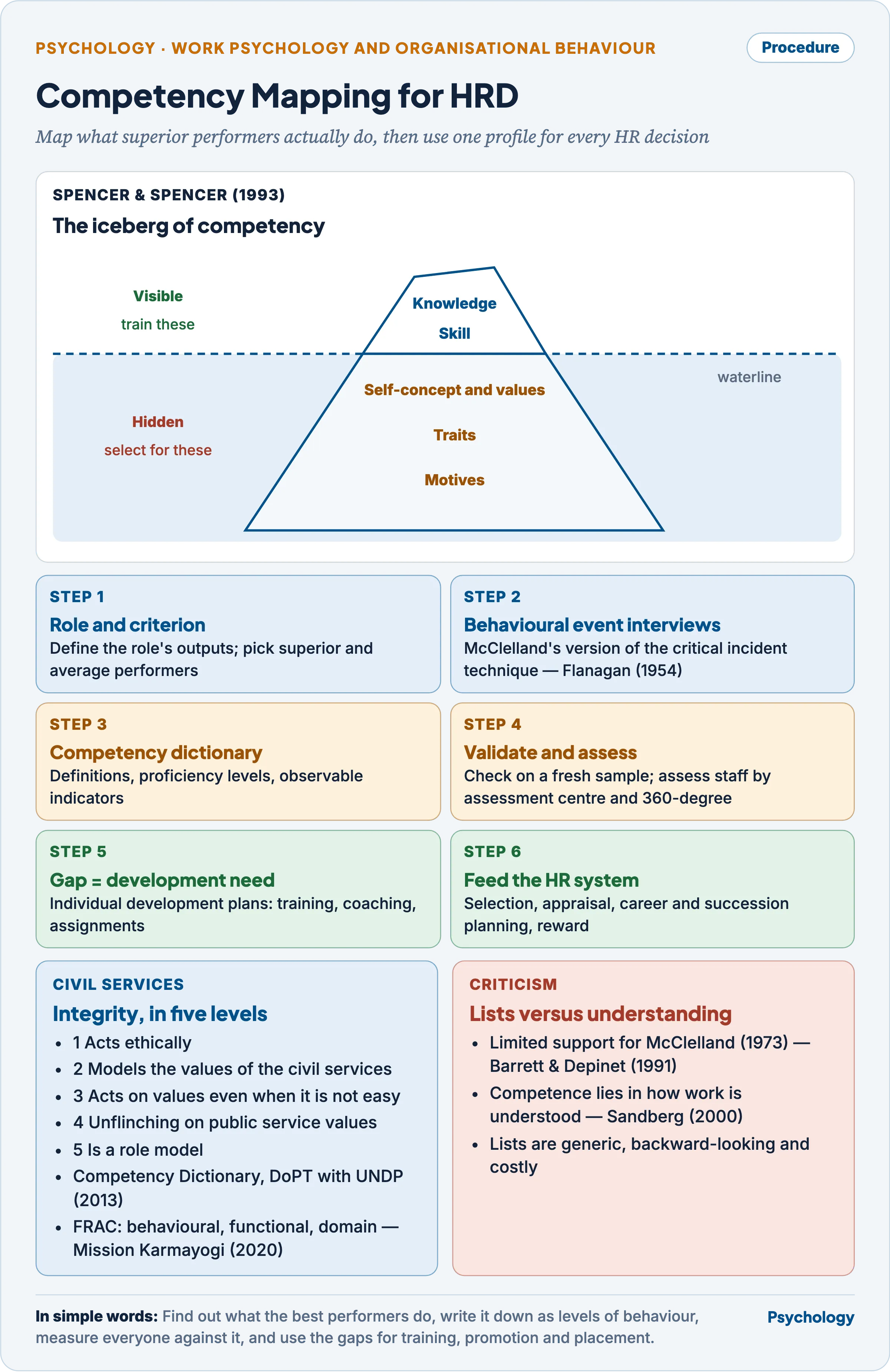
One mapped profile feeds five HR decisions; the deeper the layer of the iceberg, the more it is selected for rather than trained.
- McClelland (1973), in “Testing for competence rather than for ‘intelligence'”, argued that grades and aptitude tests predicted little of occupational success and disadvantaged minorities.
- His alternative: “The best testing is criterion sampling” — observe what effective performers actually do, and test that.
- A competency is “an underlying characteristic of an individual that is causally related to criterion-referenced effective and/or superior performance in a job or situation” (Spencer and Spencer, 1993).
- Boyatzis (1982), in The Competent Manager, derived generic managerial competencies; effectiveness follows from the fit of a person’s competencies with job demands and organisational environment.
- The iceberg model (Spencer and Spencer, 1993): knowledge and skill sit above the waterline, visible and trainable; self-concept and values, traits and motives lie below, harder to change and better selected for.
- Threshold competencies are the minimum any job-holder needs; differentiating competencies separate superior from average performers.
- Mapping proceeds in steps.
- Define the role’s outputs and a performance criterion; identify superior and average incumbents.
- Collect behaviour through behavioural event interviews — McClelland’s adaptation of the critical incident technique (Flanagan, 1954) — plus job analysis and expert panels.
- Code themes into a competency dictionary of definitions, proficiency levels and observable behavioural indicators.
- Validate on a fresh sample, then assess incumbents through assessment centres and 360-degree feedback to locate gaps.
- One profile serves the whole HR system: selection (see Personnel Selection and the Use of Psychological Tests in Industry), training needs (gap = need), appraisal, career and succession planning, and reward.
- The Competency Dictionary for the Civil Services (Department of Personnel and Training with UNDP, 2013) groups 25 competencies under Ethos, Ethics, Equity and Efficiency.
- Integrity has five proficiency levels: acts ethically; models the values of the civil services; acts on values even when it is not easy; is seen unflinching on public service values; is a role model.
- Mission Karmayogi (2020) calibrates every civil service post to a Framework of Roles, Activities and Competencies (FRAC) of behavioural, functional and domain competencies; confirmation after probation, deployment and work assignment are eventually to be integrated with it (Press Information Bureau, 2020).
- A worked illustration for a Block Development Officer:
- Activities — plan rural-employment works, run gram sabha consultations, resolve grievances, release funds.
- Profile — domain: scheme rules; functional: planning and coordination; behavioural: people first, consensus building, integrity.
- An officer at level 1 in consensus building, where the role needs level 3, gets a behaviour-modelling course and a mentor, is reassessed by 360-degree ratings after six months, and the result informs her next posting.
- Criticism: Barrett and Depinet (1991) found limited support for McClelland’s claims, since ability tests do predict job performance; McClelland (1994) replied in defence.
- Sandberg (2000), studying Volvo engine optimisers, found competence lay in how workers conceived their work, not in a list of attributes; lists are also generic, backward-looking and costly.
Human values versus competencies in human resource development
- The values position: S. K. Chakraborty (1991), Management by Values, founder-convener of IIM Calcutta’s Management Centre for Human Values, held values and ethics integral to management training, not add-ons.
- His workshops held that techniques become obsolete while values endure, and opened with chitta-shuddhi, purifying the mind, through a forty-minute mind-stilling exercise (Bhattacharya, 2007).
- The competency position: McClelland (1973) asked that what is assessed be changeable by learning and that how to improve be made explicit; values without competence produce well-meant failure.
- The evidence on training values is mixed. Waples, Antes, Murphy, Connelly and Mumford (2009), across 25 business-ethics programmes, found minimal impact on ethical perceptions, behaviour or awareness.
- Watts and colleagues (2017), across 66 studies of science-ethics instruction (10,069 participants), found sizable benefits that had grown over the preceding decade.
- Indian policy holds both: the National Training Policy 2012 and its guidelines define competencies as knowledge, skills and behaviour and schedule ethics-and-values training; the Competency Dictionary grades integrity as observable behaviour.
- A reasoned position: the claim holds for the base of the iceberg and fails as a ranking.
- Values and motives sustain every visible competency, and in public service a competent but corrupt official is the costlier failure.
- Values enter HRD through selection, climate and modelled conduct; training develops them only once translated into observable behaviour that appraisal then rewards.
- HRD is therefore the development of competencies anchored in values, not values instead of competencies.
Criticisms and limitations
- Kirkpatrick’s hierarchy assumes each level causes the next; Alliger and Janak (1989) found little support, and Holton (1996) called it a taxonomy of outcomes that omits intervening causes such as transfer climate.
- Transfer decays (Saks and Belcourt, 2006), so a programme that changes learning but not the work environment buys a temporary effect.
- ROI figures rest on estimating training’s share of a gain and monetising soft skills; precision outruns validity.
- Shortcuts and fads — programmes bought without needs analysis treat symptoms; training cannot cure a problem of motivation or systems (Mager and Pipe, 1970).
- HRD rhetoric can relabel personnel administration without changing it; values programmes risk indoctrination when they prescribe conclusions rather than develop judgement.
- Indian work culture: J. B. P. Sinha (1990) distinguished a soft work culture, with accommodating management and non-work concerns dominating, from a synergetic one that rewards hard work; trained behaviour survives only where the second prevails.
Indian context
- Ministry of Human Resource Development (1985; the Ministry of Education since 2020) — the first in the Asia-Pacific region; public-sector bodies such as BHEL, HAL, SAIL and the State Bank of India built training departments (Aguinis and Kraiger, 2009).
- Barber (2004), observing mechanics in northern India, found informal on-the-job training built innovation and tacit skill — a feel for exactly where to strike crumpled metal.
- National Training Policy, 2012 (Department of Personnel and Training; office memorandum of 19 January 2012) — makes a competency framework the overarching basis of civil-service training.
- Each ministry appoints a Training Manager to map the competencies of all employees, with cadre and annual training plans built on the gaps.
- Principle: person-level needs analysis, training tied to the post rather than the calendar.
- Mission Karmayogi — National Programme for Civil Services Capacity Building (Union Cabinet, 2 September 2020) — moves from “rules based” to “roles based” HR management through FRACs, the iGOT Karmayogi platform and a Capacity Building Commission.
- Rs 510.86 crore was provided for about 46 lakh central employees over 2020–21 to 2024–25 (Press Information Bureau, 2020).
- By 5 August 2026 iGOT had more than 1.70 crore registered users and over 5,600 courses (Press Information Bureau, 2026).
- From 2025–26 prescribed yearly iGOT courses are recorded in central employees’ appraisal reports; a Learning Assessment Framework (April 2026) checks application at work.
- Principle: continuous, competency-based development with a behaviour-level check on transfer; leadership programmes for civil servants are set out in Leadership Training.
- Pradhan Mantri Kaushal Vikas Yojana (Ministry of Skill Development and Entrepreneurship, 15 July 2015) — free short-term training and Recognition of Prior Learning, certified against standard job roles.
- 1,64,07,263 trained and 1,29,21,524 certified by 30 June 2025 (Press Information Bureau, 2025).
- An independent evaluation of PMKVY 4.0 found employed or self-employed short-term trainees rising from 26.6 to 45.4 per cent after training (Press Information Bureau, 11 February 2026).
- Principle: competency-based assessment judged at Kirkpatrick’s results level; limitation: a before–after comparison of trainees cannot by itself separate training from other changes.
Previous Year Questions
- 2019How can one differentiate between learning and training? Discuss any two executive training methods giving suitable examples.
- 2016How is competency mapping made use of for human resource development in modern organizations? Illustrate.
- 2015To what extent would you agree that human resource development is more about inculcation of human values and less about development of competencies?
- 2006What do you mean by personnel selection and training? Explain the uses and importance of psychological tests in the industry.
- 2002Enumerate the importance of Personnel Selection and Training in Industries. Describe the more commonly used psychological tests in personnel selection and evaluation of training effects.
- 2001Human Resource Development is a continuous process to develop human capabilities and potentialities to achieve personal and organizational goals. Give your comments.