

Official syllabusPaper II · Unit 4 · Work Psychology and Organisational Behaviour
Personnel selection and training; Use of psychological tests in the industry.
Definition
“We ask how we can find the men whose mental qualities make them best fitted for the work which they have to do”
Münsterberg (1913)
This was the first of Münsterberg’s three aims for business psychology: a statement of selection’s purpose, not a definition. Selection is a prediction made before hiring: measure now what will later show as job performance. A century of validation has settled which psychological tests forecast performance; the live dispute is how large those forecasts are.
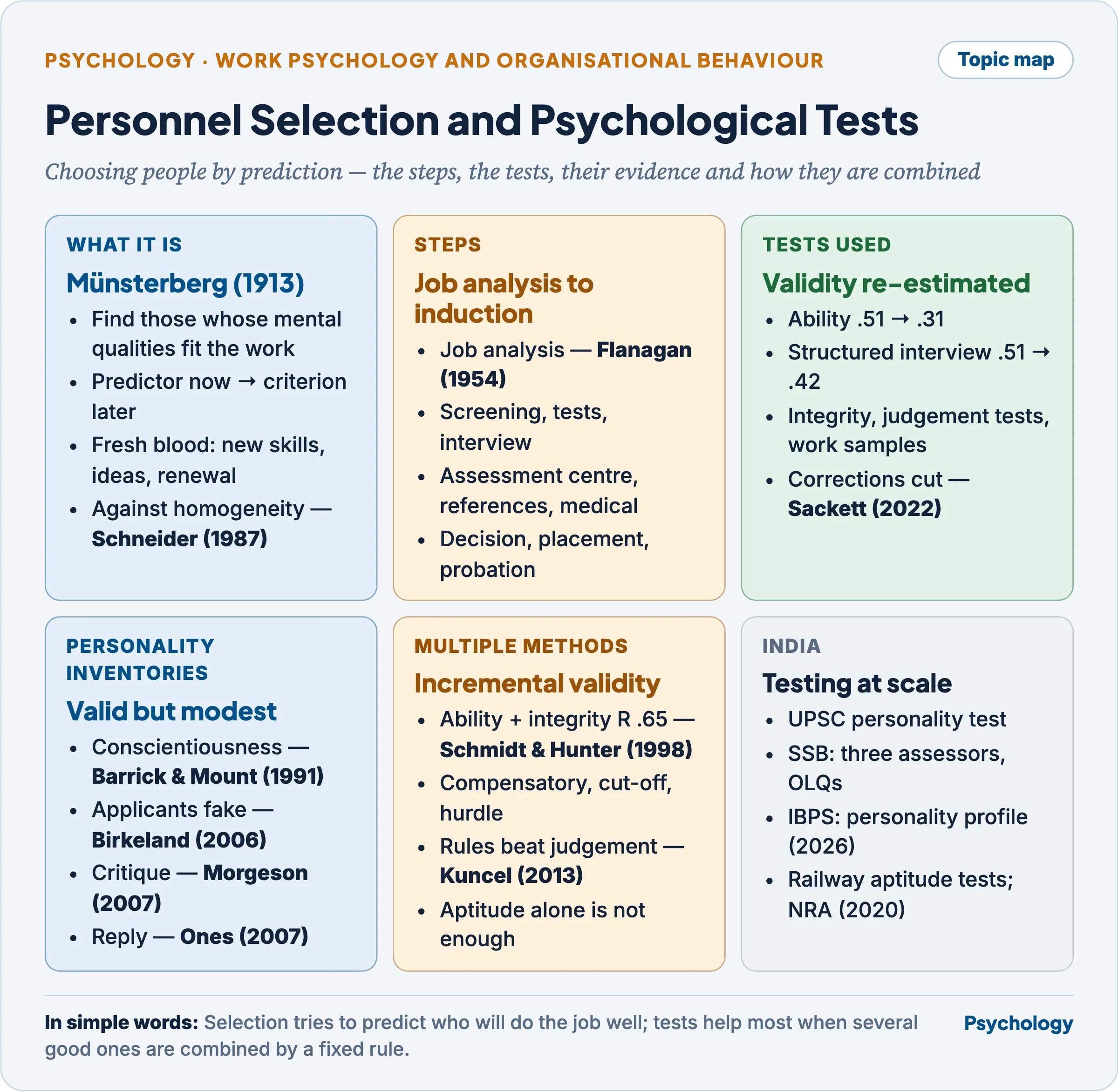
The top row is what selection is and which tests it uses; the bottom row is where the tests fall short and what adds to them.
Personnel selection and training: meaning and purpose
- Personnel selection is choosing, from a pool of applicants, those most likely to succeed, on evidence that predicts later job behaviour. Recruitment builds the pool; selection decides within it; placement assigns those taken to jobs.
- Münsterberg (1913) built an early such test for tram motormen: reaction speed did not separate safe from accident-prone men, so he devised a card task of anticipating pedestrians, horses and cars.
- The logic is a predictor (a score now), a criterion (performance later) and the validity coefficient linking them; the decision framework of Cronbach and Gleser (1957) is in Use, Misuse and Limitations of Psychological Tests (Unit 1).
- Training, the planned building of knowledge and skill after entry, is the complementary route to the same criterion: selection buys what is slow to develop (ability, disposition), training builds the rest (Training and Human Resource Development).
Selection as the infusion of fresh blood
- External selection imports KSAOs (knowledge, skills, abilities and other characteristics) the organisation lacks, new ideas and outside perspective, and replaces people lost to turnover and retirement.
- Schneider (1987) described an attraction–selection–attrition cycle that drifts organisations towards psychological homogeneity; selecting deliberately for missing capacities counters this inbreeding.
- Poor selection costs output, early exits, wasted training and, in safety posts, accidents. Schmidt and Hunter (1998) put the spread of output (SDy) at no less than 40 per cent of mean salary.
- A worker one standard deviation above average produces 19, 32 and 48 per cent more in unskilled, skilled and managerial jobs (Hunter, Schmidt and Judiesch, 1990).
- Huselid (1995) surveyed 968 US firms; his index of high-performance practices included the share of staff tested before hiring.
- A one-standard-deviation rise in the index went with 7.05 per cent lower turnover and $27,044 more sales per employee (Huselid, 1995).
- Limitation: a cross-sectional bundle of practices, so neither selection’s share nor the direction of causation is known.
- Bidwell (2011) found external hires at an investment bank were paid 18–20 per cent more than internal promotees in comparable jobs, rated lower for two years, and more likely to leave.
Steps in employee selection
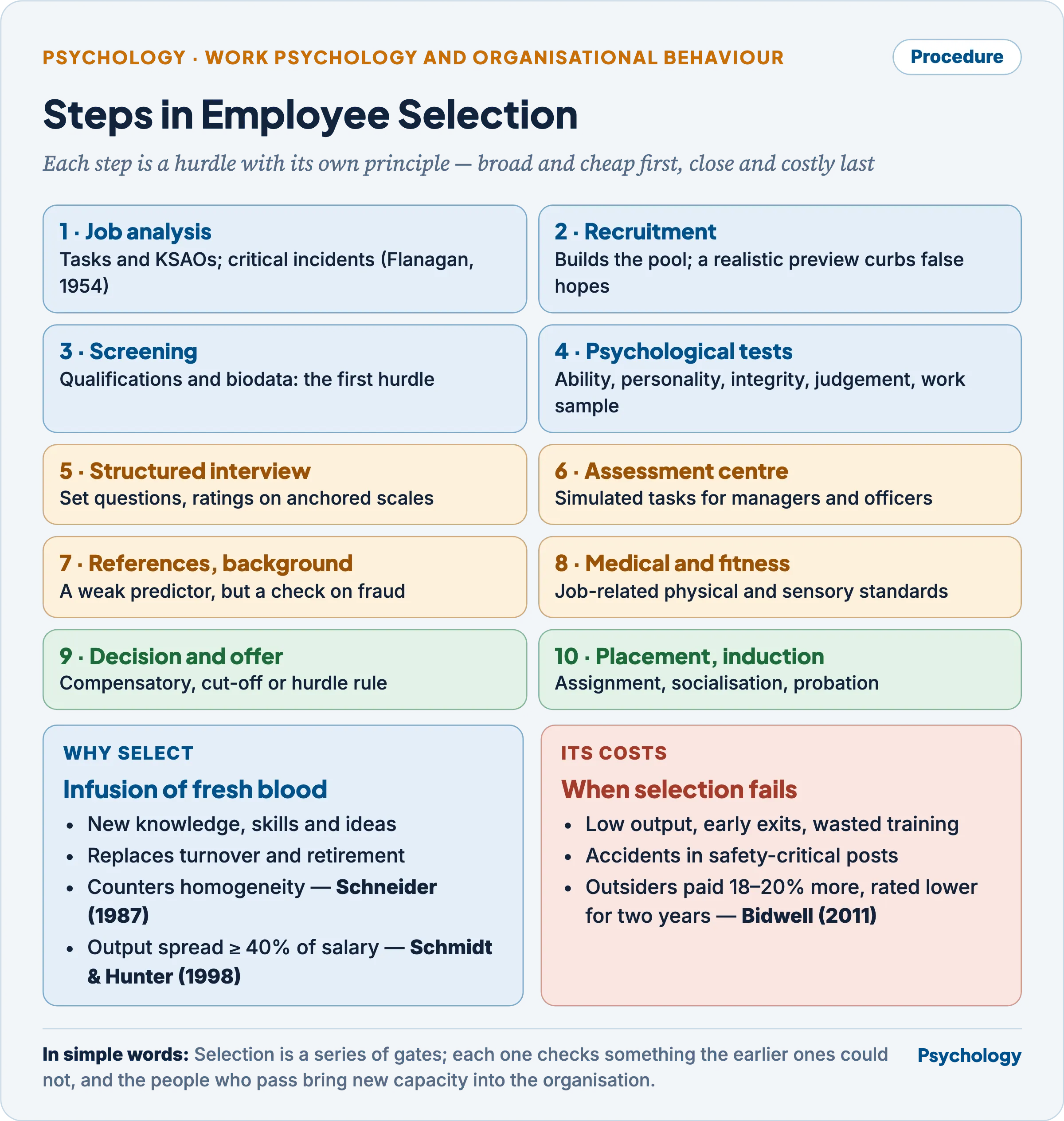
Cheap, broad screens come first and costly, close ones last, so each stage sees fewer people than the one before.
- Job analysis fixes the tasks and KSAOs, by observation, interviews and the critical incident technique (Flanagan, 1954); it supplies the content validity of everything after it.
- Recruitment sets the selection ratio; a realistic job preview lowered inflated expectations and raised self-selection, commitment, satisfaction and job survival across 21 experiments (Premack and Wanous, 1985).
- Screening of applications — minimum qualifications and biographical data, a first hurdle (biodata validity .35; Schmidt and Hunter, 1998).
- Psychological tests — ability, aptitude, personality, integrity, situational judgement, work samples.
- The selection interview, structured in good practice; an assessment centre for managerial and officer posts.
- Reference and background checks, weak predictors (.26; Schmidt and Hunter, 1998) but a check on fraud; then a medical and physical fitness examination.
- The final decision, combining the evidence by a compensatory or hurdle rule.
- Placement and induction — assignment, socialisation and probation.
Use of psychological tests in the industry: why tests matter in selection
- Prediction, including of trainability. Hunter and Hunter (1984), from over 32,000 employees in 515 jobs, put ability-test validity at .58 for professional-managerial, .51 for medium-complexity and .23 for unskilled work.
- Objectivity. Identical items, scoring and norms remove the interviewer’s idiosyncrasy; the unstructured interview is among the weakest common predictors (.38, re-estimated at .19; Sackett, Zhang, Berry and Lievens, 2022).
- Efficiency and fairness. One battery screens lakhs cheaply, gives each applicant the same chance; the legal side is in Ethical Issues in the Use of Psychological Tests (Unit 1).
- Utility. Gain is proportional to validity (Brogden, 1949); Schmidt and colleagues (1979) estimated a valid aptitude test for selecting computer programmers could add hundreds of millions of dollars of output.
- Mass testing began with the verbal Army Alpha and non-verbal Army Beta, devised in 1917 under Yerkes; by January 1919 they had examined 1,726,966 men (Yerkes, 1921).
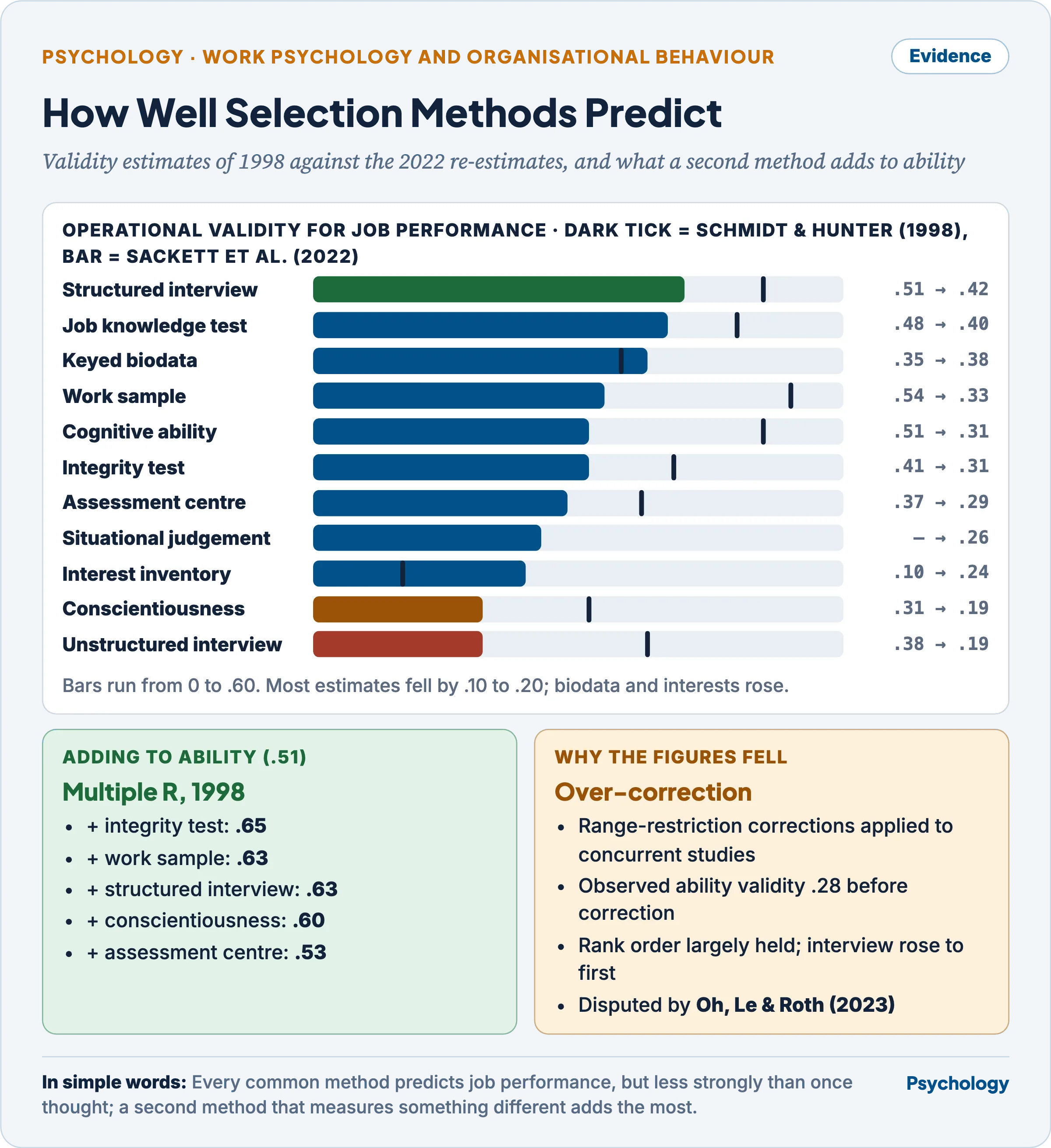
The re-estimates cut most validities by .10 to .20, yet the rank order held and the structured interview rose to first.
- Sackett and colleagues (2022) argued that range-restriction corrections had been over-applied; ability fell from .51 to .31, work samples from .54 to .33, and the structured interview, at .42, became the strongest single procedure.
- The ability database’s mean observed validity was .28 before correction. Oh, Le and Roth (2023) dispute the reasoning; the method is in Validity of Psychological Tests (Unit 1).
Psychological tests generally used in personnel selection
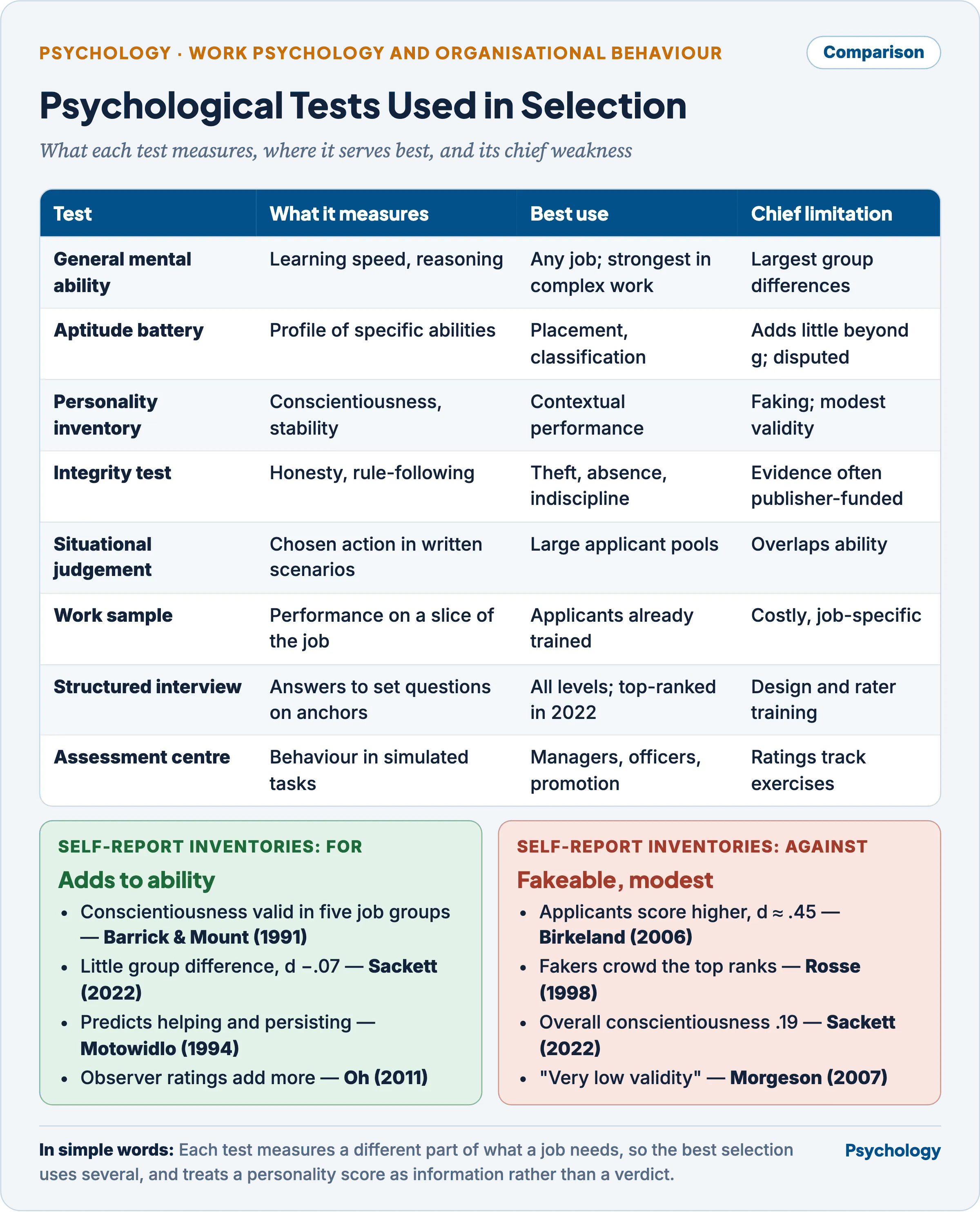
No single test both predicts best and costs least; each trades validity against cost, faking or group differences.
| Test | What it measures | Validity, 1998 → 2022 | Chief limitation |
|---|---|---|---|
| General mental ability | Speed of learning, reasoning | .51 → .31 | Largest group differences |
| Structured interview | Answers to set job questions, rated on anchors | .51 → .42 | Cost of design and training |
| Work sample | Performance on a slice of the job | .54 → .33 | Only for applicants already trained |
| Integrity test | Honesty, rule-following, theft attitudes | .41 → .31 | Publisher-funded evidence |
| Situational judgement | Choice of action in written job scenarios | — → .26 | Correlates with ability |
| Assessment centre | Behaviour in simulated managerial tasks | .37 → .29 | Ratings track exercises, not dimensions |
| Conscientiousness inventory | Dependability, achievement striving | .31 → .19 | Faking |
- Ability and aptitude batteries also yield profiles for placement, as the US Armed Services Vocational Aptitude Battery has done since 1976; the concept is in Aptitude and Its Measurement (Paper I).
- Integrity tests are overt (asking about theft) or personality-based (Sackett, Burris and Callahan, 1989).
- Ones, Viswesvaran and Schmidt (1993), pooling 665 coefficients, put validity at .41 for rated performance; the tests also predict theft, absence and indiscipline.
- Van Iddekinge and colleagues (2012), with 134 samples, found about .15 for performance and .32 for counterproductive behaviour — .27 in publisher studies, .12 in others.
- Situational judgement tests began as the low-fidelity simulation of Motowidlo, Dunnette and Carter (1990); McDaniel and colleagues (2001) found ρ = .34 across 102 coefficients and 10,640 people.
- Structured interviews standardise questions, probing and scoring; Campion, Palmer and Campion (1997) listed 15 components of structure across content and evaluation.
- Assessment centres began with the Management Progress Study at AT&T in 1956 (Bray and Grant, 1966).
- 422 men did an in-basket, a business game, a leaderless group discussion and ability and projective tests; results were withheld so they could not steer promotions (Crooks, 1974).
- Meta-analytic validity was .37 (Gaugler and colleagues, 1987); 74 per cent of the 106 centres they studied included an intelligence test (Schmidt and Hunter, 1998).
- Limitation: Sackett and Dreher (1982) found ratings clustered by exercise rather than by the dimensions assessors meant to rate.
- Projective and type measures play small roles: the TAT (Morgan and Murray, 1935) survives in the Indian officer boards, graphology predicts nothing (.02; Schmidt and Hunter, 1998), and the Myers–Briggs Type Indicator’s own foundation calls screening applicants with it unethical.
Self-report personality inventories in personnel selection: a critical evaluation
The case for
- Barrick and Mount (1991) meta-analysed Big Five scales against three criteria — job proficiency, training proficiency, personnel data — in five occupational groups.
- Conscientiousness predicted every criterion in every group; extraversion predicted for managers and sales; openness and extraversion predicted training proficiency.
- Limitation: even conscientiousness reached only ρ ≈ .20–.23, and the other traits’ coefficients were small; the model is in The Big Five Factor Theory of Personality (Paper I).
- Conscientiousness, nearly uncorrelated with ability, adds prediction: ability alone .51, with conscientiousness .60 (Schmidt and Hunter, 1998).
- It shows almost no US Black–White difference (d = −.07 against .79 for ability; Sackett and colleagues, 2022), easing the validity–diversity trade-off.
- Motowidlo and Van Scotter (1994), rating 421 US Air Force mechanics, found personality predicted contextual performance — helping, persisting, volunteering — better than task performance, which experience predicted better.
- Items framed “at work” do better: contextualised conscientiousness .25 against .19 for general scales (Sackett and colleagues, 2022).
The case against
- Validities are small: general conscientiousness .19, and extraversion, agreeableness and emotional stability near .10 (Sackett and colleagues, 2022).
- Morgeson and colleagues (2007), reporting a panel of five former journal editors, located the core problem in “the very low validity of personality tests for predicting job performance” and urged reconsidering published self-report tests in selection.
- Faking. Birkeland and colleagues (2006), across 33 studies, found applicants scored above non-applicants on conscientiousness (d = .45) and emotional stability (d = .44), most on direct Big Five scales and on traits the job seemed to want.
- Faking concentrates at the top. Rosse and colleagues (1998) found over half the top-ranked applicants had distortion scores suggesting many invented answers — exactly the people top-down selection hires.
- Self-report also depends on self-insight and intrudes on privacy; validity scales and forced choice are in Objective and Self-Report Assessment of Personality (Paper I).
The reply, and a judgement
- Ones, Dilchert, Viswesvaran and Judge (2007) answered that dozens of meta-analyses support personality in staffing and that applicant distortion does little damage to validity.
- Ones, Viswesvaran and Reiss (1996) found social-desirability scales do not predict job performance, and partialling them out leaves personality’s validity intact.
- Oh, Wang and Mount (2011) found observer ratings of the same traits more valid than self-reports, adding prediction over them but not the reverse — the fix is a second source, not abandonment.
- On balance, inventories are valid but modest and add to ability with little adverse impact; they belong contextualised, combined with other methods, never as a lone cut-off.
Is aptitude testing sufficient for selection?
- No. An aptitude score measures what a person can do; performance also depends on what the person will do, on role clarity and on the situation.
- Maier (1955) and Vroom (1964) wrote performance as a multiplicative function of ability and motivation (Theories of Work Motivation: Vroom, Adams’ Equity Theory and Porter-Lawler).
- Van Iddekinge and colleagues (2018), pooling 40–55 samples (N up to 11,283), found the effects additive: the two separately gave about 91 per cent of explained variance, their interaction about 9.
- Single aptitude tests are modest: reviews from Ghiselli (1973) to Boehm (1982) put observed validity against job proficiency near .22 (Schmitt and colleagues, 1984).
- Narrow aptitudes add little beyond general ability: Ree, Earles and Teachout (1994) found g the best predictor across seven Air Force jobs, though Nye and colleagues (2022) contest this.
- Performance has facets aptitude misses — contextual performance (Borman and Motowidlo, 1993) and counterproductive behaviour, which integrity tests predict — and ability tests carry the largest group differences (d = .79; Sackett and colleagues, 2022).
- The other tests to apply: conscientiousness or integrity, an interest inventory (.24; Sackett and colleagues, 2022), a situational judgement test or work sample, a structured interview, psychomotor and medical tests where the job demands them, and background checks.
Multiple methods and the efficacy of personnel selection
- A second method helps in proportion to its validity and its independence of the first, since it samples another facet of the criterion — incremental validity.
- With ability as the base, Schmidt and Hunter (1998) found multiple correlations of .65 with integrity, .63 with a work sample or structured interview, .60 with conscientiousness and .53 with an assessment centre.
- The assessment centre adds little because most centres already contain an ability test.
- Combination rules:
- Compensatory (regression) — a weighted sum in which a high score offsets a low one.
- Multiple cut-off — a minimum on every predictor, all administered.
- Multiple hurdle — sequential stages, cheaper ones first, each a gate.
- Hybrid — hurdles, then a compensatory ranking among survivors.
- The rule changes who is chosen. Kumar (2015) found 87 per cent of 1,306 Indian locomotive drivers passed an aggregate criterion on a five-test battery, but only 41 per cent would pass a cut-off on each test.
- Statistical prediction matches or beats clinical judgement (Meehl, 1954); Kuncel and colleagues (2013) found holistic combination lost validity even in expert hands, mechanical combination improving job-performance prediction by over 50 per cent.
- Utility per hire per year is Δr × SDy × mean standard score of those hired, less cost (Brogden, 1949; Cronbach and Gleser, 1957); usual selection ratios of .30–.70 still pay (Schmidt and Hunter, 1998).
- Limits: diminishing returns once predictors overlap, cost and delay, and applicant reactions — interviews and work samples are rated most favourably; personality, honesty and biodata measures and graphology least (Hausknecht, Day and Thomas, 2004).
- Efficacy rises only when each added method is valid, weakly correlated with the rest, and combined by rule.
Uses and importance of psychological tests in the industry: placement, promotion and training
- Placement and classification — profiles assign recruits to trades.
- Promotion and potential — assessment-centre ratings predict rate of promotion (.36; Gaugler and colleagues, 1987), and the AT&T design became the model for company programmes (Crooks, 1974).
- Training needs and evaluation of training effects — pre- and post-training knowledge tests, work samples and behaviour ratings measure what was learnt and transferred; the evaluation models are in Training and Human Resource Development.
- Attitude and climate surveys — the Job Descriptive Index (Smith, Kendall and Hulin, 1969), the Minnesota Satisfaction Questionnaire (Weiss and colleagues, 1967) and the Organizational Commitment Questionnaire (Mowday, Steers and Porter, 1979).
- Stress audits — the Indian Occupational Stress Index (Srivastava and Singh, 1981), 46 items over 12 subscales; its use belongs to Occupational Stress and Its Management.
- Career counselling and team development, where type indicators are defensible because nothing rides on them.
Criticisms and limitations
- Smaller validities than taught. Sackett and colleagues (2022) cut several classic figures by a third or more, and the usual criterion, supervisory ratings, is itself weak.
- Adverse impact. The most valid battery can exclude groups disproportionately; job-relatedness is in Ethical Issues in the Use of Psychological Tests (Unit 1), diversity in Management of Diversity and Gender Sensitivity (Unit 14).
- The research–practice gap. Highhouse (2008) traced managers’ “stubborn reliance” on intuitive judgement to beliefs in near-perfect prediction and in expertise-sharpened intuition.
- Transportability. Western-normed instruments are used in India without local norms (Use, Misuse and Limitations of Psychological Tests, Unit 1).
- Algorithmic screening learns from past decisions. Dastin (2018) reported Amazon dropped an experimental résumé scorer that downgraded résumés containing “women’s”; New York City’s Local Law 144 of 2021 now requires annual independent bias audits of such tools.
Indian context
- Civil Services personality test (Union Public Service Commission; Examination Notice 05/2026-CSE) — a board interview worth 275 of the final 2,025.
- Its object is “to assess the personal suitability of the candidate for a career in public service by a Board of competent and unbiased observers”, through “a natural, though directed and purposive conversation”.
- Principle: listed qualities such as “balance of judgement”, judged in conversation without a published anchored scale, make it a semi-structured interview.
- Services Selection Boards (Ministry of Defence; tests from the Defence Institute of Psychological Research) — Stage I screens by intelligence and picture-perception tests; Stage II runs psychological tests, group tasks, interview and conference over four days.
- Interviewing officer, group testing officer and psychologist assess Officer Like Qualities “and their trainability”, with equal weight and marks given “holistically” (UPSC Examination Notice 11/2026-CDS-II).
- Principle: a multi-method, multi-assessor assessment centre, though holistic combination is the less valid kind (Kuncel and colleagues, 2013); detail is in Military Psychology: Selection, Training and Counselling of Defence Personnel (Unit 13).
- Common Recruitment Process (Institute of Banking Personnel Selection, independent since 1984; CRP PO/MT-XVI notified 30 June 2026) — preliminary test with a cut-off in each section, main examination, a “Personality Test (self-report)”, then interview, weighted 80:20 with the main examination.
- The personality test is “non-qualifying” but compulsory; the profile is “placed before the Interview panel”.
- Principle: hurdles, then compensatory ranking, with the inventory used as information rather than a cut-off — the use the faking evidence supports.
- Railway safety-category aptitude tests (Ministry of Railways; Psycho-Technical Directorate, Research Designs and Standards Organisation) — computer-based batteries for Station Masters and Assistant Loco Pilots.
- A T-score of 42 is needed on every test, with no reservation-based relaxation for safety posts; the score then enters the merit list 70:30 with the written examination (Railway Recruitment Cell, Chennai, 2026).
- Principle: a multiple cut-off on safety attributes, then a compensatory merit list — a hybrid model.
- Kumar (2015) reported the Directorate’s validation of its computer-aided drivers’ aptitude test for trains at 110 km/h or more.
- Over 74 per cent of drivers rated suitable were graded “A” in independent field appraisal (RDSO report PT-29, 2006); accident-free drivers outperformed those who had passed signals at danger on most attributes (PT-36, 2012).
- Limitation: Kumar (2015) calls such research “scanty and sporadic”; the in-house reports compare known groups rather than follow applicants.
- National Recruitment Agency (Ministry of Personnel; Cabinet approval 19 August 2020) — a computer-based Common Eligibility Test, valid three years, to screen for Group B and C non-technical posts for the SSC, railway boards and IBPS.
- It had held no test by 25 July 2024, when the minister told the Rajya Sabha it was conducting “a detailed study of the prevalent recruitment systems”; the Public Examinations Rules, 2024 also task it with norms for computer-based tests.
- Principle: one standardised first hurdle reused across employers, cutting repeated testing.
- Officer-training wastage before and after the boards, the earliest Indian criterion evidence, is in Validity of Psychological Tests (Unit 1).
Previous Year Questions
- 2022Why is selection considered to be a process of infusion of fresh blood in the organisation? Discuss the steps involved in employee selection.
- 2019“Psychological tests are important in personnel selection.” Give reason to it and describe which psychological tests are generally used.
- 2017Critically evaluate the role of self-report personality inventories in personnel selection.
- 2015Do you think that efficacy of personnel selection can be improved by using multiple methods?
- 2006What do you mean by personnel selection and training? Explain the uses and importance of psychological tests in the industry.
- 2002Enumerate the importance of Personnel Selection and Training in Industries. Describe the more commonly used psychological tests in personnel selection and evaluation of training effects.
- 1998Discuss the uses of psychological testing in selection.
- 1997Is aptitude testing sufficient for determining the suitability of a person for a particular job? If not, mention the other tests that should be applied.