

Official syllabusPaper II · Unit 3 · Therapeutic Approaches
Psychodynamic therapies; Behaviour therapies; Client centered therapy; Cognitive therapies – effectiveness and eclecticism.
Definition
“Psychotherapy is the informed and intentional application of clinical methods and interpersonal stances derived from established psychological principles for the purpose of assisting people to modify their behaviors, cognitions, emotions, and/or other personal characteristics in directions that the participants deem desirable.”
Norcross (1990)
Each school names its own healing mechanism: insight, reconditioning, acceptance or corrected thinking. Outcome research since 1952 has settled that psychotherapy works and that the bona fide schools work about equally well, which turns the question to what they share and how treatment should fit the person.
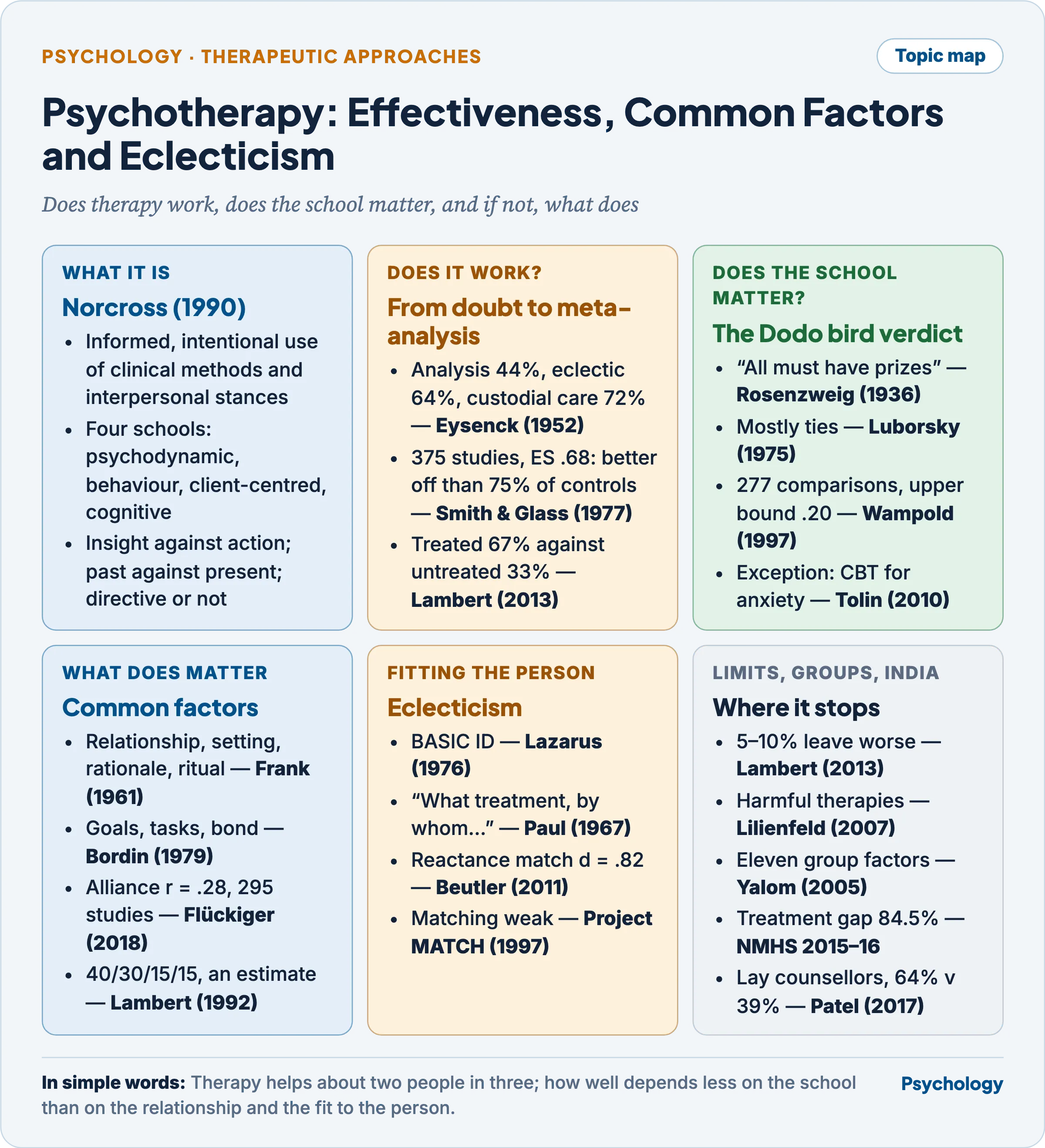
Each box answers the doubt the one before it raises: does therapy work, does the school matter, and if not, what does.
Psychodynamic, behaviour, client centered and cognitive therapies compared
| Dimension | Psychodynamic | Behaviour | Client-centred | Cognitive |
|---|---|---|---|---|
| Problem | Unconscious conflict from early relationships | Learned responses; the symptom is the disorder | Incongruence of self and experience | Distorted appraisals and schemas |
| Goal | Insight, maturer defences | Symptom removal, skills | Congruence, self-acceptance | Corrected thinking and behaviour |
| Therapist | Neutral interpreter of transference | Directive teacher | Non-directive, genuine, empathic | Collaborative but directive |
| Techniques | Free association, interpretation, working through | Exposure, reinforcement, modelling | Reflection, clarification | Socratic questioning, thought records, experiments |
| Duration | Long; brief forms over months | Short | Open-ended | Short |
| Evidence | .59 (Smith and Glass, 1977); equivalent (Steinert et al., 2017) | Desensitisation .91 (Smith and Glass, 1977) | .63; equivalent (Elliott et al., 2021) | Largest base; g = .71 (Cuijpers et al., 2013) |
- Insight against action. Psychodynamic and client-centred therapies change behaviour by changing how the self is experienced; behaviour and cognitive therapies change experience by changing behaviour and thought.
- Past against present. Psychodynamic work reconstructs the past through the transference; the other three work in the here and now.
- Directiveness runs from the non-directive stance of Rogers (1942), through collaborative empiricism (Beck, Rush, Shaw and Emery, 1979), to prescribed exposure. CBT has since absorbed mindfulness, humanistic and psychodynamic elements (Lambert, 2013).
Which is more effective in modern clinical practice
- Wampold and colleagues (1997) meta-analysed 277 direct comparisons of bona fide therapies (1970–1995): differences clustered around zero, with an upper bound of about .20.
- Steinert and colleagues (2017), psychodynamic and CBT researchers together, pooled 23 trials (2,751 patients): psychodynamic therapy was equivalent to established treatments. Shedler (2010) reported a psychodynamic effect of 0.97, rising at follow-up.
- In depression, Driessen and colleagues (2013) randomised 341 outpatients to CBT or short-term psychodynamic therapy: no difference, and remission of only 22.7 per cent.
- Cuijpers and colleagues (2013), across 115 studies, found CBT for depression at g = .71 against controls, .53 after correcting for publication bias, and no better than other psychotherapies or medication.
- The main exception: Tolin (2010), in 26 trials (1,981 patients), found CBT superior to psychodynamic therapy, not to interpersonal or supportive therapy, and only for anxiety and depressive disorders; later depression trials, above, found no gap.
- Hofmann and colleagues (2012), reviewing 106 meta-analyses, found CBT’s strongest support in anxiety disorders, somatoform disorders, bulimia, anger and general stress.
- Elliott and colleagues (2021), across 91 studies, found humanistic therapies equivalent to others (−.08); CBT’s −.26 edge came mainly from CBT-led trials of weak versions.
- The judgement: CBT is the default first line, with the largest evidence and a real edge for anxiety disorders, where exposure is the active ingredient; elsewhere interpersonal, psychodynamic and humanistic therapies are credible equals.
- Each school’s own evidence is in Psychodynamic Therapies, Behaviour Therapies, Client-Centred Therapy and Cognitive Therapies: Beck and Cognitive-Behavioural Therapy.
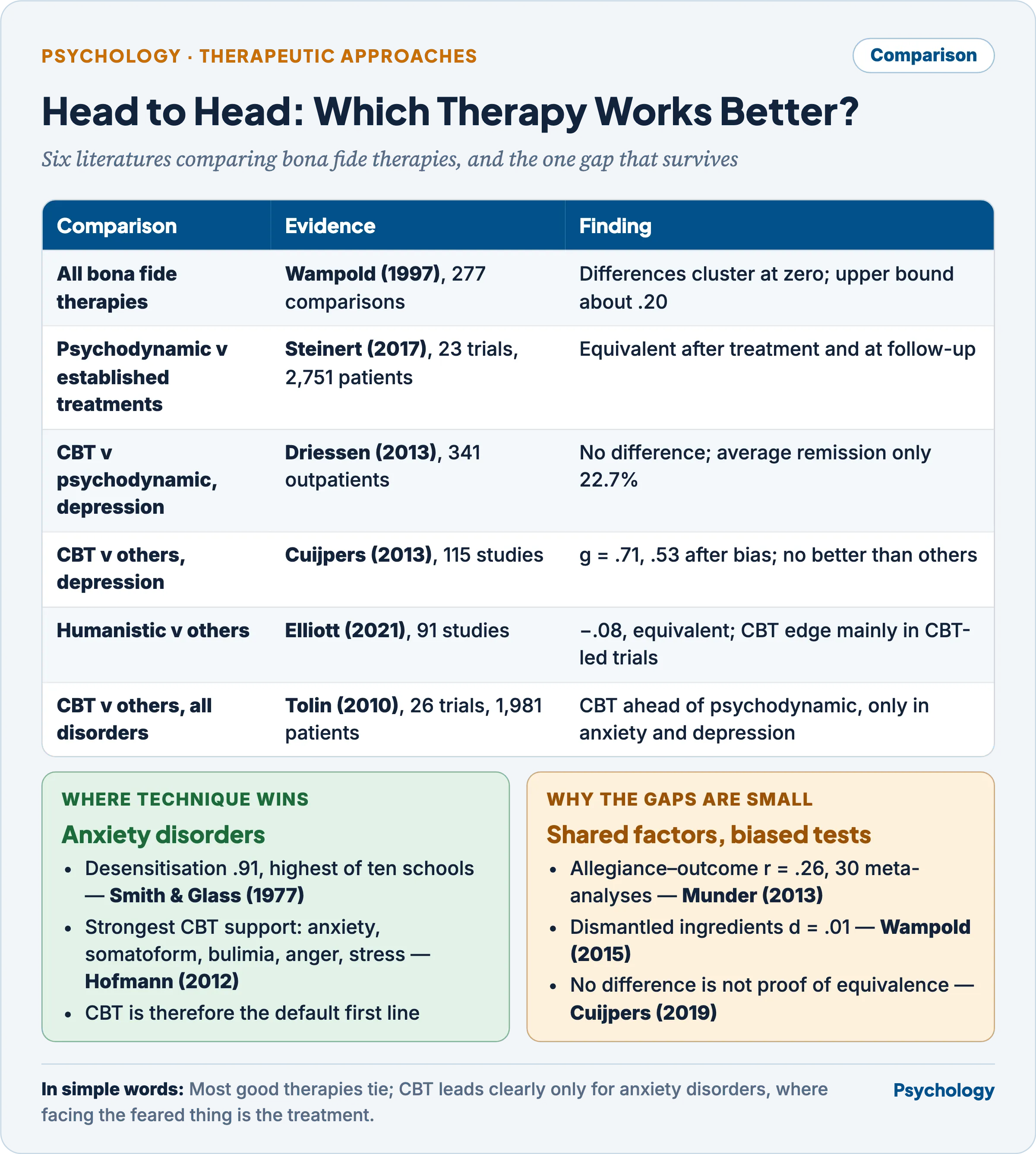
Almost every head-to-head literature ends in a tie; the gap that survives is CBT’s edge for anxiety disorders.
Spontaneous remission and the effectiveness of psychotherapy
- Spontaneous remission is improvement without formal treatment, through a disorder’s natural course, life events and informal help. It is the baseline any therapy must beat.
Eysenck’s challenge
- Eysenck (1952) pooled 19 studies covering over 7,000 neurotic patients.
- Improvement: psychoanalysis 44 per cent (about 66 counting completers only), eclectic therapy 64 per cent (Eysenck, 1952).
- Baselines: 72 per cent in mainly custodial state hospitals (Landis, 1938); among 500 disability claimants given sedatives and reassurance by general practitioners, 72 per cent recovered within two years (Denker, 1946).
- Conclusion: about two-thirds of neurotics improve markedly within two years, treated or not, so the figures “fail to prove that psychotherapy, Freudian or otherwise, facilitates the recovery of neurotic patients.”
- Limitations: no randomised controls; baselines not comparable; improvement criteria differed; reassurance was itself psychotherapy; drop-outs were scored as failures.
- Bergin (1971) put improvement after psychoanalytic therapy at about 85 per cent for completers, and Lambert (1976) put untreated improvement nearer 40 per cent (Lambert, 2013).
- McNeilly and Howard (1991), using Eysenck’s own data, found 50 per cent improved within eight sessions against 2 per cent untreated; 15 sessions achieved what two untreated years did (Lambert, 2013).
Spontaneous remission in mental illness today
- Whiteford and colleagues (2013), pooling 19 studies of untreated depression, estimated that primary-care adults remit at 23 per cent within three months, 32 within six and 53 within twelve; less in wait-listed and older samples.
- Why it happens: episodic illnesses lift; people seek help at their worst, so scores regress to the mean; family, faith and physicians help informally; and hope restores morale (Frank, 1974).
- Indian control arms show it: 39 per cent of enhanced-usual-care patients remitted within three months in the Healthy Activity Program trial (Patel and colleagues, 2017), and MANAS private-clinic controls recovered as often as the treated (Patel and colleagues, 2010).
- Implications: untreated and attention-placebo controls are mandatory; a short wait is defensible in mild depression, not in severe illness (Whiteford and colleagues, 2013).
Does psychotherapy work: meta-analysis
- Smith and Glass (1977) introduced meta-analysis to the question: 375 controlled studies, 833 effect sizes.
- Mean effect 0.68: the average treated client was better off than 75 per cent of untreated controls (Smith and Glass, 1977).
- Therapy type explained a tenth of the variance; where behavioural and non-behavioural therapies faced one control group, their effects were “about the same.”
- Limitation: Eysenck (1978), “an exercise in mega-silliness”: pooling good and bad studies is “garbage in—garbage out”.
- Across later meta-analyses the treated–untreated effect is about d = .75, success 67 against 33 per cent (Lambert, 2013).
The Dodo bird verdict
- Rosenzweig (1936) borrowed Lewis Carroll’s line, “At last the Dodo said, ‘Everybody has won, and all must have prizes,'” arguing that implicit common factors make diverse methods equally effective.
- Luborsky, Singer and Luborsky (1975) found most comparative studies were ties and declared the Dodo right; equivalence of outcome has since been called the Dodo bird verdict, and Wampold and colleagues (1997) confirmed it for bona fide therapies.
- Critics answer on four counts.
- Specificity is real in places: CBT for anxiety (Tolin, 2010); behaviour therapies such as exposure and response prevention beat non-behavioural ones for obsessive-compulsive disorder, generalised anxiety and specific phobia (Lilienfeld, 2007).
- Taken literally it lets any therapy suit any problem, yet some harm (Lilienfeld, 2007).
- Allegiance distorts comparisons: across 30 meta-analyses it correlated with outcome at r = .26 (Munder and colleagues, 2013).
- No detected difference is not proof of equivalence (Cuijpers and colleagues, 2019).
Why no single form of therapy works best for every problem
The common factors
- Frank (1961), in Persuasion and Healing, found four components shared by all psychotherapies and by religious and folk healing.
- An emotionally charged, confiding relationship with a helper.
- A healing setting.
- A rationale or myth that plausibly explains the symptoms.
- A ritual or procedure both parties believe will cure.
- Frank (1974) added the demoralisation hypothesis: people seek therapy when they lose hope of coping, and every school works partly by restoring morale.
- Lambert (1992) apportioned improvement as 40 per cent extratherapeutic (client and life) factors, 30 common factors such as the relationship, 15 expectancy and 15 technique — inferred from his narrative review, not computed statistically.
- Wampold (2015), in the contextual model, traced three pathways: the real relationship; expectations created by a convincing explanation; and specific ingredients that prompt healthy action.
- Alliance d = .57, empathy .63, cultural adaptation .32, expectations .24; against these, treatment differences at most .20 and dismantled ingredients .01 (Wampold, 2015).
- The working alliance (Bordin, 1979) is agreement on goals, assignment of tasks and a bond.
- Across 295 studies and over 30,000 patients it correlated with outcome at r = .278, across orientations and countries (Flückiger and colleagues, 2018).
- Repairing alliance ruptures related to outcome at r = .29 in 11 studies (Eubanks, Muran and Safran, 2018).
- The core conditions of Rogers (1957) are treated in Client-Centred Therapy.
- Limitation: alliance research is correlational, early improvement may build the alliance, and no common or specific factor yet meets causal criteria (Cuijpers and colleagues, 2019).
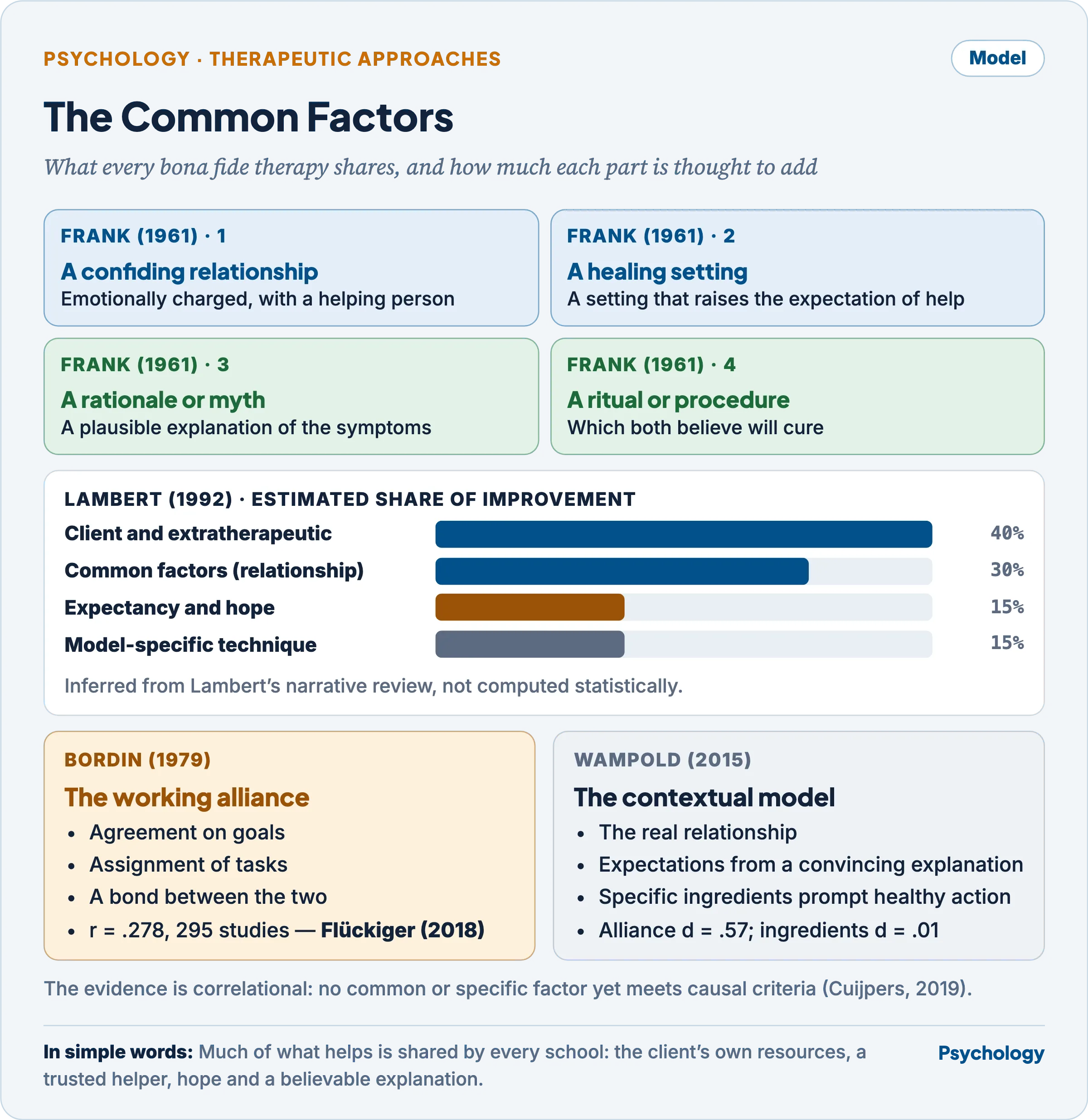
Frank’s four elements are present in every school; what differs between schools is mostly the ritual.
Why one therapy cannot suit every problem
- Shared factors carry more outcome variance than school-specific technique (Wampold, 2015).
- Problems differ in what maintains them: avoidance maintains phobia, so exposure works; distorted appraisal maintains depression; repeated relational patterns maintain personality problems.
- Persons differ: highly reactant clients do better with non-directive and low-reactant clients with directive therapy, d = .82 across 12 studies (Beutler and colleagues, 2011).
- Readiness differs: Prochaska and DiClemente (1983) described stages from precontemplation to maintenance, each needing different processes.
- Problems are multimodal, so a single technique treats one modality and leaves the rest (Lazarus, 1976).
Eclecticism and integration as the answer
- Eclecticism selects techniques from several schools by what suits the case; integration combines the theories. Norcross and Goldfried (2005) name four routes: technical eclecticism, theoretical integration, common factors and assimilative integration.
- Lazarus (1967) coined technical eclecticism: use a technique that works without adopting its theory. His multimodal therapy (Lazarus, 1976) assesses BASIC ID: Behaviour, Affect, Sensation, Imagery, Cognition, Interpersonal relationships, Drugs or biology.
- A socially anxious student avoids seminars (graded exposure), dreads them (relaxation), has palpitations (breathing control) and pictures humiliation (coping imagery).
- She thinks “they will see I am stupid” (restructuring), has few friends (social-skills practice) and drinks much coffee (cut caffeine, medical review).
- Theoretical integration: Dollard and Miller (1950) recast psychoanalytic conflict and repression in the language of learning theory; Wachtel (1977) joined psychodynamic and behaviour therapy, the basis of his cyclical psychodynamics.
- Transactional analysis (Berne, 1961) integrated early: psychoanalytic ego states translated into observable transactions and worked through explicit treatment contracts.
- Systematic treatment selection (Beutler, Consoli and Lane, 2005) prescribes by patient dimensions, such as coping style and reactance, rather than by school.
- Practice is mixed: about 55 per cent of United States clinical psychologists called themselves eclectic (Garfield and Kurtz, 1976); the largest group of eclectics meant choosing the best method for each client (Norcross and Prochaska, 1988).
- Criticisms.
- Mixing has not beaten single schools: eclectic therapies scored .48, below every school but Gestalt (Smith and Glass, 1977).
- Unsystematic borrowing becomes syncretism, a mixture without a formulation, untestable and demanding many competences.
- Matching is weak: Project MATCH (1997) assigned 1,726 alcohol-dependent clients to three therapies, and of ten matching variables only psychiatric severity interacted with treatment.
Knowing the person who has the disease: implications for psychotherapy
- The aphorism is credited to Hippocrates but appears in no Hippocratic text; its earliest close form is an 1899 London medical lecture, and from 1902 it was credited, without evidence, to the physician Walter Moxon.
- Paul (1967) gave it research form: “What treatment, by whom, is most effective for this individual with that specific problem, and under which set of circumstances?”
- Agreement is largely justified, in each of the three domains.
- Diagnosis: one label hides many persons; 3,703 depressed outpatients showed 1,030 distinct symptom profiles (Fried and Nesse, 2015), so the label alone cannot say what to treat.
- Treatment: client and extratherapeutic factors carry the largest share of change (Lambert, 1992), and the alliance and the person’s reactance shape outcome more than the school (Flückiger and colleagues, 2018; Beutler and colleagues, 2011).
- Prognosis: motivation, social network and sociopathy predicted drinking outcomes whichever therapy was given (Project MATCH, 1997).
- Therapists prefer the YAVIS client — young, attractive, verbal, intelligent, successful (Schofield, 1964) — and such selected patients improve more readily anyway (Eysenck, 1978).
- The qualification: the disease still decides the family of treatment — exposure for phobia, medication for psychosis and mania — and matching on the person rarely beats prognosis (Project MATCH, 1997).
- Implications for psychotherapy.
- Case formulation over diagnosis: why this person has this problem now.
- Evidence-based practice in psychology is “the integration of the best available research with clinical expertise in the context of patient characteristics, culture, and preferences” (APA Presidential Task Force, 2006).
- Adapt the explanation: culturally adapted therapy beat unadapted bona fide therapy by d = .32, adapting the illness myth being the only moderator (Benish, Quintana and Wampold, 2011).
- Track each person: told their clinic’s 8 per cent deterioration rate, therapists still flagged only 3 of 550 clients as likely to fail (Hannan and colleagues, 2005), so outcome feedback is needed.
The limits of psychotherapeutic methods: criticisms
- About a third of treated patients do not improve (Lambert, 2013); in routine care only about a third improve, over roughly four sessions (Hansen, Lambert and Forman, 2002).
- Bergin (1966) described a deterioration effect: some clients get worse. Five to 10 per cent of adults in trials leave worse off, and up to 14 per cent in some routine settings (Lambert, 2013).
- Lilienfeld (2007) listed potentially harmful therapies: critical incident stress debriefing, Scared Straight, recovered-memory techniques, rebirthing, and grief counselling for normal bereavement.
- One client in five drops out: 19.7 per cent across 669 studies (Swift and Greenberg, 2012).
- Severe mental illness sets a ceiling: psychotherapy is an adjunct to medication in schizophrenia and bipolar disorder, and psychodynamic treatment of schizophrenia may harm (Lilienfeld, 2007).
- The evidence is biased by publication (Cuijpers and colleagues, 2013) and allegiance (Munder and colleagues, 2013), and trial samples are more selected than routine patients.
- Talking therapies suit the verbal YAVIS client (Schofield, 1964) and Western individualism, so collectivist clients need adaptation (Benish, Quintana and Wampold, 2011); value imposition and dependency are standing ethical risks.
Group therapy
- Group therapy treats several clients together with one or two therapists, using members’ interaction as the instrument of change; the group becomes a social microcosm in which each member’s interpersonal style reappears (Yalom and Leszcz, 2005).
- Chief features: planned membership; regular meetings under confidentiality and norms; a here-and-now focus; cohesion as the group’s alliance; and economy. Formats range from psychodynamic and cognitive-behavioural groups to psychodrama and self-help.
- Yalom and Leszcz (2005) list eleven therapeutic factors:
- Instillation of hope, universality, imparting information, altruism, corrective recapitulation of the primary family group, development of socialising techniques.
- Imitative behaviour, interpersonal learning, group cohesiveness, catharsis, existential factors.
- Berne (1958) introduced transactional analysis as “a new and effective method of group therapy”, analysing members’ Parent, Adult and Child transactions and the games they replay; it scored .58 (Smith and Glass, 1977).
- Groups match individual therapy across disorders (Rosendahl and colleagues, 2021), and cohesion correlated with outcome at r = .26 across 55 studies (Burlingame, McClendon and Yang, 2018).
- Neurotic, anxiety-based conditions suit it best.
- Social anxiety disorder, the group being a live audience: across 36 trials cognitive-behavioural groups gave g = 0.84 against wait-list and equalled individual therapy (Barkowski and colleagues, 2016).
- Panic, agoraphobia and generalised anxiety, where universality counters shame; depression, through hope and altruism; adjustment and psychosomatic complaints. The disorders are in Anxiety Disorders: Types and Causal Factors.
- Poor candidates for a heterogeneous outpatient group are the acutely psychotic, paranoid, sociopathic, brain-damaged and addicted (Yalom and Leszcz, 2005).
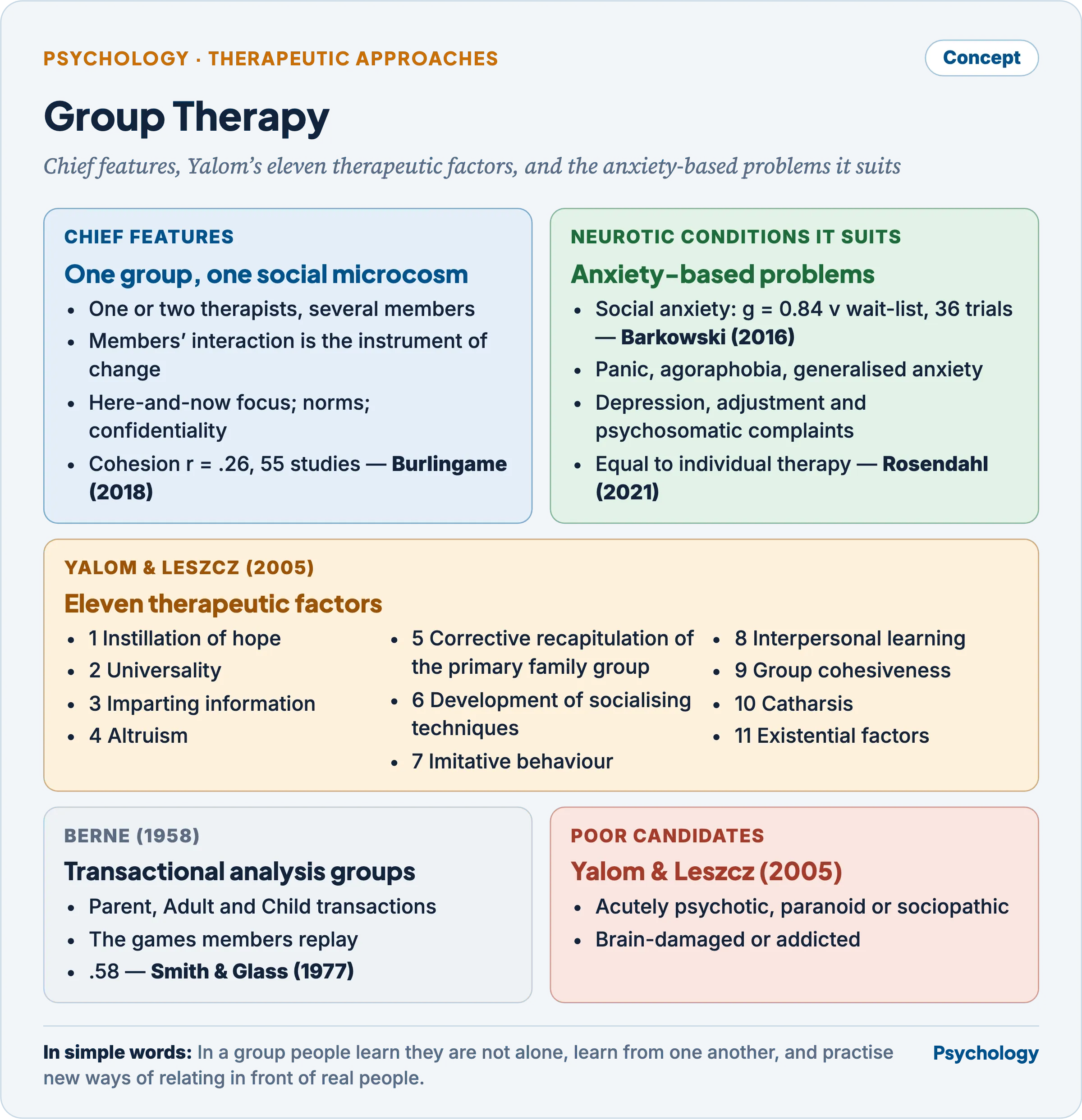
Most of the eleven factors need other people to operate, which is why a group can do what individual therapy cannot.
Indian context
- The National Mental Health Survey (2015–16) (NIMHANS, Ministry of Health and Family Welfare) found current mental morbidity of 10.56 per cent among 34,802 adults and a treatment gap of 84.5 per cent (Gautham and colleagues, 2020).
- The Parliamentary Standing Committee (2023) on Health and Family Welfare, in its 148th report, counted 0.75 psychiatrists per lakh, about 9,000; the Rehabilitation Council of India’s register held 3,795 clinical psychologists on 31 March 2024 (Rehabilitation Council of India, 2024).
- Patel and colleagues (2010), the MANAS trial, randomised 24 Goa primary-care facilities (2,796 adults) to lay-counsellor stepped care or usual care.
- Recovery at six months was 65.0 against 52.9 per cent overall and 65.9 against 42.5 in public clinics, with no effect in private ones (Patel and colleagues, 2010).
- Patel and colleagues (2017), the Healthy Activity Program, gave 495 adults with moderately severe to severe depression behavioural activation from lay counsellors: remission 64 against 39 per cent at three months.
- Nadkarni and colleagues (2017), Counselling for Alcohol Problems, randomised 377 male harmful drinkers: remission at twelve months 54.3 against 31.9 per cent, its effect mediated by readiness to change.
- Singla and colleagues (2017), across 27 non-specialist trials in low- and middle-income countries, found a pooled effect of 0.49 from a few common elements — engagement plus behavioural, interpersonal, emotional and cognitive strategies — common factors in practice.
- Neki (1973) proposed the guru–chela relationship as an Indian therapeutic paradigm, in which dependence on a directive, caring guide is accepted as part of treatment rather than interpreted as resistance.
- Kakar (1982) found at the Balaji temple and other Indian healing sites that giving illness a meaning and involving the family were central to cure — Frank’s rationale and setting in Indian form.
- Mental Healthcare Act, 2017, Section 18 (Ministry of Health and Family Welfare) — “Every person shall have a right to access mental healthcare and treatment from mental health services run or funded by the appropriate Government”; it makes effective therapy an entitlement, operationalising access.
- Tele-MANAS (Ministry of Health and Family Welfare, 10 October 2022; helpline 14416) — 53 cells across all 36 States and UTs, 47,75,644 calls (PIB, 9 October 2026); with the District Mental Health Programme (1996; 767 districts) it operationalises stepped care, brief counselling first.
Previous Year Questions
- 2026Compare and contrast psychodynamic, behavioural and cognitive therapies. Which is more effective in modern clinical practice?
- 2025Explain spontaneous remission effect in the treatment of patients with mental illness.
- 2019Why no single form of therapy works best for every problem? How an eclectic approach is an answer to it?
- 2010‘In diagnosis, treatment and prognosis, it is more important to know which person has the disease rather than the disease he has.’ Express your agreement or otherwise with the statement with justifications and discuss its implications for Psychotherapy.
- 2009Comment on the limits of psychotherapeutic methods.
- 1996Describe the chief features of group therapy and also mention the neurotic behaviour on which it can be used.