

Official syllabusPaper II · Unit 3 · Therapeutic Approaches
Fostering mental health.
Definition
“Like health promotion, mental health promotion involves actions that support people to adopt and maintain healthy lifestyles and which create supportive living conditions or environments for health.”
Herrman, Saxena and Moodie (2004)
Fostering mental health means building the capacities and conditions that keep people well, rather than waiting to treat disorder once it appears. It runs from one adolescent’s skills to a decision a village takes together, and its evidence is younger and thinner than therapy’s, so its claims need scrutiny.
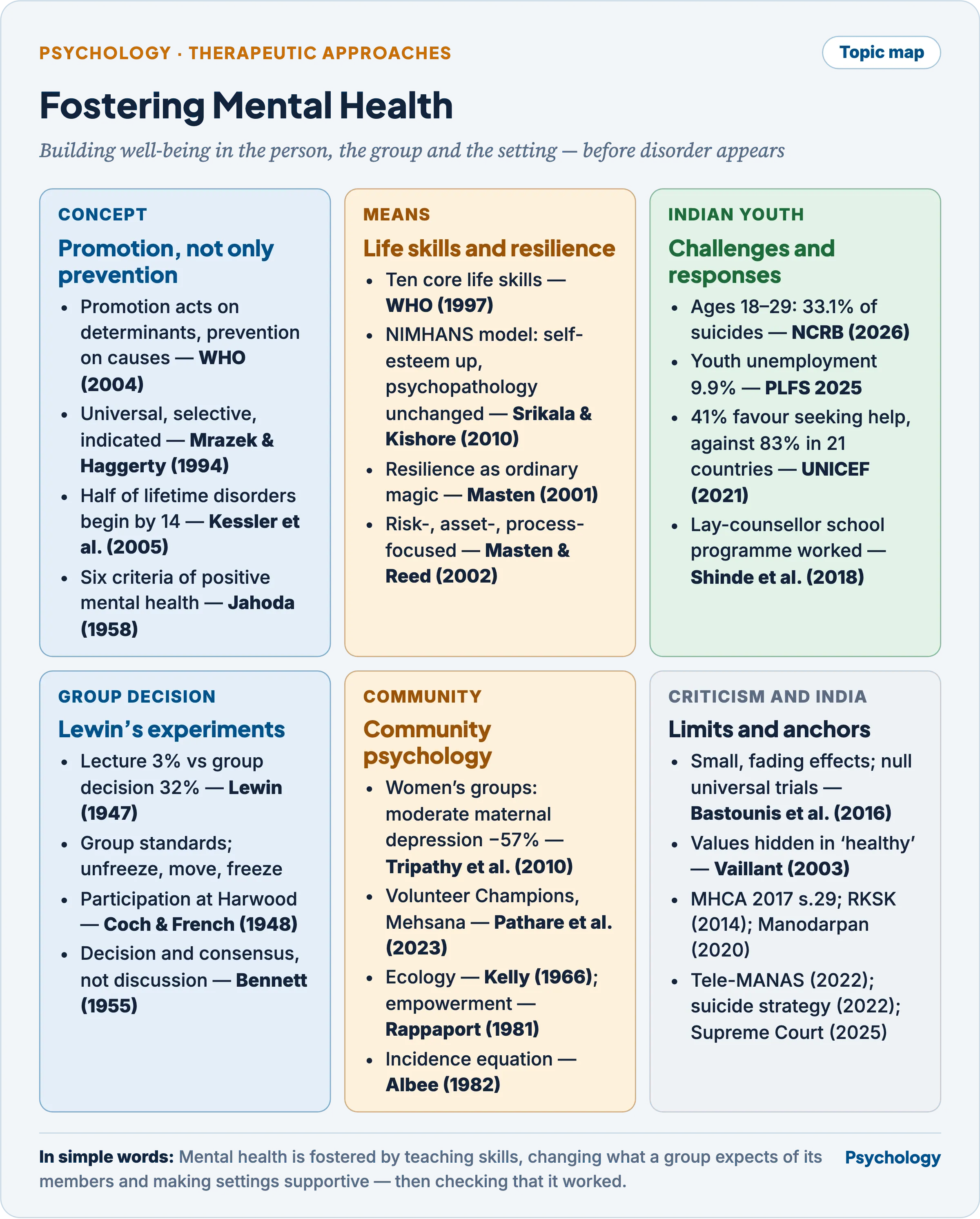
Every route works on three things at once: the person’s skills, the group’s standard and the setting.
Fostering mental health: promotion as distinct from prevention
- The World Health Organization (2004) report edited by Herrman, Saxena and Moodie fixed the current framing: prevention of mental disorders and promotion of mental health are “distinct but overlapping aims”.
- Mental health promotion works on the determinants of health and on positive outcomes — well-being, competence, resilience — for whole populations, the well included.
- Prevention works on the causes of disease, to cut the incidence of new cases by reducing risk.
- Prevention is graded by target as universal, selective and indicated (Gordon, 1983; Mrazek and Haggerty, 1994), succeeding Caplan’s (1964) primary, secondary and tertiary levels, set out in Prevention and Rehabilitation of the Mentally Ill.
- Promotion needs its own case because illness and health are separate axes: removing symptoms does not by itself produce flourishing (Keyes, 2002), as developed in Health, Ill-Health, Positive Health and Well-Being (Unit 2).
- It must start early. In a US national survey, Kessler and colleagues (2005) found that half of all lifetime cases begin by age 14 and three-quarters by 24 — the school and college years.
- The Ottawa Charter (WHO, 1986) supplies the action frame: build healthy public policy, create supportive environments, strengthen community action, develop personal skills and reorient health services.
| Promotion | Prevention | Treatment | |
|---|---|---|---|
| Target | Everyone, the well included | People at risk, or all exposed to a risk | People with a disorder |
| Aim | Raise well-being and competence | Cut new cases | Relieve symptoms, restore function |
| Works on | Skills, settings, policy | Risk and protective factors | The disorder |
| Outcome measured | Well-being, coping, school climate | Incidence, suicide attempts | Remission, relapse |
| Indian example | Life-skills education in schools | Suicide-means restriction (NSPS, 2022) | District Mental Health Programme clinics |
Positive mental health: what is to be fostered
- Jahoda (1958), in Current Concepts of Positive Mental Health, named six criteria — the targets of promotion:
- Attitudes towards the self — self-acceptance, a correct self-concept, a sense of identity.
- Growth, development and self-actualisation — investment in living.
- Integration — a unifying outlook and resistance to stress.
- Autonomy — regulation of behaviour from within and independence from social influences.
- Perception of reality — relative freedom from need-distortion, and empathy.
- Environmental mastery — adequacy in love, work, play and problem-solving.
- The WHO (2022) definition adds a social clause: mental health enables people to “contribute to their community”, so fostering it is partly a community task.
- Limitation: the criteria are value-laden. Vaillant (2003) warned of “the two-fold danger of contamination by values”; autonomy as independence suits individualist cultures more than the interdependent Indian self described in Culture, Child-Rearing and the Indian Self (Paper I).
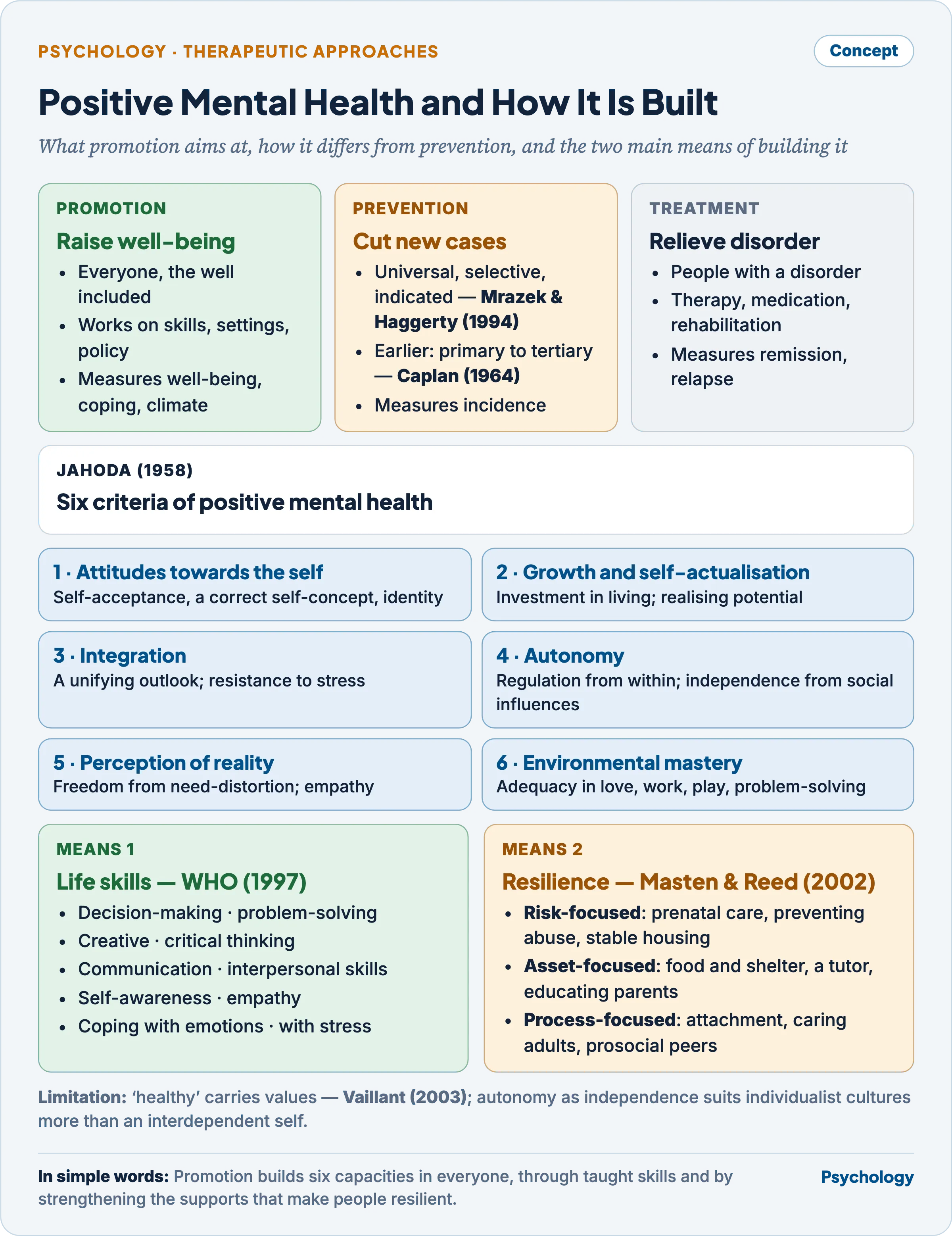
Promotion aims at Jahoda’s six capacities; life skills and resilience strategies are the means of building them.
Ways of fostering mental health: life skills and resilience
- Life skills are “abilities for adaptive and positive behaviour that enable individuals to deal effectively with the demands and challenges of everyday life” (WHO, 1997).
- Ten core skills in five pairs: decision-making and problem-solving; creative and critical thinking; communication and interpersonal skills; self-awareness and empathy; coping with emotions and with stress.
- Srikala and Kishore (2010) evaluated the NIMHANS life-skills model, taught weekly by trained teachers in 261 Karnataka secondary schools.
- Design: 605 adolescents after a year in the programme against 423 matched pupils from schools without it.
- Programme pupils reported higher self-esteem and self-efficacy, better adjustment with teachers and school, and more prosocial behaviour (Srikala and Kishore, 2010).
- No difference in psychopathology, or in adjustment at home and with peers.
- Limitation: no baseline, a non-randomised comparison group, self-report scales.
- Resilience is positive adaptation despite significant adversity. Masten (2001) called it ordinary magic: it grows from common protective systems — attachment, self-regulation, competent schools — so it can be built.
- Masten and Reed (2002) sorted strategies for fostering it into three kinds:
- Risk-focused — reduce exposure to adversity: prenatal care, preventing abuse, stable housing.
- Asset-focused — add resources: food and shelter, a tutor, educating parents.
- Process-focused — mobilise adaptive systems: secure attachment, bonds with caring adults and prosocial peers, chances to succeed.
- The trials temper the promise. The Penn Resiliency Program beat no-intervention controls slightly and active controls not at all (Brunwasser, Gillham and Kim, 2009); nine universal trials showed no effect (Bastounis and colleagues, 2016).
- These trials and school well-being curricula are set out in Factors Influencing Positive Health, Well-Being, Lifestyle and Quality of Life (Unit 2).
Challenges to the mental health of Indian youth
- The National Mental Health Survey (NIMHANS, 2016) found mental morbidity in 7.3 per cent of 13–17-year-olds, rising to 13.5 per cent in urban metros against 6.9 per cent in rural areas.
- Accidental Deaths and Suicides in India 2024 (NCRB, May 2026) recorded 1,70,746 suicides; ages 18 to under 30 formed the largest share (33.1 per cent), and students numbered 14,488, up 4.3 per cent on 2023.
- Caution: police records lack a student denominator, and at 18–29 examination failure was the recorded cause in 1.6 per cent of suicides, family problems in 33.2 per cent (Dandona, Kumar and Sagar, 2026).
- Academic pressure. High-stakes examinations and coaching-hub competition tie self-worth to outcomes the student cannot control — the condition for helplessness traced in Escape, Avoidance and Learned Helplessness (Paper I). Examination failure was recorded in 1,071 under-18 suicides (NCRB, 2026).
- Unemployment and stalled transitions. Youth (15–29) unemployment was 9.9 per cent in 2025 and 13.6 per cent in urban areas; 25.0 per cent were in neither work, education nor training (PLFS, MoSPI, 2026).
- Jahoda (1982) explained the harm through latent deprivation: work supplies time structure, social contact, collective purpose, status and regular activity, and losing it removes all five.
- Substance use. Among 10–17-year-olds, 1.3 per cent used alcohol, 1.8 per cent opioids and 1.17 per cent inhalants — the one substance commoner in children than adults (Magnitude of Substance Use in India, 2019).
- Digital life. Cyberbullying, sleep loss, social comparison and compulsive gaming; NIMHANS opened its SHUT clinic (Service for Healthy Use of Technology) in 2014. Yet technology use explained at most 0.4 per cent of variance in adolescent well-being (Orben and Przybylski, 2019).
- Relationships, family and identity. Family problems (3,101) and love affairs (1,671) outranked examination failure among recorded causes of under-18 suicides (NCRB, 2026); caste, gender and sexual-minority discrimination add minority stress.
- Stigma and silence. Only 41 per cent of Indians aged 15–24 thought it good to seek support for mental health problems, against 83 per cent across 21 countries (UNICEF, 2021); the treatment gap is 70–92 per cent (NIMHANS, 2016).
Ways a psychologist would foster the mental health of Indian youth
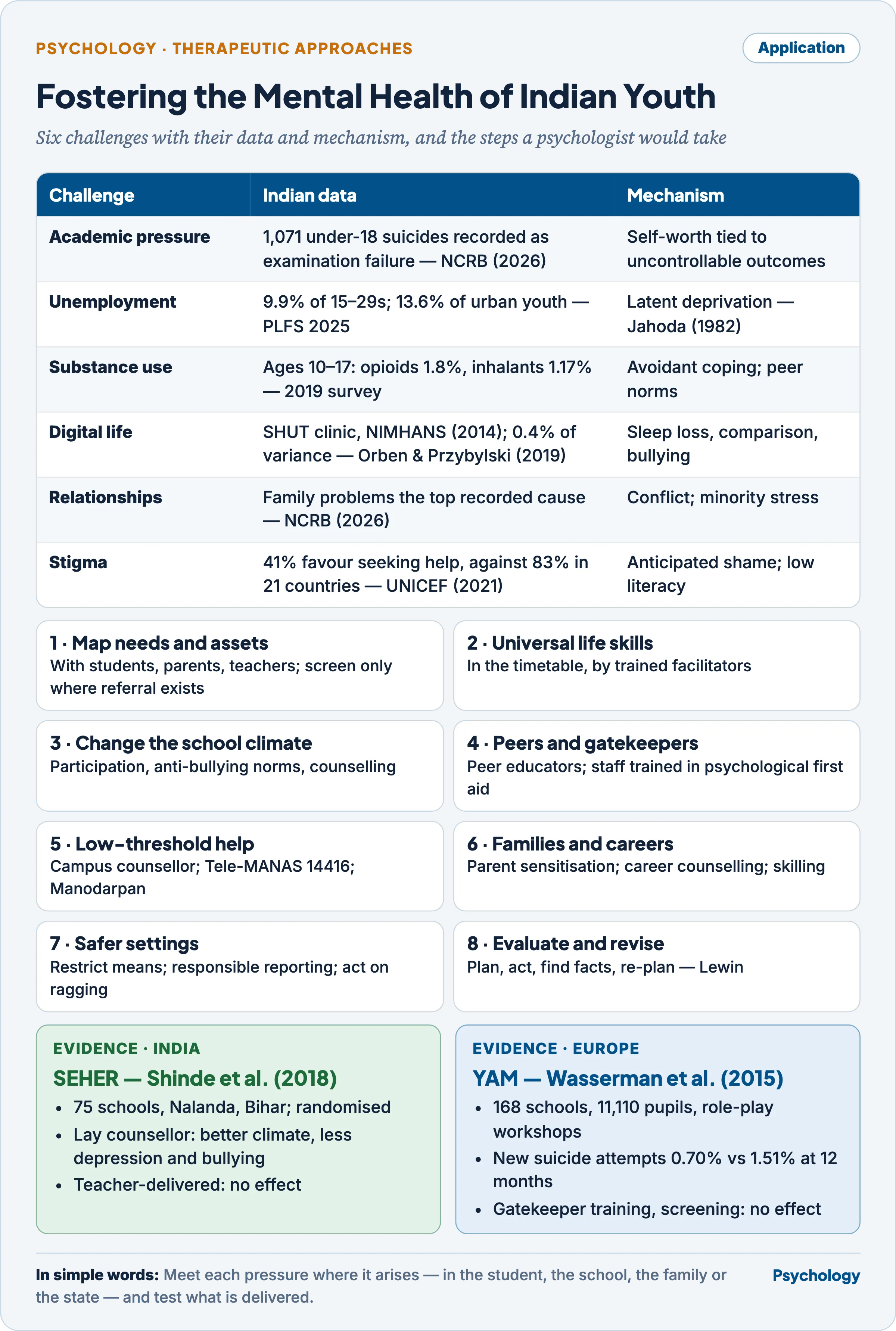
Each pressure arises at a different level — student, institution, family or state — and each step answers one of them.
- A worked plan, built from the evidence below, moves through eight steps:
- Map needs and assets with students, parents and teachers; screen only where a referral route exists.
- Teach life skills universally inside the timetable, by trained and supervised facilitators.
- Change the school climate, not only the pupil — participation, anti-bullying norms, counselling.
- Build a peer and gatekeeper layer: trained peer educators, and staff trained in psychological first aid.
- Lower the threshold for help: a campus counsellor, Tele-MANAS (14416) and Manodarpan (8448440632).
- Work with families and careers: parent sensitisation, career counselling that widens the meaning of success, links to skilling.
- Make settings safer: restrict means, report suicide responsibly, act on ragging and discrimination.
- Evaluate and revise through Lewin’s (1946) spiral of planning, action and fact-finding.
- Shinde and colleagues (2018) tested a whole-school programme, SEHER, in Bihar.
- Design: 75 government schools in Nalanda randomised to delivery by a lay counsellor, by a teacher, or the standard Adolescence Education Programme; about 14,000 grade-9 pupils.
- Lay-counsellor schools improved sharply in school climate, with less depression, bullying and violence; teacher-delivered schools showed no effect (Shinde and colleagues, 2018).
- Limitation: self-report outcomes in one district. Who delivers a programme matters as much as its content.
- Wasserman and colleagues (2015) ran the SEYLE trial: 11,110 pupils in 168 schools across ten European countries.
- Youth Aware of Mental Health, role-play workshops for pupils, cut new suicide attempts at twelve months (0.70 against 1.51 per cent) and halved the odds of severe suicidal ideation (Wasserman and colleagues, 2015).
- Teacher gatekeeper training and professional screening had no significant effect.
- Limitation: self-report of attempts, in European schools only.
The psychological significance of group decision
- In group decision members discuss a change and then decide, publicly, whether to act; in Lewin’s (1947) words it is “a decision about individual goals in a group setting”.
- Lewin (1943, 1947) ran the founding experiments in Iowa for the National Research Council’s Food Habits Committee, changing diets in line with Second World War needs.
- Design: six Red Cross groups of 13–17 housewives, 45 minutes each. Three heard an attractive lecture with recipes; three, led by Alex Bavelas, discussed obstacles facing “housewives like yourselves” and decided by show of hands.
- Result: 3 per cent of lecture listeners served beef hearts, sweetbreads or kidneys for the first time, against 32 per cent after group decision (Lewin, 1947).
- Radke and Klisurich (1947) replicated it for milk, with the same leader in both conditions, and the gap held at two and four weeks.
- With farm mothers leaving an Iowa hospital, group decision beat individual instruction of equal length; at four weeks every group-decision mother gave orange juice as advised (Lewin, 1947).
- Limitations: Lewin himself noted that only group-decision participants were told of a follow-up and that Bavelas was unusually skilled; behaviour also rested on self-report, and groups were few.
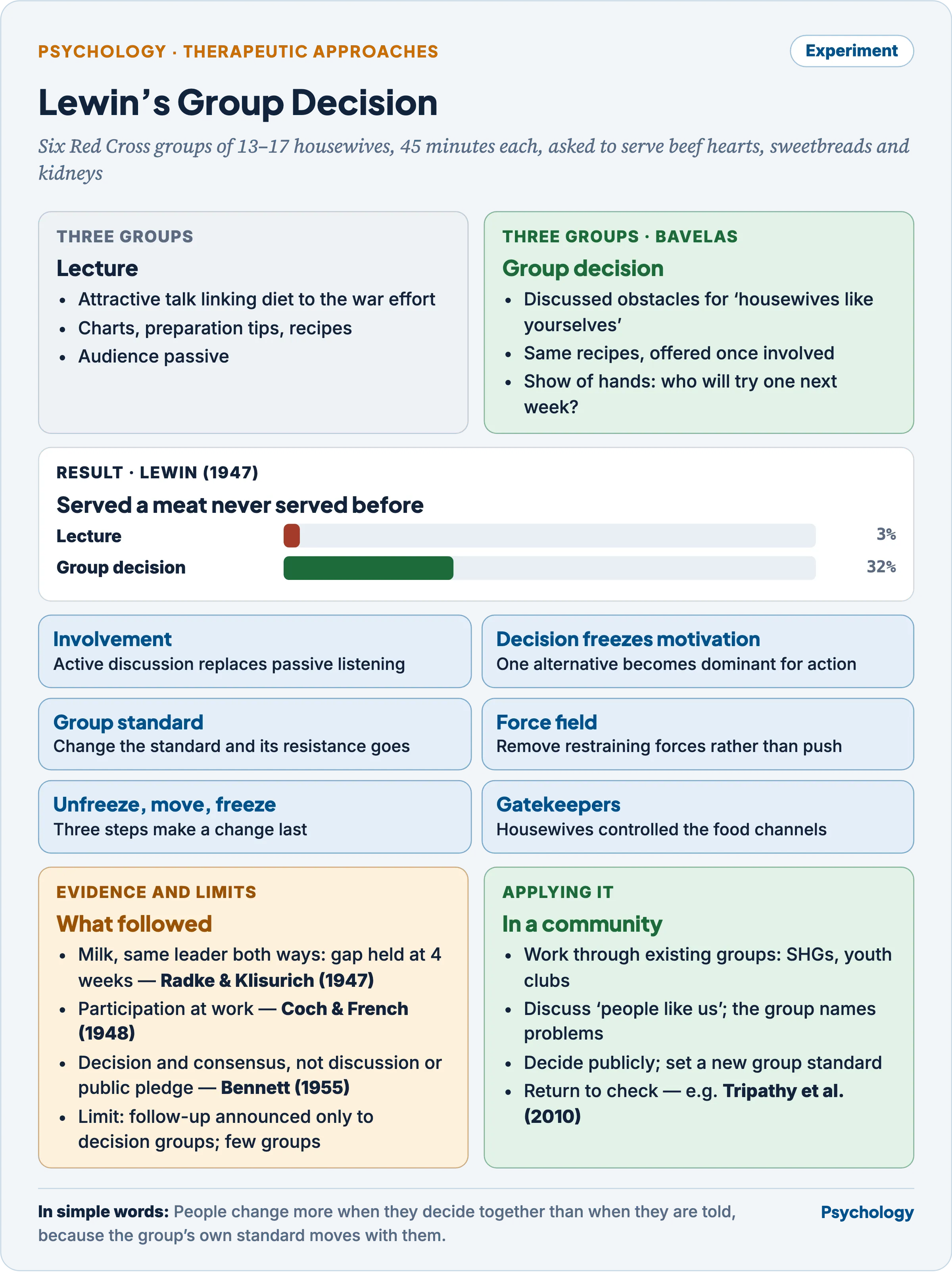
A lecture adds a driving force; a group decision removes a restraining one, and that is why the change holds.
- Lewin’s explanation gives the decision five psychological functions:
- Involvement — active participation replaces passive listening, and discussing others “like yourselves” lowers defensiveness.
- Decision as transition — a decision makes one alternative dominant and has “an effect of freezing this motivational constellation for action”.
- Group standards — individuals resist departing from their group’s standard, so changing the standard removes that resistance: “it is usually easier to change individuals formed into a group than to change any one of them separately” (Lewin, 1947).
- Force field — behaviour is a quasi-stationary equilibrium between driving and restraining forces; reducing restraint changes it with less tension than adding pressure.
- Unfreezing, moving, freezing — the three steps of durable change.
- Coch and French (1948) carried it into the Harwood factory, varying how far workers took part in planning a job change.
- No participation: output fell about 20 per cent and did not regain its earlier level. Representation: recovery in two weeks. Total participation: about 15 per cent above earlier output (Coch and French, 1948).
- Critique: Bartlem and Locke (1981) attributed the gains to perceived fairness of piece rates and extra training rather than participation.
- Bennett (1955) separated the ingredients, with volunteering for psychology experiments as the behaviour: discussion and public commitment proved inessential; making a decision, with high group consensus actually reached and perceived, reproduced Lewin’s effect.
- The process has costs: groupthink and polarisation, set out in Decision Making, Heuristics and Biases (Paper I), and the ethical risk of steering a group to a conclusion chosen in advance.
Application of group decision in fostering mental health in a community
- The principles transfer directly: work through existing face-to-face groups, let members name the problem for “people like us”, decide publicly, change the group standard — on stigma, drinking or help-seeking — and return to check results.
- Tripathy and colleagues (2010) tested this with the Ekjut women’s groups in Jharkhand and Odisha.
- Design: 36 village clusters randomised; in 18, 244 women’s groups met monthly in a participatory learning and action cycle, identifying maternal and newborn problems, choosing strategies, acting and reviewing.
- Neonatal mortality fell 32 per cent over three years and 45 per cent in years two and three; moderate maternal depression fell 57 per cent in year three (Tripathy and colleagues, 2010).
- Limitation: no overall depression effect; the reduction appeared only in year 3, when 55 per cent of pregnant women had joined (Tripathy and colleagues, 2010); the mechanisms are inferred.
- Pathare and colleagues (2023) evaluated Atmiyata in 645 villages of Mehsana, Gujarat.
- Trained volunteers (Champions) held four to six sessions of listening, behaviour activation and problem-solving, screened short films on alcoholism, domestic violence, family conflict and unemployment, and linked people to social benefits.
- In a stepped-wedge trial of 1,191 adults, the odds of recovery from depression or anxiety were 2.2 times higher at three months and 3.0 times at eight months.
- Limitation: about 30 per cent stayed symptomatic, and screening was not diagnostic (Pathare and colleagues, 2023).
- Self-help groups apply the same logic — mutual aid among caregivers, people in recovery, or women’s livelihood groups, where a group standard of help-seeking can replace one of silence.
- Arnstein (1969) ranked participation on an eight-rung ladder from manipulation through tokenism to citizen control; a group decision fosters mental health only when the group truly decides, not when it ratifies an expert’s plan.
The role of community psychology in handling community mental health problems
- Dalton, Elias and Wandersman (2001) define community psychology by its subject, the relationships of individuals to communities and society; it took shape at the Swampscott Conference (1965), and its methods belong to Unit 6.
- Its roles in a community mental health problem — a cluster of youth suicides, widespread drinking, post-disaster distress — follow from its principles:
- Ecological analysis — Kelly (1966) applied four principles from biology: interdependence, cycling of resources, adaptation and succession. The problem lies in person–setting fit, so change aims at the setting (second-order change).
- Prevention and promotion — Albee (1982) wrote incidence as organic factors plus stress, divided by coping skills, self-esteem and support groups, later adding exploitation to the numerator; intervention can shrink the numerator or grow the denominator.
- Empowerment — Rappaport (1981) argued that expert-led prevention treats communities as deficient, and that “Having rights but no resources and no services available is a cruel joke”.
- Sense of community — McMillan and Chavis (1986): membership, influence, integration and fulfilment of needs, and shared emotional connection.
- Mutual help and task-sharing — lay counsellors and volunteers, as in SEHER and Atmiyata.
- Crisis intervention and consultation — Caplan (1964) treated crisis as a time-limited turning point, and consultation strengthens teachers, police and clergy who meet distress first.
- Participatory action research and advocacy — the community defines questions, and findings feed policy.
- Limitation: empowerment of one group can disempower another, villages carry caste and gender hierarchies, volunteers burn out, and “community” can become a way of shifting the state’s duty onto the poor.
Criticisms and limitations
- Weak and decaying effects. Universal programmes show small effects that fade, and rigorous trials are often null (Bastounis and colleagues, 2016); promotion is easier to advocate than to demonstrate.
- Delivery over content. SEHER worked through lay counsellors and failed through teachers (Shinde and colleagues, 2018), so scaling through overstretched staff may deliver nothing.
- Individualising structural problems. Life skills cannot create jobs; WHO (2004) located mental health risk in poverty, low education and insecurity.
- Measurement. Well-being outcomes are self-reported, and the classic group-decision studies had few groups, aware participants and confounded procedures (Bartlem and Locke, 1981).
- Counting is not helping. Helpline calls are contacts, not people; screening without services lengthens queues; NCRB counts lack denominators (Dandona and colleagues, 2026).
- Moral panic. Digital harms are real for some users, but the population-level association is small (Orben and Przybylski, 2019).
Indian context
- Mental Healthcare Act, 2017 (Ministry of Health and Family Welfare) — Section 29 obliges government to “plan, design and implement programmes for the promotion of mental health and prevention of mental illness”, suicide reduction included; Section 30 requires stigma-reduction programmes.
- It operationalises promotion as a legal duty rather than charity.
- Rashtriya Kishor Swasthya Karyakram (MoHFW, 7 January 2014) — adolescents aged 10–19; mental health is one of six themes; four Saathiya peer educators per village, chosen with the ASHA, and adolescent-friendly clinics.
- It operationalises peer modelling (Observational Learning and Modelling, Paper I).
- Manodarpan (Ministry of Human Resource Development, now Education, 21 July 2020) — a national tele-counselling helpline, counsellor directory, advisories and handbook for students, parents and teachers. It operationalises social support and low-threshold help.
- Tele-MANAS (MoHFW, 10 October 2022) — helpline 14416, the digital arm of the District Mental Health Programme; 53 cells across all 36 States and Union Territories handled 47,75,644 calls by October 2026 (MoHFW, 2026).
- It operationalises the removal of barriers to help-seeking.
- National Suicide Prevention Strategy (MoHFW, 21 November 2022) — a 10 per cent cut in suicide mortality by 2030; district suicide-prevention services within five years, a well-being curriculum in every educational institution within eight.
- It operationalises means restriction and universal promotion.
- District Mental Health Programme (1996) — besides clinics, it funds life-skills education and counselling in schools, college counselling, workplace stress management and suicide prevention; sanctioned in 767 districts (PIB, 2026).
- Sukdeb Saha v. State of Andhra Pradesh (Supreme Court, 25 July 2025) — fifteen binding guidelines for all educational institutions, coaching centres included.
- A mental-health policy drawing on the Ministry of Education’s draft UMMEED guidelines (2023), Manodarpan and the strategy; a counsellor where 100 or more students enrol; staff trained twice a year; no batch segregation by performance; career counselling.
- It operationalises changing the setting.
- The Delhi Happiness Curriculum (2018) is evaluated in Factors Influencing Positive Health, Well-Being, Lifestyle and Quality of Life (Unit 2).
Previous Year Questions
- 2022Discuss the challenges to mental health of Indian youth. As a psychologist, suggest ways to foster their mental health.
- 2021Discuss the role of community psychology for handling community mental health problems.
- 2009Discuss the psychological significance of ‘group decision’. How can this be applied in fostering mental health in a Community?