

Official syllabusPaper II · Unit 3 · Therapeutic Approaches
Psychodynamic therapies.
Definition
“Psychodynamic or psychoanalytic psychotherapy refers to a range of treatments based on psychoanalytic concepts and methods that involve less frequent meetings and may be considerably briefer than psychoanalysis proper.”
Shedler (2010)
Psychodynamic therapies treat symptoms as the visible end of conflicts the patient cannot see, and bring those conflicts into awareness within a relationship that re-enacts them. Its forms run from Freud’s couch to twelve-session manuals; its evidence, long dismissed, now matches its rivals’.
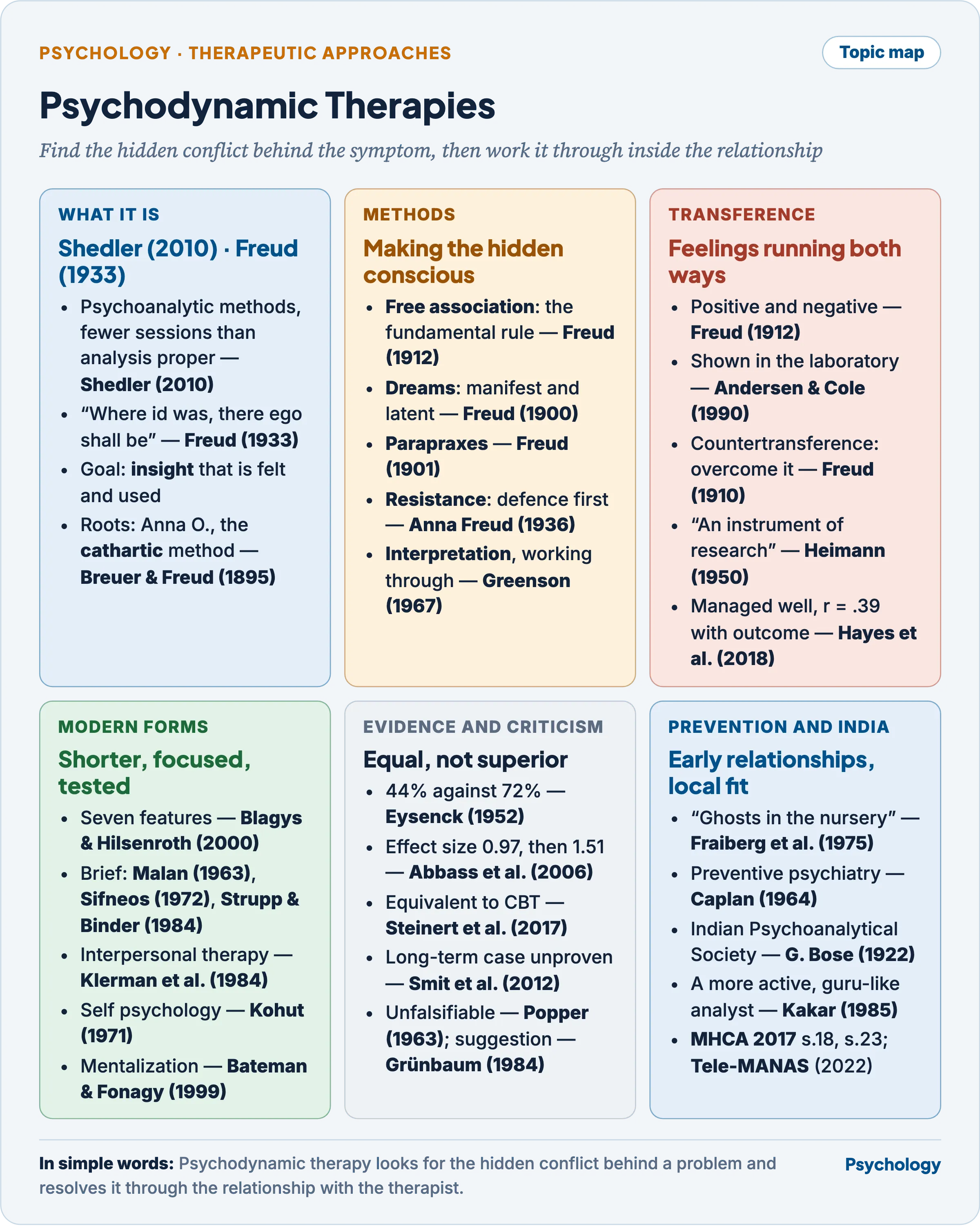
Every modern form keeps the same two working parts: making the hidden conscious, and using the relationship to do it.
Psychodynamic therapies: aim and basic principles
- Freud (1923) gave psychoanalysis three senses: a procedure for investigating mental processes “almost inaccessible in any other way”, a method of treating neurotic disorders, and the theory built from both.
- Origin. From 1880 Breuer treated “Anna O.” under hypnosis; symptoms eased as she traced each to its first occurrence. Breuer and Freud (1895) called the method cathartic; Freud later replaced hypnosis with free association.
- Aim: to “strengthen the ego, to make it more independent of the super-ego”: “Where id was, there ego shall be” (Freud, 1933). The working goal is insight — understanding that is felt, not merely known.
- The analyst allies with the patient’s ego against uncontrolled impulses (Freud, 1937), so the method needs a workable ego and fails with psychotics.
Basic principles in handling behaviour disorders
- Psychic determinism: no symptom, slip or dream is accidental; each has a meaning.
- Unconscious motivation: the decisive causes lie outside awareness.
- Conflict and defence: a wish meets a prohibition, anxiety signals danger (Freud, 1926), and defences reduce it.
- Compromise formation: the symptom both expresses and disguises the forbidden wish, so the target is the conflict, not the symptom alone.
- Repetition: the patient repeats in action what cannot be remembered (Freud, 1914), above all with the therapist.
- Working through: one insight does not dislodge a lifelong pattern; it must be applied repeatedly.
- Causal model: Abnormality, Classification and the Causal Factors of Mental Disorders; structure and defences: Psychoanalytic Theories of Personality.
Classical analysis and psychoanalytic psychotherapy
- Classical analysis: four or five sessions a week for years, the couch, neutrality, abstinence (wishes are understood, not gratified) and evenly suspended attention (Freud, 1912).
- Psychoanalytic psychotherapy: typically once or twice a week, time-limited or open-ended (Shedler, 2010).
Methods for bringing unconscious motives into consciousness
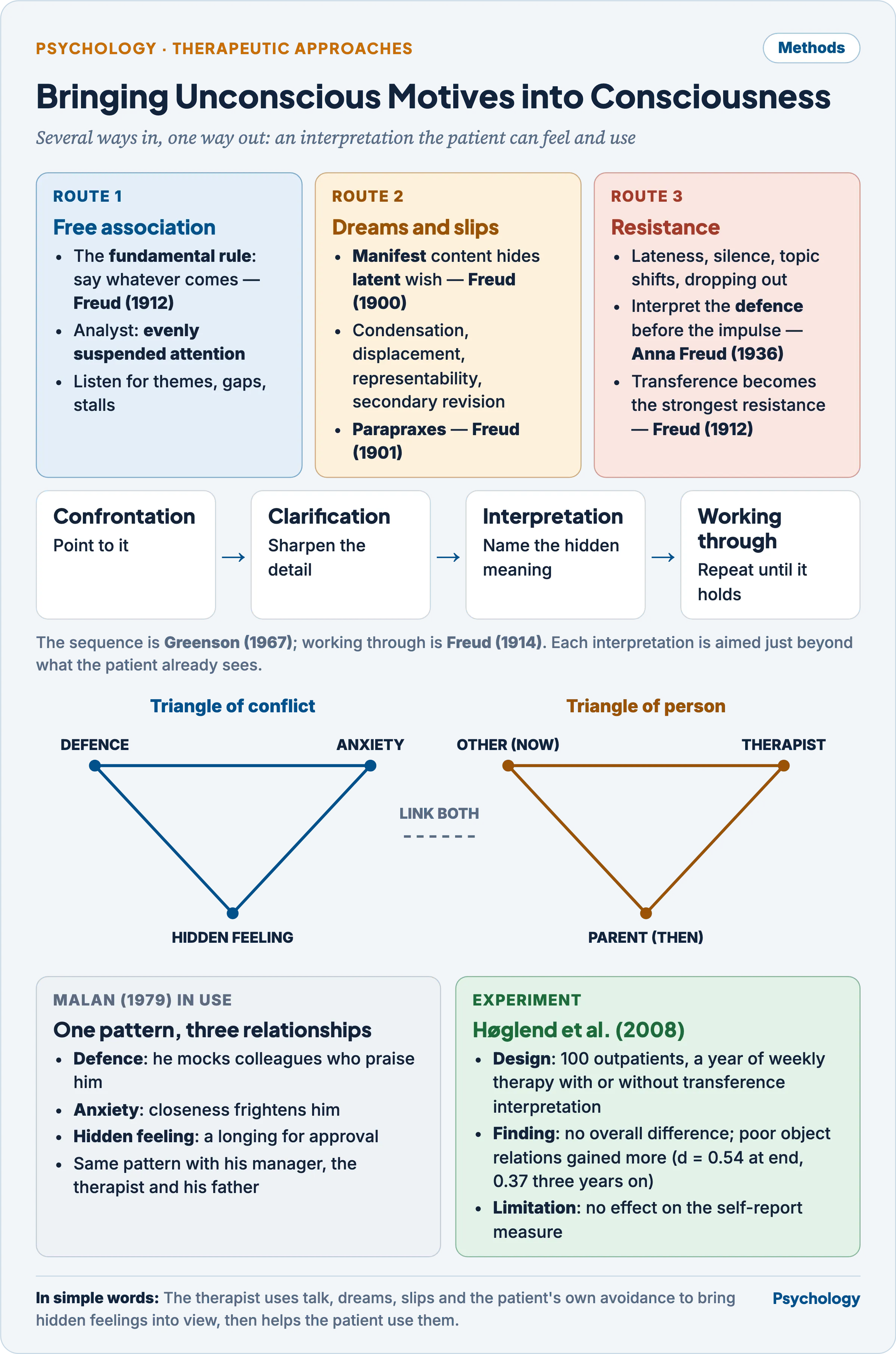
Each method opens a different window; all end in an interpretation the patient can feel and use.
- Free association: the fundamental rule (Freud, 1912; 1913) is to say whatever comes to mind, however trivial or painful. Suspending the censor lets associations drift towards excluded material; the analyst listens for themes and gaps.
- Dream analysis: the manifest content disguises a latent content through the dream-work — condensation, displacement, considerations of representability and secondary revision (Freud, 1900). Interpretation is built from the patient’s associations to each element, not from a dictionary of symbols.
- Freud added in 1909 that dream interpretation is “the royal road to a knowledge of the unconscious activities of the mind”; the theory is assessed in Dreams: Theories and Functions.
- Parapraxes — slips, forgetting, mislaying — are compromises between an intention and a disturbing wish (Freud, 1901).
- Analysis of resistance: resistance is whatever opposes the work — silence, lateness, missed sessions, changes of topic, intellectualising.
- Anna Freud (1936) made the defence itself the object: interpret the defence and its motive before the impulse it wards off, working from surface to depth.
- Interpretation makes the hidden meaning of an experience conscious. Greenson (1967) set the sequence: confrontation, clarification, interpretation, working through.
- Malan (1979) drew two triangles: the triangle of conflict (defence, anxiety, hidden feeling) and the triangle of person (current other, therapist, parent). A full interpretation links corners of both.
- Example: a man mocks colleagues who praise him (defence), fearing closeness (anxiety) and hiding a longing for approval (hidden feeling); the pattern recurs with manager, therapist and father.
- Høglend and colleagues (2008) tested transference interpretation directly.
- 100 outpatients had a year of weekly dynamic therapy with or without transference interpretations.
- No overall difference; patients with poor lifelong object relations gained more with transference work (d = 0.54 at termination, 0.37 three years later).
- Limitation: the effect appeared on clinician ratings, not on the self-report measure.
Transference and countertransference
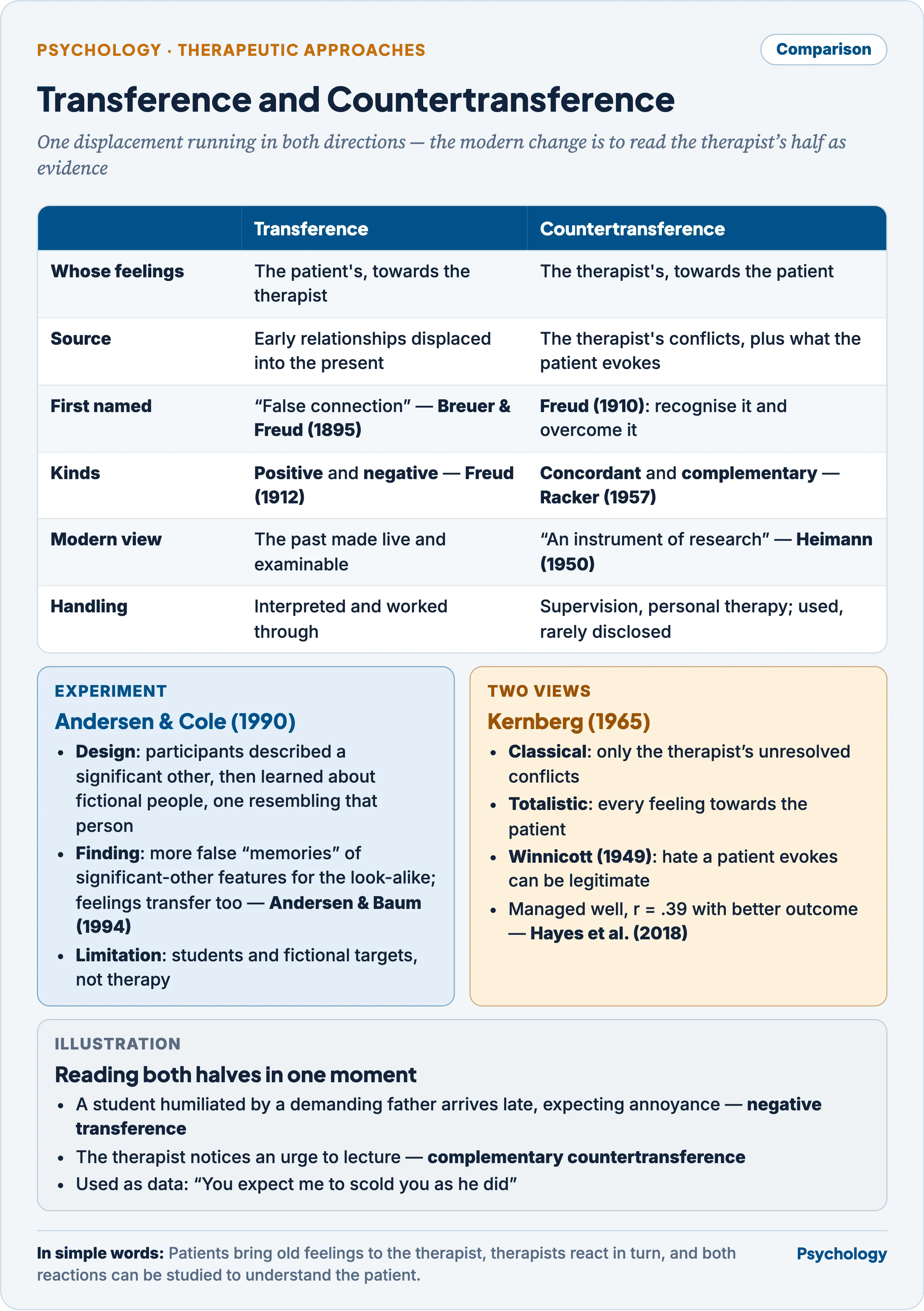
The same displacement runs both ways; the modern change reads the therapist’s half as evidence, not contamination.
- Transference: “the experiencing of feelings, drives, attitudes, fantasies, and defenses toward a person in the present which do not befit that person, but are a repetition of reactions originating in regard to significant persons of early childhood” (Greenson, 1967).
- Breuer and Freud (1895) called it a “false connection”; after Dora broke off treatment, Freud (1905) blamed his failure to analyse it.
- Freud (1912) separated positive (affectionate) from negative (hostile) transference; the affectionate part sustains the work, while erotic and hostile currents become resistance.
- Transference is “a universal phenomenon of the human mind”, merely “uncovered and isolated” by analysis (Freud, 1925). Its full form, the transference neurosis, re-creates the illness around the analyst (Freud, 1914).
- Andersen and Cole (1990) demonstrated transference experimentally.
- Participants described a significant other, then learned about fictional people, one resembling that figure.
- They falsely “remembered” more significant-other features for the resembling person; Andersen and Baum (1994) showed feelings transfer too.
- Limitation: students and fictional targets, far from clinical transference.
- Countertransference: Freud (1910) named what arises in the analyst “as a result of the patient’s influence on his unconscious feelings”; he must “recognize this counter-transference in himself and overcome it”.
- Heimann (1950) reversed the valuation: “The analyst’s counter-transference is an instrument of research into the patient’s unconscious.”
- Kernberg (1965) named the two positions: classical (the therapist’s own unresolved conflicts) and totalistic (every feeling towards the patient).
- Winnicott (1949) held that hate a difficult patient evokes is real and must be recognised; Racker (1957) separated concordant identification (feeling what the patient feels) from complementary (feeling like a figure in the patient’s inner world).
- Hayes, Gelso, Goldberg and Kivlighan (2018) pooled the evidence: countertransference reactions predict poorer outcome (r = −.16, 14 studies), successful management better outcome (r = .39, 9 studies). Limitation: correlational, heterogeneous.
- Illustration: a student humiliated by a demanding father arrives late expecting annoyance (negative transference); the therapist feels an urge to lecture (complementary countertransference). Used as data: “You expect me to scold you as he did.”
| Transference | Countertransference | |
|---|---|---|
| Whose | Patient’s, towards the therapist | Therapist’s, towards the patient |
| Source | Early relationships displaced into the present | Therapist’s conflicts, plus what the patient evokes |
| Classical view | Obstacle, then main vehicle (Freud, 1912) | Interference to overcome (Freud, 1910) |
| Modern view | The past made live and examinable | Information about the patient (Heimann, 1950) |
| Management | Interpreted, worked through | Supervision, personal therapy; used, rarely disclosed |
Modern psychodynamic therapy
- Blagys and Hilsenroth (2000), reviewing studies of recorded sessions, found seven features distinguishing manualised psychodynamic therapy from CBT (Shedler, 2010):
- focus on affect and its expression; exploration of avoidance (defence, resistance); recurring themes and patterns; past experience; interpersonal relations; the therapy relationship; and fantasy life — wishes, dreams, daydreams.
- Goals include capacities — fuller relationships, realistic self-esteem — not only symptom remission (Shedler, 2010).
Brief and short-term dynamic therapies
- Alexander and French (1946): the corrective emotional experience — the therapist responds differently from the original figure.
- Malan (1963) at the Tavistock Clinic showed brief focal therapy could produce deep change. Sifneos (1972) selected patients with a circumscribed complaint, one meaningful early relationship, psychological mindedness and motivation to change.
- Mann (1973) fixed twelve sessions around separation; Davanloo (1980) confronted defences relentlessly until feeling broke through; Strupp and Binder (1984) targeted the cyclical maladaptive pattern as enacted with the therapist.
- Luborsky (1984) built supportive–expressive therapy on the core conflictual relationship theme: a wish, the expected response of others, and the response of self.
- Shared: a focus, 6 to 40 sessions (Holmes, 1994), an active therapist, early transference work.
- Interpersonal psychotherapy (Klerman, Weissman, Rounsaville and Chevron, 1984) drew on Sullivan (1953) and Bowlby (1969): 12–16 weekly sessions on grief, role disputes, role transitions or interpersonal deficits. Present-focused, without transference interpretation, it derives from the tradition without belonging to it.
Object relations, self psychology and mentalization
- Klein (1932) treated children’s play as free association and interpreted projective identification (Klein, 1946) in the transference; Winnicott (1960) described the mother’s holding and its counterpart in the analyst’s care of a dependent patient.
- Kohut (1971) found narcissistic patients forming mirroring and idealising transferences (later twinship), the basis of self psychology; empathy, “vicarious introspection” (Kohut, 1959), is its method.
- Mentalization, or mentalizing, is “the process by which we make sense of each other and ourselves, implicitly and explicitly, in terms of subjective states and mental processes” (Bateman and Fonagy, 2010).
- Trial (Bateman and Fonagy, 1999): 38 borderline patients, up to 18 months of psychoanalytically oriented partial hospitalisation against standard psychiatric care.
- Self-harm, suicide attempts, inpatient days and depression fell; five years after treatment, 13 against 87 per cent still met borderline criteria (Bateman and Fonagy, 2008).
- Limitation: small, run in the developers’ own unit.
- Transference-focused psychotherapy (Kernberg’s model) interprets split images of self and other as they appear with the therapist. Clarkin, Levy, Lenzenweger and Kernberg (2007) randomised 90 borderline patients to it, dialectical behaviour therapy or supportive therapy.
- All improved; TFP changed 10 of 12 variables, DBT 5, supportive 6; only TFP reduced irritability and assault.
- Limitation: with no untreated control, gains shared by all three cannot be credited to any one.
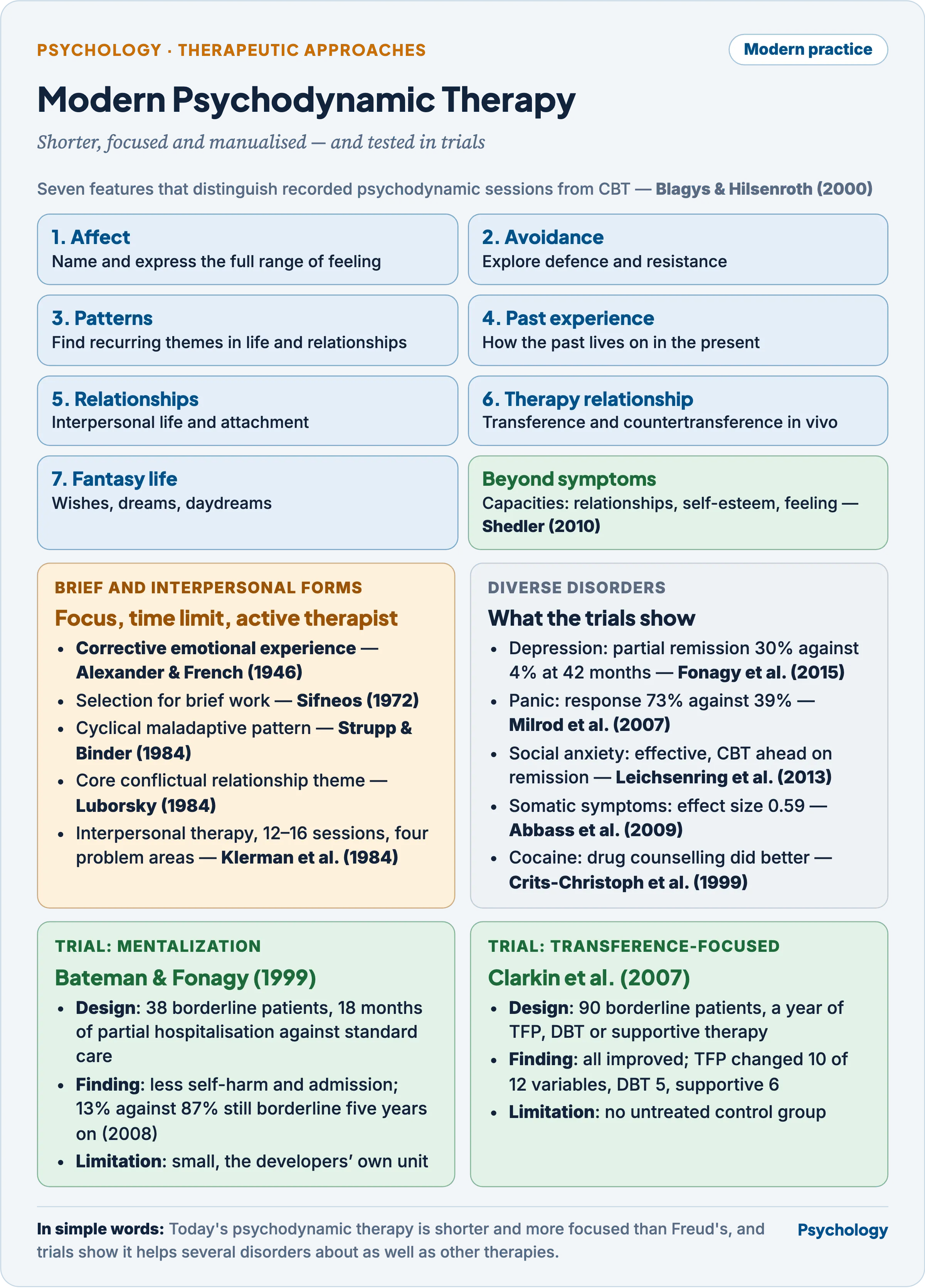
Shorter, focused and manualised, the modern forms were tested in trials that changed the tradition’s reputation.
Application to a diverse array of disorders
- Depression: in the Tavistock Adult Depression Study (Fonagy and colleagues, 2015), 129 treatment-resistant patients had 60 weekly sessions plus usual care, or usual care. No significant difference at 18 months; at 42 months partial remission was 30.0 against 4.4 per cent.
- Panic: Milrod and colleagues (2007), 49 adults, panic-focused psychodynamic therapy against applied relaxation: response 73 against 39 per cent.
- Social anxiety: Leichsenring and colleagues (2013), 495 patients: remission 36 per cent with CBT, 26 with psychodynamic therapy, 9 on waiting list — both effective, CBT ahead on remission.
- Somatic conditions: effect sizes 0.69 (psychiatric) and 0.59 (somatic symptoms) across 23 studies (Abbass, Kisely and Kroenke, 2009).
- Substance dependence is the exception: Crits-Christoph and colleagues (1999), 487 cocaine-dependent patients, found drug counselling outperformed supportive–expressive and cognitive therapy.
Effectiveness of psychodynamic therapies
- Eysenck (1952), pooling 19 studies, reported improvement in 44 per cent of psychoanalytic patients (about 66 per cent of completers), 64 with eclectic therapy and 72 with custodial or general-practitioner care; the debate is in Psychotherapy: Effectiveness, Common Factors and Eclecticism.
- Shedler (2010) assembled the reply: “Effect sizes for psychodynamic therapy are as large as those reported for other therapies that have been actively promoted as ’empirically supported’ and ‘evidence based.'”
- Abbass and colleagues (2006): 23 trials, 1,431 patients, short-term therapy: effect size 0.97, rising to 1.51 beyond nine months. Antidepressants averaged 0.31 (Turner and colleagues, 2008).
- Gains grew after treatment ended in at least five meta-analyses.
- Long-term therapy: Leichsenring and Rabung (2008) reported 1.8 against shorter therapies, flagged as inflated (Thombs, Bassel and Jewett, 2009); Smit and colleagues (2012), 11 trials, found recovery rates equal and evidence “limited and at best conflicting”.
- Steinert, Munder, Rabung, Hoyer and Leichsenring (2017), an adversarial collaboration of 23 trials and 2,751 patients, found psychodynamic therapy equivalent to established treatments, CBT included (g = −0.15 at post-treatment, within a ±0.25 margin).
- Dissent: Tolin (2010), 26 trials, found CBT superior to psychodynamic therapy (d = 0.28), the advantage confined to anxiety and depression and not robust against unpublished null results.
Psychodynamic, client-centred and cognitive therapy compared
| Psychodynamic | Client-centred | Cognitive | |
|---|---|---|---|
| Image of the person | Driven by unconscious conflict | Trustworthy, growth-seeking | Interpreter of events |
| Source of disorder | Conflict, defence, early relationships | Incongruence from conditions of worth | Cognitive triad: negative views of self, world, future (Beck, 1967) |
| Aim | Insight, stronger ego | Congruence, self-actualisation | Corrected thinking, symptom relief |
| Time focus | The past alive in the present | Here and now | Present, tracing core beliefs |
| Therapist | Interprets; neutral | Offers congruence, unconditional positive regard, empathy (Rogers, 1957) | Collaborative, directive, teaching |
| Relationship | Arena of transference | Itself curative | Alliance for tasks |
| Methods | Free association, dreams, resistance, transference | Reflection, empathic understanding | Questioning, thought records, behavioural experiments |
- Similarities: all are talking cures resting on the relationship; psychodynamic and client-centred therapy both seek awareness of denied or distorted experience, prize felt over intellectual understanding, and aim at personality rather than the symptom alone.
- Lineage: Beck, a trained psychoanalyst, found depressed patients dreamed of rejection and defeat (Beck and Hurvich, 1959) and left the inverted-hostility account.
- Humanistic evidence: Elliott, Watson, Timulak and Sharbanee (2021), 91 studies: large pre–post change (d = 0.86) and equivalence with other therapies.
- The tenets of each are in Client-Centred Therapy and Cognitive Therapies: Beck and Cognitive-Behavioural Therapy.
Unresolved inner conflicts: the suitable treatment
- Psychodynamic therapy fits this problem: the symptom is a compromise between conflicting wishes, Malan’s triangle of conflict targets defence, anxiety and hidden feeling, and the relationship lets the conflict appear live.
- Matching: a circumscribed conflict in a motivated, psychologically minded patient suits brief dynamic therapy (Sifneos, 1972); pervasive relational conflict calls for transference work, from which Høglend’s (2008) poorly related patients gained most.
- Evidence supports the choice without making it exclusive: equivalence with CBT (Steinert and colleagues, 2017), delayed gains (Fonagy and colleagues, 2015), and change in reflective function only under TFP (Levy and colleagues, 2006).
- Alternatives: Perls, Hefferline and Goodman (1951) staged conflict as a two-chair dialogue; with 16 participants Greenberg and Clarke (1979) found it deepened experiencing more than empathic reflection, though goal attainment did not differ.
- Judgement: psychodynamic therapy for conflict outside awareness, two-chair work for a split already felt, neither while psychosis or active addiction dominates.
Role in the prevention of mental illness
- If disorder grows from early relationships, prevention means protecting them. Anna Freud’s Hampstead Child Therapy Course (1947) and clinic (1952) carried analytic work to children.
- Caplan (1964), trained at the Tavistock Clinic under Bowlby and in psychoanalysis, founded preventive psychiatry: crisis intervention built on Lindemann (1944) and the primary–secondary–tertiary scheme set out in Prevention and Rehabilitation of the Mentally Ill.
- Fraiberg, Adelson and Shapiro (1975) described “ghosts in the nursery”: parents repeat their own unremembered childhood pain with their infants, so infant–parent psychotherapy treats the relationship.
- Cicchetti, Rogosch and Toth (2006) tested it.
- 137 maltreated one-year-olds and their mothers were randomised to infant–parent psychotherapy, psychoeducational parenting or community services.
- At 26 months both interventions raised secure attachment; disorganisation persisted with community services. A year later only psychotherapy held its gains (Stronach and colleagues, 2013).
- Limitation: behaviour problems did not differ between groups.
- Post-treatment gains guard against relapse (Shedler, 2010), but long treatment and scarce therapists make it a minor tool for whole populations.
Criticisms and limitations
- Unfalsifiability: Popper (1963) held that a theory explaining every outcome forbids none, and so is not scientific.
- Grünbaum (1984) judged the theory testable but its clinical evidence contaminated by suggestion: a patient’s assent to an interpretation cannot validate it.
- Weak founding cases: Wolpe and Rachman (1960) reread Little Hans as fear conditioned by seeing a horse fall; Ellenberger (1972) found Anna O. entered a sanatorium after her “cure”.
- Cost and selection: classical analysis is long, expensive, and favours the “YAVIS” patient — young, attractive, verbal, intelligent, successful (Schofield, 1964).
- A thinner evidence base: fewer trials than CBT and mixed diagnoses, conceded by Shedler (2010); long-term superiority is unproven (Smit and colleagues, 2012).
- Unsuited to psychosis, crisis and active substance dependence (Crits-Christoph and colleagues, 1999), and to cultures that do not prize introspection (Kakar, 1985); intense transference can foster dependence and regression.
- Strengths: outcomes matching established therapies, durable gains, an experimentally supported concept of transference, and techniques skilled therapists of other schools also use (Shedler, 2010).
Indian context
- Girindrasekhar Bose earned the first doctorate in psychology from an Indian university for Concept of Repression (1921), proposing a theory of opposite wishes: every wish has a counterpart, and conflict arises between them.
- Freud replied (1929) that the theory stressed “rather a formal element than a dynamic factor”; Bose answered that “the desire to be a female is more easily unearthed in Indian male patients than in European”.
- Bose founded the Indian Psychoanalytical Society in Kolkata on 26 January 1922, recognised by the International Psychoanalytical Association that year; its 1940 nursing home, later Lumbini Park Mental Hospital, is described as India’s first inpatient psychotherapy facility.
- The Society opened the Girindrasekhar Clinic (1970) at an affordable fee; Mumbai’s Psychoanalytic Therapy and Research Centre (1974) began India’s first child and adolescent psychotherapy training in 1999.
- Kakar (1985) held that the Indian analyst must be “much more actively involved than may be considered desirable in the classical model”.
- Patients expect warmth “nearer to what he would expect from a personal guru than from a professional doctor”; psychological mindedness is rare outside the Westernised upper class, and distress is often read through karma.
- Relational models fit them better than drive theory.
- Neki (1973) proposed the guru–chela relationship as a therapeutic paradigm; his later work held dependence, which Western therapy works to end, culturally relative (Neki, 1976).
- Mental Healthcare Act, 2017 (Ministry of Health and Family Welfare) — section 18 gives a right to accessible, affordable care; section 23 a right to confidentiality, extended to digital records by section 24(2). It secures the confidential frame free association depends on.
- Tele-MANAS (National Tele Mental Health Programme, Ministry of Health and Family Welfare, 10 October 2022) — 47,75,644 calls through 53 cells in all 36 States and UTs (PIB, 9 October 2026). It operationalises access for brief formats.
- The same release lists the District Mental Health Programme as sanctioned for 767 districts.
- The constraint is the gap: the National Mental Health Survey (NIMHANS, 2016) found 10.6 per cent of adults affected and a treatment gap of 70–92 per cent, so long-term dynamic therapy stays largely urban and private.
Previous Year Questions
- 2025Which form of psychological treatment is suitable for dealing with unresolved inner conflicts? Explain.
- 2024Write a note on transference versus countertransference in the context of psychodynamic therapies.
- 2021Describe the main tenets of cognitive therapy. Compare it with psychoanalytic therapy.
- 2021Discuss the methods used by a psychoanalyst to bring unconscious motives into conscious.
- 2020Illustrate the basic tenets of psycho-dynamic and client centered therapies. Discuss the effectiveness of these therapies as forms of treatment of mental disorders.
- 2018Discuss the distinctive aspects of modern psychodynamic therapy. How can it be helpful in the treatment of diverse array of disorders?
- 2016Discuss the salient features of psychodynamic therapies and evaluate their role in the prevention of mental illnesses.
- 2012Critically evaluate the strengths and limitations of psychodynamic therapies in the treatment of mental disorders.
- 2005Write a short note on: Psychodynamic therapies.
- 2002Comment on: Describing the important features of client centered therapy, present the similarities and differences between psychoanalytic therapy and client centered therapy.
- 1998Highlight the basic principles of psychodynamic approach in handling behaviour disorders.
- 1997What is the aim of psychoanalytic therapy? Discuss the significance of free association and dream analysis in the process of psychoanalytic therapy.
- 1995What is the basic principle of psycho-dynamic approach in handling behaviour disorder? Does it equally qualify as other kinds of therapeutic techniques?