

Official syllabusPaper II · Unit 3 · Therapeutic Approaches
Behaviour therapies.
Definition
“Behaviour therapy may be defined as the attempt to alter human behaviour and emotion in a beneficial manner according to the laws of modern learning theory.”
Eysenck (1964)
Behaviour therapy treats a disorder as learned behaviour that can be unlearned. It began in the 1950s as a challenge to psychoanalysis and is now the behavioural core of most evidence-based psychological treatment.
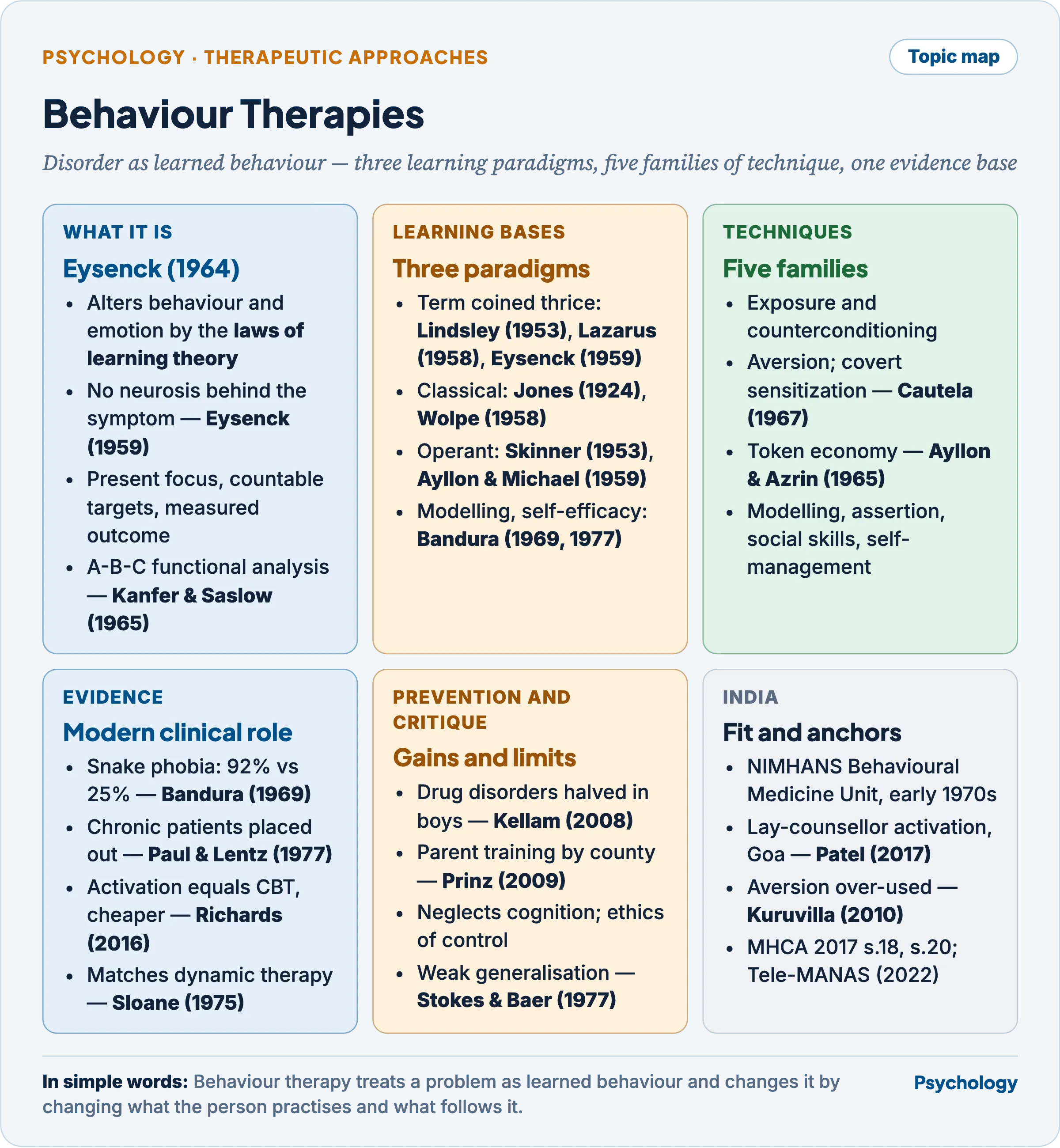
Every technique on the map traces to one of three learning paradigms, and every criticism to what those paradigms leave out.
Behaviour therapies: nature and salient features
- Assumptions: normal and abnormal behaviour are acquired by the same learning principles. Maladjustment is a skill deficit, adaptive responses never learnt, or a learned excess maintained by reinforcement, so it can be unlearnt or relearnt.
- Eysenck (1959) stated the radical version: “there is no neurosis underlying the symptom, but merely the symptom itself. Get rid of the symptom and you have eliminated the neurosis.”
- Salient features:
- Present focus: current maintaining conditions, not childhood origins.
- Operational targets: the problem stated as behaviour that can be counted.
- Functional analysis: Kanfer and Saslow (1965) replaced diagnostic labels with analysis of the antecedents and consequences controlling a behaviour, later summarised as the A-B-C sequence.
- Empirical evaluation: a baseline, repeated measurement, and single-case or controlled designs.
- An active, directive therapist acting as teacher, model and reinforcer, with homework in the natural setting.
- Self-management: the client learns to run the procedures; treatment usually takes weeks, not years.
Theoretical and learning bases of behaviour therapy
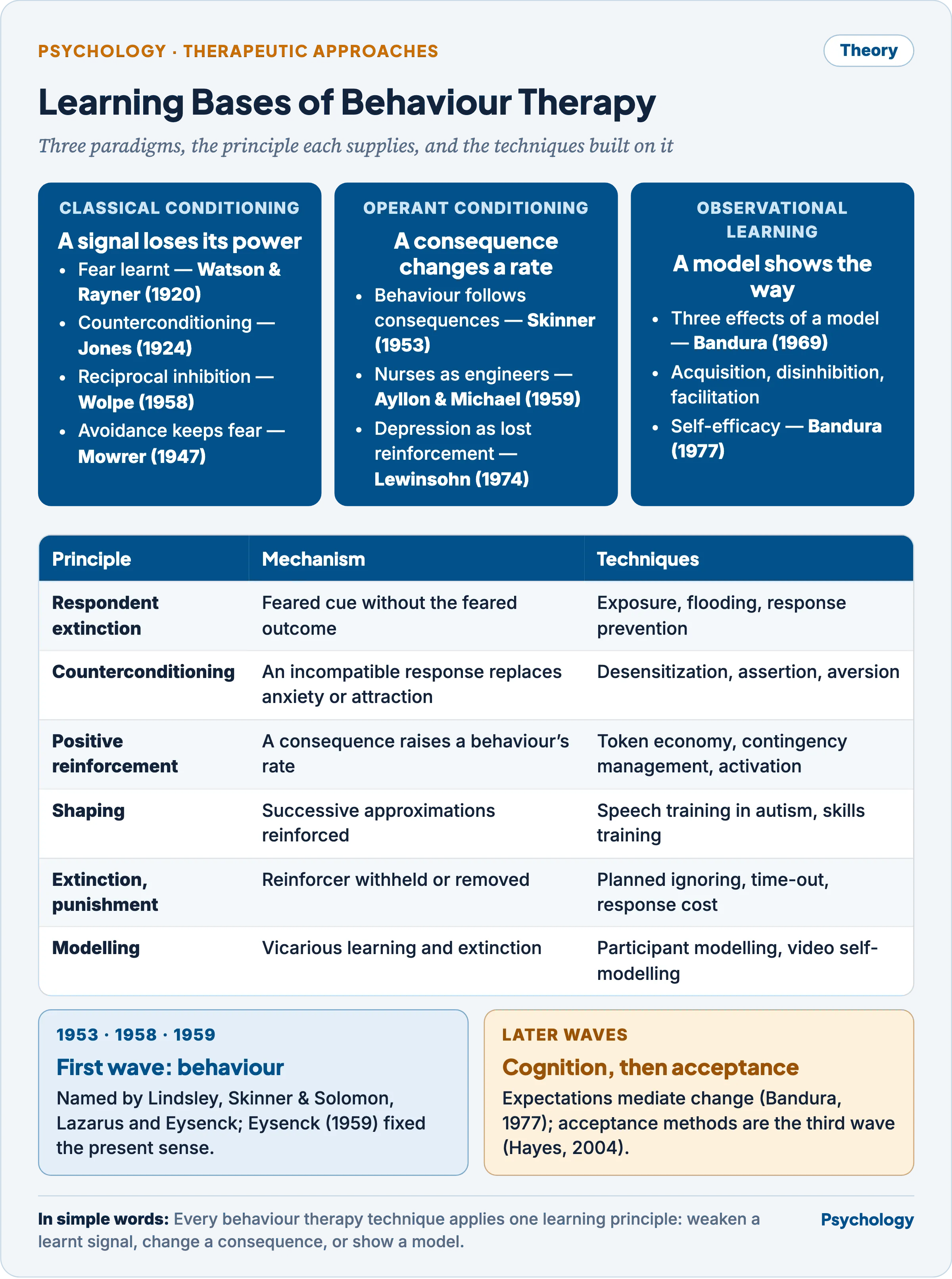
Three paradigms, three kinds of change: a signal loses its power, a consequence changes a rate, a model shows the way.
Origins in the 1950s
- The term arose independently three times. Lindsley, Skinner and Solomon (1953) named an operant laboratory for psychotic patients at Metropolitan State Hospital “Studies in Behavior Therapy”; Lazarus (1958) used it in print in South Africa.
- Eysenck (1959) gave the term its present sense, all treatment derived from learning theory, and founded Behaviour Research and Therapy in 1963. Wolpe (1958), Psychotherapy by Reciprocal Inhibition, supplied the first clinical method.
Classical conditioning
- Watson and Rayner (1920) conditioned fear of a rat in an infant, so phobias could be learnt (Classical Conditioning, Paper I).
- Mary Cover Jones (1924) removed a boy’s fear of a rabbit by bringing it closer while he ate: counterconditioning, a precursor; systematic desensitization is Wolpe’s (1958).
- Mowrer (1947): fear acquired by pairing is maintained by avoidance, which relief reinforces, so treatment needs exposure without escape (Escape, Avoidance and Learned Helplessness, Paper I).
Operant conditioning
- Skinner (1953), Science and Human Behavior: behaviour is a function of its consequences, so change the consequences. Ayllon and Michael (1959) trained ward nurses as “behavioral engineers” who reinforced adaptive acts and ignored psychotic talk.
- Lewinsohn (1974) read depression as loss of response-contingent positive reinforcement, the basis of behavioural activation. The schedules are in Reinforcement, its Types and Schedules (Paper I).
Observational learning
- Bandura (1969), Principles of Behavior Modification, distinguished three effects of a model: observational learning of new responses, inhibition or disinhibition of existing ones (fear reduction disinhibits approach), and response facilitation.
- Bandura (1977) argued that all behavioural treatments work by raising self-efficacy, most strongly through performance accomplishments (Social Cognitive Theory – Self-Efficacy and Self-Regulation, Paper I).
| Principle | Mechanism | Techniques |
|---|---|---|
| Respondent extinction | Feared cue occurs without the feared outcome | In vivo exposure, flooding, response prevention |
| Counterconditioning | An incompatible response replaces anxiety or attraction | Systematic desensitization, assertion training, aversion therapy |
| Positive reinforcement | A consequence raises a behaviour’s rate | Token economy, contingency management, behavioural activation |
| Shaping | Successive approximations reinforced | Speech training in autism, social skills training |
| Operant extinction, punishment | Reinforcer withheld or removed | Planned ignoring, time-out, response cost |
| Stimulus control | Cues narrowed to the target behaviour | Stimulus control for insomnia, cue avoidance in addiction |
| Modelling | Vicarious learning and extinction | Participant modelling, video self-modelling |
- Hayes (2004) named the acceptance-based methods (ACT, dialectical behaviour therapy, mindfulness-based cognitive therapy) the third wave; the second, cognitive wave is in Cognitive Therapies: Beck and Cognitive-Behavioural Therapy.
Techniques of behaviour therapy
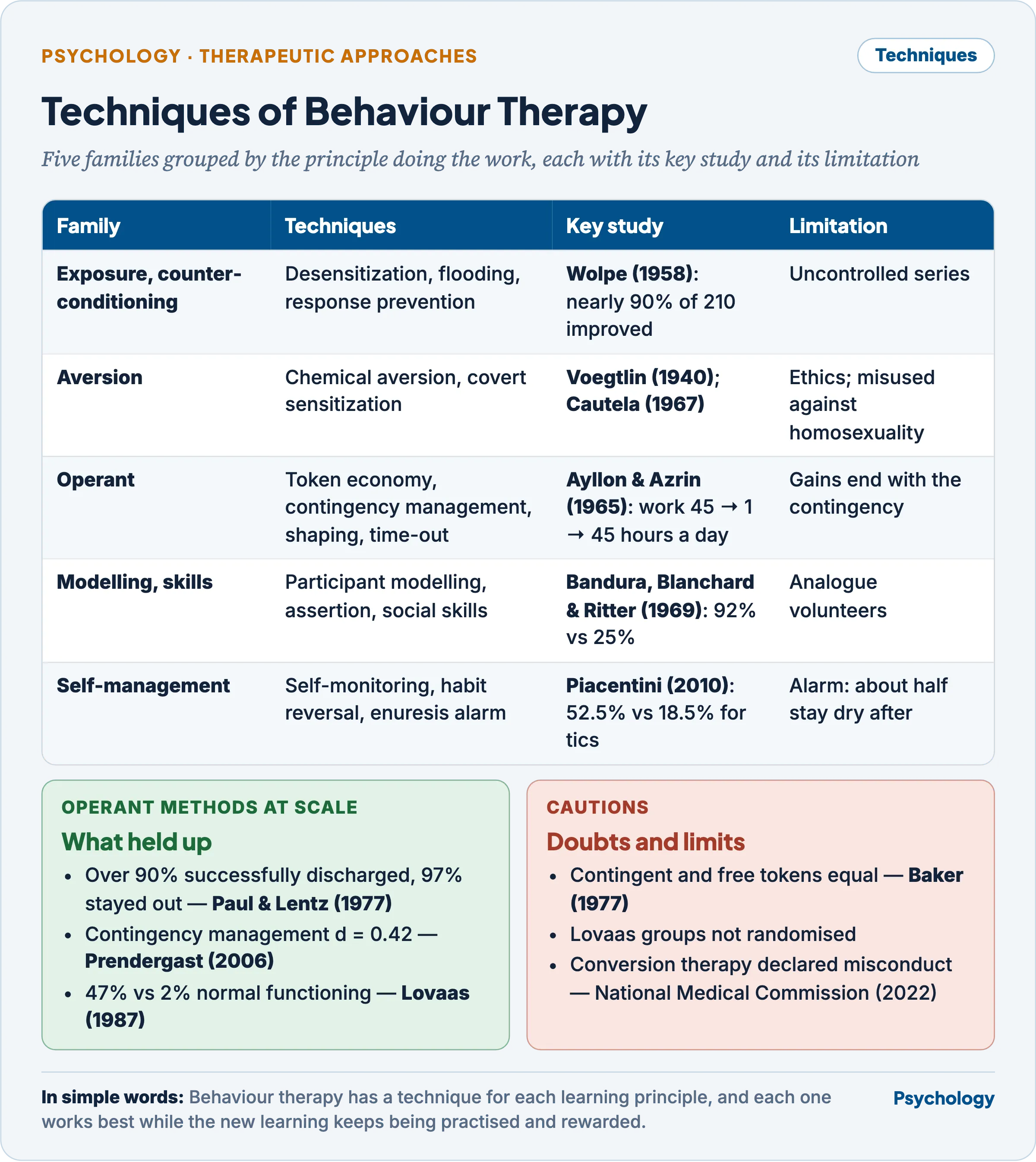
Grouped by the principle doing the work, the techniques form five families, each with its best study and its limitation.
Exposure and counterconditioning
- Systematic desensitization, in vivo and imaginal exposure, flooding, and response prevention for obsessive-compulsive disorder (Meyer, 1966) are set out in Systematic Desensitization and Exposure Therapies.
- Wolpe (1958) reported nearly 90 per cent of 210 neurotic patients apparently cured or much improved: an uncontrolled series.
Aversion therapy and covert sensitization
- Aversion therapy pairs an unwanted attraction with an aversive unconditioned stimulus. It is classical counterconditioning, not punishment by removing rewards. Voegtlin (1940) paired drinking with emetine-induced vomiting; his abstinence figures came from uncontrolled sanatorium series.
- Disulfiram is not an emetic: it blocks alcohol metabolism, so drinking brings flushing and nausea, and it deters by anticipation rather than conditioning.
- Covert sensitization (Cautela, 1967) pairs the urge with imagined nausea or disgust, avoiding physical harm.
- Ethical critique: aversion was used to “cure” homosexuality. Kuruvilla (2010) found Indian behaviour-therapy reports leaned heavily on aversive methods, homosexuality included; India’s National Medical Commission declared conversion therapy professional misconduct on 25 August 2022, on a Madras High Court direction.
Operant methods
- Ayllon and Azrin (1965) built the first token economy, tokens as conditioned reinforcers exchangeable for privileges, on a ward of 44 long-stay women at Anna State Hospital.
- Ward work ran at about 45 hours a day; with tokens given regardless of work it fell to about one hour, and returned to 45 when the contingency was restored.
- Limitation: gains lasted only while the contingency ran.
- Paul and Lentz (1977) randomly assigned severely chronic inpatients, averaging 17 years in hospital, to a social-learning (token) programme, milieu therapy or routine hospital care.
- Over 90 per cent of social-learning residents achieved successful discharge and 97 per cent of dischargees stayed in the community; routine care released the fewest (Paul, 2006).
- Limitation: every dischargee received social-learning aftercare, which Paul (2006) credits for community tenure.
- Baker and colleagues (1977) found contingent and non-contingent tokens improved chronic schizophrenic patients equally. A review found only three randomised trials, with 110 patients (McMonagle and Sultana, 2000): ward structure, not tokens alone, may do the work.
- Contingency management rewards verified abstinence with vouchers; Prendergast and colleagues (2006), across 47 comparisons, found d = 0.42, larger for opiates and cocaine, decaying after treatment.
- Shaping, extinction (Williams, 1959, removed a toddler’s bedtime tantrums by ignoring them), time-out from positive reinforcement, response cost, differential reinforcement of incompatible behaviour and written behavioural contracts complete the set.
- Lovaas (1987) gave 19 autistic children under four about 40 hours a week of applied behaviour analysis.
- 47 per cent reached normal intellectual and educational functioning, against 2 per cent of 40 controls (Lovaas, 1987).
- Limitation: groups were not randomly assigned; assessments varied; the early aversive procedures are now unacceptable.
Modelling and participant modelling
- Bandura, Blanchard and Ritter (1969) assigned 48 snake-phobic volunteers to symbolic desensitization, film modelling, live modelling with guided participation, or no treatment.
- 92 per cent after participant modelling held a snake in their laps, against 25 per cent after desensitization (Bandura and colleagues, 1969); partial responders then succeeded with brief participant modelling.
- Limitation: an analogue sample of volunteers rather than patients.
Assertiveness training
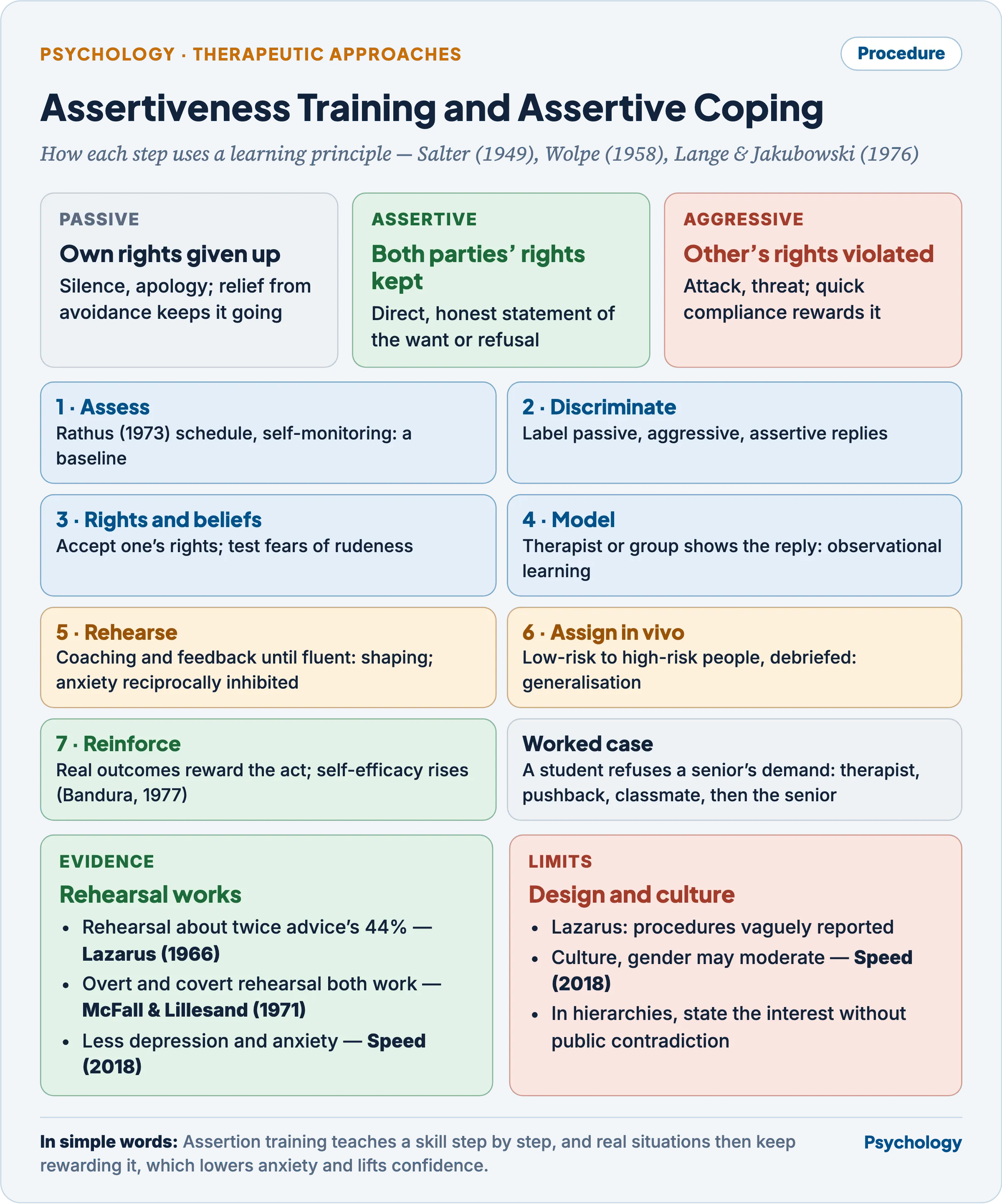
Each step of assertion training uses a different learning principle, and real situations go on rewarding the skill.
- Assertive behaviour is the direct, honest expression of one’s wants, feelings and rights without violating those of others, as distinct from passive and aggressive responding.
- Salter (1949), Conditioned Reflex Therapy, treated unassertiveness as excess inhibition; Wolpe (1958) argued that assertive responses reciprocally inhibit anxiety; Wolpe and Lazarus (1966) made behaviour rehearsal the core method.
- Behaviour therapy builds assertive coping, acting on a stressor rather than submitting or attacking, in learning steps.
- Assessment of situations and deficits with the Rathus (1973) Assertiveness Schedule and self-monitoring.
- Discrimination training among passive, aggressive and assertive replies.
- Rights and beliefs: Lange and Jakubowski (1976) added accepting personal rights and dismantling beliefs that assertion is rude or dangerous.
- Modelling of the response by the therapist or group.
- Behaviour rehearsal with coaching and feedback until fluent: shaping, while anxiety is counterconditioned.
- Graded in vivo assignments, from low-risk to high-risk people, debriefed each session.
- Reinforcement: real successes are rewarded by their outcomes, and each one raises self-efficacy (Bandura, 1977).
- Worked case: a hostel student who cannot refuse a senior’s repeated demands rehearses “I can’t do it today; ask me on Saturday,” first with the therapist as the senior, then against pushback, then with a classmate, then with the senior.
- Lazarus (1966) compared behaviour rehearsal, direct advice and non-directive therapy for patients’ interpersonal problems: rehearsal changed behaviour in most cases, about twice as often as advice (44 per cent), with non-directive therapy lowest (32 per cent).
- Limitation: Lazarus (1966) reported procedures and allocation only vaguely.
- McFall and Marston (1970) and McFall and Lillesand (1971) showed that overt and covert rehearsal raised college students’ assertion.
- Speed and colleagues (2018) concluded that assertion training reduces depression and anxiety and raises self-esteem, but has been absorbed into packages such as dialectical behaviour therapy.
- Limitation: Speed and colleagues (2018) flag culture and gender as likely moderators; in hierarchical settings the effective form states the interest without publicly contradicting a senior (Effective Communication and Its Training, Paper I).
Social skills training and behavioural self-management
- Social skills training combines instruction, modelling, rehearsal, feedback and homework. Kurtz and Mueser (2008), across 22 trials with 1,521 people with schizophrenia, found d = 1.20 for skills learnt, 0.52 for community functioning and only 0.23 for relapse.
- Self-management: Kanfer and Karoly (1972) described self-control as self-monitoring, self-evaluation and self-reinforcement, run by the client alone.
- Habit reversal (Azrin and Nunn, 1973) pairs awareness training with a competing response; Piacentini and colleagues (2010) found 52.5 per cent of children with tics much improved, against 18.5 per cent with supportive therapy.
- The enuresis alarm (Mowrer and Mowrer, 1938) conditions waking to bladder tension; Glazener and colleagues (2005), reviewing 55 trials, found about two-thirds dry during use and nearly half dry afterwards.
- Behavioural activation schedules rewarding activity and blocks avoidance. In the COBRA trial Richards and colleagues (2016) found it, delivered by junior workers to 440 adults, as effective as cognitive behavioural therapy at 12 months and cheaper.
The role of behaviour therapy in modern clinical treatment
- The American Psychological Association’s Division 12 Task Force (1995) listed 18 well-established and 7 probably efficacious treatments, mostly behavioural or cognitive-behavioural, among them parent training for oppositional children, behavioural marital therapy and behaviour modification in developmental disability.
| Disorder | Behavioural treatment | Evidence |
|---|---|---|
| Specific phobia | Graded exposure, participant modelling | Bandura, Blanchard and Ritter (1969) |
| Obsessive-compulsive disorder | Exposure with response prevention | Meyer (1966) |
| Depression | Behavioural activation | Richards and colleagues (2016) |
| Social anxiety | Exposure, social skills training | Mayo-Wilson and colleagues (2014) |
| Substance use | Contingency management | Prendergast and colleagues (2006) |
| Autism | Applied behaviour analysis | Lovaas (1987) |
| Schizophrenia | Social-learning programme, skills training | Paul and Lentz (1977); Kurtz and Mueser (2008) |
| Tics; enuresis | Habit reversal; alarm | Piacentini (2010); Glazener (2005) |
| Childhood conduct problems | Parent training | Prinz and colleagues (2009) |
- Sloane and colleagues (1975) randomised 94 outpatients with anxiety neurosis or personality disorder to four months of behaviour therapy, psychoanalytically oriented therapy or a waiting list.
- Target symptoms improved equally in both treatments and more than on the waiting list; only behaviour therapy gave significant overall improvement at four months.
- Limitation: at one and two years all groups were similar, an early sign that schools converge; the wider comparison is in Psychotherapy: Effectiveness, Common Factors and Eclecticism.
Learning principles in treating students’ social anxiety: behaviour against cognitive therapy
- Behavioural formulation: avoiding speaking up is negatively reinforced by relief; safety behaviours such as silent rehearsal and averted gaze prevent disconfirmation; some students also lack the skills.
- The programme, each step with its principle:
- A graded in vivo hierarchy, from asking a question in class to answering one to presenting a seminar: extinction.
- Dropping safety behaviours during exposure: extinction without escape.
- Rehearsal with video feedback: modelling and shaping.
- Praise and self-recorded successes: reinforcement; homework in real classes: generalisation.
- Paul (1966) found desensitization superior to insight therapy for speech-anxious students (Systematic Desensitization and Exposure Therapies). Feske and Chambless (1995) meta-analytically found exposure alone as effective as exposure plus cognitive restructuring.
- Clark and colleagues (2006) randomised 62 adults: 84 per cent no longer met criteria after cognitive therapy, 42 per cent after exposure with applied relaxation, none on the waiting list, in a trial run by the therapy’s developers.
- Mayo-Wilson and colleagues (2014), a network meta-analysis of 101 trials, found individual CBT strongest (SMD −1.19 against waiting list), above exposure and social skills (−0.86); only individual CBT beat psychological placebo.
- Exposure is the shared active ingredient, and cognitive therapy built on the Clark and Wells (1995) model adds to it; the cognitive half is in Cognitive Therapies: Beck and Cognitive-Behavioural Therapy.
Efficacy of behaviour therapies in the prevention of mental illnesses
- Behavioural programmes act at each level of Caplan’s (1964) scheme, set out in Prevention and Rehabilitation of the Mentally Ill, because they change the environments that teach problem behaviour.
- Primary, universal: the Good Behavior Game (Barrish and colleagues, 1969) rewards classroom teams for low disruption.
- Kellam and colleagues (2008) followed Baltimore first-graders of 1985–86 to ages 19–21: lifetime drug abuse or dependence was 19 per cent in males who played the game against 38 per cent in same-school controls.
- Limitation: effects centred on aggressive boys, and most outcomes other than drug disorders weakened in a replication with less teacher mentoring.
- Selective: behavioural parent training breaks the coercive family cycle described by Patterson (1982). In the Triple P trial Prinz and colleagues (2009) randomised 18 South Carolina counties; maltreatment, out-of-home placements and injuries fell (d = 1.09 to 1.22).
- Limitation: county-level data, and a trial co-authored by the programme’s developer.
- Tertiary: social-learning programmes kept chronic patients in the community (Paul and Lentz, 1977), but skills training barely reduces relapse (d = 0.23; Kurtz and Mueser, 2008).
- Effects are real but modest, concentrated in high-risk groups, fidelity-dependent and mostly from high-income settings.
Psychological and behaviouristic therapies of neurosis: are they inclusive?
- The two theories are contrasted in Anxiety Disorders: Types and Causal Factors (Unit 2): psychoanalysis reads a neurotic symptom as the sign of repressed conflict, learning theory as a learned habit that is itself the disorder (Eysenck, 1959).
- For the therapies the test was symptom substitution: psychoanalysis predicted a removed symptom would be replaced.
- Yates (1958) argued it lacked evidential support; Kazdin (1982) recast it as response covariation, where changing one behaviour shifts linked ones, for better or worse.
- Baker (1969) treated enuretic children by conditioning and found no substitute symptoms; adjustment, if anything, improved.
- Practice overlaps: both confront what is avoided. Dollard and Miller (1950) translated psychoanalytic concepts into learning terms; Wachtel (1977) joined them in cyclical psychodynamics; Sloane and colleagues (1975) found equal symptom gains.
- The aims stay distinct, insight against behaviour change, so the therapies converge as technical eclecticism rather than one absorbing the other.
Criticisms and limitations of behaviour therapy
- Neglect of cognition: behaviour change is mediated by expectations (Bandura, 1977), and this critique produced cognitive-behavioural therapy.
- Ethics of control: Skinner (1971), Beyond Freedom and Dignity, defended engineering behaviour; critics feared manipulation of captive clients.
- Wexler (1973) argued that Wyatt v. Stickney (1972), guaranteeing patients privacy, adequate nutrition and pay for ward labour, made many token-economy reinforcers rights that could not be withheld.
- Generalisation and maintenance: Stokes and Baer (1977) criticised “train and hope”; token gains vanished when contingencies stopped (Ayllon and Azrin, 1965), and contingency management effects decay (Prendergast and colleagues, 2006).
- Analogue evidence and mechanical practice: much early proof came from snake-fearing volunteers and students, and early practice neglected the relationship, now held essential.
- Not confined to simple symptoms: the claim that it cannot treat personality disorders is wrong; Linehan (1993) built dialectical behaviour therapy for borderline personality disorder.
- Thin trial base for some classics: token economies, autism programmes and early assertion work rest largely on single-case or non-randomised designs.
Applicability of behaviour therapy to the Indian community
- Fit: concrete, brief and directive methods suit the interdependence, limited psychological sophistication and doctor–patient social distance listed as obstacles to Western psychotherapy in India (Manickam, 2010); families can keep reinforcement charts at home.
- With an overall treatment gap of 84.5 per cent in the National Mental Health Survey (Gautham and colleagues, 2020), methods lay workers can deliver matter most.
- NIMHANS began its Behavioural Medicine Unit in the early 1970s, offering relaxation, response prevention, assertiveness and social skills training and biofeedback; H. Narayan Murthy (1924–2011) is credited with introducing behaviour therapy there.
- Patel and colleagues (2017) tested the Healthy Activity Program, behavioural activation delivered by lay counsellors, with 495 depressed adults in ten Goa primary health centres.
- Remission at three months was 64 per cent against 39 per cent with enhanced usual care, and the programme was cost-effective (Patel and colleagues, 2017).
- Limitation: a third remained depressed, and the primary outcome was at three months.
- Limits: Kuruvilla (2010) found only 42 behaviour-therapy papers in the Indian Journal of Psychiatry, 1949–2009, ten of them case reports, with little operant work and progressive relaxation often equated with behaviour therapy.
- Selvapandiyan and colleagues (2024) found several Indian “CBT” trials relied mainly on basic behavioural techniques.
- Mental Healthcare Act, 2017 (Ministry of Health and Family Welfare): Section 18 gives a right to affordable, good-quality mental healthcare; Section 20 bars degrading treatment and guarantees privacy, wholesome food and paid, unforced work, so none can be a token reinforcer; it operationalises rights-based care.
- District Mental Health Programme (Ministry of Health and Family Welfare, 1996; sanctioned in 767 districts): outpatient and psychosocial care in each district; it operationalises treatment in the natural environment, where learning must generalise.
- Tele-MANAS (Ministry of Health and Family Welfare, 10 October 2022; helpline 14416; over 47.75 lakh calls by October 2026): it operationalises low-threshold access, since a call avoids the travel and stigma of a clinic.
Previous Year Questions
- 2025Explain how behaviour therapy encourages assertive coping.
- 2016Discuss the efficacy of behaviour therapies in the prevention of mental illnesses.
- 2015Elucidate the learning principles underlying behaviour therapies. Examine the relative efficacy of cognitive therapy and behaviour therapy in helping students overcome social anxiety.
- 2014Discuss the theoretical bases of behaviouristic approaches of psychotherapy.
- 2008Discuss the salient features of behaviour therapy. Comment on its applicability to the Indian Community.
- 2001Describe the nature and vital role of behaviour therapy in modern clinical treatment of mental disorder. Critically evaluate its effectiveness.
- 1997Mention some of the techniques used in behaviour therapy and comment on its applicability.
- 1995Evaluate the psychological and behaviouristic theories of neurosis. Do you think the therapies suggested by both the groups are inclusive of each other?