

Official syllabusPaper II · Unit 3 · Therapeutic Approaches
Behaviour therapies – systematic desensitization and exposure.
Definition
“If a response antagonistic to anxiety can be made to occur in the presence of anxiety-evoking stimuli so that it is accompanied by a complete or partial suppression of the anxiety responses, the bond between these stimuli and the anxiety responses will be weakened.”
Wolpe (1958)
Systematic desensitization was among the first psychological treatments to beat insight therapy and placebo in controlled trials, and the studies that took it apart showed its active ingredient was not relaxation but unescaped contact with what is feared. Every later exposure therapy varies how that contact is graded and delivered.
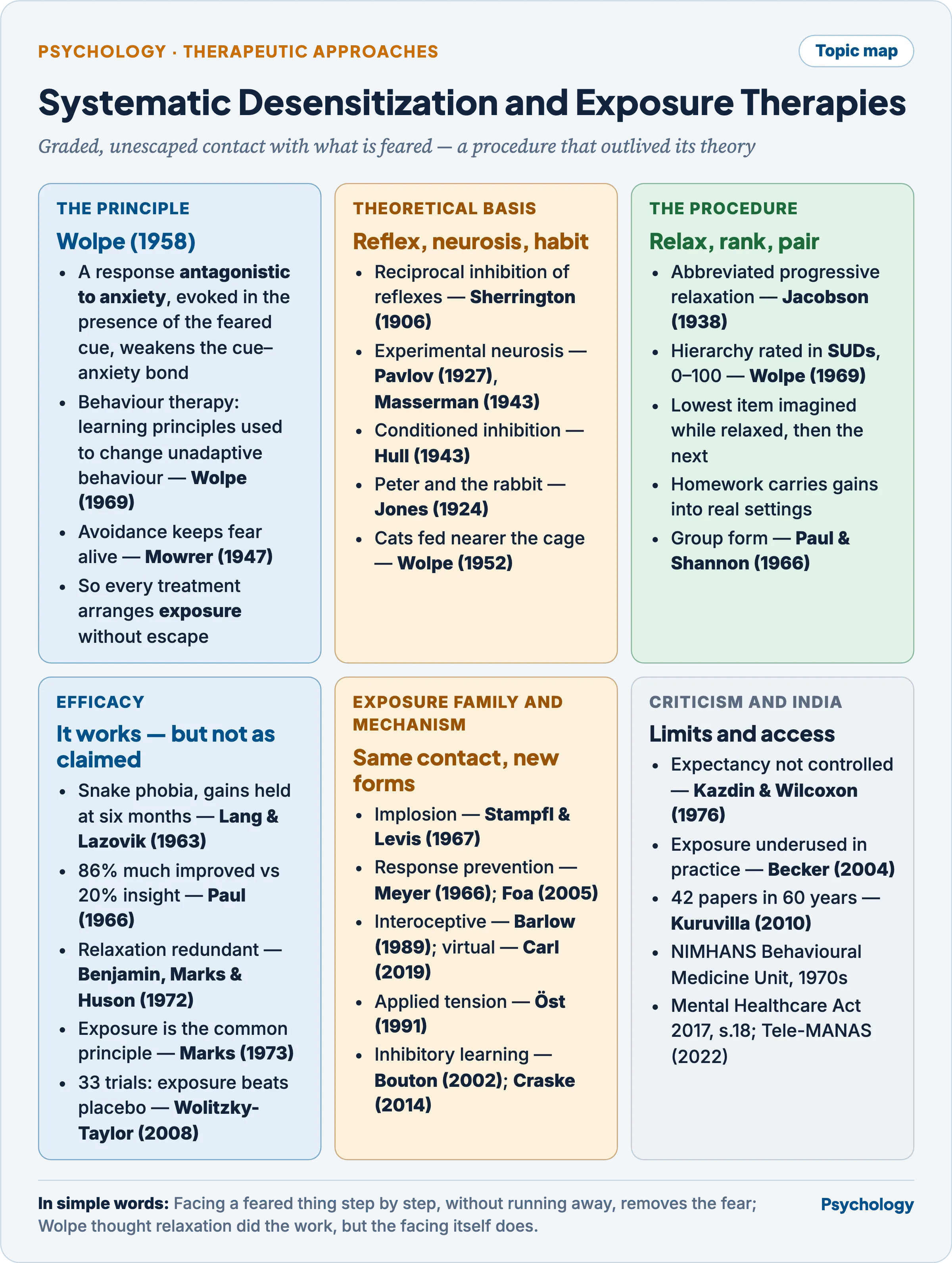
The top-row procedure survived every bottom-row test; its theory did not.
Behaviour therapies: the assumptions behind exposure
- Wolpe (1969) defined behaviour therapy as “the use of experimentally established principles of learning for the purpose of changing unadaptive behavior.”
- Its assumptions, as they bear on anxiety:
- Learned, so unlearnable — “Since neurotic behavior demonstrably originates in learning, it is only to be expected that its elimination will be a matter of ‘unlearning'” (Wolpe, 1958).
- Present maintaining conditions, not childhood origins, are the target.
- The symptom is the disorder, so removing it should not produce a substitute — a prediction the trials below upheld.
- Operational targets — approach distance, subjective ratings, heart rate — measured throughout.
- An active client practising between sessions with a directive therapist; the wider features are in Behaviour Therapies.
- Phobias persist by Mowrer’s (1947) two-factor logic: each escape is reinforced by relief, so the person never stays long enough to learn that the stimulus is safe — see Escape, Avoidance and Learned Helplessness (Paper I).
- Every behavioural treatment of phobia therefore arranges exposure, contact with the feared stimulus without escape.
Reciprocal inhibition and its theoretical basis
The theoretical basis
- Sherrington (1906) used reciprocal inhibition for a reflex property: exciting one muscle inhibits its antagonist. Wolpe (1958) borrowed the term for opposing emotional states.
- Pavlov (1927) produced experimental neurosis in dogs and Masserman (1943) in cats; Wolpe reread both as conditioned anxiety habits.
- Hull (1943) supplied drive reduction and conditioned inhibition, a learned habit of not responding, as the basis of lasting change (Wolpe, 1958).
- Jones (1924) had already removed a fear: Peter, aged nearly three, feared a rabbit, which was brought gradually closer while he ate, with fearless children as models. Wolpe reportedly called her the mother of behaviour therapy.
- This was counterconditioning by direct conditioning and imitation — not systematic desensitization, which needs relaxation training and an imagined hierarchy.
- Jacobson (1938), Progressive Relaxation (first edition 1929), showed that deep muscle relaxation lowers arousal; Wolpe cut the 100–200 training sessions Jacobson allotted to about seven (Wolpe, 1958).
Wolpe’s cat experiments
- Wolpe (1952), at the University of the Witwatersrand:
- Design: cats shocked in a small cage developed lasting anxiety to the cage and room, and would not eat there even when hungry.
- Procedure: food was offered in rooms of decreasing similarity until eating overcame anxiety (Wolpe, 1952), then in rooms ever more like the cage, and finally in it.
- Result: by this gradual ascent all the animals eventually ate in the cage room (Wolpe, 1958); eating inhibited fear step by step.
- Limitation: an animal analogue; later clinical work removed fear by exposure with no competing response (Benjamin, Marks and Huson, 1972).
The principle and the responses antagonistic to anxiety
- By the principle (Wolpe, 1958), anxiety weakens only when a competing response suppresses it in the stimulus’s presence; repeated suppression builds conditioned inhibition.
- Wolpe chose largely parasympathetic responses against anxiety’s sympathetic arousal (Carona, Ramos and Salvador, 2022): assertive for interpersonal anxiety, sexual for sexual anxieties, relaxation for phobias, respiratory for free-floating anxiety; feeding served in his cats and in Jones’s work.
- His clinical claim: of 210 patients, nearly 90 per cent were “apparently cured” or “much improved”, against about 50 per cent then reported for counselling or psychoanalysis (Wolpe, 1958) — an uncontrolled series that Wolpe rated himself.
- The basis was contested from the start: Lomont (1965) argued that extinction, not counterconditioning, could explain desensitization’s effects, since the feared cues recur without harm.
Systematic desensitization step by step
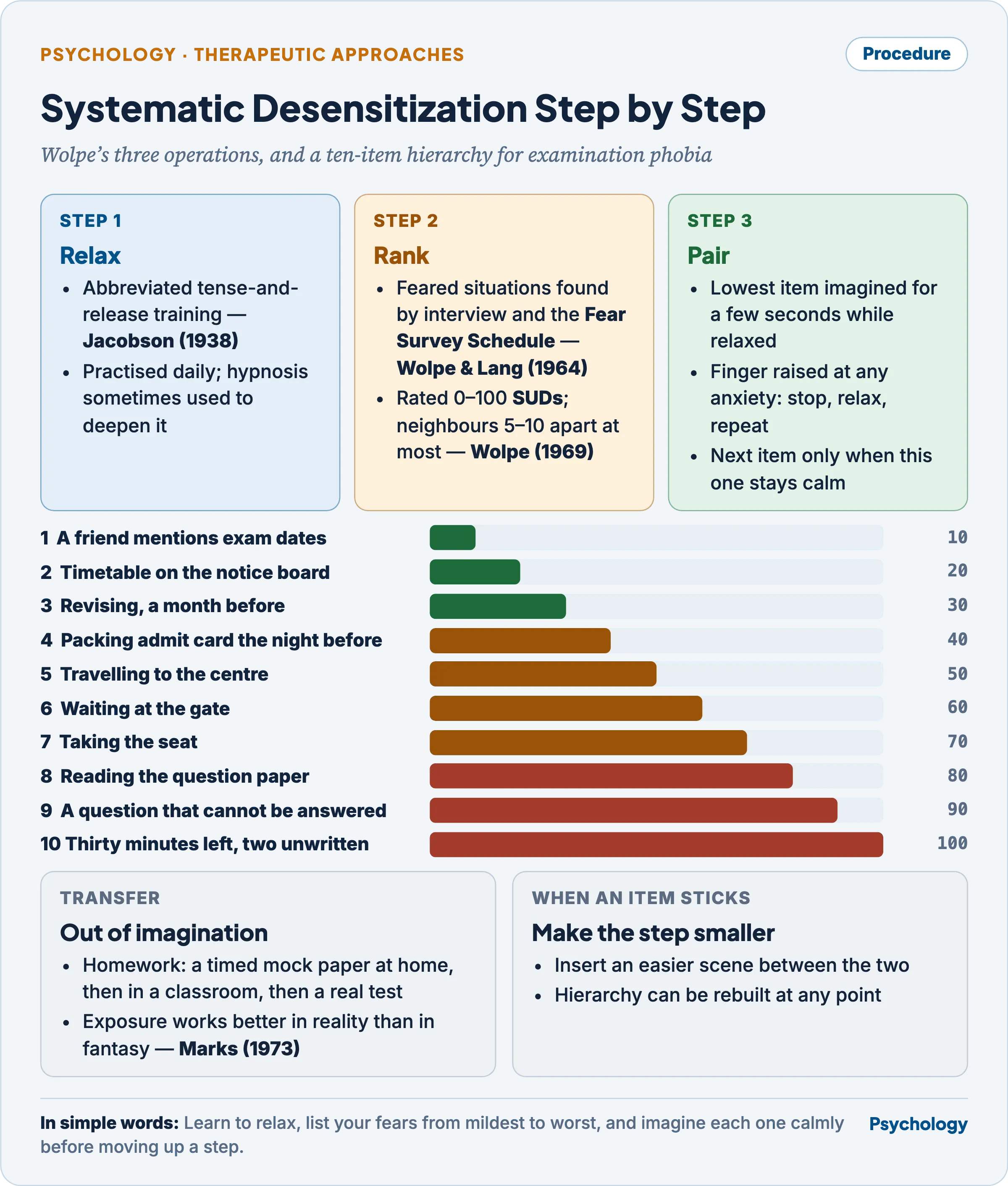
The steps are as small at the top as at the bottom: an item is introduced only once the one below has stopped arousing anxiety.
- Behavioural analysis — anxiety-evoking stimuli identified by interview and the Fear Survey Schedule (Wolpe and Lang, 1964), and grouped into themes.
- Relaxation training — an abbreviated form of Jacobson’s tense-and-release method, practised daily; Wolpe sometimes deepened it with hypnosis.
- Hierarchy construction — each situation rated on the subjective units of disturbance (SUD) scale (Wolpe, 1969), 0 for complete calm to 100 for the worst anxiety imaginable; adjacent items no more than 5–10 SUDs apart (Wolpe, 1969).
- Desensitization proper — deeply relaxed, the client imagines the lowest item for a few seconds and raises a finger at any anxiety; the scene is stopped, relaxation restored and the item repeated until it is held calmly. A stuck item is split.
- Transfer — graded real-life tasks as homework, since gains in imagination must carry over to actual situations.
Worked example: examination phobia
A hierarchy for a student whose fear of examinations has led to missed papers:
| Step | Imagined scene | SUD |
|---|---|---|
| 1 | A friend mentions the examination dates | 10 |
| 2 | Seeing the timetable on the notice board | 20 |
| 3 | Revising at home a month before | 30 |
| 4 | The evening before, packing admit card and pens | 40 |
| 5 | Travelling to the centre that morning | 50 |
| 6 | Waiting at the gate while names are checked | 60 |
| 7 | Taking the seat as invigilators walk past | 70 |
| 8 | Opening the paper and reading the questions | 80 |
| 9 | Meeting a question that cannot be answered | 90 |
| 10 | Thirty minutes left with two answers unwritten | 100 |
- Once step 10 can be imagined calmly, homework moves into reality: a timed mock paper at home, then in a classroom, then a real test.
- Variants: group desensitization, as effective as individual treatment for socially anxious students (Paul and Shannon, 1966) and still at two years (Paul, 1968); in vivo desensitization in real settings; and emotive imagery for children (Lazarus and Abramovitz, 1962), images of pride or mirth replacing relaxation.
Efficacy of systematic desensitization in reducing phobic reactions
- Lang and Lazovik (1963) — the first controlled trial.
- Design: 24 snake-phobic college students; desensitization, with hypnosis to deepen relaxation, against untreated controls, measured by approach to a live snake and fear ratings.
- Result: greater reduction in avoidance and fear, held or growing at six months, with no symptom substitution.
- Limitation: a mild fear in volunteers, not a clinical phobia. A pseudotherapy group, given relaxation and therapist attention but no hierarchy scenes, did not improve (Lang, Lazovik and Reynolds, 1965).
- Paul (1966) — the classic comparison.
- Design: 96 speech-anxious students, the most anxious of 710, assigned to desensitization, insight-oriented therapy, attention-placebo or no treatment, all given by five experienced insight-oriented therapists.
- Measures: a behavioural checklist during a test speech, pulse and palmar sweat, and self-report.
- Result: 86 per cent of the desensitization group were much improved against 20 per cent with insight therapy (Paul, 1966). The advantage held at two years, with no evidence of symptom substitution (Paul, 1967).
- Limitation: student cases and brief insight therapy, though therapist allegiance ran against desensitization.
- Davison (1968) dismantled the package with yoked controls: snake avoidance fell only when relaxation was paired with graded scenes, not with irrelevant scenes or graded scenes alone — support for counterconditioning.
- Clinical dismantling reversed this: Benjamin, Marks and Huson (1972), crossing eight phobic outpatients over desensitization and imaginal exposure without relaxation, judged relaxation redundant.
- Marks (1973) drew the conclusion: most fear-reduction methods share one principle, continued exposure until anxiety and avoidance subside, and exposure works better in reality than in fantasy.
- Wolitzky-Taylor, Horowitz, Powers and Telch (2008), meta-analysing 33 randomised trials for specific phobia: exposure-based treatment beat placebo and non-exposure therapies, and in vivo contact beat imaginal or virtual modes at post-treatment but not at follow-up.
- Verdict: desensitization durably reduces circumscribed phobic reactions because it is graded exposure; Chambless and colleagues (1998) rated it probably efficacious for specific phobia, public-speaking anxiety and social anxiety (Chambless and Ollendick, 2001). It suits children and clients who refuse intense contact.
The exposure family
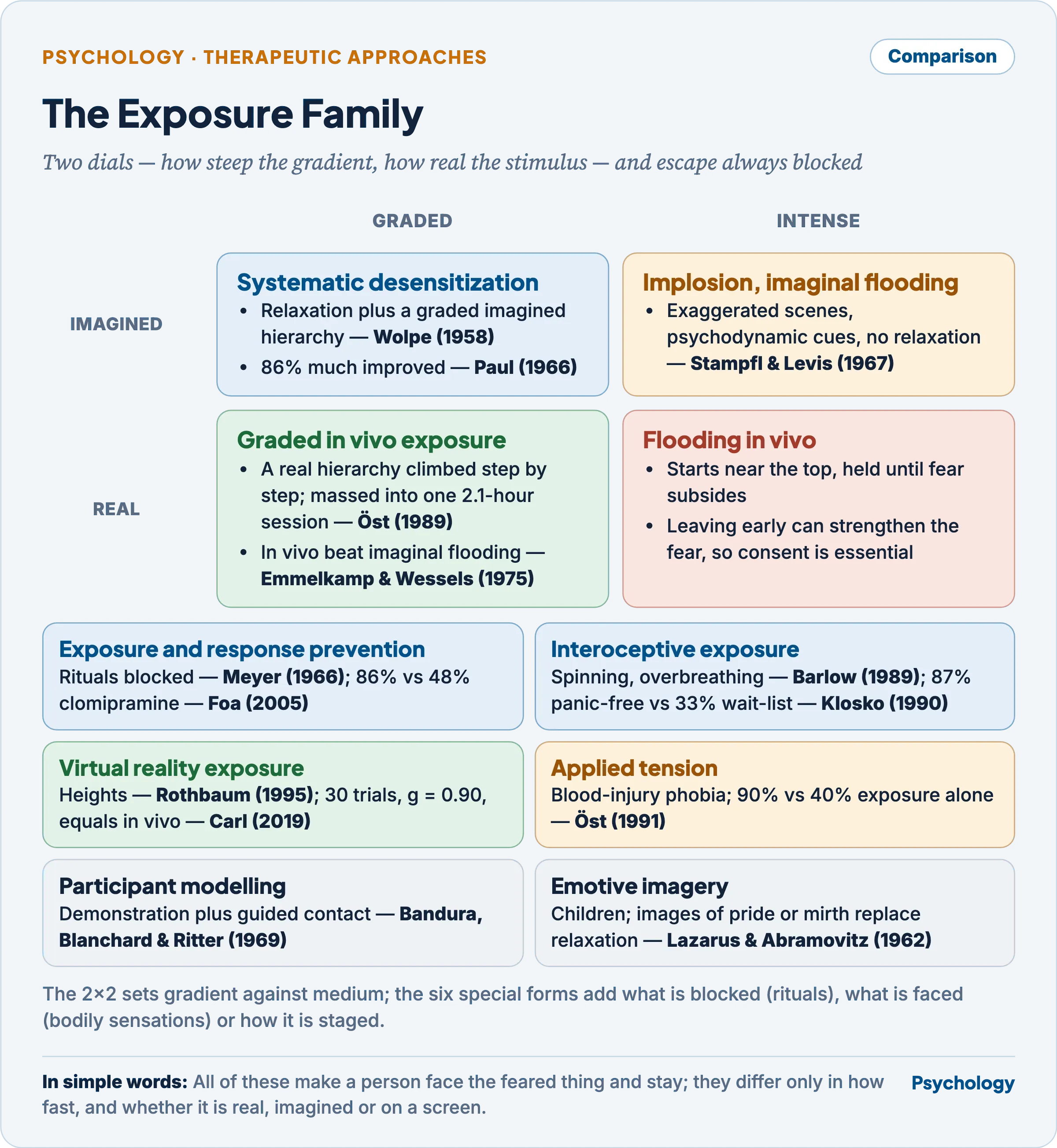
Each technique sets two dials, how steep the gradient and how real the stimulus; what never changes is that escape is blocked.
- Exposure is planned, repeated contact with a feared stimulus, without escape, until the feared outcome is disconfirmed. Techniques vary in gradient, medium and what is blocked — escape, rituals or safety behaviours.
- Graded in vivo exposure climbs a real hierarchy. Emmelkamp and Wessels (1975) gave agoraphobic patients prolonged in vivo exposure, imaginal flooding or both: in vivo had a clear advantage.
- Flooding starts near the top of the hierarchy and holds the person there, in reality or imagination, until fear subsides; leaving early can strengthen the fear, so consent is essential.
- Implosive therapy (Stampfl and Levis, 1967) floods in imagination with exaggerated scenes, including hypothesised psychodynamic cues and no relaxation; they reported marked change within one to fifteen sessions.
- Exposure and response prevention (ERP) began with Meyer (1966), who exposed two hospitalised obsessional patients to their triggers while preventing rituals, even cutting off the water supply.
- Foa and colleagues (2005) randomised 122 adults with OCD: completer response was 86 per cent with intensive ERP, 48 per cent with clomipramine, 79 per cent with both and 10 per cent with placebo.
- Interoceptive exposure provokes the feared bodily sensations, by spinning or overbreathing, in panic control treatment, which with cognitive restructuring left more patients panic-free than relaxation (Barlow, Craske, Cerny and Klosko, 1989).
- 87 per cent of completers were panic-free, against 50 per cent on alprazolam and 33 per cent wait-listed (Klosko, Barlow, Tassinari and Cerny, 1990).
- Virtual reality exposure: Rothbaum and colleagues (1995) treated 20 acrophobic students against a waiting list; across 30 trials and 1,057 participants it had a large effect against waiting lists, g = 0.90, and matched in vivo exposure (Carl and colleagues, 2019).
- One-session treatment (Öst, 1989): in vivo exposure with modelling, averaging 2.1 hours, left 90 per cent of 20 patients much improved or recovered after about four years — an uncontrolled series.
- Participant modelling (Bandura, Blanchard and Ritter, 1969) adds demonstration and guided contact; see Behaviour Therapies and Observational Learning and Modelling (Paper I).
Mechanisms: counterconditioning, extinction and inhibitory learning
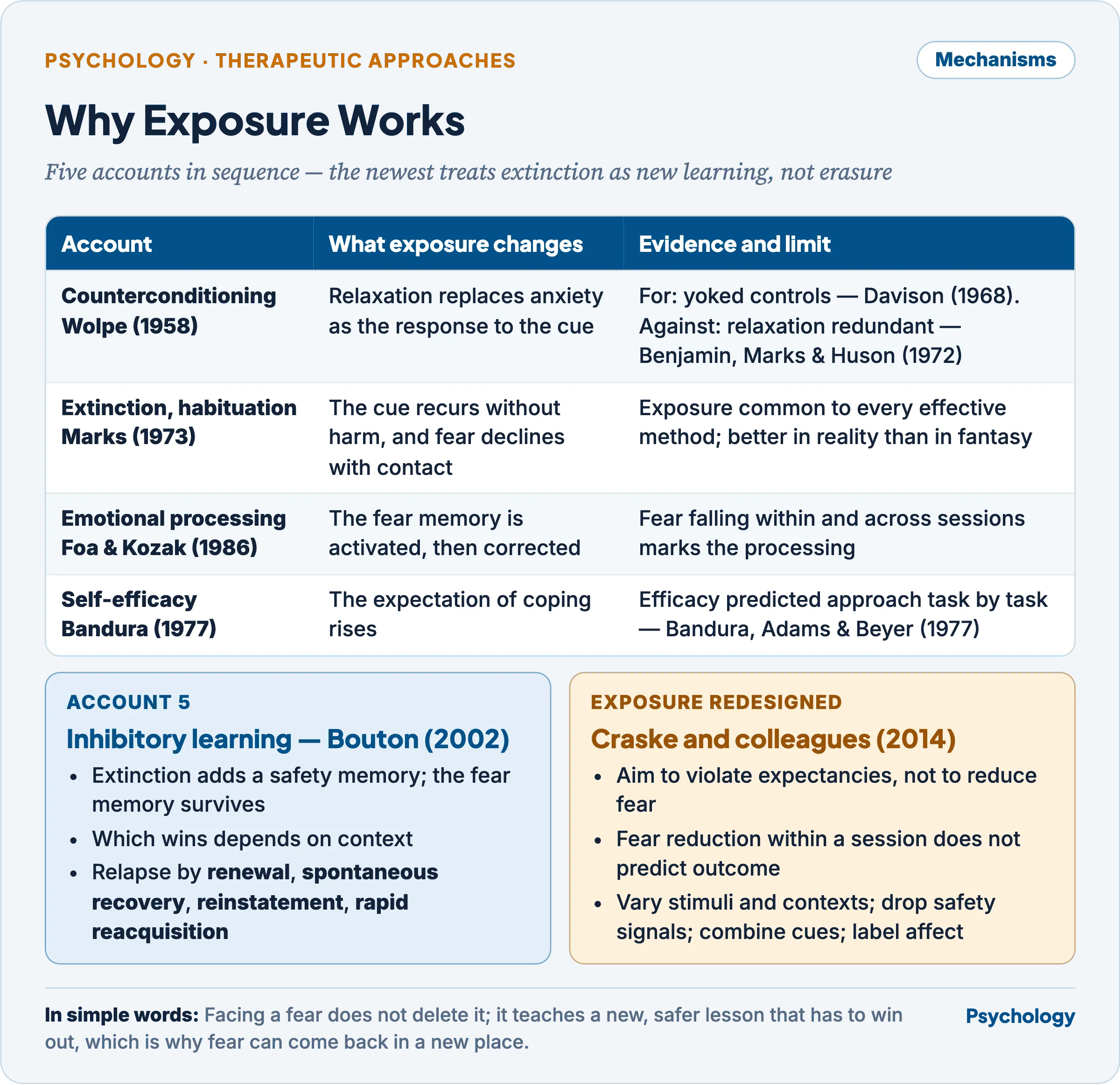
Five accounts of why exposure works; only the newest predicts the return of fear.
- Counterconditioning (Wolpe, 1958) — a competing response attaches to the cue in place of anxiety. But flooding and implosion work with no competing response, and removing relaxation leaves desensitization intact (Benjamin and colleagues, 1972).
- Extinction and habituation — the cue recurs without its aversive consequence, and the response declines with repeated or prolonged contact (Marks, 1973).
- Emotional processing (Foa and Kozak, 1986) — exposure must first activate the fear memory, then supply information incompatible with it; fear falling within and across sessions marks that processing.
- Self-efficacy (Bandura, 1977) — every procedure works by strengthening the expectation of coping.
- Bandura, Adams and Beyer (1977) gave adult snake phobics performance-based treatment, modelling alone or none: mastery raised efficacy most, and efficacy predicted approach behaviour task by task.
- Inhibitory learning — extinction does not erase the fear association but adds a competing safety association whose retrieval depends on context (Bouton, 2002).
- Hence relapse by renewal in a new context, spontaneous recovery with time, reinstatement after a fresh aversive event and rapid reacquisition (Bouton, 2002).
- Craske and colleagues (2014) therefore design exposure to violate expectancies rather than to reduce fear, since fear reduction within a session does not predict long-term outcome.
- Their strategies: expectancy violation, deepened extinction, occasional reinforced extinction, removal of safety signals, variability, retrieval cues, multiple contexts and affect labelling.
Types of phobias in clinical practice and the application of behaviour therapy
DSM-5-TR (2022) recognises five specific phobia subtypes alongside social anxiety disorder and agoraphobia; the classification is in Anxiety Disorders: Types and Causal Factors (Unit 2).
| Phobia | Behaviour therapy | Evidence |
|---|---|---|
| Animal (snakes, spiders, dogs) | Graded in vivo or one-session exposure; participant modelling | Lang and Lazovik (1963); Öst (1989) |
| Natural environment (heights, water, storms) | Graded in vivo or virtual reality exposure | Rothbaum and colleagues (1995) |
| Blood-injection-injury | Applied tension with exposure | Öst, Fellenius and Sterner (1991) |
| Situational (lifts, flying, enclosed spaces) | In vivo or virtual exposure; interoceptive work if panic coexists | Carl and colleagues (2019) |
| Other (choking, vomiting; children’s fear of loud noise) | Graded exposure; emotive imagery for children | Lazarus and Abramovitz (1962) |
| Social anxiety disorder | Exposure without safety behaviours; group desensitization | Paul and Shannon (1966) |
| Agoraphobia | Prolonged in vivo exposure, then self-directed practice | Emmelkamp and Wessels (1975) |
- Applied tension answers a physiologically different fear. Blood-injury phobia brings a diphasic response — heart rate and blood pressure rise, then fall sharply, causing fainting — so relaxation would worsen it; tensing the large muscles holds blood pressure up.
- Öst, Fellenius and Sterner (1991) treated 30 patients in five sessions: 90 per cent clinically improved with applied tension, 80 per cent with tension alone and 40 per cent with exposure alone; at one year, 100, 90 and 50 per cent.
- Social anxiety is the partial exception: Clark and colleagues (2006), randomising 62 patients, found 84 per cent no longer diagnosable after cognitive therapy against 42 per cent after exposure with applied relaxation, and none on a waiting list.
Behavioural approaches to the anxiety disorders
- DSM-5-TR’s seven anxiety disorders: separation anxiety disorder, selective mutism, specific phobia, social anxiety disorder, panic disorder, agoraphobia and generalized anxiety disorder. OCD and PTSD left the chapter in DSM-5 (2013) but are still treated by exposure.
| Disorder | Core fear | Behavioural approach | Evidence |
|---|---|---|---|
| Panic disorder | Bodily sensations | Interoceptive exposure, breathing retraining | Barlow and colleagues (1989) |
| Generalized anxiety disorder | Many everyday matters | Applied relaxation as a coping skill | Borkovec and Costello (1993) |
| Obsessive-compulsive disorder | Harm from intrusions | Exposure and response prevention | Foa and colleagues (2005) |
| Post-traumatic stress disorder | Trauma memories | Prolonged imaginal and in vivo exposure | Institute of Medicine (2007) |
- Relaxation is not part of ERP but its control condition: Fals-Stewart, Marks and Schafer (1993) randomised 93 OCD outpatients, and both group and individual ERP beat progressive muscle relaxation.
- Nor is relaxation a specific cure for panic: it beat a waiting list on general anxiety but left fewer patients panic-free (Barlow and colleagues, 1989).
- For PTSD the Institute of Medicine (2007) judged exposure the only treatment with sufficient evidence, yet only 17 per cent of responding psychologists, from 852 surveyed, used imaginal exposure (Becker, Zayfert and Anderson, 2004).
Cognitive and behaviour therapies for anxiety
| Dimension | Behaviour therapy | Cognitive therapy |
|---|---|---|
| Target | Avoidance and conditioned fear | Threat appraisals and beliefs |
| Mechanism | Extinction, inhibitory learning | Disconfirming catastrophic predictions |
| Techniques | Hierarchy, exposure, response prevention | Socratic questioning, thought records, behavioural experiments |
| Role of thought | Changes after behaviour changes | Changed directly, then tested in action |
| Founders | Wolpe (1958); Marks (1973) | Beck (1976); Clark (1986) |
- Ougrin (2011), pooling 20 trials with 1,308 patients, found no difference between cognitive therapy and exposure in panic disorder, PTSD or OCD, and cognitive therapy superior in social phobia.
- Marks and Dar (2000): exposure alone and cognitive therapy alone are each sufficient, but neither is necessary, to reduce fear.
- In practice they merge: cognitive therapy uses exposure as behavioural experiments, and exposure now tests expectancies (Craske and colleagues, 2014). The cognitive half is in Cognitive Therapies: Beck and Cognitive-Behavioural Therapy.
Criticisms and limitations
- Mechanism unproven — relaxation proved redundant and flooding works with no antagonist, so reciprocal inhibition was never shown to be the mechanism (Benjamin and colleagues, 1972).
- Expectancy — control conditions were usually less credible than desensitization, so a specific effect beyond expectancy was not established (Kazdin and Wilcoxon, 1976).
- Analogue evidence — the founding trials used mildly fearful students (Lang and Lazovik, 1963; Paul, 1966), not clinical patients.
- Return of fear — extinction is context-bound, so fear can renew in new settings (Bouton, 2002).
- Distress and underuse — the intense forms are aversive, and the belief that exposure is cruel has kept it out of practice (Olatunji, Deacon and Abramowitz, 2009).
- Narrow reach — it suits fears with a clear stimulus; diffuse worry and the self-focused beliefs of social anxiety need cognitive work (Clark and colleagues, 2006).
- Symptom substitution, predicted by psychodynamic critics, was looked for and not found (Lang and Lazovik, 1963; Paul, 1967).
Indian context
- Kuruvilla (2010), hand-searching the Indian Journal of Psychiatry from 1949 to 2009, found only 42 behaviour-therapy papers, 10 of them case reports; aversion therapy and progressive muscle relaxation were most used, operant methods rare, and the relationship with Indian psychiatry remained “a tenuous one”.
- Chopra’s (1975) desensitization series of 11 patients, including agoraphobia and OCD, all improved, six markedly, though the work was done in Australia (Kuruvilla, 2010).
- NIMHANS, Bengaluru: the Department of Clinical Psychology set up its Behavioural Medicine Unit, one of its two specialty units, in the 1970s; H. N. Murthy (1924–2011) is credited with introducing behaviour therapy there.
- Samantaray, Chaudhury and Singh (2018), in Cuttack, randomised 32 OCD patients to inhibitory-learning-based ERP with an SSRI or the SSRI alone: no difference after treatment, but the combined group did better over six months. Limitation: a small, single-masked sample.
- Workforce: 3,795 clinical psychologists were on the Rehabilitation Council of India’s register on 31 March 2024 (Rehabilitation Council of India, 2024), and there are about 0.75 psychiatrists per lakh people (PIB, 2025): the bottleneck for therapist-intensive exposure.
- Mental Healthcare Act, 2017 (Ministry of Health and Family Welfare) — Section 18 gives every person “a right to access mental healthcare and treatment from mental health services run or funded by the appropriate Government”; it operationalises access to evidence-based treatment as an entitlement.
- Tele-MANAS (Ministry of Health and Family Welfare, launched 10 October 2022; helpline 14416) — 53 cells across all 36 states and union territories and 47.75 lakh calls by October 2026 (Ministry of Health and Family Welfare, 2026).
- It operationalises low-threshold help-seeking for people whose avoidance keeps them from clinics, but it offers tele-counselling and referral (PIB, 2025); structured exposure still needs a trained therapist.
Previous Year Questions
- 2023Explain the assumptions of behaviour therapy. Discuss various techniques of behaviour therapy to treat phobia.
- 2021Describe the different types of anxiety disorders. What are the behavioural approaches to treat such patients?
- 2018Discuss the efficacy of systematic desensitization in reducing clients’ phobic reactions. Illustrate your answer with suitable example.
- 2017Explain reciprocal inhibition in behaviour therapy and point out its theoretical basis.
- 2010Enumerate the different types of phobias encountered in clinical practice. Explain the application of behaviour therapy in handling these phobic disorders.
- 2002Compare Cognitive Therapies and Behaviour Therapies. Present behaviour therapy as a method of treatment for anxiety disorders.