

Psychocybernetics.
Official Syllabus: Paper I · Unit 14 Issues and Perspectives in Modern Contemporary Psychology
“Cybernetics is the science of control and communication in the animal and the machine.”
— after Wiener (1948)
One name covers two very different things, and the first task is to separate them. Cybernetics, as Norbert Wiener defined it, is a formal science of goal-directed systems: anything that holds a variable near a reference value by sensing its own output does so by the same mathematics, whether it is a thermostat, a hand reaching for a cup or a family. Psycho-Cybernetics, published by the cosmetic surgeon Maxwell Maltz in 1960, borrows that vocabulary for a popular self-image psychology. The first produced a research tradition in psychology; the second produced a best-seller and no experimental programme, and both have to be covered as what they are.
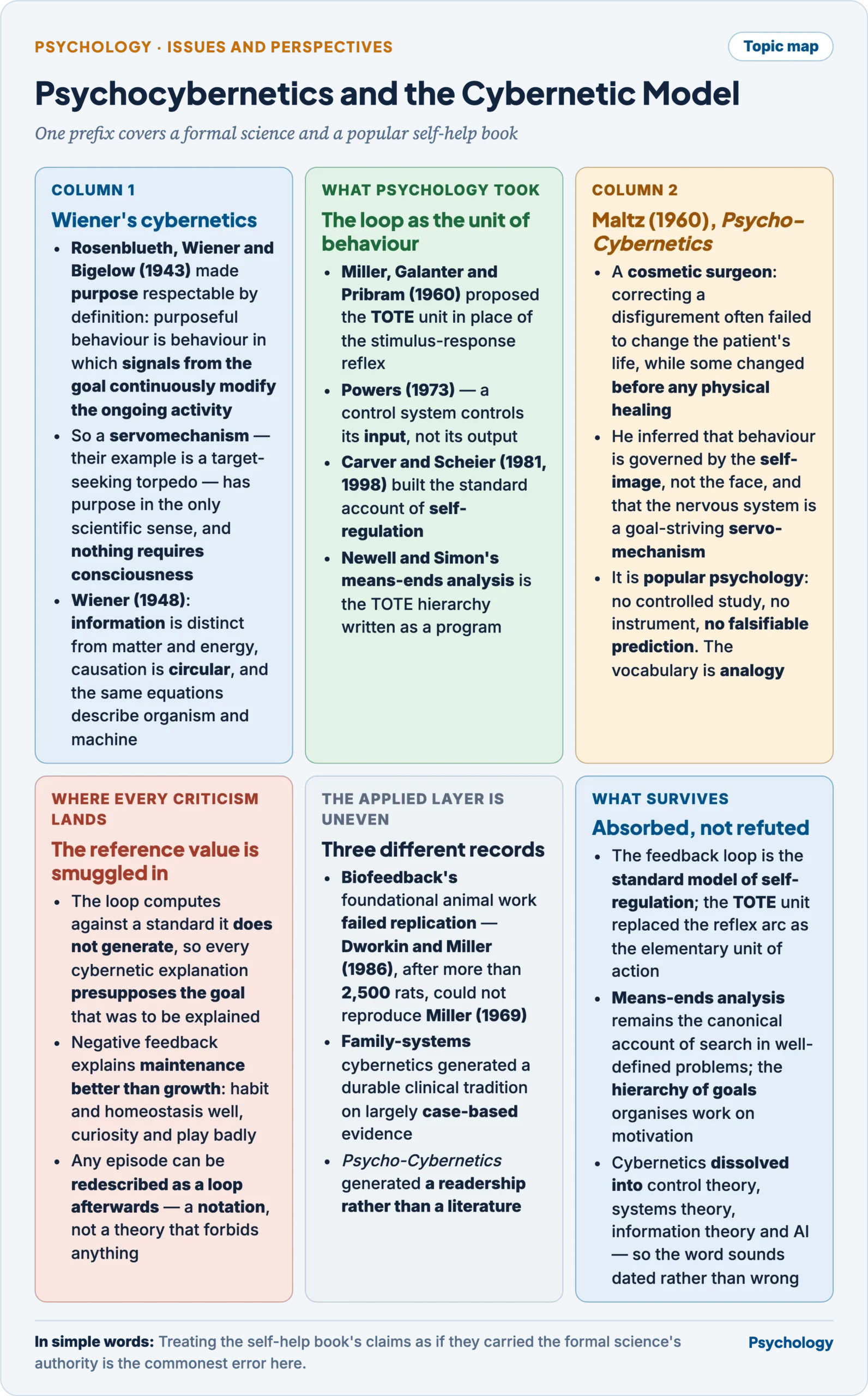
The left column is a formal science absorbed into mainstream psychology; the right column is a popular application of its vocabulary. The arrow between them runs one way only.
Wiener’s cybernetics: control and communication through feedback
Purpose made mechanical
- Rosenblueth, Wiener and Bigelow (1943) wrote the founding paper, and their achievement was to make purpose a respectable scientific term again after behaviourism had banished it.
- Their move was definitional. Behaviour is active or passive; active behaviour is purposeful or random; and purposeful behaviour is behaviour in which signals from the goal continuously modify the ongoing activity.
- A servomechanism — their example is a target-seeking torpedo — therefore has purpose in the only sense that matters scientifically, because the gap between where it is and where it is going is what steers it.
- Purpose becomes a structural property, not a mental one. Nothing in the account requires consciousness, which is why it could be applied to a reflex, a machine and a motive with the same formalism.
- Wiener (1948) generalised this into a science of control and communication, with three commitments that psychology took over: that information is a quantity distinct from matter and energy, that causation in such systems is circular rather than linear, and that the same equations describe organism and machine.
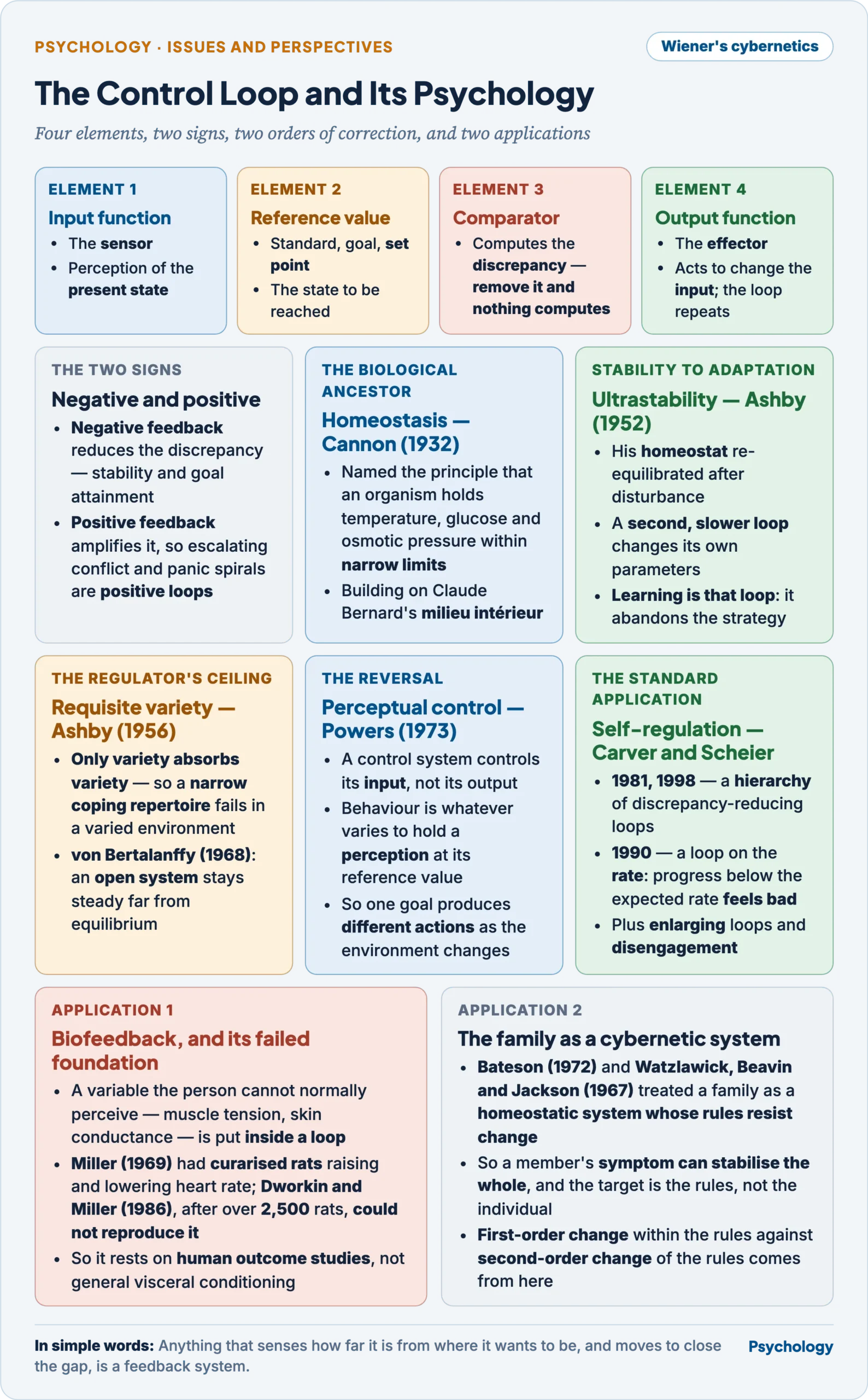
The comparator is the whole mechanism: remove the reference value and the loop has nothing to compute, which is where every criticism of the model eventually lands.
- A control loop has four elements, and naming them is what makes the model usable.
- Input function (sensor) — the system’s perception of its present state.
- Reference value (standard, goal, set point) — the state to be maintained or reached.
- Comparator — computes the discrepancy between the two.
- Output function (effector) — acts so as to change the input, after which the loop repeats.
- Negative feedback reduces the discrepancy and so produces stability and goal attainment; positive feedback amplifies it and so produces runaway change, which is why escalating conflict, panic spirals and vicious cycles are modelled as positive loops.
Homeostasis, ultrastability and variety
- The biological ancestor is homeostasis. Cannon (1932) named and popularised the principle that an organism holds its internal environment — temperature, glucose, osmotic pressure — within narrow limits by compensating for disturbance, building on Claude Bernard’s milieu intérieur.
- Ashby (1952) extended the idea from stability to adaptation. His homeostat, a machine of interconnected units that returned itself to equilibrium after arbitrary disturbance, demonstrated ultrastability: a second, slower feedback loop that changes the system’s own parameters when the first loop cannot restore equilibrium.
- The psychological reading is direct. First-order feedback corrects an error within a strategy; second-order feedback abandons the strategy. Learning is the second loop.
- von Bertalanffy (1968) generalised the same insight into general systems theory: an open system exchanges matter, energy and information with its environment and maintains a steady state far from equilibrium, which is why a living system can be orderly without being closed.
- A later generation — second-order cybernetics — turned the loop on the observer, arguing that the describer of a system is inside it; this is the lineage of the constructivist and systemic therapies.
- Ashby (1956) added the law of requisite variety: only variety can absorb variety. A regulator can neutralise only as many kinds of disturbance as it has kinds of response — a formal statement of why a narrow coping repertoire fails in a varied environment.
Feedback as the unit of behaviour in psychology
The TOTE unit
- Miller, Galanter and Pribram (1960) imported the loop into psychology and proposed the TOTE unit — Test, Operate, Test, Exit — as the replacement for the stimulus-response reflex as the elementary unit of behaviour.
- Test compares the present state with the goal state. If they match, Exit; if not, Operate and test again.
- The standard illustration is hammering a nail: the exit test is whether the nail is flush with the surface, and the operation repeats until the test is passed.
- Two further constructs do the work the loop alone cannot.
- The Image is the organism’s stored knowledge of itself and its world, which supplies the reference values.
- The Plan is a hierarchy of TOTE units, so that one unit’s Operate phase is itself a complete TOTE at a lower level — which is how a subgoal is represented.
- The significance for the discipline is that behaviour ceased to be a chain of stimulus-response links and became the execution of a hierarchically organised, internally monitored program.
Perceptual control and self-regulation
- Powers (1973) pressed the logic further: a control system does not control its output, it controls its input. Behaviour is whatever varies in order to hold a perception at its reference value, which reverses the usual explanatory direction and predicts that the same goal will produce quite different actions as the environment changes.
- Carver and Scheier (1981, 1998) built the standard psychological application, treating self-regulation as a hierarchy of discrepancy-reducing negative loops in which higher-level goals — being a certain kind of person — set the reference values for the action loops beneath them.
- Carver and Scheier (1990) added a second loop whose input is the rate of discrepancy reduction, not its size, and derived affect from it: positive affect when progress exceeds the expected rate, negative affect when it falls short. This explains why a person doing well can still feel bad about slowing down.
- They also posit discrepancy-enlarging loops for avoidance goals, where the aim is to move away from an anti-goal, and a point of disengagement at which low expectancy of success leads to abandoning the goal rather than trying harder.
- Applied cybernetics in the clinic is biofeedback: a physiological variable the person cannot normally perceive — muscle tension, skin conductance, heart rate variability — is sensed, displayed, and so brought inside a controllable loop.
- Its most famous animal foundation did not survive. Miller (1969) reported curarised rats learning to raise and lower heart rate and other visceral responses by operant reinforcement, with muscular mediation apparently excluded. Dworkin and Miller (1986), after work on more than 2,500 rats, reported that they could not reproduce the effect and concluded the original experiments were not replicable.
- After Dworkin and Miller (1986) the honest position is that clinical biofeedback rests on human outcome studies in particular conditions, not on a demonstrated general capacity for direct visceral conditioning.
- The family as a cybernetic system is the other major application. Bateson (1972) and Watzlawick, Beavin and Jackson (1967) treated a family as a homeostatic system whose rules resist change, so that a member’s symptom can function to stabilise the whole; the therapeutic target is then the system’s rules, not the individual, and the distinction between first-order change within the rules and second-order change of the rules comes from this tradition.
Psychocybernetics: Maltz’s self-image psychology
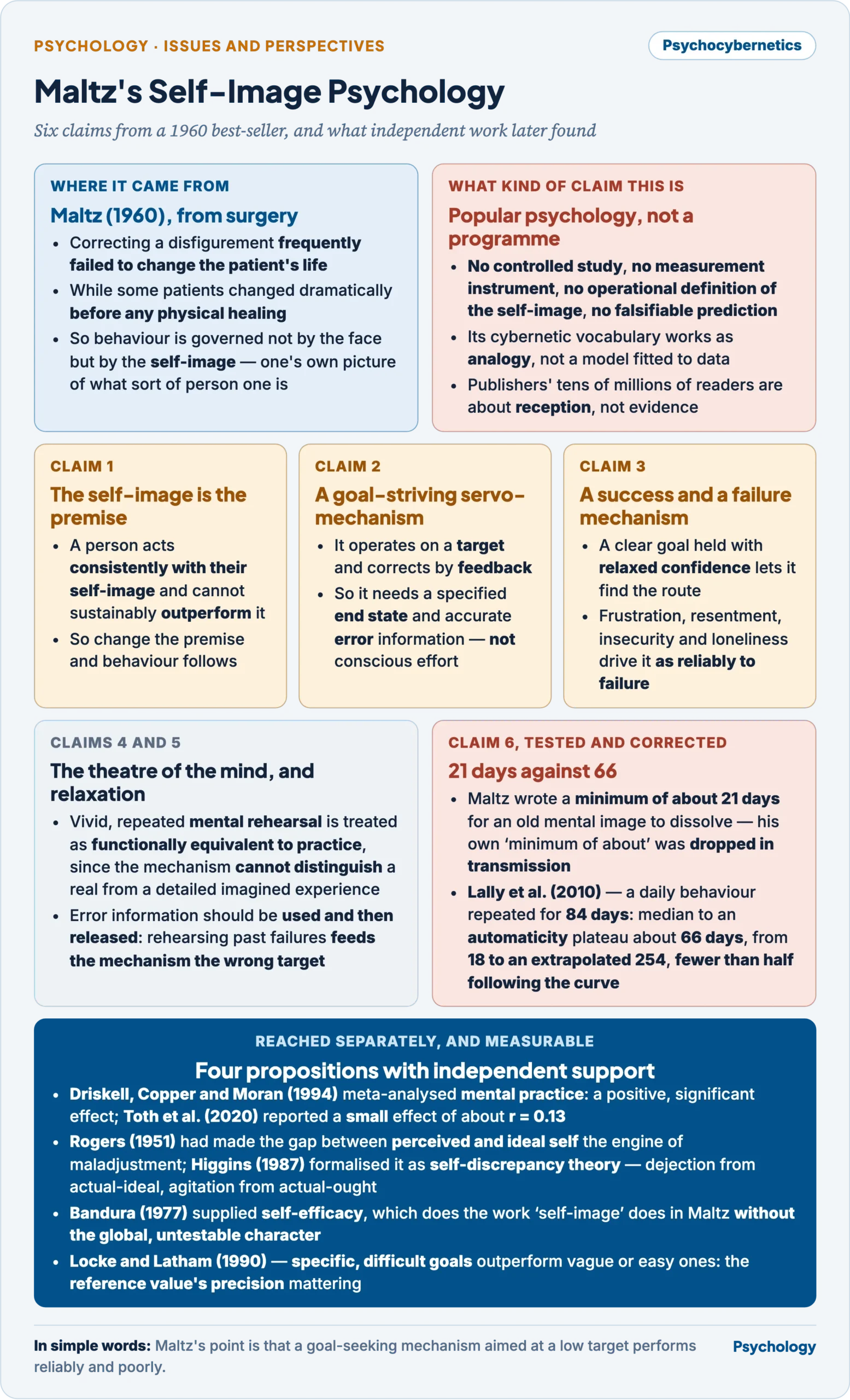
Maltz’s claim is that the reference value, not the effort, is the limiting factor: a goal-seeking mechanism aimed at a low target performs reliably and poorly.
- Maltz (1960) came to the subject from surgery. He observed that correcting a disfigurement frequently failed to change the patient’s life, while some patients changed dramatically before any physical healing — and inferred that behaviour is governed not by the face but by the self-image, the person’s own picture of what sort of person they are.
- His central ideas, which are the content of the book, are these.
- The self-image is the premise. A person acts, feels and behaves consistently with their self-image, and cannot sustainably outperform it; so change the premise and the behaviour follows without being attacked directly.
- The nervous system is a goal-striving servo-mechanism. It operates on a target and corrects by feedback, so it requires a clearly specified end state and accurate information about error; it does not require conscious effort at each step.
- A success mechanism and a failure mechanism. On Maltz’s (1960) account a clear goal held with relaxed confidence lets the mechanism find the route, while chronic frustration, resentment, insecurity, loneliness and emptiness drive it equally reliably toward failure.
- The theatre of the mind. Vivid, repeated mental rehearsal of the desired performance is treated as functionally equivalent to practice, because the mechanism cannot distinguish a real from a sufficiently detailed imagined experience.
- Relaxation and the forgetting of error. Error information should be used and then released; rehearsing past failures feeds the mechanism the wrong target.
- A minimum period for change. Maltz wrote that it requires a minimum of about 21 days for an old mental image to dissolve and a new one to set, generalising from the time his patients took to adjust to an altered face.
- What kind of claim this is matters. Psycho-Cybernetics is popular psychology, not an experimental programme: it contains no controlled study, no measurement instrument, no operational definition of the self-image and no falsifiable prediction, and its cybernetic vocabulary functions as analogy rather than as a model that could be fitted to data. Publishers’ claims of tens of millions of readers are a fact about its reception, not about its evidence.
- Several of its propositions nevertheless have independent support, arrived at separately.
- Mental rehearsal works, modestly. Driskell, Copper and Moran (1994) meta-analysed mental practice and found a positive, significant effect on performance, moderated by task type, the interval between practice and performance, and the length of the intervention; Toth and colleagues (2020), revisiting the question, reported a small overall effect of about r = 0.13.
- The self-image has a measurable form. Rogers (1951) had already made the gap between the perceived self and the ideal self the engine of maladjustment, and Higgins (1987) formalised it as self-discrepancy theory, deriving dejection-related emotion from actual-ideal discrepancy and agitation-related emotion from actual-ought discrepancy.
- The mechanism Maltz asserted was later specified. Bandura (1977) supplied self-efficacy — a belief about capability in a domain, measurable and manipulable — which does the explanatory work that “self-image” does in Maltz without the global, untestable character.
- The insistence on a clear target was vindicated from another direction. Locke and Latham (1990) established that specific, difficult goals produce higher performance than vague or easy ones, across hundreds of studies — the reference value’s precision mattering, exactly as a control model predicts.
- One of its claims has been tested and corrected. The popular descendant of Maltz’s remark, that a habit takes 21 days to form, is not supported. Lally and colleagues (2010) had volunteers repeat a new daily behaviour for 84 days and found the median time to reach a plateau of automaticity to be about 66 days, ranging from 18 days to an extrapolated 254, with fewer than half the sample following the expected curve at all. Maltz’s own “minimum of about” was dropped somewhere in transmission.
The cybernetic model of behaviour and problem solving
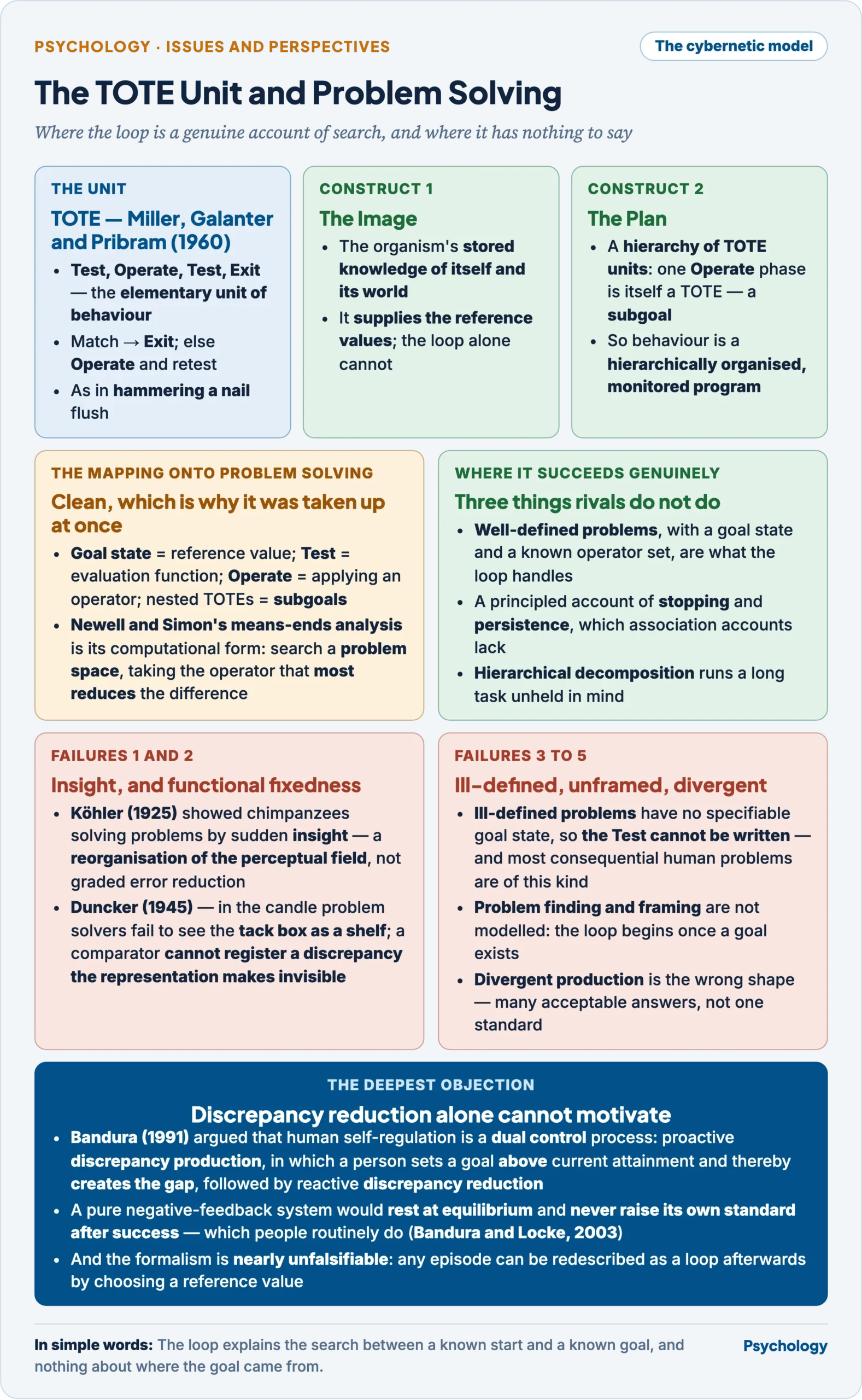
The loop is a strong account of the search between a known start and a known goal, and has nothing to say about the step that changes what the goal looks like.
- The model maps onto problem solving cleanly, which is why it was taken up at once.
- The goal state is the reference value; the Test is the evaluation function; Operate is the application of an operator; and nested TOTEs are subgoals.
- Newell and Simon’s means-ends analysis is the computational implementation, with the problem recast as search through a problem space: compute the difference between current and goal states, select the operator that most reduces it, and recur when a precondition is unmet — a TOTE hierarchy written as a program.
- Where it succeeds, it succeeds genuinely.
- Well-defined problems, with a specifiable goal state and a known operator set, are exactly what the loop handles.
- It supplies a principled account of stopping and of persistence, which association-based accounts lack, and of error correction during skilled action.
- Hierarchical decomposition explains how a long task is executed without the whole sequence being held in mind.
- Its failures are equally specific, and they are the examinable half.
- Insight and restructuring lie outside the loop. Köhler (1925) showed chimpanzees solving problems by sudden insight, a reorganisation of the perceptual field rather than graded error reduction.
- Duncker (1945) demonstrated functional fixedness: in the candle problem, solvers fail to see the tack box as a shelf because it is already represented as a container. A comparator cannot register a discrepancy that the current representation makes invisible.
- Ill-defined problems have no specifiable goal state, so the Test cannot be written. Most consequential human problems — writing, designing, deciding what to do with a life — are of this kind.
- Problem finding and problem framing are not modelled. The loop begins once a goal exists; where the goal comes from, and how a vague dissatisfaction becomes a formulated problem, is assumed.
- Divergent production is the wrong shape for the model. Generating many acceptable possibilities is not discrepancy reduction against a single standard.
- Discrepancy reduction alone cannot motivate. Bandura (1991) argued that human self-regulation is a dual control process: proactive discrepancy production, in which a person sets a goal above current attainment and thereby creates the gap, followed by reactive discrepancy reduction. A pure negative-feedback system would rest once equilibrium was reached and would never raise its own standard after success, which is what people routinely do. Bandura and Locke (2003) restated the case against treating negative discrepancy as the motivator.
- The formalism is nearly unfalsifiable. Any goal-directed episode can be redescribed as a loop after the event by choosing a suitable reference value, which makes the model a notation for problem solving rather than a theory that forbids anything.
Criticisms and evaluation
- The ambiguity in the name is itself a problem. Wiener’s cybernetics and Maltz’s self-image psychology share a prefix and little else; treating the popular book’s claims as though they carried the formal science’s authority is the commonest error on this topic.
- Cybernetics was absorbed rather than refuted. Its concepts survive completely — in control theory, general systems theory, information theory, artificial intelligence and self-regulation research — while cybernetics as a unified discipline dissolved into them, which is why the term now sounds dated rather than wrong.
- Negative feedback explains maintenance better than growth. A system built to reduce discrepancy models adaptation, habit and homeostasis well, and models curiosity, play, exploration and the deliberate seeking of difficulty badly.
- The reference value is smuggled in. The loop computes against a standard it does not generate, so every cybernetic explanation of behaviour presupposes the goal whose origin was the thing to be explained.
- The machine analogy under-describes the organism. A thermostat has one variable and one standard; a person holds many standards simultaneously, in conflict, at several levels, with affect attached to the rate of progress rather than the state — and modelling that requires most of the psychology the analogy was meant to replace.
- The applied layer is uneven. Biofeedback’s foundational animal work failed replication; family-systems cybernetics generated a durable clinical tradition on largely case-based evidence; and Psycho-Cybernetics generated a readership rather than a literature.
- What survives is considerable. The feedback loop is the standard model of self-regulation; the TOTE unit replaced the reflex arc as psychology’s elementary unit of action; means-ends analysis remains the canonical account of search in well-defined problems; the hierarchy of goals is the organising idea of modern work on motivation; and the distinction between correcting an error within a strategy and changing the strategy is now basic to accounts of learning and of therapy.
Previous Year Questions
- 2023Discuss some key ideas from Psychocybernetics.
- 1997Can the Cybernetic model of behaviour explain problem solving behaviour?