

Study of consciousness.
Official Syllabus: Paper I · Unit 14 Issues and Perspectives in Modern Contemporary Psychology
“An organism is conscious if there is something it is like to be that organism, and a mental state is conscious if there is something it is like to be in that state.”
— Chalmers (1995)
That definition is thin because every richer one has failed. Consciousness is the one subject matter in psychology nobody can observe in anyone but themselves, which is why a discipline measuring reaction times to the millisecond spent half a century refusing to study it. What has to be settled is what the term can mean, what explains it, and how its organisation changes when the ordinary waking state is displaced.
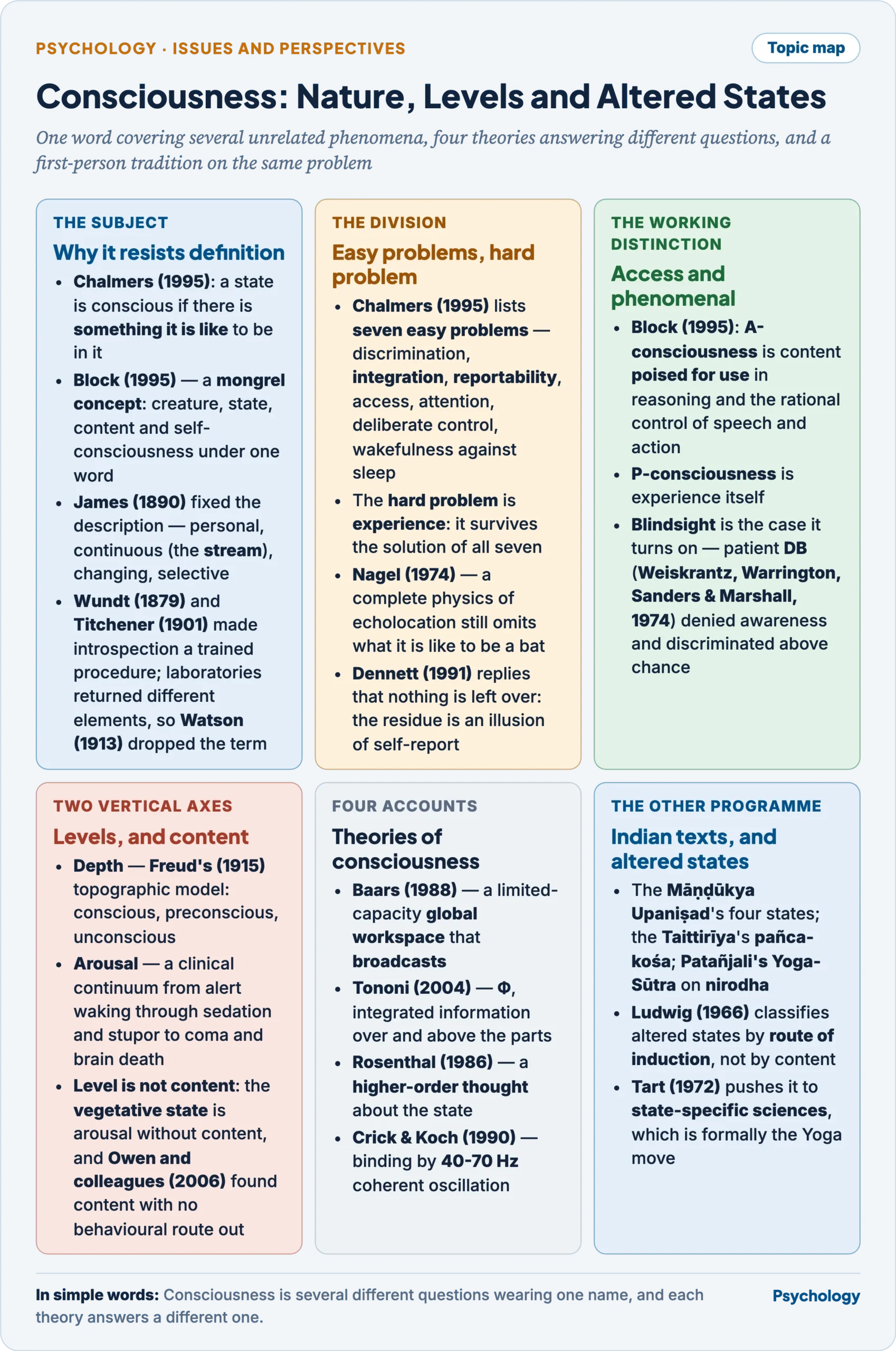
The definitional work on the left is not a preliminary to the theories on the right: each theory survives by answering a different sense of the word.
The nature of consciousness and why it resists definition
- Block (1995) called consciousness a mongrel concept — one word covering several unrelated phenomena, so two researchers can argue past each other about different things.
- Four senses have to be kept apart before any theory can be assessed.
- Creature consciousness — a property of the whole organism: awake rather than comatose.
- State consciousness — a property of a particular mental state, which may be conscious or may do its work unnoticed.
- Content — what the state is about, the perception or thought occupying awareness.
- Self-consciousness — awareness of oneself as the subject of the experience, a later and narrower achievement.
- James (1890), in The Principles of Psychology, fixed the descriptive features still in use: consciousness is personal, continuous (the stream of consciousness), changing, selective, and always about something.
- The stream metaphor does real work: experience has no gaps from the inside even across dreamless sleep, so continuity belongs to the report rather than to the underlying process.
- The method meant to deliver it collapsed. Wundt (1879) and later Titchener (1901) made introspection a trained procedure for decomposing experience into elements, and observers in different laboratories returned different elements with no third party able to adjudicate.
- Watson (1913) drew the conclusion that psychology should drop the term and define itself by observable behaviour. Consciousness returned with the cognitive revolution, approached through performance measures rather than through report alone.
- Nagel (1974) supplied the argument that keeps the problem alive: a complete physical account of a bat’s echolocation still would not say what it is like to be a bat.
The easy problems and the hard problem
- Chalmers (1995) divided the field. The easy problems are those open to the standard methods of cognitive science, explicable by computational or neural mechanism.
- He lists seven: discriminating, categorising and reacting to stimuli; the integration of information; the reportability of mental states; a system’s access to its own internal states; the focus of attention; the deliberate control of behaviour; and the difference between wakefulness and sleep.
- “Easy” is relative: Chalmers allows “a century or two of difficult empirical work”.
- The hard problem is the problem of experience: why physical processing is accompanied by any inner life.
- Its distinguishing feature is that it survives the solution of all the easy problems — explain every function, and why performing those functions feels like anything remains open.
- Dennett (1991) supplies the standing objection, and it is the one to carry: nothing is left over, and the sense of a residue is an illusion produced by the mechanisms of self-report, so the hard problem dissolves rather than being solved.
Access consciousness and phenomenal consciousness
- Block (1995) separated the two senses the single word conflates, and the distinction organises most later argument.
- Phenomenal consciousness (P-consciousness) is experience — what it is like to be in the state.
- Access consciousness (A-consciousness) is availability: content poised for use in reasoning and in the rational control of speech and action.
- Blindsight is the case the argument turns on. Weiskrantz, Warrington, Sanders and Marshall (1974) described patient DB, blind in part of the visual field after surgery affecting the visual cortex.
- He denied any visual awareness in that field and yet located and discriminated stimuli presented there well above chance.
- Block’s (1995) diagnosis is that an obvious function of the machinery of access was illicitly transferred to phenomenal consciousness: the information is represented and cannot be harnessed.
- The objection is that blindsight may be severely degraded conscious vision, in which case the dissociation is of degree and not of kind.
Levels of consciousness
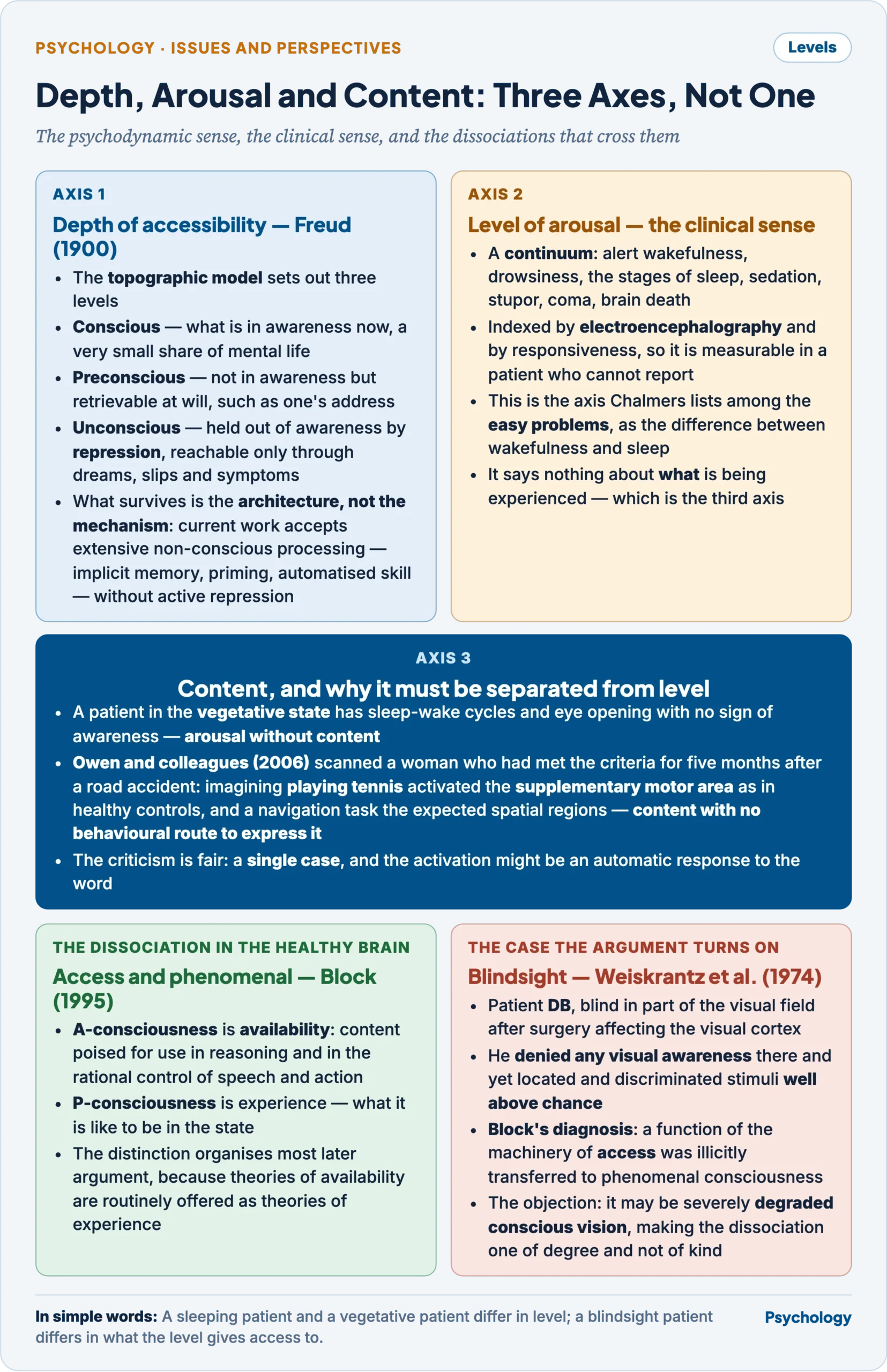
Depth and arousal are two different vertical axes, and the clinical cases cross them: content without arousal, and arousal without content.
- Depth of accessibility is the psychodynamic sense. Freud (1900) set out a topographic model with three levels, in the seventh chapter of The Interpretation of Dreams, and returned to it in the metapsychological papers.
- Conscious — what is in awareness now, a very small share of mental life.
- Preconscious — not in awareness but retrievable at will, such as one’s address.
- Unconscious — held out of awareness by repression, reachable only through dreams, slips and symptoms.
- What survives is the architecture, not the mechanism: current work accepts extensive non-conscious processing — implicit memory, priming, automatised skill — without the claim of active repression.
- Level of arousal is the clinical sense: a continuum from alert wakefulness through drowsiness, the stages of sleep, sedation, stupor and coma to brain death, indexed by electroencephalography and responsiveness.
- Level must further be separated from content. A patient in the vegetative state has sleep-wake cycles and eye opening with no sign of awareness — arousal without content.
- Owen and colleagues (2006) scanned a woman who had met the clinical criteria for the vegetative state for five months after a road accident, asking her to imagine playing tennis.
- Tennis imagery activated the supplementary motor area, as in healthy controls, and a navigation task activated the expected spatial regions — content with no behavioural route to express it.
- The criticism is fair: a single case, and the activation might be an automatic response to the word.
Theories of consciousness
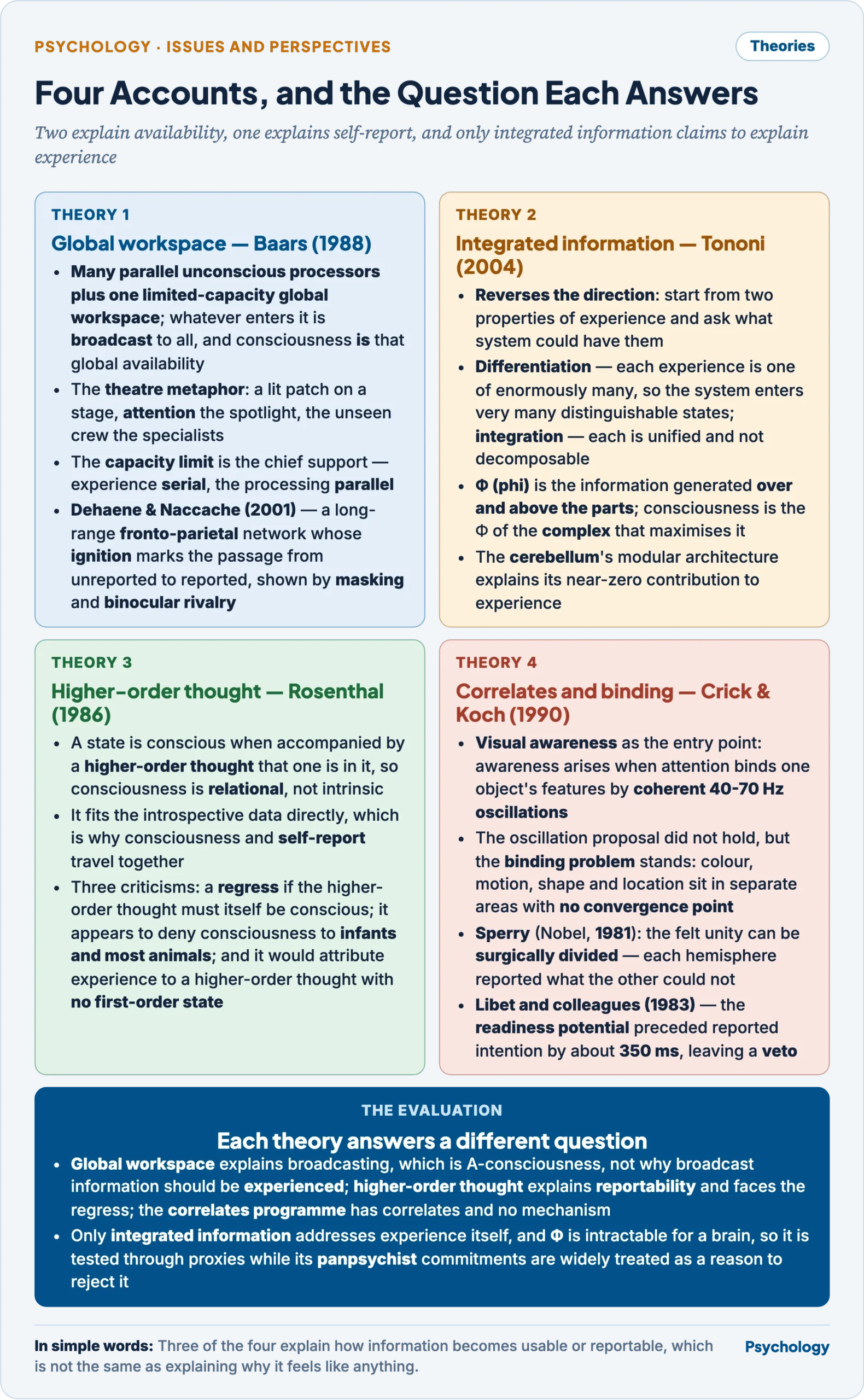
The four accounts are not rivals on one question: two explain availability, one explains self-report, and only integrated information claims to explain experience itself.
Global workspace theory
- Baars (1988) proposed a very large number of specialised, parallel, unconscious processors plus one limited-capacity global workspace. Content entering the workspace is broadcast to all the processors, and consciousness just is that global availability.
- His theatre metaphor makes the architecture concrete: conscious content is the lit patch on a stage, attention is the spotlight, and the unseen audience and backstage crew are the unconscious specialists.
- The capacity limit is the chief support: one coherent content occupies the workspace at a time, so experience is serial while the processing behind it is massively parallel.
- Dehaene and Naccache (2001) gave it a neural form as the global neuronal workspace — a long-range fronto-parietal network whose sudden, self-amplifying activation, ignition, marks a stimulus passing from unreported to reported.
- The supporting paradigms hold the stimulus constant while awareness varies: masking, inattentional blindness, the attentional blink and binocular rivalry.
- Criticism: the theory explains broadcasting, which is A-consciousness, not why broadcast information should be experienced; and the theatre image invites a homunculus watching from the stalls, which Baars disowns.
Integrated information theory
- Tononi (2004) reversed the direction of explanation, starting from two properties of experience and asking what physical system could have them.
- Differentiation — each experience is one of an enormous number of possibilities, so the system must enter very many distinguishable states.
- Integration — each experience is unified and cannot be decomposed into parts experienced separately.
- The quantity Φ (phi) measures the integrated information a system generates over and above its parts; the amount of consciousness is the Φ of the complex that maximises it.
- Two consequences make it attractive. The cerebellum holds far more neurons than the cortex and contributes almost nothing to experience, which its modular architecture explains.
- Loss of consciousness in deep sleep and anaesthesia coincides with a breakdown of effective cortical connectivity rather than with a loss of activity.
- Criticism: Φ is intractable to compute for anything brain-sized, so the theory is tested only through proxies; and because Φ is non-zero for many simple physical systems, its panpsychist commitments are widely treated as a reason to reject it.
Higher-order thought accounts
- Rosenthal (1986) proposed that a mental state is conscious when accompanied by a higher-order thought to the effect that one is in that state. Consciousness is therefore relational, not intrinsic to the first-order state.
- The account fits the introspective data directly, which is why consciousness and the capacity for self-report travel together.
- Criticism runs on three fronts.
- A regress threatens if the higher-order thought must itself be conscious.
- The account appears to deny consciousness to infants and most animals, who lack thoughts about their own states.
- It would attribute an experience to a higher-order thought with no corresponding first-order state at all.
The neural correlates programme and the binding problem
- Crick and Koch (1990) argued that visual awareness was the tractable entry point, and proposed that awareness arises when attention transiently binds the neurons coding one object’s features by generating coherent semi-synchronous oscillations in the 40-70 Hz range.
- This states the binding problem sharply: colour, motion, shape and location are processed in separate cortical areas with no anatomical convergence point, yet experience is of one moving coloured object, so the unity is constructed.
- The oscillation proposal did not hold and Koch later withdrew it; the binding problem remains, with synchrony now one candidate among several.
- Split-brain work tests whether that unity is real. After commissurotomy for intractable epilepsy, Sperry — Nobel laureate in 1981 for this work on hemispheric specialisation — described each hemisphere handling information the other could not report, with its own memories inaccessible to the other.
- Whether that is two streams of consciousness in one skull is contested interpretation; the secure claim is that the felt unity of consciousness can be surgically divided.
- Libet and colleagues (1983) recorded the readiness potential before self-initiated movements, its onset preceding the reported moment of conscious intention by about 350 ms.
- A second interval, often confused with the first, is the roughly 150 to 200 ms between that reported intention and the movement itself. The two measure different things: the first is how far the brain’s preparation precedes awareness, the second is the window still left for action.
- Libet preserved a role for conscious control, since that second window is long enough to veto the movement; later analyses treat the readiness potential as spontaneous fluctuation rather than a decision, so the anti-volition reading does not hold.
The Indian account of consciousness
- Indian philosophical psychology works from the opposite end: not a problem for a third-person science but a set of states with an avowed first-person method of entry and a graded map of what lies there.
- The Māṇḍūkya Upaniṣad sets out a four-state taxonomy keyed to the syllable AUM, and it classifies states rather than contents.
- Jāgrat — waking, awareness turned outward to gross objects; its subject is vaiśvānara.
- Svapna — dream, awareness turned inward on mentally constructed objects; its subject is taijasa.
- Suṣupti — dreamless sleep, awareness undifferentiated and objectless; its subject is prājña.
- Turīya — the fourth, described by negation as neither outward- nor inward-turned, and mapped to the silence after the syllable rather than to any of its three sounds.
- The structural point is substantive: deep sleep is a positive state of consciousness without an object, not consciousness switched off.
- The Taittirīya Upaniṣad adds the pañca-kośa scheme, five sheaths through which the self is progressively located — annamaya (material body), prāṇamaya (vital function), manomaya (mind), vijñānamaya (discriminative intellect) and ānandamaya (bliss).
- It is a method as much as a map: each sheath is examined and set aside as not being the self, so the procedure is successive negation rather than accumulation.
- Patañjali’s Yoga-Sūtra defines yoga as nirodha — the restraint of the processes (vṛtti) of consciousness (citta) — making the control of states, not their description, the object of the discipline.
- Five classes of vṛtti are distinguished: pramāṇa (valid cognition), viparyaya (erroneous cognition), vikalpa (imagination), nidrā (sleep) and smṛti (memory).
- Sleep appearing as a mental process in its own right, rather than as a gap, is the same claim the modern evidence for actively generated sleep makes.
- The commentator Vyāsa records five conditions of citta — kṣipta (wandering), mūḍha (stupefied), vikṣipta (occasionally steady), ekāgra (one-pointed) and niruddha (restrained) — only the last two usable for practice.
- Samādhi is graded, from saṁprajñāta levels retaining a cognitive object through to asaṁprajñāta samādhi, in which the processes of consciousness are restrained and no object of cognition remains.
- The tradition states a strong verification condition: on Vyāsa’s view only yoga is the means to the knowledge of yoga, so the procedure is publicly repeatable while the result is privately verified, like a report of pain.
- Anand, Chhina and Singh (1961) gave the claim an electrophysiological test on four practitioners of samādhi.
- The alpha rhythm persisted and increased in amplitude modulation during meditation and, unlike in ordinary relaxed wakefulness, was not blocked by sensory stimulation.
- Two participants held a hand in ice-cold water for 45 to 55 minutes with alpha persisting throughout (Anand, Chhina and Singh, 1961).
- The limitations are those of its date: four participants, no blinding, no control group, no artefact rejection. Its value was to specify a falsifiable signature of a traditional state.
- The first-person method is precisely what the hard problem says cannot be replaced, so these are a competing programme on the same question, not decoration.
- Their weakness is equally plain: a privately verified result cannot adjudicate between two practitioners who disagree.
Altered states of consciousness and the routes to them
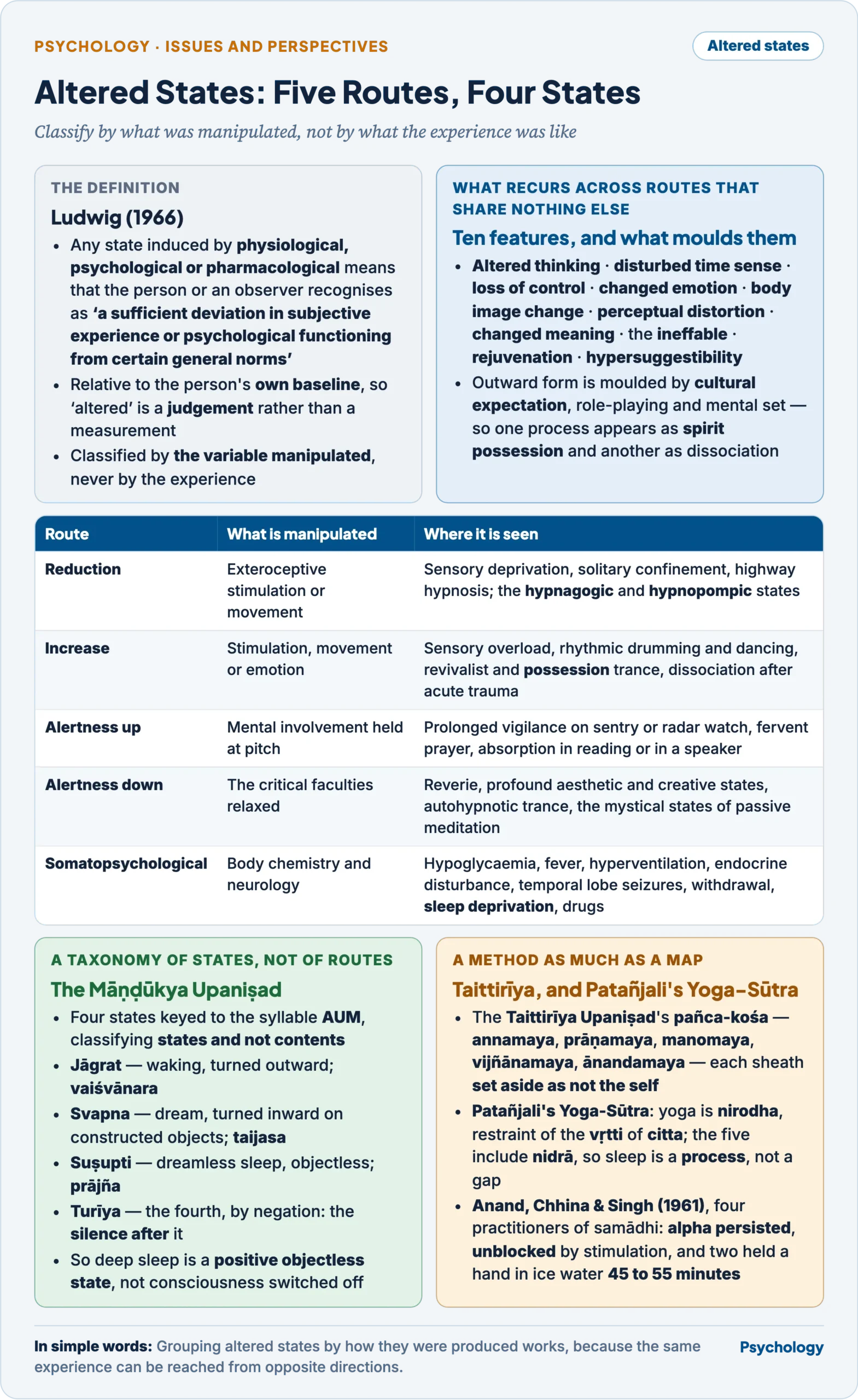
Routes are the useful axis, not states: the same state can be reached from opposite directions, and the five routes carve the field without reference to content.
- The working definition remains Ludwig’s (1966): any mental state, induced by physiological, psychological or pharmacological means, which the individual or an outside observer recognises as “a sufficient deviation in subjective experience or psychological functioning from certain general norms for that individual during alert, waking consciousness”.
- It is relative to the person’s own baseline, which is both its strength and its weakness: it absorbs individual and cultural variation, and makes “altered” a judgement rather than a measurement.
- Ludwig classified the ways such states are acquired by the variable manipulated, not by the resulting experience.
- Reduction of exteroceptive stimulation or motor activity — sensory deprivation, solitary confinement, monotonous input, highway hypnosis, and the hypnagogic and hypnopompic states at the edges of sleep.
- Sleep is treated in Sleep: Stages, Physiology and Functions, its timing in Sleep-Wake Schedules and Circadian Rhythms, dreaming in Dreams: Theories and Functions.
- Increase of exteroceptive stimulation, motor activity or emotion — sensory overload, rhythmic drumming and dancing, trance in revivalist and possession settings, rites of passage, and dissociative states after acute trauma.
- Increased alertness or mental involvement — prolonged vigilance on sentry or radar watch, fervent prayer, and total absorption in reading or in a speaker.
- Decreased alertness or relaxation of the critical faculties — reverie, profound aesthetic and creative states, autohypnotic trance, and the mystical states reached through passive meditation. Meditation is treated in Meditation and Its Effects and the hypnotic state in the article on hypnosis.
- Somatopsychological factors — hypoglycaemia, fever, dehydration, hyperventilation, endocrine disturbance, temporal lobe seizures, withdrawal from alcohol or barbiturates, sleep deprivation and administered drugs. Deprivation is treated in Sleep Deprivation and Sleep Disorders, the pharmacological routes in the article on psychoactive drugs and consciousness.
- Reduction of exteroceptive stimulation or motor activity — sensory deprivation, solitary confinement, monotonous input, highway hypnosis, and the hypnagogic and hypnopompic states at the edges of sleep.
- Ten features recur across states reached by very different routes, and justify treating them as one family: alterations in thinking, disturbed time sense, loss of control, change in emotional expression, body image change, perceptual distortion, change in meaning or significance, a sense of the ineffable, feelings of rejuvenation and hypersuggestibility.
- Their outward form is moulded by cultural expectation, role-playing, demand characteristics and mental set, which is why one process appears as spirit possession in one setting and a dissociative episode in another.
- On function Ludwig treated altered states as final common pathways, Sherrington’s phrase, for many forms of human expression.
- Maladaptive uses include conflict resolved through fugue and amnesia, escape through intoxication, and inadvertent highway-hypnosis trance.
- Adaptive uses include induced states in healing practice across cultures, and their use as avenues to new knowledge.
- Tart (1972) pushed the logic further with state-specific sciences.
- A state is defined by the overall pattern of psychological functioning rather than by any content, and the ordinary waking state is one configuration among several, not a privileged baseline.
- Because observation changes with the state, what is learnt in one may not be expressible in another, so trained observers should conduct replicable enquiry from within particular states — formally the move the Yoga tradition makes.
- The objection is that this abandons the inter-subjective check that makes a science self-correcting, and no consensus has formed since.
Criticisms and evaluation
- The concept has not been unified. Access and phenomenal consciousness, arousal and content, state and creature consciousness are still argued about under one word, so much apparent disagreement between theories is disagreement about which of them is being addressed.
- The evidence base is report-dependent. Almost every measure reduces to what a participant says, so absence of report is read as absence of experience — an inference the vegetative-state imaging of Owen and colleagues (2006) shows can be wrong.
- The hard problem is untouched. Every theory above is, on Chalmers’s division, an account of an easy problem; whether that is a failure or the correct scope turns on Dennett’s (1991) deflationary reply, which the field has not settled.
- Each theory answers a different question. Global workspace explains availability, not experience; integrated information uses a quantity nobody can compute for a brain; higher-order thought explains reportability and faces the regress; the correlates programme has correlates and no mechanism.
- Altered states are defined by deviation from a norm that is itself unspecified, so the category partly tracks social judgement, and its common features come from retrospective self-report.
- The Indian accounts offer the most developed phenomenology available and the least public verification, on very small samples of exceptional practitioners.
- What survives is substantial. The access-phenomenal distinction is standard working vocabulary; the level-content distinction is clinically consequential; the dissociations that hold a stimulus constant while awareness varies are a genuine method; and classifying altered states by route of induction organises an otherwise unmanageable field.
Previous Year Questions
- 2011Elaborate upon the salient developments in consciousness studies and indicate the effect of ‘meditation’ on psychological functions.
- 1996What do you mean by altered states of consciousness? Describe the ways in which they can be acquired.