

Artificial intelligence.
Official Syllabus: Paper I · Unit 14 Issues and Perspectives in Modern Contemporary Psychology
“Every aspect of learning or any other feature of intelligence can in principle be so precisely described that a machine can be made to simulate it.”
— McCarthy, Minsky, Rochester and Shannon (1955)
That sentence, from the proposal that coined the term artificial intelligence, is a conjecture about psychology as much as engineering: it asserts that mental processes are describable without residue. Psychology’s stake is double. A working machine is a possible theory of how a process is organised; a machine that cannot be built marks a feature of mind that resists description.
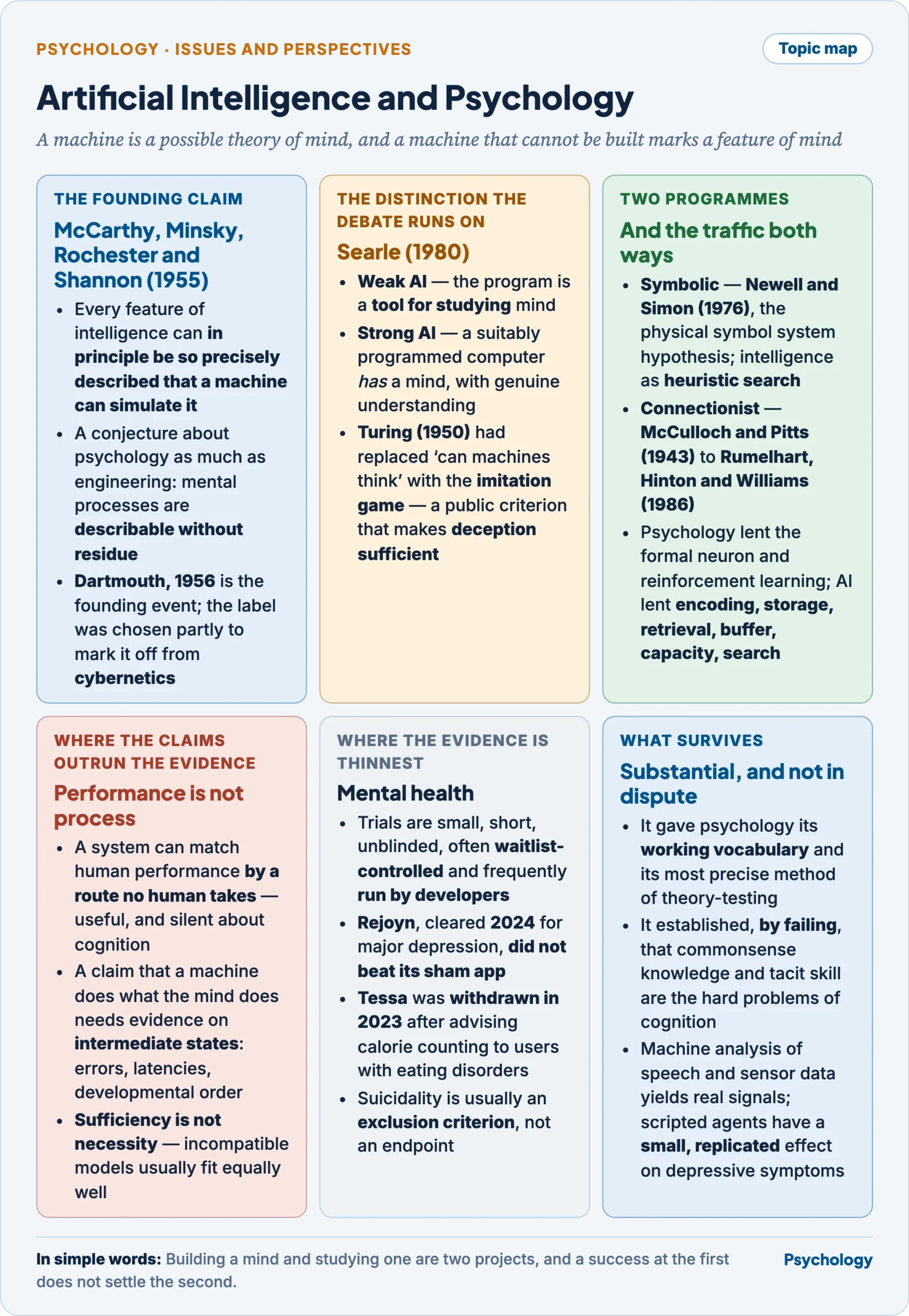
The engineering and psychological questions come apart early: a system can match human performance by a route no human takes, which makes it useful and says nothing about cognition.
The founding claim and two research programmes
- McCarthy coined the phrase in the 1955 proposal written with Marvin Minsky, Nathaniel Rochester and Claude Shannon; the Dartmouth Summer Research Project on Artificial Intelligence of 1956 is the field’s founding event. The label was chosen partly to mark it off from cybernetics.
- Searle (1980) supplied the distinction the debate still runs on. Weak artificial intelligence treats the program as a tool for studying mind; strong artificial intelligence holds that a suitably programmed computer has a mind, with genuine understanding.
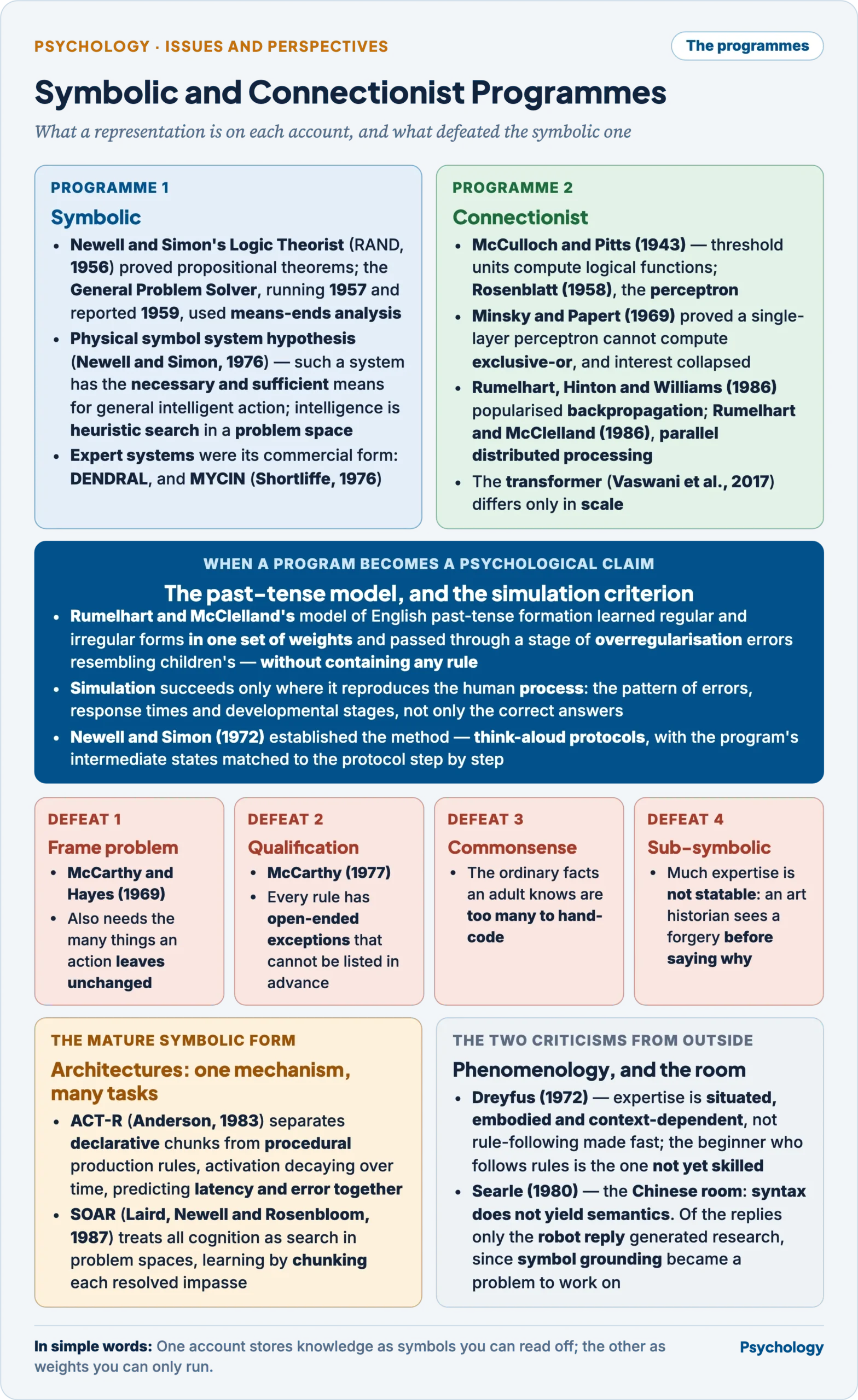
The programmes disagree about what a representation is: a symbol that can be inspected, or a pattern of weights that can only be exercised.
The symbolic programme
- Newell and Simon built the first working programs. The Logic Theorist (RAND report, 1956) proved theorems in propositional logic; the General Problem Solver, first running in 1957 and reported in 1959, solved problems by means-ends analysis — comparing the current state with the goal state and selecting an operator that reduces the largest difference.
- Their general thesis is the physical symbol system hypothesis (Newell and Simon, 1976): a physical symbol system has the necessary and sufficient means for general intelligent action. Intelligence is then heuristic search through a problem space of states and operators.
- Expert systems were the programme’s commercial form in the 1980s: DENDRAL for chemical structures, MYCIN for bacterial infection (Shortliffe, 1976) — a knowledge base of if-then rules plus an inference engine, the rules elicited from experts.
- Four representational problems defeated it, each naming something about human knowledge.
- The frame problem (McCarthy and Hayes, 1969) — stating what an action changes requires also stating the indefinitely many things it leaves unchanged.
- The qualification problem (McCarthy, 1977) — every rule has open-ended exceptions that cannot be listed in advance.
- The extent of commonsense knowledge — the ordinary facts an adult knows are too many to hand-code.
- Sub-symbolic knowledge — much expertise is not statable; an art historian sees a statue is a forgery before being able to say why.
The connectionist programme
- McCulloch and Pitts (1943) showed a network of threshold units could compute logical functions; Rosenblatt (1958) built the perceptron, which adjusted connection weights from feedback. Minsky and Papert (1969) then proved a single-layer perceptron cannot compute functions that are not linearly separable — exclusive-or being the standard case — and interest collapsed.
- The revival came with multi-layer networks and an algorithm for training them. Rumelhart, Hinton and Williams (1986) popularised backpropagation, which propagates output error backwards to adjust hidden-layer weights, and Rumelhart and McClelland (1986) set out parallel distributed processing as a general framework.
- Its properties are those a symbolic system lacks: distributed representation, learning from examples, generalisation, graceful degradation under damage, and extraction of a prototype from instances none of which is the prototype.
- Their model of English past-tense formation learned regular and irregular forms in one set of weights and passed through a stage of overregularisation errors resembling children’s, without containing any rule — which made it a psychological claim and not only an engineering result.
- The current generation is continuous with this programme and differs in scale. The transformer architecture (Vaswani and colleagues, 2017) with self-supervised training on very large corpora produces large language models whose fluency was neither programmed nor anticipated from the training objective.
| Dimension | Symbolic systems | Connectionist networks |
|---|---|---|
| Representation | Explicit, inspectable symbols | Weights distributed over units |
| Processing | Serial rule application | Massively parallel constraint satisfaction |
| Failure mode | Brittle; fails completely outside its rules | Degrades gradually; errs plausibly |
| Explains well | Reasoning, planning, language structure | Perception, pattern recall, skill, development |
The Turing test and its critics
- Turing (1950) replaced “can machines think” with an operational criterion. In the imitation game an interrogator communicates by text with a human and a machine and tries to tell which is which; a machine not reliably identified has passed.
- The move is behaviourist in form, which is both its strength and the objection: it fixes a public criterion and makes deception sufficient for intelligence.
- Weizenbaum’s (1966) ELIZA, running the DOCTOR script, reflected statements back as Rogerian questions by keyword substitution, and users credited it with understanding — the ELIZA effect, and the reason its author became the programme’s critic. Colby’s (1972) PARRY simulated paranoid speech and was likewise mistaken for a patient.
- Searle (1980) made the sharpest argument against strong artificial intelligence. A person sealed in a room manipulating Chinese characters by an English rule book produces answers indistinguishable from a speaker’s while understanding no Chinese; since the program is only the rule book, running it cannot constitute understanding. Syntax does not yield semantics.
- The systems reply holds that the whole room understands though the person does not; Searle answers that internalising the rule book adds nothing. The robot reply holds that symbols grounded in perception and action would acquire meaning — the one reply that generated research, since symbol grounding became a problem to work on.
- Dreyfus (1972) attacked the symbolic programme from phenomenology rather than logic. Expertise is not rule-following made fast; it is situated, embodied and context-dependent, and the beginner who follows rules is the one not yet skilled. His prediction that rule-based systems would stall on everyday competence was borne out.
Simulating human intelligence: the computer as a theory
- Simulation differs from engineering performance. It succeeds when it reproduces the human process — matching the pattern of errors, response times and developmental stages, not only the correct answers.
- The method was established by Newell and Simon (1972), who collected think-aloud protocols from people solving problems and wrote programs whose intermediate states matched the protocol step by step — a testable account rather than a description.
- Cognitive architectures generalised the approach into unified theories, where one fixed mechanism must account for many tasks: ACT-R (Anderson, 1983) separates declarative chunks from procedural production rules with activation decaying over time, predicting latency and error together, while SOAR (Laird, Newell and Rosenbloom, 1987) treats all cognition as search in problem spaces, learning by chunking each resolved impasse.
- Connectionist simulation added a further claim: a deficit can arise from one network’s architecture rather than a damaged module, which has been used to model acquired and developmental reading disorders.
- The implications for understanding behaviour are real and bounded.
- A running model forces a verbal theory to be fully specified, and yields quantitative predictions, so it can be disconfirmed by data a verbal theory would absorb.
- Sufficiency is not necessity. A model reproducing the data shows one mechanism that would suffice, and incompatible models usually fit equally well — multiple realisability, aggravated by free parameters fitted to the very data explained.
Artificial intelligence and cognitive psychology as a symbiotic relation
- The cognitive revolution’s information-processing framework was borrowed from computing. Miller (1956) described the human as a limited-capacity channel; Broadbent (1958) modelled selective attention as a filter feeding a limited channel; Newell, Shaw and Simon (1958) proposed the problem solver as an information-processing system; Miller, Galanter and Pribram (1960) replaced the stimulus-response unit with a feedback-controlled plan.
- The traffic runs both ways, which is what makes the relation symbiotic rather than a one-way metaphor.
- Psychology into artificial intelligence — the formal neuron from neurophysiology; reinforcement learning from the conditioning literature, its reward prediction error descended from the Rescorla-Wagner account; attention mechanisms from selective attention; problem spaces from protocol studies.
- Artificial intelligence into psychology — production rules, schemas and frames, parallel distributed processing, and the standard working terms of memory research: encoding, storage, retrieval, buffer, capacity, search.
- The metaphor misleads in identifiable ways: the brain has no hardware-software split, no central clock and no addressable memory locations, and computes under metabolic, developmental and affective constraints no program has.
Limits of artificial intelligence and of the human information processing system
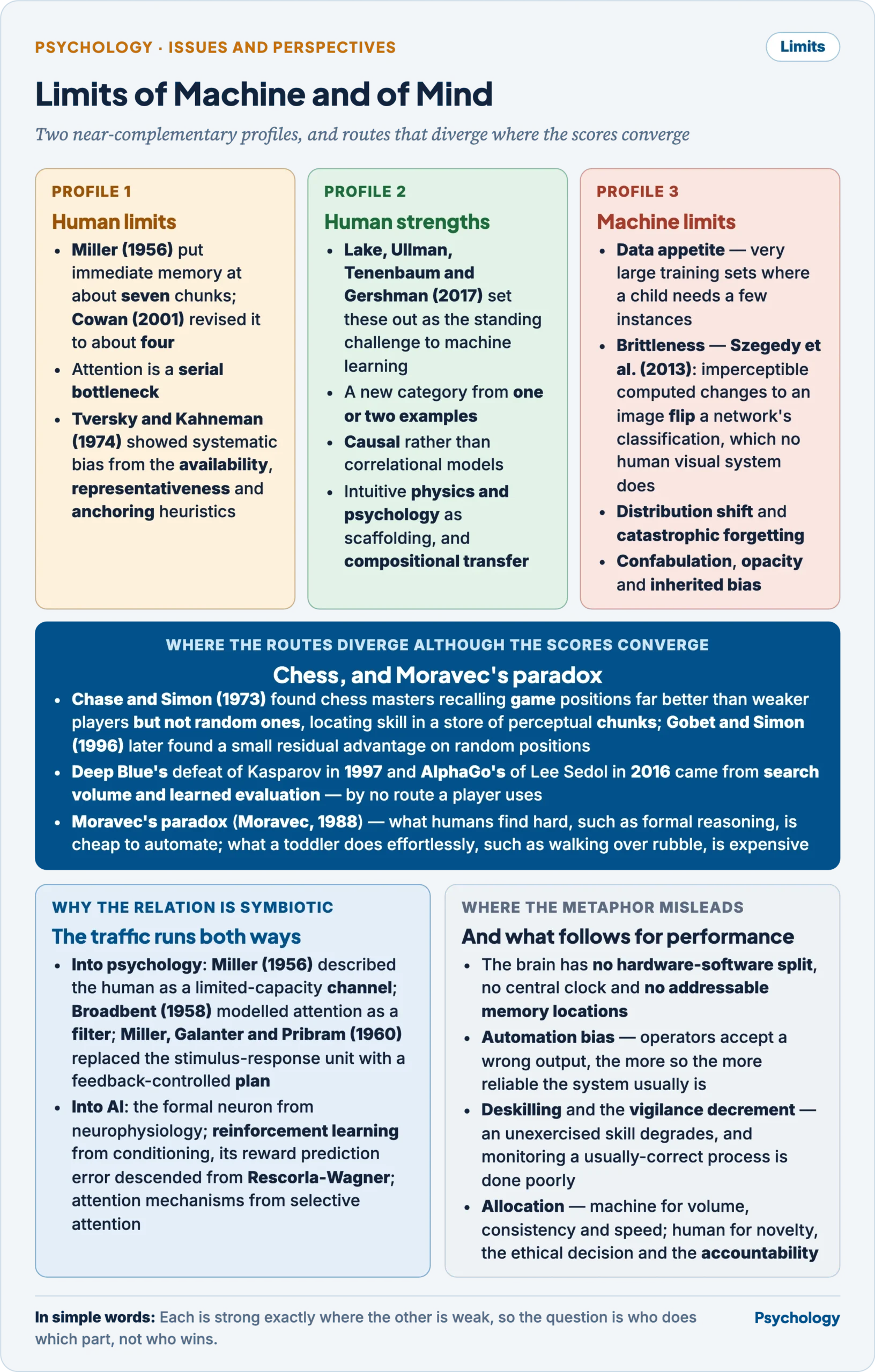
The profiles are near-complementary, which is why allocation of work matters more than replacement.
- Human processing limits are well mapped. Miller (1956) put immediate memory at about seven chunks and Cowan (2001) revised it to about four; attention is a serial bottleneck; and Tversky and Kahneman (1974) showed systematic bias from the availability, representativeness and anchoring heuristics.
- Human strengths mirror these, and Lake, Ullman, Tenenbaum and Gershman (2017) set them out as the standing challenge to machine learning: a new category from one or two examples, causal rather than correlational models, intuitive physics and psychology as scaffolding, and compositional transfer.
- Machine limits are equally specific.
- Data appetite — performance requires very large training sets where a child needs a few instances.
- Brittleness — Szegedy and colleagues (2013) showed imperceptible, deliberately computed changes to an image flip a network’s classification, which no human visual system does.
- Distribution shift and catastrophic forgetting — accuracy falls when the input population changes, and new learning overwrites old.
- Confabulation — fluency is independent of accuracy, so false statements arrive in the same confident register as true ones.
- Opacity and inherited bias — a decision’s basis cannot be inspected, and the corpus’s skew is reproduced as a finding.
- Moravec’s paradox (Moravec, 1988) — what humans find hard, such as formal reasoning, is cheap to automate; what a toddler does effortlessly, such as walking over rubble, is expensive.
- The routes diverge where they appear to converge. Chase and Simon (1973) found chess masters recalling game positions far better than weaker players but not random ones, locating skill in a store of perceptual chunks; Gobet and Simon (1996) later found a small residual advantage on random positions. Deep Blue’s defeat of Kasparov in 1997 and AlphaGo’s of Lee Sedol in 2016 came from search volume and learned evaluation, by no route a player uses.
- The consequences for human performance are those of a division of labour.
- Automation bias — operators accept a system’s output when it is wrong, the more so the more reliable it usually is.
- Deskilling and the vigilance decrement — an unexercised skill degrades, and monitoring a usually-correct process is something humans do poorly.
- Allocation — give the machine volume, consistency and speed; keep with the human judgement under novelty, the ethical decision and the accountability.
Identifying psychological abnormality
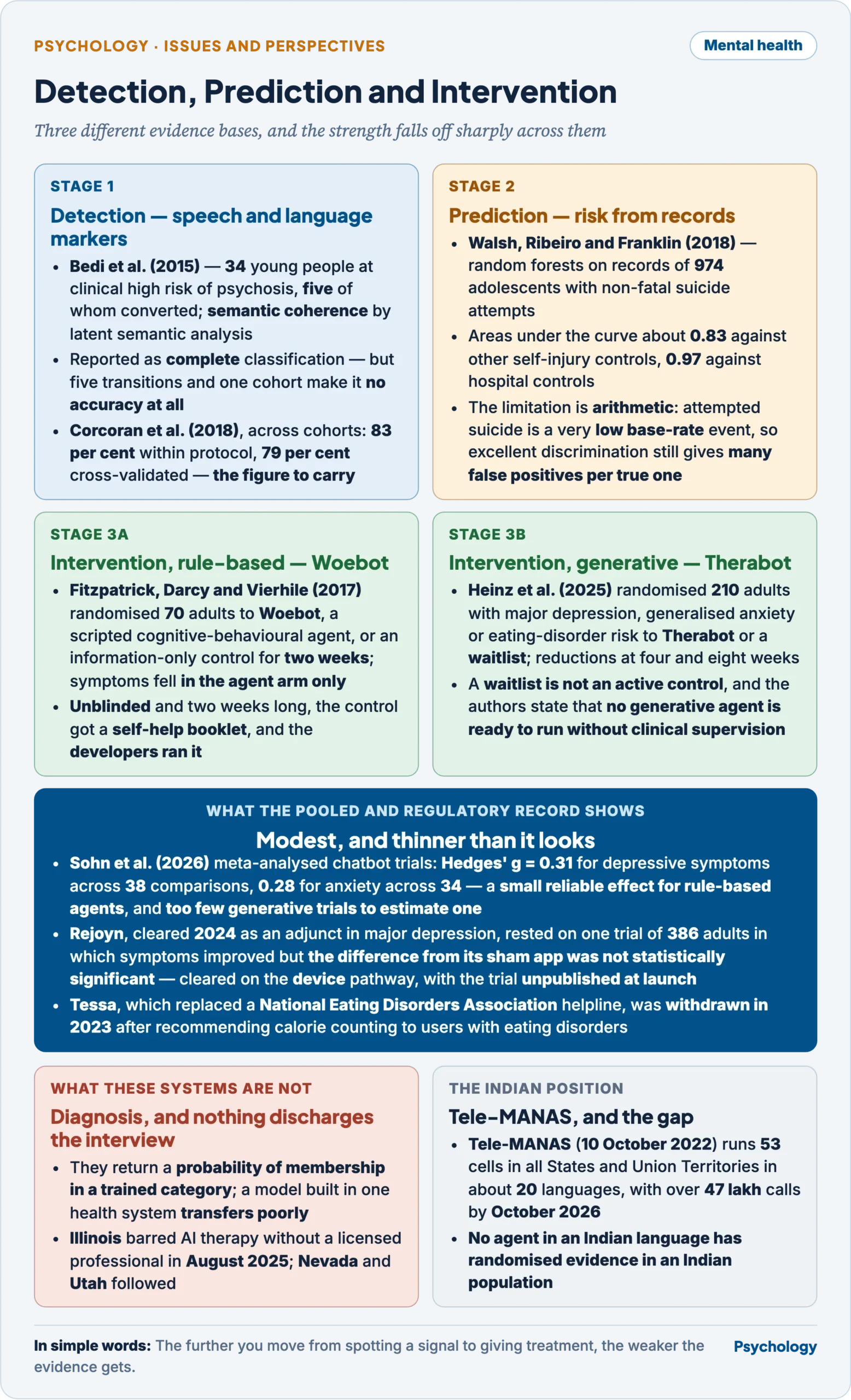
Detection, prediction and intervention rest on three different evidence bases, and the strength falls off sharply across them.
- Speech and language markers. Bedi and colleagues (2015) recorded free-speech interviews from 34 young people at clinical high risk of psychosis, five of whom later made the transition, and derived semantic coherence by latent semantic analysis plus two syntactic markers of complexity.
- Classification of the converters was reported as complete, but with five transitions and leave-one-out cross-validation on a single cohort (Bedi and colleagues, 2015) the figure is unstable and should not be quoted as an accuracy.
- Corcoran and colleagues (2018) tested the same markers across cohorts and reported roughly 83 per cent accuracy within protocol and 79 per cent cross-validated — the figure that should be carried.
- Risk prediction from records. Walsh, Ribeiro and Franklin (2018) trained random forests on records of 974 adolescents with non-fatal suicide attempts against several control groups, with areas under the curve from about 0.83 against other self-injury controls to 0.97 against hospital controls close to the event.
- The limitation is arithmetic and decisive: attempted suicide is a very low base-rate event, so even an excellent discrimination index yields many false positives per true one, and a screening programme must be judged on that ratio, not the curve.
- Diagnosis is not what these systems do. They return a probability of membership in a trained category, and a model built in one health system transfers poorly to another. Nothing in it discharges the clinical interview.
Artificial intelligence as an intervention in mental health
- Rule-based therapeutic agents came first. Fitzpatrick, Darcy and Vierhile (2017) randomised 70 adults aged 18 to 28 to Woebot, a scripted cognitive-behavioural conversational agent, or an information-only control for two weeks; depressive symptoms fell significantly in the agent arm only.
- Three qualifications belong with it: the trial was unblinded and two weeks long, the control received a self-help booklet rather than an active comparator, and the agent’s own developers ran it.
- Generative agents have one trial of record. Heinz and colleagues (2025) randomised 210 adults with major depressive disorder, generalised anxiety or high risk for a feeding and eating disorder to Therabot, a generative therapy chatbot, or a waitlist, four weeks prompted and four unprompted, and found symptom reductions at four and eight weeks with working-alliance ratings comparable to outpatient psychotherapy.
- The authors’ own position is the correct one to carry: a waitlist is not an active control, and no generative agent is ready to operate without clinical supervision.
- Pooled evidence is modest. Sohn and colleagues (2026) meta-analysed therapeutic chatbot trials and found Hedges’ g = 0.31 for depressive symptoms across 38 comparisons and 0.28 for anxiety across 34 — the anxiety interval running from 0.05, so close to zero that the effect is barely distinguishable from none — with larger effects in clinical and subclinical than non-clinical samples. Separating architectures gives a small reliable effect for rule-based agents and too few generative trials to estimate one.
- Regulated products show how thin the threshold is. EndeavorRx, a game-based attention training, was authorised in the United States in June 2020 for childhood attention-deficit hyperactivity disorder, through the De Novo route for a device with no predicate. Rejoyn, cleared in 2024 as an adjunct in major depression, rested on one trial of 386 adults in which symptoms improved but the difference from its sham app was not statistically significant — and it was cleared on the device pathway, by substantial equivalence to a predicate device, with the trial unpublished at launch.
- The failure cases are instructive. Tessa, a wellness chatbot run by the National Eating Disorders Association, was withdrawn in 2023 after recommending calorie counting and a daily deficit to users with eating disorders, having been introduced to replace a human-staffed helpline.
- Regulation has begun. Illinois enacted the first statutory bar on delivering therapy by artificial intelligence without a licensed professional in August 2025, with penalties for providers and developers; Nevada legislated comparable restrictions and Utah a disclosure requirement in the same year.
Positive and negative effects on human behaviour
- Access and scale are the strongest positive claim: an agent answers at three in the morning, in the user’s language, with no waiting list. Candour is the second — people disclose stigmatised behaviour more fully to a machine than to an interviewer.
- Assistive gains are concrete rather than promissory: speech recognition and live captioning for deaf users, scene description for blind users, and translation that removes a language barrier from a consultation.
- Cognitive offloading runs the other way: externalising memory to a device changes what is retained, people recalling where information is kept better than the information, and the same applies to reasoning handed to a model.
- Parasocial attachment is a new clinical phenomenon. A system trained to be agreeable reinforces a user’s framing instead of challenging it, which is the opposite of what therapy does, and dependence on an agent its vendor may alter or withdraw is itself a risk.
- Displacement, bias and accountability are the structural harms: automated hiring and credit decisions reproduce training-data bias at scale; deepfakes attack the evidential status of recordings; and when a system causes harm, no professional is answerable.
Indian context
- Tele-MANAS (Ministry of Health and Family Welfare, launched 10 October 2022) runs 53 cells across all States and Union Territories in about 20 languages on one national number, and had handled more than 47 lakh calls by October 2026 — the triage and routing layer onto which any automated screening tool must fit.
- National Strategy for Artificial Intelligence (NITI Aayog, 2018), framed as “AI for All”, names healthcare a priority sector; the IndiaAI Mission approved in March 2024 carries an outlay of about Rs 10,372 crore over five years under the Ministry of Electronics and Information Technology.
- Mental-health data is personal data under the Digital Personal Data Protection Act, 2023 and its 2025 Rules, so consent, purpose limitation and erasure obligations bind any screening or chatbot deployment.
- The gap to state plainly: no conversational agent in an Indian language has randomised evidence in an Indian population, and a translated script is not a validated one. Idioms of distress differ, and a model trained on Western English corpora has not learnt them.
Criticisms and evaluation
- The Turing test is a poor criterion. It rewards imitation and is passed by systems nobody credits with understanding; it survives as a thought experiment about what evidence of mind could consist in.
- Performance parity is not process parity. A claim that a machine does what the mind does needs evidence on intermediate states — errors, latencies, developmental order — and most such claims rest on outcome data alone.
- Both programmes remain incomplete. Symbolic systems never solved commonsense knowledge; connectionist systems have not delivered compositional, causal reasoning, and scale has not supplied it.
- The mental-health evidence base is weakest where the claims are loudest. Trials are small, short, unblinded, often waitlist-controlled and frequently run by developers; follow-up rarely exceeds weeks; suicidality is usually an exclusion criterion, not an endpoint; and the cleared prescription app for depression did not beat its sham.
- Some functions cannot be delegated. Confabulation, sycophancy and the absence of escalation are architectural properties, so the known harms occurred where an agent replaced a human service; consent, duty of care, confidentiality, accountability and the judgement that a person is at risk now are legal and ethical functions, not computational ones.
- What survives is substantial. The field gave psychology its working vocabulary and its most precise method of theory-testing; it established, by failing, that commonsense knowledge and tacit skill are the hard problems of cognition; machine analysis of speech and sensor data yields real signals for disorders hard to detect early; and scripted agents have a small, replicated effect on depressive symptoms.
Previous Year Questions
- 2024Critically evaluate the positive and negative effects of modern computer technology and artificial intelligence on human behaviour.
- 2022Discuss the role of artificial intelligence in dealing with mental health problems.
- 2020What is the role of artificial intelligence in psychology? How can it be applied as an intervention in identifying different psychological abnormalities?
- 2018Discuss contemporary researches on simulating human intelligence using machines and their implications for understanding human behaviour.
- 2014Compare the limits of artificial intelligence and human information processing system. Discuss their implications for human performance.
- 2008Artificial Intelligence and cognitive psychology have a symbiotic relationship. Elaborate this statement.
- 1996Can computer ever acquire human-like ability to think, remember and solve problems? Discuss fully with illustrations.