

Official syllabusPaper I · Unit 13 · Language and Communication
Human language – Properties, structure and linguistic hierarchy.
Definition
“We dissect nature along lines laid down by our native languages.”
Whorf (1940)
Two questions are tangled here and must be separated before either can be answered. The first is whether the world’s languages are built to a common pattern, and what that reveals about the mind. The second is whether speaking a particular language shapes how its speakers think. The first belongs to linguistic typology; the second is an empirical question in psychology, and the popular literature on it overstates the evidence in both directions.
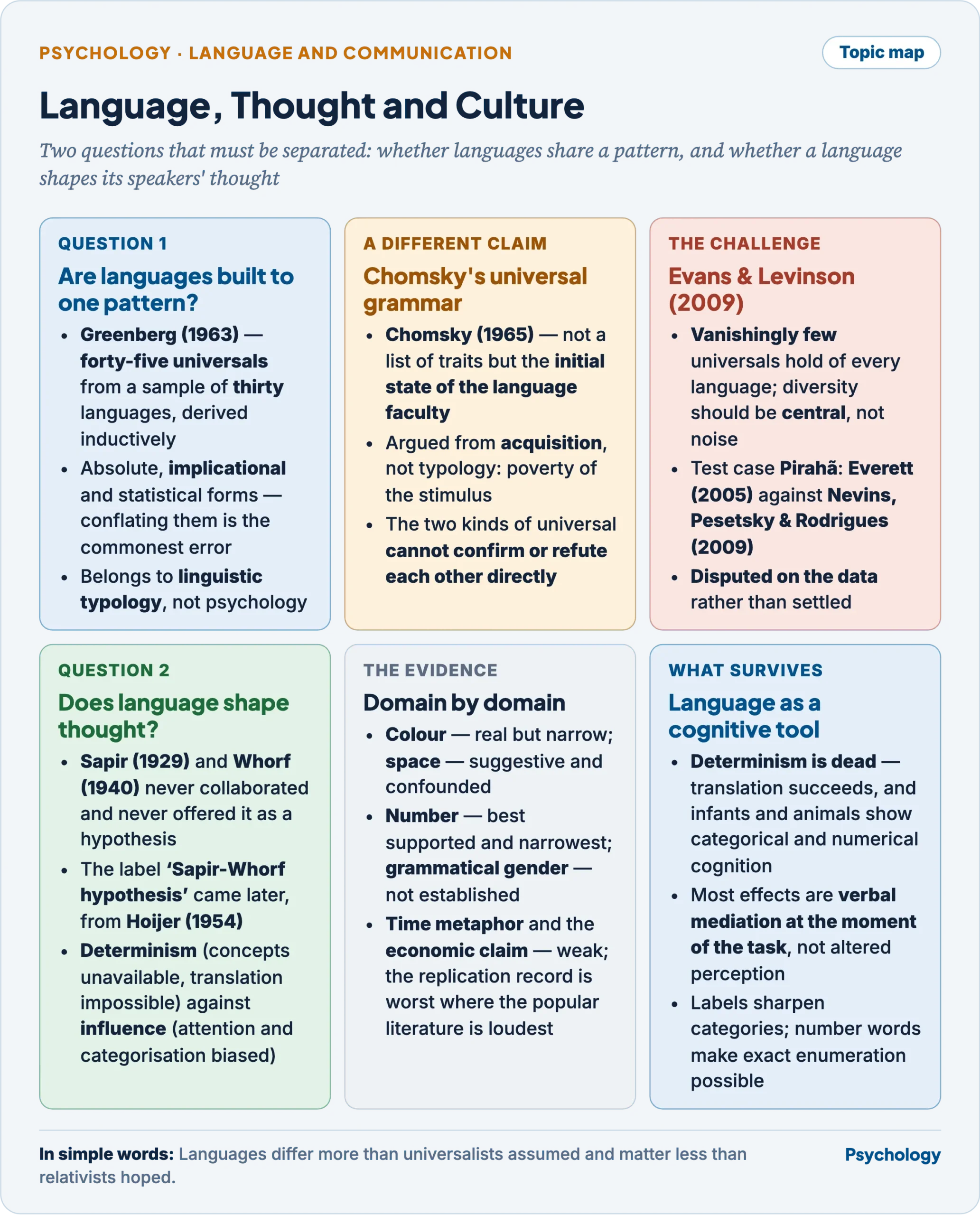
Universals and relativity pull in opposite directions only if both are stated strongly; the surviving versions of each are compatible.
Language universals: the typological programme
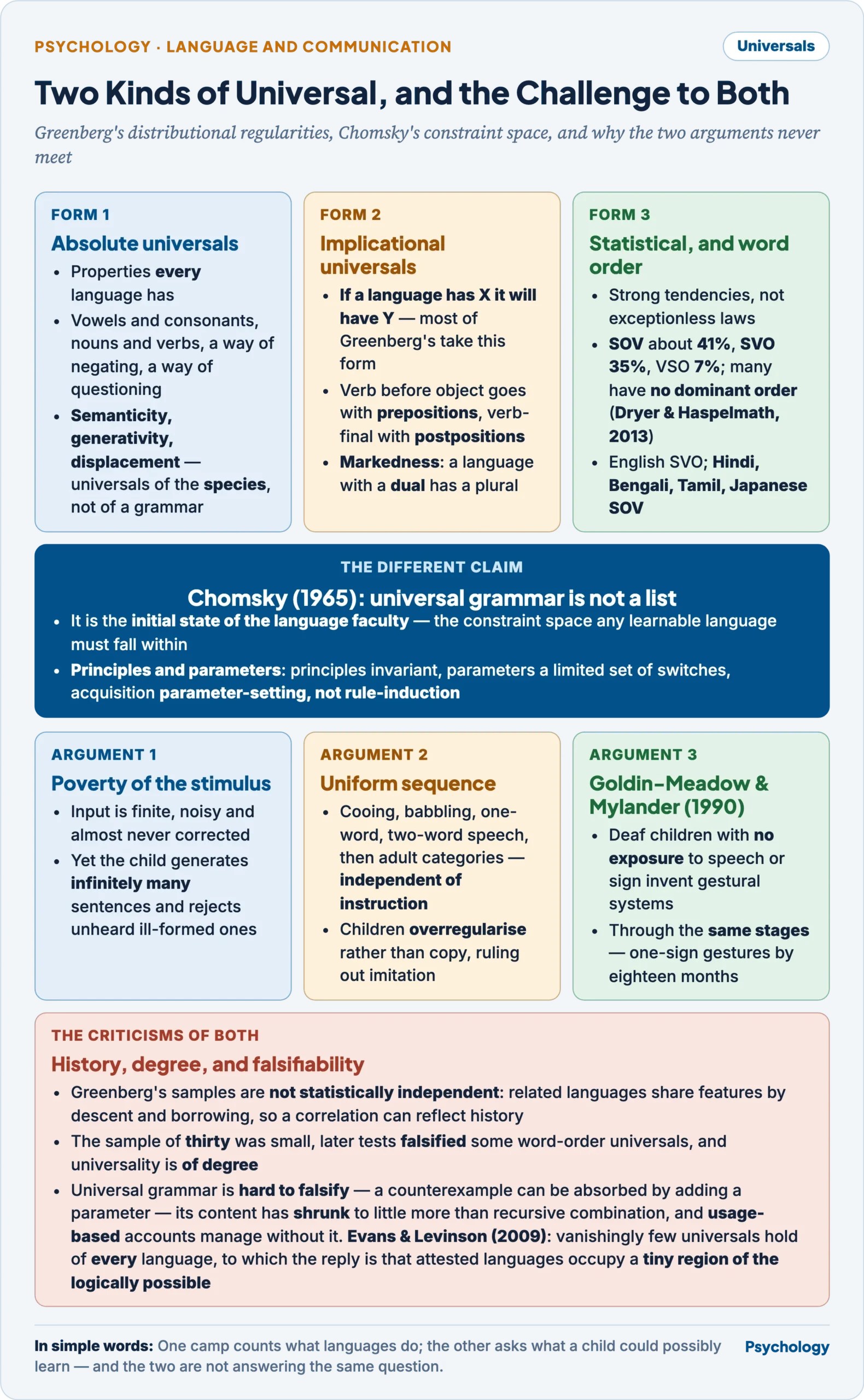
Most of Greenberg’s universals are conditional: they say that if a language has one property it will have another, not that all languages share a trait.
- Greenberg (1963) proposed forty-five universals, derived inductively from a sample of thirty languages chosen to span unrelated families and regions. The method is comparison of observed distributions, not inspection of a single grammar.
- The universals come in distinct logical forms, and conflating them is the commonest error.
- Absolute universals — properties every language has. All languages have vowels and consonants, nouns and verbs, a way of negating, a way of questioning.
- Implicational universals — conditional statements of the form if a language has X it will have Y. The best known concern word order: a language whose verb precedes its object tends to have prepositions, while a verb-final language tends to have postpositions.
- Statistical universals — strong tendencies rather than exceptionless laws, holding of most languages but not all.
- Word order typology is the programme’s most durable product. Across a large sample, SOV is the commonest basic order at roughly 41 per cent and SVO next at roughly 35 per cent, VSO at around 7 per cent, with a substantial group having no dominant order (Dryer and Haspelmath, 2013). English is SVO; Hindi, Bengali, Tamil and Japanese are SOV.
- Semanticity, generativity and displacement are universals of a different kind: properties no human language lacks, which makes them properties of the species rather than of a grammar.
- Markedness hierarchies supply further universals: where a language makes a distinction at a less common point on a scale it makes it at all more common points too — a language with a dual number has a plural.
- Criticisms:
- The samples are not statistically independent. Languages related genetically or in contact share features by descent and borrowing, so a cross-language correlation can reflect history rather than a constraint on possible grammars.
- The sample of thirty was small, and later large-database tests have falsified some word-order universals, including those on object-verb and adjective-noun order.
- Universality has turned out to be a matter of degree, which weakens the inference from a distributional regularity to a cognitive constraint.
Chomsky’s universal grammar: a different claim
- Chomsky (1965) made a claim of a different logical type. Universal grammar is not a list of traits all languages display; it is the initial state of the language faculty — the constraint space within which any learnable human language must fall.
- The argument is from acquisition, not from typology.
- The poverty of the stimulus: the input is finite, noisy and almost never corrected, yet the child arrives at a grammar generating infinitely many sentences and rejecting ill-formed ones never encountered.
- Acquisition follows a uniform sequence across languages and cultures — cooing, babbling, one-word utterances, two-word telegraphic speech, then adult categories — on a timetable largely independent of instruction.
- Children make systematic errors, overregularising rules rather than copying what they have heard, which rules out imitation as the mechanism.
- Goldin-Meadow and Mylander (1990) found that deaf children with no exposure to speech or sign invent gestural systems developing through the same stages, one-sign gestures emerging around eighteen months and two- and three-sign combinations following.
- The principles and parameters formulation makes the claim more precise: principles are invariant, parameters are the limited set of switches a particular language sets, and acquisition is parameter-setting rather than rule-induction.
- The two kinds of universal cannot confirm or refute each other directly. Greenberg’s are observed distributional regularities across attested languages; Chomsky’s is a hypothesis about an innate constraint space, which permits regularities to be statistical and even to have exceptions.
- Criticisms:
- The theory is hard to falsify, because any apparent counterexample can be accommodated by reformulating a principle or adding a parameter. The content of universal grammar has also shrunk drastically over time, from a rich set of substantive universals to little more than recursive combination.
- Usage-based alternatives argue that general learning mechanisms plus statistical regularities in the input plus the child’s social-cognitive capacities suffice, with no language-specific endowment.
- Nothing in the theory explains the distribution of actual languages, which is what typology set out to describe.
The challenge from linguistic diversity
- Evans and Levinson (2009) mounted the strongest attack, arguing that the universalist framing has misled cognitive science into supposing that all languages are built to a common pattern. Their claim is that there are vanishingly few universals in the direct sense that every language exhibits them.
- They took a published list of supposed substantive universals and argued that none holds of all languages, concluding that diversity should be central to theories of cognition rather than treated as noise.
- The reply from the universalist side is that diversity is exaggerated when the space of conceivable but non-occurring languages is ignored: the attested languages occupy a tiny region of the logically possible, and that is what universal grammar is about.
- Pirahã, an Amazonian language, became the test case. Everett (2005) reported that it lacks recursive embedding, number words, quantifiers, colour terms and a deep kinship vocabulary, and argued that these gaps are caused by a cultural constraint on talking about anything outside immediate experience.
- Nevins, Pesetsky and Rodrigues (2009) reassessed the data and reported strong syntactic and semantic evidence for embedded clauses, found no evidence that the language lacks quantifiers, and concluded that there is no support for the proposed causal relation between culture and grammatical structure. Everett (2009) replied that the criticisms were unfounded.
- The honest verdict: the space of attested variation is wider than the universalist literature assumed, and the single most publicised counterexample is disputed on the data rather than settled. Whether any of this refutes universal grammar depends on how strongly universal grammar is formulated — which is itself the problem.
Linguistic relativity: what Sapir and Whorf actually said
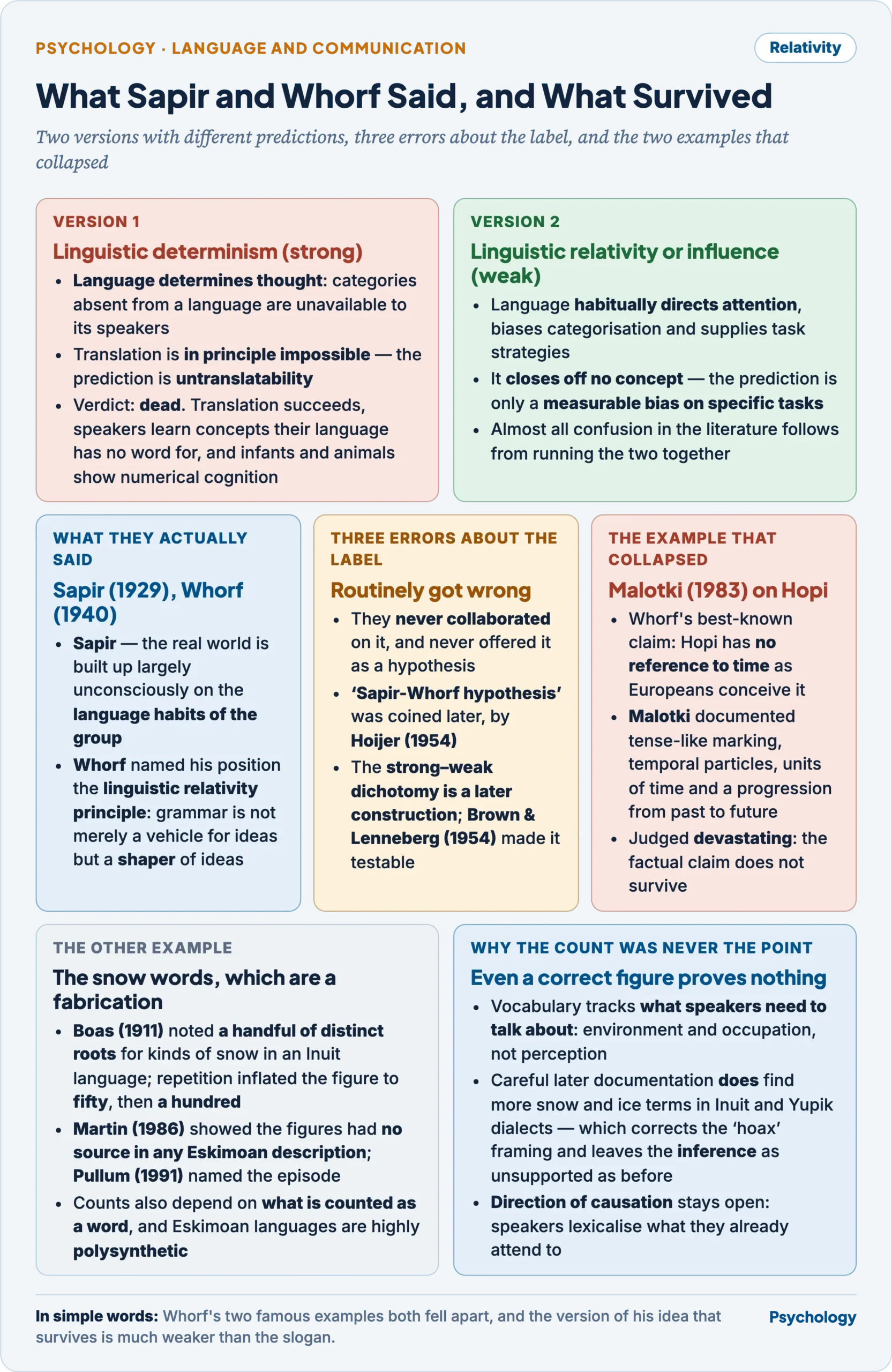
The two versions make different predictions: determinism predicts untranslatability, influence predicts only a measurable bias on specific tasks.
- Sapir (1929) held that the “real world” is to a large extent built up unconsciously on the language habits of the group, so that no two languages present the same social reality.
- Whorf (1940) named his own position the linguistic relativity principle: the background grammatical system of each language is not merely a vehicle for ideas but is itself a shaper of ideas.
- Three facts about the label are routinely got wrong.
- Sapir and Whorf never collaborated on any statement of the view and never put it forward as a hypothesis. The term “Sapir-Whorf hypothesis” was introduced later, by Hoijer (1954).
- The strong-weak dichotomy is a later construction by commentators. Neither man drew it.
- It was Brown and Lenneberg (1954) who reformulated the principle as a testable empirical hypothesis, which is where the psychology of the subject begins.
- The two versions must be kept apart, because almost all confusion in the literature follows from running them together.
- Linguistic determinism (the strong version) — language determines thought; categories absent from a language are unavailable to its speakers; translation across languages is in principle impossible.
- Linguistic relativity or influence (the weak version) — language habitually directs attention, biases categorisation, and supplies strategies that affect performance on specific tasks, without closing off any concept.
- Whorf’s own empirical examples have not survived. His best-known claim was that Hopi has no reference to time as Europeans conceive it. Malotki (1983) produced an extensive grammar of time in Hopi documenting tense-like marking, temporal particles, units of time and a spatial progression from past through present to future, and the argumentation was widely judged devastating. Relativist readings survive, but the specific factual claim does not.
The snow-words claim, which is a fabrication
- Boas (1911) observed that an Inuit language had a handful of distinct roots for kinds of snow where English uses modified phrases. Whorf repeated the observation, and the figure then inflated through repetition in popular and journalistic sources to fifty words and then to a hundred.
- Martin (1986) traced that escalation and showed that the figures had no source in any description of any Eskimoan language, and that the example had displaced serious research on the question. Pullum (1991) gave the episode its name and concluded that there is no evidence whatever for the claim as usually stated.
- The numbers are not the deepest problem. Even a correct count would prove nothing, for two reasons.
- Word counts depend on what is counted as a word. Eskimoan languages are highly polysynthetic, so derivatives of one root can be multiplied almost indefinitely; by the same method English has dozens of snow words.
- Vocabulary tracks what speakers need to talk about, which is a fact about their environment and occupation, not evidence that their perception or reasoning differs. Specialist vocabularies exist within every language without implying that specialists perceive differently.
- The honest qualification, which is rarely given: careful later documentation does find that Inuit and Yupik dialects have substantially more snow and ice terms than English. That corrects the “hoax” framing on the facts and leaves the inference exactly as unsupported as before.
The modern evidence, domain by domain
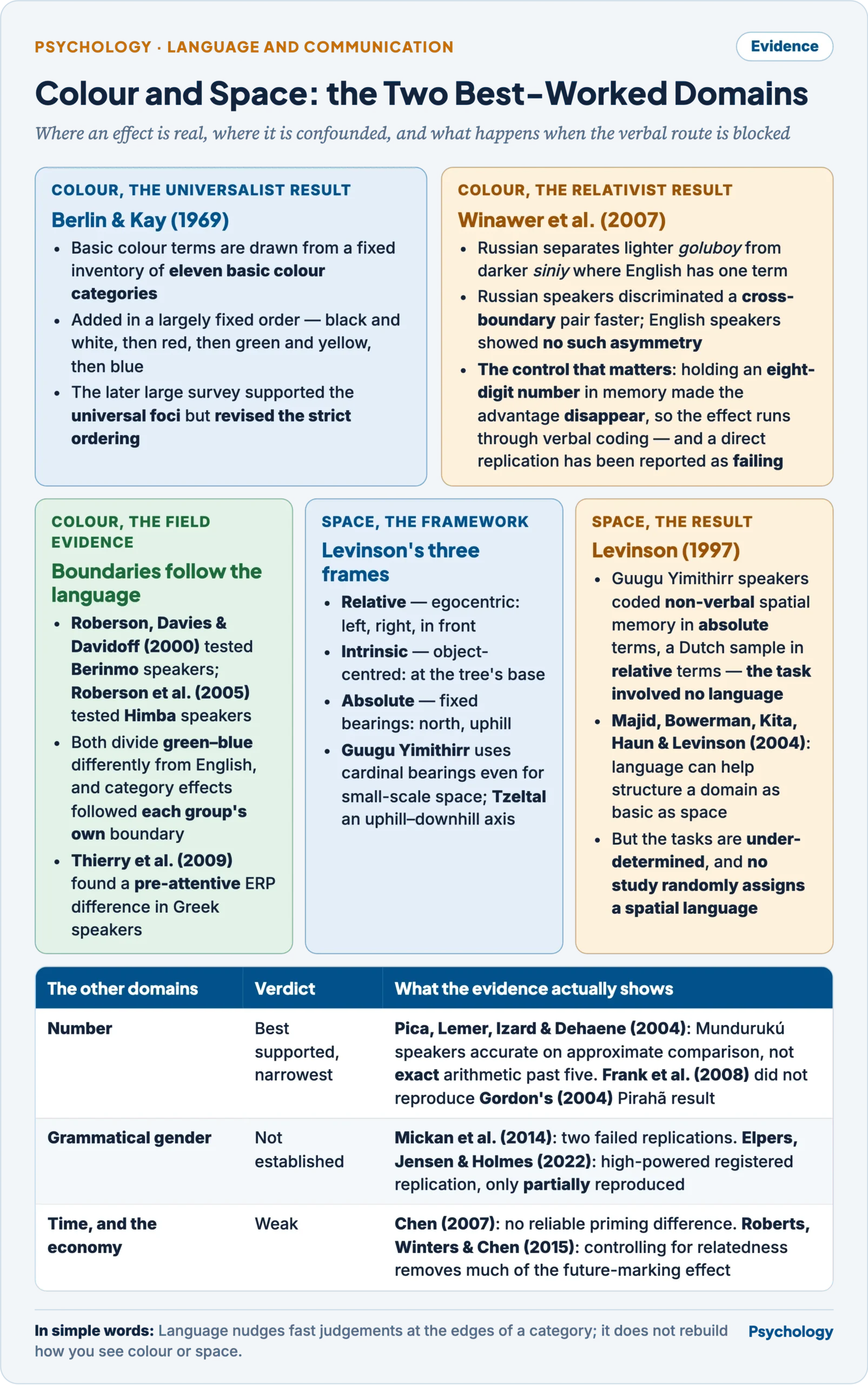
Where effects appear they are small, confined to speeded judgements near a category boundary, and abolished when the verbal route is blocked.
Colour
- Colour was the first battleground and initially produced a universalist result. Berlin and Kay (1969) surveyed basic colour terms and found that languages draw them from a fixed inventory of eleven basic colour categories, adding terms in a largely fixed order — black and white first, then red, then green and yellow, then blue, and so on.
- The large cross-language survey that followed broadly supported the universal category foci while substantially revising the strict ordering, so the finding stands in weakened form.
- Winawer and colleagues (2007) produced the best-known relativist result. Russian makes an obligatory distinction between lighter blue (goluboy) and darker blue (siniy) where English has one term; Russian speakers discriminated a cross-boundary pair faster than a within-category pair, while English speakers showed no such asymmetry.
- The condition that matters most is the control: when Russian speakers held an eight-digit number in memory during the task, the advantage disappeared. The effect runs through on-line verbal coding, not through altered colour vision.
- Caution is warranted: a direct replication attempt on Winawer and colleagues (2007) has been reported as failing, so the result is unsettled rather than established.
- Roberson, Davies and Davidoff (2000) tested Berinmo speakers in Papua New Guinea, and Roberson and colleagues (2005) tested Himba speakers in Namibia; both languages divide the green-blue region differently from English. Category effects followed each group’s own linguistic boundaries, which is the pattern linguistic relativity predicts and nativism does not.
- Thierry and colleagues (2009) recorded event-related potentials from Greek speakers, whose language separates two blues, and found a pre-attentive electrophysiological difference, which places part of the effect earlier than deliberate judgement.
- Verdict: a real but narrow effect. Language-specific categories modulate speeded discrimination near boundaries; they do not create or abolish colour perception, and the universalist finding on category foci stands.
Space
- Levinson (2003) distinguished three frames of reference for spatial description: relative (egocentric: left, right, in front), intrinsic (object-centred: at the tree’s base), and absolute (fixed bearings: north, uphill).
- Guugu Yimithirr, an Australian language, uses cardinal bearings even for small-scale space — an ant on your south leg, a cup to the north of the plate. Tzeltal, a Mayan language, uses a fixed uphill-downhill axis that must be tracked continuously.
- Levinson (1997) found that Guugu Yimithirr speakers coded non-verbal spatial memory predominantly in absolute terms while a comparison sample of Dutch speakers coded it in relative terms. The task involved no language, which is what makes the result interesting.
- Majid, Bowerman, Kita, Haun and Levinson (2004) reviewed this literature and argued that language can help structure or restructure a domain as fundamental as spatial cognition, and that children acquire whichever system their community uses with comparable ease.
- Criticism: the rotation tasks used are under-determined — a participant can solve them on either frame — and language is confounded with terrain, settlement pattern, literacy and schooling. No study randomly assigns a spatial language.
Grammatical gender
- The claim is that assigning a noun masculine or feminine gender biases how speakers conceptualise the object. The widely cited demonstration had German and Spanish speakers describe objects whose grammatical gender differs between the two languages.
- This is the domain where the replication record is worst.
- Mickan and colleagues (2014) reported two unsuccessful attempts to replicate the original experiment, which had been heavily cited but never fully published.
- Elpers, Jensen and Holmes (2022) ran a high-powered registered replication and only partially reproduced the original pattern.
- Preregistered replications using implicit measures of perceived potency have returned Bayesian evidence favouring the null.
- Verdict: not established. Any effect here is small and inconsistent, and this is the clearest case of a claim that entered the popular literature well ahead of its evidence.
Number
- This is the best-supported domain, and the one where the mechanism is clearest.
- Pica, Lemer, Izard and Dehaene (2004) tested Mundurukú speakers, whose language has number words only up to five. Approximate comparison and approximate addition of large quantities were performed accurately; exact arithmetic beyond the counting range was not. Their conclusion was a distinction between approximate and exact mental representations of number, with language required only for the second.
- Gordon (2004) tested Pirahã speakers on matching tasks and found accurate performance with two or three items and a pattern of analog estimation above that, which he read as a strong Whorfian effect.
- Frank, Everett, Fedorenko and Gibson (2008) retested the Pirahã and did not reproduce Gordon’s key finding. Participants succeeded on simple one-to-one matching needing no memory or transformation, and failed only on memory-dependent versions — on which comparably tested American participants also did poorly.
- Their interpretation is now generally accepted: number words are a cognitive technology for holding exact quantities in memory, not a precondition for numerical thought.
- Verdict: a genuine and well-replicated effect, but narrower than first claimed — it concerns exact enumeration and its retention, not numerical cognition as such.
Time, and the economic claim
- The claim that Mandarin speakers conceptualise time vertically and English speakers horizontally, from the languages’ dominant spatial metaphors, has largely failed to replicate.
- Chen (2007) found no reliable priming difference in either group, and showed by corpus analysis that Mandarin speakers in fact use horizontal time metaphors more often than vertical ones; January and Kako (2007) obtained a pattern running against the original.
- A much-publicised economic version held that speakers of languages which grammatically mark the future save less than speakers of languages which do not.
- Roberts, Winters and Chen (2015) showed that the languages compared were not statistically independent, and that controlling for relatedness and contact removes much of the apparent effect. The classification of languages as future-marking was also contested.
- Verdict: weak. These are the cases that most need the caution the replication record warrants.
Criticisms and limitations
- Linguistic determinism is dead, and the arguments against it are decisive. Translation across languages succeeds; speakers readily learn concepts their language has no single word for; pre-linguistic infants and non-human animals show categorical and numerical cognition; and new vocabulary follows new concepts rather than preceding them.
- Language cannot be experimentally assigned. Every comparison between language communities is confounded with ecology, subsistence, schooling, literacy and culture, so a cross-linguistic difference licenses no causal claim about language in particular.
- Most effects are verbal mediation, not altered perception. The single most informative result in the whole literature is that the Russian colour advantage vanishes under verbal interference. Language is being recruited as a strategy at the moment of the task; the perceptual system is not rebuilt.
- The direction of causation is open. Speakers lexicalise what they habitually attend to, so a vocabulary can be the consequence of an established practice rather than its cause.
- The replication record is poor in exactly the domains the popular literature favours — grammatical gender, time metaphor, and the economic extension — while the domain with the strongest evidence, exact number, is the narrowest.
- The field evidence rests on very small samples drawn from a few small communities, often tested by a single investigator with an interest in the outcome, while the laboratory evidence is drawn from undergraduates in industrialised societies. Neither base supports a general claim about language and thought.
- Effect sizes are small even where results hold, and they are measured in milliseconds of discrimination latency or in error rates on artificial tasks, not in differences of belief, reasoning or worldview of the kind Whorf described.
- Multilingual populations are the obvious natural test and remain under-used. Most Indians use two or more languages daily, with different grammatical resources for gender, number, honorifics and spatial reference.
- Strong relativity predicts that such speakers should think differently in each language. That is not what the lived evidence suggests, and the within-person shifts reported in the bilingual literature are modest.
- What survives is worth stating precisely. Language functions as a cognitive tool: labels sharpen categories, number words make exact enumeration possible, and habitual grammatical encoding directs attention to what must be expressed.
- These are real effects on performance, shown in specific domains and consistent with a universal cognitive architecture — a long way from the claim that a language fixes what its speakers can think.
Previous Year Questions
- 2025What is the Whorfian hypothesis of linguistic relativity? Evaluate with empirical evidences.
- 2019How can language be analyzed for its similarities across cultures? Explain with scientific evidences.