

Official syllabusPaper I · Unit 13 · Language and Communication
Human language – Properties, structure and linguistic hierarchy.
Definition
Speech production runs from a communicative intention, through a preverbal message and a phonetic plan, to overt articulation — three processing components, each feeding the next, monitored through the speaker’s own comprehension system.
after Levelt (1989)
Producing and understanding speech are the two halves of language use, and they are not mirror images. Production begins with a meaning and must find a form; comprehension begins with a degraded acoustic signal and must find a meaning. Both run at two to three words per second, with error rates low enough that the failures are the best evidence about the machinery.
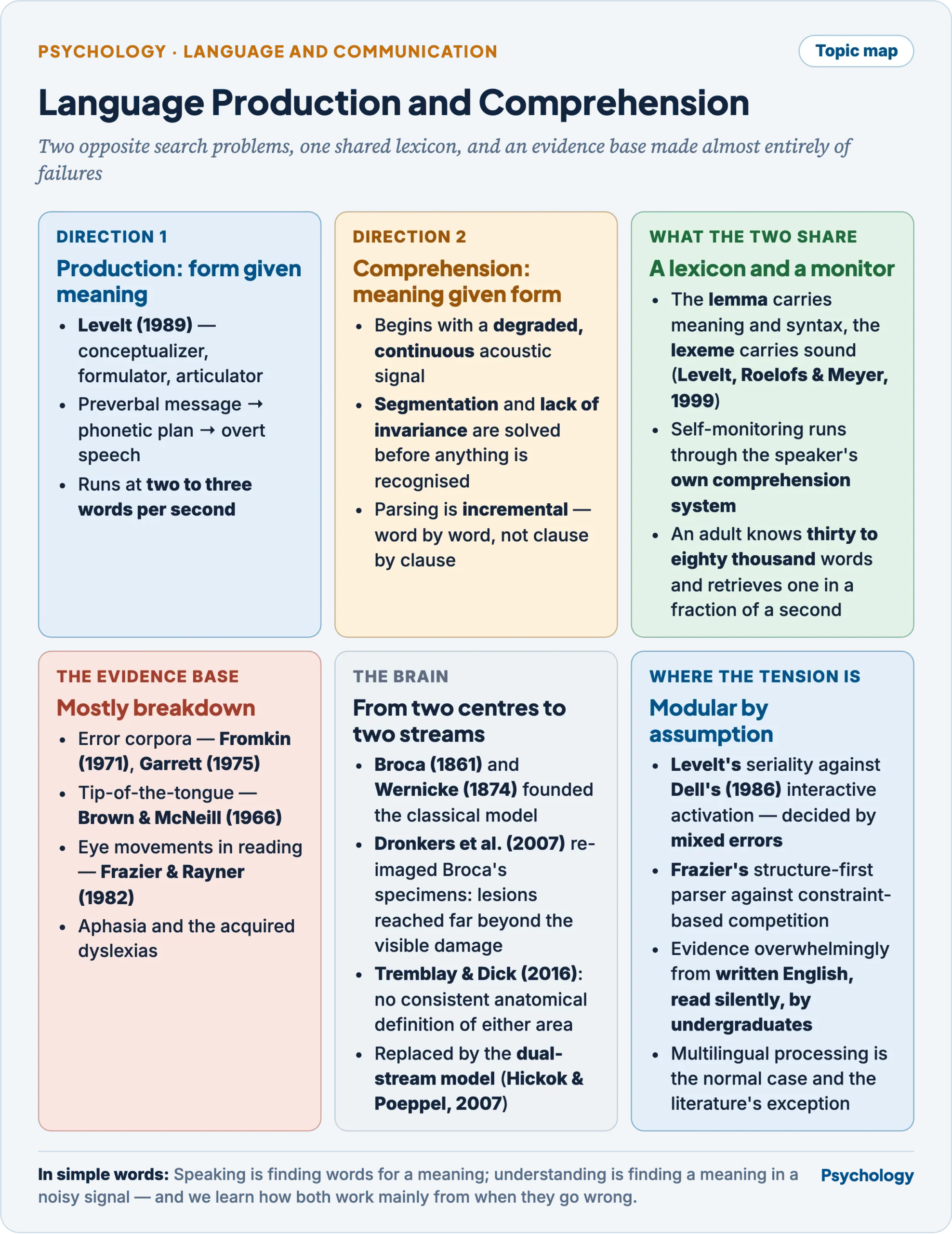
Production is a search for form given meaning; comprehension a search for meaning given form. The two share a lexicon and a monitor.
Levelt’s model of speech production
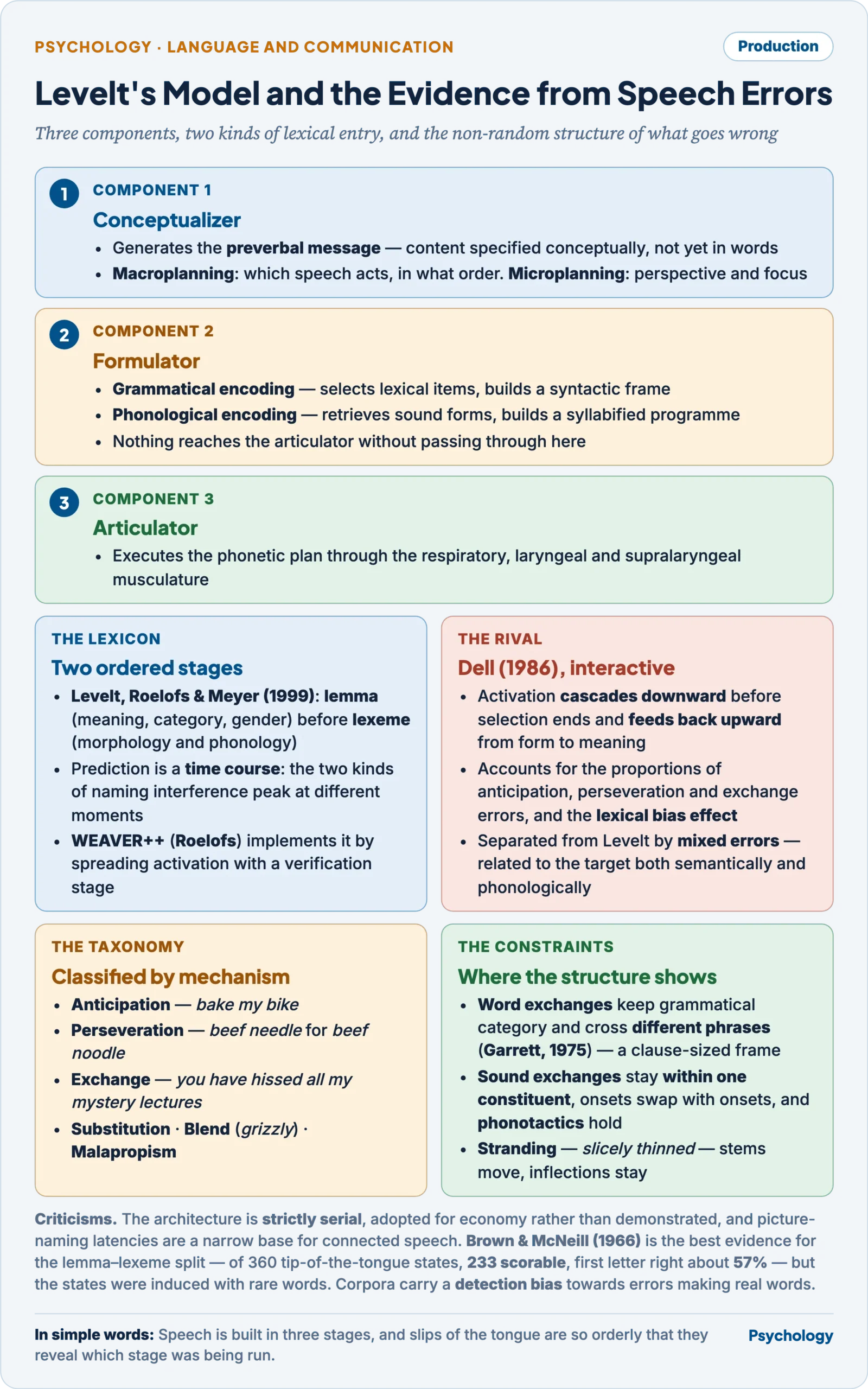
Nothing in the model reaches the articulator without passing through the formulator, which is why speech errors are overwhelmingly errors of form rather than of intention.
- Levelt (1989) proposed a modular architecture with three main processing components, each converting one representation into the next.
- The conceptualizer generates the preverbal message — the content to be expressed, specified conceptually and not yet in words. It performs macroplanning (which speech acts, in what order) and microplanning (perspective, topic and focus for each).
- The formulator turns that message into a phonetic plan in two sub-stages: grammatical encoding, which selects lexical items and builds a syntactic frame, and phonological encoding, which retrieves sound forms and builds a syllabified articulatory programme.
- The articulator executes the phonetic plan as overt speech through the respiratory, laryngeal and supralaryngeal musculature.
- The formulator draws on the mental lexicon, which stores two separable kinds of information about each word — the model’s most productive claim.
- Self-monitoring runs through the speaker’s own speech-comprehension system on two loops: an internal loop inspecting the phonetic plan before articulation, and an external loop hearing the output. Repairs begun before the error is fully uttered evidence the internal loop.
- Criticism: the architecture of Levelt (1989) is strictly serial, so nothing flows backwards from form to meaning. The seriality was adopted for economy rather than demonstrated, and mixed errors related to the target both semantically and phonologically are hard to explain without feedback.
Lexical access
- Levelt, Roelofs and Meyer (1999) split word retrieval into two ordered stages, the standard account.
- The lemma carries a word’s meaning and syntactic properties — category, gender, argument structure — but not its sound.
- The lexeme (word form) carries the morphological and phonological specification.
- The prediction is a time course: semantic information becomes available before phonological, so the two kinds of interference in a naming task peak at different moments.
- WEAVER++, the computational implementation developed by Roelofs, works by spreading activation with a verification stage, and reproduces a large body of picture-naming reaction-time data.
- The rival account is Dell’s (1986) spreading-activation model, interactive rather than serial: activation cascades downward before selection is complete and feeds back upward from form to meaning. It accounts for the relative proportions of anticipation, perseveration and exchange errors, for the lexical bias effect (sound errors tend to produce real words), and for the rise in errors with speaking rate.
- The two are distinguished by mixed errors, which Dell’s (1986) interactive model predicts directly and a strictly serial model does not.
- The tip-of-the-tongue state is the strongest everyday evidence for the split: a speaker can have the lemma — the word’s meaning, often its gender — while the lexeme remains unavailable.
- Criticism: picture-naming latencies are a narrow base for a model of connected speech, and the lemma level has been questioned as an unnecessary intermediate representation.
The evidence from speech errors
- Errors are rare, and their non-randomness is what makes them informative. Pioneering corpora were compiled by Fromkin (1971) and Garrett (1975), and the standard taxonomy classifies errors by mechanism rather than content.
- Anticipation — a later element arrives early: bake my bike for take my bike.
- Perseveration — an earlier element recurs: beef needle for beef noodle.
- Exchange (spoonerism) — two elements swap: you have hissed all my mystery lectures.
- Substitution — a word replaces another, usually a semantic neighbour or antonym.
- Blend — two competing words fuse: grizzly from ghastly and grisly.
- Malapropism — a phonologically similar, semantically unrelated word intrudes.
- The constraints on errors are where the structural evidence lies.
- Word exchanges overwhelmingly involve the same grammatical category and typically come from different phrases, placing them where a syntactic frame is built (Garrett, 1975).
- Sound exchanges stay within a single constituent, and the segments occupy similar positions in their words — onsets swap with onsets, not codas.
- Errors almost always respect the phonotactics of the language: the resulting string is pronounceable even when it is not a word.
- Stranding errors — slicely thinned for thinly sliced — show that stems move while inflections stay, so stems and affixes are retrieved separately.
- Two levels are thereby implied: errors of meaning and category operate over a clause, errors of sound over a phrase.
- Criticism: naturalistic corpora are opportunistically collected, so there is a detection bias towards errors producing real words, amusing results and stressed positions. Laboratory induction corrects this but produces errors under unnatural pressure.
- Freudian slips have little support. Induced errors can be biased by prior emotional priming, but the claim that slips routinely reveal repressed content is not established.
Hesitation and the units of planning
- Brown and McNeill (1966) produced the classic study of retrieval failure. They read out definitions of rare words and asked participants to name the target; on reporting a tip-of-the-tongue state, a participant was asked what they could recall of the unavailable word.
- Of 360 reported states 233 were scorable; the first letter was guessed correctly on roughly 57 per cent, and the number of syllables reported well above chance (Brown and McNeill, 1966).
- This establishes partial lexical access: the state is genuine possession of fragmentary form information rather than an illusion of imminent retrieval, which is why Brown and McNeill (1966) is read as evidence for separable lemma and lexeme levels.
- Limitation of the Brown and McNeill (1966) method: the state is generated artificially with rare words, and self-reported partial knowledge is vulnerable to the respondent reconstructing a plausible answer.
- Pause and hesitation data indicate the size of the planning unit. Silent pauses cluster at clause boundaries rather than falling randomly, and longer pauses precede clauses of greater structural or semantic difficulty, placing the planning unit at roughly the clause.
- Filled pauses (um, er) are not noise. They hold the turn while planning continues, and cluster before low-frequency words and complex constituents.
- Criticism: pause location is confounded with breathing and turn-taking pressure, and a clause-sized unit is an average rather than a buffer; planning overlaps with articulation.
Speech perception and its problems
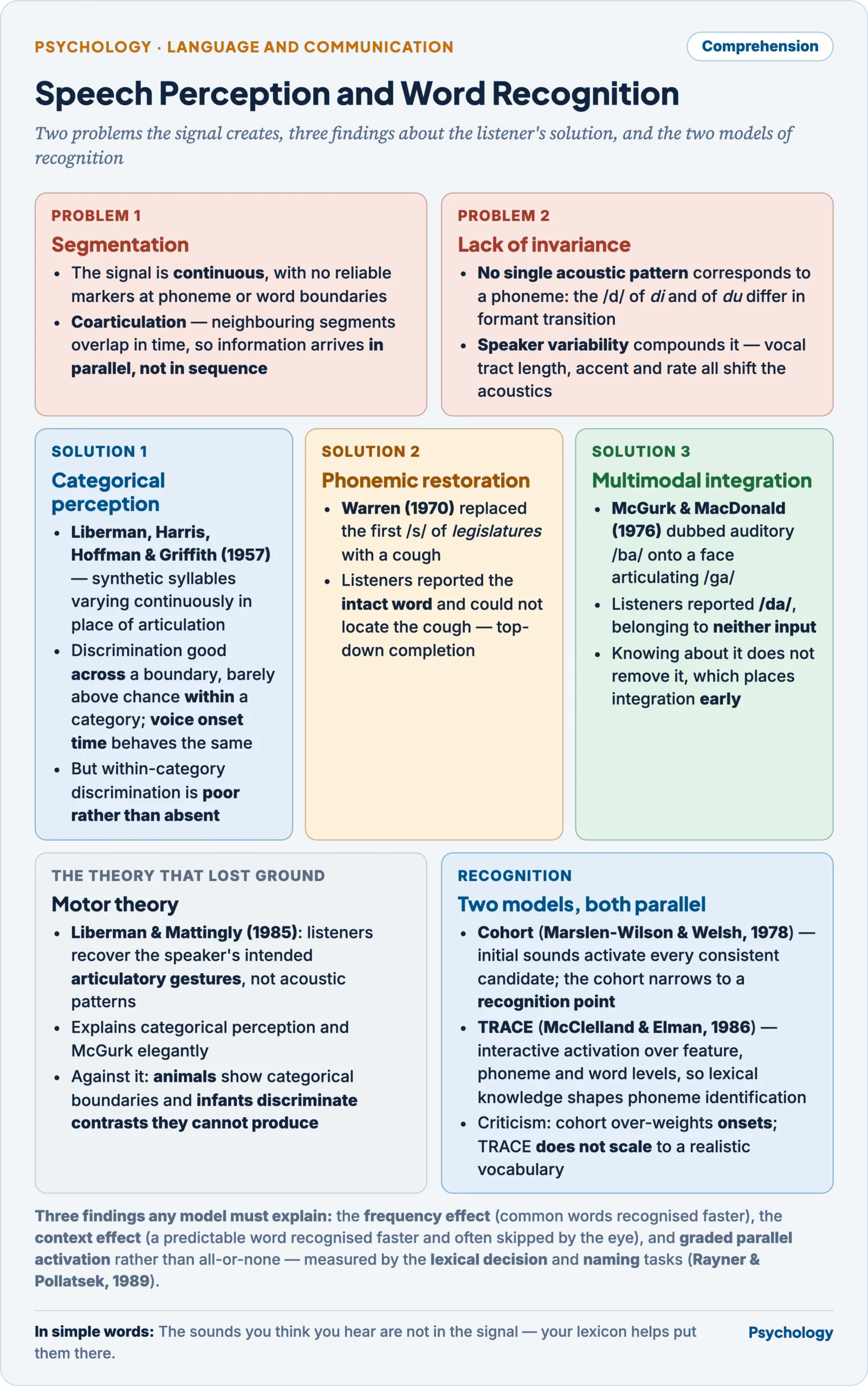
The acoustic signal does not contain the units the listener reports hearing; every arrow in the figure is a problem the listener has already solved.
- The segmentation problem: the signal is continuous, with no reliable acoustic markers at phoneme or word boundaries. Because articulation of neighbouring segments overlaps in time — coarticulation — information for successive phonemes arrives in parallel rather than in sequence.
- The lack of invariance: no single acoustic pattern corresponds to a given phoneme. The /d/ of di and the /d/ of du differ substantially in formant transition, yet both are heard as /d/. Speaker variability compounds this, since vocal tract length, accent and rate all shift the acoustics of the same intended sound.
- Categorical perception is part of the listener’s solution. Liberman, Harris, Hoffman and Griffith (1957) presented synthetic syllables varying continuously in place of articulation and found discrimination good across a phoneme boundary and barely above chance within a category. Perception imposes categories the signal does not contain.
- The voiced–voiceless contrast behaves the same way, using voice onset time as the varying cue.
- Qualification: the effect is not absolute. Within-category discrimination is poor rather than absent, and it weakens with training and with non-speech controls, which undermines its use as proof of a speech-specific module.
- Phonemic restoration shows top-down completion. Warren (1970) deleted the first /s/ from legislatures in a recorded sentence and replaced it with a cough; listeners reported hearing the intact word and could not locate the cough.
- The McGurk effect shows that speech perception is multimodal. McGurk and MacDonald (1976) dubbed an auditory /ba/ onto a face articulating /ga/; listeners reported /da/ — a fusion belonging to neither input. Knowing about the illusion does not remove it, which places the integration early rather than at judgement.
- The motor theory (Liberman and Mattingly, 1985) held that listeners recover the speaker’s intended articulatory gestures rather than acoustic patterns. It explains categorical perception and the McGurk effect elegantly but has lost ground: non-human animals show categorical boundaries, and infants discriminate contrasts they cannot produce.
Word recognition
- The lexicon is the full set of mental representations of words. An adult knows between thirty and eighty thousand and retrieves one in a fraction of a second, which is the fact any model must explain.
- A word’s representation is a network of three components: phonological features (sounds), orthographic features (letters) and semantic features (meaning). Reading adds the grapheme–phoneme mapping between the first two.
- Two models dominate, and both abandon serial search.
- The cohort model (Marslen-Wilson and Welsh, 1978) holds that a word’s initial sounds activate every candidate consistent with them; the cohort narrows as input arrives until one survives. It predicts the recognition point — where a word becomes unique — and explains identification before completion.
- TRACE (McClelland and Elman, 1986) is an interactive-activation network with feature, phoneme and word levels connected upward and downward. Top-down word-to-phoneme connections let lexical knowledge shape phoneme identification, which accommodates phonemic restoration.
- Three findings constrain any model: the frequency effect (common words recognised faster), the context effect (a predictable word recognised faster, often skipped by the eye), and graded parallel activation rather than all-or-none.
- The standard tasks are the lexical decision task, timing the judgement that a string is a word, and the naming task, timing reading aloud (Rayner and Pollatsek, 1989).
- Criticism: the cohort model over-weights word onsets and handles mispronounced or noise-masked beginnings poorly; TRACE does not scale to a realistic vocabulary.
Sentence comprehension and parsing
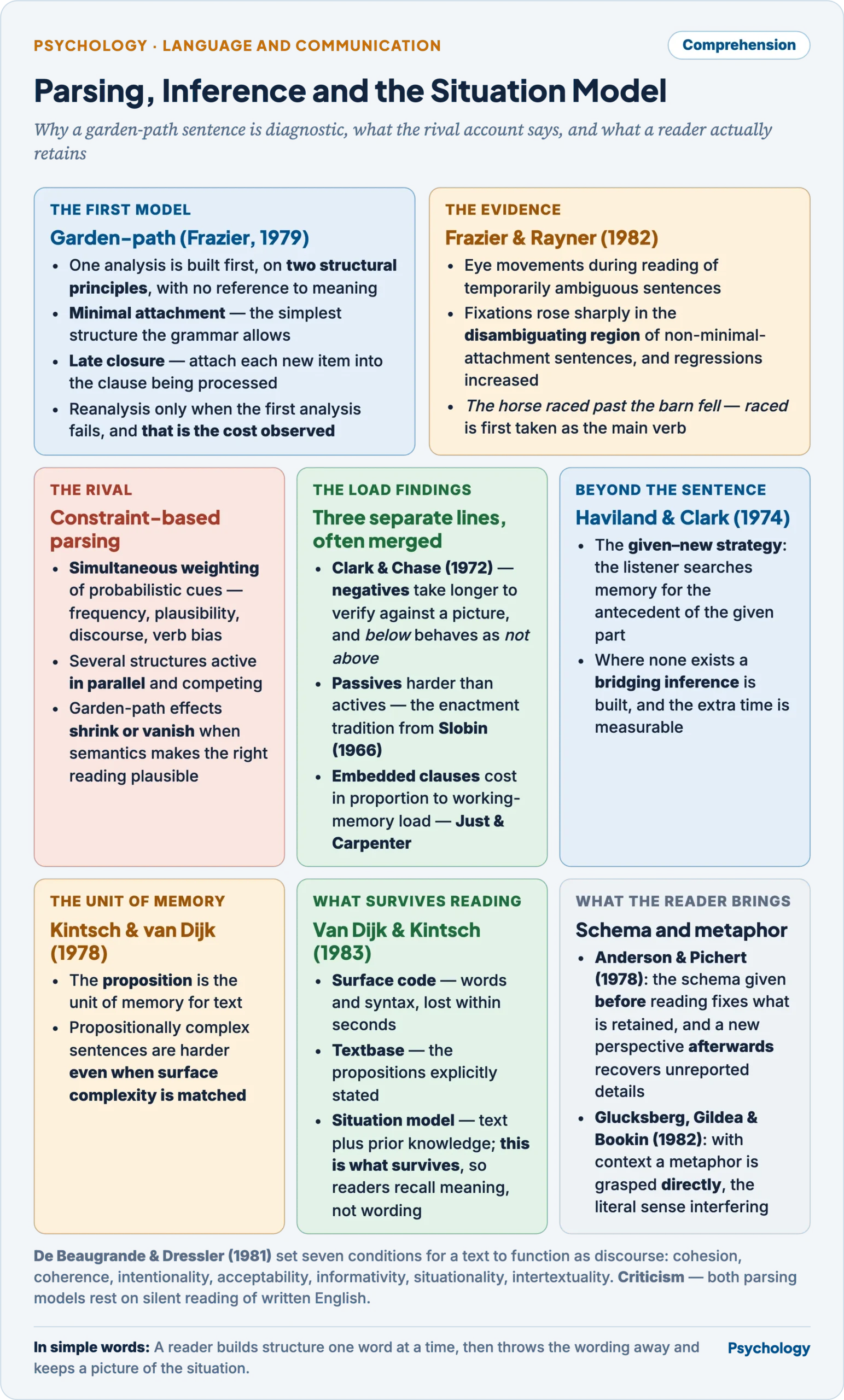
The garden-path sentence is diagnostic because the reader must have committed to one structure in order to be disrupted by the other.
- Parsing is the assignment of syntactic structure to an incoming string, and it proceeds incrementally — word by word rather than after the clause is complete, which is why temporary ambiguities cause measurable trouble.
- The garden-path model (Frazier, 1979) holds that one analysis is built first, on two structural principles and with no reference to meaning or plausibility.
- Minimal attachment — build the simplest structure consistent with the grammar, adding no unnecessary nodes.
- Late closure — attach each new item into the clause or phrase currently being processed.
- Reanalysis occurs only when the first analysis fails, and that reanalysis is the cost observed.
- Frazier and Rayner (1982) recorded eye movements during reading of temporarily ambiguous sentences. Fixation durations rose sharply in the disambiguating region of sentences requiring non-minimal attachment, and regressions to earlier material increased.
- The classic illustration is the horse raced past the barn fell, where raced is first taken as the main verb and must be reanalysed as a reduced relative clause.
- The rival constraint-based account treats parsing as the simultaneous weighting of probabilistic cues — lexical frequency, plausibility, discourse context, verb bias — with several structures active in parallel and competing.
- Its evidence is that garden-path effects shrink or vanish when semantics makes the correct reading plausible, which a purely structural first pass should not permit.
- Clark and Chase (1972) showed in a sentence-and-picture verification task that negation costs processing time: a negative statement took longer to check against a picture than an affirmative one, and below behaved as though it were encoded as not above.
- Two related costs come from separate lines of work, and the three are often run together as though one study had found them all. Passives are harder to verify and act out than actives, from the sentence-enactment tradition beginning with Slobin (1966). Embedded clauses impose costs that scale with working-memory load, which is the Just and Carpenter reading-capacity account.
- Criticism: both models rest on reading of written English, with its relatively rigid word order, and the early eye-movement work had too few regressions to analyse reanalysis statistically.
Context, inference and discourse
- Comprehension does not stop at the sentence. The listener builds a representation of connected text by adding inferences the text does not state.
- Haviland and Clark (1974) demonstrated the given–new strategy: a sentence divides into information treated as known and information offered as new, and the listener searches memory for the antecedent of the given part. Where none exists a bridging inference is constructed, and the extra time is measurable.
- Kintsch and van Dijk (1978) established the proposition as the unit of memory for text. Sentences of greater propositional complexity are harder to comprehend than propositionally simple ones even when surface complexity is matched.
- Van Dijk and Kintsch (1983) distinguished three levels of representation, which explains what readers retain.
- The surface code — the actual words and syntax, lost within seconds.
- The textbase — the network of propositions explicitly stated.
- The situation model — an integrated representation of the state of affairs described, combining text with prior knowledge. This is what survives, which is why readers recall meaning and forget wording.
- Anderson and Pichert (1978) showed that the schema a reader is given before reading determines which details are retained, and that supplying a different perspective afterwards recovers details previously unreported.
- Two accounts of conversational understanding compete. The code model assumes enough shared knowledge for encoding and decoding to suffice; the inferential model (Grice, 1975) treats comprehension as recovery of the speaker’s intention. Sperber and Wilson (1986) argued that speakers blend the two.
- Non-literal language is not handled by computing the literal meaning and rejecting it. Glucksberg, Gildea and Bookin (1982) found that with adequate context a metaphor’s intended sense is grasped directly, the literal meaning interfering rather than being tried first.
- De Beaugrande and Dressler (1981) set out seven conditions a text must satisfy to function as discourse: cohesion, coherence, intentionality, acceptability, informativity, situationality and intertextuality.
The neural basis, and why the classical model is too simple
- Broca (1861) examined a patient, Leborgne, who produced almost no articulate speech while comprehending adequately, and located the lesion in the left frontal lobe. Wernicke (1874) described the complementary case: a left temporal lesion producing fluent but empty speech with impaired comprehension.
- The classical model built on this assigns production to Broca’s area, comprehension to Wernicke’s area, and a connecting pathway between them, predicting three syndromes.
- Broca’s aphasia — effortful, agrammatic, telegraphic output with relatively preserved comprehension.
- Wernicke’s aphasia — fluent, well-articulated, semantically empty speech with impaired comprehension and poor awareness of the deficit.
- Conduction aphasia — comprehension and spontaneous speech relatively intact, repetition disproportionately impaired, attributed to disconnection.
- The model is now regarded as too simple, on several independent grounds.
- Dronkers and colleagues (2007) re-imaged Broca’s preserved specimens at high resolution. The lesions reached medial structures well beyond the surface damage Broca could see, did not cover the whole of what is now called Broca’s area, and included the superior longitudinal fasciculus. The founding cases do not support the localisation they are cited for.
- Damage restricted to Broca’s area does not reliably produce persisting Broca’s aphasia; the full syndrome generally requires extension into surrounding cortex and white matter.
- Tremblay and Dick (2016) surveyed researchers in the field and found no consistent anatomical definition of either area, so the terms do not pick out the same tissue across studies.
- The anatomy is distributed, not two centres joined by one tract: multiple fibre pathways support both production and comprehension, and subcortical structures participate.
- The replacement is the dual-stream model (Hickok and Poeppel, 2007): a bilateral ventral stream mapping sound onto meaning, and a left-dominant dorsal stream mapping sound onto frontal articulatory representations.
- Reading recruits partly separate machinery, and its disorders map onto the levels of the hierarchy.
- The dual-route model posits a lexical route giving direct access to a stored word form and a non-lexical route performing grapheme–phoneme conversion, the second slower and necessary for unfamiliar words.
- Acquired dyslexias dissociate accordingly. Surface dyslexia spares regular words and impairs irregular ones, implicating the lexical route; phonological dyslexia spares familiar words and impairs non-words, implicating the conversion route; deep dyslexia adds semantic errors in reading aloud.
- Boder (1973) classified developmental dyslexia into a dysphonetic type with auditory-phonological decoding failure, a dyseidetic type with whole-word visual recognition failure, and a mixed type. Validation has been uneven, several studies finding the profiles more similar than the scheme assumes.
- Paulesu and colleagues (2001) compared readers of English, French and Italian — orthographies of sharply different regularity — and found the same reduced left occipito-temporal activity in dyslexic readers of all three: a common neural basis beneath culturally variable surface severity.
Criticisms and limitations
- Production is far less well understood than comprehension, because the experimenter controls the input in comprehension and only the intention in production. Most production data are picture-naming latencies and error corpora, neither resembling connected conversational speech.
- The models are modular by assumption. Levelt’s seriality and Frazier’s structure-first parser were adopted for parsimony, and evidence for feedback and for parallel constraint satisfaction has accumulated against both.
- Errors and disfluencies are an indirect evidence base. They show what can go wrong, not what normally happens, and the inference from breakdown to architecture assumes the erring system is the intact one minus a component.
- The evidence is overwhelmingly from English, read silently, by university students. Word-order rigidity, orthographic depth and morphological richness all differ in Indian languages, and parsing principles derived from a fixed-order language do not transfer automatically.
- Multilingual processing is the normal case in much of the world and the exceptional case in the literature; a model of one lexicon with one phonology describes a minority of speakers.
- Neuropsychological inference is weakened by lesion heterogeneity. Natural lesions do not respect functional boundaries, patients are few, and the classical syndromes are clinical conveniences rather than natural kinds.
- What survives is substantial. The three-component architecture of production, the lemma–lexeme distinction, the systematic structure of speech errors, categorical perception, multimodal integration, incremental parsing, the situation model and the dual-stream account are all robust and all load-bearing.
Previous Year Questions
- 2025State the structure of language and explain its role in speech perception and comprehension.
- 2013What are the processes of language production?