

Official syllabusPaper I · Unit 13 · Language and Communication
Human language – Properties, structure and linguistic hierarchy.
Definition
“Language is a purely human and non-instinctive method of communicating ideas, emotions and desires by means of a system of voluntarily produced symbols.”
Sapir (1921)
Every clause of that definition does work. Language is symbolic, so the signal is detached from what it stands for; it is voluntarily produced, so it is not a reflex discharge of emotion; and it is a system, so a finite inventory of units combines under rules into an unbounded set of messages. The topic settles how a species-wide behaviour that looks effortless can be described precisely enough to be compared with the signalling of other animals.
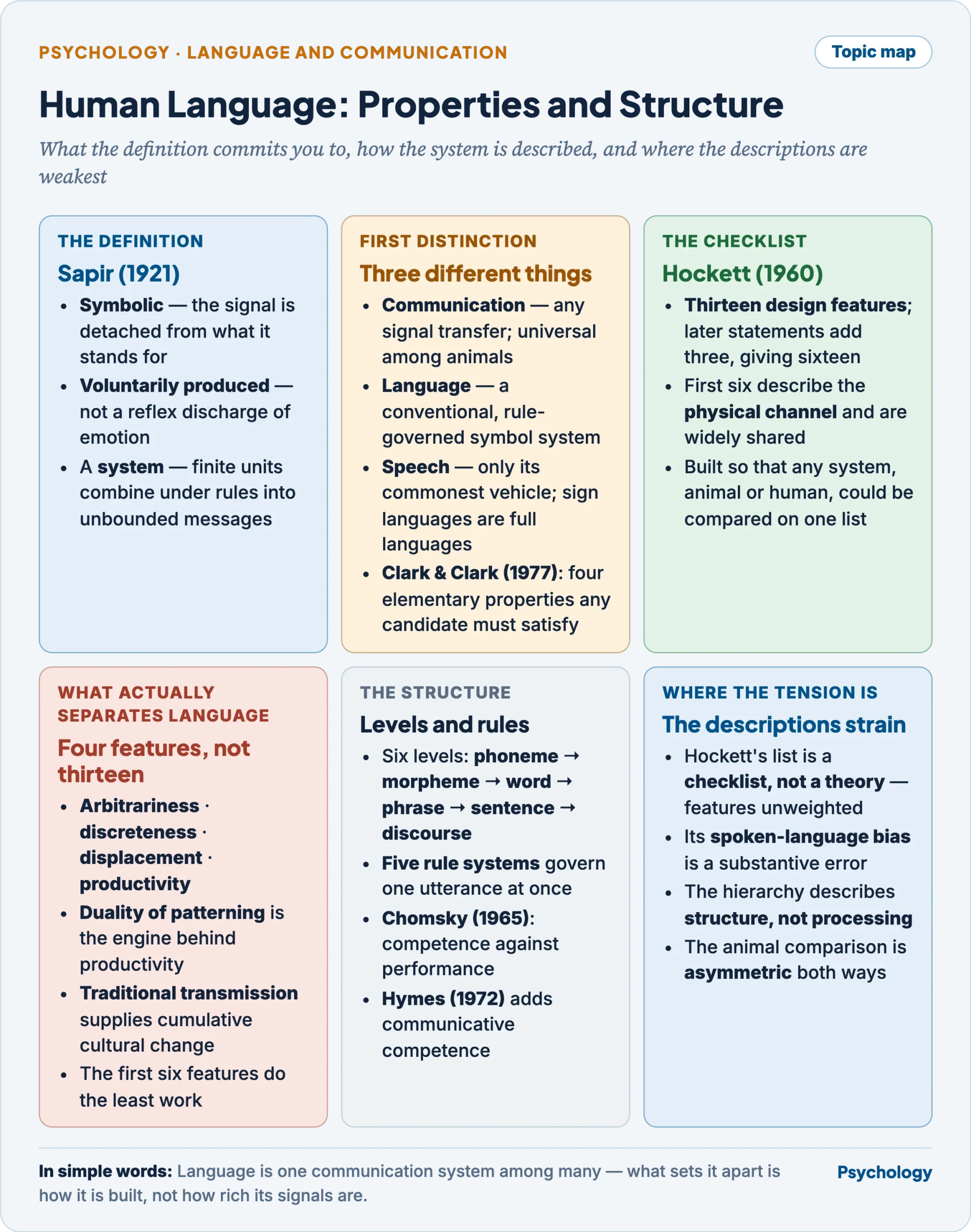
The levels stack, but the rule systems cut across them: a single utterance is simultaneously phonological, morphological, syntactic, semantic and pragmatic.
Language, speech and communication are three different things
- Communication is the transfer of information from a source to a destination by means of signals. It is universal among animals and needs neither symbols nor grammar.
- Language is one particular communication system: a conventional, rule-governed symbol system. Speech is only its commonest physical vehicle; sign languages are full languages in another channel, and writing is a derived, recent encoding.
- The three come apart in observable cases. A person with severe dysarthria has language without usable speech; a parrot produces speech sounds without language; a traffic signal communicates without being either.
- Clark and Clark (1977) fixed four elementary properties any candidate system must satisfy: children can acquire it, adults can produce and understand it easily, it captures the ideas people ordinarily convey, and it supports communication within a social and cultural group.
- Two kinds of signal are distinguished. A sign is causally or naturally linked to what it conveys — smoke for fire, a wince for pain. A symbol is linked only by social convention, and language is overwhelmingly symbolic.
Hockett’s design features
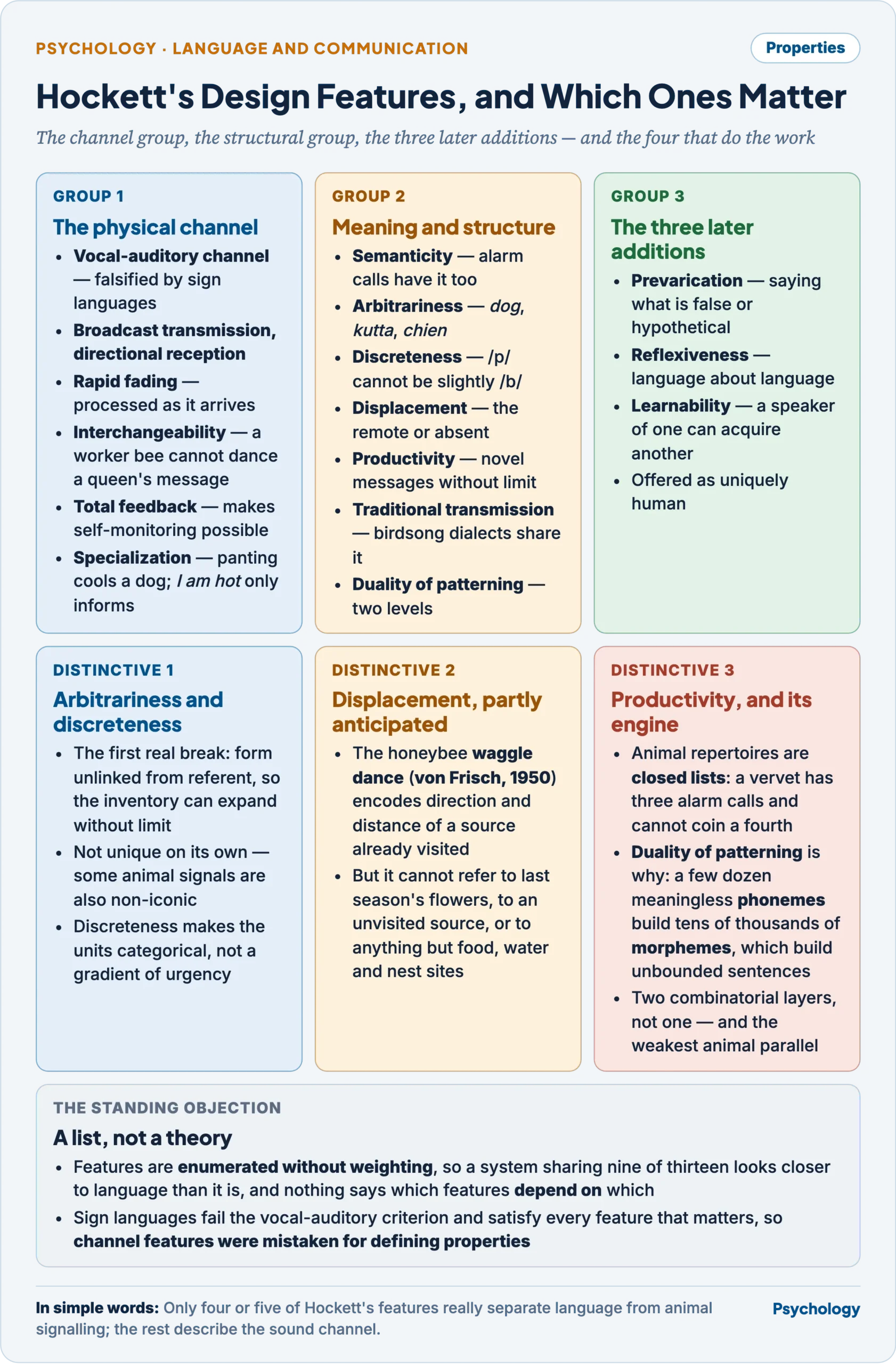
The first six features describe the channel; the distinctive cluster sits at the bottom of the list, not the top.
- Hockett (1960) set out thirteen design features intended as a checklist against which any communication system, animal or human, could be compared. Later statements of the list add three more, giving the sixteen often quoted.
- The first group describes the physical channel and is shared with a great many species.
- Vocal-auditory channel — produced by the vocal tract, received by the ear. Sign languages falsify this feature, which is the chief reason the list is now called spoken-language-centric.
- Broadcast transmission and directional reception — the signal radiates in all directions, while the hearer locates its source.
- Rapid fading (transitoriness) — the signal does not persist, so it must be processed as it arrives.
- Interchangeability — any competent user can send whatever they can receive. A worker bee cannot dance a queen’s message.
- Total feedback — the sender perceives their own signal completely, which makes self-monitoring and self-correction possible.
- Specialization — the signal’s only function is to inform; it does no other work. Panting cools a dog; saying “I am hot” does nothing but inform.
- The second group concerns meaning and structure, and here the comparison becomes informative.
- Semanticity — signals have fixed associations with things and situations. Partly shared: alarm calls have it.
- Arbitrariness — the form of the signal bears no resemblance to its referent. Dog, kutta and chien pick out the same animal with no shared sound.
- Discreteness — the signal is built from a small set of categorically distinct units, not from a continuous gradient. A pitch cry can be more or less urgent; /p/ cannot be slightly /b/.
- Displacement — reference to things remote in space or time, or absent altogether.
- Productivity (generativity) — novel messages never heard before can be produced and understood without limit.
- Traditional transmission — the particular language is learnt from other users, not inherited. Shared in part: birdsong dialects are learnt.
- Duality of patterning — the system has two independent levels of structure, meaningless units combining into meaningful ones.
- The three later additions are offered as uniquely human: prevarication (the capacity to say what is false or hypothetical), reflexiveness (the use of language to talk about language), and learnability (a speaker of one language can acquire another).
Which features are genuinely distinctive
- Arbitrariness is the first real break. Because form is unlinked from referent the inventory can expand without limit — but arbitrariness alone is not unique, since some animal signals are also non-iconic.
- Displacement is partly anticipated. The waggle dance of the honeybee, described by von Frisch (1950), encodes the direction and distance of a nectar source the dancer visited earlier. That is displacement of a restricted kind: it cannot refer to last season’s flowers, to a source the bee has not visited, or to anything but food, water and nest sites.
- Productivity is the sharpest contrast. Animal repertoires are closed lists; a vervet has three alarm calls and cannot coin a fourth. Human speakers routinely produce and understand sentences never before uttered.
- Duality of patterning is the engine behind productivity and the feature with the weakest animal parallel. A few dozen meaningless phonemes combine into tens of thousands of morphemes, which combine into an unbounded set of sentences. Two layers of combination, not one, buys the open-endedness.
- Together these four — with traditional transmission supplying cumulative cultural change — are the defensible answer to what separates language from signalling. The first six features do the least work.
The linguistic hierarchy
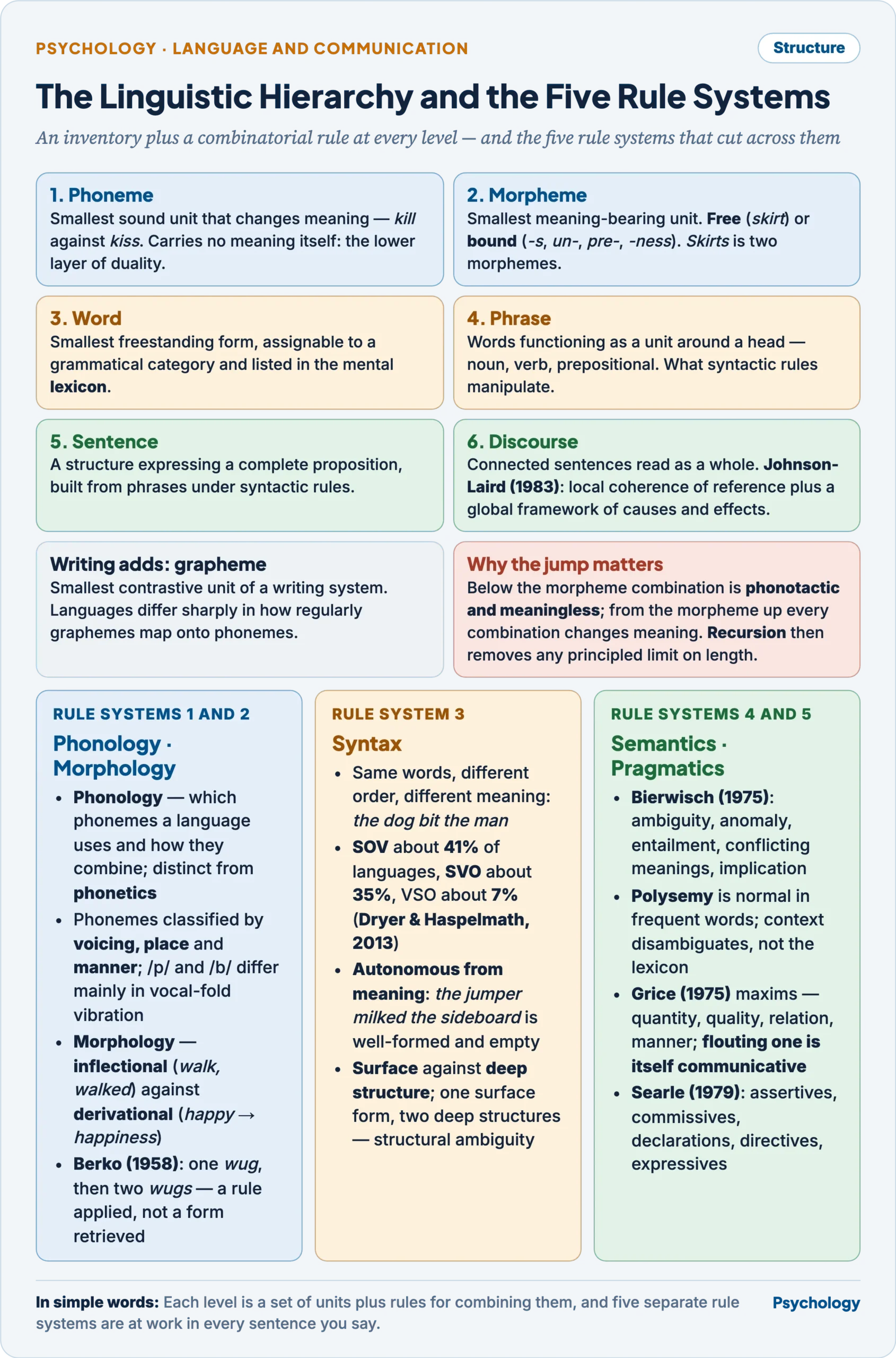
Each level is an inventory plus a combinatorial rule; the jump from phoneme to morpheme is where meaning enters the system.
- The hierarchy runs from the smallest contrastive unit to the largest interpretable one. Six levels are standardly distinguished.
- Phoneme — the smallest unit of sound that changes meaning when exchanged. Kill and kiss differ by one phoneme. Phonemes themselves carry no meaning, which is the lower layer of duality.
- Morpheme — the smallest unit that carries meaning. A free morpheme can stand alone (skirt); a bound morpheme cannot (-s, un-, pre-, -ness). Skirts is two morphemes.
- Word — the smallest freestanding form, assignable to a grammatical category and listed in the mental lexicon.
- Phrase — a group of words functioning as a unit around a head: noun phrase, verb phrase, prepositional phrase. Phrases are what syntactic rules manipulate, which is why sentence structure is hierarchical rather than a chain.
- Sentence — a structure expressing a complete proposition, built from phrases under syntactic rules.
- Discourse — connected sentences interpreted as a whole. On Johnson-Laird’s (1983) account, discourse exists where references in successive sentences are locally coherent and the whole fits a global framework of causes and effects.
- Below the morpheme, combination is phonotactic and meaningless; from the morpheme upward, every combination changes meaning. The two layers are not the same kind of thing.
- Hierarchy is what makes recursion possible: a phrase can contain a phrase of the same type, so sentence length has no principled upper bound even though memory imposes a practical one.
- Writing adds one further unit, the grapheme — the smallest contrastive unit of a writing system. Languages differ sharply in how regularly graphemes map onto phonemes, with measurable consequences for reading.
The rules of language
- Five rule systems govern a single utterance simultaneously. Each has its own units, its own well-formedness conditions, and its own characteristic errors.
Phonology
- Phonology is the study of a language’s sound system: which phonemes it uses and how they combine. It is distinct from phonetics, the study of the physical production and acoustics of speech sounds.
- Phonemes are classified by voicing, place of articulation and manner of articulation. The /p/ of pay and the /b/ of bay are articulated almost identically and differ mainly in whether the vocal folds vibrate.
- Inventories differ across languages, and so do permissible combinations. English allows /str/ word-initially; many languages do not. A contrast absent from the native inventory is heard poorly, which is the basis of the familiar difficulty some Japanese speakers report with English /l/ and /r/.
- The allophone is the limiting case: two physically different sounds that do not contrast in one language are variants of a single phoneme there, and separate phonemes elsewhere. Phonemic status is a fact about a language, not about acoustics.
Morphology
- Morphology is the system of rules for building words from morphemes. Inflectional morphology marks grammatical properties without changing category (walk, walked, walking); derivational morphology creates new words, often in a new category (happy → happiness).
- Morphological rules are productive rather than memorised, which is why children overregularise: goed, mouses, bringed. Berko (1958) showed this with invented words — children shown one wug and then two supplied wugs, so a rule was applied rather than a stored form retrieved.
- Hindi and other Indian languages carry case, number, gender and honorific information in inflection that English spreads across separate words.
Syntax
- Syntax is the set of rules specifying how words and morphemes combine into acceptable sentences. Its clearest demonstration is that the same words in a different order mean something else: the dog bit the man against the man bit the dog.
- Basic word order is the most studied typological variable. Across a large sample of the world’s languages, SOV order is the commonest at roughly 41 per cent and SVO next at roughly 35 per cent, with VSO around 7 per cent and a substantial group having no dominant order (Dryer and Haspelmath, 2013). English is SVO; Hindi, Bengali, Tamil and Japanese are SOV.
- Syntax is autonomous from meaning, and the dissociation runs both ways. The jumper milked the sideboard is syntactically impeccable and semantically empty; eaten by Ram the cake was is ill-formed yet interpretable.
- Surface structure is the actual arrangement of symbols in the utterance; deep structure is the underlying meaning relation it expresses. One deep structure supports several surface forms (Ram ate the cake / the cake was eaten by Ram), and one surface form can support two deep structures — structural ambiguity: the police must stop drinking after midnight.
Semantics
- Semantics is the study of meaning and of how speakers mentally represent the meanings of words and sentences. Bierwisch (1975) identified five phenomena any semantic theory must handle, and they double as a diagnostic of what semantics is for.
- Ambiguity — more than one reading for one form: go to the right table.
- Anomaly — syntactically correct and semantically impossible: tables fly long hairs in the air.
- Entailment — information conveyed beyond what is stated: Rita is my best friend entails that the best friend is female.
- Conflicting meanings — apparent self-contradiction that resolves into a finer distinction: my cat is not my pet.
- Implication — alternative construals of a complete sentence: students hate annoying lecturers.
- Polysemy — one form carrying several related senses — is the normal condition of frequent words, and context rather than the lexicon does the disambiguating.
Pragmatics
- Pragmatics is the system of social rules determining how language is used in context: the same content is delivered differently to an employer and to a friend. It is the level at which literal meaning and intended meaning come apart.
- Grice (1975) proposed a cooperative principle with four maxims — quantity (be as informative as required, no more), quality (be truthful), relation (be relevant) and manner (be clear). Their interest is that flouting a maxim is itself communicative: an irrelevant answer signals refusal to answer.
- Searle (1979) classified utterances by what they do rather than what they state: assertives state a belief, commissives commit the speaker to an action, declarations bring about a state of affairs, directives get the hearer to act, expressives convey an internal state.
- Pragmatics makes language a dialogue rather than a transmission. The speaker monitors their own output for error and the hearer for comprehension at once, which is why conversation repairs itself continuously.
Competence and performance
- Chomsky (1965) separated linguistic competence — the speaker-hearer’s tacit knowledge of the rules of the language — from performance, the actual use of language on a particular occasion, with its hesitations, slips and memory failures. Grammaticality is a property of competence; acceptability belongs to performance.
- The distinction makes a theory possible. No corpus of actual speech contains all and only the well-formed sentences, so a grammar must model what the speaker knows rather than summarise what they have said. It also explains productivity: a speaker judges a never-encountered sentence well-formed or not, which is knowledge of a rule, not familiarity with an instance.
- Hymes (1972) argued that this is too narrow and added communicative competence — knowing when, to whom and in what register something may appropriately be said. A speaker with perfect grammar and no pragmatics is not a competent user of a language.
- Criticism: the ideal speaker-hearer of a homogeneous community is an abstraction no population matches, and treating systematic variation as noise discards data that sociolinguistics has shown to be rule-governed. Competence is also reachable only through performance.
Human language against animal communication
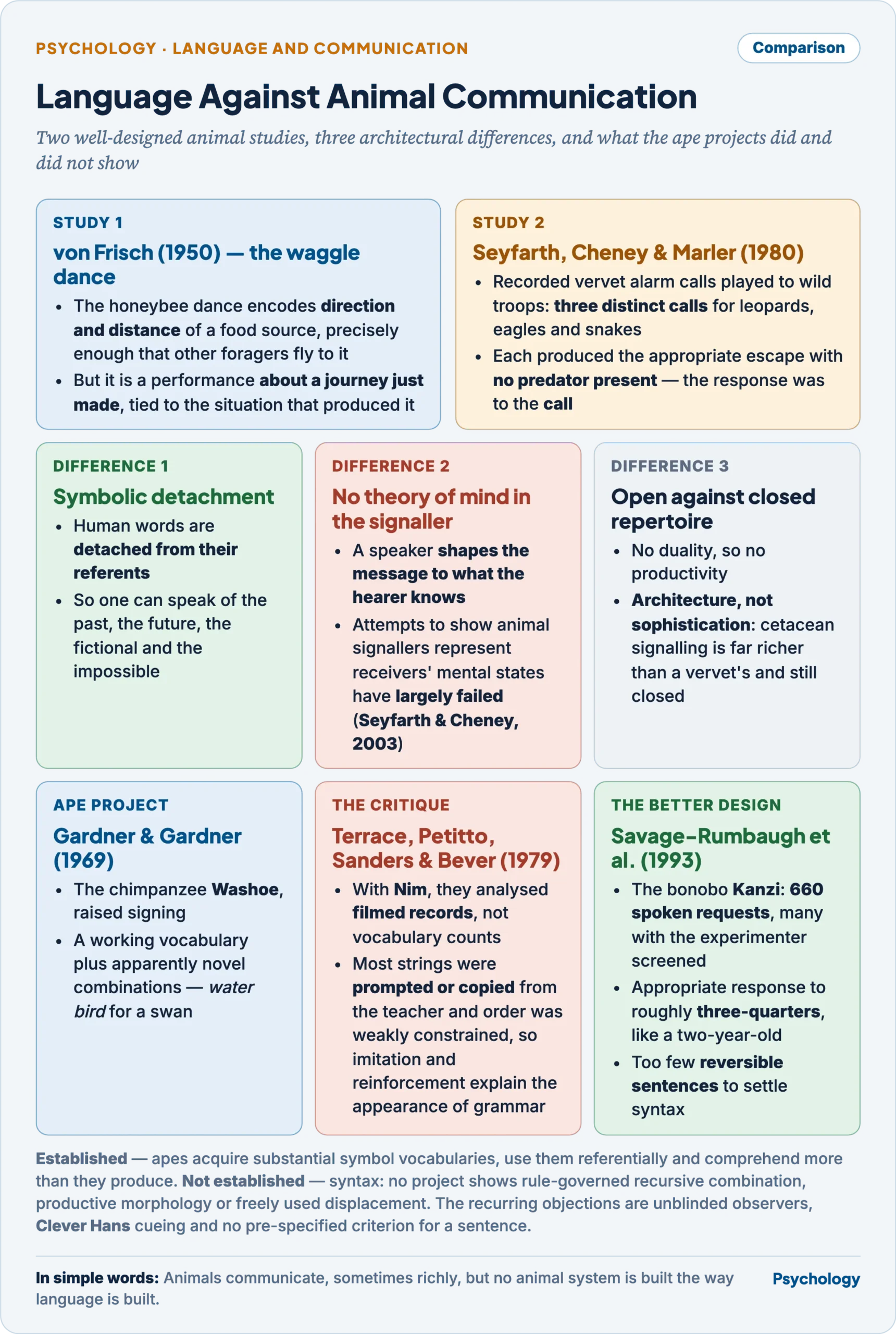
Animal systems match language on individual features and on none of the combinations; the gap is in the architecture, not in the richness of the signal.
- Humans are not unique in communicating. von Frisch (1950) established that the honeybee’s waggle dance encodes direction and distance of a food source precisely enough for other foragers to fly to it.
- Seyfarth, Cheney and Marler (1980) played recordings of vervet monkey alarm calls to wild troops and found three functionally distinct calls, for leopards, eagles and snakes, each producing the predator-appropriate escape response — running into trees, looking up, scanning the ground — with no predator present. The design is the point: because the stimulus was a loudspeaker, the response was to the call and not to the animal.
- Three differences then stand out, and each has an identifiable mechanism.
- Symbolic detachment — the bee’s dance is tied to the situation that produced it, a performance about a journey just made. Human words are detached from their referents, which makes it possible to speak of the past, the future, the fictional and the impossible.
- No theory of mind in the signaller — when a person speaks, the hearer learns about the speaker’s beliefs and intentions, and the speaker shapes the message to what the hearer is taken to know. Attempts to show that animal signallers represent receivers’ mental states have largely failed (Seyfarth and Cheney, 2003).
- Open against closed repertoire — animal systems lack duality of patterning and so lack productivity. Three calls remain three calls.
- These are differences of architecture, not of sophistication. Cetacean signalling is acoustically far richer than a vervet’s, and still closed.
The ape language projects and why they are contested
- The strongest test of whether the architecture is species-specific is to teach a non-human the system directly. Since apes lack the vocal tract for speech, the projects used signs, plastic tokens or keyboard symbols.
- Gardner and Gardner (1969) raised the chimpanzee Washoe in a signing environment and reported a working vocabulary of signs plus apparently novel combinations, the most quoted being water bird for a swan.
- Terrace, Petitto, Sanders and Bever (1979) ran the decisive critique. Working with the chimpanzee Nim, they analysed filmed records rather than summary vocabulary counts and found that most multi-sign strings were prompted or partly copied from the teacher’s immediately preceding signs, that sign order was weakly constrained, and that long strings were repetitive rather than structured.
- Their conclusion was that the appearance of grammatical competence could be explained by non-linguistic processes — imitation, prompting and reinforcement.
- Their objection to Washoe was methodological as much as theoretical: sign order in multi-sign combinations had largely gone unreported, so no grammatical analysis was possible.
- Savage-Rumbaugh and colleagues (1993) answered on comprehension rather than production, the better-designed line of work. The bonobo Kanzi was given 660 spoken English requests, 416 with the experimenter behind a one-way screen so cueing was impossible, many deliberately bizarre. He responded appropriately to roughly three-quarters, comparable to a two-year-old child on the same items.
- One criticism survives, and it is specific. Grammatical knowledge would show on reversible sentences, where word order alone distinguishes the readings, and that subset was too small to settle the question (Savage-Rumbaugh and colleagues, 1993).
- Established — apes acquire substantial symbol vocabularies, use them referentially and spontaneously, and comprehend more than they produce.
- Not established — syntax. No project has shown rule-governed recursive combination, productive morphology, or displacement used freely. Recurring objections are unblinded observers, inadvertent cueing of the Clever Hans type, anecdotal reporting of best performances, and no pre-specified criterion for what would count as a sentence.
Criticisms and limitations
- Hockett’s list is a checklist, not a theory. It enumerates features without weighting them, so a system sharing nine of thirteen looks closer to language than it is, and it says nothing about which features depend on which — although duality and productivity plainly do.
- Its spoken-language bias is a substantive error. Sign languages fail the vocal-auditory criterion and satisfy every feature that matters, so the channel features were mistaken for defining properties.
- The hierarchy is an idealisation. Levels are presented as discrete and strictly ordered, whereas processing at each level is influenced by those above: phoneme identification is affected by lexical knowledge, word recognition by sentence context. A bottom-up hierarchy describes structure, not processing.
- The units are theory-laden. The word is hard to define cross-linguistically, the morpheme breaks down in languages with non-concatenative morphology, and the phoneme is inferred from contrast rather than observed acoustically.
- Competence and performance separate cleanly in theory and poorly in practice, and the idealisation to a homogeneous speech community excludes bilingualism and dialect variation — the normal condition in India.
- The animal comparison is asymmetric. Animal systems are assessed on their natural repertoires and human language on its full capacity; the ape projects reverse the bias by testing animals on a system they did not evolve to use.
- What survives is substantial. Arbitrariness, discreteness, displacement, productivity and duality of patterning remain the working vocabulary for comparing communication systems; the five rule levels remain the standard decomposition of linguistic knowledge and map onto dissociable impairments; and the competence-performance distinction remains the reason a grammar can be written at all.
Previous Year Questions
- 2026Differentiate between surface and deep structure of language. Describe the hierarchy of language.
- 2025State the structure of language and explain its role in speech perception and comprehension.
- 2020What are the different rules of language? Critically analyze ‘critical period hypothesis’.
- 2018Describe the structure and features of language focussing on what makes human language unique in comparison to communication in animals.
- 2011How does language differ from other forms of communication? Referring to relevant studies, document children’s progress from non verbal communication to the use of language.
- 2005Discuss properties and structure of human language.