

Official syllabusPaper I · Unit 12 · Attitudes, Values and Interests
Changing others behaviour.
Definition
“A person does not act upon the world, the world acts upon him.”
Skinner (1971)
Changing another person’s behaviour is a technical problem with an ethical structure. The technical question is which contingency, cue or default actually controls the behaviour; the ethical one is who chooses the target and whether the person may refuse. The methods divide by mechanism — consequences, requests, norms, architecture, commitment — each with its own evidence record and cost to autonomy.
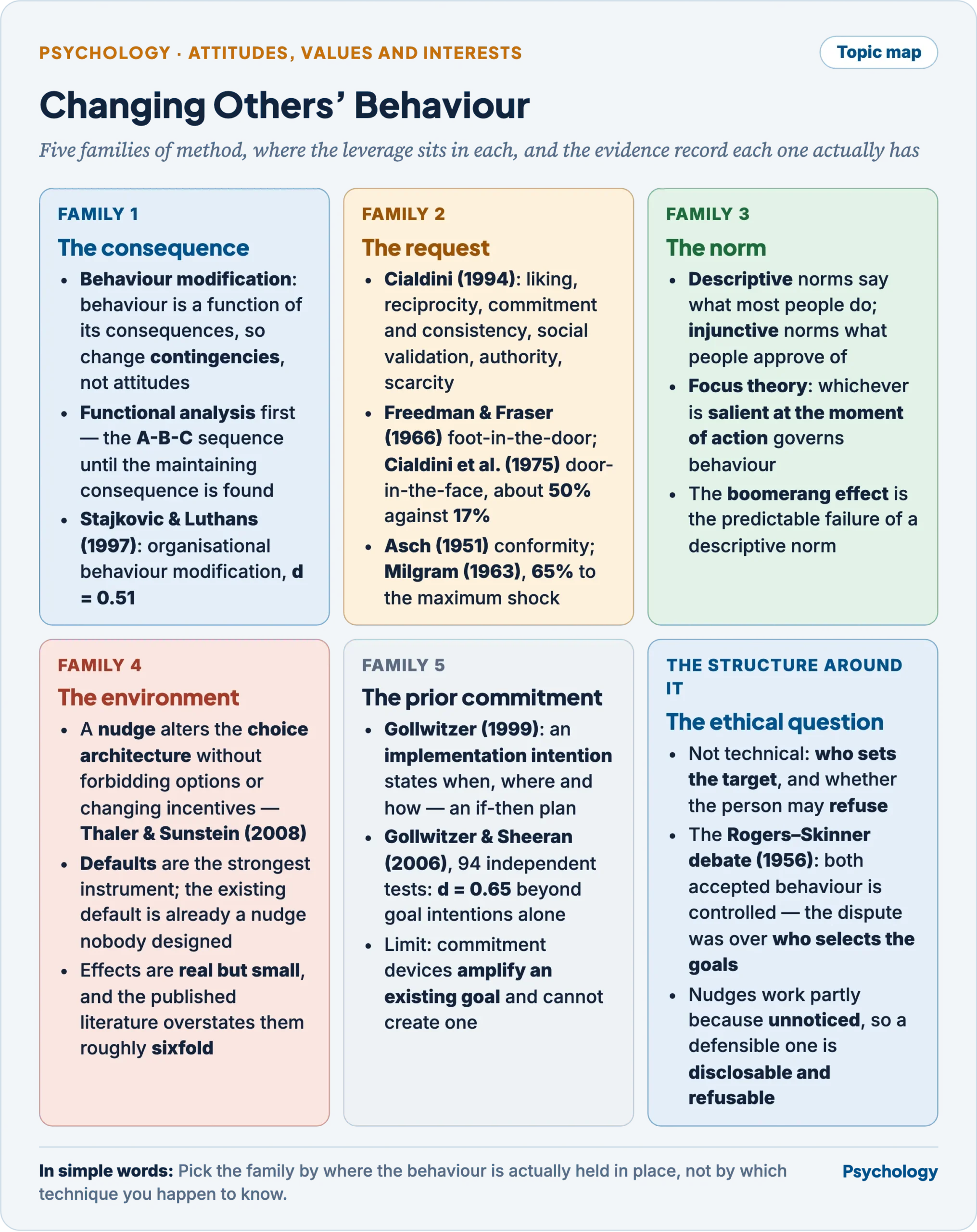
The five families differ in where the leverage sits: the consequence, the request, the norm, the environment, or a prior commitment.
Behaviour modification: the operant core
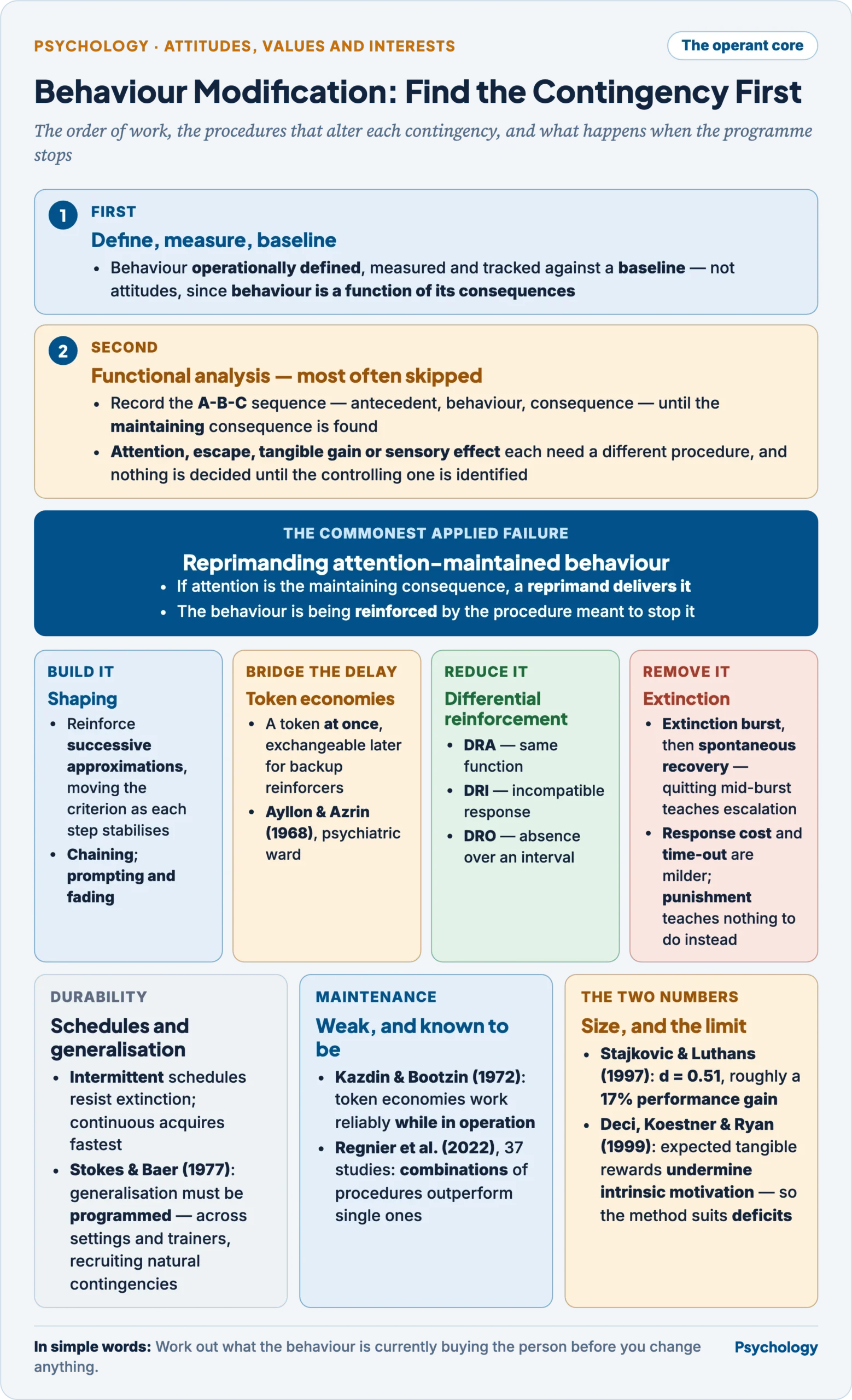
Nothing is decided until the controlling contingency is identified; each technique alters one.
- Behaviour modification applies operant principles to behaviour operationally defined, measured and tracked against a baseline. Behaviour is a function of its consequences, so one changes contingencies rather than attitudes.
- Functional analysis comes first and is most often skipped: the A-B-C sequence — antecedent, behaviour, consequence — is recorded until the maintaining consequence is found.
- The same behaviour may be maintained by attention, escape, tangible gain or sensory effect, each needing a different procedure. Attention-maintained behaviour met with reprimands is being reinforced — the commonest applied failure.
- Shaping builds behaviour not yet in the repertoire by reinforcing successive approximations, moving the criterion as each step stabilises. Chaining links components; prompting and fading hand control to natural cues.
- Token economies make reinforcement portable: a token delivered at once is exchangeable later for backup reinforcers, bridging delay. Ayllon and Azrin (1968) established the method on a psychiatric ward; it now runs in classrooms, residential care and de-addiction.
- Contingency contracting writes the arrangement down — target, measure, reinforcer, timing, signatures — making the contingency negotiable rather than imposed.
- Differential reinforcement reduces behaviour without punishment: DRA reinforces an alternative serving the same function, DRI an incompatible response, DRO the behaviour’s absence over an interval.
- Extinction withholds the maintaining consequence. Two facts govern its use: the extinction burst, a temporary rise in rate and intensity, and spontaneous recovery. Programmes abandoned mid-burst teach that escalation works.
- Response cost removes earned reinforcers and time-out removes access to reinforcement, both milder than punishment.
- Punishment suppresses quickly and is a poor first choice: it teaches nothing to do instead, produces escape from the punisher rather than the behaviour, and models coercion.
- Schedules determine durability: continuous reinforcement acquires behaviour fastest, intermittent schedules make it resistant to extinction.
Durability and generalisation of behaviour change
- Kazdin and Bootzin’s (1972) review set the terms still used: token economies work reliably while in operation, with little attention to generalisation or to resistance to extinction once reinforcement stops.
- Stokes and Baer (1977) argued that generalisation must be programmed, not hoped for — training across settings and trainers, recruiting natural contingencies, and enlisting the person’s own community as reinforcing agent.
- Regnier and colleagues’ (2022) review of maintenance in token economies, covering 37 studies, found combinations of procedures outperforming single ones, at least one transferring control to other reinforcers.
- The opposite risk is overjustification: Deci, Koestner and Ryan’s (1999) meta-analysis found expected tangible rewards reliably undermining intrinsic motivation, so the method suits behaviour deficits, not behaviour people already enjoy.
- Stajkovic and Luthans’s (1997) meta-analysis of organisational behaviour modification studies, 1975 to 1995, found an average d of 0.51 — roughly a 17 per cent performance gain — larger in manufacturing than services.
Which model of man behaviour modification presupposes
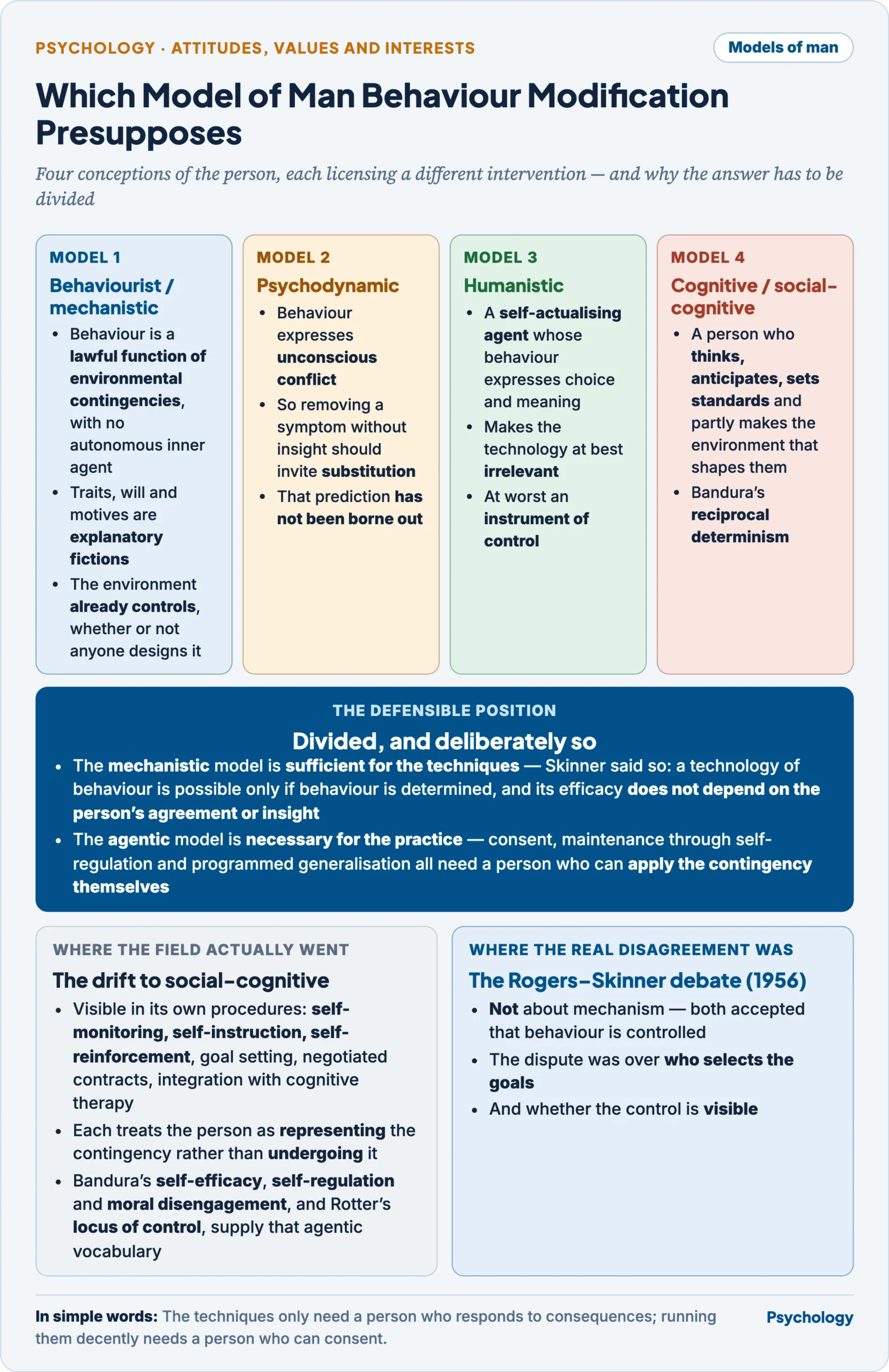
The techniques need only the mechanistic model; the practice as conducted needs the agentic one.
- Four conceptions of the person are in contention, each licensing a different intervention.
- The behaviourist or mechanistic model — an organism whose behaviour is a lawful function of environmental contingencies, with no autonomous inner agent. Traits, will and motives are explanatory fictions, and the environment already controls whether or not anyone designs it.
- The psychodynamic model — behaviour expresses unconscious conflict, so removing a symptom without insight invites substitution; that prediction has not been borne out.
- The humanistic model — a self-actualising agent whose behaviour expresses choice and meaning, making the technology at best irrelevant and at worst an instrument of control.
- The cognitive and social-cognitive model — a person who thinks, anticipates, sets standards and partly makes the environment that shapes them: Bandura’s reciprocal determinism.
- Strictly, behaviour modification presupposes the mechanistic model, and Skinner said so: a technology of behaviour is possible only if behaviour is determined, and its efficacy does not depend on the person’s agreement or insight.
- In practice the field has drifted to the social-cognitive model, visible in its own procedures — self-monitoring, self-instruction, self-reinforcement, goal setting, negotiated contracts, integration with cognitive therapy. Each treats the person as representing the contingency rather than undergoing it.
- Bandura’s self-efficacy, self-regulation and moral disengagement, and Rotter’s locus of control, supply that agentic vocabulary; they are set out in the article on behavioural and social-cognitive theories of personality.
- The defensible position is divided: the mechanistic model is sufficient for the techniques, the agentic model necessary for the practice, since consent, maintenance through self-regulation and programmed generalisation need a person who can apply the contingency themselves.
- The Rogers–Skinner debate (1956) located the real disagreement, which was not about mechanism. Both accepted that behaviour is controlled; the dispute was over who selects the goals, and whether the control is visible.
Compliance, conformity and obedience as levers
- Compliance is change in response to a direct request, no authority relation needed. Cialdini (1994) grouped the techniques under six principles — liking, reciprocity, commitment and consistency, social validation, authority and scarcity.
- Foot-in-the-door secures a small request first, then the target. Freedman and Fraser (1966) obtained petition signatures, then asked for a large lawn sign: over half of signers agreed against 17 per cent approached only with the large request, through commitment and self-perception.
- Door-in-the-face reverses the order. Cialdini and colleagues (1975) asked students to counsel juvenile offenders for two years, then to chaperone one zoo trip: about 50 per cent agreed against 17 per cent asked only for the trip — reciprocal concession and perceptual contrast.
- Low-ball obtains commitment at one price and then raises the terms, and Burger and Cornelius (2003) showed public commitment is central. That’s-not-all adds a bonus before refusal is possible; deadline tactics work through scarcity.
- Burger’s (1999) review found several processes operating in foot-in-the-door rather than one — the honest status of the family.
- Conformity works through others’ real or imagined presence, by two routes Deutsch and Gerard (1955) distinguished: informational influence, the wish to be right, and normative influence, the wish to be accepted.
- Sherif (1935) used the autokinetic effect to show norms emerging in ambiguous situations and persisting when participants were alone again — informational, and internalised.
- Asch (1951) used an unambiguous line task: about 75 per cent conformed at least once, though participants were 98 per cent accurate alone. One dissenting confederate cut conformity to 5 to 10 per cent, and written responses reduced it sharply — largely public compliance.
- Bond and Smith’s (1996) meta-analysis of that task found conformity higher in collectivist than individualist cultures.
- Obedience is compliance with a direct order. Milgram (1963) found 65 per cent delivering the maximum shock, obedience raised by the authority’s presence, gradual escalation, diffusion of responsibility and the pace of events, and cut by rebellious peers.
- The ethical limits sit inside these findings: compliance techniques bypass deliberation, conformity yields behaviour without acceptance that reverses once the audience leaves, and obedience yields behaviour the person would otherwise refuse. Moscovici’s work on minority influence is the counter-lever: a consistent minority converts rather than merely obtaining compliance.
Social norms interventions
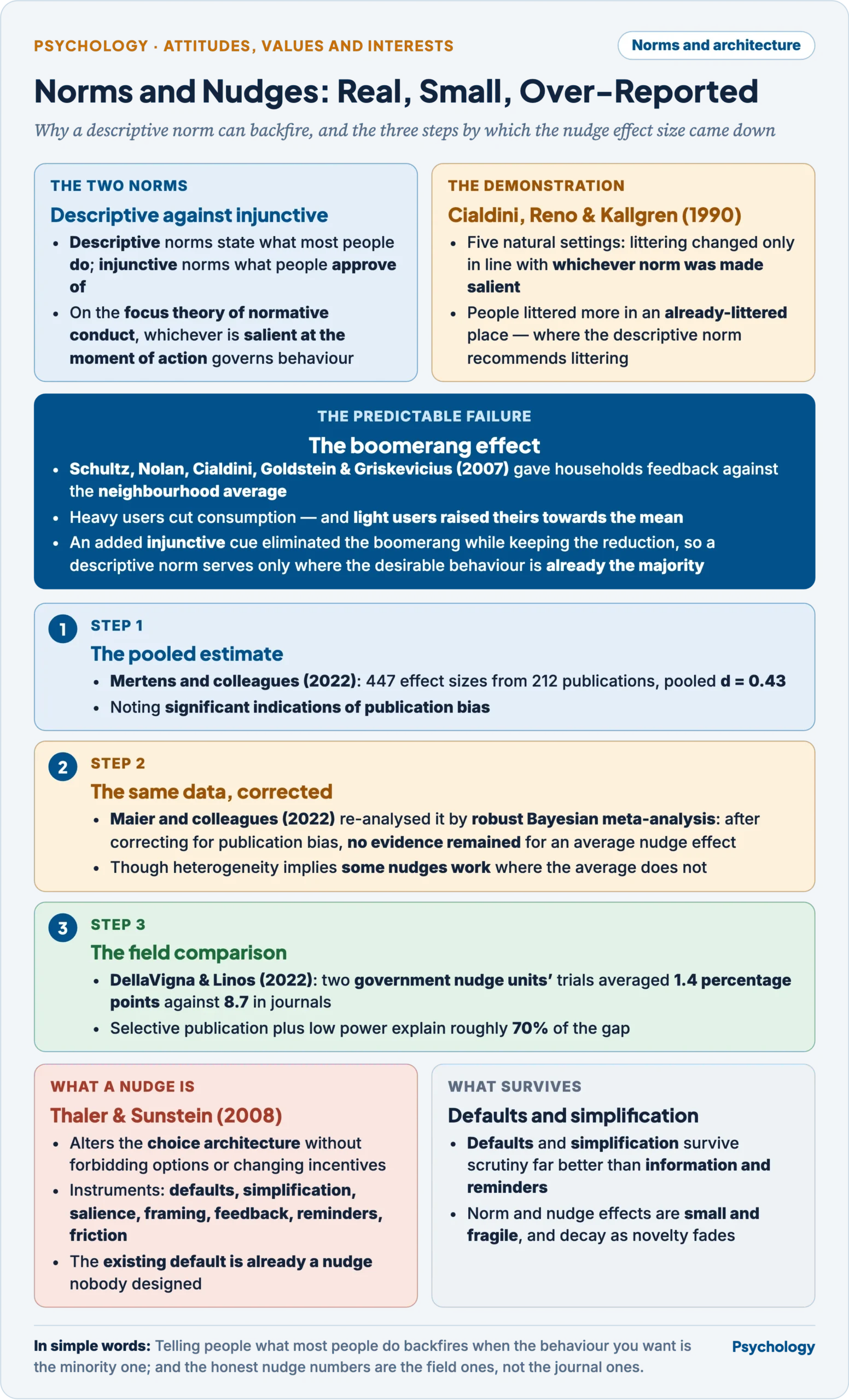
A descriptive norm pulls people towards the average from both directions, so it needs an injunctive partner.
- Descriptive norms state what most people do; injunctive norms what people approve of. On the focus theory of normative conduct, whichever is salient at the moment of action governs behaviour.
- Cialdini, Reno and Kallgren (1990) showed this across five natural settings: littering changed only in line with whichever norm was made salient, and people littered more in an already-littered environment, where the descriptive norm itself recommends littering.
- The boomerang effect is the predictable failure. Schultz, Nolan, Cialdini, Goldstein and Griskevicius (2007) gave households feedback against the neighbourhood average: heavy users cut consumption, light users raised theirs towards the mean. An added injunctive cue eliminated the boomerang while keeping the reduction.
- The rule follows: a descriptive norm serves only where the desirable behaviour is already the majority. Otherwise the levers are injunctive norms, trending norms, or a reference group narrow enough that it is modal within it.
Nudges, choice architecture and defaults
- A nudge, on Thaler and Sunstein’s (2008) definition, alters behaviour through the choice architecture without forbidding options or materially changing incentives. Its instruments are defaults, simplification, salience, framing, feedback, reminders and friction.
- Defaults are the strongest family, governing what happens when the person does nothing — pension auto-enrolment and presumed-consent organ donation are the standard cases. The existing default is already a nudge nobody designed.
- The effect-size evidence has three steps, and the honest account keeps all three.
- Mertens and colleagues (2022) meta-analysed 447 effect sizes from 212 publications and reported a pooled d of 0.43, noting significant indications of publication bias.
- Maier and colleagues (2022) re-analysed the same data by robust Bayesian meta-analysis: after correcting for publication bias no evidence remained for an average nudge effect, though heterogeneity implies some nudges work where the average does not.
- DellaVigna and Linos (2022) found the average across two government nudge units’ trials was 1.4 percentage points against 8.7 in journals, selective publication plus low power explaining roughly 70 per cent of the gap.
- The summary: nudges are real but small, the published literature overstates them roughly sixfold, and defaults and simplification survive scrutiny far better than information and reminders.
Commitment and implementation intentions
- Goal intentions state what one wants; implementation intentions, on Gollwitzer’s (1999) account, state when, where and how — an if-then plan linking a cue to a response.
- The mechanism is delegation of action control to the cue: once formed, the situation triggers the response without a fresh decision, so it suits forgetting, competing habit or deliberation failure.
- Gollwitzer and Sheeran’s (2006) meta-analysis of 94 independent tests found d = 0.65 on goal attainment beyond goal intentions alone.
- Commitment devices attach a cost to defection — public announcement, a forfeited deposit, a named witness — working through consistency and reputation.
- Limit: they amplify an existing goal and cannot create one, so they are useless where the person does not want the change.
Changing aggressive responses to norm violation
- Aggression against those who defy social norms is usually moralistic rather than impulsive, and its causes are specifiable.
- On Tedeschi and Felson’s (1994) social interaction theory the aggressor uses coercive action instrumentally, to restore compliance and assert the norm, choosing it by expected rewards and costs.
- A violation is read as a threat to the self and the group; threatened high self-esteem is a reliable precursor, and narcissists aggress most when challenged.
- Normative beliefs legitimating violence convert threat into action. Guerra and colleagues (1995) found greater acceptance of aggression among children of low socioeconomic status; honour codes justify violence in defence of reputation.
- Deindividuation removes restraint: Zimbardo (1969) found hooded participants delivering twice as many shocks as identifiable ones — the mechanism behind crowd violence.
- Scripts make the response automatic: on Huesmann’s (1998) account, aggressive scripts learned by observation are highly accessible and retrieved as ready-made plans.
- The General Aggression Model of Anderson and Bushman (2002) integrates these: person and situation inputs act through arousal, affect and cognition, the outcome turning on appraisal — which is where intervention is possible.
- Changing it means working on the same inputs rather than on the aggression.
- Reattribution of the violation — from defiance to ignorance, constraint or a different norm — removes the justification licensing the aggression.
- Removing aggressive cues, lowering crowding, heat and alcohol availability, and slowing the episode reduce the chance of an aggressive script being retrieved.
- Incompatible responses, empathy induction and self-regulation training make the aggressive response unavailable or controllable, and forgiveness interventions benefit both parties. Multisystemic therapy addresses the family, peer and school systems maintaining serious aggression.
- Superordinate goals reduce aggression where the violation is an intergroup marker, and India’s non-violence tradition supplies both a normative frame and a practised repertoire.
- Punishing the aggressor is the usual institutional response and the weakest, working only when prompt, certain, proportionate and just.
Enhancing cleanliness in public places
- The Indian problem is not primarily a knowledge or infrastructure deficit, and the evidence is specific.
- Gupta and colleagues (2019) re-surveyed rural households in Bihar, Madhya Pradesh, Rajasthan and Uttar Pradesh: open defecation fell from about 70 per cent of rural people in 2014 to about 44 per cent in 2018, almost wholly through new latrine construction.
- The behavioural finding matters more. In the same data (2019) the share who owned a latrine and still defecated in the open was about 23 per cent in both rounds — unchanged. Provision changed; use did not.
- That survey (2019) also found coercion by local officials common, Dalit households roughly twice and Adivasi households roughly three times as likely to face it.
- Swachh Bharat Mission, 2014 (Ministry of Jal Shakti for the rural component, Ministry of Housing and Urban Affairs for the urban) combined subsidised latrine construction with mass communication and local triggering, declared rural India open-defecation-free in 2019, and moved to ODF Plus for sustained use. Its psychological principle is norm change through visible collective commitment.
- Chakrabarti and colleagues (2024) analysed 640 districts over 2011 to 2020: those where over 30 per cent of households received a mission toilet had infant mortality lower by 5.3 and under-five mortality by 6.8 points, consistent with roughly 60,000 to 70,000 infant deaths averted annually.
- What the psychology prescribes, given that evidence:
- Make the injunctive norm salient at the point of action: a soiled environment carries a descriptive norm recommending the behaviour, so rapid clearing does more than signage. Naming the dirtiest ward advertises that norm, whereas Swachh Survekshan rankings attach reputation to the desirable comparison.
- Trigger affect rather than argue: community-led sanitation works by walk-through exposure, disgust and whole-settlement public commitment, changing the perceived norm rather than beliefs.
- Treat the latrine-use gap as a functional analysis problem: non-use is maintained by pit-size anxiety and emptying costs entangled with caste-based purity beliefs, by open defecation being routine and sociable, and by poor construction — none of which a message answers.
- Reduce friction and supply antecedents — bins at the point of disposal, working water, lighting and privacy for women, and separating the toilet from the dwelling where purity beliefs block use.
- Reinforce rather than punish: group contingencies for ward cleanliness, recognition for sanitation workers and school token systems are the operant instruments. Fines are weak where enforcement is improbable.
A behaviour modification plan for late arrival and early departure
- Define and measure first: define lateness as arrival after a stated minute and early leaving as departure before another, log both per employee for two to four weeks as a baseline, and record output and any pattern by day or shift.
- Run the functional analysis before choosing a procedure. Lateness maintained by commute failure, caregiving duty, an aversive first task, absence of consequence, or a norm that arrival time is nominal each needs a different remedy; only the last two suit contingency management.
- Fix the antecedents the analysis implicates — stagger shift starts, allow flexitime around a fixed core, move the aversive task off the start of the day, and place a valued activity late enough to make early leaving costly.
- Reinforce the target rather than punishing its absence, by differential reinforcement of an alternative: recognition, preferred tasks or a lottery entry contingent on a full on-time day, continuous at first and thinned as it stabilises.
- Shape where behaviour is far from target: for an employee habitually an hour late, reinforce thirty minutes, then fifteen, moving the criterion as each level stabilises.
- Give feedback individually and often: private weekly graphed feedback is the active ingredient in most workplace programmes, while naming individuals publicly adds shaming without effect.
- Use group contingencies with caution: a team reward recruits peer pressure, and breeds resentment where one member cannot comply, so pair it with an individual one.
- Keep response cost late, applied to earned privileges rather than pay, graded and announced in advance; formal discipline is last.
- Plan maintenance from the start, on Stokes and Baer’s (1977) logic: thin the schedule, shift to self-recording, and transfer control to natural reinforcers.
- Evaluate with a single-case design: an A-B-A-B withdrawal or a multiple baseline across teams shows whether change tracks the intervention, with a second observer checking agreement.
- Apply an ethical check first: explain the programme and obtain agreement; use the least restrictive effective procedure; do not monitor beyond the defined behaviour; keep records confidential; and check no group is disadvantaged by a contingency it cannot meet.
Criticisms and limitations
- Behaviour modification changes behaviour, not its causes. Where behaviour is maintained by poverty, illness, caste exclusion or an unsafe environment, a contingency programme shifts it while the generating conditions stand.
- Maintenance remains the weakest point. Gains attenuate when programmed reinforcement is withdrawn, and the literature reports few direct comparisons between maintenance procedures.
- The compliance techniques are a technology of manipulation, exploiting consistency, reciprocity and scarcity rather than giving reasons, and the same mechanisms serve fraud. Conformity and obedience likewise yield compliance without acceptance, and provoke reactance once visible.
- Norm and nudge effects are small and fragile. The boomerang is a structural risk of descriptive norms, nudge effects shrink roughly sixfold from journals to field units, and they decay as novelty fades.
- The ethical questions are not technical. Who sets the target, whether the person may refuse, whether the influence is disclosed, and whether it substitutes for a structural remedy are not settled by evidence of efficacy. Nudges work partly because unnoticed, so a defensible one is disclosable and refusable.
- What stands up is substantial. Functional analysis, shaping, differential reinforcement, token economies with programmed generalisation, implementation intentions, injunctive-norm framing and defaults are all well evidenced. Behaviour changes reliably and modestly when its conditions change; the large one-shot change of popular accounts does not.
Previous Year Questions
- 2017Why do some people behave aggressively towards those who defy social norms? How can such aggressive behaviours be changed?
- 2014What psychological techniques can be used to enhance cleanliness in public places?
- 2010You are the head of an office in which employees habitually come late and leave early. Suggest a behaviour modification plan for such employees.
- 1999Which model of man is most suited and relevant to behaviour modification?