

Official syllabusPaper I · Unit 12 · Attitudes, Values and Interests
Theories of attribution.
Definition
“The tendency for attributors to underestimate the impact of situational factors and to overestimate the role of dispositional factors in controlling behaviour.”
Ross (1977), naming the fundamental attribution error
The classical theories specify what a rational perceiver would do with causal information. What people do departs from that specification in directions that are stable, measurable and consequential: the departures protect the self, favour the group, and make other people look more like their behaviour than they are.
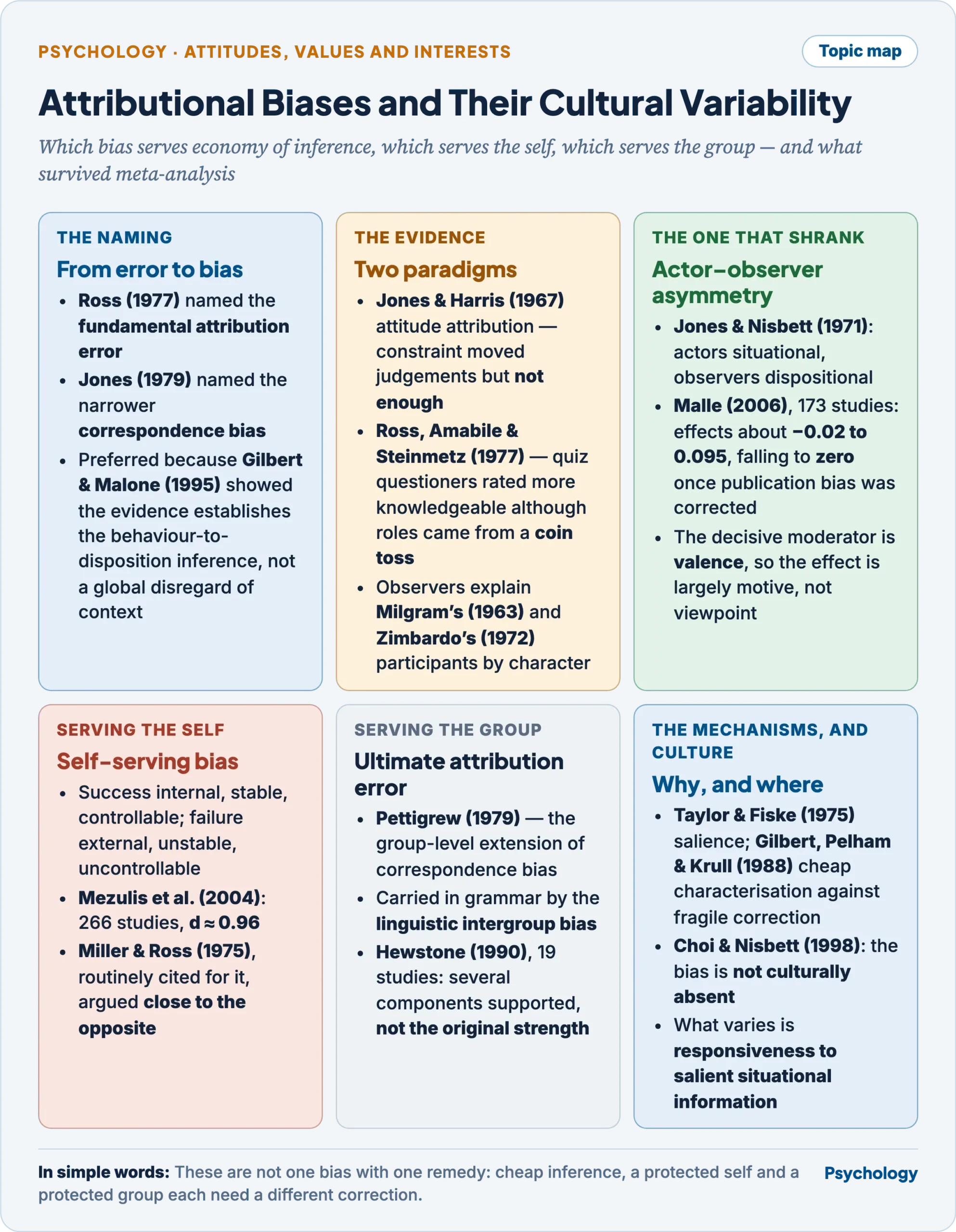
The biases sort by what they serve — economy of inference, the self, or the group — and the three need different remedies.
The fundamental attribution error and the correspondence bias
- Ross (1977) named the fundamental attribution error: a general tendency to under-weight situational and over-weight dispositional causes in explaining another’s behaviour.
- Jones (1979) named the narrower correspondence bias: the inference to a disposition corresponding to the observed behaviour, drawn even where a sufficient situational cause is known and stated.
- Correspondence bias is now the preferred term, for three substantive reasons.
- The broad claim is not supported as stated. People do not generally neglect situations; in other tasks they over-attribute to them. Gilbert and Malone (1995) argued the evidence establishes the behaviour-to-disposition inference, not a global disregard of context.
- The word error presupposes a known correct answer. In the standard paradigms the target’s real attitude is never measured, so the inference cannot be scored wrong — only as insufficiently adjusted.
- Correspondence bias is defined operationally, by the gap between the inference made and the inference the stated constraint should license, which makes it measurable where a general tendency is not.
The evidence: attitude attribution and assigned social roles
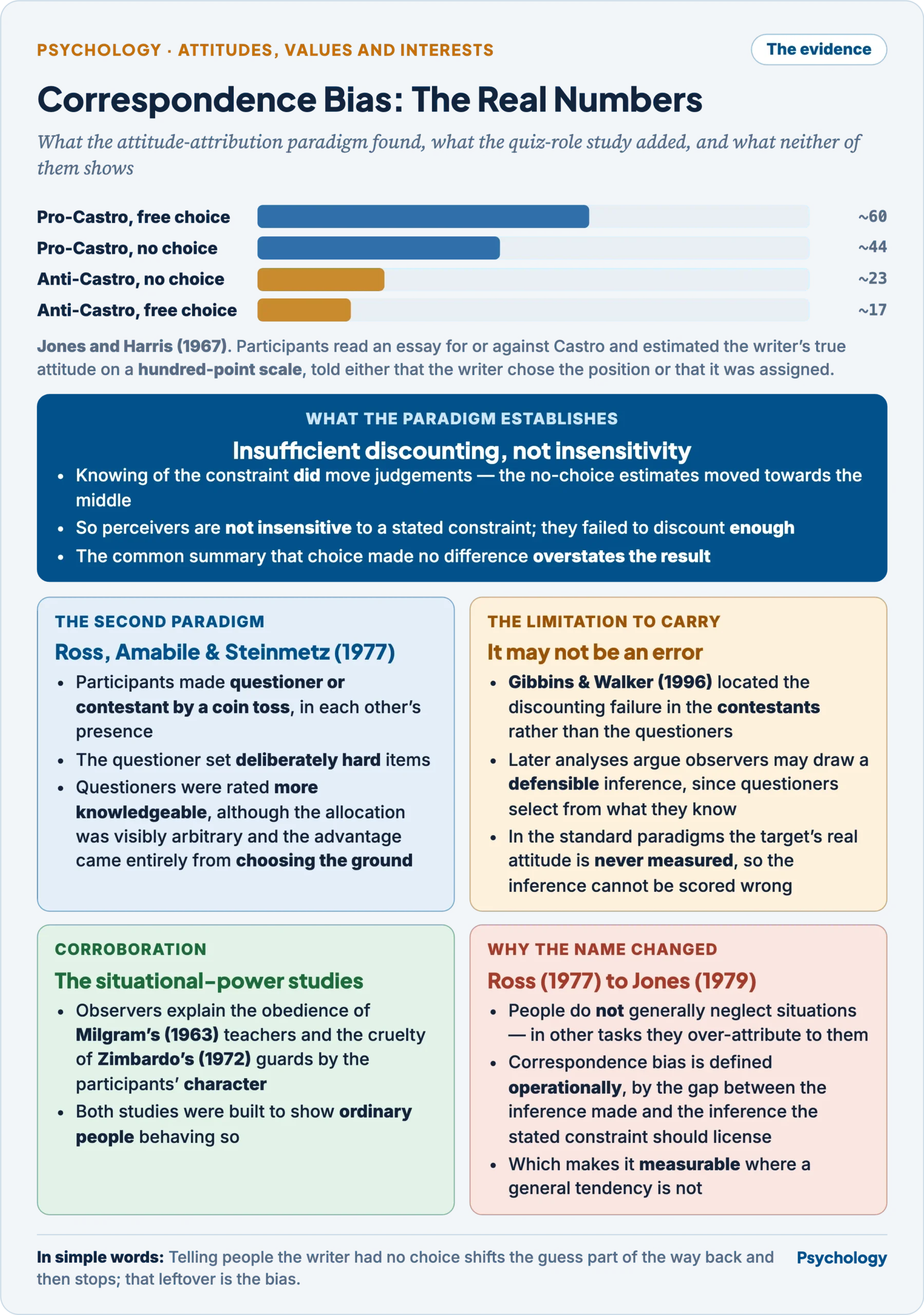
Knowing the writer had no choice reduces the inference but nowhere near abolishes it; the residue is the bias.
- Jones and Harris (1967) built the attitude-attribution paradigm: participants read an essay for or against Castro and estimated the writer’s true attitude, told either that the writer chose the position or that it was assigned.
- Estimates followed the essay’s direction even under no choice — on a hundred-point scale, around 44 for the pro-Castro no-choice essay and 23 for the anti-Castro one, against roughly 60 and 17 under free choice.
- The careful statement matters. Knowing of the constraint did move judgements, so perceivers are not insensitive to it; they failed to discount enough. The common summary that choice made no difference overstates the result.
- Ross, Amabile and Steinmetz (1977) showed the bias operating on assigned social roles. Participants were made questioner or contestant by a coin toss in each other’s presence; the questioner set deliberately hard items; contestants and observers then rated general knowledge.
- Questioners were rated more knowledgeable, although the allocation was visibly arbitrary and their advantage came entirely from choosing the ground.
- A limitation worth carrying: Gibbins and Walker (1996) located the discounting failure in contestants rather than questioners, and later analyses argue observers may draw a defensible inference, since questioners select from what they know.
- The situational-power studies corroborate this. Observers explain the obedience of Milgram’s (1963) teachers and the cruelty of Zimbardo’s (1972) guards by the participants’ character, when both were built to show ordinary people behaving so.
The actor–observer asymmetry, and what the evidence now supports
- Jones and Nisbett (1971) proposed the actor–observer asymmetry: actors explain their own behaviour situationally, observers explain the same behaviour dispositionally. The classic illustration is the stumble — mine was the uneven pavement, yours is your clumsiness.
- Two mechanisms were offered. Differential salience: the actor looks outward at the situation, the observer at the actor. Differential information: the actor knows their own conduct across situations, the observer sees one episode.
- The finding is far weaker than its reputation. Malle’s (2006) meta-analysis of 173 published studies found average effect sizes between about −0.02 and 0.095, falling to zero once publication bias was corrected.
- It is conditional, not general, appearing where the actor was portrayed as idiosyncratic, the events hypothetical, actor and observer intimates, and free-response explanations coded rather than rating scales.
- The decisive moderator is valence. A robust asymmetry survives for negative, self-relevant outcomes — which is the self-serving bias, not a perspective effect — and frequently reverses for positive ones. What was presented as a consequence of viewpoint is largely a consequence of motive.
- Malle, Knobe and Nelson (2007) salvaged real asymmetries in the use of reasons, which are stable but are not the standard internal–external asymmetry.
The self-serving bias
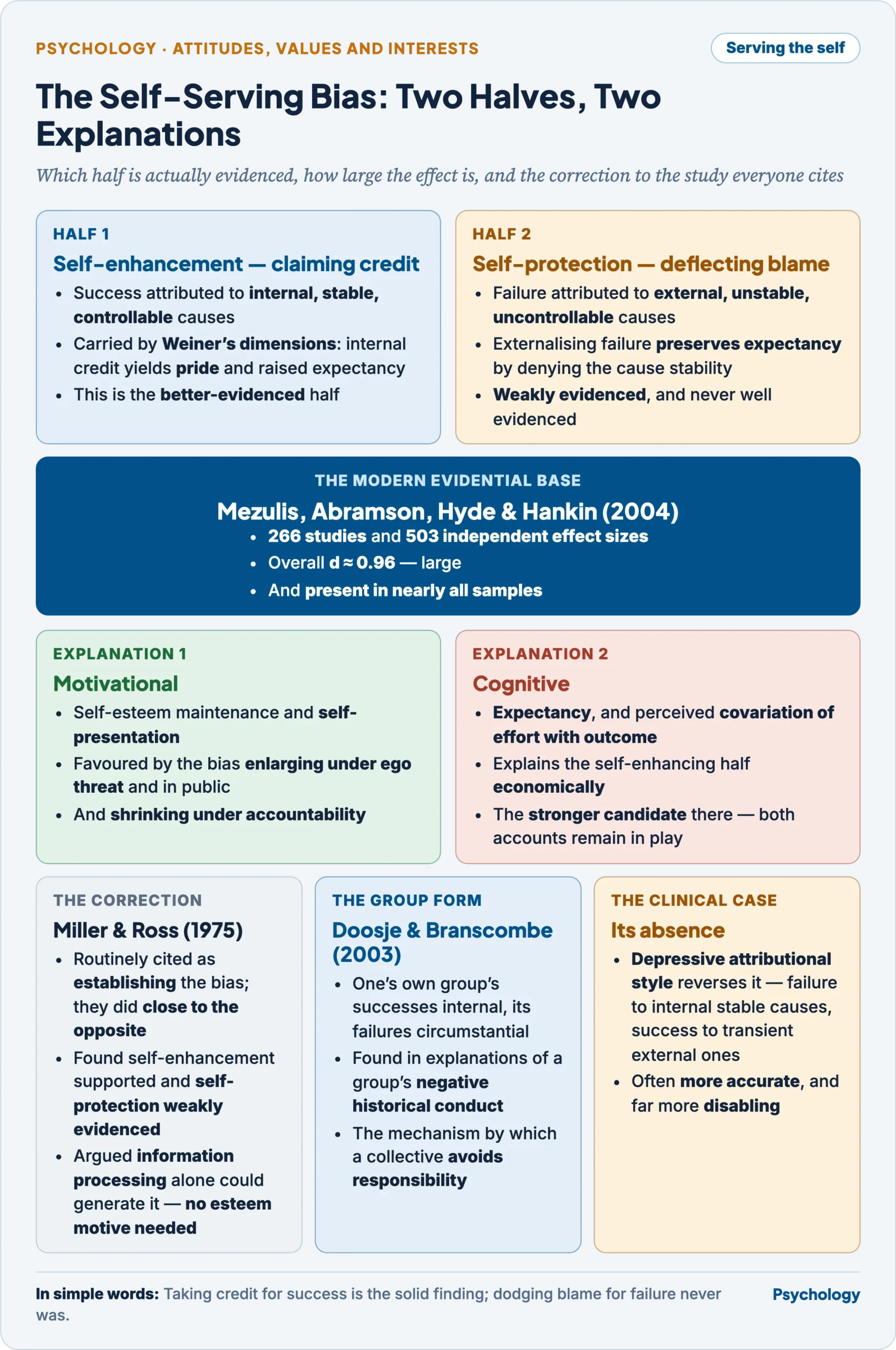
The self-enhancing half is better evidenced than the self-protective half, and the two have different explanations.
- The self-serving attributional bias attributes success to internal, stable, controllable causes and failure to external, unstable, uncontrollable ones. Its halves separate: self-enhancement claims credit, self-protection deflects blame.
- The effect is carried by Weiner’s dimensions, set out in the companion article: crediting success internally yields pride and raised expectancy, while externalising failure preserves expectancy by denying the cause stability.
- Miller and Ross (1975) are routinely cited as establishing the bias; they did close to the opposite. Their review found the self-enhancing half supported and self-protection weakly evidenced, and argued that information processing — expectancy, and perceived covariation of effort with good outcomes — could generate it without any esteem motive.
- The modern evidential base is Mezulis, Abramson, Hyde and Hankin’s (2004) meta-analysis of 266 studies and 503 independent effect sizes, with an overall d of about 0.96 — large, and present in nearly all samples.
- Two explanations remain in play, and both have support.
- The motivational account invokes self-esteem maintenance and self-presentation, favoured by the bias enlarging under ego threat and in public and shrinking under accountability.
- The cognitive account invokes expectancy and perceived covariation of effort with outcome. It explains the self-enhancing half economically and is the stronger candidate there.
- The bias has a group form: a person’s own group’s successes are internal and its failures circumstantial. Doosje and Branscombe (2003) found the pattern in explanations of a group’s negative historical conduct — the mechanism by which a collective avoids responsibility.
- The clinically important fact is the bias’s absence. Depressive attributional style reverses it — failure to internal stable causes, success to transient external ones — which is often more accurate and far more disabling.
Defensive attribution, the just world and false consensus
- Defensive attribution is the set of judgements made about another’s misfortune in order to keep feeling safe from it. Severity of outcome and personal and situational similarity between observer and victim determine where responsibility is placed.
- The pattern pulls two ways. Similarity to the victim encourages a blameless situational account, since blame would implicate the observer; dissimilarity plus a severe outcome encourages victim-blaming, which preserves the observer’s sense of control.
- Belief in a just world — Lerner’s (1980) construct that people get what they deserve — is the generalised form. It makes the world predictable and effort worthwhile, at the cost of victim-blaming.
- It is measurable, with Rubin and Peplau’s (1973) scale, and predicts harsher judgement of the poor, the ill, the low-caste and survivors of assault.
- False consensus — Ross, Greene and House (1977) asked students to wear a campus sandwich board; among those who agreed, about 62 per cent expected peers to agree, while among those refusing about 67 per cent expected refusal. One’s own choice becomes the baseline, so departures look dispositional.
Group-serving attribution and the ultimate attribution error
- Pettigrew (1979) named the ultimate attribution error: the group-level extension of correspondence bias, in which an out-group’s bad conduct is explained by its members’ character while its successes are explained away as luck or unfair advantage. The in-group gets the opposite treatment.
- The mechanism is not a new bias but asymmetric application of an old one: social identity supplies the motive, the attributional machinery supplies the means.
- This is what makes prejudice self-confirming through contact. Stereotype-consistent conduct is stored as dispositional evidence; inconsistent conduct is explained away situationally, so disconfirming experience never accumulates.
- The linguistic intergroup bias carries it in grammar: an in-group member’s good act is described abstractly, as a trait, and a bad act concretely, as an isolated action, with the reverse for out-group members — so the bias transmits through ordinary description.
- Evidence is partial. Hewstone’s (1990) review of nineteen studies supported several components, including the explaining-away of out-group success, but not the original claim’s full strength, with effects moderated by group status and conflict.
Why the biases occur: the proposed mechanisms
- Perceptual salience. Behaviour engulfs the field: the actor moves and is bounded, the situation is diffuse background. Taylor and Fiske (1975) showed causal weight tracking mere visual prominence — observers seated so one discussant was more visible judged that person more influential.
- Anchoring and insufficient adjustment. The dispositional inference is made first and then adjusted for the situation, stopping too early. Quattrone (1982) reversed the anchor: primed with a situational starting point, perceivers under-adjusted the other way — evidence for the process, not for dispositionism as such.
- Cognitive load. Gilbert, Pelham and Krull (1988) separated characterisation, automatic and cheap, from correction, effortful and fragile. Cognitively busy participants made the dispositional inference and failed to correct it, so the bias is strongest where attention is scarce.
- Gilbert and Malone’s (1995) four mechanisms are the standard decomposition, their point being that there is no single bias:
- lack of awareness of the situational constraint;
- unrealistic expectations about how strongly situations constrain behaviour;
- inflated categorisation of the situation, so a weak constraint is treated as already allowed for;
- incomplete correction, where the constraint is known and the adjustment still falls short.
- Linguistic and category factors. Languages carry a rich trait vocabulary and a thin situational one, and a trait word both describes an act and explains it. The linguistic category model of Semin and Fiedler (1988) holds that an act’s level of description fixes how dispositional the inference will be.
- The norm of internality. Where a culture or institution rewards holding people responsible for outcomes, internal explanation is socially correct as well as cheap, and is learned as a skill.
Consequences for problem solving and judgement
- The problem is defined wrongly. Attributing a shortfall to a person rather than a process sends the search into the wrong space; replacing the person leaves the process intact and the failure recurs.
- Search closes prematurely. A dispositional explanation feels complete, so information gathering stops. A situational explanation is intrinsically unfinished — which feature, and how altered — so it keeps the search open.
- The feedback loop breaks at both ends. Self-serving credit for success means its real causes are never identified, so the method cannot be deliberately repeated; self-serving blame for failure removes the error signal, so strategy is never revised.
- Confidence is miscalibrated. Credit taken for outcomes owing much to circumstance inflates estimates of one’s own ability, so the next problem gets too little preparation and too much certainty.
- Joint work suffers twice. Members’ self-serving attributions do not sum to the whole, so claimed credit exceeds what was available; and blame travelling to individuals leaves system defects uncorrected — the argument behind blameless incident review in medicine and aviation.
- Negotiation is made harder. Reading a counterpart’s hard bargaining as character rather than role makes concession look futile, and the bias strengthens as the stake rises — when accuracy matters most.
- Correctives follow from the mechanisms. Reducing load restores correction; making situational information explicit helps where awareness is the defect; perspective-taking and asking what another person would have done in the same position reduce the bias.
- The counter-case is real. A modest self-serving bias sustains persistence after failure and protects self-efficacy, and the accurate attributional style of the depressed is the less adaptive one. The goal is calibration, not elimination.
Cultural variability of the attribution biases
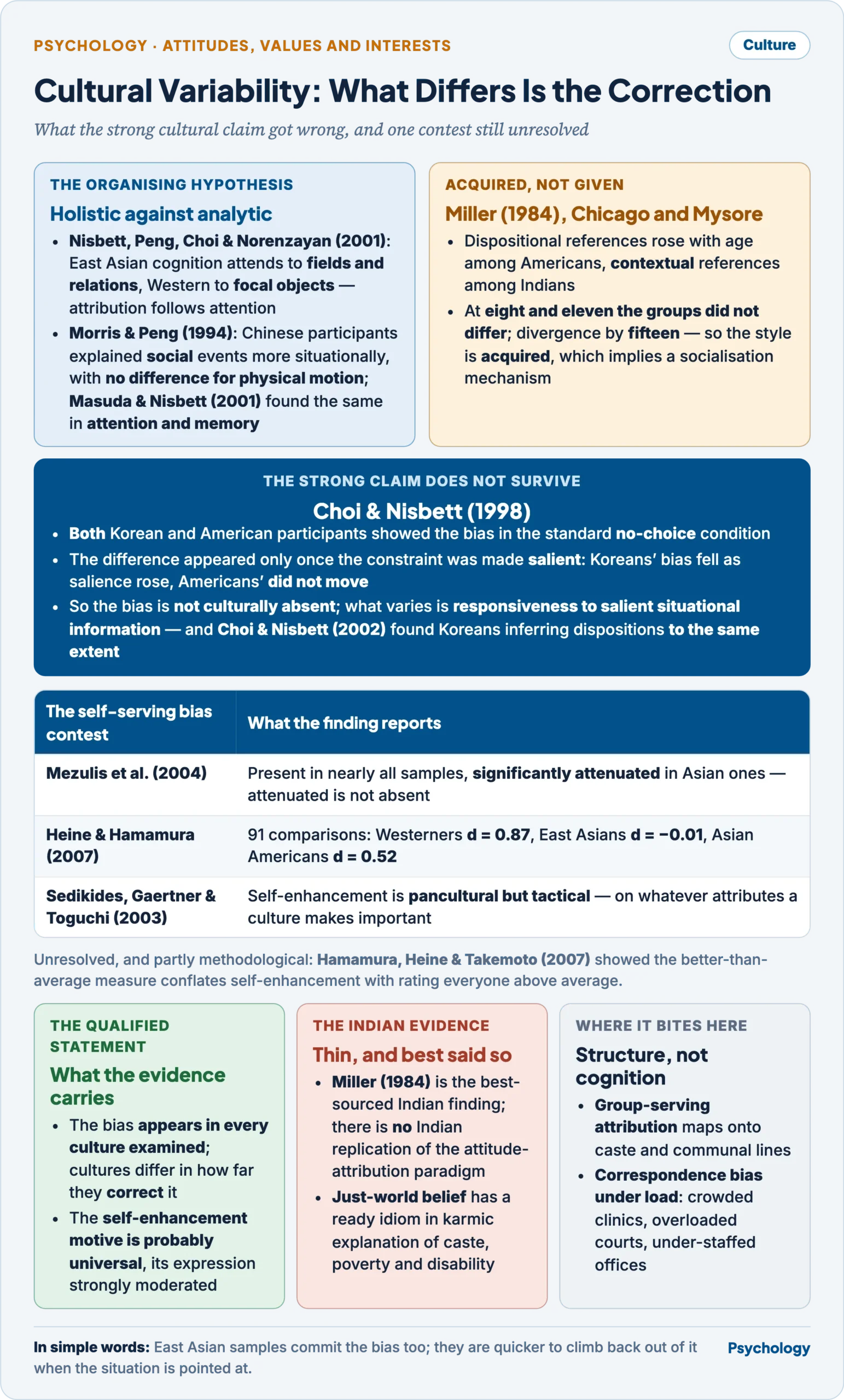
East Asian samples show the correspondence bias too; what differs is how far they correct it once the situation is made plain.
- The holistic–analytic account is the organising hypothesis. Nisbett, Peng, Choi and Norenzayan (2001) proposed that East Asian cognition attends to fields and relations while Western cognition attends to focal objects and their properties, and that attribution follows attention.
- Morris and Peng (1994) found Chinese participants explaining social events more situationally than Americans, with no cultural difference for physical object motion — locating the difference in social inference, not in causal reasoning generally.
- Masuda and Nisbett (2001) found the matching difference in what is attended to and remembered in a scene, giving the account a perceptual basis.
- Miller’s (1984) developmental study is the strongest evidence that the difference is acquired. Participants in Chicago and Mysore explained good and wrong acts by people they knew well.
- Dispositional references rose steeply with age among Americans and contextual references among Indians; at ages eight and eleven the groups did not differ, divergence emerging by fifteen and widening in adults.
- An acquired difference implies a socialisation mechanism, which is what makes the cultural claim credible rather than merely labelled.
- The strong version of the claim does not survive, and this is the point most often got wrong: East Asian samples are not free of the correspondence bias.
- Choi and Nisbett (1998) ran the attitude-attribution paradigm with Korean and American participants. Both groups showed the bias in the standard no-choice condition. The difference emerged only in a second study making the constraint salient: Koreans’ bias fell as salience rose, Americans’ did not move.
- The accurate generalisation is not that East Asians attribute situationally, but that they are more responsive to salient situational information. Where it is not made plain, they infer dispositions much as Westerners do.
- Choi and Nisbett’s (2002) follow-up, separating dispositional from situational inference, found Koreans inferring dispositions to the same extent as Americans. Taiwanese and Japanese samples show the bias too, notably where the essays were weakly diagnostic.
- The self-serving bias evidence is genuinely contested, and the contest turns on measurement.
- Mezulis and colleagues’ (2004) meta-analysis found the bias present in nearly all samples while significantly attenuated in Asian ones. Attenuated is not absent.
- Heine and Hamamura’s (2007) meta-analysis of 91 comparisons reported Westerners at d = 0.87, East Asians at d = −0.01 and Asian Americans intermediate at d = 0.52 — the strongest statement of a real cultural difference.
- Against this, Sedikides, Gaertner and Toguchi (2003) and Sedikides, Gaertner and Vevea’s (2005) meta-analysis argue self-enhancement is pancultural but tactical: people enhance on whatever attributes their culture makes personally important, so East Asians enhance on collectivistic attributes. The motive is universal, only its target varies.
- The dispute is unresolved and partly methodological. Hamamura, Heine and Takemoto (2007) showed the widely used better-than-average measure conflates self-enhancement with a tendency to rate everyone above average; removing that confound eliminated apparent self-enhancement in Japanese samples.
- Self-criticism and modesty findings are reliable in themselves: East Asian samples report more self-critical attributions, accept more responsibility for failure and describe themselves more modestly. Whether that reflects a different self-concept or a presentation norm is unsettled, and the gap is largest where self-presentation pressure is highest.
- The current, qualified statement is what the evidence will carry.
- The correspondence bias appears in every culture examined; cultures differ in how far they correct it when situational information is salient, not in whether they commit it.
- The self-enhancement motive is probably universal; its expression in explicit attributions is strongly moderated by culture, and may be largely absent from East Asian self-report.
- Just-world belief and false consensus travel widely, while the ultimate attribution error is conditional on the intergroup relation rather than on culture.
The Indian evidence
- Miller (1984) remains the single best-sourced Indian finding: Hindu Indian adults and children in Mysore against an American sample, showing a contextual rather than dispositional explanatory style acquired across adolescence.
- The surrounding Indian literature is thin, and should be presented as such. No Indian replication of the attitude-attribution paradigm, and no Indian self-serving-bias synthesis, stands on the scale of the East Asian work.
- What can be said with more confidence concerns where the biases bite in Indian conditions, which is social structure rather than measured cognition.
- Just-world belief has a ready idiom in karmic and merit-based explanation, which supplies a dispositional account of caste position, poverty and disability.
- Group-serving attribution maps onto caste and communal lines, where identical acts by in-group and out-group members receive opposite explanations and an out-group’s advancement is put down to unfair advantage.
- Correspondence bias under load is the condition of most Indian institutional judgement — crowded clinics, overloaded courts, under-staffed offices — which is where the busyness finding predicts correction will fail.
- The norm of internality is unevenly distributed, strong in urban professional and examination settings and weak where outcomes are visibly controlled by others, so a single national attributional style is not defensible.
Criticisms and limitations
- The paradigms are narrow. Most evidence comes from the attitude-attribution task and a small family of vignettes with student participants, where the inference is cheap, the target a stranger, and nothing follows from being wrong.
- The biases are often not errors. Where base rates make dispositions genuinely likely, a dispositional inference is Bayesian rather than mistaken; and the no-choice condition is a strange conversational situation, in which participants may assume the essay carries information.
- Effect sizes have shrunk under scrutiny. The actor–observer asymmetry essentially disappeared under meta-analysis, the self-protective half of the self-serving bias was never well evidenced, and the cultural moderation has had no large multi-site replication.
- Individualism–collectivism is too coarse to carry the cultural explanation: a national-level label used on individual-level cognition, masking within-country variation, with the comparative work almost entirely North America against East Asia.
- Mechanism and motive are hard to separate. Cognitive and motivational accounts of the self-serving bias predict the same pattern in most designs, and the discriminating manipulations yield effects too small to settle it.
- What stands up is substantial. The correspondence bias is among the most reliably reproduced findings in social psychology; the automatic-characterisation and effortful-correction architecture is established; the self-enhancing attribution of success is large and robust; and the cultural work has shown that the correction process is culturally variable even where the bias is not.
Previous Year Questions
- 2021Humans strive to assign causes to actions of self and others and fall into traps of biases and errors. Critically discuss.
- 2018Explain the concepts of self-serving bias and fundamental attribution error. How do they affect problem solving?
- 2017People emphasize the personal traits more than the situational factors. Evaluate the statement.
- 2014Is self-serving bias universal in attribution process? Comment.
- 2013Explain correspondence bias. Is it universal or culturally variable?