

Official syllabusPaper I · Unit 12 · Attitudes, Values and Interests
Theories of attribution.
Definition
“How the social perceiver uses information to arrive at causal explanations for events.”
Kelley and Michela (1980)
Attribution is the ordinary business of social life: before a person can evaluate, predict or respond to another, they must settle why the other acted. The classical theories are normative in form — each specifies what information a rational perceiver would use, and how — which is what makes the reliable departures from them measurable.
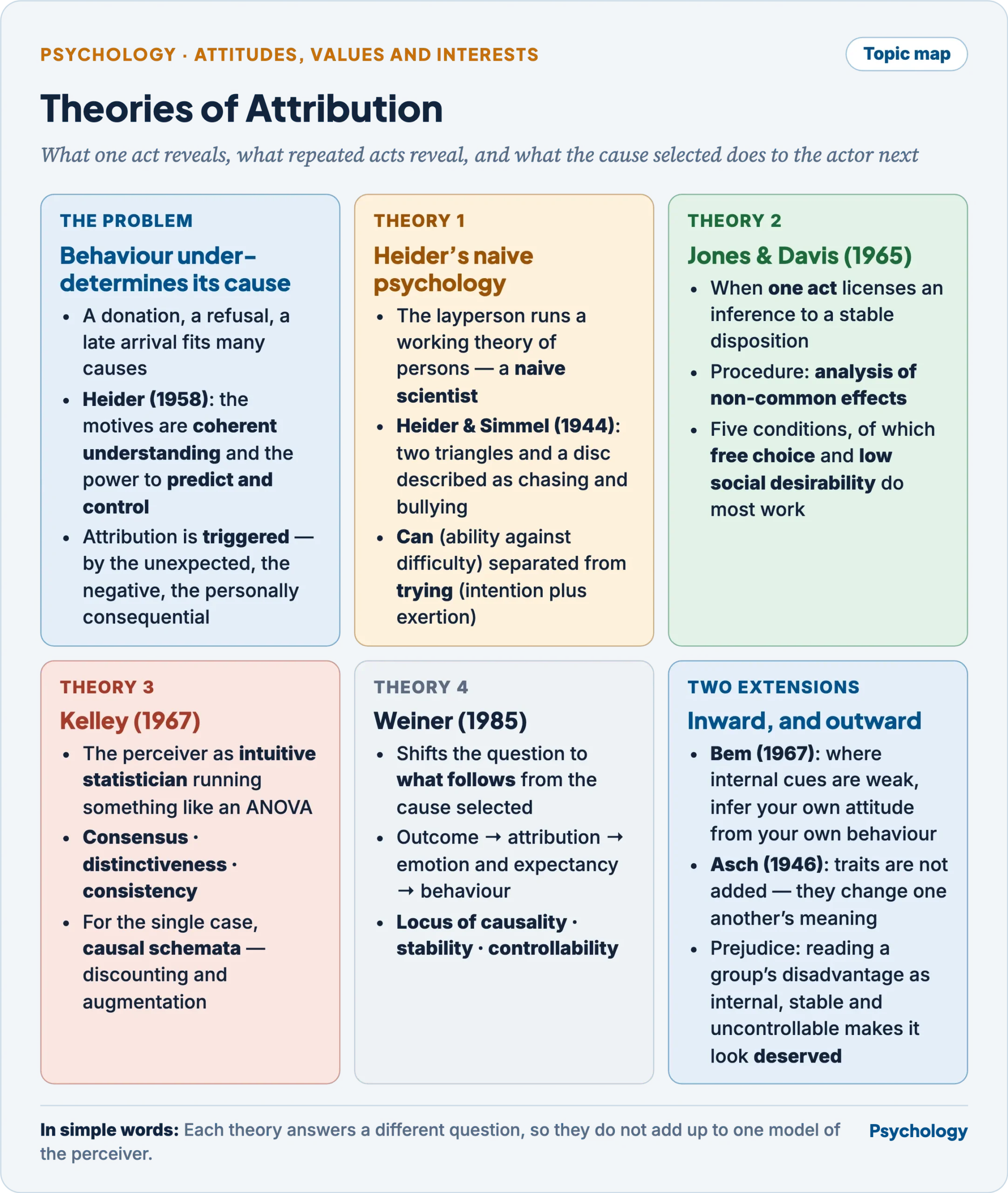
Each classical theory answers a different question: what one act reveals, what repeated acts reveal, and what the cause selected does to the actor next.
Causal inference as the basic problem of social perception
- Behaviour under-determines its cause. A donation, a refusal, a late arrival — each is compatible with many causes, so the perceiver always infers more than is observed.
- Two motives drive it, on Heider’s (1958) account: the need for a coherent and consistent understanding of the world, and the need to predict and control it. Explanation is instrumental; it buys the capacity to act.
- Attribution is triggered, not continuous. The reliable triggers are the unexpected, the negative and the personally consequential — a failure prompts a causal search that a routine success does not.
- The distinction every theory builds on is internal (dispositional) against external (situational) causation: the cause placed in the actor’s traits, abilities, motives and attitudes, or in the task, the setting, other people and chance.
- The consequences are behavioural. Whether a shortfall is read as low ability or low effort decides whether the person tries again; whether a group’s poverty is read as indolence or as structure decides what policy is tolerated.
Heider’s naive psychology
- Heider (1958) argued that the layperson operates a naive psychology — a working, largely unformulated theory of persons, good enough to support interaction. The perceiver is a naive scientist looking for the stable dispositional properties behind variable behaviour.
- The founding demonstration is Heider and Simmel (1944): observers shown an animated film of two triangles and a disc described it as chasing, bullying and escaping. Causal and intentional structure is imposed, not read off — and it is imposed even on geometry.
- Personal causality against impersonal causality is his first distinction, and it turns on intention, not location. Personal causality requires that the actor intended the outcome; impersonal causality covers whatever was brought about unintentionally, including the actor’s own stumble.
- Within personal causality he separated “can” from “trying”. Can combines the actor’s power or ability with the environment’s difficulty; trying is the intention plus exertion the actor supplies. An outcome needs both, which is why ability and effort are not interchangeable.
- Attribution tends towards the dispositional because behaviour engulfs the field: actor and act are figure, the situation is ground. Heider said this before anyone measured it, and it became the central finding of the generation that followed.
- Limitation: the account is descriptive and programmatic rather than predictive. It names the distinctions and the motives but specifies no procedure — exactly the gap Jones and Davis and Kelley set out to fill.
Jones and Davis: the theory of correspondent inference
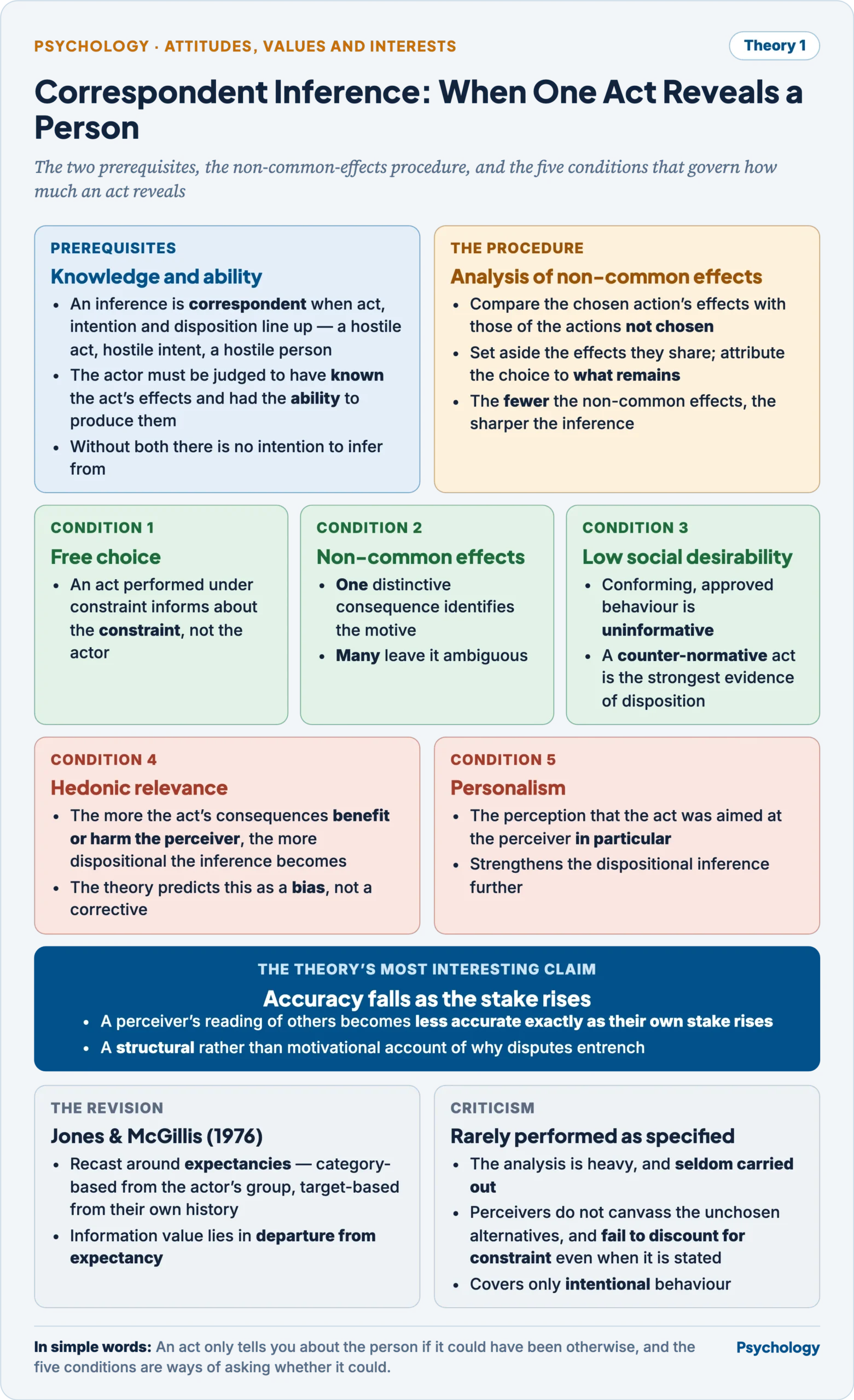
An act informs only where it could have been otherwise; the five conditions are ways of asking whether it could.
- Jones and Davis (1965) set out the conditions under which a single observed act licenses an inference to a stable disposition. An inference is correspondent when act, intention and disposition line up — a hostile act, hostile intent, a hostile person.
- Two prerequisites: the actor must be judged to have known the act’s effects and had the ability to produce them. Without both, there is no intention to infer from.
- The procedure is an analysis of non-common effects: compare the chosen action’s effects with those of the actions not chosen, set aside the effects they share, and attribute the choice to what remains. The fewer the non-common effects, the sharper the inference.
- Five conditions, on Jones and Davis’s account, govern how much an act reveals.
- Free choice — an act performed under constraint informs about the constraint, not the actor.
- Non-common effects — one distinctive consequence identifies the motive; many leave it ambiguous.
- Low social desirability — conforming, normatively approved behaviour is uninformative, since anyone would produce it. A counter-normative act is the strongest evidence of disposition.
- Hedonic relevance — the more the act’s consequences benefit or harm the perceiver, the more dispositional the inference becomes. The theory predicts this as a bias, not a corrective.
- Personalism — the perception that the act was aimed at the perceiver in particular strengthens the inference further.
- The last two are the theory’s most interesting claim: a perceiver’s reading of others becomes less accurate exactly as their own stake rises — a structural rather than motivational account of why disputes entrench.
- Jones and McGillis (1976) recast the theory around expectancies, category-based from the actor’s group and target-based from their own history. Information value lies in departure from expectancy.
- Criticism: the non-common-effects analysis is computationally heavy and rarely performed. Perceivers do not canvass the unchosen alternatives, and fail to discount for constraint even when it is stated. The theory also covers only intentional behaviour.
Kelley’s covariation model: consensus, distinctiveness and consistency
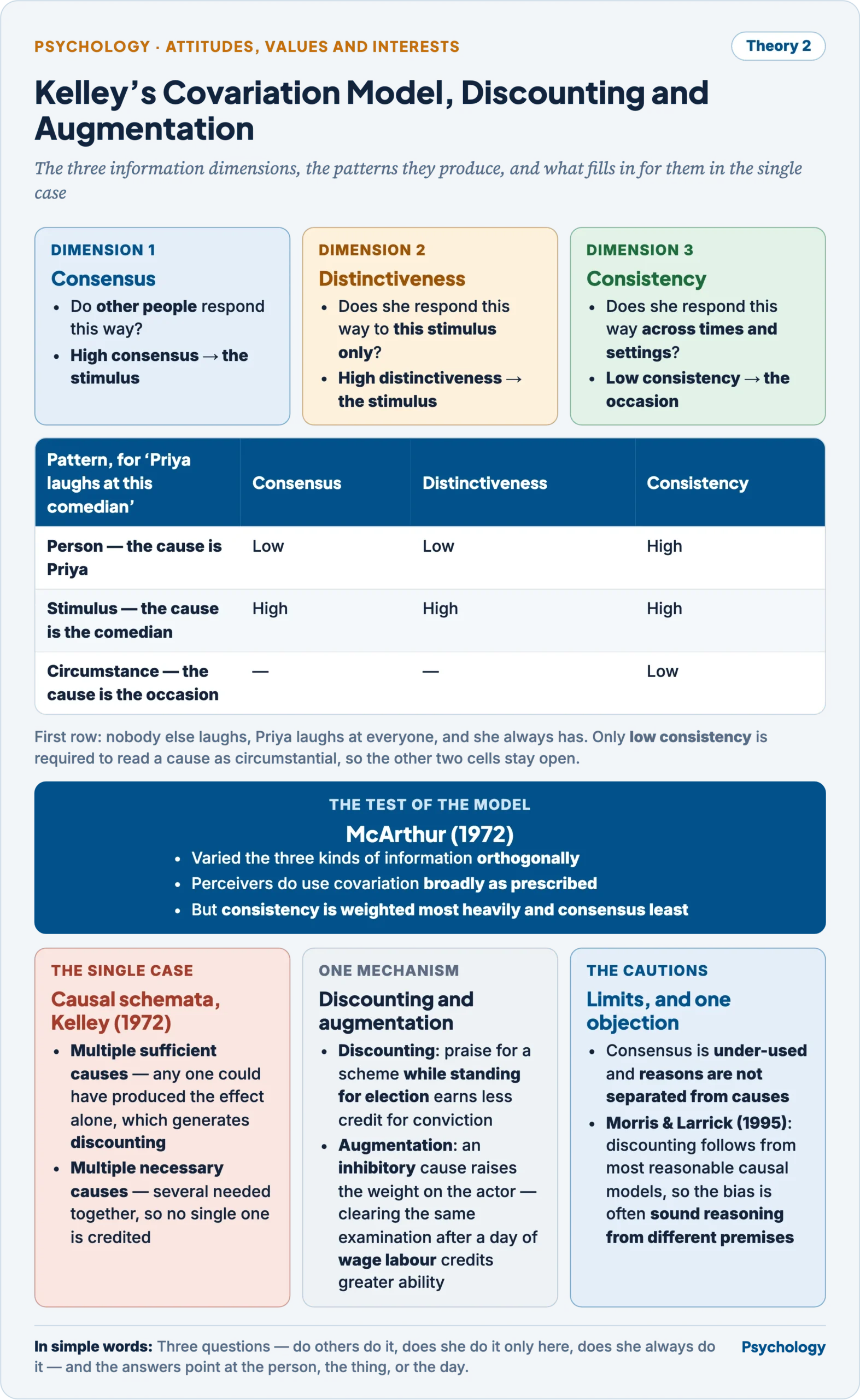
Consistency is the dimension perceivers weight most and consensus the one they weight least, which is where the model and its users part company.
- Kelley’s (1967) model treats the perceiver as an intuitive statistician running something like an analysis of variance: a cause is whatever the effect covaries with across persons, stimuli and occasions.
- Three kinds of information, each a different comparison.
- Consensus — whether other people respond this way to this stimulus. High consensus implicates the stimulus.
- Distinctiveness — whether the actor responds this way to this stimulus only or to many. High distinctiveness implicates the stimulus.
- Consistency — whether the actor responds this way to this stimulus across times and settings. Low consistency implicates the occasion.
- The configurations, taking “Priya laughs at this comedian” as the effect:
- Person attribution — low consensus, low distinctiveness, high consistency. Nobody else laughs, Priya laughs at everyone, and she always has: the cause is Priya.
- Stimulus (entity) attribution — high consensus, high distinctiveness, high consistency. Everyone laughs, Priya laughs at no other comedian, and she always laughs at this one: the cause is the comedian.
- Circumstance attribution — the signature is low consistency. She does not usually laugh at him, so the cause lies in this particular occasion rather than in either party.
- McArthur (1972) tested the model by varying the three kinds of information orthogonally and found that perceivers do use covariation broadly as prescribed, with consistency weighted most heavily and consensus least.
- Limitations: consensus information is systematically under-used; the full three-way information is seldom available, which is why Kelley added the schemata below; and the model does not separate reasons from causes, treating a deliberate choice and a reflex alike.
Causal schemata, discounting and augmentation
- The covariation model needs multiple observations. For the single case, Kelley (1972) proposed causal schemata — stored assumptions about how causes combine, invoked when two or more plausible causes are in play.
- The multiple sufficient causes schema covers effects that any one cause could have produced alone, and it generates discounting.
- The multiple necessary causes schema covers effects requiring several causes together, typical of difficult or unusual outcomes, and it makes perceivers reluctant to credit any single cause.
- Discounting principle — a cause’s role in producing an effect is discounted to the degree that other plausible causes are present. A candidate who praises a welfare scheme while standing for election earns less credit for conviction: ambition explains the praise equally well.
- Augmentation principle — where a facilitative cause and an inhibitory cause are both present, the facilitative cause is judged stronger than if it had acted alone. Known costs, risks or constraints working against the act increase the weight placed on the actor.
- A worked illustration. Two candidates clear the same examination: one studied in a quiet home with paid tuition, the second after a full day of wage labour in a household without electricity. The inhibitory conditions augment the inference, and the second is credited with far greater ability.
- It also works through cost. A legislator who votes against the party line, at known risk to a career, is read as deeply convinced; the same vote cast with party approval reveals nothing.
- Augmentation and discounting are complements of one mechanism: a cause working with the effect is discounted by a rival facilitative cause, while a cause working against it augments whatever overcame it.
- Objection: whether discounting is an error at all is unsettled. Morris and Larrick (1995) showed that discounting follows from most reasonable causal models of a situation, so what is scored as bias is often sound reasoning from different premises.
Weiner’s attributional theory of achievement motivation
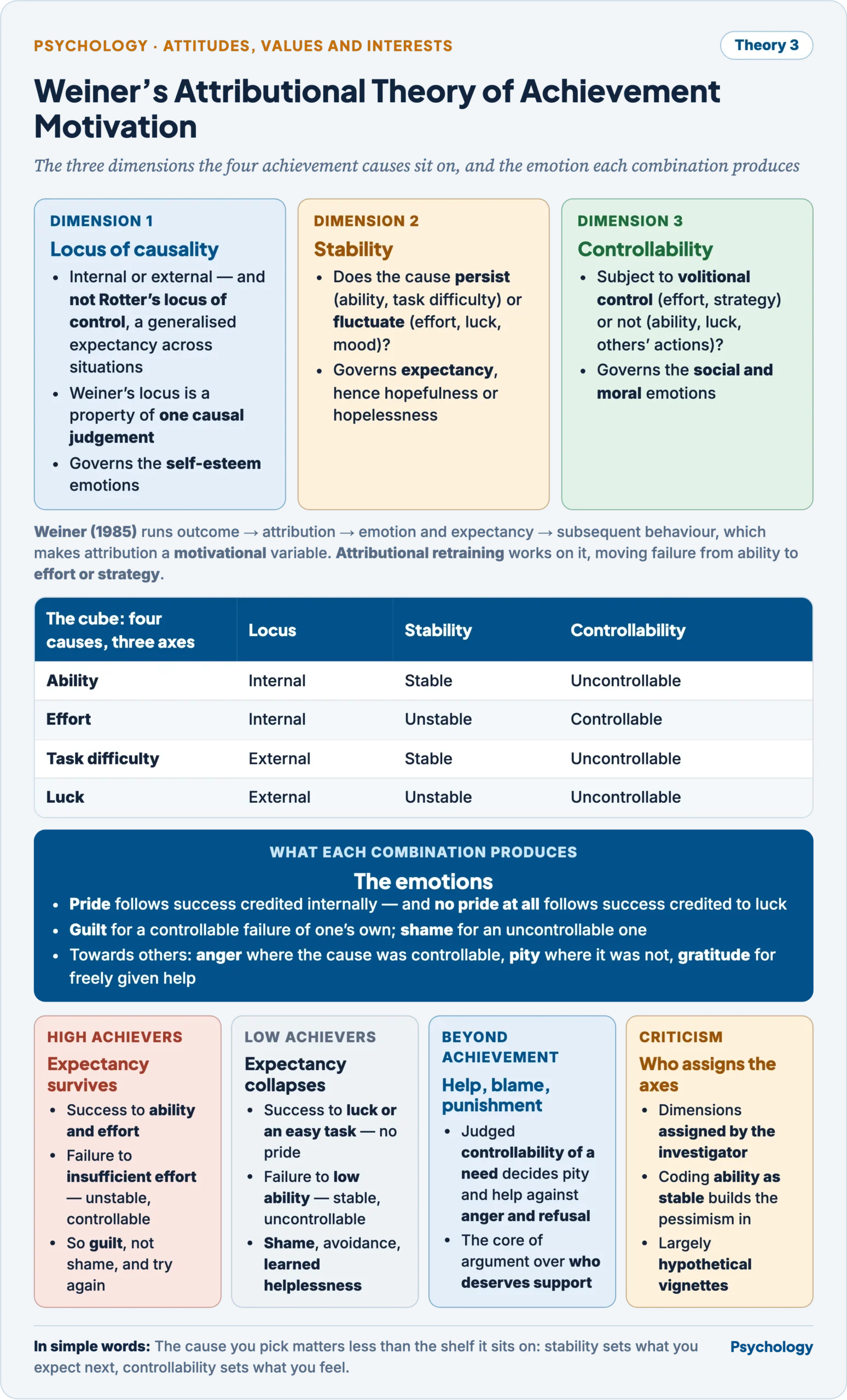
The cause selected matters less than the dimension it sits on: stability sets the expectancy, controllability sets the emotion.
- Weiner (1985) shifted attention from which cause the perceiver selects to what follows from having selected it. The sequence runs outcome → attribution → emotion and expectancy → subsequent behaviour, which makes attribution a motivational variable rather than a perceptual one.
- Four perceived causes dominate achievement settings — ability, effort, task difficulty and luck — but they are not the theory’s content. The explanatory work is done by the dimensions they sit on, so any cause named in any culture can be located.
- Three dimensions:
- Locus of causality — internal to the actor or external. This is not Rotter’s locus of control, a generalised expectancy carried across situations and treated with the social-learning theories of personality; Weiner’s locus is a property of one particular causal judgement.
- Stability — whether the cause persists over time (ability, task difficulty) or fluctuates (effort, luck, mood).
- Controllability — whether the cause is subject to volitional control (effort, strategy) or not (ability, luck, others’ actions).
- Each dimension carries a distinct consequence, and that separation is the model’s main achievement.
- Locus governs the self-esteem emotions — pride follows success credited internally, and no pride at all follows success credited to luck.
- Stability governs expectancy of future outcomes, hence hopefulness or hopelessness. Failure attributed to a stable cause predicts failure again; attributed to an unstable one it leaves the future open.
- Controllability governs the social and moral emotions — guilt for a controllable failure of one’s own, shame for an uncontrollable one; towards others, anger where the cause was controllable against pity where it was not, and gratitude for freely given help.
- Applied to success and failure, the dimensions separate high from low achievers without invoking any difference in ability.
- High achievers credit success to ability and effort and failure to insufficient effort — unstable and controllable, so expectancy survives, the emotion is guilt rather than shame, and the prescription is to try again.
- Low achievers credit success to luck or an easy task — external, so no pride accrues — and failure to low ability, which is internal, stable and uncontrollable. Expectancy collapses, the emotion is shame, the prescription is avoidance: in effect, learned helplessness.
- The therapeutic implication is attributional retraining: moving failure attributions from ability to effort or strategy restores persistence, those causes being unstable and controllable. Shifting the mirror-image depressive pattern is the attributional component of cognitive therapies for depression.
- The model extends beyond achievement to help-giving, blame and punishment. Judged controllability of a person’s need decides whether they attract pity and assistance or anger and refusal — the psychological core of public argument over who deserves support.
- Criticism: the dimensions are usually assigned by the investigator rather than reported by the actor, and coding ability as stable builds the pessimistic prediction into the measurement. Much evidence comes from hypothetical vignettes, and everyday causes are messier than three orthogonal axes.
Bem’s self-perception: attribution to oneself
- Bem (1967) turned the apparatus inward: people infer their own attitudes and dispositions by observing their own behaviour and the circumstances in which it occurred, in the same way an outside observer would.
- The operating condition is weak or ambiguous internal cues. Where an attitude is clear and strongly held there is nothing to infer; where it is not, behaviour becomes the evidence.
- Bem (1967) advanced it as a non-motivational alternative to cognitive dissonance, reproducing the same findings with no aversive drive state: a person who argued a position for trivial payment concludes they must have believed it, because nothing else explains the arguing.
- The overjustification effect is its strongest support. Lepper, Greene and Nisbett (1973) rewarded children for drawing, which they already enjoyed; those rewarded showed reduced spontaneous drawing afterwards. A sufficient external cause had been supplied, so the internal one was discounted.
- Fazio, Zanna and Cooper (1977) ended the long dispute by dividing the territory: dissonance operates where behaviour falls outside the person’s latitude of acceptance, self-perception where it falls inside.
- Limitation: self-perception cannot account for the arousal dissonance experiments reliably produce, and it understates the privileged access people have to their own intentions.
Person perception and impression formation
- Impression formation is the process by which separate items of information about a person are combined into one unified impression; the perceiver’s insistence on coherence makes it a process rather than a tally.
- Asch (1946) gave participants trait lists identical except for one word — warm or cold, among intelligent, skilful, industrious, determined, practical, cautious. The warm list produced a person judged generous, sociable and popular; the cold list did not.
- His conclusion is the configural model: traits are not added, they change one another’s meaning. Intelligent in a warm person reads as wise; in a cold person, calculating.
- Central traits reorganise the whole impression, warm and cold being the classic pair; peripheral traits, such as polite and blunt, do not.
- Anderson’s (1968, 1981) rival algebraic or information-integration model is elementaristic: each trait carries a scale value and the impression is their weighted average. Averaging fits the data better than summing, which is why one lukewarm item dilutes a strong one.
- Primacy effect — traits encountered first dominate the impression. Three mechanisms compete: Asch’s change of meaning, where early traits set the interpretive frame; inconsistency discounting, where later clashing traits are down-weighted; and attention decrement, where the perceiver stops attending once an impression has formed.
- Implicit personality theories are the perceiver’s own beliefs about which traits travel together, and they supply what observation does not. The physical-attractiveness stereotype — what is beautiful is good — is the best-documented instance, and the content of these theories is heavily culturally supplied.
- Impressions form extremely fast. Willis and Todorov (2006) exposed faces for a tenth of a second and obtained trait ratings correlating around 0.6 to 0.75 with ratings made under unlimited viewing time, so the rapid judgement largely is the judgement.
- Accuracy decides whether person perception actually helps interaction, and the answer is uneven.
- Visible attributes are judged fairly accurately; internal states — feelings, motives, personality — much less so.
- Accuracy is hard even to define: there is no agreed criterion, self-report is itself fallible, and a rater’s judgement is shaped as much by which trait dimensions they habitually use as by the target.
- Some inaccuracy is functional. Miller, Niehuis and Huston (2006) followed recently married couples over thirteen years and found that positive illusions about the partner persisted and went with better relationship outcomes.
- Person perception is therefore critical but not veridical. Interaction depends on it entirely, proceeds on impressions formed in under a second, and works partly because partners’ expectations shape each other’s behaviour as much as they record it.
Causal attribution in prejudice and discrimination
- Prejudice is sustained by the causal explanations attached to group outcomes, not by evaluation alone. Where a group’s disadvantage is attributed to internal, stable, uncontrollable causes, the disadvantage appears deserved and discrimination requires no further justification.
- The engine is asymmetric explanation of identical conduct by in-group and out-group members, and the controllability judgement in Weiner’s sense is what converts a perceived cause into blame, anger and the withdrawal of help.
- Attribution also makes prejudice self-sealing. A dispositional reading of an out-group member’s conduct is stored as confirming evidence; a situational reading of an in-group member’s identical conduct is not, so contact can harden conviction rather than soften it.
- Caste, communal and gender prejudice in India run largely through this channel: differences in educational attainment, occupation and ritual position are explained dispositionally and treated as deserved, which is why documenting the structural causes shifts attitudes less than the evidence warrants.
- The specific errors doing this work — correspondence bias, group-serving attribution, the ultimate attribution error — and their cultural reach are carried by the companion article on attributional biases; stereotype content and formation belong with the article on stereotypes and prejudice.
Criticisms and limitations
- These are normative models used as descriptions. Each specifies the information a rational perceiver should use; people use less of it, less often, so the models describe the ideal better than the actual.
- They assume attribution is effortful and deliberate, whereas most causal inference is rapid and automatic — spontaneous trait inference occurs on mere exposure, with no intention to judge.
- Reasons are not causes. Intentional action is explained by the actor’s reasons, unintentional events by causes, and the classical theories fold both into one internal–external dichotomy. This is the core of Malle’s (1999) folk-explanation critique and the most serious structural objection.
- The internal–external dichotomy is itself unstable: effort and ability are both internal yet differ in everything motivationally consequential, which is why Weiner had to add dimensions.
- Convergence across the theories is weaker than standard treatments suggest. Correspondent inference, covariation and the dimensional account address different questions over different timescales.
- The evidence base is predominantly Western, undergraduate and laboratory, and leans on hypothetical vignettes rather than consequential judgements.
- Nothing in the normative frameworks accounts for motivated attribution — the systematic protection of the self and the in-group — which must be imported from outside them.
- What survives is load-bearing. The internal–external distinction, the covariation criteria, discounting and augmentation, the self-perception mechanism, and above all Weiner’s dimensional analysis with its emotional and expectancy consequences remain the working vocabulary of research on achievement, helping, blame and clinical attribution.
Previous Year Questions
- 2026Examine the role of causal attribution in the formation of prejudice and discrimination.
- 2025Do attribution processes explain success and failure behaviour in social context? Answer this in the light of Weiner’s model of attribution.
- 2016What is meant by attribution? Describe, citing examples, the phenomenon of attributional augmentation.
- 2008Describe pattern of attribution that are used by persons in supporting their interaction.
- 1998Is person perception a critical variable in human interaction? Illustrate your answer.