

Official syllabusPaper I · Unit 12 · Attitudes, Values and Interests
Formation of stereotypes and prejudices; Changing others behaviour.
Definition
“[Prejudice] may be reduced by equal status contact between majority and minority groups in the pursuit of common goals. The effect is greatly enhanced if this contact is sanctioned by institutional supports (i.e., by law, custom, or local atmosphere).”
Gordon Allport (1954), The Nature of Prejudice
Allport’s sentence is a conditional, and the conditions are the content. Mere proximity is not a remedy and sometimes makes things worse; what reduces prejudice is contact of a particular structure. The practical question is not whether to bring groups together but on what terms, and who has the authority to set them.
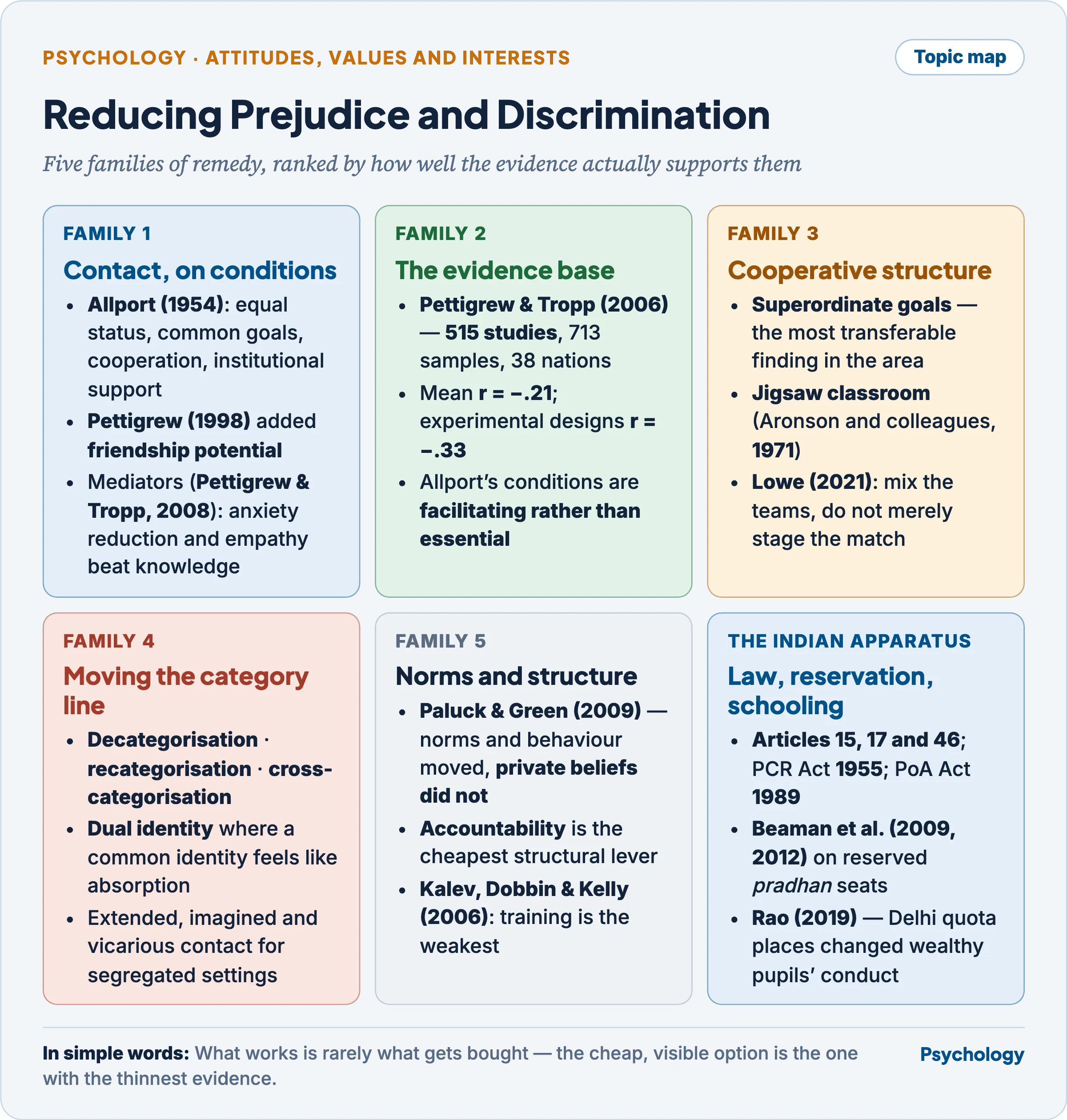
The contact hypothesis and its conditions
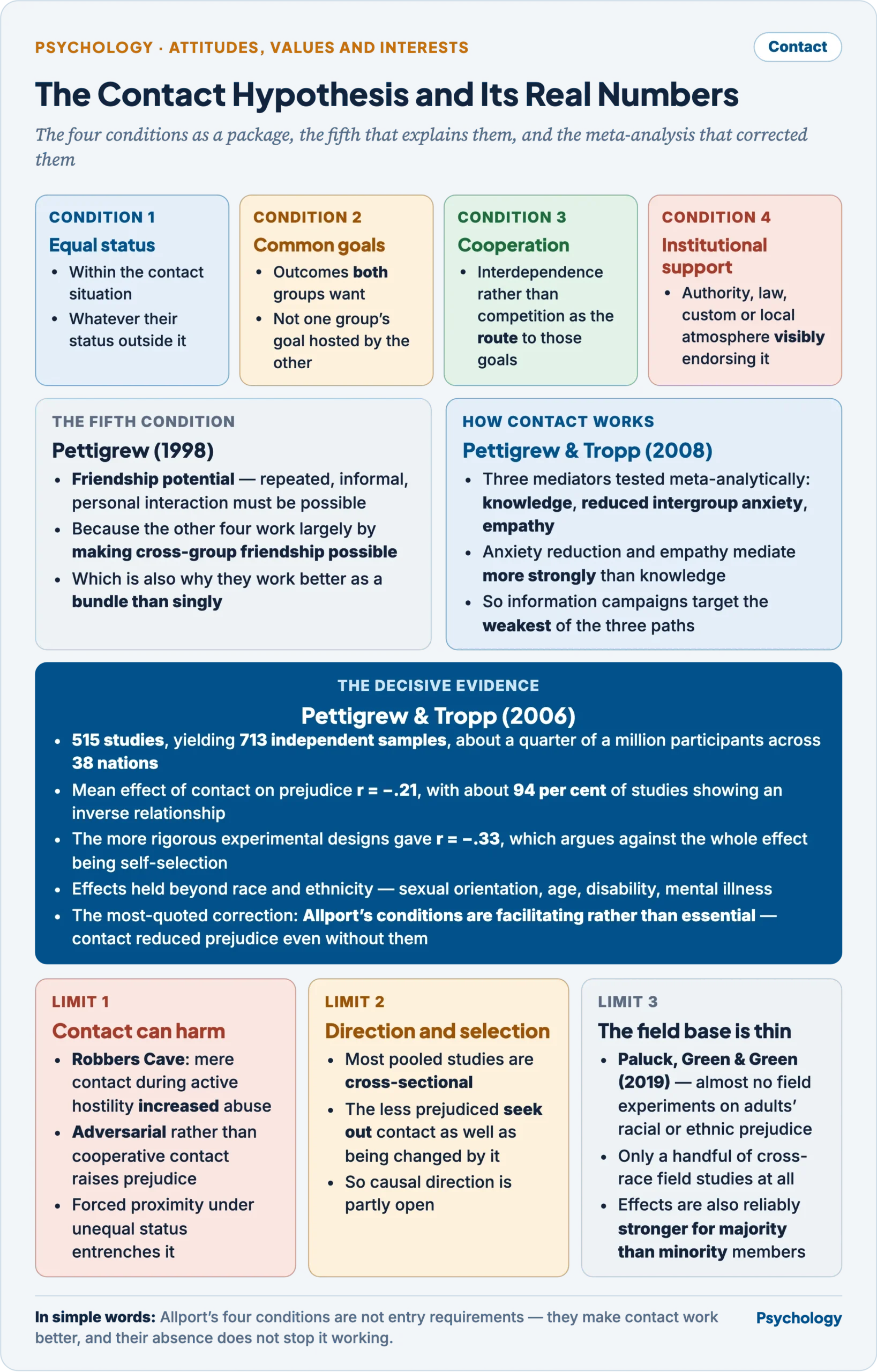
- Four conditions are usually drawn from Allport (1954), and they are a package rather than a menu.
- Equal status within the contact situation, whatever their status outside it.
- Common goals that both groups want.
- Intergroup cooperation rather than competition as the route to those goals.
- Institutional support — authority, law, custom or local atmosphere visibly endorsing it.
- Pettigrew (1998) added a fifth, friendship potential: the setting must allow repeated, informal, personal interaction, since the other four work largely by making cross-group friendship possible.
- Pettigrew and Tropp (2008) tested three mediators meta-analytically: contact works by increasing knowledge of the out-group, reducing intergroup anxiety, and increasing empathy. Anxiety reduction and empathy mediate more strongly than knowledge — so information campaigns target the weakest of the three paths.
- Sherif’s Robbers Cave camp is the field demonstration. Bringing the hostile groups together for meals and a film increased abuse; hostility fell only under superordinate goals neither group could achieve alone. Contact plus interdependence, not contact alone.
What the meta-analytic evidence actually shows
- Pettigrew and Tropp (2006) is the decisive evidence, and its numbers are worth holding exactly.
- 515 studies in all (Pettigrew and Tropp, 2006), yielding 713 independent samples, about a quarter of a million participants across 38 nations.
- Mean effect size between contact and prejudice of r = −.21, with about 94 per cent of studies showing an inverse relationship (Pettigrew and Tropp, 2006).
- The more rigorous experimental designs gave a stronger mean of r = −.33, which argues against the whole effect being self-selection.
- Effects held beyond race and ethnicity — sexual orientation, age, disability, mental illness — so the theory generalises past the case it was built on.
- Allport’s conditions are facilitating rather than essential: contact under them produced larger reductions, but contact reduced prejudice even without them. This is the most-quoted correction to the original hypothesis.
- The conditions also work better as a bundle than singly: reviews since Pettigrew and Tropp (2006) report that no single one strongly predicts effect size, consistent with their operating through friendship potential.
- The asymmetry matters for policy: contact effects are reliably stronger for majority than for minority members, so integration buys more attitude change among the advantaged than the disadvantaged.
- The limits are real.
- Most pooled studies are cross-sectional, so causal direction is partly open: the less prejudiced seek out contact as well as being changed by it.
- Paluck, Green and Green (2019) re-examined the field-experimental literature and found it thin where it matters most — almost no studies of adults’ racial or ethnic prejudice, and only a handful of cross-race field studies at all. Their conclusion is that the gaps must be filled before contact can guide policy.
- Adversarial rather than cooperative contact can increase prejudice — the Robbers Cave finding, confirmed in the Indian field evidence below.
Cooperative learning and the jigsaw classroom
- The jigsaw classroom was built by Elliot Aronson and colleagues in 1971 in newly desegregated schools in Austin, Texas, after a district official reported fighting between Black, white and Hispanic pupils. They concluded the hostility was fed by the competitive structure of the classroom itself.
- The design engineers all of Allport’s conditions into an ordinary lesson.
- The material is divided into parts, one per pupil in a mixed group.
- Each pupil becomes the sole expert on their part and must teach it to the others.
- Nobody can succeed without every other member, so positive interdependence is structural, not exhorted.
- Status is equalised because each pupil holds information the others need, and the teacher’s authority supplies institutional support.
- Reports from Aronson and his team describe reduced absence, improved academic performance for minority pupils, and markedly more racially mixed play at recess within weeks.
- The evidence is weaker than the technique’s reputation. Blaney and colleagues (1977), evaluating ten fifth-grade classes across seven schools, found gains in self-perceived competence but no direct effect on achievement; and a Norwegian field trial by Bratt (2008) found no effect on intergroup attitudes, cross-group friendship or empathy. The Austin studies were small and largely observational.
- What survives is the structural insight: changing the incentive structure of a shared task changes intergroup behaviour, where exhortation does not.
Recategorisation, decategorisation and cross-categorisation
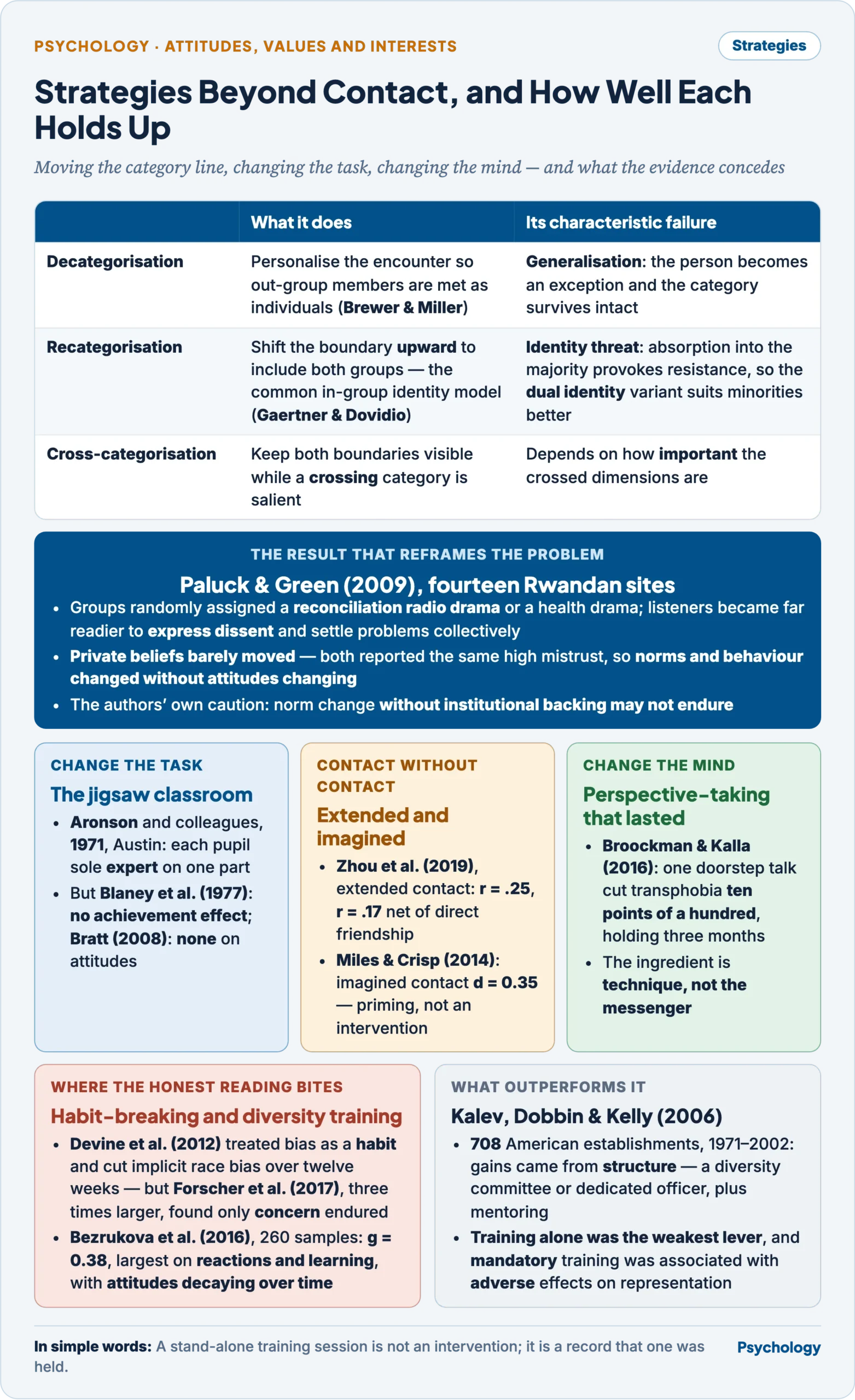
- Three categorisation-based strategies follow, each with a characteristic failure.
- Decategorisation — personalising the encounter so out-group members are met as individuals, not category members (Brewer and Miller). It improves attitudes to the individual met; its weakness is generalisation, since the person becomes an exception and the category survives.
- Recategorisation — the common in-group identity model of Gaertner and Dovidio, which shifts categorisation upward to a boundary including both groups: “us” enlarged, not dissolved. Shared uniforms, seating, naming and pronouns are its instruments.
- Mutual intergroup differentiation or cross-categorisation — keeping both boundaries visible while making a crossing category salient, so each person is an out-group member on one dimension and an in-group member on another. Its effect depends on how important the crossed dimensions are.
- Recategorisation’s failure mode is identity threat. A superordinate identity that feels like absorption into the majority provokes resistance, which is why the dual identity variant — subgroup and common group affirmed at once — works better with minority groups than a single common identity.
- Superordinate goals are recategorisation’s behavioural form: a shared task no single group can complete makes the inclusive category real rather than announced. This is the most transferable finding in the area.
Extended, imagined and vicarious contact
- Extended contact (Wright, Aron, McLaughlin-Volpe and Ropp, 1997) holds that merely knowing an in-group member has a close out-group friend reduces prejudice. It scales where direct contact is impossible, as in segregated settlements.
- Zhou and colleagues (2019), meta-analysing 115 studies and 248 effect sizes, found an overall association of r = .25, falling to r = .17 once direct friendship was partialled out — small-to-medium, independent of direct contact, and larger for perceived than for actual extended contact.
- Imagined contact (Crisp and Turner) asks people to picture a positive interaction with an out-group member. Miles and Crisp (2014) meta-analysed it and found a mean effect of d = 0.35, present in published and unpublished studies alike, and larger when participants elaborated the imagined setting.
- The honest reading: small, measured mostly on immediate self-report in laboratory samples, with no good evidence that it changes behaviour or persists. A priming manipulation, not an intervention.
Perspective-taking, empathy and dialogue
- Empathy induction works by instruction. Batson and colleagues (1997) showed that asking participants to attend to a stigmatised person’s feelings rather than to the information improved attitudes towards the whole group, not only the individual.
- Broockman and Kalla (2016) provide the strongest field demonstration of a conversation changing a prejudice.
- Canvassers held single ten-to-fifteen-minute door-to-door conversations with South Florida voters, using perspective-taking — asking about a time the voter was judged for being different — not argument.
- Transphobia fell by roughly ten points on a hundred-point feeling scale, support for anti-discrimination law rose, and the change persisted for the three months measured, surviving opposing attack advertisements.
- Canvassers who were not themselves transgender produced lasting effects too, so the active ingredient is technique, not the messenger’s identity. Kalla and Broockman (2020) replicated the durability across three further field experiments.
- Devine, Forscher, Austin and Cox (2012) treated implicit bias as a habit, teaching awareness of it, concern about it, and specific replacement strategies. Their intervention group showed reduced implicit race bias over twelve weeks, with the largest reductions among those who reported using the strategies.
- The replication by Forscher and colleagues (2017), with a sample over three times larger, found the effect on concern about bias endured but the implicit-bias difference did not separate from the control group. The durable change is in knowledge and belief, not in the implicit measure.
- Intergroup dialogue — structured, sustained, facilitated encounter between groups in conflict — is the practitioner’s version of the contact conditions. It improves reported understanding and attitudes; evidence that it changes behaviour outside the dialogue, or persists, is thin.
Norms, accountability and institutional design
- Paluck and Green (2009) ran the field experiment that reframes the whole problem. Groups in fourteen Rwandan sites were randomly assigned to listen to a reconciliation radio drama or to a health drama.
- Listeners to the reconciliation programme became markedly more willing to express dissent and to resolve communal problems collectively rather than by deferring to authority.
- Private beliefs barely moved: both groups in Paluck and Green’s (2009) data reported the same high levels of community mistrust.
- The finding is that the programme changed perceived norms and behaviour without changing attitudes, which is the opposite of the standard theory of change.
- Why norm change may matter more than attitude change, for anyone with administrative levers.
- Discrimination is an act, and acts are governed by what is expected and sanctioned, not only by what a person privately feels.
- Norms are public and observable, so they can be shifted by visible enforcement, by elite example and by correcting pluralistic ignorance about what others actually think.
- Norms reach a population at once, where persuasion reaches one person at a time.
- The authors’ own caution: norm change without institutional backing may not endure.
- Accountability is the cheapest structural lever. Decision-makers who must justify a decision by stated criteria to an identifiable audience discriminate less, because justification forces the controlled process Devine (1989) identified.
- Institutional design does the work that attitude change cannot.
- Criteria fixed and recorded before candidates are seen; structured rather than open interviews; selection panels that are themselves mixed.
- Anonymising applications where feasible. Goldin and Rouse (2000) estimated that screened orchestra auditions raised women’s advancement, though the estimates carry large standard errors and the headline figure is contested; anonymisation has produced null or reversed results elsewhere, so it must be evaluated locally.
- Disaggregated monitoring: counting outcomes by group, publishing them, and making a named officer answerable.
- Engineering contact through allocation — mixed hostel rooms, classroom seating and work units — which places people under Allport’s conditions without asking anyone to change their mind first.
Diversity training: popular and weakly supported
- Bezrukova and colleagues (2016) meta-analysed over forty years of evaluations across 260 samples and found an overall effect of g = 0.38. The honest breakdown is less flattering than the headline.
- Effects were largest on participant reactions and cognitive learning — what people know and how they rate the session.
- Effects on attitudes decayed over time, while cognitive learning was retained.
- Gains were larger where training was sustained over time, paired with other diversity initiatives, and targeted at skills as well as awareness — that is, where it was not a stand-alone session.
- Kalev, Dobbin and Kelly (2006) examined managerial diversity in 708 American establishments between 1971 and 2002 — the behavioural rather than attitudinal test.
- The measures associated with real gains were structural: assigning organisational responsibility through a diversity committee or a dedicated officer, and relationship-building measures such as mentoring and networking.
- Training alone was the weakest lever, and mandatory training was associated with adverse rather than positive effects on representation.
- The conclusion to carry: training is the cheapest, most visible and least effective option, and it substitutes for the accountability structures that work. A stand-alone session is not an intervention; it is a record that one was held.
The Indian apparatus
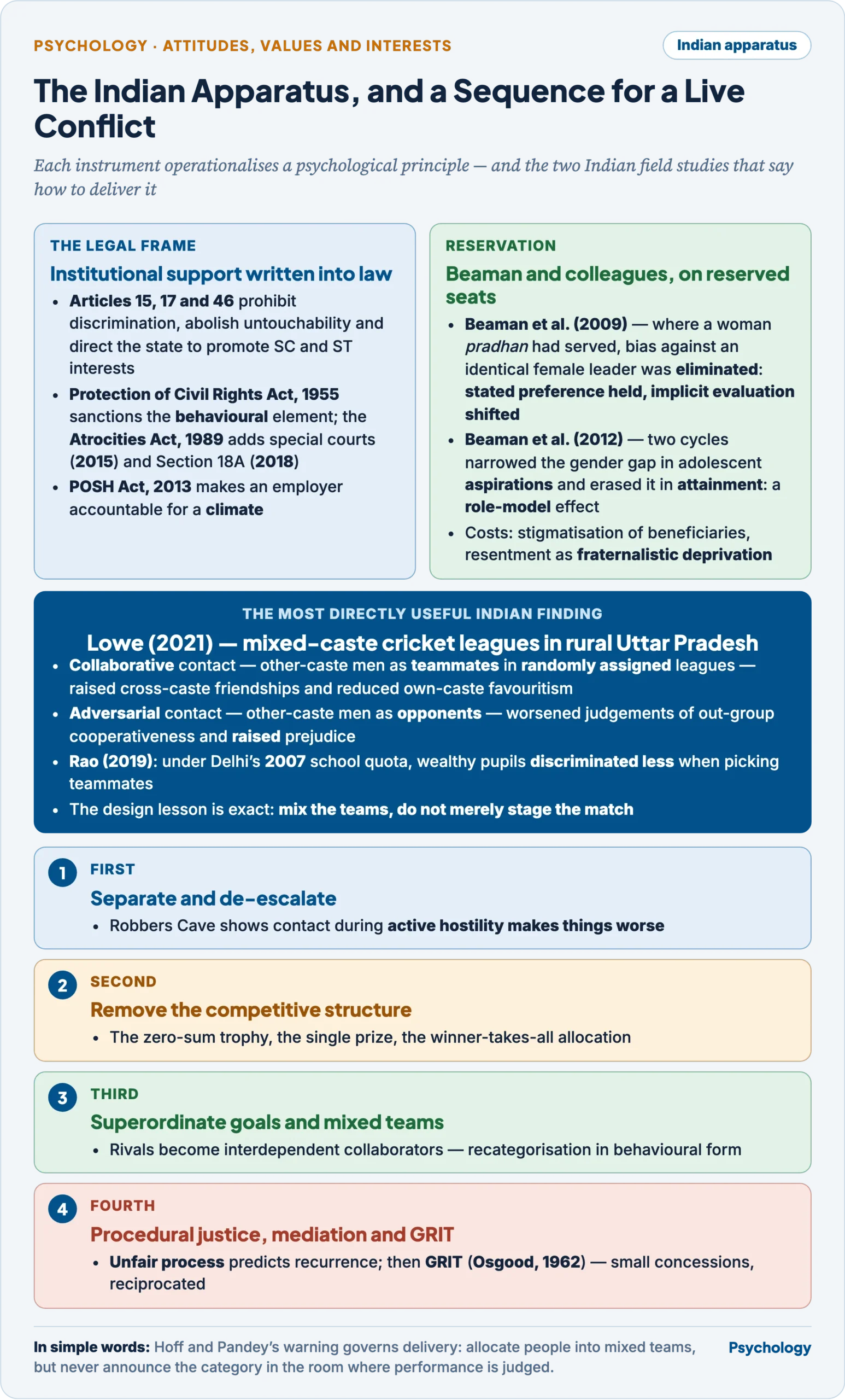
- The legal and constitutional frame is unusually strong, and each instrument operationalises a psychological principle.
- Articles 15, 17 and 46 of the Constitution prohibit discrimination, abolish untouchability and direct the state to promote the educational and economic interests of the Scheduled Castes and Tribes — the institutional support condition written into founding law.
- The Protection of Civil Rights Act, 1955 criminalises the practice of untouchability, attaching sanction to the behavioural element directly.
- The Scheduled Castes and the Scheduled Tribes (Prevention of Atrocities) Act, 1989 (Ministry of Social Justice and Empowerment) creates specific atrocity offences and penalties for dereliction by public servants. The 2015 amendment added exclusive special courts and a chapter on victims’ and witnesses’ rights; the 2018 amendment inserted Section 18A restoring the bar on anticipatory bail.
- The Sexual Harassment of Women at Workplace (Prevention, Prohibition and Redressal) Act, 2013 makes an employer institutionally accountable for a climate, which is the accountability principle applied to gender.
- Reservation is the largest affirmative-action programme anywhere, and the psychological evidence on it cuts both ways.
- Beaman, Chattopadhyay, Duflo, Pande and Topalova (2009) used the random reservation of village council leadership for women in West Bengal. Male villagers who had never had a woman pradhan rated a hypothetical female leader below an identical male leader; where one had served, that bias was eliminated. Stated preference did not shift but implicit evaluation did — exposure changed the automatic response first.
- Beaman, Duflo, Pande and Topalova (2012) found two election cycles of reservation narrowed the gender gap in adolescent aspirations and erased it in educational attainment, with girls also spending less time on chores. With no change in labour-market returns, the authors read this as a role-model effect.
- The counterweight is Hoff and Pandey’s (2006) finding that making caste publicly salient depresses low-caste performance. A policy that allocates by category must therefore be delivered in ways that do not announce the category in the setting where performance is judged.
- Reservation’s psychological costs are real and should be named: stigmatisation of beneficiaries as unqualified, majority resentment framed as fraternalistic deprivation, and the risk that visible categorisation sustains the very boundary it is meant to dissolve.
- Rao (2019) supplies the Indian test of the contact hypothesis in schools. A 2007 Delhi policy obliged many private schools to admit a quota of poor children; wealthy pupils with poor classmates became more generous in allocation games and volunteering, discriminated less when picking teammates in an incentivised sports contest, and were readier to socialise with them outside school. The academic cost was a marginally significant fall in English scores, none in Hindi or mathematics.
- Lowe (2021) randomly assigned young men in rural Uttar Pradesh to mixed-caste cricket leagues and separated the two kinds of contact, which is the finding most directly useful for managing a sporting conflict.
- Collaborative contact — other-caste men as teammates — increased cross-caste friendships, reduced own-caste favouritism and improved efficiency in trade.
- Adversarial contact — other-caste men as opponents — worsened judgements of out-group cooperativeness and raised prejudice in intergroup interactions.
- Both forms reduced ability-based statistical discrimination, and participation on balance narrowed intergroup differences. The design lesson is exact: mix the teams, do not merely stage the match.
- Education policy reaches people before prejudice consolidates. NEP 2020 (Ministry of Education) frames inclusion around Socio-Economically Disadvantaged Groups, with special education zones and bridge programmes; shared mid-day meals remain one of the few routine practices in Indian public life that breach commensality rules by design.
- Conflict-resolution strategies for an intergroup fight, in the order a public official would deploy them.
- Separate and de-escalate first. Robbers Cave shows that contact during active hostility makes things worse; cooling-off precedes anything else.
- Remove the competitive structure that produced the fight — a zero-sum trophy, a single prize, a winner-takes-all allocation.
- Impose superordinate goals and mixed teams, which converts the rivals into interdependent collaborators.
- Third-party mediation by a credible neutral, and integrative bargaining that looks for the shared interest behind incompatible positions.
- Procedural justice: visible, impartial rules and officiating, since a sense of unfair process predicts recurrence better than the dispute’s content.
- GRIT (Osgood, 1962) — Graduated and Reciprocated Initiatives in Tension-reduction: one side announces and makes a small unilateral conciliatory move, invites reciprocity, and repeats, rebuilding trust without requiring agreement first.
- Change the norm, then record it: a publicly announced standard of conduct, enforced once and visibly, does more than appeals to sentiment.
Criticisms and limitations
- The effect sizes are modest. An r of about −.21 is real but small, and the experimental subset at −.33 comes from conditions easier to arrange in a laboratory than in a district.
- Expressed attitudes and behaviour move separately. Interventions that shift questionnaire responses often leave conduct untouched, and the Rwandan radio result shows the reverse — norms and behaviour changing while private beliefs do not. Which outcome was measured is the first question to ask of any claimed success.
- Durability is the weakest link. Most studies measure within days. The exceptions — twelve weeks for habit-breaking, three to four months for canvassing, two electoral cycles for reservation — are short for a problem measured in generations.
- Causal direction and selection are unresolved across the correlational literature, and Paluck, Green and Green (2019) showed the field-experimental base is thin where policy needs it.
- Contact can harm. Adversarial contact worsens prejudice, forced proximity under unequal status entrenches it, and a superordinate identity felt as assimilation provokes backlash from the group asked to give up its own.
- The most popular intervention is the weakest. Diversity training is widely purchased and poorly supported, while the accountability structures that work are less visible and politically harder.
- What stands up is substantial and actionable. Cooperative interdependence reduces intergroup hostility; superordinate goals work in the field; the four conditions facilitate even if none is strictly necessary; anxiety reduction and empathy are the operative mechanisms; norm change can move behaviour faster than attitude change; and structural accountability outperforms persuasion. Enough to design on, provided the design is evaluated.
Previous Year Questions
- 2024What advice would you give to a civil servant to reduce prejudice and discrimination in Indian society? Discuss.
- 2020While playing cricket, Team-A got into fight with Team-B. Discuss it in the context of ‘realistic group conflict theory’. How can conflict resolution strategies be used to manage and control such fights?
- 2013What is the role of social categorization in the formation of prejudice? Suggest some strategies to reduce prejudice.