

Official syllabusPaper I · Unit 12 · Attitudes, Values and Interests
Formation of stereotypes and prejudices.
Definition
“Prejudice is an antipathy based upon a faulty and inflexible generalization.”
Gordon Allport (1954), The Nature of Prejudice
Allport adds that prejudice “may be felt or expressed” and “may be directed toward a group as a whole, or toward an individual because he is a member of that group.”
Two features of that definition do the work. Prejudice is an antipathy — an affective state, not a belief — and it attaches to a person because of a category, so the individual’s own attributes are irrelevant. Formation is the question of how a category acquires an evaluation.
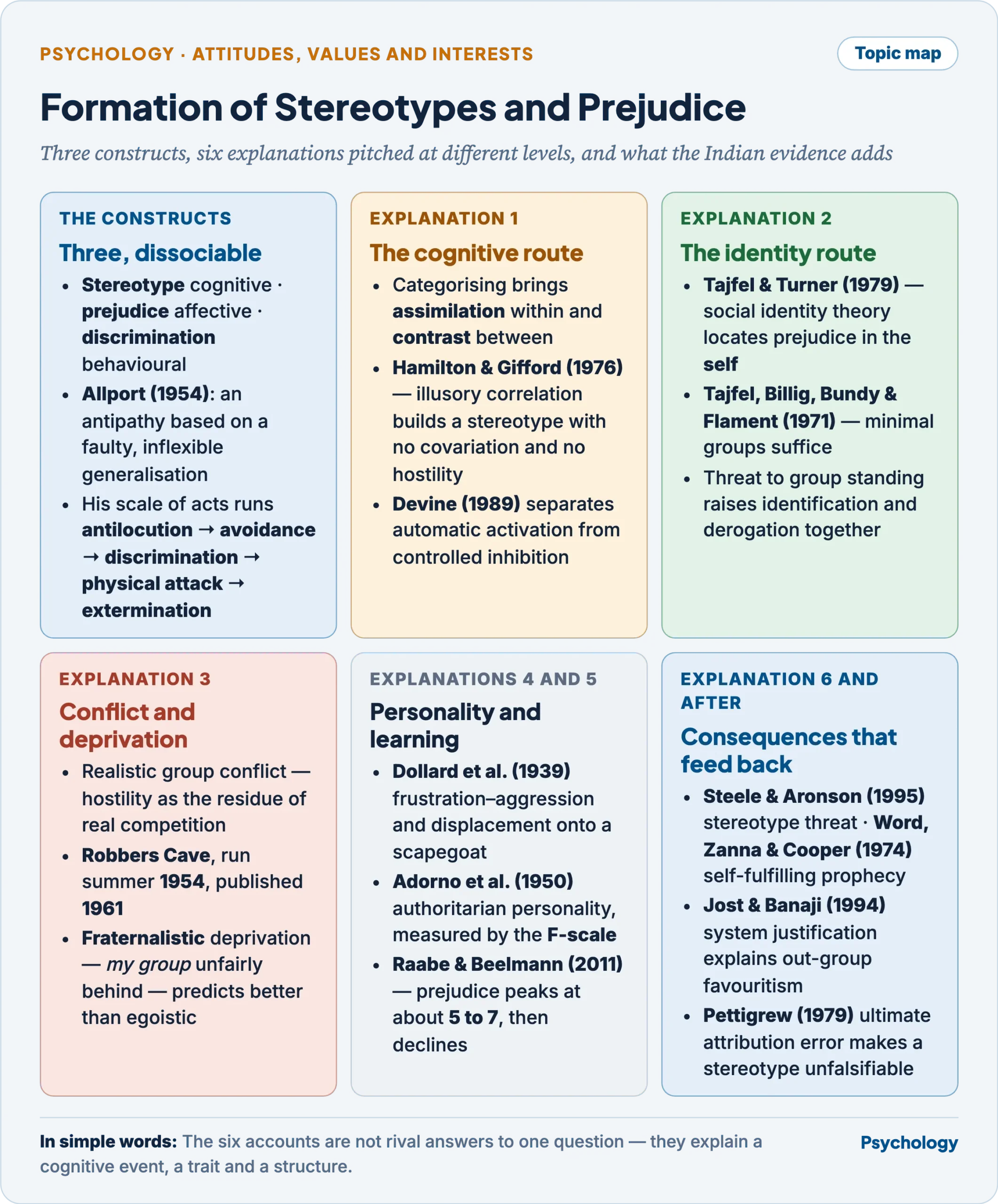
Stereotype, prejudice and discrimination: three constructs
- A stereotype is a set of beliefs about a social group’s attributes, applied to a person on membership alone. It is the cognitive element, and may be negative, positive or descriptive.
- Prejudice is the affective element: a favourable or unfavourable evaluation of a group’s members based on membership. Brewer (1999) argued much intergroup bias is in-group love, not out-group hate.
- Discrimination is the behavioural element: unequal treatment because of membership. Allport’s (1954) scale ranks its forms — antilocution, avoidance, discrimination, physical attack, extermination.
| Stereotype | Prejudice | Discrimination | |
|---|---|---|---|
| Component | Cognitive | Affective | Behavioural |
| Unit | Belief about attributes | Evaluation of the group | Act towards a member |
| Measured by | Trait ascription, latency | Feeling scales, implicit tests | Allocation, hiring, violence |
| Moved by | Information, individuation | Affect, contact | Law, incentives, norms |
- The three are correlated but dissociable. A stereotype can be held without dislike, dislike can coexist with correct conduct, and discrimination can be purely institutional. Prejudice also commonly serves the ego-defensive function the attitudes article sets out.
- So the claim that stereotypes lead to prejudice and discrimination is half right. The cognitive element supplies content an evaluation can rest on — Macrae, Milne and Bodenhausen (1994) showed stereotypes act as energy-saving devices — but belief becomes feeling only given motivation, and feeling becomes act given opportunity.
- Eagly and Chaiken (1993) established that attitudes and behaviour correspond loosely, so absence of overt discrimination is no evidence prejudice has gone.
Social categorisation and its cognitive economy
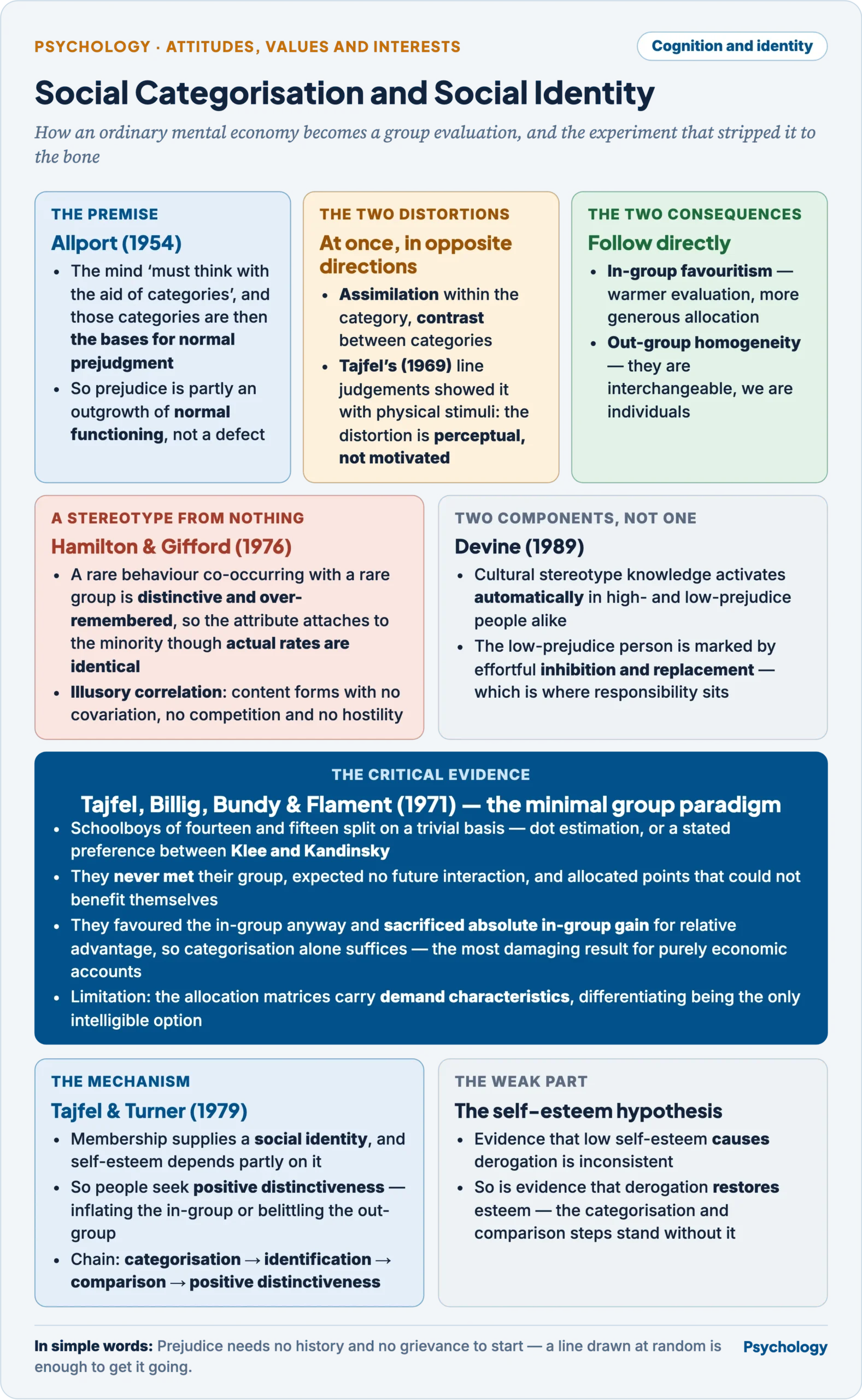
- Allport (1954) held prejudice to be partly an outgrowth of normal functioning: the mind “must think with the aid of categories”, and once formed they are “the bases for normal prejudgment”.
- Categorising distorts perception two ways at once — assimilation, minimising within-category differences, and contrast, exaggerating between-category ones. Tajfel’s (1969) line judgements showed this with physical stimuli, so the distortion is perceptual, not motivated.
- Two consequences follow directly: in-group favouritism, more positive evaluation of and more generous allocation to in-group members, and the out-group homogeneity effect, out-group members seen as interchangeable while in-group members are seen as individuals.
- Hamilton and Gifford (1976) demonstrated illusory correlation: a rare behaviour co-occurring with a rare group is distinctive and over-remembered, so the attribute attaches to the minority though actual rates are identical. A stereotype forms with no covariation and no hostility.
- Devine (1989) separated automatic from controlled components. Cultural stereotype knowledge activates automatically in high- and low-prejudice people alike; the low-prejudice person is distinguished by effortful inhibition and replacement.
Social identity theory and the minimal group paradigm
- Tajfel and Turner (1979) located prejudice in the self rather than in competition. Group membership supplies social identity; since self-esteem depends partly on it, people seek positive distinctiveness for the in-group, by inflating it or belittling the out-group.
- The mechanism runs social categorisation → social identification → social comparison → positive distinctiveness. Threat to the group’s standing raises both identification and derogation, so prejudice spikes under status insecurity.
- Tajfel, Billig, Bundy and Flament (1971) — the minimal group paradigm, the critical evidence.
- Schoolboys of fourteen and fifteen were split into two groups on a trivial basis: ostensible over- or under-estimation of dots in one experiment, a stated preference between paintings by Klee and Kandinsky in another. Assignment was arbitrary.
- They never met their group, expected no future interaction, and allocated points that could not benefit themselves. They favoured the in-group anyway, and sacrificed absolute in-group gain to secure relative advantage over the out-group.
- Categorisation alone, without history, competition or self-interest, therefore suffices for discrimination: the most damaging result for purely economic accounts.
- Limitation: the allocation matrices carry demand characteristics, differentiating being the only intelligible option.
- Self-categorisation theory (Turner et al., 1987) added that identity shifts with the comparative context, so which category is salient settles who counts as “us” — the lever most reduction strategies pull.
- The self-esteem hypothesis is the weakest part: evidence that low self-esteem causes derogation, or derogation restores esteem, is inconsistent.
Realistic group conflict and the Robbers Cave field study
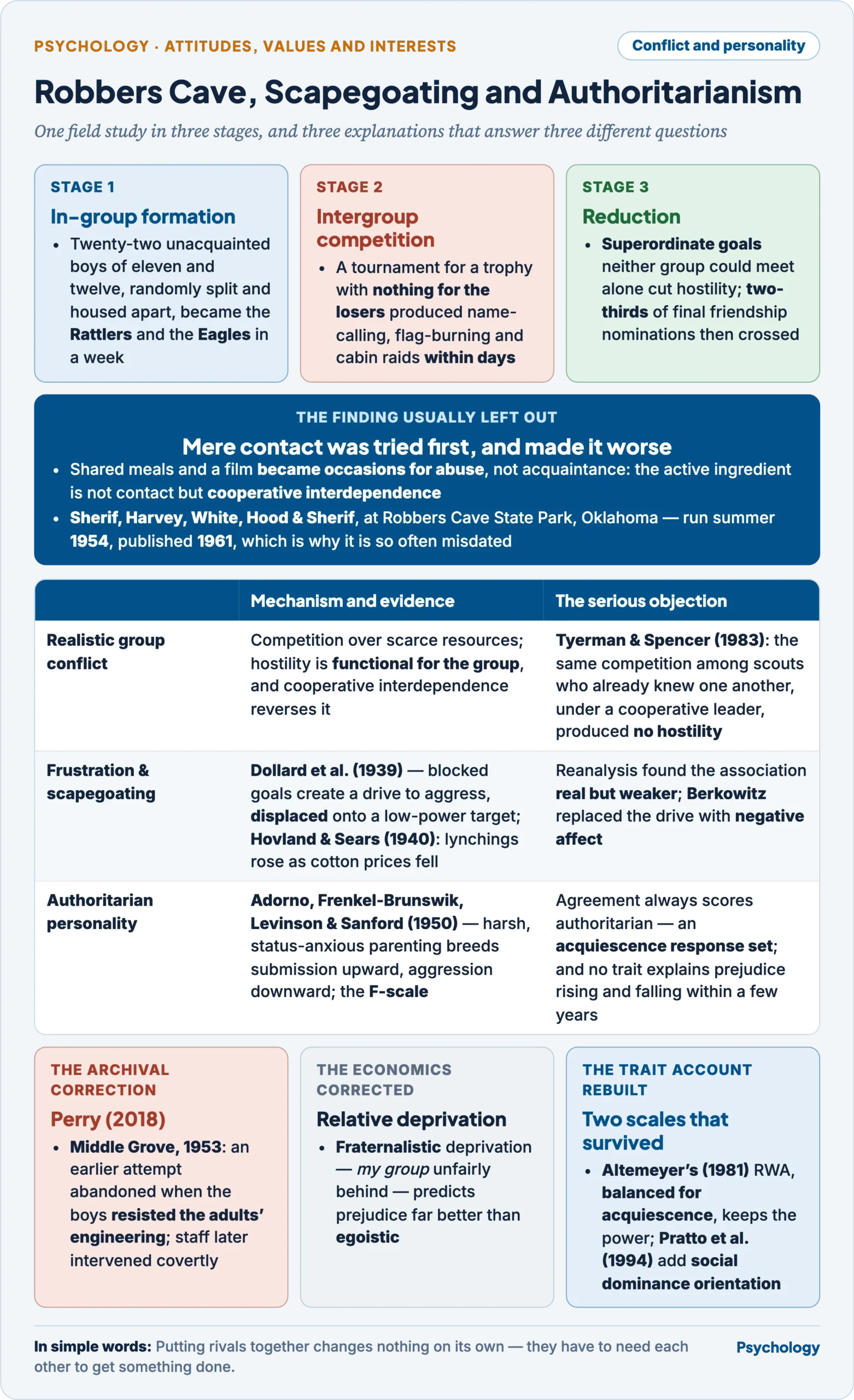
- Realistic group conflict theory holds prejudice to be the residue of real competition over scarce resources — jobs, land, seats, status. Hostility is functional for the group, not pathological in the individual.
- Sherif, Harvey, White, Hood and Sherif — the Robbers Cave field experiment, run in summer 1954 at a camp in Robbers Cave State Park, Oklahoma, published 1961.
- Twenty-two unacquainted boys of eleven and twelve, matched on background, were randomly split into two groups housed apart and unaware of each other.
- Stage 1, in-group formation. A week of separate hiking, swimming and chores produced names — Rattlers and Eagles — flags, norms and leadership.
- Stage 2, intergroup competition. A tournament for a trophy, nothing for the losers, produced name-calling, flag-burning, cabin raids and theft within days.
- Stage 3, reduction. Mere contact failed — shared meals and a film became occasions for abuse. Hostility fell only under superordinate goals neither group could meet alone: restoring a sabotaged water supply, pooling money for a film, hauling a stalled truck. Two-thirds of final friendship nominations crossed group lines.
- Criticisms are serious; the claim survives.
- Gina Perry (2018) established from the archives that an earlier attempt at Middle Grove in 1953 was abandoned because the boys resisted the adults’ engineering of their conflict.
- Staff intervened covertly, helping one group win and staging the water and truck crises, so the design is closer to demonstration than experiment; and the deception would not now pass review.
- Tyerman and Spencer (1983) ran comparable competition among scouts who already knew one another under a cooperative leader and found no hostility — making prior relationships and leadership moderators Sherif held constant.
- The sample was twenty-two boys of one age, sex, class, religion and ethnicity. Yet competitive interdependence reliably produces hostility, and cooperative interdependence reduces it.
- Relative deprivation corrects the theory’s economics: what predicts hostility is the perceived shortfall against a comparison group, not absolute shortage. Fraternalistic deprivation — that my group is unfairly behind — predicts prejudice far better than egoistic deprivation about one’s own position.
Frustration, scapegoating and the authoritarian personality
- The frustration–aggression hypothesis (Dollard et al., 1939) holds that blocked goal attainment generates a drive to aggress. Where the real source is unavailable or too powerful, aggression is displaced onto a scapegoat — typically a visible, low-power minority.
- Hovland and Sears (1940) reported that lynchings in the American South rose as cotton prices fell; later time-series reanalysis found the association real but weaker. Berkowitz replaced the drive with negative affect, covering prejudice rising under heat, crowding and insecurity.
- Adorno, Frenkel-Brunswik, Levinson and Sanford (1950) proposed the authoritarian personality: harsh, status-anxious parenting produces submission to authority, aggression towards the weak, conventionalism and a need for rigid order, measured by the F-scale. Prejudice here is generalised across out-groups.
- The critique is severe and the construct survives in rebuilt form.
- Agreement on the F-scale always scores authoritarian, confounding the construct with an acquiescence response set, and the childhood evidence came from retrospective interviews by investigators who knew the scores already.
- Only right-wing authoritarianism is predicted, and no personality account explains prejudice that rises and falls across a society within a few years.
- Altemeyer’s (1981) right-wing authoritarianism scale, balanced for acquiescence, retains the predictive power, and social dominance orientation (Pratto, Sidanius, Stallworth and Malle, 1994) captures a separate route — preference for group-based hierarchy.
Social learning: family, peers, media and language
- Children are not born with stereotypes, and the evidence is specific about acquisition.
- In-group preference appears by about three or four, before coherent beliefs about out-group attributes exist, so the affective element can precede the cognitive one.
- Raabe and Beelmann (2011), a multinational meta-analysis of age differences, found ethnic and national prejudice rising through the preschool years to a peak at about five to seven, then declining through middle childhood as classification skill improves.
- Clark and Clark (1947) — the doll studies, the classic evidence that evaluations are internalised early.
- African American children aged three to seven were shown otherwise identical brown and white dolls and asked which they preferred, which was nice, which looked bad.
- A majority preferred the white doll and gave the negative attributes to the brown one; many identified themselves with the doll they had just disparaged. The finding was used in the litigation that produced Brown v. Board of Education.
- Limitations: the forced choice inflates apparent preference, identification is conflated with preference, and the data come from a segregated society.
- Four transmission channels are distinguishable, the first weaker than intuition suggests.
- Family. Reinforcement and observational learning transmit evaluations, but parent–child correlations in prejudice are only modest; children acquire the categories and the norms of expression more reliably than the evaluations themselves.
- Peers. Norms about which groups may be excluded gain weight through middle childhood and often override family content.
- Media. Restricted, stereotyped portrayal supplies content about groups a child has never met, which is when out-group homogeneity is strongest.
- Language. Category labels, generics of the form “they are…”, and the linguistic intergroup bias — in-group good acts and out-group bad acts described in abstract trait terms, their opposites in concrete episodic terms — encode prejudice in ordinary speech.
- Jane Elliott’s (1968) blue-eyed/brown-eyed classroom exercise, run with third-graders the day after the assassination of Martin Luther King Jr, showed how fast an arbitrary category plus an authority’s endorsement produces superiority, submission and performance differences. It was an exercise, not an experiment — no controls, no measures, no consent — so it shows the effect’s speed, not its size.
Stereotype threat, self-fulfilling prophecy and system justification
- Steele and Aronson (1995) identified stereotype threat: the pressure on a member of a negatively stereotyped group that their performance may confirm the stereotype. African American students taking a hard verbal test did worse than matched white students when it was framed as diagnostic of ability, and comparably when framed as unrelated to it. The belief creates the conditions of its own confirmation.
- Honest limits: some replications of the identity-salience variant have failed, and the popular claim that gaps disappear without threat overstates what the original design, which adjusted for prior test scores, can support.
- Word, Zanna and Cooper (1974) demonstrated the self-fulfilling prophecy in behaviour. White interviewers gave black applicants less immediacy, more speech errors and shorter interviews; white applicants later given that same nonverbal treatment were rated as performing less adequately and as more nervous.
- Jost and Banaji (1994) added system justification: stereotypes make inequality look natural and deserved, which is why disadvantaged groups hold them too, sometimes more strongly than the advantaged. Out-group favouritism among subordinate groups is unintelligible on in-group-interest accounts and predicted here.
Old-fashioned and modern prejudice
- Old-fashioned prejudice is overt and endorsed — explicit claims of inferiority, open support for exclusion. Its measured prevalence has fallen sharply wherever it has been tracked.
- Modern or subtle prejudice replaced it. The person holds egalitarian values alongside negative group associations, and expresses bias only where a non-prejudicial justification is available. Self-report tracks the old form, not the new.
- Modern racism appears as denial that discrimination persists and resentment of group-based remedies; modern sexism, as denial that sex discrimination persists.
- Aversive racism, in Gaertner and Dovidio’s formulation, is marked by discomfort rather than hostility, showing as avoidance and withheld help where the act can be explained away.
- Glick and Fiske (1996) separated hostile sexism from benevolent sexism — protective, idealising attitudes that feel positive, are socially rewarded, and legitimise women’s confinement to prescribed roles, and are therefore defended as respect.
Causal attribution in the formation of prejudice
- How a group’s conduct is explained settles whether it updates or confirms the stereotype, so attribution both expresses and manufactures prejudice.
- Pettigrew (1979) named the ultimate attribution error: negative out-group behaviour is attributed to the group’s disposition, while positive out-group behaviour is explained away in one of four ways.
- The exceptional case — the individual is differentiated from the group.
- Luck or special advantage — success credited to a quota or chance.
- The situational context — anyone so placed would have done as well.
- Extraordinary motivation — the person overcame the group’s deficiency, leaving the stereotype intact.
- The structure makes a stereotype unfalsifiable by experience: disconfirming evidence is routed to a situational cause and the dispositional belief survives. Hence contact with counter-stereotypic individuals so often fails to generalise.
- Taylor and Jaggi (1974) gave the first Indian demonstration. Hindu respondents in a South Indian setting attributed desirable acts by Hindu actors to internal causes and undesirable acts to external ones, reversing the pattern exactly for Muslim actors.
- Just-world reasoning and the fundamental attribution error (Ross, 1977) feed the same loop — the first making disadvantage look deserved, the second under-weighting the constraints on disadvantaged groups. The attribution theories themselves are treated in the attribution articles.
The Indian context
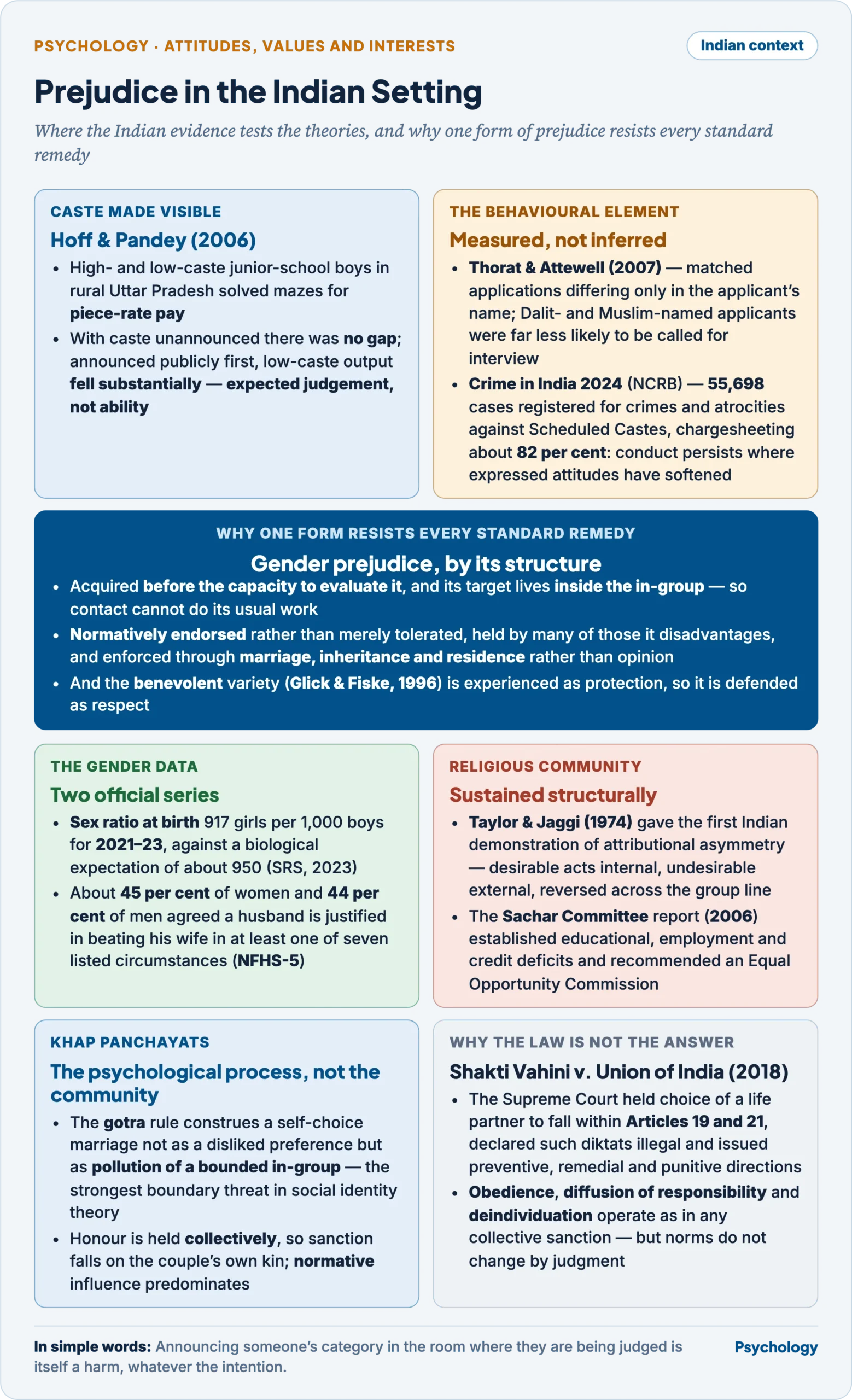
- Caste fuses a category, a ritual rank and an occupational ascription, so the three constructs arrive together rather than separably.
- Hoff and Pandey (2006) made the mechanism visible. High- and low-caste junior-school boys in rural Uttar Pradesh solved mazes for piece-rate pay. With caste unannounced there was no gap; when each boy’s caste was announced publicly beforehand, low-caste output fell substantially. Expected prejudicial judgement, not ability, produced it.
- Thorat and Attewell (2007) sent matched applications differing only in the applicant’s name to private-sector job advertisements. Dalit- and Muslim-named applicants were significantly less likely to be called for interview than identically qualified high-caste ones.
- Crime in India 2024 recorded 55,698 cases registered for crimes and atrocities against Scheduled Castes, with a chargesheeting rate of about 82 per cent (National Crime Records Bureau, 2024) — the behavioural element persisting where expressed attitudes have softened.
- Purity-and-pollution reasoning gives caste prejudice a moral vocabulary, and a prejudice framed as moral obligation resists change better than one framed as preference.
- Religious community prejudice is sustained by residential segregation, selective memory of past conflict, rumour and the attributional asymmetry Taylor and Jaggi (1974) documented. The Sachar Committee report (2006, chaired by Justice Rajindar Sachar) established the community’s educational, employment and credit deficits and recommended an Equal Opportunity Commission.
- Gender prejudice has the deepest roots and the clearest data.
- India’s sex ratio at birth stood at 917 girls per 1,000 boys for 2021–23 against a biological expectation of roughly 950 (Sample Registration System Statistical Report, 2023) — prejudice expressed before a child exists.
- About 45 per cent of women and 44 per cent of men agreed a husband is justified in beating his wife in at least one of seven listed circumstances (NFHS-5, 2019–21); women’s agreement fell from the previous round while men’s rose slightly.
- Its resistance has identifiable sources: it is acquired before the capacity to evaluate it; its target lives inside the in-group, so contact cannot do its usual work; it is normatively endorsed rather than merely tolerated; it is held by many of those it disadvantages; it is enforced through marriage, inheritance and residence rather than through opinion; and the benevolent variety is experienced as protection.
- Region and language supply further categories, mobilised in nativist claims on local jobs, stereotypes of migrants, prejudice against people from the North-East and the ranking of accents.
- Khap panchayats and honour-based norm enforcement yield to constructs already in place.
- The gotra rule treats same-gotra marriage as incest, so a self-choice marriage is construed not as a disliked preference but as pollution of a bounded in-group — the strongest form of boundary threat social identity theory describes.
- Honour is held collectively: the lineage’s standing, not the individual’s, is damaged, so sanction falls on the couple’s own kin.
- Normative rather than informational influence predominates: members comply to avoid ostracism, and public commitment makes retreat costlier than escalation.
- Obedience to authority, diffusion of responsibility and deindividuation operate as in any collective sanction: the assembly issues the diktat, individuals execute it, no one is its author. System justification sustains the arrangement, and just-world reasoning recasts the couple as having brought it on themselves.
- In Shakti Vahini v. Union of India (2018) the Supreme Court held the choice of a life partner to fall within Articles 19 and 21, declared such diktats illegal, and issued preventive, remedial and punitive directions to the states. But the psychological object is a norm, and norms do not change by judgment.
Criticisms and limitations
- The field is better at explanation than at forecast. Categorisation, identity, conflict, deprivation, frustration, learning and system justification each fit prejudice after the fact, but when one dominates is poorly specified.
- Levels of explanation get confused: the authoritarian personality explains a trait, realistic group conflict a structure, illusory correlation a cognitive event. They are often presented as rival answers to one question when they answer three.
- The cognitive turn can excuse, making prejudice look an inevitable by-product of normal categorisation; Devine’s (1989) automatic–controlled distinction locates responsibility in what follows activation.
- Evidence is heavily laboratory-based and Western. The minimal group paradigm is a matrix-allocation task with its own demand characteristics, Robbers Cave was twenty-two homogeneous boys with covert staff intervention, and the canonical results come from societies with no caste.
- Implicit measures were over-claimed: they detect group-level associations reliably, but test–retest reliability is poor and prediction of individual behaviour weak. Developmental data are mostly cross-sectional, so the timetable is inferred, not traced in the same children.
- What stands up is considerable: categorisation alone suffices for in-group bias; competition and interdependence move hostility in opposite directions; stereotype content is culturally shared; prejudice is acquired early in a known sequence; attribution insulates stereotypes from disconfirmation; and stereotypes damage those they describe.
Previous Year Questions
- 2026Examine the role of causal attribution in the formation of prejudice and discrimination.
- 2025Why do human beings form attitudes and prejudices? Discuss the role of psychosocial factors in bringing the change in them, in the present Indian socio-cultural context.
- 2023Discuss formation of stereotypes and prejudices with the help of suitable examples.
- 2020While playing cricket, Team-A got into fight with Team-B. Discuss it in the context of ‘realistic group conflict theory’. How can conflict resolution strategies be used to manage and control such fights?
- 2019“Stereotypes can lead to the development of prejudice and discrimination.” Explain citing examples from Indian context.
- 2015“Children are not born with stereotypes; they learn them from their family, peers, media and society.” — Discuss.
- 2014Discuss the roots of gender-related prejudice in the Indian society. Why is it so resistant?
- 2013What is the role of social categorization in the formation of prejudice? Suggest some strategies to reduce prejudice.
- 2010Khap Panchayats have been in the news recently because of their opposition to same-‘gotra’ marriages. What psychological constructs would explain their behaviour?