

Official syllabusPaper I · Unit 12 · Attitudes, Values and Interests
Definition of attitudes, values and interests; Measurement of attitudes, values and interests.
Definition
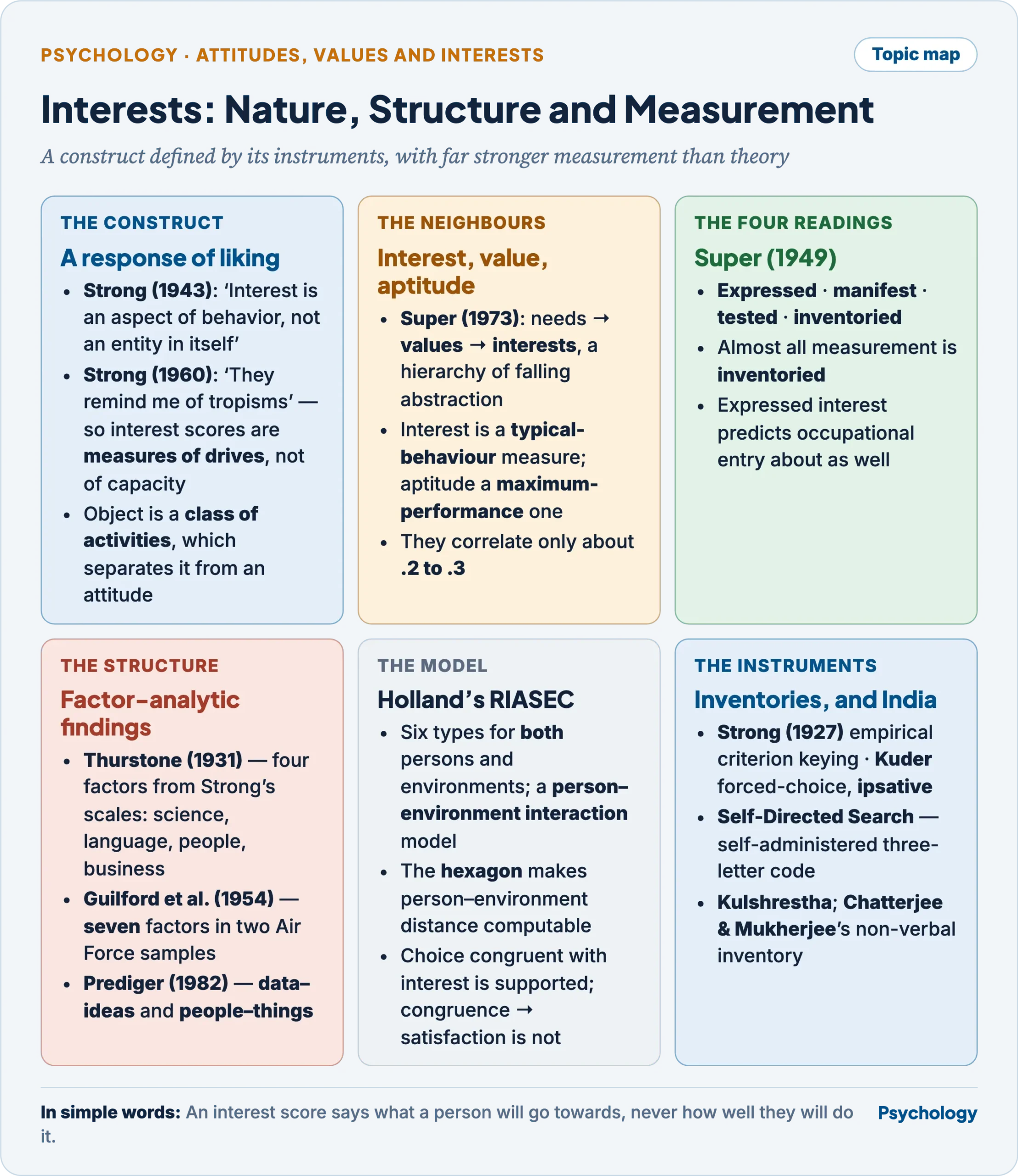
“Experimentally an interest is a response of liking…. Interest is an aspect of behavior, not an entity in itself.”
Strong (1943)
No conceptual definition of interest has ever been generally accepted in vocational psychology, with the consequence that interests are usually defined by what an instrument measures. The operational definitions converge on one thing — a pattern of likes and dislikes for classes of activities, occupations, settings and people — and the measurement literature is far stronger than the theory beneath it.
What an interest is
- Strong (1960) gave the construct its directional reading: interests are “activities that are liked or disliked…. They remind me of tropisms. We go toward liked activities, go away from disliked activities.” Interest scores are therefore measures of drives, not of capacity.
- The object of an interest is a class of activities, not a single entity. That separates it from an attitude, whose object may be any one person, group, policy or idea.
- Interests are learned, and so changeable. Strong’s insistence that interest is an aspect of behaviour rather than an entity is the reason: what experience builds, further experience can alter.
- Stability rises with age and is substantial by late adolescence. Low, Yoon, Roberts and Rounds (2005), over 66 longitudinal studies from age 12 to 40, found adjusted rank-order stability of about .55 to .58 across ages 12 to 18 and higher thereafter, with profile stability exceeding rank-order stability.
- Interests are widely read as personality expressed in work. Darley and Hagenah (1955) called vocational interest assessment “a special case in personality theory”, in which interests reflect “the value systems, the needs, and the motivations of individuals”. Holland (1973) concluded that if interests express personality, then “interest inventories are personality inventories”.
Interest, attitude, value, aptitude and ability
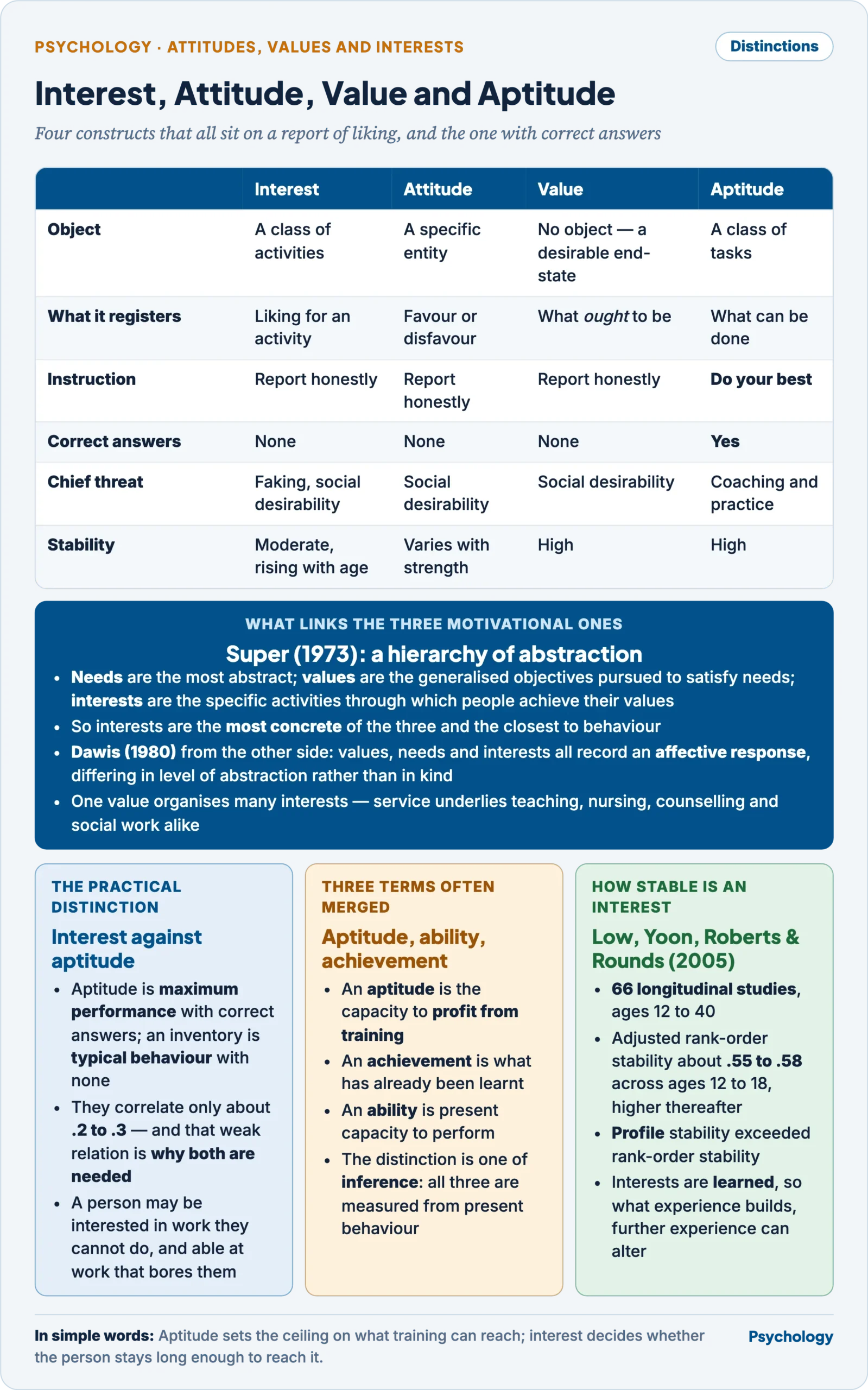
| Interest | Attitude | Value | Aptitude | |
|---|---|---|---|---|
| Object | A class of activities | A specific entity | No object — a desirable end-state | A class of tasks |
| What it registers | Liking for an activity | Favour or disfavour | What ought to be | What can be done |
| Instruction | Report honestly | Report honestly | Report honestly | Do your best |
| Correct answers | None | None | None | Yes |
| Abstractness | Moderate | Low | High | Low |
| Chief threat | Faking, social desirability | Social desirability | Social desirability | Coaching and practice |
| Stability | Moderate, rising with age | Varies with strength | High | High |
- Super (1973) supplies the link the three motivational constructs actually have, and it is a hierarchy of abstraction. Needs are the most abstract; values are the generalised objectives pursued in order to satisfy needs; interests are the specific activities through which people achieve their values and satisfy their needs.
- Interests are thus the most concrete of the three and the closest to behaviour. Dawis (1980) made the same point from the other side, holding that values, needs and interests all record an affective response and differ in level of abstraction rather than in kind.
- The practical consequence is that one value organises many interests. A value placed on service underlies interest in teaching, nursing, counselling and social work alike, which is why an interest profile is interpretable as evidence about values.
- Interest against attitude. An attitude supplies favour or disfavour towards a named object and need not imply engagement; an interest is a preference for doing something, and so predicts choice of activity directly. Attitudes are treated in the companion article.
- Interest against aptitude is the distinction that matters most in practice. An aptitude test is a maximum-performance measure with correct answers; an interest inventory is a typical-behaviour measure with none.
- They correlate only weakly, commonly around .2 to .3, and that weak relation is why both are needed: a person may be interested in work they cannot do, and able at work that bores them.
- Aptitude against ability and achievement. An aptitude is the capacity to profit from training; an achievement is what has already been learnt; an ability is present capacity to perform. The distinction is one of inference, since all three are measured from present behaviour.
Four operationalisations of interest
- Super (1949) sorted the ways interest is operationalised into four categories, and the division is still standard.
- Expressed interest — what a person states on introspection, without a list of options. Parsons (1909) simply asked respondents to write their interests down. It is subjective and depends heavily on how the question is phrased.
- Manifest interest — inferred from actual participation in an activity or occupation. Non-reactive, and confounded with opportunity: a child with no access to a laboratory shows no manifest interest in science.
- Tested interest — inferred from objective performance, usually knowledge of a field, on the reasoning that people accumulate information about what interests them. The least fakeable and the least used.
- Inventoried interest — the normative level of interest in a content area, from a standardised list of activities, subjects and occupations. Almost all measurement is of this kind.
- The four do not agree closely. Expressed interest predicts eventual occupational entry about as well as an inventory does, so the case for inventories rests on breadth and reliability, not superior prediction.
The factor-analytic structure of interests
- Thurstone (1931) developed multiple factor analysis and used Strong’s correlations as its first demonstration. Analysing eighteen of Strong’s occupational scales, he found the table accounted for by four general interest factors — science, language, people and business.
- Strong (1943) repeated the analysis on larger sets of occupational scales and reported the same four factors recurring, classifying occupations as Thurstone’s smaller analysis had.
- Guilford, Christensen, Bond and Sutton (1954) ran the most comprehensive study of the period, building about a hundred ten-item scales across thirty-three content areas and administering them to two large Air Force samples.
- They recovered seven interest factors — mechanical, scientific, social welfare, aesthetic expression, clerical, business and outdoor work — and concluded that vocational interest factors are genuine psychological entities. Holland (1997) later acknowledged this study as the empirical support for his six types.
- Roe (1956) proposed a two-dimensional scheme rather than a factor list: eight interest groups — service, business contact, organisation, technology, outdoor, science, general cultural, arts and entertainment — crossed with six levels of responsibility. Attempts to confirm the theory failed; the structural description proved durable.
- The number of factors depends on the level of analysis, which is the standing caution against quoting any single count. Analyses of scale scores typically yield four to eleven factors; analyses at item level yield fourteen to eighteen.
- Prediger (1982) reduced the structure to a general factor plus two bipolar dimensions, data–ideas and people–things, arguing these underlie Holland’s hexagon. The general interest factor took about 40 per cent of the variance, more than the two bipolar dimensions together.
- Tracey and Rounds (1993), in a structural meta-analysis of 77 RIASEC matrices, supported the hypothesised circular ordering of the six types in United States samples.
- Rounds and Tracey (1996), extending this across 18 countries, found that data from American minority and international groups fitted the circular model less well — the central limit on the model’s claim to universality.
- Su, Rounds and Armstrong (2009) pooled 47 inventories and 503,188 respondents, finding large sex differences on the people–things dimension (d = 0.93), men preferring things; Realistic d = 0.84 and engineering d = 1.11 favoured men, Social d = −0.68 and Artistic d = −0.35 favoured women. Mean effects varied by inventory from 0.08 to 0.79.
- The structure of values has been mapped by a parallel factorial and circumplex literature, treated in the companion article on values.
Holland’s RIASEC model
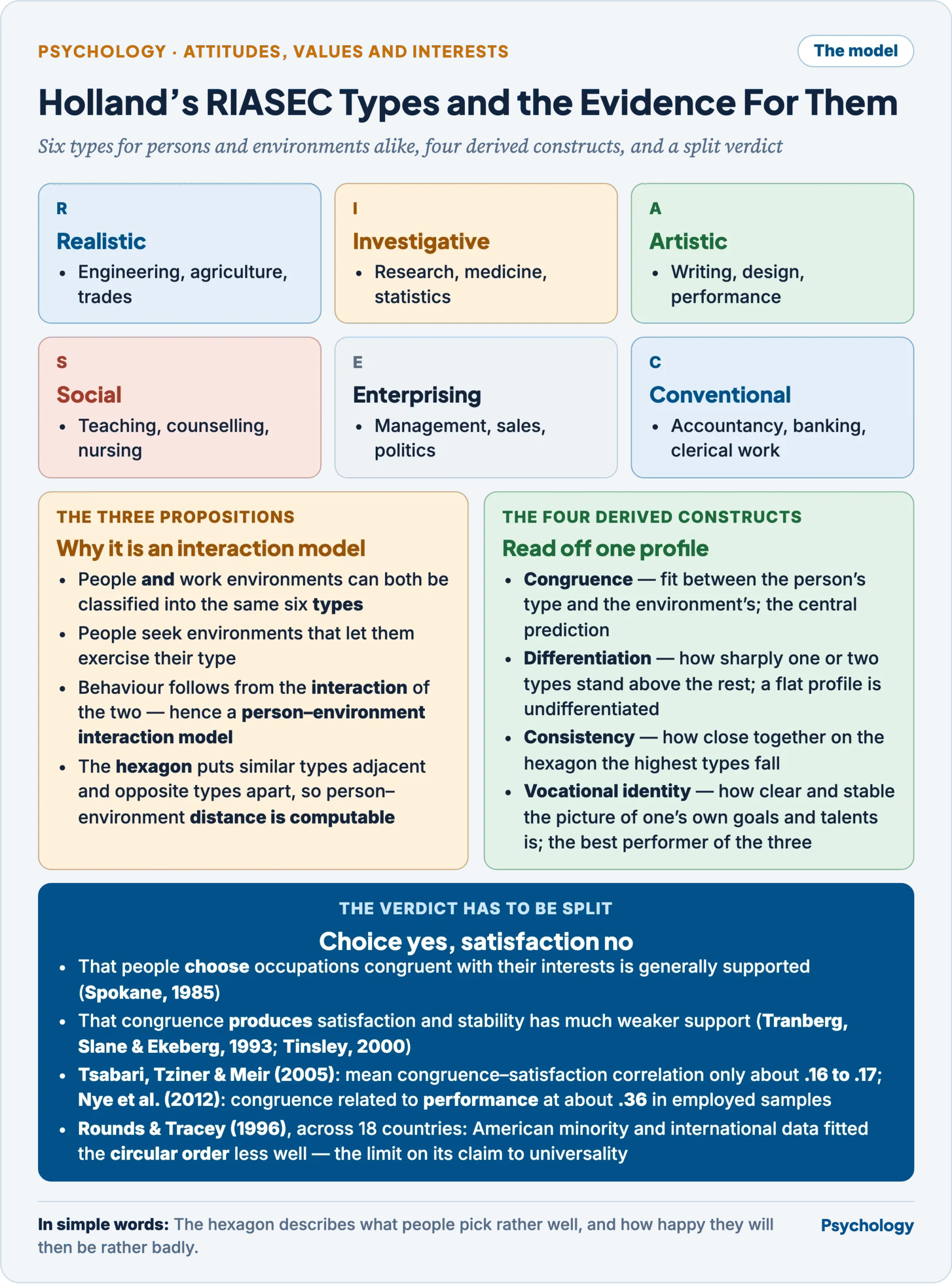
- Holland’s typology is the modern form of the trait-and-factor approach, resting on three propositions: people and work environments can both be classified into types; people seek environments that let them exercise their type; and behaviour follows from the interaction of the two. It is accordingly called a person–environment interaction model.
- Six types describe both persons and environments — Realistic (engineering, agriculture, trades), Investigative (research, medicine, statistics), Artistic (writing, design, performance), Social (teaching, counselling, nursing), Enterprising (management, sales, politics) and Conventional (accountancy, banking, clerical work).
- The hexagon arranges the six so adjacent types are most similar and opposite types least similar, which turns the typology into a measurement model: the distance between a person’s code and an environment’s is computable.
- Four further constructs are built on the profile.
- Congruence — the fit between a person’s type and the environment’s. The central prediction.
- Differentiation — how sharply one or two types stand above the rest; a flat profile is undifferentiated.
- Consistency — how close together on the hexagon a person’s highest types fall.
- Vocational identity — how clear and stable the person’s picture of their own goals and talents is.
- The evidence has to be split. Holland’s main proposition, that people choose occupations congruent with their interests, is generally supported (Spokane, 1985). His further claim that congruence produces satisfaction and stability has found much weaker support (Tranberg, Slane and Ekeberg, 1993; Tinsley, 2000).
- Tsabari, Tziner and Meir (2005) found a mean congruence–satisfaction correlation of only about .16 to .17. Nye and colleagues (2012) found congruence related to performance at about .36 in employed samples, appreciably better than the satisfaction result.
- Support for differentiation, consistency and vocational identity is mixed, with identity performing best as a direct index of readiness to choose.
- Holland’s largest practical contribution was instrumentation rather than theory. The Self-Directed Search, the Vocational Preference Inventory, My Vocational Situation and the Vocational Exploration and Insight Kit turned the typology into devices a counsellor could use.
Measuring interests: the inventories
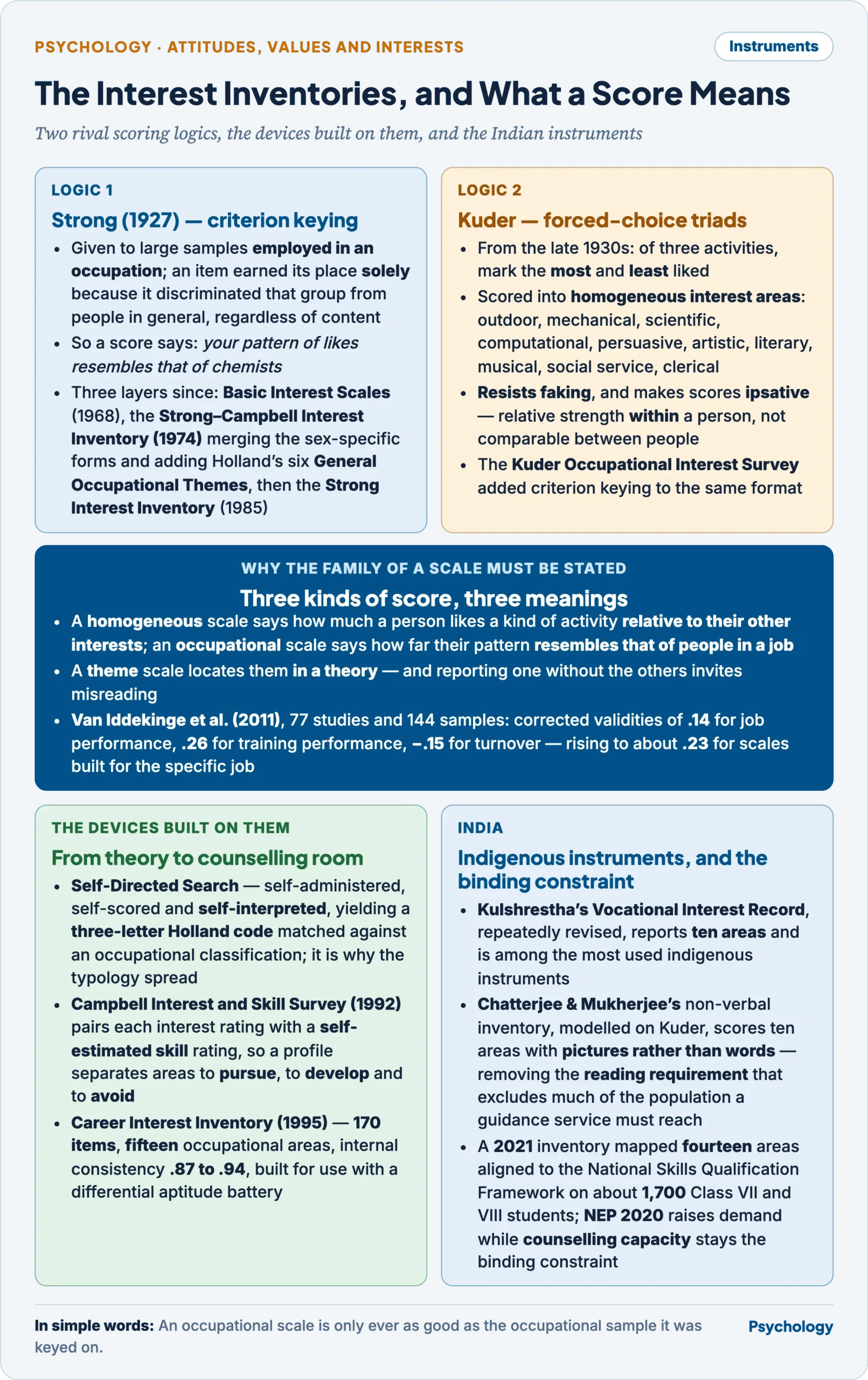
- Strong’s Vocational Interest Blank (1927) established empirical criterion keying. Given to large samples employed in an occupation, an item earned a place on that occupation’s scale solely because it discriminated the group from people in general, regardless of content. A score says: your pattern of likes resembles that of chemists.
- The instrument accumulated three layers, and most modern inventories report all three. Basic Interest Scales — homogeneous content scales such as art, science and public speaking — were added in the 1968 revision. The Strong–Campbell Interest Inventory (1974) merged the separate men’s and women’s forms and added Holland’s six General Occupational Themes. It became the Strong Interest Inventory in 1985.
- Kuder’s Preference Record, from the late 1930s, took the opposite approach. Items are forced-choice triads — of three activities, mark the most and least liked — scored into homogeneous interest areas: outdoor, mechanical, scientific, computational, persuasive, artistic, literary, musical, social service and clerical.
- The forced-choice format resists faking and makes scores ipsative: they report the relative strength of a person’s interests within that person, and cannot properly be compared between people. The Kuder Occupational Interest Survey added criterion keying to the same format, scoring about a hundred triads against occupational groups.
- The Self-Directed Search is self-administered, self-scored and self-interpreted, and yields a three-letter Holland code that the user matches against an occupational classification. It is the reason the typology spread.
- The Campbell Interest and Skill Survey (1992) pairs each interest rating with a self-estimated skill rating, so a profile distinguishes areas to pursue, to develop and to avoid — a design response to the weak interest–ability relation.
- The Career Interest Inventory (1995) is a 170-item instrument reporting interest in fifteen occupational areas on a five-point liking scale. Internal consistency across the fifteen groups runs from .87 to .94, content validity is anchored to a published dictionary of occupational titles, and it is designed for use with a differential aptitude battery.
- The families differ in what a score means. A homogeneous scale says how much a person likes a kind of activity relative to their other interests; an occupational scale says how far their pattern resembles that of people in a job; a theme scale locates them in a theory. Reporting one without the others invites misreading.
The measurement of aptitude
- An aptitude is the capacity to profit from training in an occupation or skill, measured under maximum-performance instructions. Aptitude testing divides into two kinds of instrument.
- Multi-aptitude batteries test several abilities together and report a profile — the Differential Aptitude Tests of Bennett, Seashore and Wesman, the General Aptitude Test Battery, and scholastic aptitude tests used for admission.
- Component ability tests measure one ability: mechanical comprehension, spatial relations, clerical speed and accuracy, artistic judgement, musical aptitude, psychomotor dexterity assessed with apparatus.
- The differential claim that justifies a battery — that tailored composites outpredict a single general measure — has repeatedly proved weak, and profile peaks within the standard error are routinely over-read. The evidence, and the case against using such profiles to stream school children, is in the article on aptitude and its measurement.
- Both are needed because they correlate weakly: aptitude sets the ceiling on what training can achieve, interest predicts whether the person will persist long enough to reach it. Guidance consulting only one is predictably wrong in one of two ways.
Interests in career guidance
- The use of interests in guidance begins with the trait-and-factor approach of Parsons (1909) and Williamson, which assumes an ideal match exists between a person’s traits and an occupation’s requirements, and treats career choice as rational problem-solving on collected information. Holland’s typology is its modern form.
- Interests are one input among several. Competent practice reads a profile alongside aptitude, attainment, personality, the person’s own account and actual opportunity. A score widens the range of occupations considered rather than issuing a verdict, and the client helps interpret their own profile.
- Social Cognitive Career Theory — Lent, Brown and Hackett (1994) — identifies a mechanism pure matching misses: interests are regulated by self-efficacy and outcome expectations, so a person who believes they cannot succeed in a field reports no interest in it. A measured absence of interest may record a belief about ability rather than a preference, which matters most for girls in technical fields and for first-generation entrants.
- The predictive validity evidence is modest and should be stated plainly. Van Iddekinge, Roth, Putka and Lanivich (2011), over 77 studies and 144 samples, found corrected validities for single interest scales of .14 for job performance, .26 for training performance and −.15 for actual turnover.
- Their one encouraging moderator is that scales built for the specific job did better — about .23 for job performance — so interests predict where they are matched to the work. Congruence outpredicts raw interest, and interests predict persistence and satisfaction better than proficiency.
Interest inventories in India
- Kulshrestha’s Vocational Interest Record, long in print and repeatedly revised, reports interest across ten areas and is among the most used indigenous instruments in Indian schools and guidance centres.
- Chatterjee and Mukherjee’s non-verbal interest inventory, modelled on the Kuder preference record for Indian conditions, scores ten interest areas using pictures rather than words. Its significance is that it removes the reading requirement, which a verbal inventory cannot do and which excludes a large part of the population a guidance service needs to reach.
- An inventory published in 2021 for the elementary stage mapped interest across fourteen vocational areas aligned to the National Skills Qualification Framework, trialling it on about 1,700 students of Classes VII and VIII in four states — attaching interest assessment to the vocational courses actually on offer.
- Most Indian practice still relies on adapted Western instruments whose occupational scales were keyed on other labour markets, and whose norms were rarely re-established on representative Indian samples. An occupational scale is only as good as the occupational sample behind it.
- The National Education Policy, 2020 (Ministry of Education) removes rigid separation of academic and vocational streams, provides flexible subject choice, and introduces vocational exposure from the middle stage. It raises demand for interest assessment while the binding constraint remains counselling capacity, since a profile interpreted without trained judgement becomes a verdict.
Criticisms and limitations
- The construct has no agreed conceptual definition, so interests are defined by what inventories measure. The measurement tradition is far more developed than the theory, and definitional work was largely displaced by instrument-building.
- Inventories measure self-concept as much as interest. They ask what a person likes, and the answer is filtered through what they believe about themselves and what they think is available to them.
- They are open to faking wherever the result affects something the respondent wants, as in selection or admission, since there are no correct answers and the desirable pattern is usually obvious.
- Ipsative scores are not interpersonally comparable. A forced-choice format buys resistance to faking at the cost of scores that describe a person’s internal ordering and cannot be ranked across people.
- Criterion-keyed occupational scales inherit their criterion groups, so a scale is tied to the labour market and occupational samples of the period in which it was keyed, and dates as those change.
- The circular order of RIASEC fits Western samples better than others, as Rounds and Tracey (1996) showed, which limits the model’s claim to be a universal structure of interests.
- Prediction of performance is weak, as Van Iddekinge and colleagues (2011) established. Interests predict persistence, choice and satisfaction better than proficiency, so an interest score should not be used to forecast how well someone will do the work.
- Large sex differences on the things–people dimension, as Su, Rounds and Armstrong (2009) found, mean that an inventory faithfully reflecting existing preferences will also reproduce existing occupational segregation. Whether such differences are to be reflected or counteracted is a decision the instrument cannot make.
- In India the binding constraint is often opportunity rather than interest. Where stream and institution follow from one aggregate score, from family expectation and from what is reachable within means, a congruent recommendation may be unactionable.
- What survives is considerable. Interests are among the most reliably measurable and most stable individual differences, with stability already substantial by mid-adolescence; the six-type structure replicates well where it was developed; Super’s abstraction hierarchy gives a defensible account of how interests, values and needs relate; and inventories do reliably what guidance most needs, which is to widen the set of options a person will consider.
Previous Year Questions
- 2007Distinguish between aptitude and interest and describe methods of their measurement.
- 2006Trace the common linkages between interests and values. Describe the factor analytical studies of the structure of interests and values. Also delineate upon those strategies that ought to be adopted for fostering values in the Indian socio-cultural milieu.