

Official syllabusPaper I · Unit 12 · Attitudes, Values and Interests
Theories of attitude change.
Definition
“Two elements are in a dissonant relation if, considering these two alone, the obverse of one element would follow from the other.”
Festinger (1957)
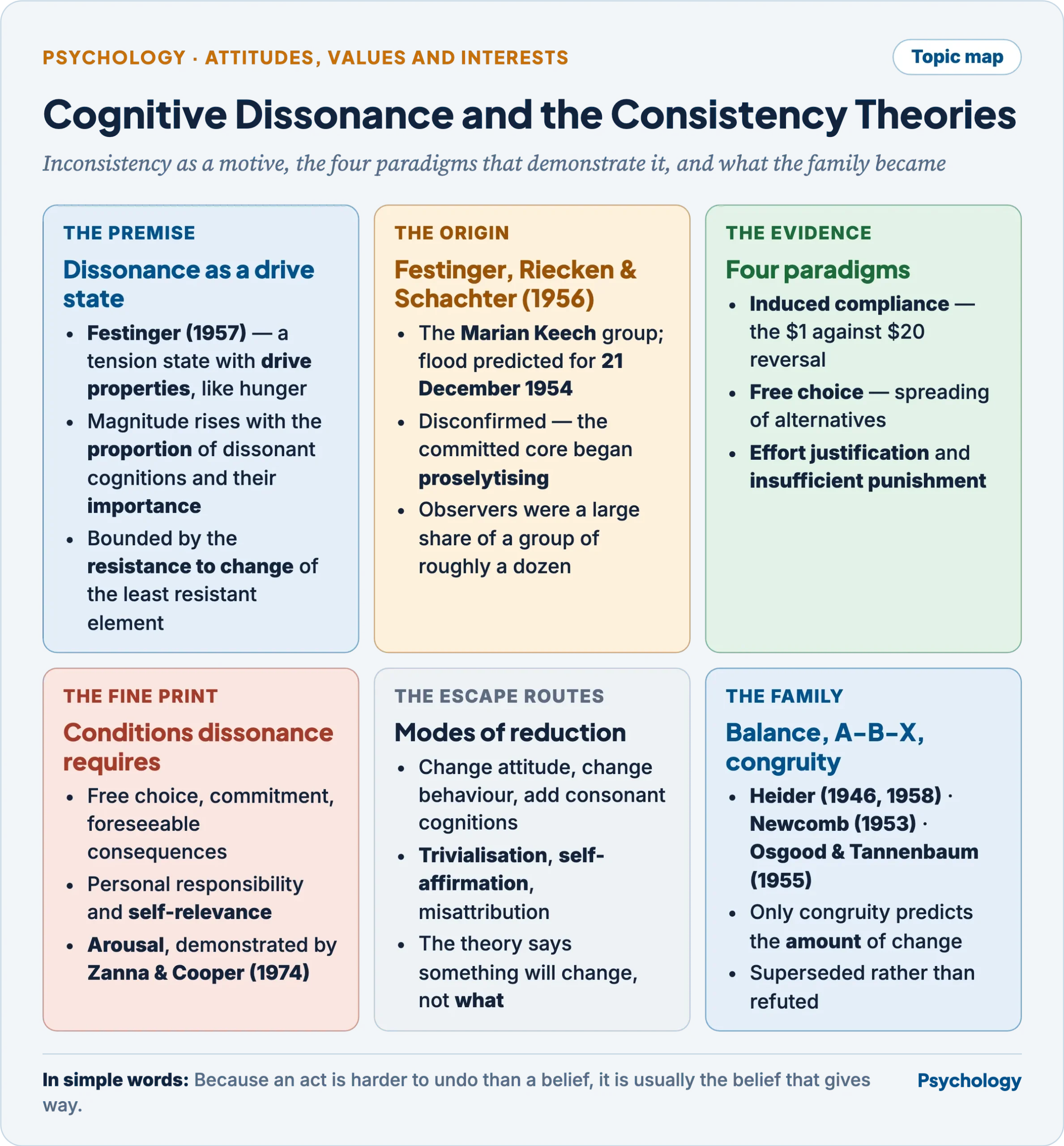
Dissonance on his account is a motivating factor in its own right: an antecedent condition that drives activity towards its own reduction, “just as hunger leads to activity oriented toward hunger reduction.”
The consistency theories share one premise: inconsistency among a person’s cognitions is aversive, and the pressure to remove it is a motive. Dissonance theory draws the most counter-intuitive conclusion from it — because behaviour is usually harder to undo than belief, it is the attitude that gives way. Changing what a person does becomes a way of changing what they think, which reverses the direction every reinforcement account assumes.
The theory: dissonance as a drive state
- A cognition is any item of knowledge, belief or opinion about oneself, one’s behaviour or the environment. Any two stand in one of three relations: consonant, dissonant or irrelevant.
- Magnitude of dissonance rises with the proportion of relevant cognitions that are dissonant and with the importance of the elements. A trivial inconsistency about a trivial matter generates almost nothing.
- Dissonance is a tension state with drive properties — unpleasant, graded, motivating — so the theory predicts behaviour rather than naming a logical defect.
- Total dissonance is bounded by the resistance to change of the least resistant element. Once the cheapest cognition is altered the pressure is spent, which is why the theory predicts change but not its target.
- Smoking against health knowledge, and caste practice held alongside a professed belief in equality, are both dissonant structures. The theory’s reach is its appeal and its problem.
The field study that produced the theory
- Festinger, Riecken and Schachter (1956) observed a small Chicago group gathered around a woman given the pseudonym Marian Keech, who produced messages by automatic writing from beings she placed on the planet Clarion.
- The message predicted a flood destroying the city and much of the continent before dawn on 21 December 1954, with believers lifted off beforehand by flying saucer.
- Members had given up jobs and possessions. Nothing happened; a fresh message declared that the group’s faith had spread enough light to spare the world.
- The committed core did not abandon the belief — it began proselytising, seeking the press coverage it had previously shunned, while peripheral members quietly fell away.
- Festinger drew out five conditions under which disconfirmation increases rather than destroys conviction: deep conviction; irrevocable commitment; a belief specific enough to be disconfirmed; disconfirmation unmistakable and recognised as such; and social support from fellow believers.
- The study’s standing is weaker than its fame.
- The observers were a substantial fraction of a group of roughly a dozen, and so shaped what they recorded.
- Archival work has alleged that proselytising before the date was understated and activity after it overstated. The study motivates the theory; it does not test it.
Induced compliance and insufficient justification
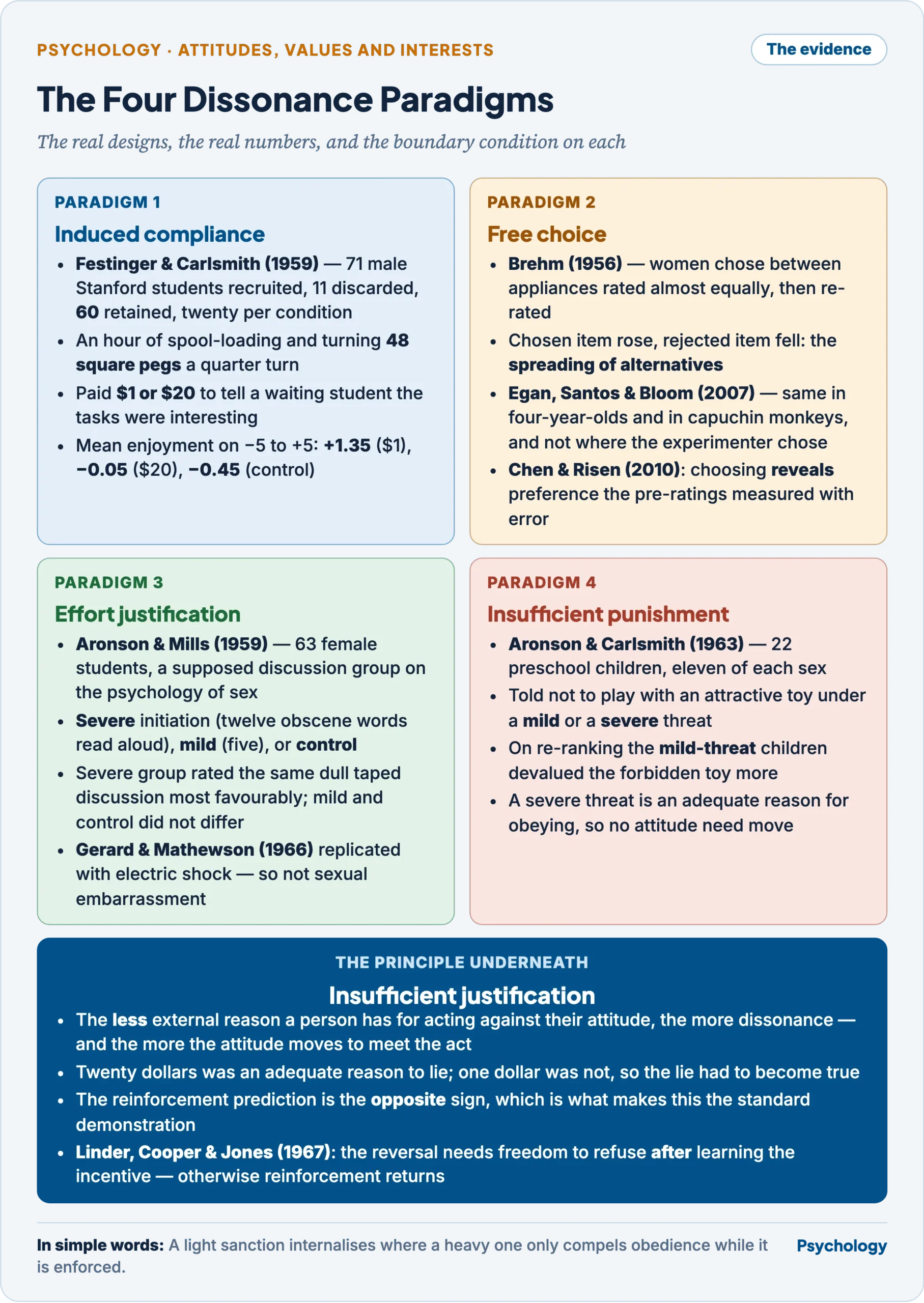
- Festinger and Carlsmith (1959) established the induced-compliance paradigm. Of 71 male Stanford students recruited, 11 were discarded on pre-set criteria, leaving 60, twenty per condition.
- Each spent an hour on two tedious tasks: loading twelve spools onto a tray and emptying it repeatedly, then turning 48 square pegs a quarter turn clockwise.
- They were then paid either $1 or $20 to tell a waiting student the tasks had been interesting. A control group did the tasks and said nothing.
- On a scale from -5 to +5, mean rated enjoyment was +1.35 in the $1 condition, -0.05 in the $20 condition and -0.45 in the control. The $20 group did not differ reliably from the control.
- The reinforcement prediction is the opposite: the larger payment should have produced the larger liking. Getting the sign of the effect wrong is what makes this the standard demonstration that behaviour can drive attitude.
- Insufficient justification is the principle: the less external reason a person has for acting against their attitude, the more dissonance, and so the more the attitude moves to meet the act.
- Twenty dollars was an adequate reason to lie; one dollar was not, so the lie had to become true.
- Linder, Cooper and Jones (1967) located the boundary. The inverse incentive effect appears only where the participant is still free to refuse after learning the incentive.
- Where commitment precedes the announcement of payment, the ordinary reinforcement effect returns and the larger reward produces the larger change.
Free choice and post-decision dissonance
- Brehm (1956) ran the first study in the free-choice paradigm. Women rated household appliances for desirability, chose between two they had rated almost equally, then re-rated everything.
- The chosen item rose in rating and the rejected item fell — the spreading of alternatives.
- The mechanism is structural. Every decision leaves the attractive features of what was given up and the defects of what was taken, so the dissonance is post-decisional.
- Egan, Santos and Bloom (2007) found the same spreading in four-year-olds choosing between equally liked stickers and in capuchin monkeys choosing between sweets — and not where the experimenter chose for them.
- Chen and Risen (2010) raised the sharpest methodological objection in the field.
- Choosing reveals preference information that the pre-ratings measured only with error, so the standard procedure can produce apparent spreading with no change in true preference.
- The mathematics has since been contested, and the design re-run with the control the critique demands, the effect surviving in reduced form.
Effort justification
- Aronson and Mills (1959) — 63 female college students volunteered for what they took to be a discussion group on the psychology of sex, and were assigned to one of three initiations.
- Severe: reading aloud twelve obscene words and vivid sexual passages from novels to a male experimenter. Mild: five mildly sexual words. Control: no initiation.
- All then heard the same dull taped discussion of the group they expected to join, and rated the discussion and its members on evaluative scales.
- The severe-initiation group rated the group most favourably; mild and control did not differ. Effort justification resolves the dissonance between a costly effort and a worthless reward by upgrading the reward.
- Gerard and Mathewson (1966) replicated the result using electric shock as the initiation, which removes the possibility that sexual embarrassment rather than effort was doing the work.
- The principle generalises to hazing, long training and fees charged for therapy, all of which raise the valuation of what they gate and make an organisation harder to criticise from inside.
- An alternative reading survives. A dull discussion may seem better by contrast with a harsher preceding experience, and surveys of real initiations do not consistently find that severity increases liking.
Insufficient punishment: the forbidden toy
- Aronson and Carlsmith (1963) tested 22 preschool children, eleven of each sex. Each ranked a set of toys, was told not to play with one ranked as attractive, and was left alone with the toys.
- Half received a mild threat of the experimenter’s displeasure; half a severe threat that all the toys would be removed.
- On re-ranking, the mild-threat children devalued the forbidden toy more.
- Insufficient punishment mirrors insufficient justification. A severe threat supplies an adequate reason for not playing, so no attitude need change; a mild threat does not, so the child concludes the toy was never desirable.
- The applied consequence runs against intuition. A sanction heavy enough to compel obedience produces compliance only while it is enforced; the lightest sanction sufficient to secure obedience produces internalised change.
The conditions dissonance requires
- Free choice. Counter-attitudinal behaviour arouses dissonance only when volitional. Coerced action is fully explained by the coercion.
- Commitment. The act must be done and difficult to retract. A decision still open generates no post-decision dissonance.
- Foreseeable consequences. The unwanted outcome must have been anticipable at the time of acting; an unforeseeable one is attributed to circumstance.
- Personal responsibility. Responsibility must be accepted rather than diffused onto the experimenter, the institution or the group.
- Self-relevance. The inconsistency must implicate something the person values. A discrepancy touching nothing central produces discomfort and no change.
- Arousal, demonstrated rather than assumed. Zanna and Cooper (1974) gave 77 male students an inert pill described as making them tense, as relaxing them, or as having no side effects, before a high- or low-choice counter-attitudinal essay.
- With no stated side effects the usual pattern appeared, high choice producing more attitude change than low choice.
- Where the arousal could be attributed to the pill the effect was eliminated; where participants expected to feel relaxed it was enhanced.
- This is the decisive evidence that dissonance is a real state of arousal, and what a purely cognitive reinterpretation cannot accommodate.
Modes of dissonance reduction
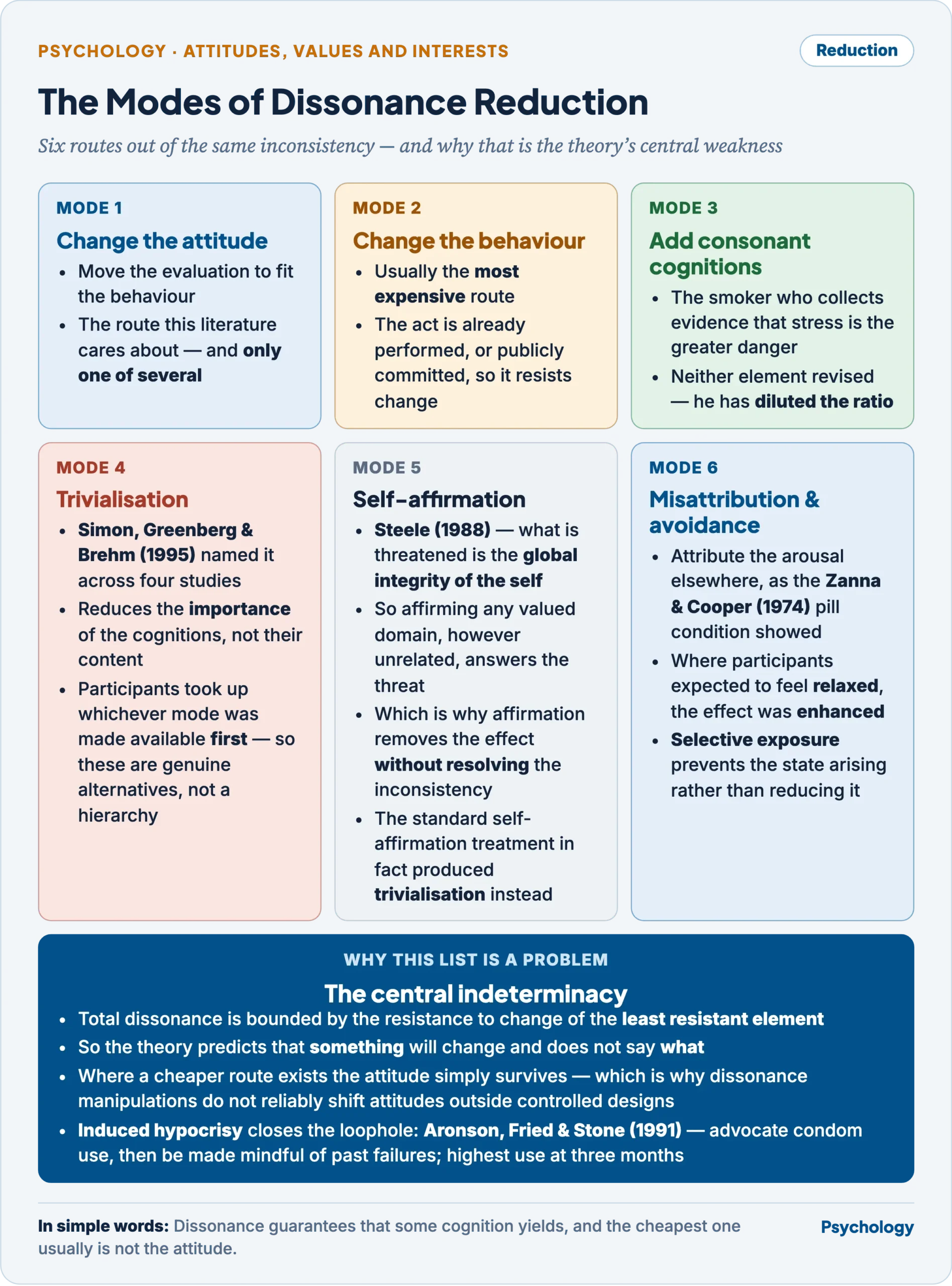
- Change the attitude to fit the behaviour — the route this literature cares about, and only one of several available.
- Change the behaviour to fit the attitude. Usually the most expensive, the act being already performed or publicly committed.
- Add consonant cognitions. The smoker who collects evidence that stress is the greater danger has revised neither element; he has diluted the ratio.
- Trivialisation — reducing the importance of the dissonant cognitions rather than their content, so the same inconsistency weighs less. Simon, Greenberg and Brehm (1995) named and demonstrated it across four studies.
- After counter-attitudinal behaviour, participants took up whichever mode was made available first, trivialisation or attitude change, which establishes the two as genuine alternatives rather than a hierarchy.
- The standard self-affirmation treatment, long read as reducing dissonance directly, produced trivialisation instead.
- Making a genuinely important issue salient supplied a trivialising frame, and produced trivialisation with no opportunity for self-affirmation at all.
- Self-affirmation in an unrelated domain, restoring the self’s overall worth without touching the inconsistency.
- Misattribution of the arousal to another cause, as the pill condition showed, and selective exposure, which prevents the state arising rather than reducing it.
- The theoretical cost is the same for all of them. Dissonance predicts that something will change and does not say what; where a cheaper route exists, the attitude survives. This is why dissonance manipulations do not reliably shift attitudes outside controlled designs.
Dissonance as a deliberate instrument of change
- Induced hypocrisy is the most usable version. Aronson, Fried and Stone (1991) had sexually active undergraduates record a persuasive speech advocating condom use for a school audience, then made them mindful of their own past failures to use them.
- The hypocrisy condition reported the highest condom use at a three-month follow-up, and a replication with a behavioural measure found more of these participants actually bought condoms.
- The design avoids the standing objection to induced compliance. The person advocates what they already believe, so nothing counter-attitudinal is demanded; the dissonance lies between the advocacy and their own conduct, and the cheapest resolution is to amend the conduct.
- That makes dissonance a technology. It applies to sanitation, immunisation, helmet use and water conservation, where almost everyone endorses the attitude and fails to act on it.
The revisions that reinterpreted the theory
- Bem (1967) mounted the fundamental challenge with self-perception theory: a person lacking a clear internal signal infers the attitude from their own behaviour and its circumstances, exactly as an outside observer would.
- On this account the dollar result needs no drive and no discomfort. The participant had no external cause to point to, and read himself off his own conduct.
- The two were separated on two grounds. Zanna and Cooper showed arousal to be necessary, which self-perception does not predict.
- Fazio, Zanna and Cooper (1977) then divided the territory: self-perception for change following attitude-congruent behaviour, inside the latitude of acceptance, and dissonance for change following attitude-discrepant behaviour outside it.
- Cooper and Fazio (1984) — the new look. Dissonance arises not from inconsistency as such but from feeling personally responsible for a foreseeable aversive consequence.
- They also split dissonance arousal from dissonance motivation, since the arousal must be attributed to the discrepancy before it motivates. Later work from the same laboratory found aversive consequences sufficient but not necessary.
- Steele (1988) — self-affirmation theory. What is threatened is the global integrity of the self, not a local consistency, so the threat can be answered by affirming any valued domain however unrelated. This explains why affirmation removes dissonance effects without resolving the inconsistency.
- Aronson (1968, 1992) — self-consistency. Dissonance arises where behaviour is discrepant with a self-concept of being decent and competent, which is why the paradigms all involve lying, cruelty or folly rather than neutral inconsistency.
- The two self-based accounts make opposite predictions about self-esteem: self-consistency implies high-esteem people feel more dissonance, having more to contradict; self-affirmation implies they feel less, having more resources to affirm.
- Stone and Cooper (2001) reconciled them in a self-standards model: which process runs depends on whether the context makes a personal or a normative standard salient.
The other consistency theories of attitude change
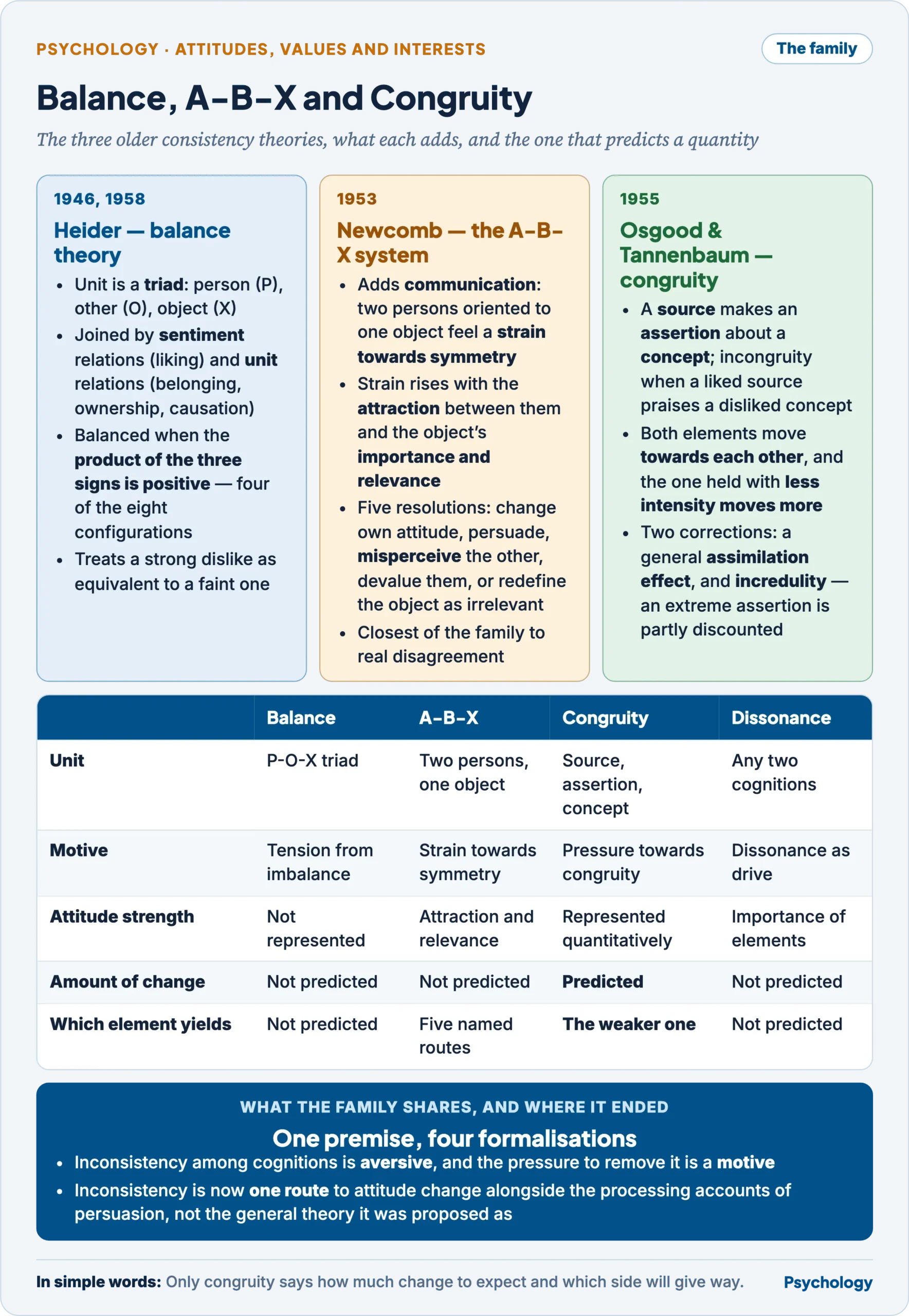
- Heider (1946, 1958) — balance theory, the earliest of the family. The unit is a triad of the person (P), another person (O) and an attitude object (X), joined by sentiment relations of liking and unit relations of belonging, ownership or causation.
- A triad is balanced when the product of the three signs is positive — all three positive, or one positive and two negative. Four of the eight configurations are balanced.
- Imbalance produces tension, and resolution follows the path of least resistance: change the attitude to X, change the attitude to O, or sever the relation.
- Its limits are definite. It specifies neither the magnitude of the pressure nor which relation yields, and treats a strong dislike as equivalent to a faint one.
- Newcomb (1953) — the A-B-X system, which converts the problem from intrapersonal to interpersonal by adding communication. Two persons oriented to the same object experience a strain towards symmetry.
- The strain increases with the attraction between the two persons and with the object’s importance and relevance to both. Where either is low, disagreement is tolerated.
- Resolution takes five forms: change one’s own attitude, persuade the other, misperceive the other as closer than they are, devalue the other, or redefine the object as irrelevant.
- It is the consistency theory closest to real disagreement: it predicts when people argue, when they misread each other, and when they drop the subject.
- Osgood and Tannenbaum (1955) — the congruity principle, a special case carrying the quantitative claim the others lack. A source towards which the person holds an evaluation makes an assertion about a concept towards which they hold another.
- Incongruity exists when a liked source praises a disliked concept, or a disliked source praises a liked one.
- It predicts both direction and amount: both elements move towards each other, and the element held with less intensity moves more, in inverse proportion to the two strengths.
- It also adds two corrections: a general assimilation effect, and incredulity, by which an extreme assertion is partly discounted rather than absorbed.
| Balance | A-B-X | Congruity | Dissonance | |
|---|---|---|---|---|
| Unit | P-O-X triad | Two persons, one object | Source, assertion, concept | Any two cognitions |
| Motive | Tension from imbalance | Strain towards symmetry | Pressure towards congruity | Dissonance as drive |
| Attitude strength | Not represented | Attraction and relevance | Represented quantitatively | Importance of elements |
| Predicts amount of change | No | No | Yes | No |
| Predicts which element changes | No | Five named routes | Yes — the weaker | No |
Cross-cultural evidence on when dissonance arises
- Heine and Lehman (1997) compared Canadian and Japanese participants on the free-choice paradigm. Canadians showed the standard spreading of alternatives; Japanese participants did not, and the self-esteem account offered for the Western pattern did not transfer.
- Kitayama, Snibbe, Markus and Suzuki (2004) located the missing condition. Japanese participants justified their choices only when self-relevant others had been primed — for instance by being asked first to think about the average student at their own university.
- Hoshino-Browne, Zanna, Spencer and Zanna (2005) completed the picture. Dissonance appeared in European-heritage participants choosing for themselves, and in East Asian participants choosing for a close friend.
- The reading is not that dissonance is absent outside the West. What varies is the standard whose violation threatens the self: a personal one where the self is construed as independent, a relational one where it is interdependent.
- The implication for Indian material is direct. Where attitudes to caste, community and gender are group positions rather than private evaluations, an appeal to a private inconsistency finds nothing to work on, while conduct that embarrasses the family produces acute dissonance.
Criticisms and limitations
- The central indeterminacy. The theory predicts that the least resistant element will change without specifying which that is, so almost any outcome can be accommodated after the fact. Trivialisation and self-affirmation enlarged the permitted set further.
- Dissonance is rarely measured directly. It is inferred from the attitude change it is meant to cause, which is circular, and the arousal evidence rests on a small set of misattribution designs.
- The free-choice paradigm carries a statistical confound that can manufacture the effect, and induced compliance has proved difficult to replicate cleanly in recent attempts, with effects smaller than the figures usually quoted.
- Alternative explanations survive for each paradigm — self-perception for induced compliance, contrast for effort justification, impression management wherever the attitude is reported to the experimenter who caused the behaviour.
- The enabling conditions are so numerous that they narrow the theory’s reach. Choice, commitment, foreseeability, responsibility and self-relevance must all hold, and most everyday inconsistency fails at least one.
- The ethical cost is real. Every paradigm requires deception, and the forbidden-toy and initiation designs would not now pass review as run.
- What survives is substantial.
- The reversed incentive effect is robust and still counter-intuitive, and arousal has been demonstrated rather than assumed.
- The enabling conditions are mapped well enough to be engineered, and induced hypocrisy closes the gap between an endorsed attitude and actual conduct.
- That mild sanctions internalise where severe ones only compel is among the field’s most useful results.
- The consistency family has been superseded rather than refuted. Inconsistency as a motive is now one route to attitude change alongside the processing accounts of persuasion, not the general theory it was proposed as.
Previous Year Questions
- 2024Is cognitive dissonance effective in changing attitude? Discuss in the light of research evidence.
- 2018In what way can dissonance be an effective means for changing attitudes and behaviour?
- 2017A young person helped a visually impaired woman to cross the road. He explained his action saying that he has positive attitude towards such persons. Did his attitude determine his behaviour or the behaviour determine his attitude. Explain.
- 2016Discuss cognitive dissonance theory of attitude change.
- 2010What is likely to happen if a person is asked to behave in a manner contrary to the attitude the person holds? Explain on the basis of a theory.
- 2005Citing experimental studies, discuss cognitive-dissonance theory of attitude change.
- 2001Citing experimental evidences discuss how social learning, social comparison and genetic factors influence formation of attitudes. Also explain how trivialisation reduces cognitive dissonance.