

Official syllabusPaper I · Unit 12 · Attitudes, Values and Interests
Theories of attitude change.
Definition
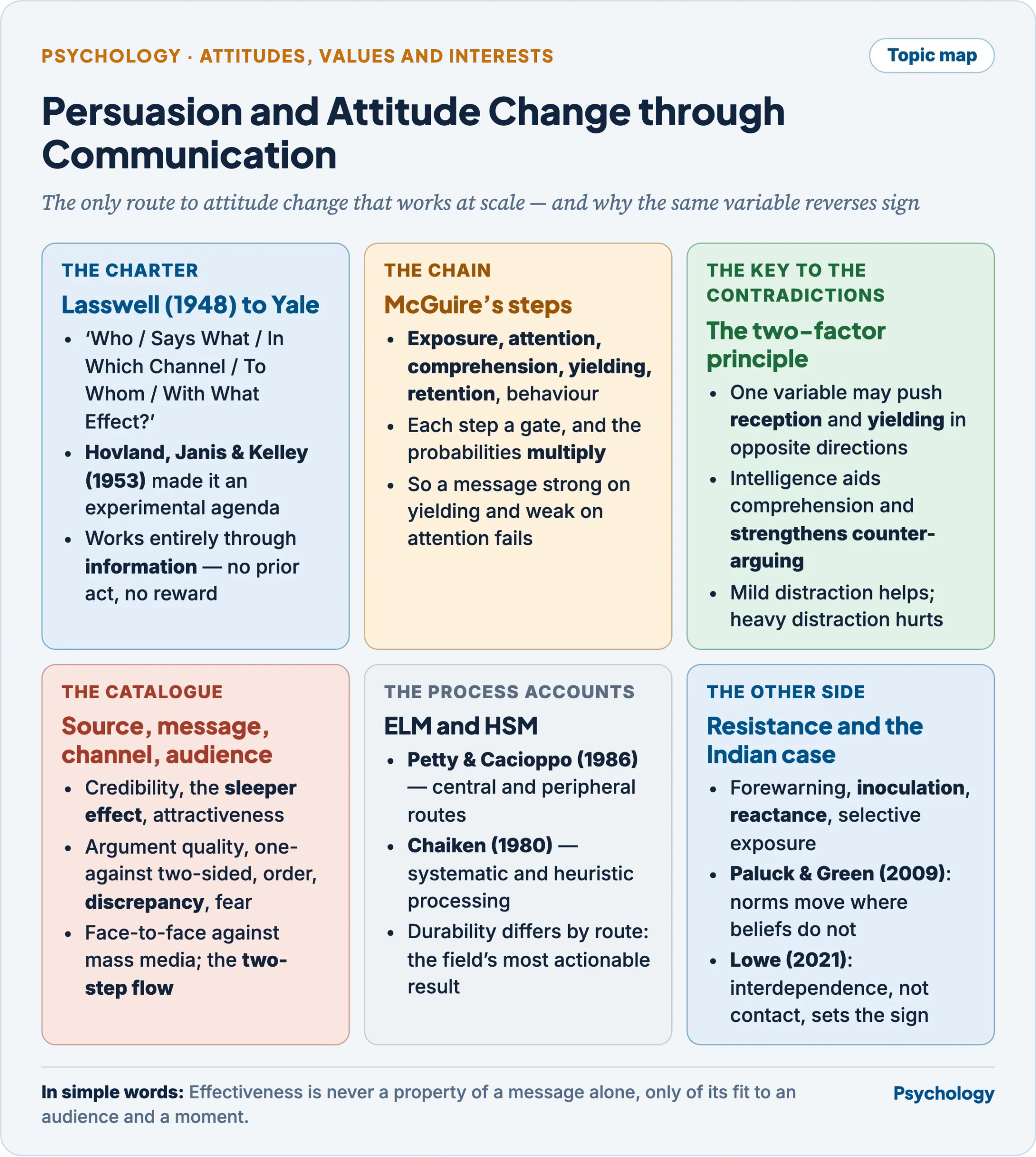
“Who / Says What / In Which Channel / To Whom / With What Effect?”
Lasswell (1948)
The Yale programme on communication and persuasion (Hovland, Janis and Kelley, 1953) turned that formula into an experimental agenda: persuasion is attitude change produced by a message, and its causes lie in the source, the message, the channel and the audience.
Persuasion differs from the other routes to attitude change in working entirely through information. It needs no prior act, as dissonance does, and no reward, as conditioning does, which makes it the only route available at scale. Its history is two answers to one question: which variables matter, and why the same variable helps in one study and hurts in the next.
What effective persuasive communication is
- Persuasion is a deliberate attempt to change attitudes, beliefs or behaviour through a message, the recipient remaining free to reject it. That last clause separates it from coercion.
- It differs too from the compliance techniques — foot-in-the-door, door-in-the-face, low-balling — which obtain behaviour without altering the evaluation.
- McGuire, in chapters from the late 1960s onward, set out the chain a message must complete: exposure, attention, comprehension, yielding, retention, behaviour. Each step is a gate and the probabilities multiply, so a message strong on yielding and weak on attention fails.
- The chain yields the two-factor principle, the key to the programme’s contradictions: one variable may affect reception and yielding in opposite directions, giving a non-monotonic effect.
- Intelligence improves comprehension and strengthens counter-arguing, so the most and least intelligent are both hard to persuade, for opposite reasons.
- Mild distraction impairs counter-arguing and helps; heavy distraction impairs comprehension and hurts.
- Effectiveness is therefore a property not of a message but of its fit to an audience and a situation, which is why no list of techniques works unconditionally.
The Yale programme and its organisation of the problem
- The programme grew out of wartime research on training films and troop morale, reported in Hovland, Lumsdaine and Sheffield (1949), and became a systematic literature at Yale.
- Its premise was learning-theoretic: a message persuades to the extent that it is attended to, understood, accepted and retained, with acceptance strengthened by the incentives it offers for holding the new position.
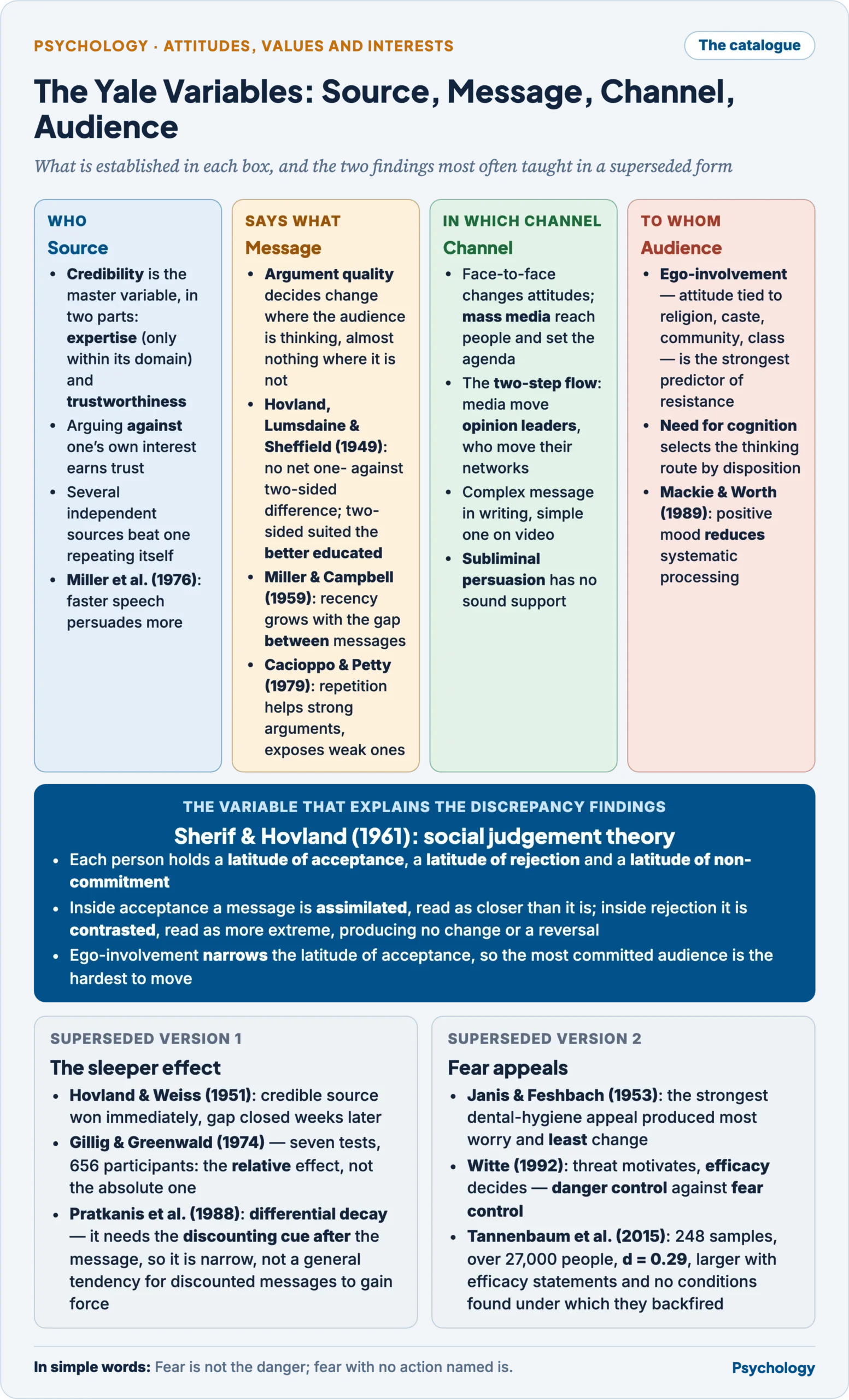
- Its organisation survives as the working framework — source, message, channel, audience — and most established findings sit in one of them.
- Its weakness is equally clear. It produced a catalogue of variables rather than a process account, so it could not say why a variable worked or when its sign would reverse.
Source or communicator variables
- Credibility is the master variable, with two separable components.
- Expertise — perceived knowledge of the topic. It confers persuasion only within its domain; a credible source outside it gains nothing.
- Trustworthiness — perceived absence of an intent to persuade or a personal stake. A communicator who argues against their own interest gains trust; one with much to gain loses it.
- Several independent sources saying the same thing persuade more than one repeating itself: consensus is read as evidence.
- Hovland and Weiss (1951) gave one message a high- or a low-credibility attribution. Immediate opinion change was greater for the credible source, and the gap had closed on re-measurement weeks later.
- The sleeper effect — a delayed increase in the persuasiveness of an initially discounted message — has a contested history, and the version usually taught is the superseded one.
- Gillig and Greenwald (1974) ran seven tests on 656 participants and obtained the relative effect, where the discounted message decays more slowly, but not the absolute effect, where persuasion rises.
- Pratkanis, Greenwald, Leippe and Baumgardner (1988) recovered it with a differential decay account in place of the older dissociation hypothesis.
- The effect appears where the message has strong initial impact, the discounting cue arrives after the message, and the cue’s impact decays faster.
- Kumkale and Albarracín (2004), meta-analysing the literature, confirmed it as real but conditional, strongest where ability and motivation to think are high.
- So it is a genuine but narrow phenomenon, requiring a specific ordering of message and cue, not a general tendency for discounted messages to gain force with time.
- Attractiveness and liking raise persuasion, and the dual-process models say where: as peripheral cues, they matter most when elaboration is low and least when the audience is thinking hard.
- Similarity and reference-group membership add force: an in-group message is processed less defensively than the same message from an out-group.
- Miller and colleagues (1976) found faster speech more persuasive than slow, and powerful speech — fluent, unhedged, direct — outperforms hesitant delivery.
Message variables
- Argument quality is the strongest determinant of change where the audience is thinking, and has almost no effect where it is not — the central finding of the dual-process era.
- Number of arguments behaves differently. At low elaboration it acts as a cue; at high elaboration a weak argument added to a strong one dilutes.
- Hovland, Lumsdaine and Sheffield (1949) found no net overall difference between one-sided and two-sided messages, and two interactions underneath it.
- The two-sided version was more effective among the better educated, whatever their starting position; the one-sided version worked mainly on the less educated who already agreed.
- The later refinement: a two-sided message helps when it refutes the opposing arguments the audience already knows, and hurts when it merely reports them.
- Order effects run both ways: primacy favours the first message, recency the last. Miller and Campbell (1959) specified the conditions.
- Recency strengthens as the interval between the messages grows, and weakens as the delay between the last message and the measurement grows.
- The rule: speak first when the messages are back to back and the decision is later; speak last when there is a gap between them and the decision follows at once.
- Discrepancy between the message’s position and the audience’s own has a non-monotonic effect, formalised by Sherif and Hovland (1961) as social judgement theory.
- Each person holds a latitude of acceptance, a latitude of rejection and a latitude of non-commitment around their own position.
- A message inside the latitude of acceptance is assimilated, read as closer to one’s own view than it is; one inside the latitude of rejection is contrasted, read as more extreme, producing no change or a reversal.
- Ego-involvement narrows the latitude of acceptance, which is why the most committed audience is hardest to move by any discrepancy worth attempting.
- Fear appeals were the programme’s most-studied message variable and its most revised finding.
- Janis and Feshbach (1953) delivered three versions of a dental-hygiene lecture to high-school students, differing only in fear intensity.
- The strong appeal produced the most reported worry and the least change in brushing practice; the minimal appeal produced the most change.
- That generated the inverted-U teaching, which later work replaced with a conditional account. Witte (1992), in the extended parallel process model, holds that perceived threat — severity plus susceptibility — supplies the motivation while perceived efficacy decides what the motivation does.
- High threat with high efficacy produces danger control: the recommended action is adopted.
- High threat with low efficacy produces fear control: denial, avoidance, derogation of the message.
- Tannenbaum and colleagues (2015) meta-analysed 248 independent samples covering over 27,000 people: an average effect of d = 0.29 in favour of fear appeals, larger where the message carried efficacy statements, with no identified conditions under which they backfired.
- The corrected statement is not that fear is dangerous but that fear without an actionable recommendation is.
- Janis and Feshbach (1953) delivered three versions of a dental-hygiene lecture to high-school students, differing only in fear intensity.
- Repetition has a two-factor profile of its own. Zajonc (1968) established that familiarity from mere exposure increases liking; Cacioppo and Petty (1979) showed repetition helps strong arguments by allowing fuller processing and hurts weak ones by exposing their flaws.
- Framing. The same content stated as a gain or a loss persuades differently, and Broemer (2004) found the moderator to be ease of imagination: a frame works when its outcome is easy to picture.
- Matching the message to the function the attitude serves raises its effect: argument against a cognitively based attitude, affect against an affectively based one.
Channel variables
- Face-to-face communication outperforms mass media at changing an attitude; mass media are far better at reaching people and at setting the agenda of what is discussed.
- The two-step flow reconciles the two: media influence opinion leaders, who influence their networks in person. A campaign ignoring local intermediaries converts far less than its reach suggests.
- Modality interacts with difficulty. A complex message persuades better in writing, which the reader can pace; a simple one on video, where peripheral cues are available.
- Distraction. Festinger and Maccoby (1964) showed that moderate distraction increases persuasion by a counter-attitudinal message, occupying the capacity counter-arguing needs; heavy distraction reduces it by blocking comprehension.
- Subliminal persuasion has no sound evidential support.
Audience or target variables
- Ego-involvement — the attachment of an attitude to one’s religion, caste, community or class — is the strongest predictor of resistance: it narrows the latitude of acceptance and recruits identity.
- Issue involvement is the central determinant of route in the elaboration models: a message with personal consequences is judged on its merits.
- Need for cognition. Those who enjoy effortful thinking take the central route by disposition; those low on it are moved by cues. Need for closure predicts resistance to any change of position.
- Age. Adolescents and young adults are more persuadable, an effect now attributed less to age than to the inducements to change the young encounter.
- Mood. Mackie and Worth (1989) found positive mood reduces systematic processing, partly through a capacity deficit, so good mood favours cues and negative mood promotes scrutiny.
- Prior attitude strength — certainty, accessibility, importance, supporting knowledge — governs all of the above, and is treated with the components of attitudes.
The Elaboration Likelihood Model
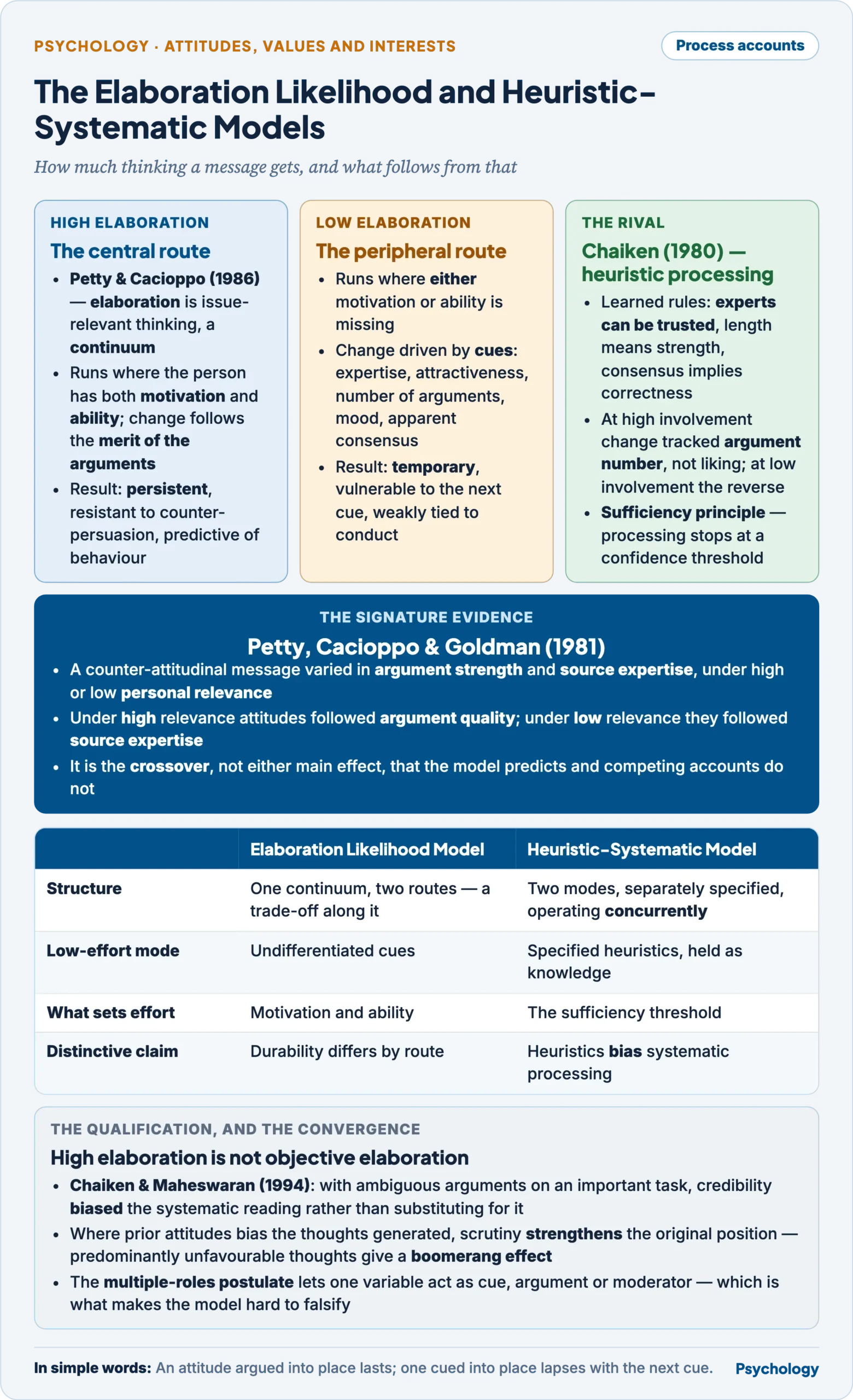
- Petty and Cacioppo (1986) define elaboration as the extent of issue-relevant thinking a message receives, and treat it as a continuum rather than a pair of boxes.
- The central route operates at high elaboration, where the person has both the motivation and the ability to think. Change is driven by the perceived merit of the arguments.
- The peripheral route operates at low elaboration, where either is missing. Change is driven by cues: source expertise, attractiveness, number of arguments, mood, apparent consensus.
- The consequences for durability are the model’s most useful claim. An attitude formed centrally is persistent, resistant to counter-persuasion and predictive of behaviour; one formed peripherally is temporary, vulnerable to the next cue and weakly related to conduct.
- Petty, Cacioppo and Goldman (1981) produced the signature evidence. Undergraduates received a counter-attitudinal message varying in argument strength and source expertise, under high or low personal relevance.
- Under high relevance, attitudes followed argument quality. Under low relevance, they followed source expertise.
- The crossover, not either main effect, is what the model predicts and competing accounts do not.
- The multiple-roles postulate states that one variable does different work at different elaboration levels: source credibility may serve as a peripheral cue, as an argument in its own right, or as a determinant of how much thinking occurs.
- High elaboration is not objective elaboration. Where prior attitudes bias the thoughts a message generates, scrutiny strengthens the original position, and predominantly unfavourable thoughts yield a boomerang effect.
The Heuristic-Systematic Model
- Chaiken (1980) distinguishes systematic processing of argument content from heuristic processing by learned rules — experts can be trusted, length means strength, consensus implies correctness.
- In her experiment, under high involvement opinion change rose with the number of arguments and was unaffected by the communicator’s likability; under low involvement likability drove change and argument number did not.
- The sufficiency principle governs effort: a person processes only until confidence reaches a sufficiency threshold, so accountability and accuracy concerns raise processing.
| Elaboration Likelihood Model | Heuristic-Systematic Model | |
|---|---|---|
| Structure | One continuum, two routes | Two modes, separately specified |
| Concurrent operation | A trade-off along the continuum | Yes, both at once |
| Low-effort mode | Undifferentiated peripheral cues | Specified heuristics, as knowledge |
| What sets effort | Motivation and ability | The sufficiency threshold |
| Distinctive claim | Durability differs by route | Heuristics bias systematic processing |
- The sharpest difference is the last. Chaiken and Maheswaran (1994) showed that where argument quality was ambiguous and the task important, source credibility biased the systematic reading of the arguments rather than substituting for it. In practice the two models have converged.
Resistance to persuasion

- Forewarning of persuasive intent, or of a message’s content, confers resistance by allowing anticipatory counter-arguing before the message arrives.
- It works only in the committed. Where commitment is weak it can facilitate change, prompting a shift towards the coming position in advance.
- Inoculation — McGuire (1961), with Papageorgis — is the deliberate version. His insight was that cultural truisms, beliefs so widely shared they have never had to be defended, are the most vulnerable of all: their holders possess no practised counter-arguments.
- A refutational defence presents a weakened form of the attack and refutes it, supplying both the threat that motivates defence and the material to defend with.
- A supportive defence, which merely adds confirming evidence, confers much less resistance. The immunological analogy is exact: a weakened dose protects where a nutrient does not.
- Reactance — Brehm (1966) — is the state aroused when a persuasive attempt is read as a threat to one’s freedom to decide. It drives restoration of that freedom, often by moving away from the advocated position.
- Selective exposure and selective avoidance keep dissonant material out, now amplified by algorithmic curation.
- Active defences include counter-arguing, attitude bolstering by rehearsing supportive beliefs without engaging the attack, and source derogation.
- Resistance to a failed attack leaves the attitude stronger than before, which makes a badly judged attempt worse than none.
Attitude change in Indian communication contexts
- The attitudes that matter most here are the least tractable kind. Those to religious community, caste and gender in India are strong, early-acquired, group-anchored and normatively supported — where the literature predicts a single appeal will fail.
- Norms before beliefs. Paluck and Green (2009) ran a year-long randomised radio intervention in Rwanda.
- It had little effect on beliefs and attitudes, and a substantial effect on willingness to express dissent and on how communities resolved disputes.
- Public conduct follows the perceived norm, and the norm is the easier target.
- Entertainment over argument. Jensen and Oster (2009), on a three-year panel from rural India, found the arrival of cable television associated with falls in the reported acceptability of domestic violence and in son preference, and with greater reported autonomy for women.
- Narrative bypasses the counter-arguing an explicit appeal invites.
- Cooperative structure, not proximity. Lowe (2021) assigned men in Uttar Pradesh to cricket leagues at random, varying teammates and opponents by caste.
- Other-caste teammates increased cross-caste friendship and reduced own-caste favouritism; other-caste opponents reduced cross-caste interaction.
- Interdependence, not contact as such, decides the sign of the effect — the standing lesson for communal-harmony programming.
- In-group sources. Where institutional trust is low and community identity high, a message carried by a community’s own religious figures, panchayat members, teachers or doctors is read as in-group information; from an outside authority it arouses reactance.
- Counter-messaging and misinformation correction are the live applied problem, and the evidence is specific rather than encouraging.
- The continued influence effect is the baseline difficulty: information identified as false keeps shaping inferences after the correction is accepted.
- Badrinathan (2021) ran a field experiment with 1,224 respondents in Bihar during the 2019 general election.
- An hour-long media-literacy intervention produced no average improvement in identifying misinformation, and among supporters of the governing party it reduced identification of congenial falsehoods.
- The backfire effect is not a general law. Nyhan and Reifler (2010) reported it on a few issues; Wood and Porter (2019), across 52 statements and some 10,100 participants, found no correction capable of triggering it.
- Prebunking. Roozenbeek, van der Linden and colleagues (2022) tested short videos teaching manipulation techniques rather than refuting claims, across six randomised studies with 6,464 participants and a field test with 22,632 viewers.
- Recognition of those techniques improved by roughly five to ten per cent. Inoculation scales where correction does not.
- Distribution is itself a persuasion variable: limits on how far a message can be forwarded cut its reach without engaging any attitude.
- A harmony message must carry an efficacy component. Alarm about communal danger with no action named produces fear control — avoidance, fatalism, derogation of the messenger — not danger control.
- Where the attitude is already endorsed and only the conduct lags, self-persuasion is the stronger instrument; the dissonance article carries the method.
Criticisms and limitations
- The catalogue problem. The Yale tradition identified the right variables and could not predict their sign, having no account of how a message comes to be accepted. Half a century of contradictory findings was the cost.
- Small and short-lived effects. Most of the literature measures immediate self-reported attitude, not behaviour weeks later, and that gap is the field’s largest unmeasured quantity.
- Low ecological validity. Student samples, invented campus issues, captive attention and single exposures say little about a campaign competing against indifference.
- Several key findings circulate in their superseded form: the sleeper effect, the inverted-U for fear and the primacy-recency rule have each been substantially revised.
- The Elaboration Likelihood Model is hard to falsify. The multiple-roles postulate lets any variable act as cue, argument or moderator; elaboration is usually inferred from the data it explains; thought-listing is reactive.
- Cultural narrowness. The literature is Western, individual and single-message. Where an attitude is group property, maintained by everyone the holder knows, a model built around one message reaching one mind measures the wrong unit.
- The field has no internal ethics. The same findings serve public health and propaganda equally, and nothing in the theory separates legitimate persuasion from manipulation.
- What survives is substantial.
- The source-message-channel-audience organisation remains the checklist for designing or diagnosing any attempt at influence.
- The elaboration principle, and the asymmetry in durability between centrally and peripherally formed attitudes, is the field’s most robust and actionable result.
- Argument quality under involvement, inoculation, fear coupled with efficacy, and cooperative contact and norm change in place of direct appeal are all usable as they stand.
Previous Year Questions
- 2022Explain the nature of human attitudes. How is the knowledge of attitude change process helpful in bringing religious harmony in the Indian context? Discuss.
- 2013What makes a persuasive attempt effective? Discuss.
- 2007What is effective communication? Discuss the role of message and communicator variables in ensuring effective persuasive communication.
- 1999Can attitudes be changed? Discuss the factors to be considered in changing attitudes.
- 1995What are attitudes? Can they be changed? Explain the characteristics of the source of message which strongly affect one’s response to any attempt at changing attitudes.