

Official syllabusPaper I · Unit 12 · Attitudes, Values and Interests
Measurement of attitudes, values and interests.
Definition
“It will be conceded at the outset that an attitude is a complex affair which cannot be wholly described by any single numerical index… The point is that it is just as legitimate to say that we are measuring attitudes as it is to say that we are measuring tables or men.”
Thurstone (1928), opening Attitudes Can Be Measured
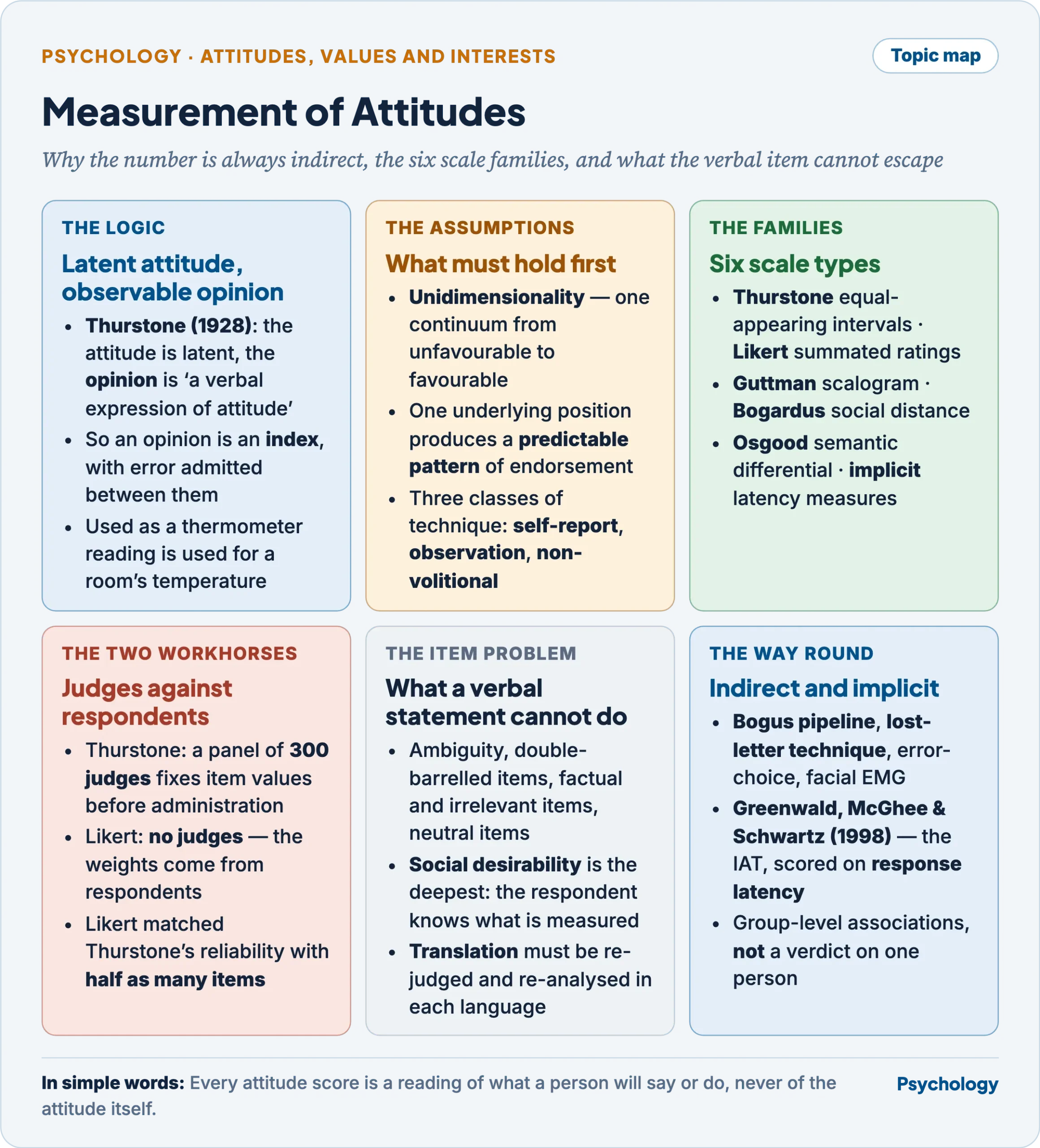
The same paper defines an attitude as “the sum total of a man’s inclinations and feelings, prejudice or bias, preconceived notions, ideas, fears, threats, and convictions about any specified topic”, and an opinion as “a verbal expression of attitude”. That pair carries the logic of the field: the attitude is latent, the opinion observable, so an opinion serves as an index of an attitude with error admitted between them. What an attitude is, and its components, belong to the companion article on attitudes.
Why attitudes have to be measured indirectly
- Nobody observes an attitude. It is an inferred disposition, so every measurement reaches only an expression of it — what a person says, what they do, or how their body and response times behave.
- Thurstone’s account of the gap is the honest one. An opinion may be a lie or softened for courtesy; an overt act may equally distort. A thermometer reading is used the same way, as though it were the room’s temperature.
- Two contestable assumptions must hold before any number exists: unidimensionality, that attitudes lie on one continuum from unfavourable to favourable, and that one underlying position produces a predictable pattern of endorsement.
- Every technique belongs to one of three classes: self-report scaling of verbal statements, observation of behaviour taken as a sign, and non-volitional indices of physiology and response latency.
The families of attitude scales
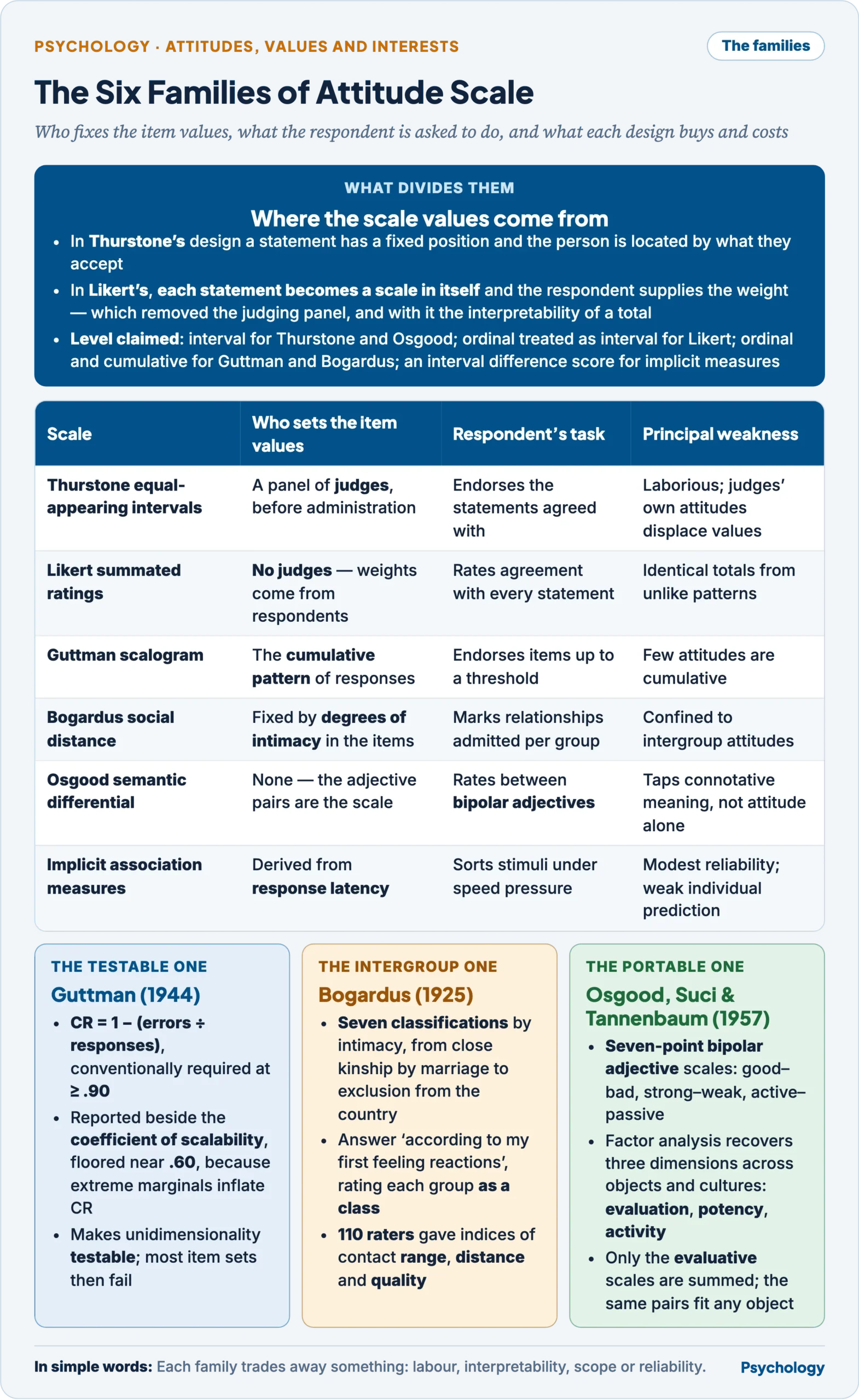
| Scale | Who sets the item values | Respondent’s task | Level claimed | Principal weakness |
|---|---|---|---|---|
| Thurstone equal-appearing intervals | A panel of judges, before administration | Endorses the statements agreed with | Interval | Laborious; judges’ own attitudes displace values |
| Likert summated ratings | No judges — weights come from respondents | Rates agreement with every statement | Ordinal, treated as interval | Identical totals from unlike patterns |
| Guttman scalogram | The cumulative pattern of responses | Endorses items up to a threshold | Ordinal, cumulative | Few attitudes are cumulative |
| Bogardus social distance | Fixed by degrees of intimacy in the items | Marks relationships admitted per group | Ordinal, cumulative in use | Confined to intergroup attitudes |
| Osgood semantic differential | None — the adjective pairs are the scale | Rates between bipolar adjectives | Interval, treated so | Taps connotative meaning, not attitude alone |
| Implicit association measures | Derived from response latency | Sorts stimuli under speed pressure | Interval difference score | Modest reliability; weak individual prediction |
Thurstone’s method of equal-appearing intervals
The sequence below is the construction procedure of Thurstone and Chave (1929), whose scale for attitude towards the church is the worked exemplar. Each step carries an objective check.
- Step 1. Name one psychological object and state the variable as a single continuum. A scale measures attitude to one object only.
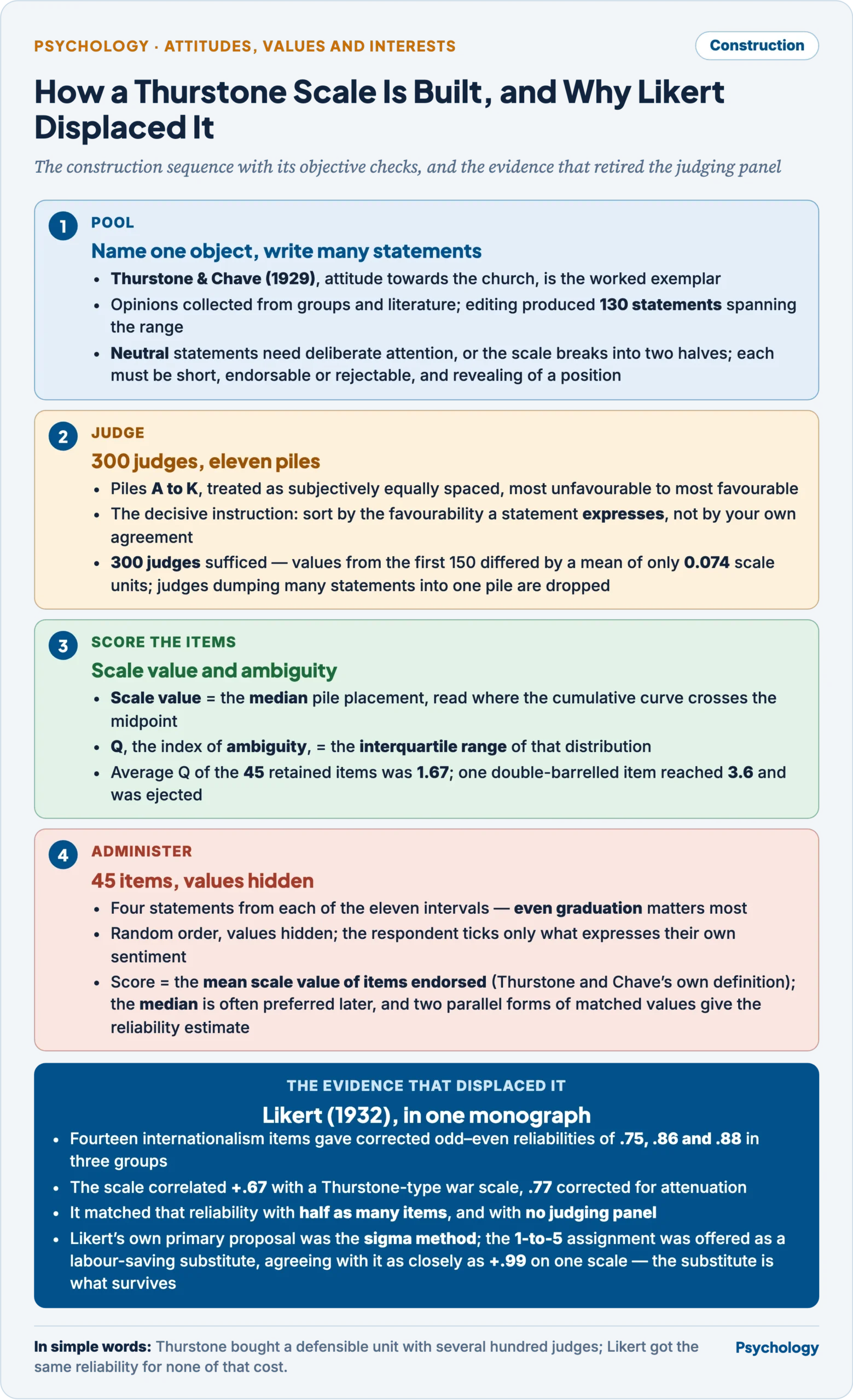
- Step 2. Assemble a large pool. Opinions were collected from groups and from the literature, and editing produced 130 statements spanning the range. Neutral statements need deliberate attention, since a random collection omits them and the scale breaks into two halves.
- Step 3. Edit the pool. Statements must be short, capable of endorsement or rejection, and such that endorsement reveals a position. The list of fourteen informal criteria is usually credited to Edwards (1957), though his text presents it as a summary of Wang (1932), Thurstone and Chave, Likert (1932), Bird (1940) and Edwards and Kilpatrick (1948).
- Step 4. Judges sort every statement into eleven piles, labelled A to K and treated as subjectively equally spaced, from most unfavourable to most favourable. The instruction is decisive: they sort by the favourability a statement expresses, not by their own agreement with it.
- Step 5. Use enough judges and screen them. Thurstone and Chave used 300 judges, showing this sufficed because values from the first 150 differed by a mean of only 0.074 scale units. Judges dumping many statements into one pile are dropped.
- Step 6. Compute each statement’s scale value: the cumulative proportion of judges placing it at or below each pile is plotted, and the value is where that curve crosses the midpoint — the median of their placements.
- Step 7. Compute Q, the index of ambiguity: the interquartile range of that distribution. Small Q means the judges read the statement alike. The average Q of the 45 retained items was 1.67; one double-barrelled item reached 3.6 and was ejected.
- Step 8. Apply the criterion of irrelevance. Q concerns judges’ readings; irrelevance concerns actual votes — a statement endorsed indifferently by people at every position on the continuum is not on it.
- Step 9. Select the final set for low Q, survival of the irrelevance test, and above all even graduation of scale values. The published scale had 45 statements, four from each of the eleven intervals.
- Step 10. Administer in random order with scale values hidden; the respondent ticks only statements expressing their own sentiment. The score is the mean scale value of items endorsed — Thurstone and Chave’s own definition; the median is often preferred later, since one stray endorsement distorts a mean.
- Step 11. Split the items into two parallel forms of matched scale values and correlate them for reliability. Validity is checked internally: endorsements should cluster rather than scatter.
Paired comparisons and successive intervals
- The method of paired comparisons rests on Thurstone’s law of comparative judgment (1927). Judges see every pair and say which is more favourable; proportions become normal deviates and scale values follow. No judge imagines equal intervals, which makes it the most defensible of the three.
- Its cost is prohibitive — n(n−1)/2 comparisons, so 130 statements demand 8,385 judgements per judge. It survives only for small stimulus sets.
- The method of successive intervals is the compromise: judges sort into ordered categories as before, but category widths are estimated from the data rather than assumed equal — repairing the one assumption equal-appearing intervals cannot defend.
Likert’s method of summated ratings
- Likert (1932), in a monograph belonging to a larger investigation begun in 1929 under Gardner Murphy, removed the judges — answering an aspiration Thurstone himself recorded, that ideally scale values “may be extracted from the records of actual voting”.
- The conceptual shift matters more than the arithmetic. For Thurstone a statement has a fixed position and the person is located by what they accept; for Likert each statement becomes a scale in itself.
- The construction sequence is short.
- Write a pool, about half favourable and half unfavourable, on the same editing criteria.
- Attach five response points. Likert’s own alternatives were strongly approve, approve, undecided, disapprove, strongly disapprove; agree–disagree wording is a later convention.
- Administer to a development sample, then run an item analysis. Likert’s own check was odds-against-evens internal consistency; present practice uses the item–total correlation, or an item’s power to separate the top and bottom quarters.
- Score by assigning 1 to 5 with 1 always at the negative pole, reverse-scoring unfavourable items, and summing.
- Likert’s primary proposal was not the 1-to-5 method but the sigma method: the percentage checking each position converted into normal-deviate sigma values, assuming attitudes are normally distributed. He offered the simple integer assignment as a labour-saving substitute, justified by how closely the two agreed — a correlation reported as high as +.99 on one scale, though later work found the agreement lower on others. The substitute is what survives; the method it substituted for is forgotten.
- The evidence that displaced Thurstone’s method is in the same monograph. Fourteen internationalism items gave corrected odd–even reliabilities of .75, .86 and .88 in three groups; the scale correlated +.67 with a Thurstone-type war scale, .77 corrected for attenuation; and it matched its reliability with half as many items.
- Equal reliability, no judging panel and far less labour made the case decisive. What was lost is interpretability: the total sums ordinal ratings, equal intervals are assumed, identical totals arise from different patterns, and acquiescence is invited.
Guttman’s scalogram analysis
- Guttman (1944) asked whether a set of items measures one dimension at all. With items ordered by difficulty of endorsement, a cumulative scale means whoever endorses an item endorses every easier one, so the pattern is recoverable from the total score.
- The scalogram arranges persons by total score and items by endorsement frequency, and inspects the matrix for its characteristic triangular pattern. Departures are Guttman errors.
- The coefficient of reproducibility is `CR = 1 − (errors ÷ number of responses)`, with the conventional requirement CR ≥ .90 — fewer than one response in ten needing correction.
- CR alone is insufficient, since items endorsed by almost everyone or almost nobody inflate it mechanically. Guttman’s (1944) coefficient is therefore reported beside the coefficient of scalability, floored at about .60.
- Guttman’s achievement is that unidimensionality becomes testable rather than assumed. The limitation is that very few attitudes are cumulative, so most item sets fail, and those that pass are narrow behavioural hierarchies.
Bogardus’s social distance scale
- Bogardus (1925), in Measuring Social Distances, built the first usable instrument for intergroup attitudes, adapting a suggestion of Robert Park. Social distance is the degrees and grades of understanding and feeling persons experience regarding each other.
- Racial and national groups are listed against seven classifications ordered by intimacy: to close kinship by marriage; to my club as personal chums; to my street as neighbours; to employment in my occupation in my country; citizenship in my country; as visitors only to my country; would exclude from my country.
- The instruction is to answer “according to my first feeling reactions”, and to rate each group as a class — explicitly not the best or worst member one has known.
- Bogardus’s 110 raters yielded indices of social contact range, distance and quality. Ratings tracked the raters’ own ancestry, so the scale measures the rater’s position as much as the group’s standing.
- It is now treated as a cumulative Guttman-type instrument, and its wording changed across versions. It remains the template for caste and community surveys.
Osgood’s semantic differential
- Osgood, Suci and Tannenbaum (1957) reached attitude through connotative meaning. The object is rated on seven-point bipolar adjective scales — good–bad, strong–weak, active–passive, clean–dirty, fast–slow.
- Factor-analysing large sets of such ratings recovers three dimensions repeatedly, across objects and across cultures: evaluation, marked by good–bad, which takes the largest share of variance and is the attitude component proper; potency, marked by strong–weak; and activity, marked by active–passive.
- The score sums the evaluative scales only, and the same adjective pairs fit any object, so comparison across objects and languages becomes possible without a new item pool.
The problems with verbal statements as scale items
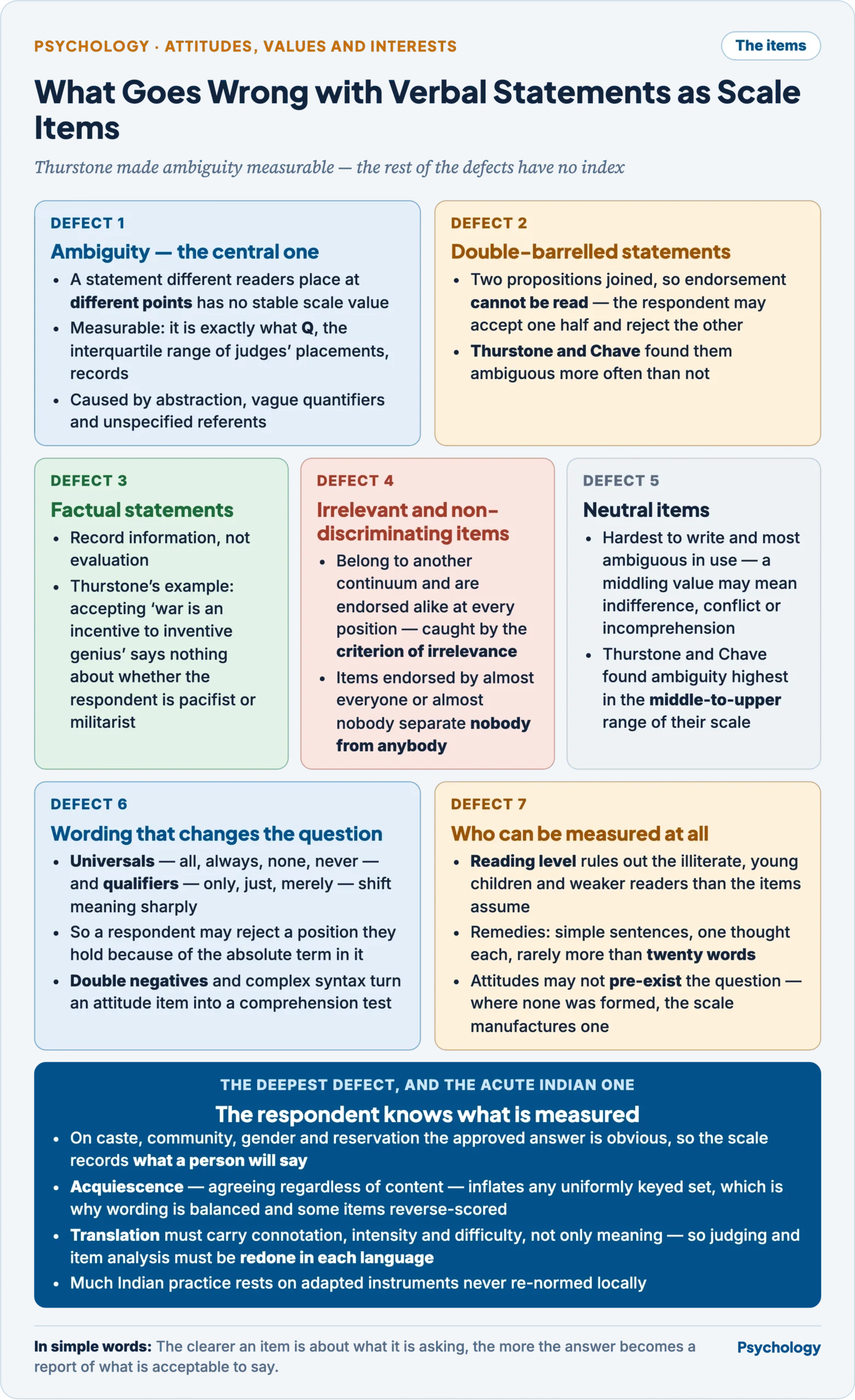
- Ambiguity is the central defect, and Thurstone made it measurable. A statement different readers place at different points has no stable scale value; abstraction, vague quantifiers and unspecified referents cause it.
- Double-barrelled statements join two propositions, so endorsement cannot be read — the respondent may accept one half and reject the other. Thurstone and Chave found them ambiguous more often than not.
- Factual statements record information rather than evaluation. Thurstone’s example is that accepting “war is an incentive to inventive genius” says nothing about whether the respondent is pacifist or militarist.
- Irrelevant statements belong to another continuum and are endorsed alike at every position. The criterion of irrelevance detects them if most of the pool is on the intended variable.
- Neutral items are the hardest to write and most ambiguous in use, since a middling value may mean indifference, conflict or incomprehension. Thurstone and Chave found ambiguity highest in the middle-to-upper range of their scale.
- Items endorsed by almost everyone or almost nobody carry no information, separating nobody from anybody.
- Universals and qualifiers — all, always, none, never; only, just, merely — shift meaning sharply, so a respondent may reject a position they hold because of the absolute term in it.
- Double negatives and complex syntax turn an attitude item into a comprehension test. The remedies are simple sentences, one thought per statement, and rarely more than twenty words.
- Reading level limits who can be measured at all. A verbal scale is unusable with the illiterate, with young children, and with weaker readers than the items assume.
- Social desirability is the deepest problem, because the respondent knows what the item measures. On caste, community, gender and reservation the approved answer is obvious, so the scale records what a person will say.
- Acquiescence — agreeing regardless of content — inflates scores on any uniformly keyed set, which is why wording is balanced and some items reverse-scored.
- Response styles add error of their own: habitual extreme responding, habitual midpoint responding, carelessness in long instruments.
- Attitudes may not pre-exist the question. Where no evaluation has been formed, the scale manufactures one, and the number is an artefact of having asked.
- Translation is the acute Indian problem. A statement must carry over connotation, intensity and difficulty as well as meaning; a blunter version has a different scale value, so judging and item analysis must be redone in each language. Much Indian practice rests on adapted instruments never re-normed locally.
Indirect and unobtrusive measures
- The bogus pipeline — Jones and Sigall (1971) — persuades respondents that an apparatus already reads their true attitude, so misreporting would be detected. Their participants then reported interracial attitudes markedly more negative than on ordinary self-report. It is unusable at scale, needing elaborate deception and collapsing once known.
- The lost-letter technique — Milgram, Mann and Harter (1965) — drops stamped, addressed, apparently lost letters in public places and uses the return rate for differently addressed envelopes as the index. Returns predicted voting across electoral wards; it yields a rate for an area, not a score for a person.
- Behavioural and trace measures generally — attendance, donation, seating distance, wear on library books — avoid self-report, at the cost of narrow sampling and many possible causes for one act.
- Galvanic skin response and heart rate index arousal, which rises with any strong attitude, so they register intensity but cannot distinguish favour from disfavour. That retired them from attitude work.
- Facial electromyography does better, since distinct muscle groups differentiate positive from negative affect; pupil dilation was proposed as a directional index and did not survive replication. All such measures need apparatus and one participant at a time, ruling out survey use.
- The error-choice technique disguises an attitude measure as a knowledge test: items offer two answers, both wrong, erring in opposite directions, and the direction of a respondent’s errors indexes the attitude.
The Implicit Association Test
- Greenwald, McGhee and Schwartz (1998) built the dominant implicit measure. Stimuli are sorted into paired categories at speed, and the score is the difference in mean response latency between compatible and incompatible pairings — sorting being faster when the categories are already associated.
- It is not under deliberate control, so it bypasses misreporting and the limits of self-knowledge — which is why it has been applied so heavily to caste, race, gender and religion. It reliably detects group-level associations.
- Greenwald and colleagues (2009), over 122 reports, found an average correlation of about .27 with behavioural, judgmental and physiological criteria, outperforming self-report on interracial behaviour.
- Oswald, Mitchell, Blanton, Jaccard and Tetlock (2013) re-analysed the discrimination studies and found the test a poor predictor of almost every criterion, no better than simple explicit measures. The exchange that followed narrowed the dispute to how small the relation is, not whether it is small.
- Test–retest reliability is the decisive limitation — a median near .56 in the reports Greenwald and colleagues (2009) reviewed, below what an individual-difference measure needs. Greenwald’s own position is that this suits research but is not diagnostic of a single person.
- Forscher and colleagues (2019) found that procedures shifting implicit measures produce little change in behaviour. The defensible conclusion is narrow: the test shows an automatic association exists in a population, not that a given person will discriminate.
Measuring intergroup prejudice in a classroom
- A Likert scale suits this task: no judging panel, one period for a whole class, a score per student.
- Construction. Name the target group explicitly. Write about twenty-five statements, half favourable and half unfavourable, one thought each, under twenty words, in the medium of instruction. Pilot on a comparable class, discard items with low item–total correlation or near-uniform answers, keep sixteen balanced items.
- Administration and scoring. Anonymity is not optional: a traceable response lets social desirability swallow the measurement. Reverse-score the unfavourable items and sum; with no norms a score means something only against the class distribution, making it a group-level indicator for planning, not a verdict on a child.
- Corroborate with something that is not self-report, since the scale records what children will write. A sociometric measure of friendship and seating choice, plus observation of group work, catches the rest.
- What changes behaviour is not exhortation. Allport’s (1954) contact conditions specify the mechanism — equal status, common goals, intergroup cooperation, institutional support — and cooperative learning that makes children depend on one another’s contributions operationalises all four.
- Moral education works in proportion to how concretely it is enacted. A value-education period asserting equality, in a school whose seating, naming and grouping practices enact hierarchy, teaches the practice rather than the precept.
- The National Education Policy, 2020 (Ministry of Education) places constitutional and human values in the curriculum and presses experiential, discussion-based pedagogy. The principle it operationalises is that attitudes resting on direct experience with the object are the strongest, so arranged experience changes them where instruction does not.
Criticisms and limitations
- Thurstone’s method is expensive, several hundred judges and two administrations preceding one score, and in Thurstone and Chave (1929) the equal appearance of the intervals is asserted by instruction rather than demonstrated.
- Judges are not neutral instruments. Thurstone and Chave held placement to be independent of the judge’s own attitude; later work showed that judges with extreme positions displace scale values, most strongly for items near their own end.
- Likert’s gain in practicality cost interpretability: a total has no defined position on a continuum, and two students scoring alike may hold different patterns of belief.
- Guttman’s test is the most rigorous and the least usable, since real attitudes are rarely cumulative and reproducibility can be inflated by extreme marginals. The semantic differential, for its part, measures connotative meaning, of which evaluation is only one part.
- All verbal scales share one vulnerability — the respondent knows what is measured. On exactly the attitudes that matter most socially, social desirability and response style are the largest source of variance. Implicit measures were introduced to escape this and brought their own: modest reliability, contested interpretation, weak individual prediction.
- Scale values and norms do not travel. An instrument normed on one population misplaces respondents from another, and the error is largest at the extremes where decisions are taken — a direct constraint on Indian use of adapted scales.
- What survives is substantial and largely methodological. Thurstone (1928) established that an attribute with no physical unit can be scaled at all, and left two devices that outlived his method — an objective index of item ambiguity and an objective test of item relevance.
- Likert (1932) showed respondents can supply the item weights themselves; Guttman (1944) that unidimensionality is testable; Osgood and colleagues (1957) that evaluation dominates connotative meaning. Convergence of a verbal with a behavioural measure is what the objections recommend.
Previous Year Questions
- 2020Discuss in detail about different attitude rating scales. How can we measure intergroup prejudice among students in the class using Likert scale and how can their behaviour be rectified through moral education?
- 2012Discuss A-B-C components of attitude. Describe the procedure of development of a tool for measurement of attitude.
- 2009Discuss nature, formation and measurement of attitude. Can attitude be changed? Substantiate your answer citing research finding.
- 2004Discuss the significance of attitudes, interests and values in human life. Explain the usefulness of different procedures of attitude measurement.
- 2002Describe in detail the Thurstone’s method of scale-construction.
- 2000Discuss the problems encountered in the use of verbal statements as the items of attitude scales.